

Update on DM26
This LTB provides a comprehensive update on DM26 and ensures that all representatives and members have the latest information regarding its deployment across the network.
It is important to remind all CWU representatives that management must be held accountable for the safeguards contained within the agreement. No unit should be deployed unless a fully agreed resourcing plan is in place for up to 6 weeks and all pre-deployment checks and governance processes have been completed.
You have the full support of CWU Headquarters to oppose deployment in any unit where an agreed resourcing plan has not been established. To date, more than 700 change requests have been agreed, with the vast majority resulting in deployment delays through the agreed Go/No Go process.
Regional Steering Groups retain full authority to pause or delay any deployment where adequate resources are not in place. Experience has already shown that units have been prevented from going live where they failed to meet the Go/No Go deployment criteria.
CWU Headquarters will fully support any Regional Steering Group decision to delay deployment where a unit is not appropriately resourced or prepared to implement DM26 successfully from day one.
Current Update on Deployed Units
As of 8 August 2026, a total of 320 Delivery Units had deployed DM26.
We asked Branches, Area Delivery Representatives and local representatives to provide feedback on how deployment is progressing within their units. The results are as follows:
Deployment Status
- 119 units are operating broadly in line with the agreed plan.
- 114 units have reported operational issues affecting clearance and performance. The severity of issues varies between units.
- Some reported isolated POD concerns.
- Others highlighted multiple POD and workload-related problems.
- 87 units have yet to submit feedback. Area Delivery Representatives are currently being contacted for updates.
- Further information will be communicated once received.
Main reasons why units are experiencing difficulties
The four most commonly reported issues are:
- POD-related concerns, including excessive workloads and duties that are not currently achievable.
- Insufficient staffing levels and resource shortages.
- Sickness absence and day-to-day operational pressures.
- Increased parcel traffic and workload volumes.
The agreement clearly states:
“There will be a formal review process following deployment in each Delivery Office. This review of both indoor and outdoor operations will ensure the plan remains robust and fit for purpose, with any required changes implemented as soon as possible. Reviews will be undertaken jointly by the COM and CWU Representative on a daily basis, with a documented review taking place through the weekly resourcing meeting.”
Representatives should also remember that the agreement states that no surplus staffing issues can be addressed until a unit is consistently achieving its quality targets. Our immediate priority must be to stabilise and support those units experiencing difficulties.
We should also recognise that DM26 represents one of the most significant operational changes in Royal Mail’s history. As with any major transformation programme, there will be a period of adjustment and learning
Evidence supplied by Royal Mail yesterday suggests that DM26-related issues are limited to 39 Delivery Units. In addition, a further 24 Delivery Units are facing resourcing challenges as a result of sickness absence and employees leaving the business.
Regardless of whether 114 or 39 units are not working, the requirement remains clear: they must be resolved without delay and in accordance with the agreement.
Royal Mail has provided further evidence showing that Delivery Point Coverage, which measures the percentage of delivery points receiving a daily delivery, has increased from 91% to 98.2% in units that have already deployed DM26.
We also understand that the majority of deployed units have achieved the Delivery Point Coverage metric used within the incentive scheme.
Duty Patterns Selected
One of the key benefits arising from USO reform is the opportunity for delivery units to improve work-life balance through enhanced attendance patterns and increased Saturday rest days.
Prior to DM26:
- Fewer than 2% of employees worked a four-day week.
- Only 7% worked a nine-day fortnight.
- The overwhelming majority worked a traditional attendance pattern with a single scheduled day off per week.
All attendance patterns available under DM26 represent an improvement for most employees when compared with previous arrangements.
Attendance Patterns Adopted Attendance Pattern
Units Deployed
2 in 5
207
2 in 5 Banked (Wallington)
47
9 Day Fortnight – Option 1
71
9 Day Fortnight – Option 2
21
4 Day Week
6
13 in 18
4
In addition, 10 pilot units elected to continue operating under ODM arrangements and retain their chosen attendance patterns. Within these units, firms and rural duties have moved to a 50/50 configuration.
PT increases and up to FT
Alongside the circa 320 units that have deployed, the CWU have received the below updated information which confirms that 1,585 employees have moved from PT to FT and 687 employees have increased their PT contracted hours on average by 4 hours.
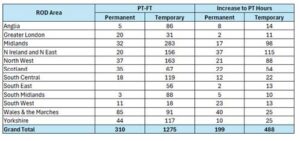
The number of temporary part-time uplifts is due to two factors.
First, the formal review will determine whether any surplus exists within the delivery unit. Any identified surplus will be managed in accordance with the Managing the Surplus Framework (MTSF), with outcomes determined by seniority.
The second relates to an error the business alerted the CWU to, an issue within the original DM26 model week, in which the RM systems had overstated certain traffic forecasts and the temporary uplifts were put in place to ensure that the model week issue does not inflate the 6,000 part time uplifts to a much higher number.
Discussions between the CWU and Royal Mail have now aligned on an agreed position to progress the matter to support both those units already deployed and those still scheduled for deployment. Royal Mail has confirmed that this overstatement does not affect the agreed opportunities created by the programme for up to 6,000 part-time employees moving to full-time positions.
With fewer than one-third of delivery units deployed and most of the larger units yet to be implemented, we remain on track to achieve the target of converting 6,000 permanent part-time roles to full-time positions.
Conclusion
The evidence to date suggests that where the full DM26 deployment process has been followed, implementation has generally been more successful and sustainable. Feedback from local Representatives and Area Delivery Representatives consistently supports this conclusion.
That is not to say there are no challenges. Some units are experiencing issues relating to POD structure, workload design and duty performance. Others have reported difficulties managing parcel volumes, even where routes are performing just first-class deliveries and on the day absences which is a business-as-usual subject that needs to be resolved.
The important point is that the agreement provides the flexibility and mechanisms necessary to address these issues. Encouragingly, several units have already worked jointly to identify practical solutions and improve performance.
Regional Steering Groups must continue to ensure that any office experiencing problems resolves these issues before review processes are signed off. These safeguards were negotiated for a reason and must be fully utilised where required.
A number of units are currently experiencing difficulties because they deployed with existing vacancies and insufficient resource levels. This should not have happened.
The CWU has raised these concerns directly with Royal Mail and there is clear agreement that no unit should be deployed without a fully agreed resourcing plan being in place.
The message to all local representatives and Area Delivery Representatives is clear:
If management is seeking to deploy DM26 in a unit that does not have an agreed resourcing plan in place, the answer should be no.
Any such concerns should be immediately escalated through to Divisional Representatives and the Regional Steering Group.
Experience has already demonstrated that DM26 cannot succeed without the appropriate resource levels being established from the outset. Every duty must be covered within an agreed resourcing plan, with a minimum reserve level of one in six built into the deployment.
We fully recognise that many members will feel apprehensive about the scale of change that DM26 represents. It is one of the most significant transformations ever undertaken within Royal Mail’s delivery operation.
However, the national agreement contains important protections and safeguards designed to ensure that where units encounter problems, those issues are identified, reviewed and resolved.
It is equally important to recognise the positive feedback emerging from many deployed units. Representatives report that employees are no longer experiencing the same concerns around returning from rest days to find large amounts of their duty left unfinished. For many, this represents a significant improvement compared with previous ways of working.
Feedback from deployed offices also suggests that, whilst DM26 remains a major operational change, it is viewed more positively than the Optimised Delivery Model (ODM). Nevertheless, successful implementation will require time, adjustment and ongoing joint review to ensure that remaining issues are properly addressed.
Finally, we must remember that USO Reform was not optional. Following Ofcom’s decision to change the Universal Service Obligation in June 2025, both Royal Mail and the CWU have had to respond to a fundamentally different regulatory environment.
Our responsibility now is to ensure that Royal Mail delivers every commitment contained within the national agreement and that all agreed safeguards are fully applied and enforced.
The CWU will continue to support representatives at every level to ensure that happens.
The message is clear:
- Deploy only where an agreed resourcing plan is in place.
- Deploy only after all pre-deployment checks are completed and Regional Steering Group approval has been secured.
- All units reported to have deployment issues require an agreed plan to resolve these operational issues.
- Escalate concerns through the full union structure where necessary: Local, Area, Divisional and National.
Any enquiries relating to the content of this LTB should be referred to the Deputy General Secretary (Postal) department hford@cwu.org.
Yours sincerely,
Martin Walsh
Deputy General Secretary (Postal)


Leave a Reply