Election of National Representative Positions – 2026
CWU Retired Members Committee (2026-2028)
Further to LTB 213/26 dated 30th July 2026, please see below the results of the ballot that closed today.
6 Retired members living in England to be electedJohn FarnanEastern No 675,133*ElectedMick GoldsmithEastern No 543,420Daniel McGouganLeeds No 1 Amal50,953*ElectedBrendan O’BrienMidland No 168,434*ElectedSean RyanEast London Postal64,748*ElectedJohn SkeltonManchester Combined61,670*ElectedKenneth WardPlymouth & East Cornwall60,244*Elected
Please find attached a branch analysis of the ballot result
Any enquiries regarding this Letter to Branches should be sent by email to lparrett@cwu.org or by telephone on 0208 971 7222.
This LTB provides a comprehensive update on DM26 and ensures that all representatives and members have the latest information regarding its deployment across the network.
It is important to remind all CWU representatives that management must be held accountable for the safeguards contained within the agreement. No unit should be deployed unless a fully agreed resourcing plan is in place for up to 6 weeks and all pre-deployment checks and governance processes have been completed.
You have the full support of CWU Headquarters to oppose deployment in any unit where an agreed resourcing plan has not been established. To date, more than 700 change requests have been agreed, with the vast majority resulting in deployment delays through the agreed Go/No Go process.
Regional Steering Groups retain full authority to pause or delay any deployment where adequate resources are not in place. Experience has already shown that units have been prevented from going live where they failed to meet the Go/No Go deployment criteria.
CWU Headquarters will fully support any Regional Steering Group decision to delay deployment where a unit is not appropriately resourced or prepared to implement DM26 successfully from day one.
Current Update on Deployed Units
As of 8 August 2026, a total of 320 Delivery Units had deployed DM26.
We asked Branches, Area Delivery Representatives and local representatives to provide feedback on how deployment is progressing within their units. The results are as follows:
Deployment Status
119 units are operating broadly in line with the agreed plan.
114 units have reported operational issues affecting clearance and performance. The severity of issues varies between units.
Some reported isolated POD concerns.
Others highlighted multiple POD and workload-related problems.
87 units have yet to submit feedback. Area Delivery Representatives are currently being contacted for updates.
Further information will be communicated once received.
Main reasons why units are experiencing difficulties
The four most commonly reported issues are:
POD-related concerns, including excessive workloads and duties that are not currently achievable.
Insufficient staffing levels and resource shortages.
Sickness absence and day-to-day operational pressures.
Increased parcel traffic and workload volumes.
The agreement clearly states:
“There will be a formal review process following deployment in each Delivery Office. This review of both indoor and outdoor operations will ensure the plan remains robust and fit for purpose, with any required changes implemented as soon as possible. Reviews will be undertaken jointly by the COM and CWU Representative on a daily basis, with a documented review taking place through the weekly resourcing meeting.”
Representatives should also remember that the agreement states that no surplus staffing issues can be addressed until a unit is consistently achieving its quality targets. Our immediate priority must be to stabilise and support those units experiencing difficulties.
We should also recognise that DM26 represents one of the most significant operational changes in Royal Mail’s history. As with any major transformation programme, there will be a period of adjustment and learning
Evidence supplied by Royal Mail yesterday suggests that DM26-related issues are limited to 39 Delivery Units. In addition, a further 24 Delivery Units are facing resourcing challenges as a result of sickness absence and employees leaving the business.
Regardless of whether 114 or 39 units are not working, the requirement remains clear: they must be resolved without delay and in accordance with the agreement.
Royal Mail has provided further evidence showing that Delivery Point Coverage, which measures the percentage of delivery points receiving a daily delivery, has increased from 91% to 98.2% in units that have already deployed DM26.
We also understand that the majority of deployed units have achieved the Delivery Point Coverage metric used within the incentive scheme.
Duty Patterns Selected
One of the key benefits arising from USO reform is the opportunity for delivery units to improve work-life balance through enhanced attendance patterns and increased Saturday rest days.
Prior to DM26:
Fewer than 2% of employees worked a four-day week.
Only 7% worked a nine-day fortnight.
The overwhelming majority worked a traditional attendance pattern with a single scheduled day off per week.
All attendance patterns available under DM26 represent an improvement for most employees when compared with previous arrangements.
Attendance Patterns Adopted Attendance Pattern
Units Deployed
2 in 5
207
2 in 5 Banked (Wallington)
47
9 Day Fortnight – Option 1
71
9 Day Fortnight – Option 2
21
4 Day Week
6
13 in 18
4
In addition, 10 pilot units elected to continue operating under ODM arrangements and retain their chosen attendance patterns. Within these units, firms and rural duties have moved to a 50/50 configuration.
PT increases and up to FT
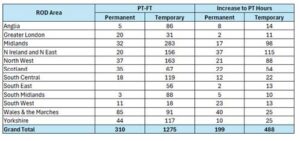
Alongside the circa 320 units that have deployed, the CWU have received the below updated information which confirms that 1,585 employees have moved from PT to FT and 687 employees have increased their PT contracted hours on average by 4 hours.
The number of temporary part-time uplifts is due to two factors.
First, the formal review will determine whether any surplus exists within the delivery unit. Any identified surplus will be managed in accordance with the Managing the Surplus Framework (MTSF), with outcomes determined by seniority.
The second relates to an error the business alerted the CWU to, an issue within the original DM26 model week, in which the RM systems had overstated certain traffic forecasts and the temporary uplifts were put in place to ensure that the model week issue does not inflate the 6,000 part time uplifts to a much higher number.
Discussions between the CWU and Royal Mail have now aligned on an agreed position to progress the matter to support both those units already deployed and those still scheduled for deployment. Royal Mail has confirmed that this overstatement does not affect the agreed opportunities created by the programme for up to 6,000 part-time employees moving to full-time positions.
With fewer than one-third of delivery units deployed and most of the larger units yet to be implemented, we remain on track to achieve the target of converting 6,000 permanent part-time roles to full-time positions.
Conclusion
The evidence to date suggests that where the full DM26 deployment process has been followed, implementation has generally been more successful and sustainable. Feedback from local Representatives and Area Delivery Representatives consistently supports this conclusion.
That is not to say there are no challenges. Some units are experiencing issues relating to POD structure, workload design and duty performance. Others have reported difficulties managing parcel volumes, even where routes are performing just first-class deliveries and on the day absences which is a business-as-usual subject that needs to be resolved.
The important point is that the agreement provides the flexibility and mechanisms necessary to address these issues. Encouragingly, several units have already worked jointly to identify practical solutions and improve performance.
Regional Steering Groups must continue to ensure that any office experiencing problems resolves these issues before review processes are signed off. These safeguards were negotiated for a reason and must be fully utilised where required.
A number of units are currently experiencing difficulties because they deployed with existing vacancies and insufficient resource levels. This should not have happened.
The CWU has raised these concerns directly with Royal Mail and there is clear agreement that no unit should be deployed without a fully agreed resourcing plan being in place.
The message to all local representatives and Area Delivery Representatives is clear:
If management is seeking to deploy DM26 in a unit that does not have an agreed resourcing plan in place, the answer should be no.
Any such concerns should be immediately escalated through to Divisional Representatives and the Regional Steering Group.
Experience has already demonstrated that DM26 cannot succeed without the appropriate resource levels being established from the outset. Every duty must be covered within an agreed resourcing plan, with a minimum reserve level of one in six built into the deployment.
We fully recognise that many members will feel apprehensive about the scale of change that DM26 represents. It is one of the most significant transformations ever undertaken within Royal Mail’s delivery operation.
However, the national agreement contains important protections and safeguards designed to ensure that where units encounter problems, those issues are identified, reviewed and resolved.
It is equally important to recognise the positive feedback emerging from many deployed units. Representatives report that employees are no longer experiencing the same concerns around returning from rest days to find large amounts of their duty left unfinished. For many, this represents a significant improvement compared with previous ways of working.
Feedback from deployed offices also suggests that, whilst DM26 remains a major operational change, it is viewed more positively than the Optimised Delivery Model (ODM). Nevertheless, successful implementation will require time, adjustment and ongoing joint review to ensure that remaining issues are properly addressed.
Finally, we must remember that USO Reform was not optional. Following Ofcom’s decision to change the Universal Service Obligation in June 2025, both Royal Mail and the CWU have had to respond to a fundamentally different regulatory environment.
Our responsibility now is to ensure that Royal Mail delivers every commitment contained within the national agreement and that all agreed safeguards are fully applied and enforced.
The CWU will continue to support representatives at every level to ensure that happens.
The message is clear:
Deploy only where an agreed resourcing plan is in place.
Deploy only after all pre-deployment checks are completed and Regional Steering Group approval has been secured.
All units reported to have deployment issues require an agreed plan to resolve these operational issues.
Escalate concerns through the full union structure where necessary: Local, Area, Divisional and National.
Any enquiries relating to the content of this LTB should be referred to the Deputy General Secretary (Postal) department hford@cwu.org.
We have been advised by the Newcastle Amal branch that Tom Gaffney, former UCW Executive Council Member and Chair, sadly passed away last week at the age of 90.
Tom joined the old GPO in 1960 and served as a member of the union’s Executive Council from 1984 up until his retirement in 1995.
Tom was also a stalwart of the Newcastle Amal branch holding numerous positions within the branch from 1972 through to his election to the National Executive.
We wish to place on record our sincere condolences to Tom’s wife Sheridan and all his family.
Further information will be sent out on Tom’s funeral arrangements once they are known.
Any enquiries on the above LTB should be addressed to the General Secretary’s office aobrien@cwu.org.
Royal Mail: PFSL Pay – National Briefing & Membership Consultative Ballot
Further to LTB 221/26 dated 6th August. Branches are advised that our negotiating team met with PFSL management face to face earlier today. Whilst the meeting was cordial, unfortunately we were unable to make any further progress and there are no further pay meetings planned at this stage. As a consequence, the Postal Executive has this afternoon made the following decisions:
Consultative Ballot of PFSL Members (timetable to be confirmed) – we will undertake a consultative ballot of all PFSL members with a recommendation that the members support the Postal Executive’s rejection of the pay offer coupled with the lack of progress on Conference policy in respect of PFSL members being eligible to join the Collective Plan pension scheme.
National Briefing – To support the preparation for the consultative ballot, we will hold a National Briefing of Branch Secretaries with PFSL members, along with Local and Senior PFSL Representatives on:
Wednesday 9th September – 12.30 – 15:30
Indian YMCA
41 Fitzroy Square,
London W1T 6AQ
The National Briefing will enable Reps to fully discuss the pay offer and the reasons for rejecting it, along with the need to deliver the necessary support for rejecting the pay offer in the forthcoming consultative ballot.
Branches and PFSL Representatives are urged to make this National Briefing a priority.
In preparation for this year’s National Young Workers Conference, taking place in Manchester on 21st October 2026, the Union is facilitating two motion writing workshops taking place on the below dates.
The purpose of these workshops is to help branch young worker officers prepare motions for conference by developing an understanding of how motions should be worded, what issues comprise suitable topics for the young worker conference and how the process of debating, voting and implementing a motion is a core part of the Union’s democracy.
The sessions will be delivered via zoom by Joyce Stevenson from the Standing Orders Committee and Kerry Fleck, Young Workers Co-ordinator. They are open to all CWU members aged 30 or under who are considering attending conference and are interested in submitting a motion, they do not need any prior knowledge or materials but should consider some topics for a possible motion in advance.
Workshop 1: Wednesday 2nd September 1pm Workshop 2: Wednesday 2nd September 7pm
Branches are further reminded of the below deadlines relating to the Young Worker Conference and encouraged to urgently sign-up delegates to facilitate organisation.
Young Worker Conference Motion Deadline: 21st September (12noon)
Young Worker Conference Delegate Registration Deadline: 9th October
Branches will be aware that the CWU has supported a campaign called Truth About Zane for many years. Following a tragic incident which occurred in 2014, whereby 7-year-old Zane Gbangbola died following flooding across the UK.
After floodwater entered the basement of Zane’s home in Chertsey, Surrey, Zane and his father lost consciousness. Zane’s father Kye survived but now lives with paralysis however young Zane tragically lost his life. Since then, the fight for the truth regarding the real cause of Zane’s death has raised high profile interest from across the political and media world.
Zane’s death was registered as being caused by carbon monoxide pump which was alleged to have been used to pump flood water from the home. However, emergency services at the scene recorded levels of Hydrogen Cyanide. Leading to emergency government COBRA meetings and specialists from the military Science and Technology laboratory in Porton Down attending the scene and securing the area for a number of months.
In the search for answers, Zane’s parents met with a number of whistle blowers and journalists who discovered that the land around their home had previously been used for military testing.
For over 12 years, the family have fought for answers with the full support of the CWU and other trade unions. The fundamental demand from the campaign has remained for a full independent panel Inquiry.
We are now pleased to confirm that the government has now granted this, indeed it has been strengthened to a Non-Statutory Public Inquiry incorporating the provisions of the Hillsborough Law, The Public Authority Accountability Act. The panel will now be able to access all redacted documents and information surrounding this tragic case and the
supporters of the campaign are confident the family will now achieve the justice they deserve.
Election of: Parcelforce Worldwide Area Health & Safety Representative and Substitute Area Health & Safety Representative 2026 – Central Region
The elections for the two positions above were originally held in January 2026. Following an issue that has come to light regarding the nomination process, the election for these two posts is now being re-held.
Therefore, nominations are invited from Branches with Members in the Central Parcelforce Worldwide region (including members in RMSS) for the following:
Parcelforce Worldwide Area Health & Safety Representative.
Substitute Parcelforce Area Health & Safety Representative.
The term of office for the above positions concludes in March 2028 and the date of commencement will be notified following the conclusion of these elections. Candidates should, however, be aware that the above positions have been under review for some time by the CWU & Parcelforce and therefore the term of office may be subject to change.
A Nomination form is attached to this LTB. All branch nominations must be agreed at a properly constituted branch meeting. Branches must also ensure they adopt the ‘Branch best practice’ for nominations as outlined in LTB 197/26 circulated on 10 July 2026. Nomination forms must be signed by the Branch Secretary and Branch Chair (or accredited deputies) and the nominee. Completed forms mustbe returned by email, to the following email elections@cwu.org by 30th September 2026 (14.00).
The timetable for the election is as follows:
Nominations Open: 24thAugust 2026
Nominations Close: 30thSeptember 2026 (14.00)
If Ballots are required, branches will be advised of the timetable in due course. Any ballots will be conducted on an individual member ballot basis of the relevant eligible CWU members and will be conducted in accordance with the election guidelines for CWU Senior Regional/Field officials. A copy of the guidelines is attached for information.
Any enquiries regarding this Letter to Branches should be addressed to Lisa Parrett on telephone number 020 8971 7222, or email address lparrett@cwu.org.
National Network Review (Network 26) Update – Deployment Date
Further to LTB 118/26 Monday 14thSeptember 2026 has been agreed as the target deployment date for the National Network Review (Network 26).
The aim will now be to ensure that any outstanding issues are resolved, through the IR Framework if necessary, and duty sets and re-picks are concluded where possible in readiness for the deployment date. The NWG will remain available to offer advice and assistance where necessary.
Branches and representatives are requested to ensure that our Network members are made aware of the contents of this LTB at the earliest opportunity.
Any enquiries in relation to this LTB should be addressed to Davie Robertson, Assistant Secretary, email: jrodrigues@cwu.org or jmansell@cwu.org quoting reference LTB 232/26.
The course will focus on a number of areas designed to better equip representatives with mis-truths, difficult conversations in the workplace and more.
If you wish to attend the training, please contact your branch, applications should be made via the Portal by the 14th September 2026.
Royal Mail Group – Severe Weather Guidance Updated Version (v2.3)
Dear Colleagues,
The purpose of this LTB is to advise Branches, Representatives and members alike of an updated version of the RMG Severe Weather Guidance, which reflects previous and ongoing discussions held with Royal Mail to date.
As a means of background, we have been in discussions with Royal Mail on seeking enhancements to its overall Severe Weather Guidance, which is the Royal Mail Group’s primary safety document designed to address all-year-round severe weather conditions, but with recent focus obviously covering the ongoing spell of extreme heat.
Whilst updated versions of the Severe Weather Guidance have been issued to CWU Safety Reps during this period of discussions to ensure enhancements made are communicated at the time, and following the former RMG Severe Weather Guidance (v1.0) issued last year. For direct reference, please find attached to this LTB the latest version of the guidance.
All Representatives (both Safety and IR) are encouraged to make themselves familiar with the full details of this Severe Weather Guidance, but particular attention is drawn to the following details:
The Severe Weather Guidance covers all operations, functions, and business units and should be used by all managers who have line manager responsibility.
The guidance supports Royal Mail’s duties under the Health and Safety at Work etc, Act 1974, and the Management of Health and Safety at Work Regulations 1999, which require the assessment and control of risks arising from severe weather conditions, including extreme heat.
The guidance is clear on the matter of CWU Workplace Safety Representatives (WSRs) and Area Safety Representatives (ASRs) consultation around severe weather assessments, including involvement in the severe weather twice-a-year preparation checklist activity.
It outlines the inclusion of UK Health Security Agency (UKHSA) Alerts as part of the overall Severe Weather Guidance.
It confirms the need and requirement for advanced and individual support for members at increased risk due to extreme heat, alongside outlining an initial list of examples of such groups of individuals.
It confirms that all managers who have line manager responsibility should subscribe for email notifications from both the MET Office and UK Health Security Agency (UKHSA).
It confirms that a Severe Weather Manager Assessment (SWMA) and duty adjustments are required at the point of a UKHSA Yellow Alert in the case of heat, for members at increased risk.
It confirms that a SWMA and duty adjustments are required for all other members at the point of a UKHSA Amber and Red Alert, and MET Office Amber and Red Warnings, in the case of heat.
It confirms that all managers who have line manager responsibility must brief staff when there is a UKHSA Yellow Alert and MET Office Yellow warning. It confirms that a Severe Weather Manager Assessment and duty adjustments are required at the point of a UKHSA Amber and Red Alert, and MET Office Amber and Red Warnings, in the case of other severe weather conditions. With the temporary stoppage of all outdoor activities in the case of a Red Alert/Warning against other weather conditions.
It further confirms that in the case of all individuals who fall under the ‘Person Specifically at Risk’ process (disability, young person, new or expectant mother), the impact of all types of severe weather should be considered in their risk assessment.
It offers a list of duty adjustments and controls applicable against different types of weather conditions and covers both indoor and outdoor working. It includes the provisions of additional breaks with workload adjustments to support these breaks being taken in the case of heat.
It confirms that all managers who have line manager responsibility must communicate to staff what they need to do during the period of severe weather and keep a record of what was briefed.
It confirms the need to make staff aware that they need to apply Dynamic Risk Assessments and are empowered to make decisions such as returning to their unit/not attempting to make a delivery or collection at a given location/s, in severe weather conditions.
The guidance confirms that in the case of RED Warnings/Alerts from the MET Office or UKHSA, a national level urgent meeting will be held to review and agree further required actions.
The guidance outlines that a central database will record all submitted Severe Weather Manager Assessments in the case of MET Office or UKHSA Warnings/Alerts. This database will be shared with the CWU nationally for onward circulation to CWU ASRs to support confirmation of the mandatory application of these severe weather assessments.
In summary, it confirms the direct requirement for an assessment and adjustment in working arrangements linked to the outlined levels of UKHSA and MET Office Alerts and Warnings. This means that when such levels of Alerts and Warnings are in place, risk reduction controls must be put in place locally and clearly communicated.
Whilst our discussions to date have resulted in enhancements to the former Severe Weather Guidance issued last year, our talks continue, in particular, in relation to the matter of Red MET Warnings and UKHSA Red Alerts covering heat, which remains an area of disagreement between us and RMG.
Accordingly, both parties have now agreed to escalate these discussions upwards with the aim of seeking to establish common ground on this point, but in the absence of any wider Health and Safety regulations covering a maximum indoor and outdoor working temperature.
It is hoped that the circulation of this most up-to-date version of the RMG Severe Weather Guidance will offer further assistance to Branches, our Representatives and members in dealing with this current and unprecedented spell of extreme heat, alongside other severe weather conditions going forward.
Any enquiries regarding this LTB should be referred to the DGS(P) Department, email address: Hford@cwu.org or ACorbett@cwu.org.