

Understanding Proposition 65 Warning Labels (California) vs UK/EU Regulatory Requirements.
Dear Colleagues,
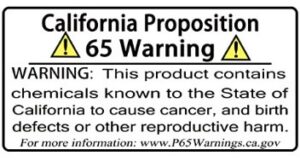
This LTB aims to provide an explanation and clarification to our Branches around the commonly found California Proposition 65 (Prop 65) warning labels which are often seen on electronic equipment and other manufactured products and how these labels differ from chemical‑safety requirements in the UK and EU. We are also keen to address any member concerns, on whether they indicate a safety risk for users. Recent concerns over Prop 65 labelling came to light during the installation of Dash-Cams supplied by Camera Solutions on Royal Mail fleet, where the Prop 65 warning was included on the manufacturer’s packaging.
What Is Proposition 65 (Pop 65)?
Proposition 65 is officially the Safe Drinking Water and Toxic Enforcement Act of 1986, and is a California Law requiring businesses to warn consumers if a product exposes them to chemicals known to cause cancer, birth defects, or reproductive harm.
Why is it so commonly seen in the UK?
Many companies choose to apply Prop 65 warnings on all U.S. and global products to avoid legal risk, even when exposure is minimal, and even when the products are sold outside California.
Key points to consider:
- Prop 65 focuses on exposure, not material content or overall concentration.
- The State of California maintains a list of 990+ chemicals that require ‘right to know’ warnings on exposure.
- Warnings are widely used across consumer products, electrical equipment, food and beverage packaging and cosmetics.
Does a Prop 65 Warning Mean the Product Is Dangerous?
No, it does not. The presence of a Prop 65 warning does not mean the product is unsafe or that it exceeds international safety limits. Prop 65 requires a warning whenever:
- A listed chemical is present, and
- Potential exposure, even at very low levels, may exceed California’s strict thresholds.
The Prop 65 warning:
- Does not indicate a product defect.
- Does not mean levels exceed UK or EU limits.
- Is only legally required for California residents.
For users in the UK, EU, or elsewhere, these warnings generally do not indicate any heightened risk.
UK Regulations for Electrical and Electronic Equipment (EEE)
Products placed on the market in Northern Ireland must comply with the UK RoHS Regulations, Regulations: restriction of hazardous substances (RoHS) – GOV.UK which strictly limit the concentration of specific hazardous substances in electrical and electronic equipment.
Manufacturers placing Electrical and Electronic Equipment on the market in Great Britain and/or Northern Ireland must evaluate their production controls to ensure that their products do not exceed the maximum prescribed levels of the following hazardous substances:
- cadmium (0.01%)
- lead (0.1%)
- mercury (0.1%)
- hexavalent chromium (0.1%)
- polybrominated biphenyls (0.1%)
- polybrominated diphenyl ethers (0.1%)
- bis(2-ethylhexyl) phthalate (0.1%)
- benzyl butyl phthalate (0.1%)
- dibutyl phthalate (0.1%)
- Di isobutyl phthalate (0.1%)
In summary The Prop 65 warning reflects California Law regarding ‘potential’ exposure. UK and EU regulations focus on material content to ensure levels remain well below strict recognised hazardous thresholds. Royal Mail Group have also recently confirmed that they view Prop 65 warnings as fully precautionary under California state legislation only. They do not perceive any risk from the use of identified Prop 65 items, be that during normal use or during any accidental physical damage.
If you have any questions or need any further information, please contact:
Jamie McGovern FRSPH MIIAI
CWU Health & Safety Policy Assistant at jmcgovern@cwu.org.
LTB 065/26 – PROPOSITION 65 WARNING LABELS GUIDANCE
 CWU Eastern No5 Branch
Leave a comment