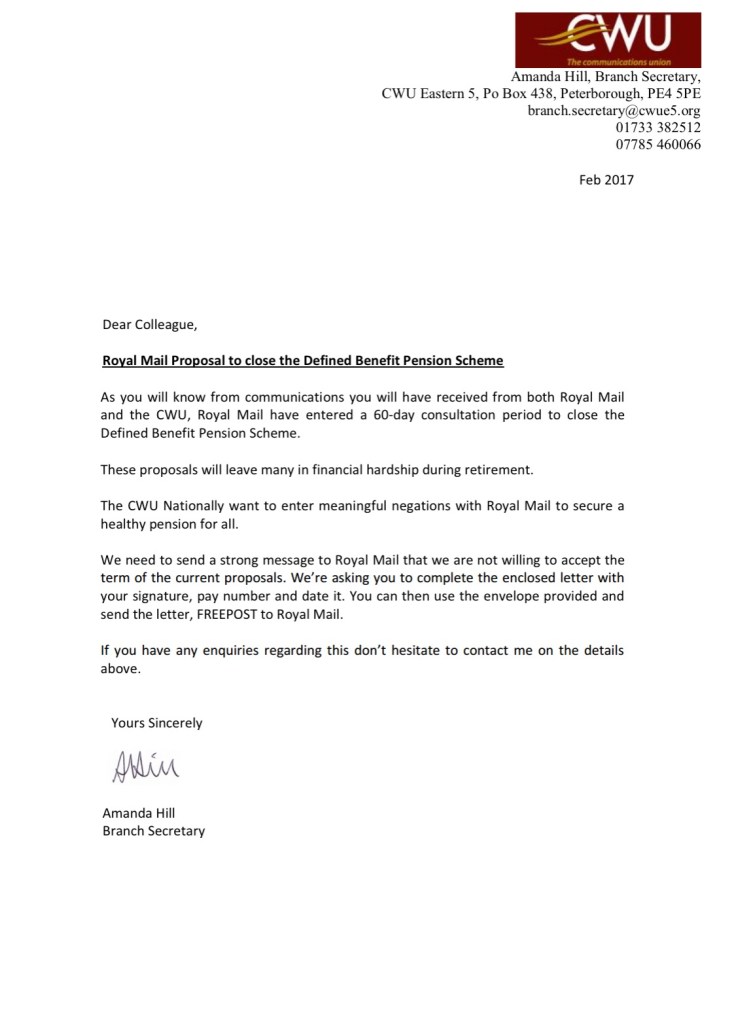
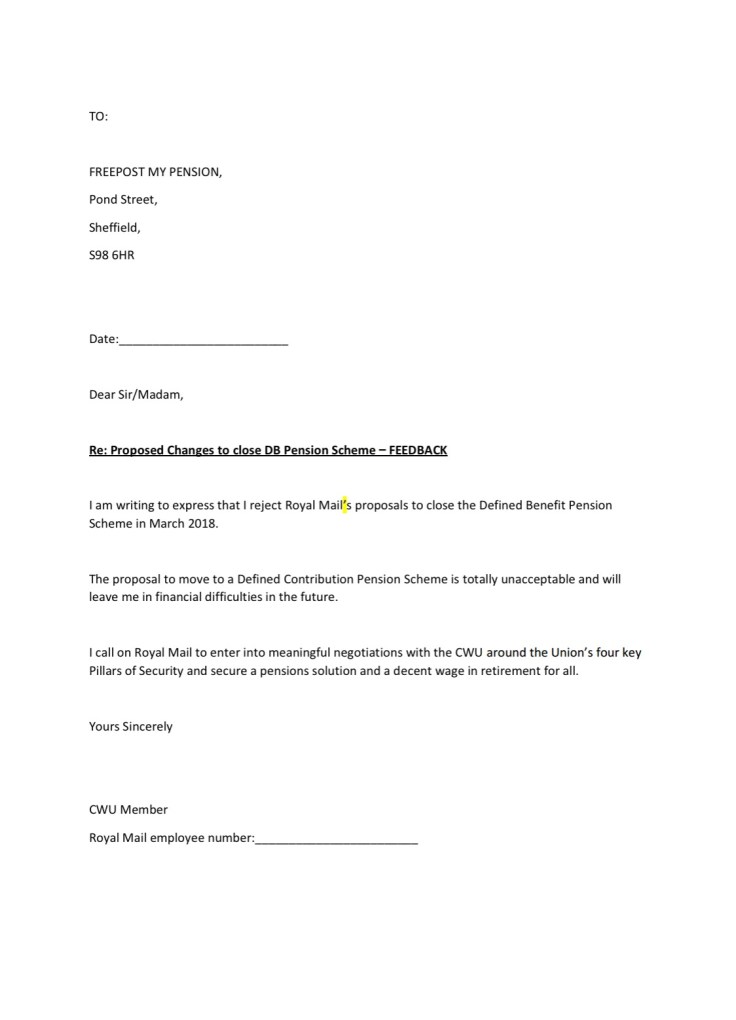
Any Branches wishing to use these documents as templates may do so by clicking on the links below to download.

Workers of the world unite; you have nothing to lose but your chains. Karl Marx.

Any Branches wishing to use these documents as templates may do so by clicking on the links below to download.
JOINT STATEMENT REGARDING REALIGNMENT OF WORKLOAD IN RELATION TO TRAFFIC SMOOTHING IN THE PROCESSING FUNCTION AND MAIL CENTRE WORKPLAN
Dear Colleagues
Branches and representatives will be aware that the department have been in discussions for some time on issues relating to the Processing Workplan and business aspirations to smooth the flow of traffic and avoid pinch points in the Pipeline, in particular in the RDC Network.
From a CWU perspective concerns had been raised with the department that the business were attempting to advance 2c items onto the night shift using the rationale of White Book Staffing contingency arrangements. Discussions culminated in an interim position being reached on a Joint Statement Regarding Mail Centre Workplan and Christmas Arrangements for the Processing Function circulated in LTB 647/16 on the 2nd November 2016.
That Joint Statement covered seasonal arrangements to protect the Pipeline during peak and committed both parties to further discussions on longer term, mutual interest solutions. It was stipulated that should no final position be reached by 17th January 2017 then the agreed pre-Christmas arrangements at each site should be reinstated, which happened as talks had not concluded.
It has become apparent that changing customer requirements, traffic streams and volumetrics are all impacting on our Pipeline and available capacity at our RDC’s at certain times of the day and that there are operational benefits in despatching available volumes of Outward 2c and Tracked earlier.
Discussions have continued on these issues with the department also pursuing an agenda based on ending any misuse of White Book contingency arrangements to advance traffic and the achievement of the current Conference Policy in relation to 2c and Workplan:
Motion: 22 – 2015
This Conference instructs the Postal Executive that the National Workplan should be altered to protect early shifts in Mail Centres as the emphasis on doing 2nd class traffic on late shift and night shift is having a detrimental effect on the early shifts.
Newcastle Amal
These discussions have now concluded with the attached Joint Statement which we believe does enable discussions on a smoothing of traffic flows across the Pipeline through realignment of workload across the 24 hour period and includes the achievement of a number of significant commitments in regard to the protection of early shifts across the Mail Centre Network. These include:
➢ A statement confirming that both parties recognise the historic impacts of workload and traffic changes on early shifts in Mail Centres and that the processing of a non-premium product, i.e. 2c on the night shift is not cost efficient and should be avoided.
➢ A further statement recognising that work should not be realigned from early shifts to night shifts solely due to under-utilised contingency arrangements.
➢ A commitment that any agreed arrangements to advance 2c to achieve the aspiration of 50% by 10.00 should retain the work on the early shift and is conditional that arrangements maintain viable alternative workload in the post 10.00 period through the realignment of other work streams.
Branches will note that in addition the Joint Statement also contains commitments that any revised arrangements should:
➢ Maximise full time employment across all shifts with efficient alignment to workload.
➢ Reduce to a minimum, reliance on agency or casual resource.
➢ Maintain meaningful workload and earnings opportunities by aligning resources appropriately across all shifts.
In recognition that at some sites our Representatives have negotiated arrangements which go beyond the 50% 2c aspiration on the basis that they were mutual interest, the Joint Statement allows for such agreements as long as there is no adverse affect on early shift duty numbers or earnings opportunities.
We have also confirmed that where the 50% of 2c by 10.00 has already been achieved then no further activity is required.
Branches and representatives should also note that this agreement does not change National Workplan and that any proposed realignment of workload should support National Workplan and Core Standards.
The department believes that the discussions have produced some significant concessions and in line with the spirit and intent of the Conference Policy provide real commitments to the protection of early shifts in Mail Centres. The Joint Statement should also provide real clarity on what is in scope in any realignment of Processing workload. Moreover the Joint Statement, for the first time in many years, commits the business to measures designed to protect early shifts across the Mail Centre Network.
Any enquiries in relation to this LTB should be addressed to Davie Robertson, Assistant Secretary, email: dwyatt@cwu.org or shayman@cwu.org quoting reference number: 722.01.
Yours sincerely
Davie Robertson
Assistant Secretary
Click on the links below to view
17ltb081attachment-1-js-traffic-smoothing-in-the-processing-function-mail-centre-workplan
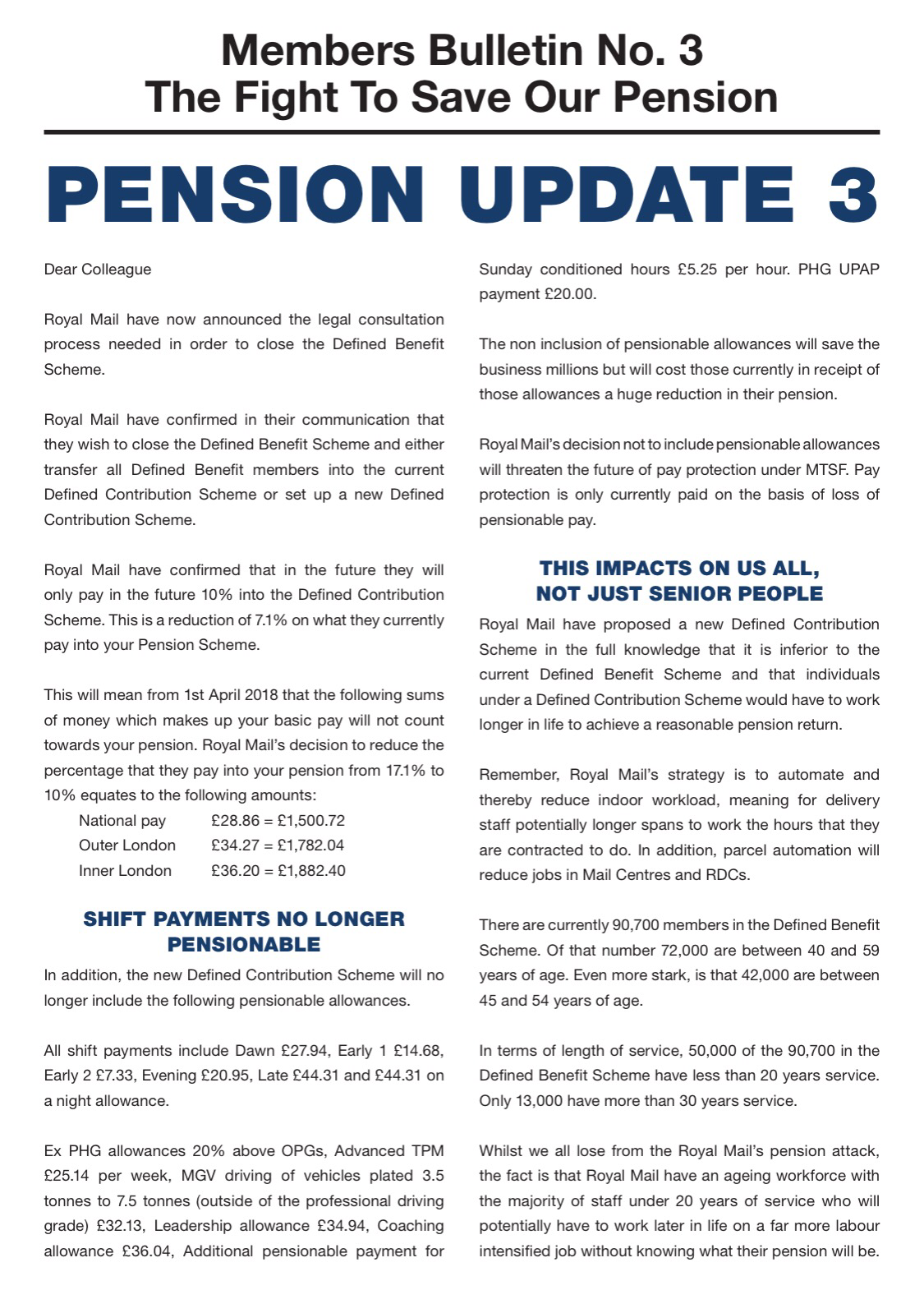
Members Bulletin
The Fight To Save Our Pension
PENSION UPDATE
Dear Colleague
Royal Mail have now announced the legal consultation process needed in order to close the Defined Benefit Scheme.
Royal Mail have confirmed in their communication that they wish to close the Defined Benefit Scheme and either transfer all Defined Benefit members into the current Defined Contribution Scheme or set up a new Defined Contribution Scheme.
Royal Mail have confirmed that in the future they will only pay in the future 10% into the Defined Contribution Scheme. This is a reduction of 7.1% on what they currently pay into your Pension Scheme. This will mean from 1st April 2018 that the following sums of money which makes up your basic pay will not count towards your pension. Royal Mail’s decision to reduce the percentage that they pay into your pension from 17.1% to 10% equates to the following amounts:
National pay £28.86 = £1,500.72
Outer London £34.27 = £1,782.04
Inner London £36.20 = £1,882.40
SHIFT PAYMENTS NO LONGER PENSIONABLE
In addition, the new Defined Contribution Scheme will no longer include the following pensionable allowances.
All shift payments include Dawn £27.94, Early 1 £14.68, Early 2 £7.33, Evening £20.95, Late £44.31 and £44.31 on a night allowance.
Ex PHG allowances 20% above OPGs, Advanced TPM £25.14 per week, MGV driving of vehicles plated 3.5 tonnes to 7.5 tonnes (outside of the professional driving grade) £32.13, Leadership allowance £34.94, Coaching allowance £36.04, Additional pensionable payment for Sunday conditioned hours £5.25 per hour. PHG UPAP payment £20.00.
The non inclusion of pensionable allowances will save the business millions but will cost those currently in receipt of those allowances a huge reduction in their pension.
Royal Mail’s decision not to include pensionable allowances will threaten the future of pay protection under MTSF. Pay protection is only currently paid on the basis of loss of pensionable pay.
THIS IMPACTS ON US ALL, NOT JUST SENIOR PEOPLE
Royal Mail have proposed a new Defined Contribution Scheme in the full knowledge that it is inferior to the current Defined Benefit Scheme and that individuals under a Defined Contribution Scheme would have to work longer in life to achieve a reasonable pension return.
Remember, Royal Mail’s strategy is to automate and thereby reduce indoor workload, meaning for delivery staff potentially longer spans to work the hours that they are contracted to do. In addition, parcel automation will reduce jobs in Mail Centres and RDCs.
There are currently 90,700 members in the Defined Benefit Scheme. Of that number 72,000 are between 40 and 59 years of age. Even more stark, is that 42,000 are between 45 and 54 years of age.
In terms of length of service, 50,000 of the 90,700 in the Defined Benefit Scheme have less than 20 years service. Only 13,000 have more than 30 years service.
Whilst we all lose from the Royal Mail’s pension attack, the fact is that Royal Mail have an ageing workforce with the majority of staff under 20 years of service who will potentially have to work later in life on a far more labour intensified job without knowing what their pension will be.
WHAT ARE THE IMPACTS ON;
SECTIONS A, B AND C PENSION SCHEMES?
There are less than a dozen members in the Section A Pension Scheme which was the old Civil Service Scheme pre 1971.
There are 13,100 employees in the Section B Scheme who earn less than £30,000 per annum, including pensionable allowances. These employees would have been in the post prior to 31st March 1987.
However, the biggest majority are those who earn less than £30,000 per annum and are in the Section C Scheme, which was set up from 1st April 1987. There are 70,000 members in this Scheme.
All Sections A, B, and C members will see a reduction in total pension after the proposed changes which demonstrates that the average pension loss of the current Defined Benefit Scheme members is 19% of their total pension, if they were to retire at 60. If they were to retire at 65 the average loss would increase to 28%.
The scale of the loss is dependent on the individuals age and their closeness to retirement. Those closest to retirement will see smaller losses but those who are further away will see the biggest losses.
For those in Section C there is a further sting in the tail as not only will they see a reduction in their future pension, they will also have to pay a slightly higher contribution rate due to the lower earning reduction. Based on £20,000 pensionable pay you would have to pay an additional £8 per month into your pension. The higher your pensionable salary the bigger the increase.
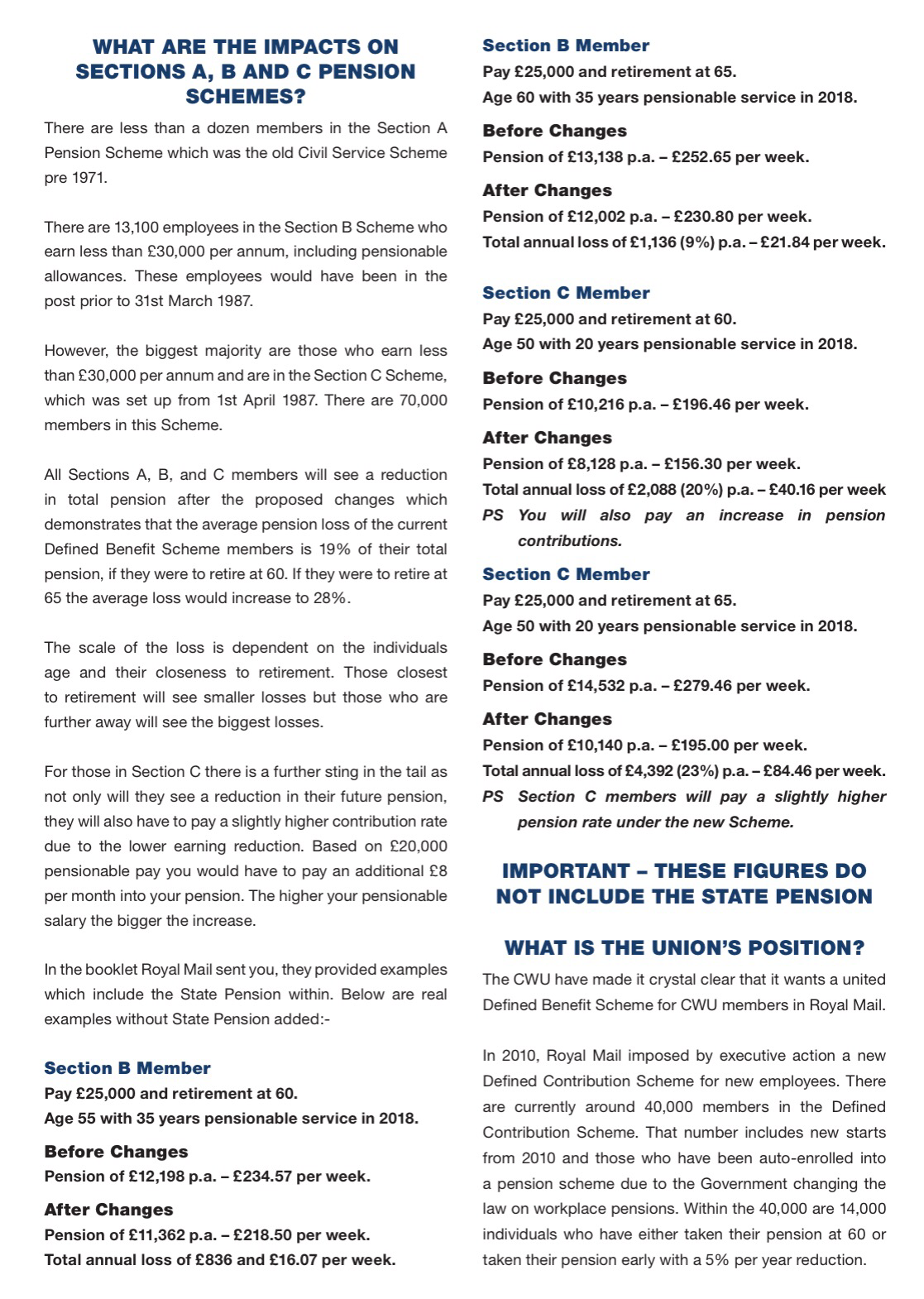
In the booklet Royal Mail sent you, they provided examples which include the State Pension within. Below are real examples without State Pension added:-
Section B Member
Pay £25,000 and retirement at 60.
Age 55 with 35 years pensionable service in 2018.
Before Changes
Pension of £12,198 p.a. – £234.57 per week.
After Changes
Pension of £11,362 p.a. – £218.50 per week.
Total annual loss of £836 and £16.07 per week.
Section B Member
Pay £25,000 and retirement at 65.
Age 60 with 35 years pensionable service in 2018.
Before Changes
Pension of £13,138 p.a. – £252.65 per week.
After Changes
Pension of £12,002 p.a. – £230.80 per week.
Total annual loss of £1,136 (9%) p.a. – £21.84 per week.
Section C Member
Pay £25,000 and retirement at 60.
Age 50 with 20 years pensionable service in 2018.
Before Changes
Pension of £10,216 p.a. – £196.46 per week.
After Changes
Pension of £8,128 p.a. – £156.30 per week.
Total annual loss of £2,088 (20%) p.a. – £40.16 per week
(You will also pay an increase in pension contributions)
Section C Member
Pay £25,000 and retirement at 65.
Age 50 with 20 years pensionable service in 2018.
Before Changes
Pension of £14,532 p.a. – £279.46 per week.
After Changes
Pension of £10,140 p.a. – £195.00 per week.
Total annual loss of £4,392 (23%) p.a. – £84.46 per week.
(Section C members will pay a slightly higher pension rate under the new Scheme.)
IMPORTANT – THESE FIGURES DO NOT INCLUDE THE STATE PENSION
WHAT IS THE UNION’S POSITION?
The CWU have made it crystal clear that it wants a united Defined Benefit Scheme for CWU members in Royal Mail.
In 2010, Royal Mail imposed by executive action a new Defined Contribution Scheme for new employees. There are currently around 40,000 members in the Defined Contribution Scheme. That number includes new starts from 2010 and those who have been auto-enrolled into a pension scheme due to the Government changing the law on workplace pensions.
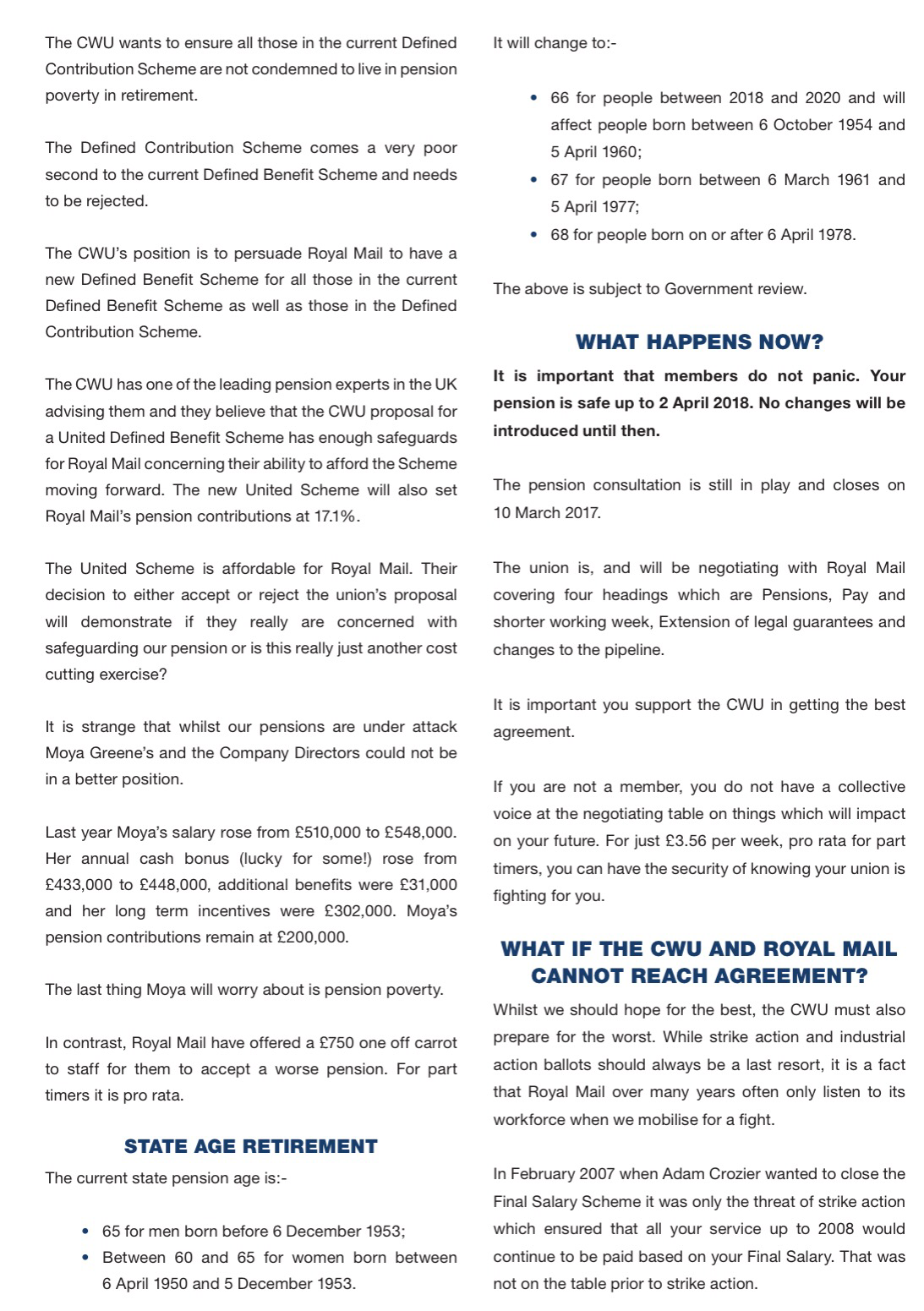
Within the 40,000 are 14,000 individuals who have either taken their pension at 60 or taken their pension early with a 5% per year reduction. The CWU wants to ensure all those in the current Defined Contribution Scheme are not condemned to live in pension poverty in retirement.
The Defined Contribution Scheme comes a very poor second to the current Defined Benefit Scheme and needs to be rejected.
The CWU’s position is to persuade Royal Mail to have a new Defined Benefit Scheme for all those in the current Defined Benefit Scheme as well as those in the Defined Contribution Scheme.
The CWU has one of the leading pension experts in the UK advising them and they believe that the CWU proposal for a United Defined Benefit Scheme has enough safeguards for Royal Mail concerning their ability to afford the Scheme moving forward. The new United Scheme will also set Royal Mail’s pension contributions at 17.1%.
The United Scheme is affordable for Royal Mail. Their decision to either accept or reject the union’s proposal will demonstrate if they really are concerned with safeguarding our pension or is this really just another cost cutting exercise?
It is strange that whilst our pensions are under attack Moya Greene’s and the Company Directors could not be in a better position.
Last year Moya’s salary rose from £510,000 to £548,000. Her annual cash bonus (lucky for some!) rose from £433,000 to £448,000, additional benefits were £31,000 and her long term incentives were £302,000. Moya’s pension contributions remain at £200,000.
The last thing Moya will worry about is pension poverty.
In contrast, Royal Mail have offered a £750 one off carrot to staff for them to accept a worse pension. For part timers it is pro rata.
STATE AGE RETIREMENT
The current state pension age is:-
65 for men born before 6 December 1953;
Between 60 and 65 for women born between 6 April 1950 and 5 December 1953.
It will change to:-
66 for people between 2018 and 2020 and will affect people born between 6 October 1954 and 5 April 1960;
67 for people born between 6 March 1961 and 5 April 1977;
68 for people born on or after 6 April 1978.
The above is subject to Government review.
WHAT HAPPENS NOW?
It is important that members do not panic. Your pension is safe up to 2 April 2018. No changes will be introduced until then.
The pension consultation is still in play and closes on 10 March 2017.
The union is, and will be negotiating with Royal Mail covering four headings which are Pensions, Pay and shorter working week, Extension of legal guarantees and changes to the pipeline.
It is important you support the CWU in getting the best agreement.
If you are not a member, you do not have a collective voice at the negotiating table on things which will impact on your future. For just £3.56 per week, pro rata for part timers, you can have the security of knowing your union is fighting for you.
WHAT IF THE CWU AND ROYAL MAIL CANNOT REACH AGREEMENT?
Whilst we should hope for the best, the CWU must also prepare for the worst. While strike action and industrial action ballots should always be a last resort, it is a fact that Royal Mail over many years often only listen to its workforce when we mobilise for a fight.
In February 2007 when Adam Crozier wanted to close the Final Salary Scheme it was only the threat of strike action which ensured that all your service up to 2008 would continue to be paid based on your Final Salary. That was not on the table prior to strike action.
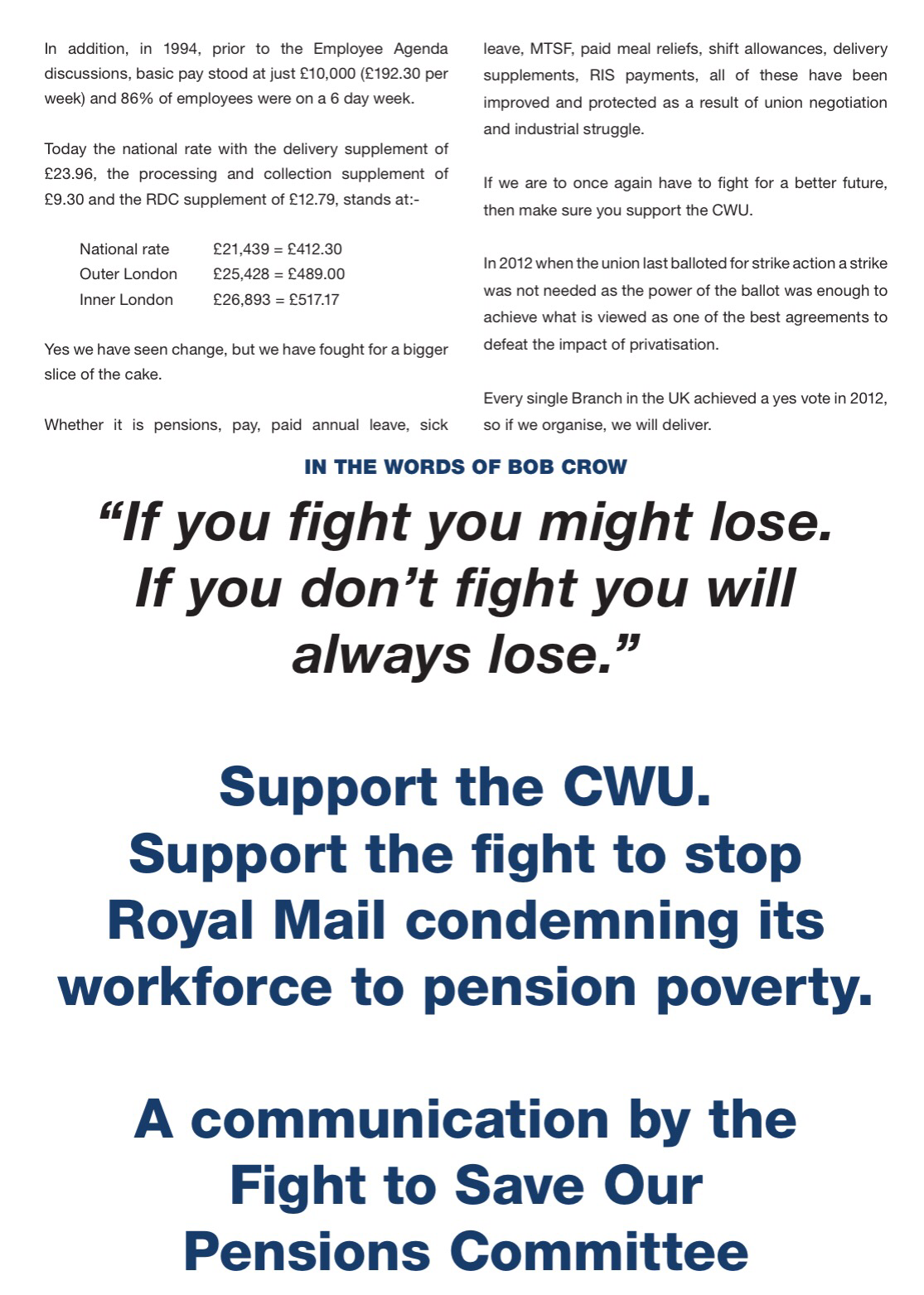
In addition, in 1994, prior to the Employee Agenda discussions, basic pay stood at just £10,000 (£192.30 per week) and 86% of employees were on a 6 day week.
Today the national rate with the delivery supplement of £23.96, the processing and collection supplement of £9.30 and the RDC supplement of £12.79, stands at:-
National rate £21,439 = £412.30
Outer London £25,428 = £489.00
Inner London £26,893 = £517.17
Yes we have seen change, but we have fought for a bigger slice of the cake. Whether it is pensions, pay, paid annual leave, sick leave, MTSF, paid meal reliefs, shift allowances, delivery supplements, RIS payments, all of these have been improved and protected as a result of union negotiation and industrial struggle.
If we are to once again have to fight for a better future, then make sure you support the CWU.
In 2012 when the union last balloted for strike action a strike was not needed as the power of the ballot was enough to achieve what is viewed as one of the best agreements to defeat the impact of privatisation. Every single Branch in the UK achieved a yes vote in 2012, so if we organise, we will deliver.
IN THE WORDS OF BOB CROW
“If you fight you might lose.
If you don’t fight you will always lose.”
Support the CWU. Support the fight to stop Royal Mail condemning its workforce to pension poverty.
A communication by the Fight to Save Our Pensions Committee
BT Supply Chain – Apprentices Opportunities announced
BT Supply Chain have announced that they are looking to continue to deliver on their growth plans and following their successful recruitment of 12 apprentices last year that they intend to recruit 25 apprentices this year. BT Supply Chains is a Directorate within the BT Wholesale and Ventures Line Of Business.
The 25 apprentice vacancies are in the following locations:
Ten roles in distribution (Cardiff, Motherwell, three x Magna Park Lutterworth, two x Bracknell, Chelmsford, Warrington, Belfast) Three roles in engineering services (Cardiff, Leeds, Sheffield) Six roles in our warehouses (three x Magna Park, three x Northallerton) One stock management apprentice (Magna Park) Five roles in staging and configuration (Staines)
The initial notice has been circulated amongst staff working within Supply Chain and is being advertised for ‘someone who is keen to earn and learn and gain a recognised professional qualification at the same time’. They are directing enquiries about the apprenticeship programme and how to apply via the BT Apprenticeships career page. http://www.btplc.com/Careercentre/earlycareers/apprentices/index.htm
They are now open for applications and assessment centres will start from April onwards. The start date for all their apprentices this year will be the 2 October 2017.
Yours sincerely,
Brendan O’Brien
Assistant Secretary
Email Attachments – Click to download
LTB 080/17 – BT Supply Chain – Apprentices Opportunities announced

Heartunions is a special week of activities throughout England and Wales to showcase the fantastic work unions do. It’s a chance for everyone to get involved, help tell their own stories and build our trade union movement.


Dear Colleague, Royal Mail – Changes to the Operational Structure The DGS(P) Department can confirm that the business have notified us of changes to the current operational structure which will increase the number of geographical regions from 3 to 4. This change will come into effect from 1st April 2017. Royal Mail have confirmed that CWU Divisional Representatives will be fully briefed on these changes and we are awaiting a matrix to be provided that will cover the alignment of Divisional Representatives although we do not envisage there will be any issues of concern in this regard. A summary of the key changes to the current operational structure is reproduced below: South East, Guildford, London, Essex, part of Anglia and part of Home Counties North will form the new South Region; Most of Anglia, Home Counties North and Great Western, together with all of East Midlands and part of South & West Yorkshire will form the new East Region; Cheshire & Merseyside, West Midlands, South Wales & Gloucester, South West, South Coast and part of Great Western will remain in the West Region; North West England, West of Scotland, Yorkshire, Tyneside, and East Scotland & NI will form the North Region; Where Delivery Directorates have been split, RODs will discuss the impact on an individual basis – however, there will continue to be 18 Delivery Directorates so it is expected that the Operations infrastructure will simply realign.
Please find attached for ease of reference a table of the revised 4 regions detailing the Mail Centre/Plant alignment and the Postcode sectors covered. As previously mentioned, at the time of writing this LTB, we are still awaiting clarification of the Divisional alignment but can confirm that the current Industrial Relations Framework Agreement continues to hold the field and will apply to any revised Royal Mail structure going forward. Further information will be circulated to Branches in due course. Any enquiries relating to this LTB should be directed to the DGS(P) Department. Yours sincerely
Terry Pullinger Deputy General Secretary (Postal)
Click on the link below to view
17ltb079-attachment-royal-mail-changes-to-the-operational-structure
Royal Mail & CWU National Joint Statement Avoiding Delay (Commit to Deliver) and Reporting Standards
Dear Colleague,
Branches and Representatives may be aware that in the lead up to Christmas of last year the Department were receiving numerous reports of USO and Workplan failures across Delivery Offices. As a result we requested that reps send us photographic evidence so this could be presented to Gary Burgess Delivery Excellence Director to inform the debate and substantiate the reports we were receiving. Royal Mail have stated that such images must not be shared outside of the company.
This lead to further discussions taking place with Royal Mail regarding whether their managers are fully aware of the ‘Delivery – Avoiding Delay’ process within the Conduct Code and whether it is being followed. In addition to this, discussions also took place involving Royal Mails quality team on whether the process was used correctly in regards to reporting USO and workplan failures and how these failures were being reported within the respective Delivery Office.
As a result both parties agreed to pull together the relevant process from the Conduct Code and the managerial brief on reporting failure into a Joint Statement which is attached for the attention of Branches and is to be jointly re-communicated.
During the discussions and recent Delivery Office visits it has also become clear that the reporting of errors with both traffic volumes and presentation is not being managed correctly and both parties believed the inclusion of the words relating to the Delivery Traffic Measurement Processes and Review Guidelines (LTB 743/14) would be helpful. As such they have been included, along with the flow chart.
Therefore, it was felt concluding the attached Joint Statement would be welcomed by CWU Representatives and in particular that it would be jointly communicated and cascaded across all Delivery offices. Managers should have no excuses going forwards in terms of mistreating our members with threats of conduct if the process is followed correctly as this is explicit and contained within the actual text of the agreed process.
Where there continue to be issues in relation to USO and Workplan failures across Delivery Offices it is important that the correct and jointly agreed processes are followed, the department would also request that we be informed of such instances to ensure these can continue to be raised with Royal Mail at the highest level.
Additionally where management locally refuses to adhere to the nationally agreed process, Branches are advised to progress this urgently through the IR framework, also using the flashpoint procedure if necessary.
Any enquiries to the content of the above please contact the Outdoor Department reference: 535. Email address: outdoorsecretary@cwu.org.
Yours Sincerely,
CWU A/Assistant Secretary
CLICK ON THE LINK BELOW TO VEIW
joint-statement-avoiding-delay-commit-to-deliver-accurate-reporting-february-2017-final
Election of:
CWU Delegates to the TUC Equality Conferences – 2017
Further to LTB 030/17 dated 19th January 2017, please find detailed below the results of the ballots:
TUC WOMENS CONFERENCE
Postal
4 Lay Members
Dale-Marie Bliben
South Central Postal
45,278
Clare Drummond
Greater Manchester
73,821 *Elected
Kath Kelly
Newcastle Amal
81,941 *Elected
Morag Rose
Scotland No 5
71,769 *Elected
Vicki Turner
Leeds No 1 Amal
75,676 *Elected
TUC BLACK WORKERS CONFERENCE
Postal
3 Lay Members
Adam Alarakhia
Leicestershire
23,386
Linford Gibbons
Nottingham District Amal
34,498
Bola Omoyeni
South Midlands Postal
39,918 *Elected
Mohammed Sakib
South Central Postal
37,112
Amarjite Singh
South East Wales Amal
81,735 *Elected
Ian Taylor
Greater Manchester
65,325 *Elected
TUC DISABLED WORKERS CONFERENCE
Postal
3 Lay Members
Adam Alarakhia
Leicestershire
38,311
Mark Anthony Bastiani
London South West
50,013 *Elected
William Johnston
Scotland No 2
29,439
Tony Sneddon
Scotland No 5
77,237 *Elected
Lee Starr-Elliott
Bristol & District Amal
74,986 *Elected
TUC LGBT CONFERENCE
Telecom & Financial Services
3 Lay Members (Minimum 1 Woman)
John Monk
London & West Branch
12,144
Jacky Morrey
Mid Wales The Marches & North Staffs,
30,642 *Elected
Jason Reynolds
Capital,
33,693 *Elected
Jean Sharrocks
North East,
30,711 *Elected
Duncan Strivens
South London Surrey & North Hampshire
16,011
The branch analysis for the above elections are attached to this LTB.
Any enquiries regarding this Letter to Branches should be addressed to the Senior Deputy General Secretary’s Department on telephone number 020 8971 7237, or email address sdgs@cwu.org.
Yours sincerely,
TONY KEARNS
SENIOR DEPUTY GENERAL SECRETARY
Email Attachments – Click to download
LTB 077/17 – Election of CWU Delegates to the TUC Equality Conferences 2017
TUC/HSE Guidance & Advice For Trade Union Health & Safety Reps on Tackling Work-Related Stress
To: All Branches
Dear Colleagues,
The TUC and Health and Safety Executive (HSE) has this week published a new guide to help Trade Union Health and Safety Representatives tackle Workplace Stress and a pdf file copy is attached for the information of CWU Reps and Branches.
Work-related stress has been viewed as a major problem by trade unions since the 1980s. Trade Unions, including the CWU, have played a key role in ensuring that stress is now recognised as one of the main ill health concerns in the workplace.
The need to tackle stress is also recognised in law. HSE’s position is that work-related stress should be treated as any other workplace hazard. Under the Health & Safety at Work etc., Act 1974 and the Management of Health and Safety at Work Regulations 1999, employers are obliged to undertake a risk assessment for health hazards at work – including stress – and to take action to control that risk. Unfortunately while many employers have accepted that stress is a major problem in their workplace, many others have no idea how to tackle it effectively.
HSE defines stress as “the adverse reaction people have to excessive pressure or other types of demand placed on them”. This definition is widely accepted and under this definition all stress is damaging. We all recognise that a certain degree of pressure is part and parcel of all work and helps to keep us motivated. However, stress can lead to physical or psychological ill health. HSE statistics show that stress is one of the top two causes of sickness absence (with musculoskeletal disorders) in Great Britain and research confirms that.
Last year 7 in 10 respondents to the TUC National Health and Safety Representatives survey, conducted across all UK Unions and Industries identified Stress as the top concern in their workplaces. As a result the TUC in conjunction with the HSE has issued this new guidance handbook, which will help Union Health and Safety Representatives and other Reps to work with employers to find practical solutions to work-related stress. The Main employers such as Royal Mail Group and BT Group have introduced Stress Risk Assessment Policies and Processes. The new TUC Guide will assist CWU Health and Safety Reps utilise those processes.
There is clear guidance available from the Health and Safety Executive (HSE), which will help organisations identify practical solutions to the problem. This is the Management Standards approach to Work-related Stress. If implemented properly, the Management Standards could significantly reduce levels of illness caused by work-related stress. That is why the TUC is working with the HSE to publish clear guidance for union health and safety representatives. It is the TUC, HSE and CWU view that safety representatives should encourage their employer to implement the HSE Stress Management Standards in their organisation. There is a legal requirement on the employer to do a risk assessment that should include stress and, if stress is a problem in the workplace, the employer has to take steps to manage it. Employers have to have in place a suitable system for managing work-related stress and Unions and their Health and Safety Reps have a major part to play in ensuring that employers take their responsibilities, to tackle work-related stress, seriously. Dealing with stress at work highlights the fact that health and safety is not divorced from the rest of the union’s work activity.
The TUC/HSE guide is based on the HSE ‘Stress Management Standards’ in handling stress. It breaks down the causes of work-related stress into six key areas:
Demands: issues like workload, work pattern and environment
Control: how much say someone has over the way in which they work
Support: available resources, line management and colleagues
Relationships: dealing with unacceptable behaviour and promoting positive working
Role: if the person understands their role at work and does not have conflicting roles
Change: how organisational change – large or small – is communicated.
The Guidance handbook suggests that Trade Union Representatives should, through their Legal Rights to carry out Health and Safety Inspections, gather information on the current situation in the workplace and discuss with management the need to carry out a stress risk assessment in order to identify practical proposals for change that could make a real difference, such as tackling poor work culture and improving workplace working practices and conditions.
Workers are increasingly suffering from the effects of workplace stress as pressures of heavy workloads, long hours and low job security are taking hold across the UK. The Guidance emphasises the fact that it’s in no-one’s interest to have an overstretched, stressed out and anxious workforce, as staff are less productive and are more likely to take time off in such circumstances. The HSE Stress Management standards provide the best way of tackling the issue.
Unions and employers working together to invest in health and safety can result in a vast improvement in other aspects of industrial relations and a working environment in which work-related stress is managed properly. This new guide is designed to help union safety representatives encourage employers and managers to work with them to implement the HSE Management Standards approach to managing work-related stress. The Management Standards, and the approach were launched in 2004 following extensive development and piloting. They are an effective tool for assisting organisations to identify the causes of work-related stress and implement practical solutions to manage the risks. They are now the main standard in use in the UK.
The new guide:
Gives a background to the problem of stress
Outlines what the Management Standards are
Says what you and your employer can do
Explains the process
Gives advice on how to build your knowledge
Tells you where to go for additional information.
The HSE Stress Management Standards approach to work-related stress and the accompanying guidance and tools have been designed to assist employers in identifying causes of stress in the workplace and to develop and implement solutions to minimize the effects on workers. The TUC and affiliated unions welcomed this development as it gives real support to employers wishing to tackle stress at work. The standards also give health and safety enforcement officers a means of assessing whether an employer is failing to manage stress adequately.
The TUC and CWU believe that the application of the approach through agreed deployment arrangements provides the most effective way of dealing with stress and highlights the critical importance of involving unions and employees at every stage of the introduction of the process in developing management systems and preventative measures. If employers try to introduce them without proper consultation they are unlikely to be effective or supported by employees.
Union Health and Safety Representatives have an important role in the process of managing stress in the workplace and a key role to play in working with employers to tackle this problem and are an integral part of the communication between members and the employer and in encouraging members to take an active role in the internal stress risk assessment process where it is being properly used. Stress is preventable if workers have reasonable workloads, supportive managers and a workplace free from violence, bullying and harassment. Union Health and Safety Reps and other Reps also have a role in tackling the stigma of stress, anxiety and mental ill-health. People perceive stress as a weakness and this may contribute to underreporting.
Yours sincerely
Dave Joyce
National Health, Safety & Environment Officer
Email Attachments – Click to download
Attachment 1 – LTB073/17 TUC/HSE Guidance & Advice For Trade Union Health & Safety Reps on Tackling Work-Related Stress

 CWU Eastern No5 Branch