TRADES UNION CONGRESS 2021: CWU DELEGATION REPORT

TRADES UNION CONGRESS 2021: CWU DELEGATION REPORT

The 2021 Trades Union Congress took place online from Sunday 12th September to Tuesday 14th September 2021.

All unions were entitled to submit two motions to the agenda.  The CWU National Executive Council agreed the following motions:-

MOTION 1: NEW DEAL FOR WORKERS MOBILISATION STRATEGY

It has never been more important in the history of our movement for this generation of trade union leaders and all trade unions to campaign and take action together in pursuit of shared industrial and political demands.

TUC policy is firmly established in this area and in 2020 we agreed to mobilise for the New Deal for Workers Campaign and we must now urgently up the ante on this by taking the following actions:-

  1. The existing TUC New Deal Charter must be sharpened with simple overarching demands and a contemporary narrative. 
  2. A mobilisation strategy must enable each union to pitch their key issues to their own members, whilst also linking this to the overarching demands and narrative of the New Deal Campaign.
  3. A national rally will be held in spring 2022. In advance of this there will be a national tour and town hall style meetings to strengthen the campaign and the turnout for the rally.
  1. All unions and their Branches, TUC regions and Trade Councils will be asked to make the New Deal Campaign an ongoing key agenda item, including a coordinated communications/engagement strategy in advance of the rally.
  2. We will build a social movement in support of the New Deal Campaign by engaging community and appropriate national membership organisations.

The New Deal mobilisation plan will be agreed by the General Council by October 2021 and will include an ongoing programme of action beyond the rally. 

MOTION 2: BUILDING COLLECTIVISM 

We face some of the most difficult circumstances in the history of the Labour movement.

As we grapple with the challenge of building a post- Covid and Brexit future, we do so knowing that prior to the pandemic there were deep structural imbalances of wealth and power in the world of work, the economy and wider society, that were decades in the making.

Climate change and the fourth industrial revolution will also accelerate the growing sense of insecurity and anxiety that people are feeling over the future. 

Against this background, the fundamental question facing all trade unions is how to unite working people, end inequality and build a coalition of support across race, gender and class to deliver change.

This should be a 1945 moment with a new social settlement, not only to rebuild from a crisis but to tackle the very same issues we face today that the Beveridge report highlighted then.

Trade unions must now join together and lead the way through the collective power of campaigning and action to make change happen on the ground.

Congress calls on the General Council to agree a plan before the end of 2021, for cross-union action – as part of a mobilisation strategy for a New Deal for Workers – to stop and reverse the privatisation of the NHS, defend public services, guarantee everyone a living income through the welfare system, establish a fully funded National Care Service and promote a national mission to abolish in-work poverty.

The CWU was also entitled to submit two amendments.  These were as follows:-

Amendment to UCU Motion:

Insert new paragraph 7: “Congress notes that the growth of automation has brought new urgency to this debate. We must strive for workers to benefit from new technologies and associated productivity improvements through a shorter working week with no loss of pay.”

Amendment to RMT Motion:

In paragraph 5, sub-paragraph iii., delete “highlighting this issue” and replace with: “that brings together affiliates and community organisations in order to recognise the wider role that key workers play in providing vital service to their communities.”

COMMUNICATION WORKERS UNION 

2021 TRADES UNION CONGRESS – ONLINE

MINUTES OF THE TUC DELEGATION MEETING 

HELD AT CWU HEADQUARTERS

150 THE BROADWAY, WIMBLEDON SW19 1RX

ON SUNDAY 12TH SEPTEMBER AT 11.30 A.M. & 

MONDAY 13TH SEPTEMBER

AT 9.30 A.M.

___________________________________________________________________

PRESENT:                            Karen Rose (Chair), Dave Ward (General Secretary), Tony Kearns (SDGS), Andy Kerr (DGS T&FS), Andy Furey (Acting DGS Postal), Maria Exall (ex officio), Steve Croke, Huge Gaffney, Keith Hamilton, Armajite Singh, Michelle Bailey, Jacky Morrey, Trish Vollans, Mel Wilson, Ken Woolley, Emma Garner, Mick Kavanagh

IN ATTENDANCE:               Bill Taylor, Lionel Sampson, Liam Young, Janina Dunn, Kate Hudson

1       WELCOME – INTRODUCTIONS & APOLOGIES


The Chair welcomed all CWU delegates to the meeting, in particular those who were attending the TUC Congress for the first time and asked the delegation to introduce themselves.

Apologies were received from Jane Loftus (family bereavement).

2          GENERAL SECRETARY OVERVIEW

The General Secretary welcomed all CWU delegates to Headquarters for the TUC online Congress and thanked them for making the journey under the current circumstances.

The General Secretary gave a brief overview of the two CWU motions submitted to TUC Congress.


3          EXPLANATION OF TUC DOCUMENTS

Bill Taylor and Liam Young provided an explanation of the TUC pack provided at the meeting which included:

  • General Council Report 2021
  • Final Agenda 2021
  • General Purposes Committee Report and Consolidated Final Agenda 2021
  • Programme of Business and General Council members’ responsibilities for motions and report paragraphs.
  • Summary of CWU Conference Policy 2019
  • CWU – TUC Congress 2021 Policy Positions.
  1. CWU POLICY POSITION ON MOTIONS AND AMENDMENTS The SDGS went through the CWU policy positions.

1. Responding to Covid-1901 UNISON

02 NASUWT
amend NEU
amend Community

70 CWU
amend UNISON

03 PCS

04 EIS

05 CSP
amend Usdaw
amend RCM

06 POA

07 AEPComposite 01
Recover and rebuild: a post-pandemic plan for public services and safety at work

CWU – SUPPORT08 TUC Disabled Workers ConferenceStands

CWU – SUPPORT2. The economy09 GMB
amend Unite

10 Prospect
amend FDA

12 Community

15 ASLEFComposite 02
The climate emergency, defending jobs and a just transition

CWU – OPPOSE11 UCU
amend NASUWTStands
accepted

CWU – SUPPORT13 ASLEF

14 TSSAComposite 03
Rail cuts, climate change and a post-pandemic recovery

CWU – SUPPORT16 Community
amend UCU
amend TSSA

17 Nautilus InternationalComposite 04
Tackling the UK skills gaps and boosting maritime training

CWU – SUPPORT18 Equity
amend AUE

19 MU

20 FDA
amend Prospect

21 AUE

22 AUE
amend PCSComposite 05
Support for the cultural sector

CWU – SUPPORT23 Prospect
amend CommunityStands
accepted

CWU – SUPPORT24 RMT
amend CWUStands
accepted

CWU – SUPPORT25 FBUStands

CWU – SUPPORT26 UCU
amend CWU
amend RMTComposite

CWU – SUPPORT27 Accord
amend FDAStands
accepted

CWU – SUPPORT28 Nautilus InternationalStands

CWU – SUPPORT29 TSSA
amend RMTStands
accepted

CWU – SUPPORT30 AegisStands

CWU – SUPPORT31 UsdawStands

CWU – SUPPORT32 BFAWU
amend Unite

33 BDAComposite 06
Right to food

CWU – SUPPORT34 MUStands

CWU – SUPPORT3. Respect and a voice at work35 Unite
amend GMB

37 UsdawComposite 07
End fire and rehire; redundancy rights now!

CWU – SUPPORT36 TUC Young Workers ConferenceStands

CWU – SUPPORT38 NUJStands

CWU – SUPPORT39 RCPStands

CWU – SUPPORT40 PFA
amend CSP
amend RCM
amend AccordComposite 08
Online abuse: time for real change

CWU – SUPPORT41 NASUWT
amend Prospect
amend FBUComposite 09
Strengthening regulatory bodies

CWU – SUPPORT42 UNISON
amend CSP

43 RCP

44 HCSA
amend GMBComposite 10
Tackling structural racism, inequalities and the ethnicity pay gap in medicine following the Covid-19 pandemic

CWU – SUPPORT45 TUC Black Workers ConferenceStands

CWU – SUPPORT46 NEUStands

CWU – SUPPORT47 RCMStands

CWU – SUPPORT48 TUC Women’s ConferenceStands

CWU – SUPPORT49 TUC LGBT+ ConferenceStands

CWU – SUPPORT50 Unite
amend PCS

51 FBU
amend UNISONComposite 11
Tory attacks on our rights: defend democracy, trade unions and the right to protest

CWU – SUPPORT52 TUC Trades Councils ConferenceStands

CWU – SUPPORT4. Good services53 UNISON

54 CSP
amend FBU

55 RCM

56 BDA
amend RCP

57 GMB
amend UNISONComposite 12
Invest in public services

CWU – SUPPORT58 PCS

59 EIS
amend NASUWTComposite 13
Public sector pay and pensions

CWU – SUPPORT60 HCSAStands

CWU – SUPPORT61 NAHTStands

CWU – SUPPORT62 FDAStands

CWU – SUPPORT63 NapoStands

CWU – SUPPORT64 NapoStands

CWU – SUPPORT65 Equity

66 NUJComposite 14
Defending public service broadcasting and saving Channel 4 from privatisation

CWU – SUPPORT5. Winning more for workers67 Unite
amend RCP

68 RMT
amend UniteComposite 15
Defending and supporting union reps and winning rights for union equality reps  

CWU – SUPPORT69 CWU
amend NEU
amend UCU

71 AegisComposite 16
Increasing membership in the private sector and mobilising for a New Deal for all workers

CWU – SUPPORT72 NEU
amend TSSAStands
accepted

CWU – SUPPORT73 POA

74 BFAWUComposite 17
Colombian government violence; justice for Colombia

CWU – SUPPORT

The above policy was agreed.

5          CWU MOTIONS AND AMENDMENTS – SPEAKERS

TUC Congress was held online this year and normal speaker arrangements were suspended.  Owing to the fact that there were no debates on motions no speakers could be selected from the delegation.  However, representatives from the union’s leadership were approved to move and/or second motions.  These were Dave Ward, Tony Kearns and Karen Rose.

6          ELECTIONS

Section D

We are entitled to cast up to 192 votes for each of up to four candidates in Section D (Women Members).  We propose casting 192 votes for Jane Loftus (CWU), 192 votes for Annette Mansell-Green (BDA), 192 votes for Fran Heathcote (PCS) and 192 votes for Sue Ferns (Prospect).

Section H

We are entitled to cast up to 192 votes for one candidate in Section H (Disabled Members). We propose casting 192 votes for Dave Allan (Unite).

General Purpose Committee

We are entitled to cast up to 192 votes for each of up to five candidates for the General Purpose Committee.  We are proposing casting 192 votes for Sharon Wilde (GMB), Michelle Rodgers (RMT), Tony Wilson (UNISON), Linda McCulloch (Unite) and Dave McCrossen (USDAW).

General Council Statements

General Council Statement 1 – After the pandemic, a trade union action plan for a just, resilient future – Policy – Support 

General Council Statement 2 -Taking forward the work of the TUC’s Anti-Racism Taskforce – Policy – Support.

The recommended candidates were agreed.
 

ANY OTHER BUSINESS

There was no other business.

Any enquiries on the above LTB should be addressed tojdunn@cwu.org

Yours sincerely,

Dave Ward

General Secretary

LTB 543/21 – Trades Unions Congress 2021 – CWU Delegation Report

View Online

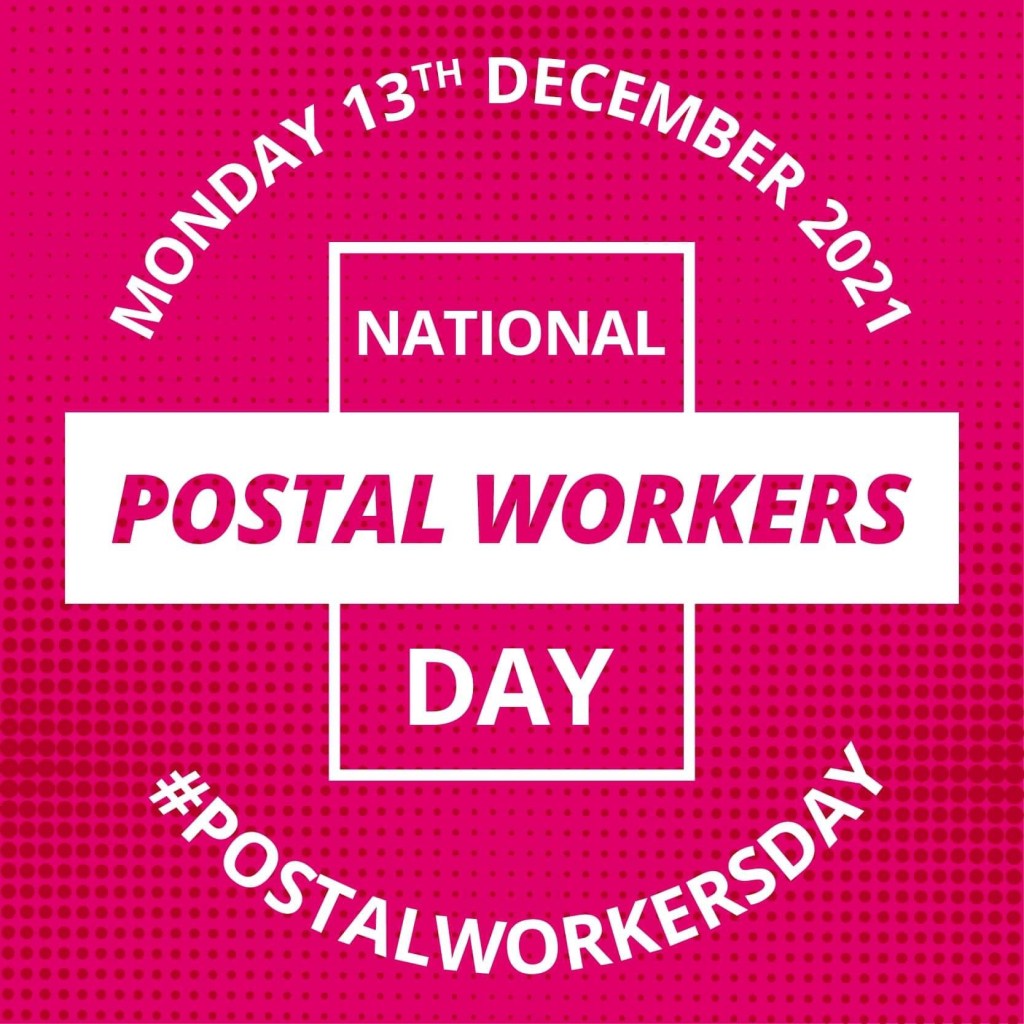
Today Monday 13th December is National #PostalWorkersDay

Today is National #PostalWorkersDay

Please share this post on Facebook https://www.facebook.com/981299138616232/posts/4650505941695515/?d=n

Join us on Twitter Spaces at 6:15pm

https://twitter.com/i/spaces/1MnxnkoPweeKO

Also, share our Christmas advert when it is released across social media at 7pm.

Use #PostalWorkersDay online as much as you can today

Revisions, Resourcing, Earnings Packages and Vans

IT IS VITAL THIS UPDATE FROM DGSP TERRY PULLINGER IS SHARED IN EVERY OFFICE IN THE UK

Revisions, Resourcing, Earnings Packages and Vans

Increasing local level autonomy to allow local managers and CWU Representatives to agree and decide local solutions to the daily challenges rather than have to wait and rely on someone distant from the problem to make the decision, is a major part of our strategy in deploying the Pathway to Change Agreement.

The revision programme we agreed was always ambitious, deployed from a standing start and historically unprecedented in scale and timelines. That strategy was always going to expose any weakness in respect of systems and decision-making, but what it has also exposed is genuine managerial capability issues. Inaccurate data, inadequate planning and poor / slow decision-making has made life really difficult for Postal Workers. In the dispute years, these failings were disguised, however deploying the Agreement has forced them to come to the surface, allowing us to combat them one by one.

In contrast, Postal Workers have shone and put in an extraordinary effort. One thing is for sure and that is that none of the failings recently prominent in the media are the fault of Postal Workers, who have been exceptional.

Trying to maintain a great public service throughout the pandemic has been incredibly difficult for everybody, especially whilst deploying major changes and considering the great annual challenge of the Christmas period pressure.

Whilst our members have been absolutely brilliant, Postal Workers and the Public we serve deserve better. This LTB is being circulated to acknowledge this and to assure all CWU Representatives that we have been addressing these issues and agreeing a series of interventions to give local managers and CWU Representatives the tools and autonomy to respond locally and at pace, in order to tackle the current challenges.

1/ To ensure that local negotiations are not constrained by local managers insisting that we only deliver T24 and T48 products, we published the following in a Joint Statement on 29th November 2021:

‘Royal Mail Group is committed to the USO and the delivery, collection and processing of letters, packets and parcels with equal status of importance and where we are experiencing challenges it is important that any required contingencies are agreed locally and must include all commercial and USO products and not priorities T24 and T48 parcels’.

If your local manager is not discussing and agreeing coverage and contingences in line with the above, the IR Framework / Dispute Resolution Procedure (DRP) should be used to ensure an appropriate agreement is reached.

2/ If resourcing issues are a problem then we have agreed to speed up the recruitment process by utilising ‘friends and family’ referrals, as well as local advertising and social media groups, to accelerate what was a far too elongated and centralised HR process.

If your local manager is refusing to adopt these strategies in an effort to relieve the pressure on the local workforce and maintain Quality of Service, then the IR Framework / DRP should be used to ensure an appropriate agreement is reached.

3/ Regarding the lack of vans, local CWU Representatives should not accept ‘jam tomorrow’ promises from managerial sources further up the line. If firm supply dates cannot be given, Representatives should insist that local managers work with them to source local suppliers where possible.

If local managers refuse to respond pro-actively in this regard, the IR Framework / DRP should be used to ensure an appropriate agreement is reached.

4/ In respect of earnings packages, which would ensure robust coverage and maintain Quality of Service, any proposals from the local CWU Representative should be considered and not be unreasonably rejected.

If local managers are refusing to respond to potential solutions addressing Quality of Service failures and robust resourcing arrangements by utilising our own skilled workforce, the IR Framework / DRP should be used to ensure an appropriate agreement is reached.

5/ In respect of the 70hrs cap, the following has been communicated to all local managers.

‘We do communicate that there is a 70hrs cap and local managers should not automatically plan above this (including Peak). However, where there is an agreed need in a specific location the cap can be exceeded. So it’s a needs based approach, locally agreed via a sensible and pragmatic approach. There is definitely not an edict to not exceed the 70hrs cap’.

If local managers are refusing to respond to reasonable proposals aimed to maintain Quality of Service, ensure robust resourcing arrangements and taking the pressure off our members by utilising the above, the IR Framework / DRP should be used to ensure an appropriate agreement is reached.

Hopefully this combination of interventions will strengthen the ability of local managers and CWU Representatives to make the right decisions where it matters, in the workplace on a daily basis. The failure of not doing all that we can to support Postal Workers through these very difficult times will further impact on the workforce morale and result in Customers and the Public not receiving the service they deserve.

We encourage all local Representatives to push hard for the most robust possible arrangements and contingencies to be put in place in order to ensure the best achievable Quality of Service, even if this means using the IR Framework / DRP when local managers are failing to adequately respond.

In closing, we wish to thank all CWU Representatives and our members for their magnificent daily efforts throughout one of the most difficult times in our history. Do not let the failings of systems, data or managerial capability define you. You all do any excellent job and it is a future worth fighting for. We will address all of these barriers and weakness, in order to deliver a Royal Mail Group fit for the next generation.

Yours sincerely,

Terry Pullinger

Deputy General Secretary (Postal)

Revisions, Resourcing, Earnings Packages and Vans

Revisions, Resourcing, Earnings Packages and Vans

Increasing local level autonomy to allow local managers and CWU Representatives to agree and decide local solutions to the daily challenges rather than have to wait and rely on someone distant from the problem to make the decision, is a major part of our strategy in deploying the Pathway to Change Agreement.

The revision programme we agreed was always ambitious, deployed from a standing start and historically unprecedented in scale and timelines. That strategy was always going to expose any weakness in respect of systems and decision-making, but what it has also exposed is genuine managerial capability issues. Inaccurate data, inadequate planning and poor / slow decision-making has made life really difficult for Postal Workers. In the dispute years, these failings were disguised, however deploying the Agreement has forced them to come to the surface, allowing us to combat them one by one.

In contrast, Postal Workers have shone and put in an extraordinary effort. One thing is for sure and that is that none of the failings recently prominent in the media are the fault of Postal Workers, who have been exceptional.  

Trying to maintain a great public service throughout the pandemic has been incredibly difficult for everybody, especially whilst deploying major changes and considering the great annual challenge of the Christmas period pressure.

Whilst our members have been absolutely brilliant, Postal Workers and the Public we serve deserve better. This LTB is being circulated to acknowledge this and to assure all CWU Representatives that we have been addressing these issues and agreeing a series of interventions to give local managers and CWU Representatives the tools and autonomy to respond locally and at pace, in order to tackle the current challenges.

1/ To ensure that local negotiations are not constrained by local managers insisting that we only deliver T24 and T48 products, we published the following in a Joint Statement on 29thNovember 2021:

Royal Mail Group is committed to the USO and the delivery, collection and processing of letters, packets and parcels with equal status of importance and where we are experiencing challenges it is important that any required contingencies are agreed locally and must include all commercial and USO products and not priorities T24 and T48 parcels’.

If your local manager is not discussing and agreeing coverage and contingences in line with the above, the IR Framework / Dispute Resolution Procedure (DRP) should be used to ensure an appropriate agreement is reached. 

2/ If resourcing issues are a problem then we have agreed to speed up the recruitment process by utilising ‘friends and family’ referrals, as well as local advertising and social media groups, to accelerate what was a far too elongated and centralised HR process.

If your local manager is refusing to adopt these strategies in an effort to relieve the pressure on the local workforce and maintain Quality of Service, then the IR Framework / DRP should be used to ensure an appropriate agreement is reached. 

3/ Regarding the lack of vans, local CWU Representatives should not accept ‘jam tomorrow’ promises from managerial sources further up the line. If firm supply dates cannot be given, Representatives should insist that local managers work with them to source local suppliers where possible.

If local managers refuse to respond pro-actively in this regard, the IR Framework / DRP should be used to ensure an appropriate agreement is reached. 

4/ In respect of earnings packages, which would ensure robust coverage and maintain Quality of Service, any proposals from the local CWU Representative should be considered and not be unreasonably rejected. 

If local managers are refusing to respond to potential solutions addressing Quality of Service failures and robust resourcing arrangements by utilising our own skilled workforce, the IR Framework / DRP should be used to ensure an appropriate agreement is reached. 

5/ In respect of the 70hrs cap, the following has been communicated to all local managers.

‘We do communicate that there is a 70hrs cap and local managers should not automatically plan above this (including Peak). However, where there is an agreed need in a specific location the cap can be exceeded. So it’s a needs based approach, locally agreed via a sensible and pragmatic approach. There is definitely not an edict to not exceed the 70hrs cap’.

If local managers are refusing to respond to reasonable proposals aimed to maintain Quality of Service, ensure robust resourcing arrangements and taking the pressure off our members by utilising the above, the IR Framework / DRP should be used to ensure an appropriate agreement is reached. 

Hopefully this combination of interventions will strengthen the ability of local managers and CWU Representatives to make the right decisions where it matters, in the workplace on a daily basis. The failure of not doing all that we can to support Postal Workers through these very difficult times will further impact on the workforce morale and result in Customers and the Public not receiving the service they deserve.

We encourage all local Representatives to push hard for the most robust possible arrangements and contingencies to be put in place in order to ensure the best achievable Quality of Service, even if this means using the IR Framework / DRP when local managers are failing to adequately respond.

In closing, we wish to thank all CWU Representatives and our members for their magnificent daily efforts throughout one of the most difficult times in our history. Do not let the failings of systems, data or managerial capability define you. You all do any excellent job and it is a future worth fighting for. We will address all of these barriers and weakness, in order to deliver a Royal Mail Group fit for the next generation.

Any enquiries in relation to the content of this LTB should be addressed to the DGS(P) Department.

Yours sincerely,

Terry Pullinger

Deputy General Secretary (Postal)

LTB 541/21 Revisions, Resourcing, Earnings Packages and Vans

View Online

CWU RMPFS Engineering and Admin Grades Officials – Vacancies

CWU RMPFS Engineering and Admin Grades Officials – Vacancies

Further to LTB 518/21 dated 30th November 2021 branches will note that there were a number of positions that remained vacant due to no nominations being received.

We are therefore re-advertising these positions and nomination forms for all vacant positions are attached to this LTB. All Candidates must have the nomination of their own branch which must be agreed at a branch meeting. Completed nomination forms must be signed by the Branch Secretary and Branch Chair (or accredited deputies) and the nominee. The Form should then be returned to Tony Kearns, Senior Deputy General Secretary, on the following email elections@cwu.org by 14.00 on 22nd December 2021

The term of office for all these positions is a period of 2 years in line with the CWU Recognition & Industrial Framework Agreement 2021.

REGIONAL REPRESENTATIVES:SPCNorth East721, 722, 813, 814, 891, 892East Anglia724, 725, 813, 876, 894, 895South West & Wales723, 726, 852, 854, 863, 893, 896Thames Valley, London & South East725, 726, 727, 862, 863, 880, 884, 892, 895, 896, 897

WORKPLACE REPRESENTATIVE – LEEDS ADMIN CENTRE

The timetable for the nominations is as follows:

Nominations open: Friday 10th December 2021
Nominations close: Wednesday 22nd December 2021

Any ballots will be run in accordance with the CWU guidelines for Regional Engineering/Admin Representatives, which are attached for your information. In the event that a ballot is required a timetable will be notified to branches in due course.

Any enquiries regarding this LTB should be addressed to the PTS Department quoting Ref 320 at e-mail address: khay@cwu.org

Yours sincerely
Carl Maden
Assistant Secretary

LTB 537/32

Att:Election Guidelines 2021

Att:Leeds Admin Centre Nom Form

Att:Regional Representative Vacancies Nom Form

View Online

Government Announcement on New Covid Rules For England – Including Working From Home If Possible And Wearing Masks In More Public Places

Government Announcement on New Covid Rules For England – Including Working From Home If Possible And Wearing Masks In More Public Places

Further to earlier LTBs, this is a summary update for Branches and Health and Safety Reps following the Government’s announcement yesterday regarding the so called ‘Plan B’ implementing further Covid restrictions for England.  Other parts of the UK have also tightened up their Covid regulations.

What are the new measures for England?

From Friday 10 December, face coverings are mandatory for most indoor public venues including places of worship, theatres and cinemas – as well as on public transport and in places like shops and hairdressers.

Masks won’t be needed in pubs or restaurants, nor in venues like gyms where it’s “not practical to wear them”.

From Monday 13 December, people should work from home“if they can”.

From Wednesday 15 December(subject to parliamentary approval), people will need an NHS Covid Pass – showing their vaccination status or a recent negative lateral flow test – to gain entry to:

  • Nightclubs
  • Indoor unseated venues with more than 500 people
  • Unseated outdoor venues with more than 4,000 people
  • Any venue with more than 10,000 people

The government also wants people to do a lateral flow test (LFT) before entering “a high-risk setting” – such as a crowded place – “involving people you wouldn’t normally come into contact with, or when visiting a vulnerable person”.

People who’ve come into contact with Omicron cases currently have to go into self-isolation for 10 days. Ministers intend to change the rules so they can do daily Covid tests, instead.

What Covid rules were already in place in England?

The rules include:

What’s happening with boosters?

Every eligible person in England, Scotland and Wales should be able to book their booster by the end of January – although some may get it at a later date.

How do I get my booster?

Why are the new changes being made?

A new Covid variant – Omicron – has been identified, and there are fears it could be more infectious and less responsive to vaccines.

What are the Covid rules in Wales?

Restrictions include:

  • NHS Covid Pass needed for entry to nightclubs, cinemas, theatres and concert halls and many other indoor and outdoor events
  • Work from home wherever possible
  • Face coverings compulsory in schools, on public transport, and in shops and hospitals

What are the rules in Wales?

What are the Covid rules in Northern Ireland?

Restrictions include:

  • A limit of 30 people from different households mixing in homes
  • Face coverings compulsory in shops, indoor seated venues and visitor attractions, public transport and some other settings
  • Post-primary pupils must wear a face covering inside school buildings, as well as on school transport. Staff are encouraged to wear masks in school areas where they can’t socially distance
  • Vaccine passports for venues including nightclubs, bars and cinemas
  • Work from home wherever possible

What are the rules in Northern Ireland? 

What are the Covid rules in Scotland?

Restrictions include:

  • 2m (6ft) physical distancing rules remain in healthcare settings such as hospitals, GP surgeries and dentists
  • Face coverings still compulsory on public transport and inside places like shops
  • All school staff and secondary pupils to wear face coverings indoors
  • Indoor hospitality venues must collect customer contact details
  • Work from home where possible until at least the middle of January
  • All over-18s required to prove their vaccine status at nightclubs and other venues
  • First Minister Nicola Sturgeon has urged people to take LFTs before mixing with other households

What are the rules in Scotland?

The implications of the announcement will, as with previous Covid restrictions announcements, be discussed with the employers.

Yours sincerely

Dave Joyce
National Health, Safety & Environment Officer

LTB 540/21 – Government Announcement on New Covid Rules For England – Including Working From Home And Wearing Masks

View Online

RMG Driver Safety WTLL Briefing W/C 13/12/21 – ‘Driver Distraction‘

RMG Driver Safety WTLL Briefing W/C 13/12/21 – ‘Driver Distraction‘:

The Royal Mail Group Road Safety Manager‎ has informed the CWU/HQ Health, Safety and Environment Department that the RMG Safety Health and Environment Team will be issuing a national road safety briefing/huddle week commencing Monday 13 December about ‘driving distractions’ which will be supported by a slide on the RMTV screens throughout the business to support the road safety message to drivers.

RMG have apologised regarding the short notice due to other current pressing matters.

Driver Distraction Study Results:

A recent driver distraction survey found the most common distracting activities were reported as:

  • Lack of concentration on driving 72%
  • Adjusting/setting in-vehicle‎ equipment 68%
  • Outside people, objects or events 58%
  • Talking to passengers 40%

Report Conclusion:

20% or one fifth of RTCs are attributed to driver distraction!

Key Messages in Next Week’s RMG Briefing:

Think about what distracts you when driving.  How can you avoid that from happening?

A few tips to help you avoid some of the most common distractions:

  • Put your phone away – there is no safe way to use a mobile phone whilst driving. Even hands-free use creates an auditory and cognitive distraction and studies show that the risks to safety are the same.  Royal Mail policy prohibits any use of mobile phones whilst driving, including hands-free.  Turn it off, or to silent, and put it out of sight.
  • Mail in the cab – ever put mail on the dashboard? How does that affect visibility?  Tried reading an address whilst driving?  What if a pedestrian stepped out in that moment? Only put mail in the driver seat in a MB44 pouch.
  • Turn the radio down – it’s ok to play music at a reasonable volume. But if it’s too loud, or if you use earphones then you will miss auditory clues about hazards – maybe the sound of children playing, a shouted warning, or a siren in the distance. Top Tip – when reversing, lower your window a little to improve your hearing.
  • Sat Nav – knowing where you are going can help you to focus attention on your safe driving, just make sure you programme it before you set off.
  • Top Tip – Commentary Drive – as you are driving try speaking out loud, saying what hazards you see and how you are reacting. This is a great technique to improve your observation and anticipation, and it requires your full concentration.  If you are struggling to keep up with everything going on, reduce your speed.

Fact Sheets and Further Advice

See attached Driver Distraction Fact Sheet from RoSPA.

Further advice, including how to ‘Stay sharp while you’re behind the wheel’ and a short video on ‘Driver Distractions – What to watch out for’ can be found on the AA website using this link:

ASR Action

Would ASRs support the briefing and ensure its delivered in all Units and cascade information.

Attachments:

  • RMG SHE Huddle FY21 042 Driver Distraction
  • Driver Distraction Fact Sheet from RoSPA

Yours sincerely

Dave Joyce
National Health, Safety & Environment Officer

LTB 539/21 – RMG Driver Safety WTLL Briefing W C 13.12.21 – ‘Driver Distraction’

Att: SHE Huddle FY21 042 Full Focus (Distraction) final

Att: ROSPA driver-distraction-factsheet

View Online

Royal Mail Group (SHE) Safety Flash (FY21 019) – Vehicle Parking:

Royal Mail Group (SHE) Safety Flash (FY21 019) – Vehicle Parking:

Audience: 

All Royal Mail and Parcelforce Delivery, Collection and Distribution Drivers and managers who manage drivers and fleet vehicles.

Priority: 

Immediate.

Key Message and Overview:

In order to greatly increase visibility and in doing so reduce the risk of collisions with other vehicles and pedestrians, where possible ensure that all vehicles reverse park into parking spaces so vehicles are facing forward for the next manoeuvre when driving away. This applies to parking in operational yards and parking spaces whilst out on delivery. 

Description, Issue, Impact and Effect:

Driving into parking spaces greatly reduces drivers’ visibility when exiting the parking bays. As well as having to use mirrors to reverse, it also creates a blind spot directly behind the vehicle which increases the risk of a collision to either another vehicle or pedestrians. On the other hand, reverse parking into parking spaces reduces the risk of a collision with other vehicles, pedestrians or stationary objects.

Learning Points:

  • Driving forward into parking bays results in the driver having to reverse the vehicle out into what may be a traffic busy yard.
  • Reversing out of a parking bay reduces visibility for the driver which increases the risk of a collision.
  • Drivers are advised to ensure, where possible, that all vehicles are reverse parked.
  • As per RMG (SHE) Safety Flash (FY21 013), when reversing into a parking bay check the way is clear, exercise extra care and attention, if not sure get out and look around, reverse slowly, checking mirrors, keep listening, turn off the radio.

Conclusion – Key Management Activities – Unit PiC Action Required

  • Promote the best practice of reverse parking wherever possible through WTLL/huddles, visuals in the unit and on-going coaching and safety conversations.
  • As part of first-class safety conversations in the yard ensure correct parking methods are monitored and where vehicles are not correctly parked ensure coaching takes place to promote best practise.
  • Communicate the ‘Safety Flash FY21 019 with drivers and display it on the Make Safety Personal notice board.

Attachment:

  • Copy of RMG SHE Safety Flash FY21 019 including images.

Yours sincerely

Dave Joyce
National Health, Safety & Environment Officer

21LTB538 Royal Mail Group (SHE) Safety Flash (FY21 019) – Vehicle Parking

SHE Flash FY21 019 – Vehicle Parking

View Online

Royal Mail Group (SHE) Safety Flash (FY21 018) – Delivery Customers Premises, Electric Car Battery Cables Trip Hazard

Royal Mail Group (SHE) Safety Flash (FY21 018) – Delivery Customers Premises, Electric Car Battery Cables Trip Hazard:

Audience: 

All Royal Mail and Parcelforce Delivery and Collections Workers.

Priority: 

Immediate.

Overview: 

With the surge in ownership of electric vehicles, trailing cables are presenting an increasing risk to employees delivering and collecting to our customers’ homes and premises.

Key Messages:

Employees must use Dynamic Risk Assessment – Look – Consider – Decide when approaching properties. Electric vehicles increase the risk of trips from trailing cables.

Description, Issue, Impact and Effect:

Trailing electric car charging cables running from charging points to electric cars parked in the front of customers’ homes can present a growing number of trip hazards, leading to falls and injuries. With dark mornings and evenings and the increased frequency of charge point installations, a new charge point may appear with little or no notice. Stay vigilant, ‘Look-Consider-Decide.’

Learning Points:

  • Delivery and Collection workforce members should always take the safest route to access the delivery/collection point and should not step over any trailing cables. Always avoid and walk around them. Staff should Follow the RM Delivery Safe System of Work (SSoW) at all times.
  • Delivery ‘Blackspur RT340 torches’ are available to the workforce and can be ordered via the Uniform Employee App or at the following link:- https://detail.dimensions.co.uk/royalmail for delivery and collection employees operating in hours of darkness.

Conclusion – Key Management Activities – Unit PiC Action Required

  • Managers to request Postmen/Postwomen OPGs to notify them of any addresses that have trailing cables across the access to a delivery or collection point in order to ensure this is reported on the WRAP system.
  • Managers to use the USO SharePoint to write to customers if electric car charge point, trailing cables present a hazard.
  • Unit PICs to ensure the SHE Flash is cascaded/briefed/shared with all delivery/collection workers and is clearly displayed in key locations.
  • Managers to ensure staff have Delivery Torches.

Attachment:

  • Copy of RMG SHE Safety Flash FY21 018 including images.

Yours sincerely

Dave Joyce
National Health, Safety & Environment Officer

21LTB536 RMG (SHE) Safety Flash (FY21 018) – Delivery Customers Premises, Electric Car Battery Cables Trip Hazard

SHE Flash FY21 018 Customers Premises Electric Charging Cables Trip Hazard

View Online

Create a website or blog at WordPress.com

Up ↑