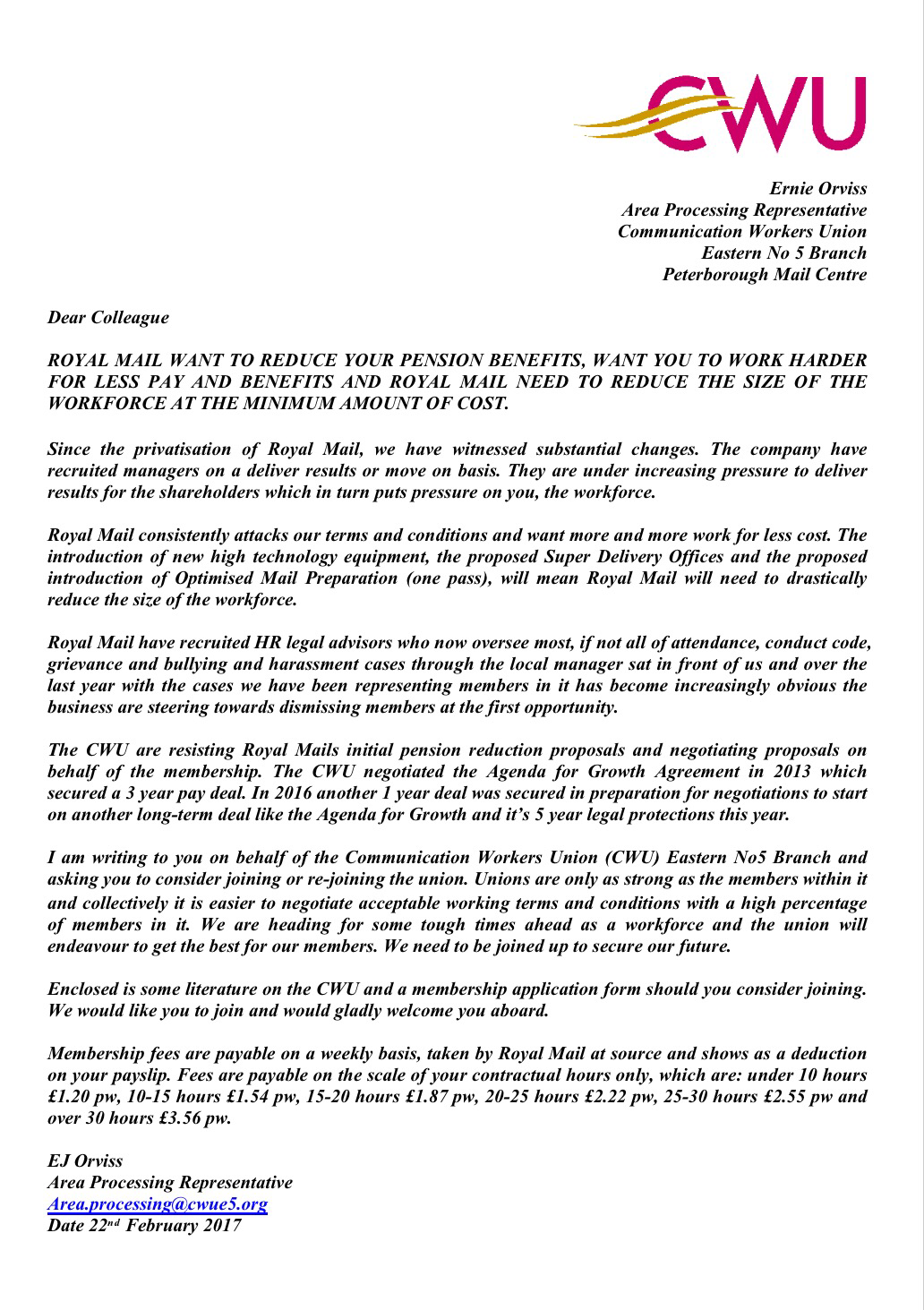
Today I have sent via the internal post the attached letter to all the processing non-members along with CWU literature and a membership application form. This will give the processing reps the opportunity to speak to the non-members on their shifts about the package and encourage them to join.
Latest from the Branch
Royal Mail – Mk 4 Parcel York Container Trial – Health, Safety, Ergonomic and Training Documentation & CWU ASR Involvement Joint Statement
Royal Mail – Mk 4 Parcel York Container Trial – Health, Safety, Ergonomic and Training Documentation & CWU ASR Involvement Joint Statement:
To: All Postal Branches, Local, Area and Divisional Representatives
All Area and Workplace Safety Representatives
Dear Colleagues,
History
The Health, Safety & Environment Department has been working with Royal Mail Logistics, the Material Handling Assets Team, the Containers Team and Manufacturers, along with input from the RM Principle Ergonomist, RM Engineering and the RM Safety Team since 2011 on the development of a new version Packet/Parcel York Container. This has been reported regularly via LTBs and at CWU Regional Health and Safety Forums and joint Royal Mail/ASRs events.
Over the years, as Branches and ASRs will know, the Health, Safety & Environment Department has been pressing Royal Mail to resolve problems around the safe movement, handling, transportation, loading, unloading of Packets/Small Parcels and Strapped Bundles in York Containers without the need for a sleeve (as used with the York Containers Mks 1, 2 & 3, first introduced in 1991) and the need to deal with the overuse and abuse of Cardboard Sleeves in Yorks.
Both sides recognised that there had been no fundamental change to the York Container design for 20 years and although the basic design was still sound, it was designed originally for Mail Bags and Letter Trays. The changing mail streams were now presenting more small parcels/packets and strapped bundles. Sleeves were originally introduced for the Amazon Contract but York sleeves present other problems and don’t deal with bundles which slide between Standard York Container bars and push out the Strapped front of the Mks 1, 2 & 3 York Containers causing Safety and Transportation problems.
A number of prototypes and solutions have been developed and considered over the years with some early prototypes looked at during 2011 and 2012. In April 2013 a competitive tender process sought to provide, “a roll container that is suitable for all mail types without the need for a separate sleeve.”
28 suppliers were invited to tender by RM.
10 responded, which through a series of evaluations, a shortlist was reduced to 7; then 4; then 2 (Hartwall and Hoza) which were close enough to the requirements to go further.
The Initial prototypes were evaluated in small scale trials against the specification and by frontline staff at an MC, and RDC, a DO, HWDC and EMA.
Robust feedback and suggestions from the evaluations were provided to the suppliers to enable them to improve their designs.
Final prototypes were received in April 2016, then evaluated by the RM project team in consultation with the CWU Health, Safety & Environment Department and a representative sample of the user population at Swindon MC.
This led to the selection of the Hartwall model as the preferred Container and it was called the Mk4 Parcel York Container and it was agreed to plan for an operational trial in early 2017.
Previous LTBs
Previous LTBs were issued by the Health, Safety & Environment Department with reference to the Mk4 Parcel York Container/Cardboard Sleeves; LTBs 1052/11, 143/2012, 916/12, 797/13, 393/14, 667/16. Several update reports on the Packet/Parcel York Container have been circulated via LTBs on Containerisation Safety, Cardboard Sleeves, ALP Sleeves, and Xmas Containerisation Strategy etc.
Joint Working Group
Following talks between the RM Containers Team and the Health, Safety & Environment Department, a Joint Working Group was established with all stakeholders involved to produce a trial programme, produce safety and ergonomics documentation, a training and information plan plus agree the trial format and a number of Offices in which to trial the Container in closed loops, including MC to MC, MC to DOs, plus a Distribution Centre and a Walk Bundling Centre and a Customer to trial/test the containers.
The Mk4 York Trial Containers
182 of the new type Mk4 Yorks have been produced and shipped to the UK and recently arrived at Swindon MC for the purpose of the trial. The idea now is to trial the concept with the small number of units (182) operating out of Swindon Mail Centre in a series of closed loop operations to different Office environments; i.e.MC to/from DOs/Hubs/MC plus test them in DC, WBC and Customer environments (POL Stores, Swindon, Customer selected).
The Mk4 Parcel York Container Description and Functionality:
The main difference between the Mk4 Parcel York Container and the Standard Mk’s 1,2 and 3 is that it is of solid sided construction with a solid, three section gate as opposed to the standard Polymer Base, Steel Cage type construction with a ‘Strapped’ open front as with the standard York Containers Mks 1,2 and 3. The Mk4 is of the same dimensions as standard Yorks and will nest with them. The Mk 4 Parcel York has an ‘integral’ adjustable two-height base, set up by the operating staff according to the use required and so will require Safety/SOP training. The base can be adjusted up or down and locked into place. Photographs of the Mk 4 York are included in the Safety Documentation attached to this LTB.
The MK 4 York is designed primarily to handle loose small parcels/packets/bundles and other loads not adequately retained by other Yorks as well as existing mail streams while being compatible with the current York container fleet. E.g. nestable with Mks 1, 2 and 3 and can be used for other mail steams if required to be used as a standard York Container. Additionally, the Parcels Automation programme is a more recent development, adding another dimension to the requirements of the new Container. This now requires a container which can be tipped, retaining its integrity when inverted, with efficient and safe evacuation of the load.
As described above, the raised base is manually adjustable when the container is empty. So, if the container is to be sent to a site with automatic tippers, the operator will place the base in the lower position; whereas if the container is to be sent to a site where it will be unloaded manually, then the base will be placed in the upper position, in order that the unloading operation can be completed in a safe and ergonomically acceptable manner. As well as making the container safe for manual small parcel operations, the upper position also offers a solution to the safe unloading of strapped bundles.
The Mk4 York is constructed of a UV stable material capable of withstanding sub-zero temperatures in normal operation, and will not deteriorate, fracture or break and can be left exposed to the elements for long periods of time.
The 200kg shelf offers improved ergonomic manual handling of strapped bundles in particular. The smooth interior allows contents to be tipped reliably with the base in either the raised or lowered position. The Mk4 has the same footprint as previous Mks 1, 2 and 3 generations of the York container. Vehicle operations and loading plans are not affected by the new Mk4 York in mixed or single type loads.
The new features are:
A Combined base and shelf for improved ergonomics when manually loading/emptying the unit.
A Solid polypropylene panelled construction to retain items.
Transparent viewing panels provide visibility inside the container from the front and back of unit.
A Lightweight 3 part door/gate which can be opened as a single piece or drop down panels to provide progressive access to the load space.
A Container that can be fork lifted and handled.
In all other respects the MK 4 York performs in a similar way to the existing York container fleet, specifically:
Brake handle
Steering and manoeuvring handles
Nesting configuration — a different arrangement for strapping when moving nested Yorks is described later
In summary the new York Mk4 Parcel Roll Container is designed as follows:-
Solid walls to retain parcels and strapped bundles
Smooth walls to allow for tipping
A three section gate that retains parcels and folds down to allow staged manual emptying
A 2-level adjustable base that can be deployed at a higher level for manual sortation
External dimensions are the same as the current York (compatible for vehicle loading)
Compatible with the current York for nesting
Ability to carry up to 21 trays if required (but not an efficient use of this asset)
A tip-able improved roll container that meets the requirements for parcel automation
Ability to tip effectively in the automated environment
Long life – Longer than an ALP Sleeve.
No need to fit and remove the ALP sleeve to this container
Reduces need to store and repatriate ALP sleeves
Reduced repair costs by reducing wear and tear maintenance on ALPs
Improved container fill in comparison with the ALP sleeve
Benefits for vehicle capacity and bullring operations
Unique barcode and suitable for potential future RFID tracking requirement
Trial Details
The trial will take place at Swindon Mail Centre, NHC Mail Centre, Oxford DO, Reading DO, SWDC and Swindon WBC. A basic overview of the trial is as follows:
Week 1: Generic type testing ; training of staff at all locations; plus WBC assessment
Week 2: Closed loop Oxford DO (CH) – Swindon MC – Oxford DO
Week 3: Closed loop Oxford DO (CH) – Swindon MC – Oxford DO; plus SWDC assessment
Week 4: Closed loop Oxford DO (CH) – Swindon MC – HCN NC – Swindon MC – Oxford DO
Week 5: Closed loop Oxford DO (CH) & Reading DO (CH) – Swindon MC – HCN NC – Swindon MC – Oxford DO & Reading DO; plus large customer (PO Stores) assessment
Week 6: Closed loop Oxford DO (CH) & Reading DO (CH) – Swindon MC – HCN NC – Swindon MC – Oxford DO & Reading DO
The trial will assess using the Mk4 York to tip mail onto the machine and receive mail from the machine at the sorter output chutes
The trial will also assess the impact of sorting to and from the Mk4 York in the manual sort process in DO and Mail Centre environments, including strapped bundles at SWDC.
The trial is scheduled to commence from 20 February 2017 and run until 31 March 2017.
Safety Documentation
To enable the trial to commence, detailed discussions have taken place of safety issues and required enabling documentation and the necessary safety documentation has now been produced. These documents have been initially reviewed and the Safe Systems of Work and Standard Operating Procedures have been developed prior to and ready for the start of the trial. These Safe Working Practices and procedures will be reviewed and updated as necessary during the trial and will be jointly evaluated on completion of the trial. Feedback will be gathered from ASRs, WSRs members and all stakeholders with the lessons learned being addressed via appropriate review risk control measures and Safety documents, Safe Systems of Work and Safety Training and Information documentation will be reviewed as required and updated. Once that is complete and the documentation is fit for purpose, final full concurrence for the Mk4 Parcel York Container will be signed-off. There will need to be a review of the Generic SSoW for York Containers V3 as well as the new Specific Mk4 York Container SSoW, to take account of the functionality of the Container and cross-references. Pending the outcome of the trial a new updated Generic York container SSoW will be produced to incorporate all versions of the York container including the Mk4.
Unit Managers operational instructions Briefing Pack & Safety Information Pack
All Trial Unit Managers will receive a Safety Information Pack and a separate operational instruction Briefing Pack. The purpose of the Managers’ Safety Information Pack is to assist Managers with general duties under the Health and Safety at Work act 1974 and relevant statutory legislation such as the Provision of Work Equipment Regulations (PUWER) 1998. The pack includes all the safety documentation that Managers require to discharge their responsibilities. The MK4 York Unit Manager Brief gives them an overview of the trial programme and the process to be followed should they have any problems with the containers. It also includes specific safety information for the user and is designed to be used as a flyer, hand-out or poster, pinned up on a notice board etc.
Documents Included are-
Safety Assessment & Concurrence (SAC1)
Work Equipment Change Safety Assessment (WECSA)
Ergonomic screening assessment
York and Mini York Generic Safe System of Work (SSoW) V3
York Container MK4 SSoW (additional requirements)
MK4 York training brief
Mk4 York Safety Inspection
Managers are instructed that before use arrangements must be made to carry out the 10 point safety checklist’ detailed in the York SSoW and carry out additional checks described in the MK4 SSoW (additional requirements) document.
Safe System of Work (SSoW)
The current Generic York SSoW (V3) is still relevant to using the MK4 Parcel York Container and Unit Managers have been instructed that this should be applied together with the contents of a Mk4 Parcel York (additional requirements) SSoW document that has been written specifically for the MK4 trial container. Pending the outcome of the trial a new updated SSoW will be produced to incorporate all versions of the York container.
Training Stipulation
Trainers are being trained this week at Swindon to deploy staff training from the trial start date. All staff taking part in the Proof of Concept Mk4 York Container Trial activity will be fully trained on the Standard Operating Procedure and SSOW. Untrained staff cannot operate the Mk4 Yorks.
Reporting M4 Parcel York Equipment Failures and Malfunctions and Feedback
All equipment malfunctions and faults must be reported. The unit manager will be given specific instructions on the steps to take and how to feedback information to the project team identifying the container concerned.
ASR involvement
ASRs with Offices in their Branch areas have been communicated with directly, briefed and updated. They will be fully involved and the ASRs have a very important role to play in monitoring the Trial from a health, safety and ergonomic perspective, feeding back on the Container’s performance in their Units, collating workforce comments and feedback and importantly on the question of the Safety documentation and the training and information given to members. ASRs can participate in the Training in their Offices and participate the WTLs sessions. A Royal Mail/CWU joint statement has been agreed on ASR involvement and input – copy attached.
Health, Safety and Ergonomic Evaluation Aspects of the Trial
In relation to the question on lifting and bending, i.e. the ergonomics of the equipment, this drives at the root of one of the key initial reasons for the Container’s development.
Firstly, the Parcel York, with its integral base overcomes the problem of Cardboard Sleeved Yorks without the Cross-Members and False Bases being inappropriately misused and abused when dispatched into the Network or inappropriately used for Packet/Parcel Transfers to DOs which causes excessive bending, stretching and lifting repetitively.
Secondly the Parcel York overcomes the problem of loads not well contained in Yorks e.g. strapped bundles which has become a major problem, sliding between the bars of Standard Yorks and bulging out the York Straps, causing breakages, jamming, entanglement and lost loads in vehicles plus the resultant safety and ergonomic problems when unloading the vehicles and subsequently unloading the Yorks. The gate that retains parcels folds down to allow staged manual emptying. From a Safety and Ergonomic view, the raised height base can be deployed at the higher level for manual unloading to enable improved working height for lifting and bending and therefore Lifting parcels, packets or bundles from the container will pose an Adequately Controlled – Moderate Manual Handling risk depending on the size and weight of the item and position in the container. Unloading the container may result in limited bending for items towards the bottom of the load but this will be minimised by deployment of the raised base for manual flows. The same as current cardboard sleeve Yorks with the cross-member and false base. Evaluation of these aspects are important – e.g. height and reach etc.
Thirdly, the Parcel York can be used specifically with parcels automation due to the Solid walls to retain parcels. It’s a tip-able container that meets the requirements for parcel automation, the ability to tip effectively in the automated environment and it has smooth walls rather than bars to allow for tipping efficiently.
The aim will be to make all three aspects work safely, healthily and successfully.
Conclusion
The trial will be formally reviewed by the Health, Safety & Environment Department and Project Team including the Containers Team and SHE Team in relation to health, safety and ergonomic considerations. The Postal Department will deal with all operational parcels automation and IR aspects. Any questions of interpretation, implementation, or application of the Trial should be referred to the appropriate Headquarters department. There will be a full joint review of the Safety Documentation at the end of the trial and the need to cross reference with the Generic York Containers SSoW as well finalising the new Specific Mk4 York Container SSoW, to take account of input including that from the ASRs. Based on the documents and concurrences provided, the Mk4 Parcel York Trial has been agreed with the following provisos:
That on completion of the trial, lessons learned are addressed via appropriate risk control measures and documents updated; and
That once the above is complete, there will be discussions in relation to a final safety concurrence for the Mk4 Parcel York, prior to national roll-out.
Attachments:-
Royal Mail Mk4 Parcel York Container Trial – CWU ASR Involvement Joint Statement
York Container Mk4 Additional Requirements SSoW (v1.2)
SAC1 York Container Mk4 Feb 2017 (v2)
WECSA York Container Mk4 Jan 2017 (v1.1)
Mk4 York Trial Plan
York and Mini York SSoW (v3)
Mk4 York Unit Manager Brief
Mk 4 York Training Brief
Yours sincerely
Dave Joyce
CWU National Health, Safety & Environment Officer
Email Attachments – Click to download
Attachment 1 – LTB103/17 Royal Mail – Mk 4 Parcel York Container Trial
Attachment 2 – Royal Mail – Mk 4 Parcel York Container Trial – CWU ASR Involvement JS s…
Attachment 3 – York Container Mk 4 additional requirements SSoW v1.2
Attachment 4 – SAC1 York Container Mk 4 Feb 2017 v2
Attachment 5 – WECSA York Container MK4 Jan 2017 V 1.1
Attachment 6 – 20170222-MK4 York Trial Plan v1-4
Attachment 7 – York and Mini-York Safe System Of Work v3.0
Wheel Sentry” – Combined Wheel Nut Indicator and Retainer System Trial on 7.5t Royal Mail Fleet
Wheel Sentry” – Combined Wheel Nut Indicator and Retainer System Trial on 7.5t Royal Mail Fleet:
To: All Branches
Dear Colleagues,
Following 6 incidents of Road Wheel detachments on 7.5t Royal Mail vehicles in 2016, Royal Mail Fleet have been looking at various solutions to help protect the fleet against wheel loss on the road. Please see attached information on the ‘Wheel Sentry’ product which Royal Mail Fleet want to trial on the 7.5t vehicles based at Nottingham MC. Fortunately none of the 6 incidents led to a major catastrophic road accident but it could of course have been very different.
Proper wheel care is needed to prevent accidents, damage, injuries and fatalities as a result of wheel loss, as well as Police prosecutions and VOSA prohibitions, vehicle downtime and costly repairs. Loose wheel nut indicators are small pointed tags, usually made of fluorescent orange, yellow or green plastic, which are fixed to the lug nuts of the wheels of large vehicles. The tag rotates with the nut, and if the nut becomes loose, the point of the tag shifts noticeably out of alignment with the other tags. If too many lug nuts are loosened, the wheel can detach from the wheel stud. Loose wheel nut indicators allow identification of loose nuts before this can occur. Although not compulsory most road safety organisations and bodies recommend their use especially on large or heavy goods vehicles, buses coaches, large vans, trucks etc. They are used extensively by the transport industry as an enhancement and development of fleet safety and roadworthiness procedures, daily walk-round inspection and defect reporting and scheduled maintenance requirements. Its use allows accurate monitoring for loose wheel nuts and helps prevent wheel hub damage or the loss of a road wheel should a wheel nut loosen. The current Royal Mail policy is that all vehicles exceeding 3.5t GVW and all trailers must have a full set of Yellow Wheel Nut Indicators fitted.
The “Wheel Sentry” product goes a step further than standard wheel nut indicators or wheel nut locking clips as it’s a itwo-in-one solution which both indicates and retains loosened wheel nuts. It is a combined Wheel Nut Indicator and Wheel Nut Retainer which provides prompt indication of any potential wheel detachment problems and makes wheel checks easy. It retains the wheel nuts in place on the studs, should they become loose, until the nuts can be re-torqued (tightened) and the clamping force restored.
This innovative product consists of bright green combined wheel nut covers and indicators, when fitted to the wheel nuts of a HGVs, LGVs or trailers which are then linked together with a Viton band that allows wheel nuts to loosen slightly, but then holds them in place at a lower torque level until the nuts are tightened. On a driver’s daily check the new position of the Wheel Sentry on a loosened wheel nut is clearly visible and ensures it receives prompt attention.
Royal Mail Fleet are of the view that this unique wheel nut indicator and retaining system will both complement and enhance existing procedures, to ensure the safe and efficient supply of goods and services with 100% confidence and zero wheel loss. The ‘Wheel Sentry’ manufacturers offer extensive operational back up and carefully monitored stock levels to ensure ease of ordering and continuity of supply.
The product will now be trialled on a fleet of ten 7.5t vehicles operating out of Nottingham Mail Centre and the Health, Safety and Environment Department has held meetings with the manufacturers and Royal Mail Fleet Engineers and has visited Nottingham to speak to Drivers, Workshop Fleet Maintenance staff and local CWU Reps who are all supportive of the trial.
The ten 7.5t Nottingham vehicles fitted with the Wheel Sentry Components are listed as follows:-
Number
Serial No.
Reg No
1
6610149
NG606
2
3610670
NG611
3
3611159
NG604
4
3610668
NG603
5
3610666
NG612
6
3611123
NG610
7
3611118
NG625
8
3610665
NG614
9
3610669
NG616
10
3610667
NG608
There will be an initial three months review on site and further reports to Branches and Area Safety Reps in due course.
See attached:-
Wheel Sentry Leaflet ‘How It Works’ 5 Step Instructions.
Wheel Sentry Leaflet ‘What You Can Put In Place To Remove The Risk Of Wheel Detachment.’
Further reports will be made on Trial completion.
Yours sincerely
Dave Joyce
National Health, Safety & Environment Officer
Email Attachments – Click to download
Attachment 1 – LTB101/17 “Wheel Sentry” – Combined Wheel Nut Indicator and Retainer System Trial on 7.5t Royal Mail Fleet
Parcelforce Worldwide – Safety Climate Survey of Selected Depots (LDs)
To: All Branches with Postal Members
Dear Colleagues,
RMG SHE Standard 17.03 is the Standard for Safety Climate Surveys.
The CWU Health, Safety & Environment Department is supporting a Safety Climate Survey initiative in PFWW using the SHE Standard 17.03 Survey in a number of depots. Members will receive a joint covering letter and a short 18 Question form to complete and the process is now underway.
The Safety Climate Survey is being carried out with the full involvement and consultation of CWU ASRs regarding depots in their respective constituency areas and the aim is to jointly support the maximum participation of our members. Our intention is to see the survey carried out across all Depots eventually to ensure that any potentially high-risk depots and those with poor safety management are not omitted and overlooked.
Members Participation in this survey is voluntary, the questionnaire will be anonymous and any information given in the questionnaire will be handled in the strictest confidence. Managers will provide members with time needed to complete the Safety Climate Survey and once completed, the forms will be returned to the manager and forwarded to the Safety Health and Environment Team for collation, analysis and report back to the Unions, Safety Reps, Depots and Managers. There will be no detriment to any employee who participates or who does not wish to participate in the survey. Members needing help in completing the survey or would like further information or support can either contact their line manager or their CWU Area Safety Representative who’s details are listed in the covering/introductory joint PFWW/CWU/Unite.CMA Letter, as follows:-
CWU ASR North – Paul Devlin T: 07793762458
CWU ASR Midlands – Matthew Burchnall T: 07742095598
CWU ASR South East – Nicola Wilmer T: 07876898793
CWU ASR South West David Manley T: 07767 405 596
Measuring the Safety Climate in a Unit/Workplace provides feedback as to how the workforce feel about Safety where they work at a particular point in time and enables the identification of improvement opportunities. Repeating surveys at regular intervals can then subsequently provide feedback as to the impact of any actions and activity to improve workplace safety. Members are encouraged to participate and will enable Parcelforce Worldwide and the CWU to jointly understand the current Safety Climate and members views and input in order to help with future improvements in Safety in PFW.
The aspiration is to get the completed surveys returned and collated before the April PFWW/CWU/Unite.CMA Joint National Operations Safety Committee. A further report will be made to Branches via LTBs.
Attachments:
RMG Safety Health & Environment (SHE) Standard 17.3 ‘Safety Climate Surveys’
Survey Participating form
Draft Survey Form
Covering Letter to Members inviting participation in the Survey.
Yours sincerely
Dave Joyce
National Health, Safety & Environment Officer
Email Attachments – Click to download
•RMG Safety Health & Environment (SHE) Standard 17.3 ‘Safety Climate Surveys’
LTB 100/07 Parcelforce Worldwide – Safety Climate Survey of Selected Depots (LDs)
Seven Health Checks Men Must Do
Seven Health Checks Men Must Do:
Men are notoriously bad at looking after No.1, averaging just four trips to their GP a year, while women average six.
As men are less likely to access disease screening and healthy-living initiatives, it is no surprise they are twice as likely as women to die before they turn 75.
But here are seven quick checks for men.
1. BOWEL CANCER
WHY? The third most prevalent cancer in men, with more than18,000 new cases each year.
SYMPTOMS: Blood or mucous in your stools, changes in bowel habits (diarrhoea, constipation or both) which last more than six weeks, still needing the toilet after going, stomach cramps or tenderness and weight loss.
THE TEST: Check symptoms with GP, who will give you a rectal exam and ask for a sample. They may refer you for hospital tests – perhaps an X-ray and colonoscopy (tube into your bottom to check bowel). The NHS is rolling out national bowel-cancer screening for over 60s.
WHERE TO GO: Your GP.
HOW OFTEN? If there is a family history of bowel cancer, get checked every two years.
2. TESTICULAR CANCER
WHY? The most common cancer in men under 35, with around 2,000 cases diagnosed every year.
SYMPTOMS: Check for swelling or pea-sized, hard lumps on the front or side of the testicles. A dull ache or sharp pain in this area? See your GP.
THE TEST: The GP could send you for a painless ultrasound scan on both testicles and often a blood test to identify raised levels of certain hormones.
WHERE TO GO: Your GP who will refer you to a hospital specialist if necessary.
HOW OFTEN? Cancer Research UK recommends examining the testicles once a month to spot changes.
3. BLOOD PRESSURE
WHY? Persistent, untreated high blood pressure can lead to heart disease, strokes and kidney disease.
SYMPTOMS: High blood pressure usually causes no symptoms, so the only way to know is to get checked.
THE TEST: Using an arm pump, your GP takes a pressure measurement of two numbers. Blood pressure readings have two numbers, for example 140/90mmHg. The top number is your systolic blood pressure (the highest pressure when your heart beats and pushes the blood round your body). The bottom one is your diastolic blood pressure (the lowest pressure when your heart relaxes between beats).
• 90 over 60 (90/60) or less: You may have low blood pressure.
• More than 90 over 60 (90/60) and less than 120 over 80 (120/80): Your blood pressure reading is ideal and healthy. Follow a healthy lifestyle to keep it at this level.
• More than 120 over 80 and less than 140 over 90 (120/80-140/90): You have a normal blood pressure reading but it is a little higher than it should be, and you should try to lower it. Make healthy changes to your lifestyle.
• 140 over 90 (140/90) or higher (over a number of weeks): You may have high blood pressure (hypertension). Change your lifestyle – see your doctor or nurse and take any medicines they may give you.
Persistent high blood pressure can increase your risk of a number of serious and potentially life-threatening conditions. Because the risk of heart attack and stroke goes up as a person’s blood pressure rises, it is best to try to lower your blood pressure as even a small amount can help lower the risk. Someone with high blood pressure is twice as likely to have a heart attack or stroke in the future as someone with normal blood pressure so, the lower you can get your blood pressure, the better.
WHERE TO GO: Your GP and some pharmacies.
HOW OFTEN? Every three years, yearly if it is high or someone in your family has high blood pressure.
4. EYES
WHY? Glaucoma, which causes increased pressure in the eye is more common in men and if left untreated can lead to blindness. If you have diabetes, a high level of short sightedness or migraines, you are at higher risk.
SYMPTOMS: The build-up in pressure is very slow, so visual loss is gradual.
THE TEST: An ophthalmologist will examine your eyes using a special machine. It takes just a few minutes.
WHERE TO GO: Your local optician.
HOW OFTEN? Men over 40 should get an annual eye check.
5. PROSTATE CANCER
WHY? It is the most commonly found cancer in all men, with 35,000 new cases each year.
SYMPTOMS: Difficulty in passing urine, needing to go more frequently and a feeling of not emptying the bladder. Also: pain in the back, hips or pelvis, impotence and, very rarely, blood in the urine or semen.
THE TEST: Your GP will do a rectal exam, a blood test for raised hormones and possibly refer you for a biopsy.
WHERE TO GO: Your GP.
HOW OFTEN? Cancer charities recommend that men over 50 get themselves checked once a year.
6. DIABETES
WHY? There are about two million people who have Type 2 Diabetes and up to half a million more may have it without realising. Men are at higher risk.
SYMPTOMS: Constant thirst, passing large amounts of urine, tiredness and weight loss. But sometimes there are no obvious symptoms.
THE TEST: Your GP can do a simple glucose blood test.
WHERE TO GO: Your GP.
HOW OFTEN? If you are over 40, overweight or have a family history of diabetes, get checked once a year.
7. CHOLESTEROL
WHY? High cholesterol can lead to heart disease.
SYMPTOMS: There are no symptoms as such, but if you eat a diet high in saturated fat, are overweight or have a family history of heart disease, you need to be checked.
THE TEST: A blood sample, taken after fasting, is used to measure cholesterol levels.
WHERE TO GO: Your GP and some high street pharmacies will test cholesterol.
HOW OFTEN? Yearly if you have high cholesterol or it runs in the family.
Yours sincerely
Dave Joyce
National Health, Safety & Environment Officer
Email Attachments – Click to download
Attachment 1 – LTB099/17 Seven Health Checks Men Must Do:
Royal Mail Group Safety Health & Environment Team/CWU/Unite CMA ‘Fixed Focus & Grow’ (FFG) (Events/Meetings For Logistics & Commercial ASRs (Including Logistics, Fleet, Engineering, International, PFWW, RMSS etc)
Royal Mail Group Safety Health & Environment Team/CWU/Unite CMA ‘Fixed Focus & Grow’ (FFG) (Events/Meetings For Logistics & Commercial ASRs (Including Logistics, Fleet, Engineering, International, PFWW, RMSS etc):
To: All Branches
Dear Colleagues,
Following discussions with Dr. Shaun Davis RMG Global Director of Safety, Health, Wellbeing & Sustainability, Stuart Harrison PFW/RMSS Head of Safety and Lisa Durrant Logistics Head of Safety, regarding the above it has been agreed not to run separate FFG events for these occupational groups but instead invite all ASRs to the three Regional events on 7th, 8th and 9th March 2017. The decision has been based on the small numbers of ASRs involved in some of the above groups and the fact that there will be a number of ‘Group Wide’ presentations that are of common interest to all concerned. Therefore over 100 CWU ASRs are invited to attend one of the three Regional Events.
Additionally, RMG and the CWU Health, Safety & Environment Department are finalising amendments to RMG SHE Standard 5.1 (Health and Safety Committee) to include the changes and additions which will improve and extend Health and Safety Committees and ASR involvement and consultation.
We have therefore agreed to provisionally make the change on this occasion, subject to review and feedback from ASRs. The option to revert back to additional/separate functional FFG events for the above groups remains open if ASR feedback is such that the separate, additional events are required and justified. Dr. Shaun Davis has made this change on the proviso that Commercial and/or Logistics based CWU ASRs do not feel they have been detrimentally treated. Any feedback is welcomed therefore.
In conclusion all CWU ASRs from Logistics, Fleet, Engineering, International, PFWW/RMSS are invited to attend one of the FFG Regional events, nearest to their base/of their choice.
Yours sincerely
Dave Joyce
National Health, Safety & Environment Officer
Email Attachments – Click to download
Attachment 1 – LTB097/17 Royal Mail Group Safety Health & Environment Team/CWU/Unite CMA ‘Fixed Focus & Grow’ (FFG)(Events/Meetings For Logistics & Commercial ASRs (Including Logistics, Fleet, Engineering, International, PFWW, RMSS etc)
CWU RE-DESIGN PROJECT – NATIONAL BRIEFING 23RD MARCH 2017
The purpose of this LTB is to advise Branches that we will be holding a National Briefing on the 23rd March to provide a comprehensive update on the CWU Re-design Project.
The Briefing will take place at the Midland Hotel, 16 Peter St, Manchester, M60 2DS and will commence at 11.00 hrs and finish no later than 14.00 hrs.
As reported previously, the CWU faces major financial and organisational pressures, which if unchecked threaten our very future as an independent trade union. The reality is the Re-design Project is the most important debate we have ever had about the future of our organisation and it is therefore essential that all CWU Branches are in attendance.
The subject of re-design and the challenges facing the union do warrant a separate briefing in advance of Conference and this will enable a more informed debate than our Conference schedule allows.
The Briefing will give us the opportunity to reinforce the case for major change within the organisation and set out a positive direction for re-design to put CWU at the forefront of activism and the UK trade union movement. Furthermore, we will explain the work we have undertaken to date at CWU Headquarters and outline our next steps, including the approach to all structures outside of Headquarters.
Entitlements to attend the Briefing are on the basis of two representatives per Branch, Senior Field Officials, National Team Members and NEC and Industrial Executive members.
Finally, to facilitate a constructive session we will be circulating a full report on the Re-design Project and the agenda for the day, in advance of the Briefing.
Any enquiries on the above LTB should be addressed to the General Secretary gsoffice@cwu.org.
Yours sincerely
Dave Ward Tony Kearns
General Secretary Senior Deputy General Secretary
Email Attachments – Click to download
LTB 095/17 – CWU RE-DESIGN PROJECT – NATIONAL BRIEFING 23RD MARCH 2017
Video Recording for CWU Branches
Dear Colleagues,
Following the successful decision to bring our video operation in-house, we are now in a position to offer this service to CWU Branches.
The studio, located at CWU HQ, can be booked by Branches alongside our equipment and the use of the team in the Communications department. We would encourage Branches to use the facility for any activity which will support you locally.
Additionally, Branches can, in some circumstances, request for the filming to take place locally. This would have to be agreed directly with myself.
Anyone wishing to book a slot or have a preliminary discussion should contact Marcia Murray mmurray@cwu.org
With over 500,000 views on our videos in the last 6 months, this has proven to be an effective form of communication with the membership. This is a great opportunity to grow that reach and creativity beyond CWU HQ.
Kind regards
Chris Webb
Head of Communications, Engagement & Media
Email Attachments – Click to download
LTB 093/17 – Video Recording for CWU Branches
CWU Conference – Bournemouth – 23rd – 27th April 2017
Crèche Facilities
We shall be making arrangements for the provision of crèche facilities at this year’s Annual Conference in Bournemouth.
If any member of your delegation would like to use these facilities they should contact Angela Niven on conferences@cwu.org for a crèche registration form as soon as possible and no later than Thursday 16th March 2017.
We require this information as early as possible to ensure that arrangements can be made to provide the correct number of staff to look after the children.
Procedures for Considering Requests for Bucket Collections
All requests for bucket collections to be taken during Annual Conference shall normally be submitted in writing to the General Secretary. Such written requests should include background material/information/full details on the organisation for which the collection is to be made. The officer to the General Conference SOC will be advised accordingly and will then make arrangements for the Union’s stewards to take such collections. The monies so collected will be counted by the Senior Deputy General Secretary’s Department and a cheque made out to the appropriate bodies.
The number of bucket collections to be taken during Annual Conference will only exceptionally exceed two.
Distribution of Documents at General Conference
All requests for the distribution of documents on delegates’ seats shall, in the first instance, be referred in writing to the General Conference SOC, together with a copy of the document(s) concerned, for consideration. Please send any requests to conferences@cwu.org
Any documents that have been agreed for distribution on delegates’ seats at General conference shall be delivered to the General Conference Administration office by no later than 5pm on the day prior to distribution.
Branches are reminded of the facility of the Conference Guide to publicise meetings and other events.
Seating at General Conference
If any member of your delegation requires an end seat due to special needs/disability they should contact Angela Niven on conferences@cwu.org as soon as possible stating the reason and no later than Thursday 16th March 2017.
Any queries regarding this Letter to Branches should be addressed to Angela Niven on 020 8971 7256 or by email to conferences@cwu.org
Yours sincerely,
A P Kearns
Senior Deputy General Secretary
Email Attachments – Click to download
LTB 091/17 – CWU Conference – Bournemouth – 23rd – 27th April 2017
Motion 139 (2015) – Royal Mail Managers Bonus Payments Linked to Accident on Duty Statistics
Motion 139 (2015) – Royal Mail Managers Bonus Payments Linked to Accident on Duty Statistics:
To: All Branches
Dear Colleagues,
Motion 139 was carried overwhelmingly at the 2015 CWU Postal Conference and this LTB is to update Branches on the discussions with Royal Mail that have taken place since then and the present Managers’ Bonus Arrangements.
The payment of bonuses to operational managers linked to reductions in accidents on duty is an issue the Health, Safety and Environment Department, along with CWU Health and Safety Reps across the country have universally condemned and have been opposed to for several years.
Managers’ Union Unite/CMA also do not support such bonus arrangements and in discussions with our Unite/CMA National Representative Colleagues, they confirmed that this was introduced without their agreement.
CWU opposition to such bonus payments have been voiced at every opportunity, including in past face to face meetings with the Royal Mail Chief Operating Officer, Director of HR and Chief of Staff.
The reason for CWU opposition to such payments is quite obvious. It encourages managers not to report accidents and at the same time encourages managers to discourage our members from reporting accidents. As a result, under reporting of accidents had become endemic in recent years and we have done everything in our power to campaign against and counter the under reporting of accidents. This is a subject that has been debated several times at CWU Conference.
Our actions have included negotiating national agreements on accident notification, investigation and reporting of accidents with full involvement of CWU ASRs.
Following the carriage of Motion 139, the matter was raised again recently with Dr. Shaun Davis, Royal Mail Group Global Director of Safety, Health, Wellbeing and Sustainability in order to put across our Conference Policy and to establish the current position.
For this current year, I am pleased to report that Mr. Davis has confirmed that Royal Mail Group works on a Corporate Key Performance Indicator (KPI) Scorecard for Managers that looks across ten measures and which has Safety as one of those measures. The Corporate Scorecard covers all levels of managers in Royal Mail Group and together all ten measures are ‘bonused’ on delivering Royal Mail Group Performance Targets.
The current measure used for Safety performance is now ‘Road Traffic Collisions’ and this was changed from the previous ‘Lost Time Accident Frequency Rate’ last year to facilitate improvements in the key area of Road Safety and Road Traffic Collision reductions.
The annual performance improvement target for RTCs is a 7% improvement with a stretch target of a 12% improvement. Progress is monitored monthly. The primary objective is to improve driver performance and behaviour.
The above is based on the explanation and information Dr. Shaun Davis kindly provided to me.
RTC reductions is not a particularly good measure to make ‘bonus worthy’, however, it is far better than the previous ‘Lost Time Accidents’ ‘bonus worthy’ targets as clearly it is far more difficult, if not impossible in many cases, to not report or under report road traffic collisions for many obvious reasons.
Motion 139 (2015) is therefore discharged.
I trust this information answers enquiries received by CWU/HQ fully.
See attached the RMG 2016-17 Corporate Score Card.
Yours sincerely
Dave Joyce
National Health, Safety & Environment Officer
Email Attachments – Click to download
Attachment 1 – LTB090/17 Motion 139 (2015) – Royal Mail Managers Bonus Payments Linked to Accident on Duty Statistics: