Latest from the Branch

POST OFFICE: THE CASE FOR A POST BANK – PUBLICATION OF CASS REPORT

POST OFFICE: THE CASE FOR A POST BANK – PUBLICATION OF CASS REPORT

Branches and members will be aware that one of the Union’s key policies to ensure a long- term sustainable Post Office for the future is the creation of a Post Bank wholly owned by the Post Office. Indeed this concept has been extremely successful in other countries, most notably in France with La Banque Postale and in Italy with Poste Italiane.

The Post Office already has a commercial arrangement with the Bank of Ireland (which we understand is due to expire in 2023) for the provision of certain financial services products including mortgages. However, this arrangement falls considerably short of a Post Office owned Post Bank and is a poor substitute with profits being shared with the Bank of Ireland (which has no outlets in the UK). Whilst this model may have been of some benefit initially, it is now with the passage of time, outdated and needs replacing with a much more robust and ambitious Post Bank that can better serve the wider community including Small and Medium Enterprises (SMEs).

As a consequence of our policy, with the aim of influencing government, earlier this year we commissioned the Centre for Banking Research, Cass Business School, City University of London, to write an independent report making the case for establishing a Post Bank. We view the publication of this important report as central to re-launching our discussions with the Post Office and the government about securing the future of the Post Office.

The comprehensive report (attached to this LTB for your information) has been published today, in time for the TUC and political party conferences, in order to ensure maximum impact.

The following extract is taken from the Cass Report’s Executive Summary:

“Our recommendation is that the partnership with the Bank of Ireland should be ended, for two key reasons:

1 Due to the persistent negative legacy from the financial crisis and further current challenges, the Bank of Ireland is unlikely to invest substantially in the partnership in the near future.

2 In more general terms, a partnership model with a large private bank for the provision of postal financial services leaves the Post Office’s ambitions for growth dependent on the fortunes of the partner.

We advise that the Post Office acquires the Bank of Ireland UK portfolio (or part thereof), thereby retaining all the customers that have acquired products and services white-labelled via Post Office Money. This strategy would alleviate


previous concerns that it would be difficult to gain market share in a very competitive market. This would also allow the Post Office to capitalise on existing skills and expertise.

We recommend that the Post Bank be set up as a subsidiary, with a separate management team. This would facilitate the newly established entity application for a banking licence to the Prudential Regulation Authority (PRA) and Financial Conduct Authority (FCA). It would also help ease the government concern that a Post Bank would introduce risk to the Post Office’s balance sheet, as the new entity would be endowed with its own capital.

We estimate that the initial equity should be in the region of £2 billion. This amount of equity would be sufficient, for example, to allow the Post Bank to acquire the Bank of Ireland UK portfolio. While we discuss different alternatives to raise this initial capital, the amount equates to the investment the government has put into the Post Office in the past seven years. We estimate that the profits the Post Bank would generate would eliminate the need for an ongoing annual subsidy for the Post Office and put it on a sustainable footing for the future. Furthermore, the current macroeconomic conditions are ideal to raise the initial capital, due to the low interest rates environment.

Government Consultation and Funding

Branches will be aware that the government undertook a consultation exercise on the Post Office network which closed just before Christmas last year. As it stands, the government hasn’t published a response to the consultation. In the Union’s submission to the consultation, we stated the following in respect of establishing a Post Bank:

“The Post Office has a highly trusted brand and a more extensive network than all of the banks and building societies in this country put together. This should be the foundation for a positive vision of a service that could have huge economic and social value to the country….

… A Post Bank would be a growth engine for the Post Office and a crucial service for businesses and individuals as banks continue to close branches across the country…

… A Post Bank could help to address financial exclusion which is a serious problem in the UK, with estimates that 1.5 million people do not have access to a bank account. It could offer affordable, responsible deals on personal loans, helping to tackle the problem of payday lenders that charge huge annualised interest rates of over 1000%. Like La Banque Postale, it could also offer financing for much needed social housing projects and we believe lending to and supporting socially useful projects would be a unique selling point for a Post Bank…

… Establishing a Post Bank would make the Post Office a lender in its own right rather than a credit broker, giving it much greater potential to grow its customer base and generate revenue. This will require capitalisation through public funding, but all the evidence from state owned post banks overseas shows that this would be an extremely worthwhile public investment…”

The statements above have been substantiated by the Cass report which in fact builds upon these important themes.

We are given to understand the government is planning to make an announcement with regards to the future funding package for the Post Office, and this is most likely to be just prior

to or during the Tory Party Conference. Presumably, any announcement surrounding future funding will also respond to last year’s consultation. We have sent a copy of the Cass report to Margot James, Parliamentary Under-Secretary (Department for Business, Energy and Industrial Strategy) and this places us ahead of any government announcement. Naturally we will be promoting the report to government with the aim of shaping the debate and narrative around the future of the Post Office and integral to this is the creation of a Post Bank.

Media & Press Coverage

Attached is a joint press release from Cass and ourselves that includes quotes from Dave Ward, General Secretary. We are very pleased with the joint press release as the two organisations together give this report gravitas and the quotes are extremely powerful so hopefully we will in the coming days see quite a lot of press coverage on this issue. An article was also published in the Guardian this morning which can be viewed by using the following link:

https://www.theguardian.com/business/2017/sep/07/government-should-cut-bank-of-ireland- out-of-post-office-bank-says-report

We have also provided a copy of the report to Paula Vennells, Post Office Chief Executive, and will be encouraging the Post Office to support the overall concept and philosophy being advanced within. We will of course be writing to our Post Office members at their home addresses to update them about this important report and our ambition to promote a viable and sustainable Post Office of the future via a Post Bank.

Further developments will be reported. Yours sincerely

Dave Ward                                       Terry  Pullinger                                      Andy Furey

General Secretary                         DGS(P)                                                       Assistant Secretary


LTB486-17 Post Office – The case for a Post Bank – Publication of Cass Report

Attachment 1 to LTB486-17 – FINAL REPORT 070917 Making the case for a Post Bank

Attachment 2 to LTB486-17 – FINAL PR 070917 New state-owned Post Bank would ensure Post Office longevity

World Suicide Prevention Day Sunday, 10 September 2017 – ‘Take a Minute, Change a Life.

World Suicide Prevention Day Sunday, 10 September 2017 – ‘Take a Minute, Change a Life.’

To:  All Branches


Dear Colleagues,


The World Health Organization (WHO) estimates that over 800,000 people die by suicide each year – that’s one person every 40 seconds. Up to 25 times as many again make a suicide attempt. Behind these statistics are the individual stories of those who have, for many different reasons, questioned the value of their own lives. Additionally, the tragic ripple effect means that there are many, many more people who have been bereaved by suicide or have been close to someone who has tried to take his or her own life. And this is happening in spite of the fact that suicide is preventable.


‘Take a Minute, Change a Life.’ is the theme of the 2017 World Suicide Prevention Day. These words are at the heart of suicide prevention.


Each one of these individuals is part of a community. Some may be well linked in to this community and their workplace and Union Branch, and they’ll have a network of family, friends and work colleagues or school mates. Others may be less well connected, and some may be quite isolated. Regardless of the circumstances, communities, workmates, first aiders and Union Reps for example have an important role to play in helping support those who are vulnerable.

This sentiment is reflected in the theme of the 2017 World Suicide Prevention Day: ‘Take a minute, change a life.’ As members of communities, it is our responsibility to look out for those who may be struggling, check in with them, and encourage them to tell their story in their own way and at their own pace. Offering a gentle word of support and listening in a non-judgemental way can make all the difference.


Taking a minute can change a life
People who have lived through a suicide attempt have much to teach us about how the words and actions of others are important. They often talk movingly about reaching the point where they could see no alternative but to take their own life, and about the days, hours and minutes leading up to this. They often describe realising that they did not want to die but instead wanted someone to intervene and stop them. Many say that they actively sought someone who would sense their despair and ask them whether they were okay.

Sometimes they say that they made a pact with themselves that if someone did ask if they were okay, they would tell them everything and allow them to intervene. Sadly, they often reflect that no one asked.

The individuals telling these stories are inspirational. Many of them recount reaching the point where they did try to take their own lives, and tell about coming through it. Many of them are now working as advocates for suicide prevention. Almost universally, they say that if someone had taken a minute, the trajectory that they were on could have been interrupted.

Life is precious and sometimes precarious. Taking a minute to reach out to someone – a complete stranger or close family member, a friend or work colleague – can change the course of their life.

No one has to have all the answers

People are often reluctant to intervene, even if they are quite concerned about someone. There are many reasons for this, not least that they fear they will not know what to say. It is important to remember, however, that there is no hard and fast formula. Individuals who have come through an episode of severe suicidal thinking often say that they were not looking for specific advice, but that compassion and empathy from others helped to turn things around for them and point them towards recovery.

Another factor that deters people from starting the conversation is that they worry that they may make the situation worse. Again, this hesitation is understandable; broaching the topic of suicide is difficult and there is a myth that talking about suicide with someone can put the idea into their head or trigger the act.

The evidence suggests that this is not the case. Being caring and listening with a non-judgemental ear are far more likely to reduce distress than exacerbate it.

Resources available

There are various well-established resources that are designed to equip people to communicate effectively with those who might be vulnerable to suicide. Mental Health First Aid, for example, is premised on the idea that many people know what to do if they encounter someone who has had a physical health emergency, like a heart attack (dial an ambulance, administer cardiopulmonary resuscitation), but feel out of their depth if they are faced with someone experiencing a mental or emotional crisis. Mental Health First Aid teaches a range of skills, including how to provide initial support to someone in these circumstances. There are numerous other examples too; relevant resources can be found on the websites of the International Association for Suicide Prevention (https://www.iasp.info/resources) and the World Health Organization (http://www.who.int).

Mental Health First Aid Training
The CWU Health, Safety & Environment Department has been raising awareness and promoting Mental Health First Aid Training for CWU Reps since the Courses became available in the UK and would continue to encourage CWU Reps to attend the 2-Day Course. See LTB177/17 ‘Mental Health First Aid (MHFA) Training Courses (2-Day)’ for further information.


World Suicide Prevention Day

However, it’s not just for one day! World Suicide Prevention Day is the annual focal point and efforts need to continue all year round on the theme ‘Take a Minute, Change a Life and the resources and information available will allow Health and Safety Reps, Branches, Health and Safety Forums, Joint Health and Safety Committees etc., to organise and run their own local awareness raising initiatives.


Please see attached:-

• WHO Fact Sheet on Suicide 2017

• IASP Suicide Toolkit 2017

• SAMARITANS – Suicide Statistics Report


Please Visit:-

• The International Association of Suicide Prevention Website at: iasp.info/wspd

• The Official World Suicide Prevention Day Facebook Event Page at: who.int/mediacentre/factsheets/fs398/en/

• The SAMARITANS Website: samaritans.org/


Join in on World Suicide Prevention Day

2017 marks the 15th World Suicide Prevention Day. The day was first recognised in 2003, as an initiative of the International Association for Suicide Prevention and endorsed by the World Health Organization. World Suicide Prevention Day takes place each year on September 10.

On September 10, you can join with others around the world who are working towards the common goal of preventing suicide. Show your support by raising awareness through workplace, branch, regional, area or community action. You can find out what local activities have been scheduled or initiate activities yourself!

Finally, if there is anyone you are concerned about, take a minute to check in with them. It could change their life.

Those interested can also participate in the World Suicide Prevention Day – Cycle Around the Globe event. More information is at:- https://goo.gl/DFZCE3

Yours sincerely


Dave Joyce

National Health, Safety & Environment Officer

17LTB480 World Suicide Prevention Day Sunday, 10 September 2017 – ‘Take a Minute, Change a Life.’

ISPA Toolkit 2017

Suicide Fact Sheet 2017

Suicide Statistics Report 2017

Launch of organ Donation Week 4-10 September – Hundreds of Transplants Missed Each Year Because Families Don’t Know What The Deceased Relative Wanted  

Launch of organ Donation Week 4-10 September – Hundreds of Transplants Missed Each Year Because Families Don’t Know What The Deceased Relative Wanted


To: All Branches

Dear Colleagues,

Further to LTB473/17, which contained details of the launch of Organ Donation Week and once again the CWU is proud to be supporting the week, in line with CWU Conference Policy and we are urging all Branches, Regions, Reps and Members to give their support to the week by raising awareness and urging members to talk about it to their families, sign-up and carry a donor card.

More than three families a week are saying no to organ donation because they didn’t know what their relative wanted.

This means around 460 lifesaving organ transplants are being missed each year.

Left with the burden of making a decision for someone they love, the families decide it is safer to say no.

NHS Blood and Transplant (NHSBT) has revealed the figure today, to mark the launch of the 2017 Organ Donation Week (September 4 to 10) and is urging people to tell their families they want become lifesaving organ donors. The reluctance to talk about the issue is contributing to a deadly shortage of organs and leaving families to make a difficult decision when someone they love dies.

Last year 457 people died while on the active transplant waiting list and a further 875 people were removed from the list, mainly due to ill health. Many of these people will have died shortly after being removed. There are currently 6,414 people waiting for a transplant.

It’s a tragedy that hundreds of people are dying unnecessarily every year waiting for transplants. NHSBT tell us that if everyone who supported donation talked about it and agreed to donate, most of those lives would be saved.

This Organ Donation Week is about urging people to tell their family that they want to save lives. A few words now can make an extraordinary difference. It will also make things much easier for the family to make the right decision should that time come. The message is; If you want to save lives, don’t leave it too late to talk to your family. If you want to be a donor, your family’s support is still needed for donation to go ahead, even if you are on the NHS Organ

Donor Register. And if you are unsure about donation, please ask yourselves as a family; what would you do if one of you needed a transplant? Would you accept a lifesaving organ? If you’d take an organ, shouldn’t you be prepared to donate?

Only one in every hundred people die in circumstances where they could donate, so every potential donor is precious. NHS Blood and Transplant’s annual audit of potential donors in 2016/17 shows 177 families said no to donation because they were not sure whether the patient would have agreed to it. Based on last year’s average number of 2.6 transplants per deceased donor, those refusals could instead have led to around 460 lifesaving or life transforming transplants.

NHS Blood and Transplant (NHSBT) surveys show more than 80% of people support organ donation but only around 49% of people have ever talked about it. Research shows that women are 30% more likely to start a conversation about organ donation than men.

The top 5 reasons people gave for not having the conversation were: 1) It never came up – 33%

2) Don’t want to talk about death – 16%

3) Not got round to it yet – 17%

4) Donating organs is a personal choice, don’t need to talk about it – 14% 5) Others wouldn’t feel comfortable talking about it – 11%

Families who agree to donation say it helps with their grief and that they feel enormous sense of pride at knowing their relative gave others the chance of a new beginning and Life!

Donating an organ can quite simply transform someone’s life. The CWU encourages every member to use this opportunity to talk to their family about their wishes – a simple conversation could make such a big difference.

• To support Organ Donation Week visit http://www.nhsbt.nhs.uk/get- involved/promoting-donation-hub/download-digital-materials/organ-donation-week/

• Figures from the 2016/2017 NHS Blood and Transplant UK Transplant Activity Report https://www.organdonation.nhs.uk/supporting-my-decision/statistics-about-organ- donation/transplant-activity-report/NHS Blood and Transplant (NHSBT) is a joint England and Wales Special Health Authority who are responsible for ensuring a safe and efficient supply of blood and associated services to the NHS in England. They are also the organ donation organisation for the UK as a whole and are responsible for matching and allocating donated organs. NHSBT are an essential part of the NHS and take pride in saving and improving lives by making the most of every voluntary donation, from blood and organs to tissues and stem cells. Their work would not be possible without donors – ordinary people doing extraordinary things by saving and improving the lives of others. Important NHSBT Notes & Information:

• Follow NHSBT on social media

•  Twitter: @NHSBT

• Facebook: http://www.facebook.com/nhsbloodandtransplant

• Instagram: @nhsorgandonor

• YouTube: http://www.youtube.com/user/NHSOrganDonation

• It is quick and easy to join the NHS Organ Donor Register. Visitwww.organdonation.nhs.uk or contact NHSBT’s 24 hour a day donor line – 0300 123 23 23.

• The register records your decision on whether you want to donate your organs and/or tissue after your death to save and improve the lives of others. It is used by authorised medical staff to establish whether someone has registered an organ donation decision.

• Letting your family know your organ donation decision will make it much easier for them to support what you want.

• Every day across the UK around three people who could have benefited from a transplant die because there aren’t enough organ donors. NHSBT needs more people to agree to organ donation

•  Anyone can join the NHS Organ Donor Register, age and medical conditions are not necessarily a barrier to donation.

• One donor can save or transform up to nine lives through organ donation and transform even more by donating tissue.

• There is a particular need for more black and Asian organ donors. People from Black and Asian communities have a higher incidence of conditions such as diabetes and certain forms of hepatitis, making them more likely to need a transplant. Black, Asian and Minority Ethnic patients make up a third of the active kidney transplant waiting list. Although some are able to receive a transplant from a white donor, for many the best match will come from a donor from the same ethnic background. Black, Asian and Minority Ethnic donors are needed to improve the chances of these patients getting the kidney transplant they need.


Whilst there may be some individual concerns relating to religious or cultural practices, all the major religions support organ donation.

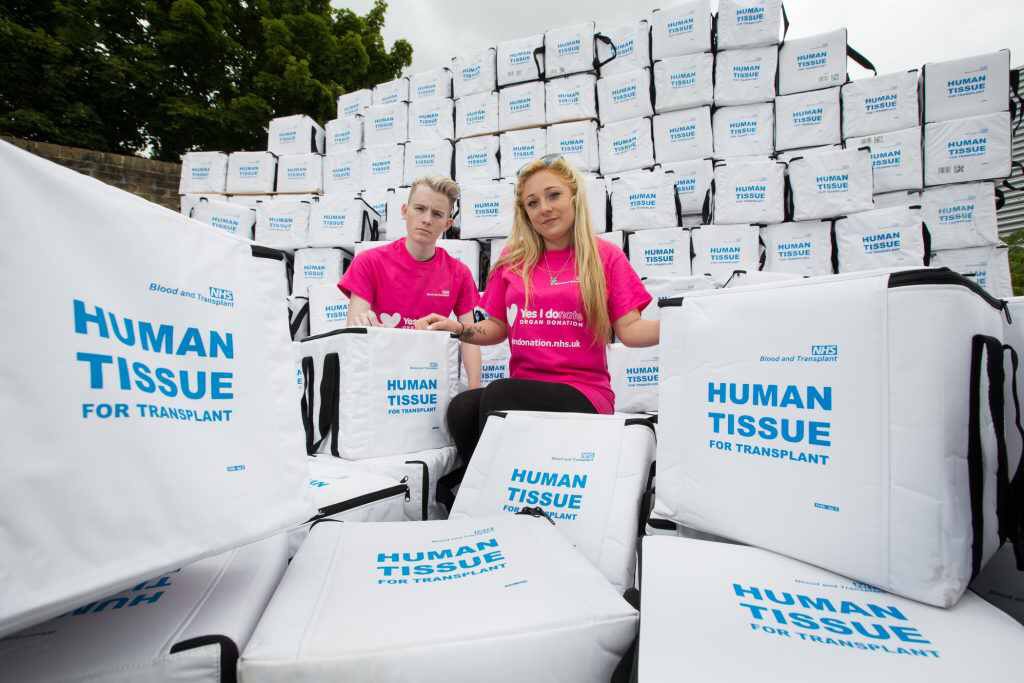
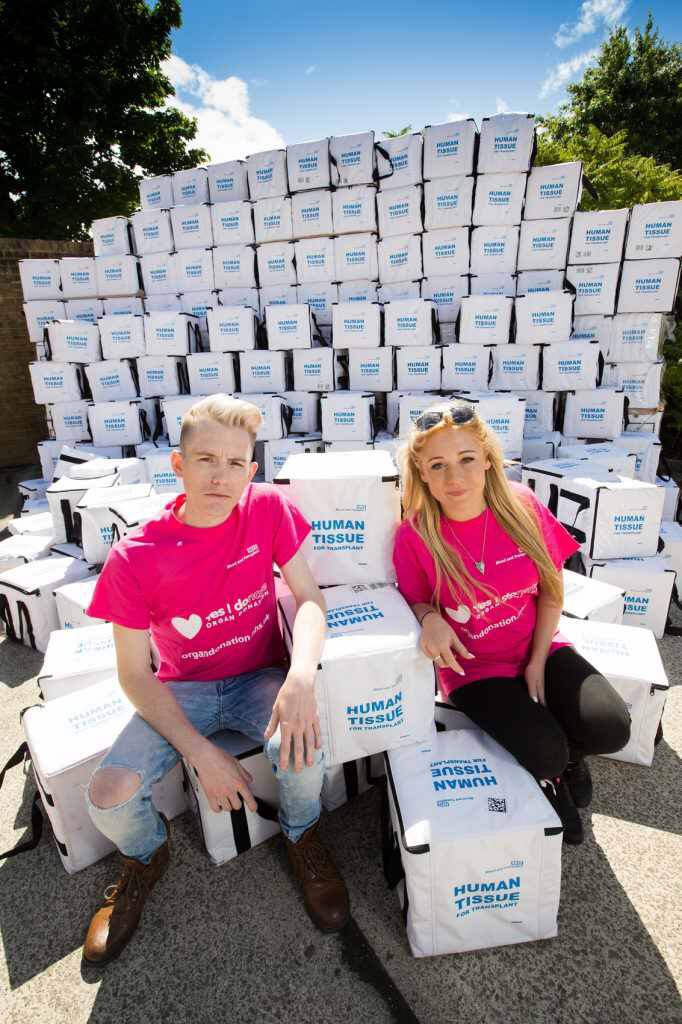
Attachment Photo: Charles Duke, 22, from New Milton, who has cystic fibrosis and is waiting for a lung transplant, with Isabel Sewell, 20, from Poole, who has polycystic kidney disease and is waiting for a kidney transplant, with 460 empty organ and tissue transport boxes at the NHS Blood and Transplant warehouse in Bristol. Around 460 potential transplants were missed last year when families declined to donate because they were not sure whether their relative would have agreed. NHS Blood and Transplant (NHSBT) is urging people to tell their families they want to donate during Organ Donation Week, September 4 to 10.

Attachment: ‘Join Us’ – Sign Up To The NHS Organ Donor Register – download.

Further Information:

For further information please contact Stephen Bailey (NHSBT) on 0151 268 7017 or

stephen.bailey@nhsbt.nhs.uk

Or visit the NHSBT Website: http://www.nhsbt.nhs.uk


Yours sincerely


Dave Joyce

National Health, Safety & Environment Officer

17LTB479 Launch of Organ Donation Week 4-10 September – Hundreds of Transplants Missed Each Year Because Families Don’t Know What The Deceased Relative Wanted

UK National ‘Organ Donation Week’ 4-10 September 2017 – Please Support The Campaign – Sign Up and Register as an Organ Donor Today

UK National ‘Organ Donation Week’ 4-10 September 2017 – Please Support The Campaign – Sign Up and Register as an Organ Donor Today:

To: All Branches

Dear Colleagues,

Next week is the UK national “Organ Donation Week” and the CWU is once again supporting the week and asking all CWU Reps, Branches and Regions to support the campaign, in line with CWU Conference Policy.

CWU is therefore proudly supporting Organ Donation Week from 4 – 10 September and is encouraging everyone to talk about organ donation.

Over the last year thousands of people have received life-saving or life changing transplants. However hundreds of life-saving transplants are being missed around the country every year because families don’t know what their relative wanted.

The number of people currently known to be alive thanks to organ transplants has broken 50,000 for the first time.

This increase is revealed in this year’s UK Transplant Activity Report 2016/17, published by NHS Blood and Transplant.

There are now 50,300 people alive today thanks to organ transplants – more than enough to fill a Premiership Football Ground. This includes:

• Kidney transplants – 36,300 people

• Pancreas transplants – 1,900 people

• Cardiothoracic (heart or lung or combined heart/lung) transplants – 3,900 people

• Liver transplants – 9,800 people

• Intestinal transplants – 100 people

The milestone figure has been reached thanks to record levels of public support for organ donation and improvements in survival rates.

The number of people receiving a transplant in a single year has reached the record figure of 4,753, an increase of 20% in the last five years. The increase means that nearly 800 more people a year have their lives saved or improved by transplants than they did five years ago.

The number of people on the NHS Organ Donor Register also reached a record number, 23.6 million, up by 4.9 million over five years. Now, 36% of the UK’s population is on the NHS Organ Donor Register, compared to 30% five years ago.

Survival rates continue to improve. An adult receiving the most common type of kidney transplant during the early 1990s had a 66% chance it would still be functioning after five years. Today’s report shows adults who received the same type of transplant five years ago have an 87% chance their kidney is still functioning today.

Many more recipients are now able to enjoy fuller lives, including starting families of their own.

During the week, NHS Blood and Transplant, hospitals, charities and supporters of organ donation are encouraging people across the UK to talk about organ donation with their relatives and friends.

NHS Blood and Transplant surveys show more than 80% of people support organ donation but only around 41% of people have ever talked about it. Research shows that women are 30% more likely to start a conversation about organ donation than men. It’s simple to register and carry a donor card.

We’re proud to support this lifesaving appeal and it’s really easy for everyone to take part – We want to get this simple message out to our members – just have a chat. That chat might be the next time you sit down for a meal, when you are shopping or working, or when you are just driving in the car. If you want to be a donor, your family’s agreement is still needed for donation to go ahead, even if you are on the NHS Organ Donor Register.

Families who agree to donate say it helps with their grief and that they feel an enormous sense of pride at knowing their relative gave others the chance of a new beginning. An organ donor can save or transform up to nine people’s lives and help even more by donating tissue, such as the donation of sight.

The NHS Blood and Organ Donation and Transplantation Service have expressed their gratitude for the CWU’s support in recent years because hundreds of lives are being lost every year and supporting the campaign for more donors is much needed.

This Organ Donation Week, we want Branches and Reps to ask members to tell their family they want to save lives. A few words now can make an extraordinary difference. If anyone is unsure about donation, they should ask themselves as a family; what would you do if one of you needed a transplant? Would you accept a life-saving organ? If you’d take an organ, shouldn’t you be prepared to donate also?

There is a particular need for more black and Asian people to talk about donation. Patients from ethnic minority communities make up 29% of the national transplant waiting list but people from these communities are less likely to agree to donate. Organs from people from the same ethnic background are more likely to be a close match and give the best chance of a positive outcome and survival.

There are lots of assets available to use in local awareness raising campaigns such as an email signature, web banner and social media assets.

All Organ Donation Week assets are now on the promoting donation hub at:-

http://www.nhsbt.nhs.uk/get-involved/promoting-donation-hub/

You might want to know the stats for the number of people who live in your area who received transplants from April 2016 – March 2017. The relevant stats can be found here at:- http://www.nhsbt.nhs.uk/get-involved/promoting-donation-hub/share-statistics/

A campaign supporter’s link has been set up to use in order to link through to a web page which encourages people to talk about organ donation. They then have the option to join the Organ Donor Register which is what the campaign aims to do – raise awareness – raise the number of registered donors. The link is at:-

https://www.organdonation.nhs.uk/talk?campaign=2663&utm_source=odw_17_nhsbt&utm_m edium=referral&utm_content=web&utm_campaign=partner

Or the short link:- http://bit.ly/2uXT6zK

Yours sincerely


Dave Joyce

National Health, Safety & Environment Officer


17LTB473 UK National ‘Organ Donation Week’ 4-10 September 2017

ODW17 – 1

ODW17 – 2

Simon Sheldon Funeral Arrangements

CWU SPECIAL NOTICE.

SIMON SHELDON.

I am sad to announce that Simon has passed away after a long illness, Simon will be greatly missed.

Our thoughts are with Simon’s family at this sad time.

Details of the funeral:

Peterborough Crematorium

Monday 25th September 10:30

Details of the wake to follow.

Steve Clarke

Area Distribution Rep

6th September 2013.

Links to media coverage of the upcoming strike ballot

https://uk.reuters.com/article/uk-royal-mail-pensions/britains-cwu-to-ballot-royal-mail-workers-on-industrial-action-idUKKCN1BG2OK

https://www.thetimes.co.uk/article/communication-workers-union-royal-mail-postal-union-ballot-raises-fear-of-christmas-strike-k5bs68h0t

https://uk.news.yahoo.com/royal-mail-staff-vote-industrial-action-union-184400834.html

https://www.thecanary.co/2017/09/05/sun-attacked-group-workers-lawyer-jumped-rescue-video/

http://www.union-news.co.uk/its-on-cwu-serves-notice-to-royal-mail-of-national-strike-ballot/

Four Pillars Campaign – Industrial Action Ballot

Four Pillars Campaign – Industrial Action Ballot

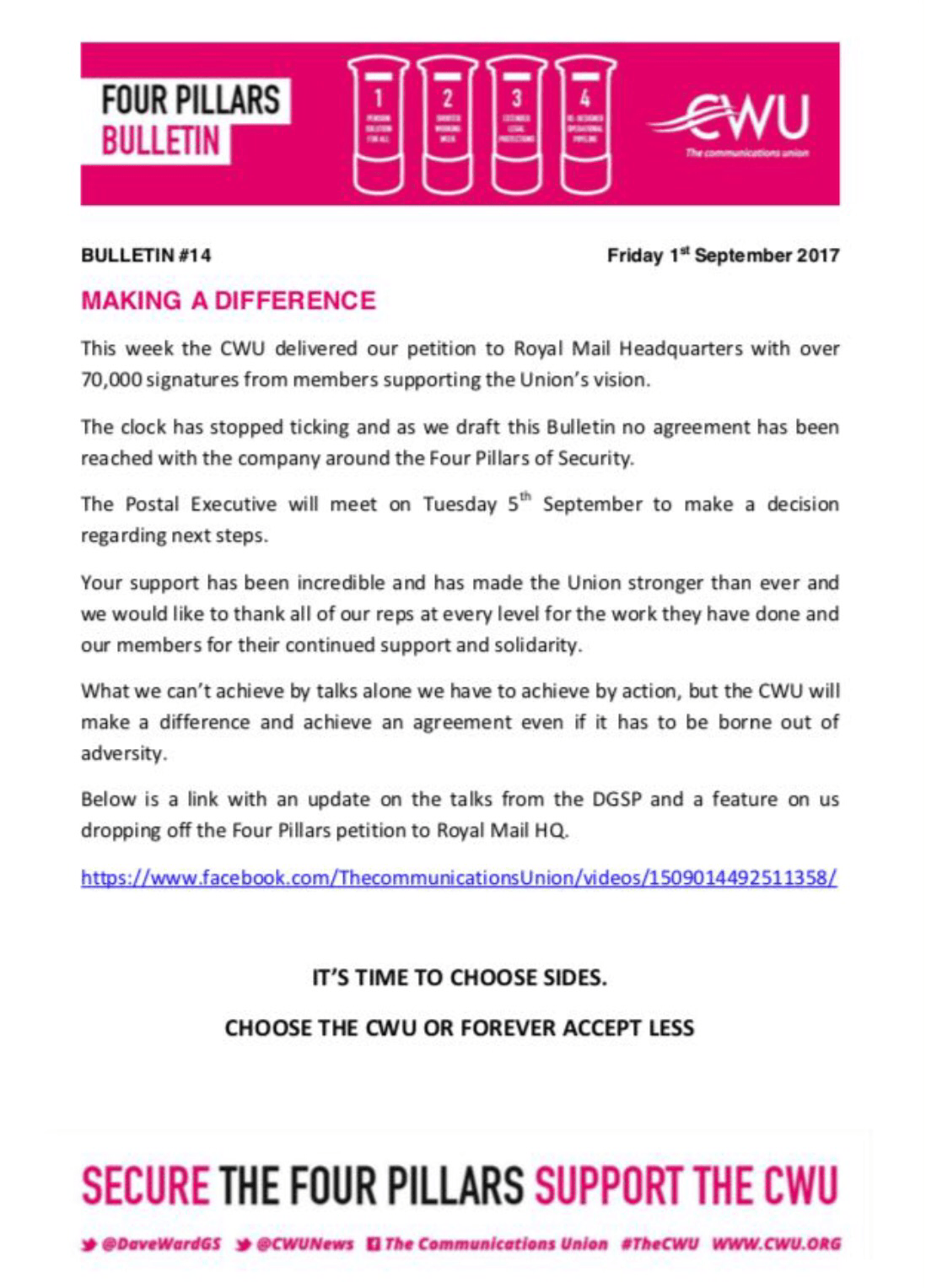
Yesterday the CWU’s Postal Executive formally authorised a ballot for Industrial Action in support of the Union’s Four Pillars of Security campaign. Branches will be aware that the PE’s decision, taken in line with long standing Union policy, is the latest step in a long running campaign designed to deliver employment, standard of living and retirement security for all CWU members in Royal Mail Group and to protect this great public service.

Despite months of talks with the business, the Union have been unable to reach a substantive agreement on the critical issues of a 2017 Pay Award, a decent pension scheme for all, a shorter working week, extending our current agreements and redesigning Royal Mail’s pipeline to deliver the long term growth and success the company signed up to in 2013.

Since privatisation, the CWU has become increasingly concerned with the company’s direction of travel, its incessant short term focus on cutting costs to maximise profits and deliver year on year increases in dividend payments to shareholders. This has led to repeated breaches of our agreements, a more toxic working environment, increased pressure on staff and a series of damaging proposals from the company to cut pension provision, attack pay and conditions of service and push the pipeline operation later into the day which not only threatens members’ future ways of working but the long term future of the UK’s vital universal service obligation (USO).

In authorising the ballot timetable, it is important to set out the key issues in this dispute. On pay, the CWU is seeking to secure a decent pay rise from April 2017 that reflects growing cost of living pressures, increased productivity of CWU members and continued profitability in Royal Mail. To date, however, Royal Mail have only offered a derisory £250 lump sum payment and are insisting that any future pay award must be tied to management’s own un-agreed, unrealistic and unachievable productivity targets.

On pensions, the company is refusing to accept either one pension scheme for all or the CWU’s credible and costed proposal for a new pension scheme for Royal Mail employees that secures a decent wage in retirement for all members currently in the company’s two failing DB and DC Schemes. Despite overwhelming opposition, the company plan to close the DB Scheme for future accrual from March 2018 and place all DB members into a vastly inferior “cash out” alternative which will see members lose around 30% of their previous pension promise.

For those already in the inferior DC Scheme, damning evidence from Royal Mail’s own trustees show that only a tiny minority are paying the maximum level of contributions needed to secure even the barest minimum income in retirement. Almost 90% of DC members are not paying enough in contributions and will not get enough out in pension benefits. The failure of Royal Mail’s DC plan reflects much wider concerns across the UK economy about the inadequacy of DC Schemes – these are not proper pension schemes but individual savings plans characterised by inadequate levels of contributions and inadequate, uncertain outcomes. At the same time, DC Schemes dump all future financial liability for pensions onto individual employees, along with responsibility for planning all their future pension provision in retirement. In response, the Union’s proposed Wage in Retirement Scheme (WINRS) will fix the contributions of both employer and employees, provide an annual mechanism for managing risk and deliver better pension outcomes for all our members that far exceeds the inferior benefits provided from both Royal Mail’s own Cash Balance or DC alternatives.

In relation to the Union’s outstanding claim for a shorter working week, while the company have made some positive moves towards agreeing the principle of a shorter working week, we still have not agreed the basis for its introduction or how this will affect different grades in different functions and business units.

On Pipeline Re-design, the company continues to display a lack of ambition and real innovation, preferring managed decline of the network to delivering future growth in the business. The company’s proposals for later acceptance times (LAT’s), route ownership and team working and pushing back deliveries later in the day, not only threatens members’ future duty patterns and ways of working but will seriously worsen service provision across large parts of the UK.

It is important to note that the CWU has picked no fight with Royal Mail. This dispute is about holding the company to account. We want Royal Mail to stick by the terms of our current agreements and honour the commitments to improve pay and pensions that they signed up to in 2013. But Royal Mail’s failure to abide by our agreements, it’s unilateral decision to close the DB pension plan, its refusal to award a proper pay rise for 2017, agree a plan for introducing a shorter working week and to redesign the pipeline to deliver future growth have given the Postal Executive little option but to trigger a ballot for action.

All members (young and old, male and female, full and part-time in every function and region) have a stake in supporting the Union in this crucial dispute. As well as protecting the interests of longer serving employees, the Union’s campaign aims to protect newer, younger entrants, stop the repeated misuse of part time and agency staff, resolve the long

standing issue of holiday pay for part-timers and stop the company’s move to introduce a two-tier workforce.

Our Four Pillars campaign has not only exposed Royal Mail’s true agenda post privatisation but has already been successful in forcing the company to withdraw some of its initial proposals to cut pay rates for new entrants, reduce sick pay, attack our Area Representative structure and force people from weekly to monthly pay. We therefore urge all members and branches to do all they can to support the union in the forthcoming ballot, secure the biggest YES vote possible and so put maximum pressure on the employer to enter serious, meaningful talks on resolving all the outstanding issues in this dispute.

We want to negotiate a new deal with Royal Mail that provides members with the employment, standard of living and retirement security they deserve, that honours and extends our current agreements and legal protections and ultimately secures genuine growth and success that will protect the long term future of one of Britain’s biggest and best loved companies.

It is absolutely essential that we maximize the returns in the ballot and send a clear message to the business, politicians and the public we serve that this Union and its membership is absolutely determined to defend themselves and this great public service.

To see the latest Four Pillars video from the DGS(P) please click on the link below;

Yours sincerely

Terry Pullinger Dave Ward

Deputy General Secretary (Postal) General Secretary


Create a website or blog at WordPress.com

Up ↑