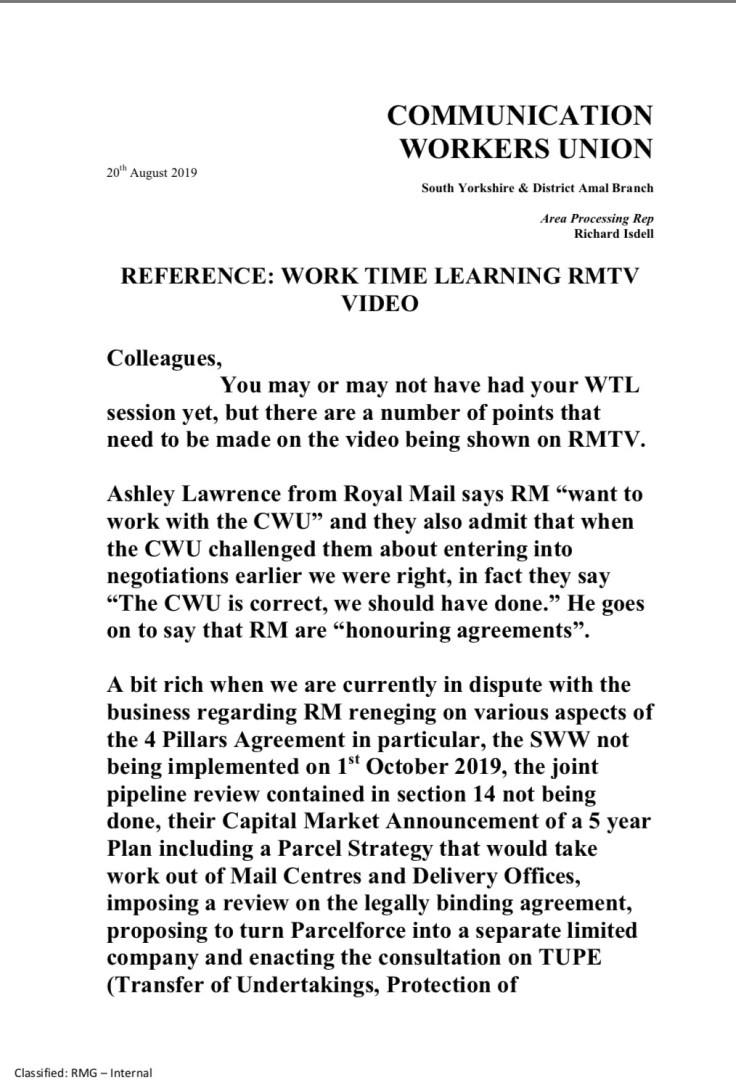
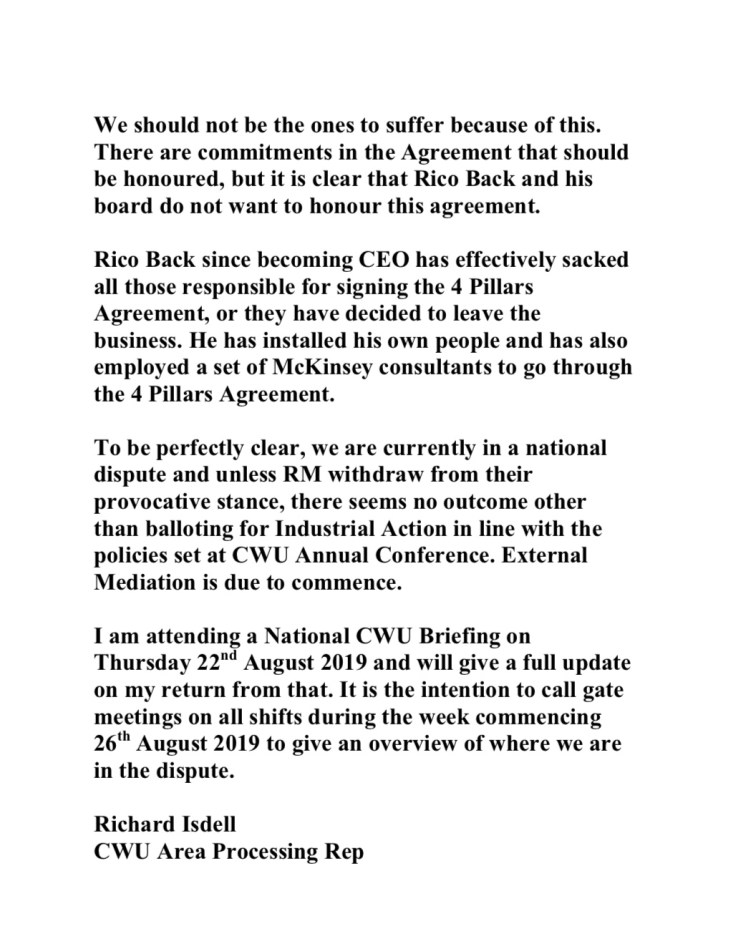
Latest from the Branch

Four Pillars – Honouring our Agreement: Industrial Action Ballot Timetable

Four Pillars – Honouring our Agreement: Industrial Action Ballot Timetable

Further to the updates provided in LTBs 454/19, 456/19 and 491/19 along with the National Briefings held in Liverpool on Wednesday 21st and Thursday 22nd August 2019, the Postal Executive met today to discuss a Ballot Timetable for Industrial Action to support the CWU’s policy as detailed in Emergency Motion 2, unanimously endorsed at the 2019’s Postal Industrial Conference held in April.

Working in close consultation with the SDGS Department, the Postal Executive endorsed the following ballot timetable for all appropriate CWU grades in the Royal Mail Group:

Membership Verification:  to commence and be completed by 3rd September 2019

Issue Industrial Action Notice to Ballot: 17th September 2019

Ballot Opens: 24th September 2019

Ballot Closes: 8th October 2019

Ballot Result: 8th October 2019

While the union has spelt out the above timetable, Branches will note that it still provides a period of weeks for further dialogue/external mediation to continue with the business to try and secure a final settlement on honouring the commitments detailed in the Four Pillars Agreement and all associated issues before the ballot process commences in late September.

It should be further noted that in setting this timetable we clearly believe that the business, in spite of their own media campaign, are not working within the spirit and intent of our National Agreements and are following their own agenda that will have long-term detrimental effects on our members’ terms and conditions of employment, job security and the future of RMG as a whole.

Any enquiries in relation to the content of this LTB should be addressed to the DGS(P) Department.

Yours sincerely,


Terry Pullinger – Deputy General Secretary (Postal)                                      

Dave Ward – General Secretary                     

Ray Ellis – Assistant Secretary

Andy Furey – Assistant Secretary                                              

Davie Robertson  – Assistant Secretary            

Mark Baulch – Assistant Secretary     

19LTB510 – Four Pillars – Honouring our Agreement Industrial Action Ballot Timetable


Royal Mail Fleet Maintenance – Territorial Reps Elections

Royal Mail Fleet Maintenance – Territorial Reps Elections

Due to the introduction of the new Fleet maintenance areas and our IR alignment, together with the 2 year election cycle, we are seeking nominations for the election of territorial reps in these areas.

There are 5 territorial rep’s positions due to be filled covering workshops in the following areas:

◦ Central, East & Midlands

◦ London & South East

◦ North of England & North Wales

◦ Scotland, Northern Ireland & Yorkshire Cluster

◦ South West, West Coast & South Wales

For ease of reference we have listed below the workshops covered by each area along with the corresponding CWU branches. All candidates must be supported by their own branch.

Area

Branches

Nomination forms for all of these positions are attached to this LTB. All candidates must have the nomination of their own Branch and completed nomination forms must be signed by the Branch Secretary and Branch Chair (or accredited deputies) and the nominee.

The time table for the submission of nominations is as follows:

Nominations Open:- Monday 9th September 2019

Nominations Close:- Monday 23rd September 2019

In the event that a ballot is required, a timetable will be notified in due course with all ballots being run in accordance with the CWU guidelines for Fleet Maintenance Territorial Representation which is attached for your information.

All enquiries regarding the content of this LTB should be addressed to the PTCS Department, quoting reference 220. Email address: khawkins@cwu.org

Ray Ellis

Assistant Secretary

19LTB508

BT Sell-off of BT Fleet Solutions Ltd

BT Sell-off of BT Fleet Solutions Ltd

Further to LTB 484/2019 and LTB 471/2019 I am writing to provide a further update on the progress of our negotiation with BT on the sale of Fleet Solutions to Aurelius.

We are pleased to inform branches that, following intensive lobbying by the CWU, a detailed agreement has been finalised that addresses all of the four key areas in which the union was seeking guarantees from the company.

Despite our resolute opposition to the sale, and our anger that BT has pursued a course of action that has caused considerable stress and anguish to employees throughout the division, the National Team is convinced that the safeguards we have secured provide crucial reassurances on our members’ future employment and terms & conditions with Fleet Solutions.

The key areas are:

A guarantee that all current contractual terms are transferred to the new company – all contractual terms and conditions of employment for team member (NewGrid) grades will not change as a result of Fleet Solutions being sold to Aurelius. Please see attached Annex A for all employment terms and conditions which are unchanged. 

Confirmation of non–contractual terms and agreement for transitional arrangements for those that are not able to transfer e.g. Broadband and BT Vision – Despite their non-contractual status, we have been able to secure an agreement that ensures most benefits will remain and you can find a list of these provided in Annex B. There are however a number of non-contractual terms which Fleet Solutions will not be able to replicate entirely and a resolution has been pressed for each benefit. One of these benefits is Broadband, BT Vision and BT Sport, as a consequence agreement has been reached on transitional arrangements for these benefits and details are attached as Annex C. There are a number of other non-contractual benefits which due to logistical reasons will need to be altered; these can be found in Annex D. 

An agreement on pension arrangements for all employees whether they are members of the BTRSS or BT Hybrid Scheme. All BTRSS members will join Fleet Solutions Retirement Saving Scheme and the contribution structure will remain the same. The BT Hybrid is a bespoke scheme for BT employees and therefore Fleet Solutions employees won’t be able to join it. For the small number of employees who have already joined the Hybrid scheme an alternative arrangement has been discussed with the CWU and Fleet Solutions have communicated directly to those employees. All those employees who were eligible to join the Hybrid have also been contacted directly. 

A full CWU recognition agreement with the new company which will ensure that collective bargaining rights including collective agreements will continue after the sale. Fleet Solutions had stated that they welcome an ongoing relationship with the CWU, therefore, current collective bargaining arrangements including collective agreements will continue after the sale. A full recognition agreement is agreed in principle, discussions will continue to finalise the detail. National facilities will continue until the end of the financial year with a commitment to discuss an appropriate set of arrangements going forward. 

We have made huge progress in the four key areas and significant progress in transitional arrangements in non-contractual areas, the agreement provides considerable safeguards for our members in a short space of time which provides stability and continuity for our members’ future job, pay, terms and conditions and we believe puts them in the best possible position when working for the new owners.

A communication has been sent to all of our BT Fleet members advising them of the above, which is attached. Branches should provide help, support and advice to their BT Fleet members through this transitional time, and seek help from the National Team, should they have any questions in relation to the final agreement.

Yours sincerely,


Andy Kerr – Deputy General Secretary (T&FS)                                             

Brendan O’Brien  – Assistant Secretary

LTB 507.2019

LTB 507.2019comms

LTB 507.2019annexA

LTB 507.2019annexB

LTB 507.2019annexC

LTB 507.2019annexD


JOINT STATEMENT BETWEEN ROYAL MAIL LOGISTICS (NETWORK) AND THE COMMUNICATION WORKERS UNION ON THE DEPLOYMENT OF POSTAL DIGITAL ASSISTANTS (PDA’S)

JOINT STATEMENT BETWEEN ROYAL MAIL LOGISTICS (NETWORK) AND THE COMMUNICATION WORKERS UNION ON THE DEPLOYMENT OF POSTAL DIGITAL ASSISTANTS (PDA’S)

Branches and representatives are advised that trial activity took place in 2015 in relation to the use of PDA’s by LGV drivers in a controlled trial in the National Distribution Centre (NDC), as a result of concerns that the business had in relation to revenue protection issues they had identified with major posting customers who are serviced by the Logistics LGV Fleet.

The trial finished in 2016 at which point it was believed that benefits had been achieved in relation to better controlling the access of mail and revenue protection, at that point next steps were to be considered.

There were however, no further developments until a recent request by the business to introduce the use of PDA’s into both the Logistics (Network) and Area Distribution functions. Royal Mail’s rationale for the proposal is that the introduction of the PDA’s will seek to build on the successes of the deployment of PDA’s in other functions and is also anticipated to provide benefits in relation to Revenue Protection, quality of service, customer service and assist the business in remaining competitive.

Discussions have therefore taken place in relation to agreements in both functions to enable the PDA to be deployed and attached for information is the Joint Statement which has now been concluded and endorsed by the Postal Executive in relation to Network.

Colleagues will note that we have achieved the usual safeguards around the use of the equipment in regard to conduct and performance management and H&S and have ensured appropriate release to enable full local CWU involvement in the deployment activity.

In addition, it has been agreed that drivers will be fully trained prior to full deployment taking place.

Training and deployment activity will be supported and monitored by the Network Working Group.

Any enquiries in relation to this LTB should be addressed to Davie Robertson, Assistant Secretary, email: dwyatt@cwu.org or shayman@cwu.orgquoting reference number: 231.06.


Yours sincerely


Davie Robertson
Assistant Secretary

LTB 506-19

Att LTB 506 Joint Statement PDA Deployment Network 21.08.19

JOINT STATEMENT BETWEEN ROYAL MAIL AREA DISTRIBUTION AND THE COMMUNICATION WORKERS UNION ON THE DEPLOYMENT OF POSTAL DIGITAL ASSISTANTS (PDA’S)

JOINT STATEMENT BETWEEN ROYAL MAIL AREA DISTRIBUTION AND THE COMMUNICATION WORKERS UNION ON THE DEPLOYMENT OF POSTAL DIGITAL ASSISTANTS (PDA’S)


Branches and representatives are advised that trial activity took place in 2015 in relation to the use of PDA’s by LGV drivers in a controlled trial in the National Distribution Centre (NDC), as a result of concerns that the business had in relation to revenue protection issues they had identified with major posting customers who are serviced by the Logistics LGV Fleet.


The trial finished in 2016 at which point it was believed that benefits had been achieved in relation to better controlling the access of mail and revenue protection, at that point next steps were to be considered.

There were however, no further developments until a recent request by the business to introduce the use of PDA’s into both the Logistics (Network) and Area Distribution functions. Royal Mail’s rationale for the proposal is that the introduction of the PDA’s will seek to build on the successes of the deployment of PDA’s in other functions and is also anticipated to provide benefits in relation to Revenue Protection, quality of service, customer service and assist the business in remaining competitive.


Discussions have therefore taken place in relation to agreements in both functions to enable the PDA to be deployed and attached for information is the Joint Statement which has now been concluded and endorsed by the Postal Executive in relation to Area Distribution.


Colleagues will note that we have achieved the usual safeguards around the use of the equipment in regard to conduct and performance management and H&S and have ensured appropriate release to enable full local CWU involvement in the deployment activity.


In addition, it has been agreed that drivers will be fully trained prior to full deployment taking place.


Training and deployment activity will be supported and monitored by the Area Distribution Working Group.


Any enquiries in relation to this LTB should be addressed to Davie Robertson, Assistant Secretary, email: dwyatt@cwu.org or shayman@cwu.org quoting reference number: 528.02.


Yours sincerely


Davie Robertson
Assistant Secretary

19LTB505

Att LTB 505 Joint Statement PDA Deployment Area Distribution 20.08.19


Royal Mail Group Trial of the ‘Whole Office’ Stress Risk Assessments – Using the HSE Work-Stress Survey Tool – Joint Statement/Communication:

Re: Royal Mail Group Trial of the ‘Whole Office’ Stress Risk Assessments – Using the HSE Work-Stress Survey Tool – Joint Statement/Communication:

Mental health problems are widespread, at times disabling, yet often hidden. Research as part of a 2018 study by the mental health charity the “Mental Health Foundation” found that three quarters of UK adults had felt ‘overwhelmed or unable to cope’ in the previous year, with one in three having suicidal feelings as a result of stress.

In line with Motion 37(2015), LTBs 166/16 and 595/2016 (copy attached) reported on the conclusion of negotiations between Royal Mail Group and the CWU for the introduction of a new revised Royal Mail Group, Work Stress, Safety, Health and Environment Standard, Guidance and Stress Risk Assessment Process as part of a new RMG ‘Stress Toolkit.’

As detailed in previous reports to Regional Health and Safety Forums and ASRs, after pressing for a review and overhaul of Royal Mail Group’s Stress Policy and Stress Risk Assessment process for some considerable time, in October 2016, RMG agreed with the CWU Health, Safety & Environment Department to jointly launch the Royal Mail Stress Toolkit, which included an individual Stress Risk Assessment (guided conversation) process and the online Stress Tool (available via the Royal Mail Group Feeling First Class Intranet site).

The HSE Stress Indicator Tool, Risk Assessment Questionnaire or Survey form which was also agreed to be part of the ‘RMG Stress Toolkit’ has not been utilised and so the Health, Safety & Environment Department has been vigorously pursuing a revised process for Stress Risk Assessing “Whole Workplaces/Offices/Depots/Plants/Groups of workers etc.”, utilising the HSE stress survey and analysis tool.

Motion 70(2017) and Motion 34(2019) carried at this year’s CWU Conference in fact endorsed our current approach and called for ‘a stress risk assessment/survey to be used in every workplace.

Building on the work done to date, Royal Mail has agreed with the CWU Health, Safety & Environment Department to now move to the next stage and to trial the introduction of a Stress Risk Assessment Survey Tool, developed by the Health and Safety Executive (HSE) as part of the HSE Stress Management Standards, which can be used to measure the workplace/workforce stress of groups of employees, teams or whole workplaces, including all staff in order to get a general picture of stress levels across all the workforce. This will be done using the HSE Stress Indicator Tool Risk Assessment Questionnaire (see copy attached).

HSE’s Work Stress Management Standards represent a set of conditions that, if present:

  • demonstrate good practice through a step-by-step risk assessment approach
  • allow assessment of the current situation using the survey tool and other techniques
  • promote active discussion and working in partnership with employees and the trade union representatives, to help decide on practical improvements that can be made
  • help simplify risk assessment for work-related stress by:
    • identifying the main risk factors,
    • helping employers identify and focus on the underlying causes and their prevention,
    • help employers to tackle the key causes of stress.

Through the Royal Mail Group five-year strategy ‘Because Healthy Minds Matter’ launched in 2017, Royal Mail Group (RMG) have committed to implement effective support strategies and tools that can make a positive difference to the workforce who are directly or indirectly affected by mental ill-health. Royal Mail Group has also committed to protect the health, safety and welfare of employees, recognising that workplace stress is a health and safety issue and acknowledge the importance of identifying and reducing workplace stressors. (See attached copy of Joint Statement).

The Royal Mail Group (RMG) 5-Year Mental Health Strategy to date has included:-

  • The signing of the Time to Change Pledge – jointly signed by RMG and CWU;
  • Development of 5 mental health support videos with the Mental Health Foundation;
  • Introduction of the Mental Health First Aid Awareness one day course for all Managers, Physical First Aiders and CWU Health & Safety Reps;
  • Launch of the Stress Toolkit;
  • Launch of the five-year strategy and underpinning plan ‘Because Healthy Minds Matter;
  • Creation of the ‘Because Healthy Minds Matter’ mental health e-learning;
  • Mental health support ‘z-cards’ with CWU sent into all units;
  • Launched a Mental Health Ambassador Pilot with CWU of 160 Mental Health Ambassadors;
  • Agreed with CWU an approach to upskilling 5,500 physical first aiders to include mental health first aid;
  • Increased promotion of RMG’s “Feeling First Class” and “Employee Assistance” programmes;
  • Continued activity through mental health charity partnerships including the ‘Everyday People’ video.

During July a ‘Joint Statement and Communication’ signed by Royal Mail Group, CWU and Unite/CMA plus a ‘Power-Point Slide Pack’ (copies attached), were sent to all managers and CWU Area Health and Safety Representatives in the agreed trial offices. Dan Clarke, Royal Mail Group Health & Wellbeing Development and Systems Manager invited those involved to participate in a series of conference calls which outlined the trial scope, approach and process as well as a question and answer session.

ASRs were requested to brief all IR Rep colleagues in trial offices, both Area Reps and Unit/Shift Reps about the trial details and invite them to participate in the conference calls if they so wished. Additionally, all Reps working together are requested to ensure we get maximum participation and survey form returns from the membership in order to get the most meaningful assessment and picture of stress levels and identification of the stressors and causes of stress.

The following offices nominated by CWU (6 DOs/MPUs, 3 Mail Centres and 2 PWW LDs) and nominated by Unite/CMA (1 Mail Centre and 2 Delivery Sectors) are participating in the three month trial of the Stress Risk Assessment Survey Tool concluding in September/October following which a joint national review will take place prior to national roll-out. The trial offices are:-

Nominated by CWU:

  • Taunton MPU (TA)
  • Crewe DO (CW)
  • Newcastle Under Lyme DO (ST)
  • Cheadle DO (ST)
  • Lincoln DO (LN)
  • Blair Gowrie DO (PH)
  • Cardiff Mail Centre (CF)
  • Northern Ireland Mail Centre (BT)
  • Exeter Mail Centre (EX)
  • Exeter LD (Parcelforce Worldwide) (EX)
  • Medway LD (Parcelforce Worldwide) (ME)

Nominated by Unite/CMA

  • Swindon Mail Centre Nights (Management team)
  • Manchester Delivery Sector (Management team)
  • ML/KA Glasgow Delivery Sector (Management team)

Attachments:

  • Joint Statement/Communication
  • HSE Stress Indicator Tool Risk Assessment Questionnaire
  • Stress Risk Assessment Power-Point Slide Pack
  • LTB 595/16 New Royal Mail Group Stress Risk Assessment Process and Guidance – Royal Mail Stress Toolkit:

A further report following the trial conclusion will be made in due course.

Yours sincerely

Dave Joyce
National Health, Safety & Environment Officer

19LTB504 Royal Mail Group Trial of the ‘WholeOffice’ Stress Risk Assessments

Trial of the Stress Risk Assessment Survey Tool Joint Statement-Communic.._

Stress – HSE Stress Indicator Tool – Risk Assessment Questionnaire

Trial of the HSE Stress Risk Assessment Survey Tool

16LTB595 New Royal Mail Group Stress Risk Assessment Process and Guidanc.._


POST OFFICE: NEW TRANSGENDER EQUALITY POLICY

POST OFFICE: NEW TRANSGENDER EQUALITY POLICY

I am pleased to advise Branches that the CWU, UNITE and Prism, (the Post Office LGBTQ+ advisory group), worked together to develop and agree a new Transgender Equality Policy and a Transgender Guidance for Managers and Employees. This is the first Transgender Policy being implemented in the Post Office.

The new policy is designed to ensure any member that is in the process of transitioning, or has transitioned, is supported and treated with dignity and respect. The aim is to increase consciousness of gender identity issues so that no current or prospective employees are subjected to discrimination or victimisation as a result of them being transgender.

To raise awareness of the policy and associated guidelines the Post Office, CWU and UNITE has issued the following Joint Statement:

Post Office Prism Group (PO LGBT+ Group), CWU and UNITE have worked together collaboratively to develop a set of transgender resources for employees to help support transgender people, managers and co-workers to feel more comfortable in the workplace. Stonewall, the charity for LGBT rights, also assisted in an advisory capacity.

The Post Office is fully committed to Diversity and Inclusion.   Respecting our transgender employees is important as they are a valued part of the team. We hope with the new guidelines and support every employee feels even more safe, valued and able to succeed based on their skills and contributions.

We have jointly developed a Post Office policy dedicated to transgender equality. The aim of the policy is to:

    • Support and sustain a positive working environment for any employee that is in the process of transitioning, or has transitioned. The policy also applies to a broad range of people whose gender identity is not expressed in ways that are typically associated with their assigned sex at birth. This includes those who have non-binary, non-gender or gender-fluid identities. 
    • To increase employees’ awareness of gender identity issues so that no current or prospective employees are subjected to discrimination or victimisation as a result of them being transgender. 

The resources developed include best practice guidance for transgender employees, managers, co-workers and HR professionals. It also provides advice on using people’s preferred names and pronouns, accessibility to restrooms, dress code, employee privacy, transitioning and much more.

All parties are committed to equality of opportunity for transgender people and believe it is important to provide a culture of inclusion and diversity in which employees feel free to disclose their gender status should they wish to do so. We want employees to feel comfortable being their “whole selves” at work.

We are also all committed to working together to ensure that the Post Office is a place that does not accept any form of discrimination, victimisation or harassment on the basis of a person’s gender identity, gender expression or transgender status.

Finally, I would particularly like to thank Lynn Simpson, Postal Executive Member and Fevzi Hussein, Policy Advisor – Equality Department, both of whom have supported this development and have had significant input in ensuring the Transgender Equality Policy is in line with current legislation and crucially with our values.

If you have any questions in relation to this LTB, please contact Lea Sheridan – lsheridan@cwu.org

Yours sincerely


Andy Furey

Assistant Secretary

19LTB503 – Post Office – New Transgender Equality Policy


House of Commons Transport Select Committee Road Safety Report – ‘Driving While Using a Mobile Phone’ Published

House of Commons Transport Select Committee Road Safety Report – ‘Driving While Using
a Mobile Phone’ Published:

In March 2019 the House of Commons Transport Select Committee of MPs launched an inquiry into road safety, looking at the Government’s current approach and considering what interventions would be most effective at reducing the number and severity of road traffic collisions in the UK. During the inquiry, the issue of driving while using a mobile phone was highlighted as a major area of concern. The Committee therefore focused part of its wider inquiry on the specific issue of road safety and mobile phones.

The Committee’s inquiry considered:-

  • Use of mobile phones by drivers and the risks this poses.
  • The adequacy of legislation relating to mobile phone use by motorists.
  • How enforcement and education around mobile phone use can be improved.

Key facts and statistics are:-

  • Driving while using a mobile phone impairs the ability to drive safely and increases the risk of a collision.
  • Using a hand-held mobile phone or other device while driving has been illegal since 2003, but the practice is still widespread and can have catastrophic consequences.
  • In 2017 there were 773 casualties, including 43 fatalities and 135 serious injuries, in road traffic collisions where a driver using a mobile phone was a contributory factor in the crash.

The Select Committee identified three key areas where the Government needed to take action:-

  • How the offence is defined in law and the penalties associated with it;
  • How the offence can be better enforced; and
  • How the public can be made aware of the risks and consequences of driving while using a mobile phone.

The central messages from the inquiry were that:-

  • If an offence is to be effective, it has to be well-defined and publicised so that motorists know what is and is not against the law.
  • Drivers need to understand the serious safety risk that driving while using a mobile phone poses to them and others.
  • The offence must be backed up with a high enough penalty for motorists to take it seriously.
  • There must be a serious prospect of offenders being caught.

Conclusions and Recommendations Summary:

The risks of using a mobile phone

Using a mobile phone or other device while driving impairs a person’s ability to drive safely and makes a road traffic collision more likely. This is true whether a device is hand-held or being used hands-free. The Government plans to publish an analysis of mobile phone use while driving, in order to help it decide what more needs to be done to tackle this activity. (Paragraph 13).

Legislative reform

The legislation defining the offence of using a hand-held mobile phone or other device while driving was drafted in 2003 and excludes activities that are known to create precisely the same risks as those covered by the legislation. The Committee recommend that the Government redefine the offence of driving while using a mobile phone or other device so that it covers all hand-held usage, irrespective of whether this involves sending or receiving data, whether for a communicative purpose or not as it’s just as dangerous, and it therefore does not make sense for legislation to distinguish between these things. (Paragraph 18).

The law currently only proscribes using a hand-held mobile phone or other device while driving. A hands-free device can be used lawfully, creating the misleading impression that hands-free use is safe. The evidence shows that using a hands-free device creates the same risks of a collision as using a hand-held device, and it is therefore inappropriate for the law to condone it by omission. The Committee recommend that the Government explore options for extending the ban on driving while using a hand-held mobile phone or other device to hands-free devices. (Paragraph 19).

Increasing the penalties for driving while using a mobile phone in 2017 appears to have changed behaviour in the short-term, but there is already evidence that bad habits are creeping back in. The Committee recommend that the Government should review the current penalties that apply to this offence and consider whether they should be increased to better reflect the serious risks created by drivers committing this offence and make clear to offenders that there are serious consequences to being caught. (Paragraph 22).

Enforcement

If motorists do not believe there will be consequences from breaking the law then many of them will continue to do so. Enforcing the law is essential to ensuring that motorists do not illegally use their mobile phone while driving. There must be a credible threat of offenders being caught. It is concerning that the number of offences resulting in Fixed Penalty Notices, driver retraining or court action have fallen by more than two thirds since 2011, while the number of people killed or seriously injured in collisions where mobile phone use is a factor in the collision has risen. The Committee recommend that the Government engage with Police forces and Police and Crime Commissioners to explore options for improving the enforcement of this offence including the use of technology alongside public awareness campaigns. (Paragraph 28).

Public Awareness

If using a mobile phone while driving is to become as socially unacceptable as drink driving, there needs to be a step change in the Government’s approach to public education. The Committee recommend that the Government set out a plan for devising and implementing a public education campaign about the risks of using a mobile phone while driving, and the penalties for being caught doing so. (Paragraph 34).

Government and public sector drivers

As well as setting policy and enacting legislation the Government can lead by example and encourage behaviour change across the public sector and Government supply chain. The Committee recommend that the Government demonstrate its recognition of the risks of using a mobile phone while driving whether hand-held or hands-free by producing guidance on the dangers of driving while using a mobile phone and instructing drivers directly in its employ not to use a mobile phone or other device whether hand-held or hands-free while driving, and explore the possibility of making this a requirement for the wider public sector and Government contractors. (Paragraph 37).

The Select Committee’s Report sets out its findings and recommendations in the above areas, for consideration by Ministers. A copy is attached for the information of Branches, Regions and Health and Safety Representatives.

Yours sincerely


Dave Joyce
National Health, Safety & Environment Officer

 19LTB501 House of Commons Transport Select Committee Road Safety Report – ‘Driving While Using a Mobile Phone’ Published

HoC Transport Select Committee Report – Road Safety Driving Whilst Using.._


Create a website or blog at WordPress.com

Up ↑