Youth Conference 2016 – Motion 9 

Youth Conference 2016 – Motion 9 
As you know Youth Conference 2016 carried Motion 9 in the following terms: 
Conference recognises that many young people are turning to alcohol to mask anxiety or depression, or other mental health problems without realising it. In fact according to a survey run by IPOS MORI based on young people’s drinking attitudes it can be confirmed that 44% of 10-17 year olds have a drink to cheer themselves up. 
“According to Drinkaware statistics show that more than half (53%) of young people that have an alcoholic drink suffer from low mental health. This is compared to the 36% of young people that have a good level of mental health. 
Therefore, this conference instructs the National youth committee to make contact with Drinkaware and work with them on building a campaign that provides information and raises the awareness amongst our young members about mental health and its association with possible alcohol problems. This could be done through leaflets, social media, The Voice magazine, workshops etc for our young members.” 
This is to inform branches that contact has been made with Drinkaware and discussions are ongoing about meeting the terms of the motion. 
In the meantime please find attached an information leaflet that we ask branches to disseminate amongst their members and note that further bespoke material will be available early in the new year. Drinkaware also have a specific area on their website relating to the effects of alcohol on mental health wellbeing. 
The Youth Committee is aware of action already taken by the Health, safety and Environment department on the issue of alcoholic-related ill-health, including their support for Alcohol Concern’s “Dry January” campaign. Discussions will take place to ensure that the CWU’s activity on this subject is coordinated and effective. 
Any queries on this LtB should be directed to my office at CWU HQ. 
Yours Sincerely,
Simon Sapper

National Officer
Email Attachments – Click to download
LTB 704/16 – Youth Conference 2016 – Motion 9

Drinkaware A5-Alcohol-Effects Leaflet

SOFTWARE UPDATE – ISOTRAK/LIVE TRAFFIC

SOFTWARE UPDATE – ISOTRAK/LIVE TRAFFIC
Dear Colleagues
Branches and representatives will be aware of the National Agreement between Royal Mail Logistics and the CWU on the Use of Telemetry Equipment in Royal Mail Network Vehicles, communicated via LTB 398/14.
The department was recently approached by Royal Mail Logistics as they wished to share information in relation to a software update that they would like to deploy Nationally from the end of November 2016. This software update adds live traffic information to the Sat Nav on the Isotrak system in Logistics.
The update allows our Logistics members to identify where there are traffic issues on their route and provides them with live updates in order that they can be routed around heavy congestion and road closures, whilst maintaining the current parameters of the equipment that take into account the height and length of the vehicle.
Under the current terms of the National Agreement covering the use of the Isotrak telemetry the Sat Nav option is not compulsory and the business have confirmed that this aspect remains unchanged. The business have also reaffirmed that they remain committed to our current National Agreement and that this is purely a software update, which can be accessed if required by our drivers.
The business is now making arrangements to roll out this update to all Network sites. The roll out process will include a USB being sent to each site which has been configured with the Live Traffic update so they can upload it into the fleet. The business will be releasing communications on the Live Traffic via Drive Time and the Courier. 
Any enquiries in relation to this LTB should be addressed to Davie Robertson, Assistant Secretary, email: dwyatt@cwu.org or shayman@cwu.org quoting reference number: 233.03
 
Yours sincerely 
 
Davie Robertson

Assistant Secretary
Email Attachments – Click to download
LTB 702/16 – SOFTWARE UPDATE – ISOTRAK/LIVE TRAFFIC

Adblue’ Use With The Royal Mail Light Commercial Fleet (LCVs) Including New Car Derived Vans (CDVs)

Adblue’ Use With The Royal Mail Light Commercial Fleet (LCVs) Including New Car Derived Vans (CDVs):
To: All Branches
Dear Colleagues,
Introduction:
Following discussions with the RMG Fuel & Environment Manager and Fleet Management Team on the above subject, the CWU Health, Safety and Environment Department is publishing information in relation to new additional and replacement Light Commercial Diesel Vehicles (LCVs) including Car Derived Diesel Vans (CDVs) within the Royal Mail Group Fleet which are now beginning to be delivered into Offices across the Country. These new vehicles must meet the new Euro 6 exhaust emissions standards and will now come fitted with ‘AdBlue’ tanks. Drivers will notice the presence of a smaller blue or black cap adjacent to the main Diesel fuel cap — this is for ‘AdBlue’.
Reducing Pollution, Protecting The Environment and Improving Health:
The motor industry has been reacting to demands from Governments for cleaner engines and taking more steps to ensure that new cars and vans are producing cleaner emissions. For diesel vehicles, the introduction of ‘AdBlue’ has been commonplace, with many manufacturers equipping their newer models with systems that use the fluid to produce less harmful emissions. This product is set to play a big part in the greener future of the industry, so it is important that Drivers know what it is and what they need to do with it. To dispel any confusion and to make sure members are reliably informed about this essential product, this comprehensive guidance contains everything they need to know about ‘AdBlue’.
What does Euro 6 mean?
From September 2016, all new Diesel Cars and Vans sold must meet the new stricter Euro 6 Standards which came into force on 1st September, for Exhaust Emissions of NOx (Nitrogen Oxide) and other Pollutants. Euro 6 (also known as EU6 or Euro VI) is the latest round of regulation set by the European Commission governing the amount of harmful exhaust gases motor vehicles can emit.
Compared with the previous Euro 5 (also known as EU5 or Euro V) emissions standard, which focused largely on carbon dioxide emissions – the CO2 that is currently used to set road tax bands for cars in the UK – Euro 6 is particularly targeting nitrogen oxide (NOx) emissions. But it will also reduce sulphur dioxide, carbon monoxide, hydrocarbon, and diesel particulate matter emissions, as well as CO2.
NOx emissions have been scientifically linked to respiratory diseases and other health issues, and environmental damage including acid rain. Depending on fuel type (and diesel is the main issue), the Euro 6 standard forces vehicle makers to reduce NOx by more than 55 percent, and it’s a mandatory requirement for all new light commercial vehicles from September 2016. The Euro 6 emissions standard aims to make vehicles cleaner and greener as global concerns for the environment deepen.
‘AdBlue’ and Selective Catalytic Reduction (SCR) Technology – Why Is It Needed?
‘Adblue is an essential component of selective catalytic reduction (SCR) technology, which is one of the most effective systems for reducing the nitrogen oxide (NOx) levels in the exhaust fumes that are outputted by diesel engines. NOx is one of the most harmful pollutants emitted by engines, as it reacts with other gases in the atmosphere to form small particles and ozone, both of which can damage sensitive lung tissue in humans and animals.
To comply with the new rules, car and van makers have had to focus on minimising harmful nitrogen-oxide emissions. Introducing a technology known as ‘selective catalytic reduction’ (SCR) has been found to be an extremely effective way of bringing diesel engines up to the standard required to meet Euro 6. It’s used by many manufacturers. An SCR system uses a solution of urea and water (AdBlue), injected in tiny amounts into vehicle exhaust Gases. ‘AdBlue’ technology has been increasingly appearing in new Diesel cars and vans, designed to help reduce exhaust emissions and helping the environment as well as the health of the population, particularly in Towns and Cities.
What is AdBlue – Is it Safe?
AdBlue is a 32.5% solution of high-purity Aqueous Urea Solution or Urea in de-mineralized water (67.5%) that is clear and is classified as non-dangerous, non-toxic, safe to handle and easy to use. It is non explosive, non flammable nor harmful to the environment. AdBlue’ is classified under the minimum risk category of transportable fluids, on Safety Data Sheets and within COSHH. It is used with the vehicle’s Selective Catalytic Reduction (SCR) system to reduce emissions of oxides of nitrogen from the exhaust of UK Diesel vehicles. Although it’s non-toxic, AdBlue is corrosive and can cause irritation to your skin, eyes and lungs, so do wash your hands after filling. Be sure to rinse any spills from the vehicle’s bodywork too, because ‘AdBlue’ can damage paintwork.
How does AdBlue work?
The Selective Catalytic Reduction (SCR) system injects microscopic quantities of the ‘AdBlue’ liquid into the flow of exhaust gases. When the ‘AdBlue (Urea and Water) solution combines with exhaust emissions, it produces nitrogen and oxygen – harmless gases that occur naturally in the environment – by breaking down mono-nitrogen oxides (gases that can be harmful and are found particularly in the fumes from diesel exhausts).
Using Adblue?
This technology has been used in buses and heavy goods vehicles (HGVs) for a long time, so its effectiveness has been proven and its reliability is better than ever. All Heavy Commercial Vehicles over 3.5t have required ‘Adblue’ for some time and, from 1 September, all newly purchased Light Commercial Vehicles (LCVs) including Car Derived Vans (CDVs) will also need it.
How Will LCV Drivers Get Vans Re-Filled and Topped-Up with AdBlue?
LCVs/CDVs will not need to visit Royal Mail Fleet Workshops for top ups. Instead, Royal Mail Group drivers will be asked to undertake the task as part of their normal driver checks. Ten litre packs of Adblue are on order by Royal Mail from DAF for drivers to top up at their offices although vehicles will be delivered with a full ‘Adblue’ tank so it’s unlikely that top ups will be required until the scheduled workshop vehicle inspection. Managers are currently handing out special ‘Information Flashcards’ to LCV Fleet drivers. The ten litre packs of ‘AdBlue’ are being ordered via the Royal Mail Group Fuel Team using a special, provided order form. The process for HGVs remains the same – they will continue to fill up at the 60 bulk tanks sites that are dotted around the country. The bulk tanks are not fit for purpose for LCVs as the fill rate is too fast and unnecessary mileage would be incurred for top ups between inspections.
Does The Van Use ‘AdBlue’?
SCR technology with ‘AdBlue’ will now become increasingly commonplace as more of the Euro 6 Standard Vehicles are introduced, but it obviously isn’t yet fitted to every Diesel Van or Car. Many Drivers are unaware the system is installed until a warning message appears on the dashboard announcing the ‘AdBlue’ tank needs replenishing. As the SCR system has no effect at all on how the Van or Car drives, it’s not always obvious whether a vehicle is so-equipped. It’s therefore important Drivers are aware of the new vans with SCR systems that require ‘AdBlue’, the attached information will help raise awareness. Drivers can check it for the location of the ‘AdBlue’ filler cap. When the SRC and ‘AdBlue’ system is fitted the ‘AdBlue’ filler, which in most Vans is commonly beside the fuel filler, but some Cars have it concealed by the boot carpet, either on the floor or at either side.
How Much ‘AdBlue’ Will The Van Use?
‘AdBlue’ consumption varies from vehicle to vehicle. Fortunately, because ‘AdBlue’ is injected into the exhaust gases in very small quantities, Drivers shouldn’t find themselves topping up too often. With most ‘AdBlue’ tanks holding around 10 litres or more, many drivers will find ‘AdBlue’ refills taken care of during their Vehicle’s annual service. Obviously, much like fuel consumption, though, the more mileage the vehicle covers and the harder and faster it’s driven will mean that more ‘AdBlue’ is used. The Royal Mail Fleet Management Team states that driver top ups will not be required until the New Year and further Comms will be issued by Royal Mail Fleet. From initial analysis by Royal Mail Fleet, it suggests that drivers will only be required to fill up the tank with ‘AdBlue’ once per year per vehicle. However, those drivers who cover higher mileages may find that refilling their vehicle’s ‘AdBlue’ tank becomes a more frequent task. Fortunately, filling the ‘AdBlue’ tank is a straightforward, simple process. Drivers are reminded in plenty of time to do this by messages on the dashboard. Average consumption of AdBlue is generally 5% of diesel use, so drivers will need to tank up much less for AdBlue than for diesel. Vans will use about 5 litres of AdBlue to every 100 litres of diesel.
Royal Mail Group Driver Training?
Driver ‘Flashcards’ have been produced for the driver training and the supply of ‘Adblue’ has been secured with the supplier.
How to Refill The ‘AdBlue’ Tank?
Royal Mail Fleet Management has advised that refilling the ‘AdBlue tank can become a driver task. Attached is a copy of the Royal Mail Fleet Drivers ‘Top Up’ Information and guidance sheet and a copy of the ‘GreenChem’ Fuelling Information Sheet. ‘GreenChem hold the RMG national supply contract for ‘AdBlue’.
Storing AdBlue? AdBlue can be stored for 18 months if this is done in the correct manner, i.e. away from direct sunlight. It needs to be protected from too warm or too cold temperatures. Its freezing point is at -11 degrees Celsius. When it thaws, the product will retain its initial quality. It should be stored in a sealed package and in a well ventilated storage area.
What happens if an engine runs without AdBlue? From 1,500 miles before the tank is empty an orange warning and audible warning reminds the driver at every engine start of the need to top up the Adblue as well as giving the remaining range. If the driver continues until the tank is empty, when the vehicle is switched off the engine will not start.
What happens if you get splashed with AdBlue?
Simply remove any contaminated clothing and wash the affected areas with running water. If any irritation persists or an allergic reaction occurs, seek medical attention.
How do you clean up a spill? Clean it up with water.
Attachments:
AdBlue Filler Cap Images Information Sheet

AdBlue Top Up Information Sheet

AdBlue Instructions

GreenChem Fuelling Information Sheet

AdBlue 10 Litre Pack Order Form

AdBlue SSoW

AdBlue COSHH Assessment Sheet

AdBlue SCR (Selective Catalytic Reduction) Diesel System Diagram Information Sheet

Yours sincerely
Dave Joyce

National Health, Safety & Environment Officer
Email Attachments – Click to download
Attachment 1 – LTB700/16 ‘Adblue’ Use With The Royal Mail Light Commercial Fleet (LCVs) Including New Car Derived Vans (CDVs):

Attachment 2 – AdBlue Filler Cap Images Information Sheet

Attachment 3 – LCV Sept 2016 Adblue Top Up_v3

Attachment 4 – AdBlue Instruction

Attachment 5 – Greenchem Fuelling Information Sheet

Attachment 6 – Copy of Adblue 10litre pack order form_Nov 2016

Attachment 7 – SSoW National v3 AdBlue (2)

Attachment 8 – COSHH SAG038 doc71

Attachment 9 – AdBlue System Diagram Fact Sheet

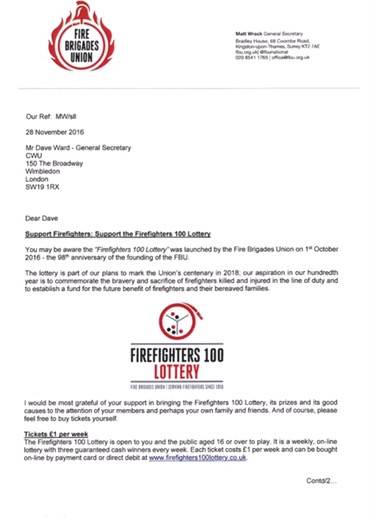
Support the FBU. Firefighters 100 Lottery 

The General Secretary has received the attached letter from Matt Wrack, General Secretary of the Fire Brigades Union and as requested we are 

bringing this to the attention of CWU Branches. 
You will see that the FBU General Secretary asks the CWU and its members to 

support the ‘Firefighters 100 Lottery’ which has recently been launched to 

help five key good causes. We are advised that at least 50p from every 

lottery ticket purchased will go towards these defined causes:- 

* Support the families of firefighters killed or seriously injured 

in the line of duty 
* Honour the bravery and sacrifice of those firefighters killed in 

the line of duty 
* Promote the lessons to be learnt from firefighter deaths and 

serious injuries 
* Support research into the physical and mental health and 

well-being of firefighters and the ‘all hazards’ nature of the modern fire 

and rescue service 
* Support humanitarian assistance, including internationally, for 

those affected by fire or disaster 
We hope that branches can give consideration to this initiative from the FBU 

and share this information with colleagues. 
Further information on this can be found at 

www.firefighters100lottery.co.uk https://www.firefighters100lottery.co.uk

WORKERS’ WRITES CREATIVE WRITING COMPETITION

WORKERS’ WRITES CREATIVE WRITING COMPETITION
Dear Colleagues,
“If you don’t write your story yourself, someone else will do it for you. So you’ve got to get out there and write it,” (Benjamin Zephaniah).
In the past few months we have seen a number of media stories placing the blame on the working class for a whole range of society’s ills, from Brexit to Donald Trump. Typically the working class have been ignored and even told that they don’t exist for decades and then all of a sudden we are rediscovered – in order to be made a convenient scapegoat for the wider failings of our political and economic system. Our culture and media are increasingly dominated by middle and upper class voices. It is time for that to change.
The CWU Education & Training Department have launched the Workers’ Writes creative writing competition in order to encourage CWU members to feel confident in expressing ourselves and telling our stories. The competition is open to all members from now until 1st March 2017.
Write a short story, poem or other form of creative writing around the theme of ‘Making My Mark’. Entries can be up to a maximum of 1,000 words – or as few as you need. They can be funny, sad, moving, angry – whatever you want them to be.
All entries should be sent to learn@cwu.org or
Workers’ Writes CWU Education & Training Department 150 The Broadway Wimbledon London, SW19 1RX 

Entrants must ensure that they include their name, contact details and CWU Branch.
The competition is supported by Express Yourself, an online course on CWU Left Click.
The course offers tips and tricks for creative writing and also helps with practical writing skills like writing a formal letter and how the English language works. The course is available now on http://www.cwu.org/leftclick

A poster advertising both is attached to this document. Could all branches please circulate to encourage maximum participation.
Yours sincerely,

TRISH LAVELLE

HEAD OF EDUCATION & TRAINING
Email Attachments – Click to download
LTB 697/16 – Workers’ Writes creative writing competition

Creative Writing Poster

OFCOM –Digital Communications Review

OFCOM –Digital Communications Review
Following press coverage this morning announcing that Ofcom is proceeding with a formal notification to require the legal separation of Openreach from BT. Please find attached a briefing to members which should be distributed as soon as possible.
Any enquiries in relation to this LTB please contact nmarshall@cwu.org.
 
Yours sincerely,
 
Andy Kerr

Deputy General Secretary (T&FS)
 
Email Attachments – Click to download
LTB 696/16 – OFCOM –Digital Communications Review

Ofcom Digital Communications Review

CWU NATIONAL CAMPAIGNING DAY – SATURDAY 3rd DECEMBER 2016

CWU NATIONAL CAMPAIGNING DAY – SATURDAY 3rd DECEMBER 2016
Firstly, I would like to thank all regions and branches who have supported the Postcard Campaign so far. The response has been fantastic and we know branches have collected thousands of signatures already. 
You will be aware that further strike action has been called for this Saturday, 3rd December 2016. 
With this in mind, and to maximise the levels of returns on our postcards, we are calling a National Day of Campaigning on Saturday. All branches, including those without Post Office members should target at least one big workplace or a local area of high footfall (high street or town centre, if you have no Crown Office) and collect as many signatures as possible for the campaign. This day of action should be viewed as a priority commitment. 
If branches need additional postcards in order to carry out this work, please email Marcia Murray mmurray@cwu.org as a matter of urgency. 
Finally, we ask that Branches share videos and photos from the day of activity (and throughout this campaign) using #PeoplesPost on social media. 
 
Yours sincerely
 
 
Dave Ward Terry Pullinger
General Secretary Deputy General Secretary (Postal)
Email Attachments – Click to download
16LTB694 – CWU NATIONAL CAMPAIGNING DAY – SATURDAY 3rd DECEMBER 2016

Eastern Labour backs CWU Post Office struggle

Eastern Labour backs CWU Post Office struggleUnanimous support for the fight to save our Post Office and hundreds of signatures on CWU campaign post cards added up to a “huge success” at this weekend’s Labour East Regional Conference in Southend, reports Paul Moffatt.
A proposition setting out the union’s strategy for overcoming the crisis in the Post Office was formally moved by Paul, CWU Eastern Region secretary, seconded by regional political committee chair Andy Beeby and adopted as a resolution by the conference, which also heard supporting speeches from Kelvin Hopkins MP and Richard Howitt MEP.
In a hard-hitting address to delegates, Paul Moffat highlighted the Government’s privatisation of the Post Office through branch closures and franchising-out of services, the drastic consequences this is having and will continue to have on vulnerable people in society, on rural communities, and the damaging impact on workers’ terms and conditions.
The resolution calls for the immediate halt to franchising and closure programme and for the government to develop a new strategy with the introduction of a national post bank through the Post Office network.
In moving the proposed resolution, the CWU also called for the Regional Labour Party executive to make a submission to the Government’s consultation on the Post Office.
“The conference was a huge success,” Paul said, adding: “As well as the welcome support for our motion, over 250 Post Office in Crisis Post cards were signed and handed back by delegates personally pledging their support for our campaign to save the Post Office from destruction.
“It was pleasing to see how well respected we are amongst trade unions and Labour Party members who spoke and supported our resolution.”
Paul added that he had also been “extremely pleased to welcome back the fire brigades union FBU,” which has recently re-affiliated to the Labour Party.
“Our FBU comrades wholeheartedly supported our resolution and we were proud to second the FBU’s resolution on cuts to fire and rescue services,” he said.

MR PAUL MALONEY BRANCH CHAIR BIRMINGHAM AND DISTRICT BRANCH

MR PAUL MALONEY BRANCH CHAIR BIRMINGHAM AND DISTRICT BRANCH
Further to LTB 585/15, it is with profound sadness that I have to advise you that Paul Maloney, Branch Chair, Birmingham District Amal Branch passed away on Saturday 19th November 2016.
Paul was 53 years of age and had recently suffered a number of serious health issues, including sepsis and had been hospitalised twice, most recently at the start of November after contracting MRSA. Unfortunately, Paul was unable to survive these serious health issues and passed away peacefully at the Queen Elizabeth Hospital, Birmingham. 
Paul leaves a wife, Jackie and three daughters, Laura, Kate and Helen.
Paul will be remembered as an inspirational man who met his life changing challenges with great dignity and humour. I know that he will be sorely missed by all his friends and colleagues in the union.
At this sad time our thoughts are of course with Paul’s wife, daughters and all his close family and friends. I will on behalf of the CWU convey our deepest sympathy and condolences to them.
We would wish to take this opportunity to thank Branches, Reps and members for all of the support given to Paul in so many ways. This support meant so much to Paul, his family and the Birmingham District Amal Branch.
A further LTB will be issued detailing funeral arrangements for Paul in due course.
If you have any enquiries on this LTB, these should be addressed to the General Secretary’s Office at gsoffice@cwu.org quoting the reference GS1.1/LTB 684/16.
 
Yours sincerely
 
Dave Ward

General Secretary
Email Attachments – Click to download
LTB 684/16 – MR PAUL MALONEY BRANCH CHAIR BIRMINGHAM AND DISTRICT BRANCH

Post Office Crisis – Postcard Campaign

Post Office Crisis – Postcard Campaign
‎As branches will be aware, CWU members in the Post Office are currently in a major industrial dispute over job losses, branch closures and the closure of the defined benefit pension scheme. These are the latest in a series of significant cost-cutting measures and it is difficult to see a long-term future for the company unless the Post Office changes course.
Because the Post Office is still in public ownership, the dispute has an important political angle. The union is therefore running a major public and political campaign to exert pressure on the government, which is ultimately responsible for what is happening. This campaign, and the arguments we have been making, have resulted in widespread criticism of the Post Office and the government in both the media and Parliament.
In response to this the government launched a public consultation on the future of the Post Office earlier this month. It is extremely important that we now use this to get public support for our key demands and ensure that the consultation exercise does not provide the government or the Post Office with an excuse for not changing course.
We are writing to you because we need the whole of the union to get behind the next stage of our campaign and support our Post Office members. We will be sending out postcards, which respond to the consultation, to every branch and we are asking you to collect signatures for these over the next three weeks. The postcards call for an immediate halt to the cuts and a fundamental change in direction from the Post Office to protect our members’ jobs and what is a cherished public service.
We would urge branches to make every effort to get as many postcards as possible completed – by both the public and our members – and return these to CWU Headquarters before 12th December (these should not be sent to the government directly directly).
Our members in the Post Office are facing an extremely serious dispute and an unprecedented attack on their job security and terms and conditions. They need the whole of the union to get behind this campaign, just as we will ask all branches to support T&FS members in their disputes.
Branches are therefore asked to treat this campaign as a priority over the coming weeks and target large workplaces and any public meetings and events to get as many postcards signed as possible. Any queries on the contents of this LTB should be directed to GSoffice@cwu.org and any requests for postcards should be made to mmurray@cwu.org.
 
Yours sincerely
 
Dave Ward Andy Kerr
General Secretary Deputy General Secretary (T&FS)
Email Attachments – Click to download
LTB 690/16 – Post Office Crisis – Postcard Campaign

Create a website or blog at WordPress.com

Up ↑