
CWU 2018 Diary
Dear Colleague
We are now taking orders for CWU 2018 diaries. Please find attached a diary order form for your branch use. Please make copies and keep on file for future orders.
This year, we are completely revamping the design and layout of our diaries to give them a fresh new look.
We continue to offer branches personalised diaries at no additional cost. Branches can personalise an area on the front cover of the CWU pocket diary and also have the option to have a personalised page (printed on one side only) which will be inserted near the front of the pocket diary.
The CWU pocket diary is still priced at only £1.50 and the A5 desk diary is priced at just £2.50.
We also continue to offer branches bulk discount on pocket diaries only on orders of 1,000 or more for £1.20 per diary.
Branches ordering unaltered diaries should return their completed order form by no later than Friday 18 August. Diaries will be dispatched from week commencing Monday 11th September 2017.
Personalised branch diary orders only
Branch personalised diary orders must be returned by no later than Friday 19th May. On receipt of your order form you will be emailed the appropriate template(s), please ensure to include your email address as this is where your template(s) will be sent and further instructions. On completion the template(s) must be sent to Leanne Shiels at the diary manufacturer by no later than Friday 9th June 2017.
You will then be sent a proof which must be checked, signed off and returned back to Leanne by no later than Monday 19th June. Due to strict deadlines any orders or proofs received after this time will not be processed. Diaries will be dispatched from week commencing Monday 2 October 2017.
If you would like to use your 2017 diary template(s) and there are no changes please advise Marcia Murray.
Orders will be based on the following:
Minimum order to personalise front cover: 250 units
Minimum order to insert page: 500 units
Minimum order to personalise front cover and insert page: 500 units
All completed order forms must be returned to Marcia Murray in the communications department by no later than the dates given and all enquiries should be addressed to mmurray@cwu.org
Kind regards,
Chris Webb
Head of Communications, Engagement and Media
Email Attachments – Click to download
LTB 168/17 – CWU 2018 Diary
CWU Annual Conference 2017 : Equality Department – Social Evening And Fringe Meeting
CWU Annual Conference 2017 : Equality Department – Social Evening And Fringe Meeting
Please note a social networking event will take place on 22nd April at the Elstead Hotel at
8pm.
There will also be a Fringe meeting on Monday 24th April at the Hermitage Hotel from 1– 2pm. This meeting will be based on the White Ribbon Campaign on Domestic Violence. Each of the Chairs will speak on their equality strand and domestic violence. A guest speaker, Richard Murgatroyd from White Ribbon Campaign UK, will address the meeting.
Yours sincerely
Linda Roy
Assistant Secretary
Email Attachments – Click to download
LTB 169/17 – CWU Annual Conference 2017 : Equality Department – Social Evening And Fringe Meeting
RE-DESIGN UPDATE REPORT
RE-DESIGN UPDATE REPORT
Please find attached to this LTB a copy of the Re-design report that will facilitate and inform this week’s National Briefing on the 23rd March.
The report will give branches a comprehensive update on re-design and is a first step in engaging the whole Union in this crucial debate about the future of our organisation.
Please ensure a copy of the report is circulated to all CWU Representatives in your Branch.
Finally, we look forward to seeing you all at the National Briefing on the 23rd March and having an informed, positive and constructive debate as we take the re-design project to a new phase.
Any enquiries regarding this LTB should be addressed to the General Secretary’s Office at gsoffice@cwu.org quoting the reference GS1.1.
Yours sincerely
Dave Ward Tony Kearns
General Secretary Senior Deputy General Secretary
Email Attachments – Click to download
LTB 166/17 – RE-DESIGN UPDATE REPORT
TUC Disability Conference 2017 – Visitors
TUC Disability Conference 2017 – Visitors
The TUC Disability Conference 2017 is being held from Thursday 18th May to Friday 19th May 2017 at the TUC, Congress House, Great Russell Street, London WC1B 3LS.
The Conference times are as follows:
Thursday 18th May 11am to 6pm
Friday 19th May 9.30am to 5.30pm
The CWU are allowed a limited number of visitors to attend the Conference and places will be allocated on a first come, first served basis.
Should anyone be interested in attending the Conference, they will need to contact their Branch initially for funding, to include a £10.00 visitor’s ticket fee.
Please let me know if you would like to attend the Conference as a visitor by no later than Friday 7th April 2017.
Please note that places will not be reserved until a cheque for the £10.00 fee (made payable to ‘TUC’) is received in my office by the closing date.
Any enquiries regarding this LTB should be referred to the Equal Opportunities Department, email: equalopportunities@cwu.org
Yours sincerely
Linda Roy
Assistant Secretary
Email Attachments – Click to download
LTB 167/17 – TUC Disability Conference 2017 – Visitors
Prostate Cancer Awareness Campaign 2017
Prostate Cancer Awareness Campaign 2017
To: All Branches
Dear Colleagues,
Prostate Cancer is the most common type of cancer in men. It can be treatable if caught early. It usually affects men over 50 and is rare in younger men. It differs from most other cancers in the body, in that small areas of cancer within the prostate are very common. It may also stay dormant (inactive) for many years. Most Prostate Cancers grow very slowly. But in a proportion of men, Prostate Cancer can grow more quickly and in some cases may spread to other parts of the body, particularly the bones.
Below are some of the very basic facts and figures about prostate cancer.
Across the UK
Prostate cancer is the most common cancer in men.
Over 47,000 men are diagnosed with prostate cancer every year – that’s 130 men every day.
Every hour one man dies from prostate cancer – that’s more than 11,000 men every year.
1 in 8 men will get prostate cancer in their lifetime.
Over 330,000 men are living with and after prostate cancer.
In Scotland
More than 3,000 men are diagnosed with prostate cancer every year in Scotland.
More than 900 men die from prostate cancer every year in Scotland.
Every day two men die from prostate cancer in Scotland.
In England
Almost 40,000 men are diagnosed with prostate cancer every year in England.
More than 9,500 men die from prostate cancer every year in England.
Every hour one man dies from prostate cancer in England.
In Wales
More than 2,500 men are diagnosed with prostate cancer every year in Wales.
More than 600 men die every year from prostate cancer in Wales.
In Northern Ireland
More than 1,000 men are diagnosed with prostate cancer every year in Northern Ireland.
More than 200 men die every year from prostate cancer in Northern Ireland.
Most Common Cancer in Men
Prostate Cancer is the most common cancer in men and many feel like it’s hit them out of the blue. Often men have no signs or symptoms and little awareness of the disease that kills 11,000 men in the UK every year and the number of men with the disease is rising at an alarming rate. It’s vital they know they can turn to Prostate Cancer UK for support and information. The CWU is joining the Cancer Charities along with other organisations and employers to reach out to men and spread the word about Prostate Cancer. The Charity also needs more people to know about Prostate Cancer to raise money and help save Men’s lives through research, support and information.
What is Prostate Cancer?
Prostate Cancer can develop when cells in the Prostate Gland grow in an uncontrolled way. Often it grows slowly. It might never cause any problems but sometimes it’s more aggressive and needs treating, to slow it down or stop it spreading to other parts of the body.
What are The Symptoms?
Some men with Prostate Cancer may have no symptoms at all and some men may have some of these symptoms:-
needing to urinate more often than usual, including at night or needing to go again after two hours
difficulty starting to urinate
straining or taking a long time to finish urinating
a weak flow when urinating
a feeling that the bladder is not fully emptied
needing to rush to the toilet
dribbling urine after finishing.
Less Common Symptoms include
pain when urinating
pain when ejaculating
blood in urine or semen*
problems getting or keeping an erection – this isn’t a common symptom of a prostate problem and is more often linked to other health conditions such as diabetes or heart problems.
*Blood in urine or semen can be caused by other health problems. Talk to your doctor if you see any blood in your urine or semen.
Are You At Risk?
In the UK, about 1 in 8 men will get prostate cancer at some point in their lives. See attached document: ‘What is my risk of prostate cancer?’ to see if you are at risk.
High Risk Group – Over 50’s
Prostate Cancer mainly affects men over the age of 50 and your risk increases if your father or brother has had Prostate Cancer. Men are two and a half times more likely to develop Prostate Cancer if their father or brother has had it.
High Risk Group – Black African or Caribbean descent
Black men are three times more likely to develop Prostate Cancer than white men of the same age. If you’re a black man over 45, speak to your GP about your risk of Prostate Cancer.
Prostate Cancer Affects Everyone including Women
Prostate Cancer may be a male disease, but it is important that women know about it too. Women have husbands, partners, brothers, fathers and family members, so everyone is affected and it’s important that women know about it too!
Campaigns in 2017
Prostate Cancer UK is supporting many campaigns throughout 2017 and you can get involved wherever you are in the UK. See the links below for further information on how you can participate in 2017.
March For Men: http://prostatecanceruk.org/get-involved/march-for-men
Many events are planned across the nation in June – London, Leeds, Glasgow, Exeter, Newcastle and others being added all the time. A marathon walk visiting 40 Football Clubs is one confirmed event. Go to the above link if interested in participating, donating or sponsorship.
Find a Fundraising Event: http://prostatecanceruk.org/get-involved/find-a-fundraising-event
The new ‘find an event’ webpage helps locate just what those wishing participate want to do. By entering the dates, locations and type of event e.g. run, cycle, walk, gold, social event etc., the Charity Search engine does the rest and tells you what’s already been organised.
Further Information:
For further information about Prostate Cancer follow the link to the Prostate Cancer UK website:
http://prostatecanceruk.org/?gclid=CNOQxdPbydICFQ4UGwody8wDaw
London
Address: Prostate Cancer UK, Fourth floor, The Counting House, 53 Tooley Street, London SE1 2QN
Phone: 020 3310 7000
Contact online
Scotland
Address: Prostate Cancer UK, Unit F22-24, Festival Business Centre, 150 Brand Street, Glasgow, G51 1DH
Phone: 0141 218 4760
Contact online
North West England
Address: Prostate Cancer UK, 11th Floor, Regent House, Heaton Lane, Stockport, SK4 1BS
Phone: 0161 475 1720
Contact online
Prostate Cancer UK – Confidential Specialist Nurses Helpline: 0800 074 8383
Know Someone Who Needs Help or Information?
They can speak to a Specialist Nurse in confidence and free of charge on0800 074 8383.
Publications
Useful publications and information factsheets are available for purchase and download on the Prostate Cancer UK website:
http://prostatecanceruk.org/prostate-information/our-publications/publications
Attachments:-
Know Your Prostate
Prostate Cancer A Guide for Men Who’ve Just Been Diagnosed
What Is My Risk Of Prostate Cancer
Diet and Physical Activity for Men with Prostate Cancer
Raise awareness in your Branch – Order an Information or Supporters Pack:
An introduction to the prostate gland and common prostate problems Includes:- Know your prostate: a guide to common prostate problems, Understanding the PSA test and Diet, activity and your risk of prostate cancer.
Prostate Cancer UK’s Information Pack and Supporter Pack has all the resources you need to start raising awareness of prostate cancer.
Inside you’ll get posters, pocket guides and leaflets which explain what prostate cancer is, which men are most at risk, and what men should do if they are worried about their risk.
Included is the Man of Men pin badge which you can wear to show you’re a supporter of Prostate Cancer UK and the Stronger Knowing More campaign.
Links:-
http://prostatecanceruk.org/prostate-information/our-publications/publications/prostate-information-pack
http://prostatecanceruk.org/get-involved/black-men-and-prostate-cancer/help-us-spread-the-word/order-an-information-pack
Specialist Nurse Helpline 0800 074 8383:
Whether you have a Branch member who has been diagnosed or have concerns about prostate cancer, Prostate Cancer UK is here to give support. They can help individuals or help partners, family members, friends, and health professionals with any questions they have.
Call: 0800 074 8383
Mon-Fri: 9am-6pm
Weds: 10am-8pm
Individuals can e-mail by going to the Specialist Nurse Webpage at:
http://prostatecanceruk.org/get-support/our-specialist-nurses/email-our-specialist-nurses
Telephone translation service:
There is also a telephone translation service available via this helpline and the Prostate Cancer UK Specialist Nurses can speak to individuals over the phone, in their own or preferred language, via an interpreter. Just call 0800 074 8383 and say, in English, the language requested.
Yours sincerely
Dave Joyce
National Health, Safety & Environment Officer
“CWU – Supporting Prostate Cancer UK – Helping end male cancer deaths from Prostate Cancer”
Email Attachments – Click to download
Attachment 1 – LTB165/17 Prostate Cancer Awareness Campaign 2017
Attachment 2 – Know Your Prostate
Attachment 3 – Prostate Cancer A Guide for Men Who’ve Just Been Diagnosed
Attachment 4 – What Is My Risk Of Prostate Cancer
Attachment 5 – Diet and Physical Activity for Men with Prostate Cancer

CWU NATIONAL WELFARE FUND
CWU NATIONAL WELFARE FUND
Please find below the branch breakdown of CWU National Welfare Fund donations which were made in 2016.
BRANCH
REASON
AMOUNT
Bristol & District Amal
Illness
£1,000
Bristol & District Amal
Domestic
£1,000
Capital
Illness
£850
Colchester & District
Illness
£600
Croydon & Sutton Amal
Domestic
£300
East London Postal
Illness
£1,000
East Midlands
Illness
£1,000
Eastern No. 5
Illness
£1,000
Glasgow & District Amal
Domestic
£1,000
Gloucestershire Amal
Domestic
£1,000
Great Western
Domestic
£530
Greater Mersey & South West Lancashire
Illness
£1,000
Greater Mersey & South West Lancashire
Illness
£700
London Parcels & Stations Amal
Illness
£1,000
Mersey
Bereavement
£1,000
Newcastle Amal
Domestic
£1,000
Newcastle Amal
Illness
£500
Northern Ireland Combined
Illness
£1,000
Portsmouth & District Postal
Domestic
£1,000
Romford Amal
Domestic
£750
South Central Postal
Bereavement
£1,000
South Central Postal
Illness
£1,000
South Wales
Illness
£1,000
Total
£20,230
Also in order to assist Branches with making claims please find attached all the relevant information and paperwork.
Any enquiries regarding this LTB should be addressed to the Senior Deputy General Secretary’s Department on telephone number 020 8971 7237 or email address sdgs@cwu.org.
Yours sincerely,
TONY KEARNS
SENIOR DEPUTY GENERAL SECRETARY
Email Attachments – Click to download
LTB 156/17 – CWU National Welfare Fund
Royal Mail and Manpower Recruitment Trial
Royal Mail and Manpower Recruitment Trial
Branches and Representatives are advised that the union has been approached by the business regarding a proposed trial of a new recruitment process in partnership with the Manpower Employment Agency, primarily for the delivery function.
Listed below are the proposed locations and a summary of the trial, inclusive of the terms and conditions that will apply.
A trial in three geographies:
East – Redhill, Derby, Ipswich, North West London
West- South Coast East – Warrington, Wolverhampton
North – North West Scotland, Sheffield North, Darlington, Durham
New recruits will be sourced from the Manpower Employment Agency instead of being directly recruited by Royal Mail.
These new recruits will be paid by the agency for the first 8-12 weeks, at a rate believed to be minimum wage, although when directly asked the actual pay rate the response was not clear.
There will be a review of the individual by the DOM in the Delivery Office at the 8 week stage from commencement of employment to establish whether “either party” wishes to continue employment.
The potential for full Royal Mail pay terms and conditions at the 12 week stage, along with a substantive contract of employment.
The CWU view this trial as wholly unacceptable and believe that not only is it in direct conflict with our agreements but is an affront to decent employment terms and conditions for working people.
In essence we believe that this trial is an attempt by the company to cover up its completely inadequate recruitment processes currently in place, rather than ensure that they are fit for purpose. It is also our considered opinion that this is a direct attempt to save money and circumnavigate the principles of recruiting new entrants to the business in line with our agreements.
It should also be noted that this proposed trial is and remains un-agreed with the CWU and that any attempt by the business to apply this un-agreed method of recruitment should be challenged by local Representatives, with immediate action sought to maintain the status quo in line with the terms of the national IR Framework Agreement and brought to the urgent attention of the appropriate National Officer
It is therefore essential that this LTB is discussed with local Representatives (especially in the trial sites named above) and they are advised to go to immediate disagreement insisting that the vacancies are recruited directly on Royal Mail contracts and RM terms and conditions. Equally they should demand that the status quo (in respect of not using this new Manpower approach) is maintained until the disagreement has been dealt with.
Any attempt by the business to ignore the terms of the IR Framework will be deemed as executive action and the appropriate action taken by all means necessary to defend our National Agreements.
The CWU believe that this un-agreed initiative is in conflict with our legally binding agreements and we will be considering our next steps in regards to the legal status of the trial should the business deploy via executive action.
Any enquiries in relation to this LTB should be addressed to the DGS(P) Department quoting reference 24000.
Yours sincerely
Terry Pullinger
Deputy General Secretary (Postal)
RE: Shorter Working Week Claim – Full Time working week from 39hrs to 35hrs
Dear Colleagues
RE: Shorter Working Week Claim – Full Time working week from 39hrs to 35hrs
Please see below CWU claim to Royal Mail for a ‘shorter working week’.
Jon Millidge
Royal Mail Group Group
HR Director 3rd Floor
100 Victoria Embankment
London
EC4Y 0HQ
Dear Jon
CWU Claim to Reduce the Full-Time Working Week from 39hrs to 35hrs
Further to our meeting on the 14th February 2017, I am writing to you to formally submit the CWU’s proposal to achieve the Union’s policy in regard to the above.
I believe it is very important to stress that this claim is not based on some fanciful desire to simply work less hours out of pure self-interest. It is a claim that the CWU believe is totally live to the current and emerging challenges of our time and our industry.
As a company you make great play of the fact that: you are one of the biggest employers in the country; you have a significant socio-economic impact in the UK; you contribute to social inclusion through employment and earnings and that you campaign for decent employment models across industry. You also say you are committed to the health and wellbeing of workers, alive and responsive to mental health and musculoskeletal issues and committed to improving the environment. It is therefore hard to believe that you are not aware of the growing academic debate on working hours, the evolving developments in the world of work and the potential benefits to companies, employees and wider society.
Leading experts in social economic and environmental science have highlighted how moving towards shorter hours of work could help tackle urgent problems that beset our daily lives from overwork, unemployment and low wellbeing to entrenched inequalities.
Over recent years, Postal Workers have felt greater pressure at work. Many members feel overworked and stressed as they endeavour to balance home life with the demanding requirements of the job, as tasks are compressed and the pace of their work increased.
Our members, your employees have faced the consequences of serious resourcing issues created by the business; greater problems taking time off/annual leave, growing concerns about the impact of automation and particularly in deliveries, longstanding issues around delivery spans and manageable workloads.
Evidence that shorter hours can boost output has been around for decades. Recent research by the New Economic Foundation (NEF) confirmed the benefits of shorter hours and set out the case for a reduced working week. According to the NEF, those who work less tend to be more productive hour for hour than those regularly pushing themselves beyond the 40 hours per week point. They are also less prone to sickness and absenteeism and therefore make up a more stable and committed workforce.
Royal Mail’s operational Lead Managers have constantly quoted to us other countries as examples of how we should work, so you should welcome our research which offers the opinion that shorter working weeks can be competitive too: the Netherlands and Germany have shorter working weeks than in Britain and the US, yet their economies are as strong or stronger. The latest trailblazers for the shorter working week are in Sweden, where a variety of major companies have cut their working week to improve wellbeing and as a result have reported significant improvements in productivity and lower rates of staff turnover.
Improved Health and Well-Being
In the UK, the truth is that despite working fewer hours than our grandparents and parents, most surveys paint a picture of British workers feeling exhausted and under growing pressure. A recent report by the Chartered Institute of Personal Development (CIPD) found many employees feel under “excessive pressure” with “far too many people doing more work than they can cope with”. It described a “wellbeing vacuum” in UK workplaces, which is costing UK employers dearly in absenteeism. These findings confirmed an earlier CIPD Report which found that;
employees felt they were working harder;
the work was more demanding and intense;
with overwhelming and numerous deadlines burdening workers with even more tasks.
Indeed by your own admission Royal Mail found that two of the major causes of long-term sickness in the business are mental illness and musculoskeletal problems. Moreover, the Mental Health Foundation states that “the pressure of an increasingly demanding work culture in the UK is perhaps the biggest and most pressing challenge to the mental health of the general population”.
Employees who work fewer hours are less prone to sickness and absenteeism and make up a more stable and committed workforce. The TUC declares Britain’s long hours culture is having a detrimental effect on productivity and health, which research has revealed to result in bad health associated with a range of physical and mental illness.
In Royal Mail, the hours and intensity of the work our members perform are increasing daily pressures and creating added stress and ill health. The Health and Safety Executive have identified the factors that can cause stress at work (if left unmanaged) and a number of these reflect the problems many of our members face in the workplace. These include feeling unable to cope with the demands of the job, not having a proper say about their work, not getting enough information and support from Managers, changes to job responsibilities and frequent changes within the organisation.
Increased Productivity
Shorter working weeks can improve productivity and spur innovation. Common sense suggests that people have better ideas and tend to get more done when they are fresh than when they have worked hours on end. Research evidence also confirms that employees who work less tend to be more productive hour for hour than those working longer hours.
Some of the happiest, most efficient and best paid nations also work the shortest hours including Germany, the Netherlands and Switzerland. Germany for example is the strongest European economy but the population works fewer hours than most other major nations. On average, Germans work a 35hr week but their productivity is higher than the UK.
Better Work-Life Balance
Spending less time at work will improve employees’ work-life balance, allowing individuals to better manage their job, family and domestic responsibilities. Further research by NEF detailed that there are clear benefits for individuals, families and society from cutting working hours. Workers can spend more time with and care for their friends and families, improve the costs and availability of childcare, promote gender equality and allow people to make more of later life.
Fourth Industrial Revolution
Stealing a march on the inevitable is an influencing factor in the Union’s general thinking in regard to the ‘Pillars of Security’ we are seeking and the Fourth Industrial Revolution should not be ignored as its threat is unlike anything humankind has experienced before. The pace of technological development is frightening and the progress of issues such as artificial intelligence (AI), autonomous vehicles, 3D printing and many more threaten our members’ jobs.
Equally, we have the emergence of the ‘gig economy’. The gig economy is an environment in which temporary positions are common and businesses contract independent workers for short-term engagements. It is a way of working that is based on people having temporary jobs or doing separate pieces of work, each paid separately. Rather than working for an employer, workers eke out a living in the gig economy doing odd jobs whenever they can. These are major threats which could be hugely damaging to workers but also managerial thinking in respect of placing obsessive profiteering and shareholder return above the spirit and intent along with the security our agreements reflect. If the company is still committed to our agreements as well as the many other aspects of the CWU, they must consider the merits of the SWW.
We believe shorter working hours can help address a number of issues the business and our members face around automation, resourcing and workloads, overtime and part-time employment. It must be remembered that shorter working hours does not always translate into shorter working days but can also be used to create inventive duty patterns of less days or long and short days or weeks.
We do not believe that the move to 35hrs is a straight issue of time or pay as we all clearly have to be mindful of our members’ future standard of living. We believe that there are many layers of potential fit that can take account of all of the challenges we face, the interests of our members (your employees) and helps the company to live up to the corporate responsibility principles you present to the wider world.
In keeping with these principles, we have sought to be open and transparent with both our vision and our negotiating position. I have therefore provided below the wide range of negotiating principles agreed by the Postal Executive that we believe would enable us to move our claim forward in a mutually agreeable manner that addresses the needs of all parties:
1. We establish the principle that a full-time OPG job in Royal Mail is 35hr gross as quickly as possible.
2. All full-time jobs established from the date of the agreement will be based on 35hrs gross at the current hourly rates applicable to the appropriate grade.
3 Between the 1st April 2017 and 1st April 2019 current full-time employees and
those currently working between 35 and 39hrs gross, will see their hours reduced in three stages to 35hrs gross. New full-timers already on the 35hrs gross will see their pay increase in three stages until both hours and pay are equalised for all grades.
4. Current full-timers can take a buy down of hours to a 35hrs gross full-time job, incentivised by a two year lump sum on the difference in basic pay upon introduction of the change and then a one year lump sum thereafter.
5. Current full-timers can elect to remain on current hours as an extension of contract from the 35hrs norm and receive the appropriate new hourly rates through the transition process.
6. We do not accept that reward should be translated as hours or pay. We will have to understand management’s proposals for the next three years in respect of productivity and new technology, job reductions, the savings they envisage, shareholder targeted returns, product and revenue growth expectations, inflation and the businesses intentions in respect of pay awards over the next three years.
7. Explore the potential for local and national productivity schemes to support further reward.
8. Some members already enjoy reduced working time via protected time-bonus reward and any final agreement must ensure equality in benefits received.
9. Provide opportunities for people to contract to work more than 35hrs on an individual basis.
10. Consider the issue of hourly overtime rates and allowances through the process.
11. Recognise that across Royal Mail Group there are different start points in different business units, functions and grades along with a range of current arrangements based on both Gross and Net working week models. Equally recognise that the operational and commercial challenges can vary greatly in these areas which have led to the adoption of different approaches to the shorter working week in the past. As such, work has commenced to consider and develop policy options in relation to the provision of equivalent benefits to other CWU grades currently not on a 39hr gross working week for future consideration by the Committee.
12. That negotiations will have to ensure that meal relief entitlements are reviewed so no benefits from the introduction of a shorter working week are lost.
This represents our formal claim and the rationale behind it. What we would now welcome is a detailed response from the business that addresses the merits of our case, the rationale behind it and our proposed framework for taking it forward.
Thank you for your time and I look forward to your reply.
Yours sincerely,
Terry Pullinger Deputy General Secretary (Postal)
Royal Mail Group Safety Health and Environment Team Re-Organisation Supporting RM Operational Move from Three to Four Regions – From 01.04.17
Royal Mail Group Safety Health and Environment Team Re-Organisation Supporting RM Operational Move from Three to Four Regions – From 01.04.17
To: All Branches
Dear Colleagues,
Introduction:
Dr Shaun Davis RMG Global Director of Safety, Health, Wellbeing and Sustainability has announced the new RMG SHE Team structure and appointments to the various positions and roles within his re-structured team.
The RMG, Group-wide structure, strongly favoured by the Union is retained and the centralised SHE function is strengthened, in order to support the Operational move from three to four Regions, effective from 1 April 2017.
In his announcement yesterday evening, Shaun Davis said that the changes were driven by Royal Mail’s Regional re-organisation and the intention was to undertake organisational realignment and rebalance his team across the four Regions and to minimise operational impact. The total SHE Team review is headcount neutral at 80 people.
Two issues raised by the CWU Health, Safety and Environment Department in respect of the previous structure was firstly the need to put in place direct links with the main Royal Mail Operational functions in the business, namely Delivery, Processing and Collections and secondly to reintroduce a senior role in the Central SHE team to deal with CWU Escalations and Disputes procedure under existing agreements. These issues have been fully addressed within the new structure.
The Restructured SHE Team Summary:
The SHE Central Leadership Team under Shaun Davis will be Andy Pearson Head of SHE Field Operations, James Radley Head of SHE Standards and Programmes and Mike Shakeshaft Head of Occupational Health Operations. Sarah Foord becomes SHE Business Manager.
Of the existing three Regional Heads of Safety, Brett Thomas is retiring, and Mike Shakeshaft and Steve Greaves move to Central SHE Team functions.
The new Regional Heads of Safety are (North) Freddy Warnock, (West) Phil Hinchey, East Robert Kelly and (South) Jayne Callaghan-Jarvis.
Head of Safety in Logistics is Matt Humphreys a new recruit to Royal Mail who replaces Lisa Durrant who has moved to another position outside SHE.
Head of Safety for Commercial remains as Stuart Harrison who covers Parcelforce, RMSS and International.
All Heads of Safety report to Andy Pearson Head of SHE Field Operations.
See attached Power Point ppt file setting out the structure and appointments in the reorganised RMG SHE Team, in fine detail. The ‘SHE Business Partner’ positions are to be filled and one other senior Central position is to be confirmed.
The key Royal Mail Regional Changes, Previously Announced Are:
South East, Guildford, London, Essex, part of Anglia and part of Home Counties North will form the new South region;
Most of Anglia, Home Counties North and Great Western, together with all of East Midlands and part of South & West Yorkshire will form the new East Region;
Cheshire & Merseyside, West Midlands, South Wales & Gloucester, South West, South Coast and part of Great Western will remain in the West Region;
North West England, West of Scotland, Yorkshire, Tyneside, and East Scotland & NI will form the North Region;
Where Delivery Directorates have been split, RODs will discuss the impact on an individual basis – however, there will continue to be 18 Delivery Directorates, so it is expected that the Operations infrastructure will simply realign.
Yours sincerely
Dave Joyce
National Health, Safety & Environment Officer
Email Attachments – Click to download
LTB 151/17 Royal Mail Group Safety Health and Environment Team Re-Organisation Supporting RM Operational Move from Three to Four Regions – From 01.04.17
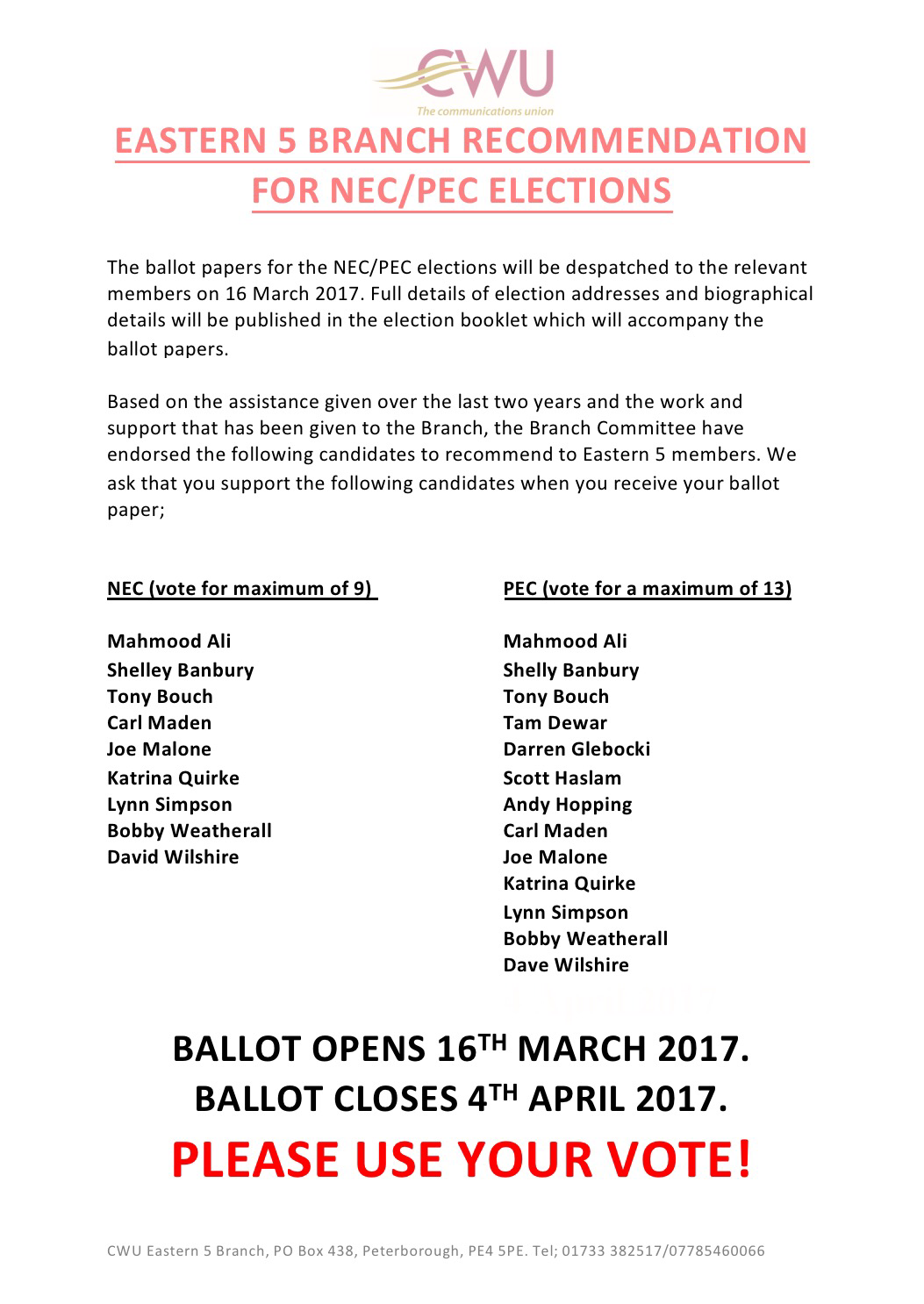
 CWU Eastern No5 Branch