Royal Mail Materials Handling Containerisation Update & Christmas Arrangements 2020 – Health & Safety Aspects

Royal Mail Materials Handling Containerisation Update & Christmas Arrangements 2020 – Health & Safety Aspects

Below is a summary update on Materials Handling Containerisation Arrangements for the 2020 Christmas period. The contents of this LTB have been discussed and agreed with Royal Mail HQ, Central Containers Team, Safety, Health & Environment Team and Head of Assets.

  1. York Containers

Royal Mail has purchased an additional 70,000 Mk3 York Containers and these, along with 552,000 (Mk1, Mk2 and Mk3) York Containers already in circulation since March due to the accelerated increase in Parcels into the RM Network brought on by the COVID-19 Pandemic and increase in e-commerce, a total fleet of around 622,000 Yorks will be in service during the Christmas pressure period. The 70,000 Yorks purchased is the highest volume of Yorks RM has purchased in a single year which was increased from a planned 34,000 due to the increase in parcels as a result of the pandemic. This is the largest order placed with the supplier, which took up their entire remaining capacity.  No further options to fabricate more Yorks is available with any supplier. Despite this large order of Yorks there is still a 30% shortfall of Yorks for the peak period of 2020 so alternative arrangements for some customers as well as contingencies within the network are required to maintain service.

Royal Mail will be looking for Yorks to be filled with the maximum 7 layers of 4 trays (28 Max), wherever possible subject to safe systems of work, weight constraints of the container and subsequently the vehicle weight limits on to which they will be loaded to comply with Safe Systems of Work and both Health and Safety and Road Traffic Act Legislation.

York Containers primarily carry mainly stacked parcels, trays or mailbags without a sleeve or small parcels and packets in ALP (Auto-Level Packet) sleeves or cardboard sleeves.

All Mk1, Mk2 and MK3 York Containers introduced in previous years have continued to be maintained, modified and updated through rework programmes as identified by the Royal Mail Assets, Containers and Manual Handling Equipment Team in consultation with the CWU Health, Safety & Environment Department and as previously reported in updates to Branches and Area Health and Safety Reps. Mk’s 1, 2 and 3 amount to the vast majority of the 622,000 York Containers.

Of the 70,000 Yorks which have been purchased this year, 10,000 will have a variation to the base based on a MK4 base type construction.

This is purely down to production issues with K Hartwall with the injection moulding supplier they use who produce our Yellow plastic bases.  Working jointly with RM and CWU it was agreed to use a proposed solution which K Hartwall are fabricating to the highest speciation at their expense to ensure our order does not impact on Christmas operations.

The bases will be swapped out for Yellow bases following peak through standardised repair flows as and when they go into service.

These are fabricated to the highest standard and meet all ergonomic requirements and in no way are any different to the operational uses and can be nested and operated in the exact same way as the Yellow bases.

Please Reference the attached document for photos – MK3 York Bases (COVID)

1(a). York Container ALP Sleeves

Royal Mail, over the last 3 years purchased 120,000 new ALP Sleeves all of which were released into the network.  A further 51,000 MK1 ALP Sleeves were purchased this year to support the increase in parcels brought on by the pandemic.  The Grey Mk2 ALP Sleeves, which include a modification to allow the ALPs to be automated/tipped within the Parcel Sortation Machine (PSM) Mail Centers (MCs) deployed as part a National Joint Trial as agreed with both the CWU Health, Safety & Environment Department and the Postal Department, have continued to be modified with some localized trials to improve the resting height of the bases.  Trials of improved Mk2 ALP Sleeves, with uprated return springs, are underway, within a closed loop operation following joint CWU/RM discussions and feedback sessions. The outcome of the trial will be considered in due course and will conclude with the replacement of all existing (Grey) Mk2 ALPS being replaced.

1(b). York Container – Cardboard Sleeves

Although Royal Mail has centrally purchased a further 51,000 New Red Mk1 ALP Sleeves this year, as Royal Mail moves further into the busiest period at Christmas, and parcel volumes begin to peak, the need to move parcels through the network quickly becomes critical and demand for ALP Sleeves increases. Even though Royal Mail has put 320,000 additional York Containers and 300,000 additional ALP Sleeves in to the network over the last seven years, amounting to 620,000 York’s in circulation with over half of those fitted with an ALP Sleeve, Royal Mail has informed us that with increasing parcel volumes and large tracked customers there may be problems with sites struggling to get sufficient numbers of ALP Sleeves to meet their operational requirements. The Central Container Team will continue to push the Zonal Areas to ensure that they clear their Delivery Offices every day and repatriations from gaining sites take place but they may still struggle to meet the demand at key locations. Royal Mail has assured CWU/HQ that they will do everything possible to ensure that Zonal Areas repatriate as many York Containers and ALP Sleeves as possible out of their Delivery Offices however the business is now seeing the continued increase in parcel volumes and traffic accelerated through COVID-19. As a result, Zonal Areas will probably struggle to get sufficient ALP Sleeves back into their Parcel Sort Centre operations and losing Mail Centers to meet demand. As and when critical emergency situations are reached in Offices, Royal Mail has proposed and CWU/HQ has agreed that, the use of Cardboard Sleeves/York Inserts will be permitted as a last resort – with agreement with the RM CPC/Container Team as follows:

(a)  As a contingency supply source at Mail Centre’s on all mail streams (including PSMs), PSCs and RDC’s for outward dispatches and inward dispatches to DOs.

(b) For outward dispatches by Mail Centers (including PSMs) and Parcel Sort Centres.

(d) Before this contingency is implemented however the site must ensure that all efforts have been made to get ALPs back from their DO’s and that permission has been sought and been given by the RM Container Team.

(e) Designated and approved Customer Streams to MC and DO (AMZ DI/DDU).

(f)   To move essential PPE and cleaning supplies through to the operation.

IMPORTANT: – If Cardboard Sleeves/York Inserts are used as a contingency, the site must ensure that:-

(a) The CWU Area Safety Representative and Area Processing Representative are consulted should this contingency need to be implemented.

(b) That the SSoW is followed at all times, rotating duties if necessary.

(c) That the mandatory cross-members and false bases must be fitted and used correctly in Cardboard Sleeved York Containers. Any Offices found not to be compliant with this instruction will be asked to investigate reasons why this has happened and furnish a report on remedial action taken with the report shared with the CWU Area Safety Representative. Such breaches of the SSoW by management will be viewed as serious!

If the demand for parcels decreases, the contingency use of Cardboard Sleeve Inserts will be withdrawn and Offices will revert back to business as usual with Cardboard Sleeves used on the agreed Amazon/Tracked Contracts only and the parcel operation must revert back to using ALP Sleeves for inward transfers to DOs and outward dispatches to Mail Centres and Regional Distribution Centres.

The cardboard MUST be in good order; the cross member and base must be inserted in compliance with the SSoW at all times.

Under no circumstances is damaged cardboard to be used and it must be discarded locally.

For reference to the current, agreed York Container SSoW (See Attachment).

For reference to the Safe Systems of Work (SSoWs) for York Containers and the new design Mk2 Cardboard Sleeves‎ (See Attachment).

1(c). York Containers – Loading Parcels of a Shoe Box Size or larger.

In previous years both Royal Mail, Tracked Customer and Amazon had concerns about the shortage of York Containers across the network and additional costs incurred by losing approximately 15% of York fill capacity when inserting Cardboard Sleeve false bases into York Containers. In line with the York Container SSoW, York Containers will be filled and stacked with parcels/packets larger than shoe box size without any form of Cardboard Sleeve or false base etc. This approach is only applied to larger items and Sleeves, Bases and Cross Members will not be removed for smaller packet items, i.e., those smaller than a shoe box size. Those packets will continue to be loaded into York Containers with either an ALP Sleeve (preferable) or a full Cardboard Sleeve with a cross-member and false base fitted. This was jointly examined and found to be the best approach.

The York Container SSoW, under the heading of ‘Approved Loads’ includes the following:- ‘loose strapped bundles and boxes which are of sufficient dimensions, that they will be retained by the load retention straps and metal container framework.’  (See Attachment).

This approach has been ergonomically tested and approved prior to concluding the York Container SSoW. It makes both safety and business sense to apply this principle for larger parcels which are not suitable for loose loading into sleeved Yorks in most cases.

1(d). York Containers – Use of Shrink-Wrap/Cling-Film

The existing agreed national policy remains as follows “There is no agreement whatsoever to use “Shrink-Wrap/Cling-Film” on York Containers under any circumstances. Also, Opsflash – CPC (2008) No 167 instructs all sites that have received new trays delivered on pallets and shrink wrapped to remove and dispose of the shrink wrap immediately. There are NO circumstances where the shrink-wrapping of Yorks is acceptable. This practice must not be allowed at any RM site.

  1. RSCs Rigid Stackable Container

RSCs are not intended for BAU usage inside Mail Centres and Delivery Offices and are primarily for the Distribution Centre’s and Parcel Sorting Centre network.  However with a shortfall in Yorks, there may be circumstances which require flows on a contingency basis for the transfer of workflows where there is sufficient space and where risk assessment and Safe Systems of Work requirements apply.  In respect of workplace transport hazards from FLTs and crush hazards etc., specific Personal Protective Equipment (PPE) regulations requirements also apply in these work environments, e.g., high visibility clothing and protective footwear. RSCs may only be used in risk controlled working environments as per the Safe Systems of Work.

  1. FSC Folding Stackable Containers 

As Above

Safe Systems of Work (SSoW) are located on a plate on the side of the container. (See Attachment).

MCs/DOs should not receive FSCs, however, if received they should be returned to the local RDC as soon as possible.

  1. Cardboard RSCs/Cardboard Euro Pallet Boxes/Amazon Gaylord Pallets/ Shrink Wrapped Pallets

As originally reported in LTB 632/05 these types of containers have been successfully utilised during successive Christmas pressure periods since 2005, and were introduced to provide contingency ‘back-up’ container assets as York Container use is maximised, as opposed to using Yorks and RSCs when in short supply so these are brought into service and used during the Xmas pressure period mainly for customer use. These are used primarily in the RDC, PSC network, RM International BAU streams and used as a ‘contingency measure’ for when demand outstrips supply of Yorks and RSCs for agreed flows – as an alternative.

These variant containers are folding, heavy-duty cardboard containers with the base fixed to a standard wooden Euro Pallet.

25,000 Euro Pallet Boxes have been purchased this year and are available as a contingency back-up as an additional container type during the Christmas peak period and intended:

  • For use anywhere in Royal Mail’s network and at large customer premises.
  • For storage of empty bags and trays to release RSCs into the network.
  • For conveyance of Customer Parcel Returns.
  • For conveyance of Customer Collections.
  • For conveyance of parcels within the RM network (RDCs, MCs, PSCs & Customers).
  • For use in RM International BAU flows.
  • For conveyance of empty bags to customers.
  • For empty bags, empty trays and bags of mail.

CRSCs and Euro Pallet boxes are intended to be:

  • A reusable container and serviceable for over 8 trips per usage.
  • Used indoors and in the network, but NOT for external storage where they may get wet.
  • Folded flat when being stored empty.

For agreed uses and safety information on CRSCs, Euro Pallet Boxes, Pallets and Amazon Gaylord Pallets loads please reference attached SSoWs.

  1. ‘A’ Frame Roll Containers 

As originally reported in LTBs 838/06 and 840/06, 12,000 supermarket type ‘Roll Cage’ Containers were introduced in 2006 by the Royal Mail Group Procurement Operational Equipment Team, manufactured by ‘Palletower’ and ‘Cargo Pak’. They were strictly intended for internal use (inside Offices) and for storage purposes only, in order to free up much needed York Containers. Since their introduction, the number of York Containers has doubled and the limitations of these ‘Roll Cages’ have seen them become outmoded against the all-round far superior York Container. These containers have therefore and will continue to be run down, phased out and withdrawn from Royal Mail service. SSOW – (See Attachment)

For removals of the containers please contact: container.reporting@royalmail.com

  1. Loose Loading of Mail Bags – Christmas 2020

Further to enquiries and concerns raised by Branches and Area Safety Reps in previous years regarding possible loose loading, Royal Mail has confirmed they will be taking a number of steps to ensure that loose loading of mail should only take place in exceptional circumstances, as a last resort due to container supply shortages.

If loose loading has to occur, local CWU Reps will be consulted and the Manual Handling/Loose Loading SSOW will be adhered to. 

Clear instructions have been issued by Royal Mail HQ CPC that should any service which is normally containerised have to be loose loaded, then the dispatching unit must inform the receiving unit in advance so that they can provide any additional staff resources and working arrangements which may be necessary to ensure health and safety standards are maintained.

Extract from Loose Loading Core Risk Assessment: 

It is a Royal Mail goal that no manual handling task will exceed risk level 2.  Mail Bags average 7kg, maximum gross weight 11kg. Lifting frequency up to 7 bags/minimum over a 30 min period (then rest). Vehicle doors are adequately maintained and must be in good working order.

Priority Services bags could exceed 11kgs but they should be clearly labelled with the weight so that special consideration can be given to lifting. NB: No Priority Services Bag exceeding 11kgs should contain more than 1 item. All equipment is used in accordance with the appropriate Safe System of Work. All staff to have received manual handling training and instruction or refresher training during the past 3 years.  All staff to understand and operate the appropriate Safe System of Work. If there are any tasks that are not listed, the manager must consult the safety team for further advice. No pregnant worker or person under 18 should undertake tasks greater than risk level 1.

  1. Plastic Letter Trays

Last year RM purchased 1m trays which stayed in the system. Letter decline has meant Royal Mail has purchased an additional 600,000 trays this year as demand is no longer as high, these are already in production and will be delivered directly from suppliers during November and December.

  1. New Blue Bags for International Dispatches

2.5 million new blue bags for international dispatches have been purchased this year and will be fed into Mail Centers via direct delivery in November ready for the DSL Operation.

New RM International MB4L Bags for Automation

RM International has this year deployed a new larger blue bag for use within its Automation Streams known as the MB4L. These bags are not to be used in RM domestic postings and are designed for export only and only to be handled and used within RM International Sites.

  1. Pallets – Transportation, Processing, Unloading and Stacking of Pallets

This year Royal Mail has again faced an increased requirement from bulk customers to accept and process palletised loads, including shrink/stretch wrapped palletised traffic and Cardboard Pallet Boxes from Amazon known as Gaylords. The SSoWs have therefore been reviewed to ensure sufficient up to date information and instruction is available to allow Offices and managers to control safety risks for the specific tasks and ensure the correct work methods are adopted and materials handling equipment is deployed for this increasing area of work to ensure it can be completed safely. The new, updated SSoW and associated, embedded SSoWs are attached. This includes embedded documents – Pallet Truck SSoW, DDT SSoW, Palletising of Trays SSoW, and Manual Handling SSoW. (See Attachment).

  1. Repatriation of York Containers, ALPs, Trays and Cardboard

To ensure sites are safe and clear throughout our busiest time of year with the largest volume of containers within the network, Delivery Offices are to ensure that Container repatriations regularly take place and are returned to the agreed locations. Repatriated Yorks should be fully nested and consolidated in line with the York SSoW as well as being identified on the Office’s Yard Risk Assessment.  This will ensure congestion and potential safety issues are avoided as well as ensuring Royal Mail can maintain York Container supplies to customers in order to deliver a good quality service.

We would encourage ASRs, WSR and IR Reps to report any excessive build up York Containers within their respective Delivery Offices to container.reporting@royalmail.com so that they can assist in site clearances and ensure safety and support for the operation and customer requirements.

  1. Repair of Faulty & Damaged Containers, Sleeves, Trays

All damaged containers must be withdrawn and repaired before being brought back into service. The following instructions relate to the repair of the individual containers:

(a) Letter Trays

  • Royal Mail has an agreement with one plastics group for the recycling of RM letter trays, for which Royal Mail receives payment.  For this to be cost effective AAC Ltd will only accept complete trailer loads of trays, equating to 5200 trays.  This process describes the use of a collection point to ensure that trays are recycled and do not build up in offices.
  • Trays must be removed from use if damaged and not suitable for use if, for example:
    • There are any obvious physical defects such as breakages or holes (other than those designed).
    • The tray sides or bottom are split.
    • The handle is damaged e.g., split.
    • The label holder is damaged in such a way as to render it unusable.
  • The tray is NOT deemed damaged if only:
    • The barcode or barcode clip is missing.
    • The tray bottom is bowed.
    • Only the corners are chipped and then only if the break does not leave a jagged or pointed edge.
  • Ensure the damage sustained to trays meets the criteria described above.
    All Mail Centres and Delivery Offices should have a process for identifying damaged trays and for isolating them from operational use.  Delivery Offices should label the trays as damaged and send them to their local Mail Centre for consolidation and recycling.
  • All damaged trays should be loaded to RSCs.  The trays should be nested, where possible 8 to a layer and 9 layers high, where the height of the trays does not exceed the height of the RSC sides. RSCs of damaged trays should be labelled as shown below and then sent to the local RDC for onward movement to NDC. Spare capacity on existing runs only should be utilised.

DAMAGED TRAYS:

SEND TO AAC via NDC

  • NDC to consolidate the RSCs of damaged trays and, when a trailer is loaded to capacity, forwards them to One 51 Plastic.

(b) York Containers

Examples of damage:

  • Sharp, jagged or pointed hazards.
  • Anything, which prevents proper assembly.
  • Anything, which prevents proper movement.
  • Temporary or amateur repairs.
  • Broken welds.
  • Excessive corrosion.
  • Damaged or missing wheels.
  • Missing wheel retaining nuts, pins or clips.
  • Poor brake operation.
  • Damaged or defective towing arrangements.
  • Missing or damaged straps or clips.

The repair process is as follows:

  • A number of sites have been nominated to receive a scheduled visit by a York repair team (currently RMP&FS).
  • Some sites also act as a consolidation site looking after a catchment area of other offices. For example, SDC in Wishaw receives all of the damaged/strapless Yorks in Scotland and Northern Ireland.
  • A contact at each site has been developed and a location for the storage and repair of Yorks identified.
  • Each Thursday a count of damaged Yorks is submitted by each site to the Royal Mail mhe_cpc e-mail inbox and the figures are used to plan a schedule for the following week’s site visits. Some offices may have a team that visits every day whilst others will be visited by mobile teams as required. The minimum requirement is that there be 50 Yorks needing repair on site.
  • A repairer can replace anything up to 100 straps per day but, if there are structural repairs also needing to be done, the overall number can reduce substantially. The repairer will check each damaged York for other possible problems and does not solely rely on the fault noted by Royal Mail staff.

Damaged Yorks may be moved, on existing services, from non-repairing sites to a consolidation site (see repair process above) to await repair. Damaged Yorks should be labelled accordingly so that the receiving site is aware.

Damaged Yorks must not, however, be used to form part of a movement order to another site and should never be sent to a customer. Neither should damaged Yorks knowingly be used to convey mail through the network.

Some straps have given the appearance of losing their elasticity but tests have been carried out at the manufacturer and replicated by our engineers in Swindon and the results show that this does not affect load retention or the safety of the York. It is not, therefore, necessary to replace such straps.

Short Strap repairs, can be carried out locally at any site for more information contact container.reporting@royalmail.com  

(c) RSC and FSC

  • Examples of damage to an RSC/FSC are as follows;

–      Sharp, jagged or pointed hazards.

–      Anything which prevents proper assembly or movement.

–      Temporary or amateur repairs.

–      Broken welds.

–      Broken side wires bent inwards or outwards.

–      Excessive corrosion.

–      Mis-aligned feet or spigots which hinder stacking.

  • In these circumstances, an ‘Out of Service’ label must be attached and the nature of the problem noted on the label.
  • Damaged RSCs/FSC’s should be moved to a designated area to await repair. They may only be stacked if the uprights are intact and make contact with the RSC/FSC above at all 4 corners.  They may not be stacked if to do so would leave an unstable stack.  If in doubt – DO NOT STACK.
  • Damaged RSCs/FSC’s must be forwarded to NDC for onward movement to MK Stores for repair. Movements of damaged RSCs should be agreed with the local Container Equipment Manager beforehand.

(d) Auto Levelling Packet Sleeves

  • A minimum of 25 sleeves will be presented for repair in a single consignment.  Sleeves are to be packed in Rigid Stackable Containers (each containing 25 sleeves).
  • Clearly labelled damaged RSCs are to be returned to SWDC for onward movement back to the manufacturer Jacon.

(e) York Cardboard Sleeves

  • Cardboard Sleeves are not repairable. Any damaged sleeves must be disposed of by local arrangement.
  • Any re-usable parts of cardboard sleeves must be returned to Amazon; whether by direct transfer or via the nearest RDC.
  • Cardboard inserts to be stored/transferred in York’s or palletised on at Regional Distribution Centre’s using good pallets.
  • If held/stored onsite ahead of transfer they must be kept under cover or protected from the weather.
  • All component parts must be in good order (certainly not water damaged or torn) and ready to use. Any not meeting these criteria should be disposed of locally.
  • Yorks must be individually packed i.e., no mixed component parts please. Yorks to separately contain X Member/Sides/Bases which must be stacked neatly.
  • Any transfers arriving at Amazon that do not meet these criteria may be refused by the Amazon Team.

(f) Cardboard RSCs/Euro Pallet Boxes

Any damage needs to be checked. The following damage would render the Cardboard RSC unusable:

  • Water damaged/wet cardboard.
  • Tears greater than 25%/¼ of the length of any one side or along any seam.
  • Tears in 2 adjoining corners of the tray or lid.
  • Staples in the seam undone with exposed points.
  • Broken Pallet Base such that the wooden planks are broken or the corner blocks are damaged such that they would not support a load.

The following would not necessarily render the Cardboard RSC/Euro Pallet Boxes unusable:

  • Small holes in the side walls, for example made by fork lift tines.
  • Small tears, i.e., less than 25%/¼ of the length of any one side or along any seam.
  • One tear in the corner of the tray or lid.

If there is any doubt as to the safe condition of the asset, then it must be considered damaged. Any damage which renders the sleeve unusable needs to be reported and the damaged part (i.e., the lid, sleeve or tray) marked with a cross from a thick marker pen. Only the damaged part needs to be marked as the undamaged parts may be used as spares.

Transport and transfer equipment must meet the receiving customer’s safety requirements.

(g) Wheeled Container Repair Process including Mini Yorks (Other than York Containers)

The following process should be used to keep wheeled containers functional:

  1. When a wheeled container (other than a York) is found to be faulty, remove it from operational service and label it accordingly.
  2. Log the fault with the Properties & Facilities Helpdesk on 0870 850 1000, who will give a reference number. The Helpdesk will then contact RMP&FS, who allocates the work to the local coordinator. A RMP&FS engineer then plans and completes the repair.
  3. If the repair is not economical, the engineer condemns the equipment and advises the Unit Manager. The Unit Manager then decides if they want it replaced, and completes a Requisition Form ECF01 and sends it to the Asset Support Team.
  4. When the repair is completed, RMP&FS invoice through the Inter Business Agreement, which is funded from the central assets budget. Area budgets are not affected.

(h)  General note on containers:

If there are any surplus containers on site that are not damaged and you are unsure of where to send them, you should consult your Regional Head of Assets for Yorks, Trays and Sleeves or your Container Equipment Manager for RSCs.

  1. Contacts & Phone Numbers – IMPORTANT

Should Area Safety Representatives wish to discuss any issues or questions in relation to Container Control or Container Equipment, the following field managers can be contacted for all Royal Mail Container related issues:-

National Team Contacts

National Asset Supply Chain Manager                           Gary Yeo – 07872 636537

National Container Supply & MHE Manager                     Ian MacDonald – 07436 560875

Container Manager North                                            Clare Smith – 07872816461

Belfast, SDC, Edinburgh, Perth, Inverness and

Aberdeen, Warrington, Chester, NWDC, NWPSC

Tyneside, Darlington, Preston, Chorley,

Carlisle, Manchester, Stockport, Leeds,

Bradford, York, YDC, Sheffield, Doncaster and

Hull, Nottingham, NEPSC, East Midlands Airport

Crewe, Shrewsbury

Container Manager South                                            Sid Rajan – 07802 921737

HCN, NHCDC, Greenford, PRDC, Jubilee, Guilford and

Woking, Derby, Coventry,

Leicester, Peterborough, Cambridge, Norwich and Ipswich

Chelmsford, Southend, Medway, SEDC, Canterbury,

Tonbridge, Croydon, Gatwick, London Central,

South Warwick, Victoria, Romford and Whitechapel

Container Manager Amazon (All Sites)                       Chris Rogers – 07860 172019

Container Manager International                                Nalin Mandalia – 07715480197

HWDC and LAMU, Atherstone international

  1. Health & Safety Processes

From a Health and Safety point of view the CWU Health, Safety & Environment Department will continue our joint work with Gary Yeo RM National Asset Supply Chain Manager and Ian MacDonald RM National Container Supply & MHE Manager along with the SHE (Safety, Health and Environment) Team and the RMPFS Property Safety and Compliance Team to monitor health and safety throughout the Christmas Operations.

  1. IR Aspects

The IR aspects of the Christmas pressure period are dealt with by the Postal Department.  All Operational enquiries should be addressed to the appropriate Postal Department Operational Officer.

Attachments:

  1. Manual Pallet Truck (MPT) SSOW v1.2
  2. York and Mini -York Safe System of Work v3.2
  3. Pallets SSOW v1
  4. Shrink-Wrapping Pallets v1.0
  5. Cardboard Sleeve York Container Additional Requirements SSOW v1.1
  6. Transport of Yorks and RSCs SSOW v1.3
  7. MK3 York Bases (COVID)
  8. Cardboard RSC and Euro Pallet Box SSOW v1.2

Yours sincerely

Dave Joyce
National Health, Safety & Environment Officer

20LTB557 Royal Mail Materials Handling Containerisation Update & Christmas Arrangements 2020 – Health & Safety Aspects

Cardboard RSC and Euro Pallet Box SSOW v1.2

Cardboard Sleeve York Container Additional Requirements SSoW v1.1

Manual Pallet Truck (MPT) SSoW_v1.2

MK3 York Bases ( COVID )

Pallets SSOW v1.1

Shrink-Wrapping Pallets_v1.0

Transport of Yorks and RSCs SSOW v.1.3

York and Mini-York Safe System Of Work v3.2

Royal Mail, Parcelforce and RM International Christmas Operations 2020 – Temporary Dedicated Parcel Sort Centres (PSCs), Outhouses and Marquees – Health and Safety

Royal Mail, Parcelforce and RM International Christmas Operations 2020 – Temporary Dedicated Parcel Sort Centres (PSCs), Outhouses and Marquees – Health and Safety

To:  All Branches with Postal Members 

Dear Colleagues,

This is to inform and update Branches and Area Health and Safety Representatives that for the tenth year running, Royal Mail Opps, Parcelforce Worldwide and Royal Mail International are setting up and opening a dedicated, nationwide network of temporary ‘outhoused’, parcel sort centre hubs and outhouses, overflow, relief sites as part of the 2020 Christmas operations, to deal with and handle the significantly increased traffic volumes and to sort a significant proportion of the parcels/packets Royal Mail handles before distribution around the UK and final delivery. The sites will be opening on a phased basis from November.

The temporary network will handle a significant proportion of the additional parcels/packets from the normal sorting network of Mail Centres and Regional Distribution Centres, enabling Royal Mail to cope adequately with the increased volumes of parcel/packet traffic as a result of the continued growth of online retail shopping as effectively as possible, providing Royal Mail with increased capacity and flexibility needed as well as reducing the potential for congestion in Mail Centres and Regional Distribution Centres that sort parcels, cards and letters at the busiest time of the year. The set up will also enable the operation to cope better in the event of any severe weather conditions.

Discussions have taken place with Royal Mail Group in relation to Health and Safety at the Temporary Outhouse Christmas Sort Centres and Satellite Offices and the Joint Statement attached has been agreed with the Royal Mail Group Global Director Compliance and Sustainability. This applies to all temporary offices and operations and ensures the full access and involvement of CWU ASRs in order to be fully consulted and to undertake Health and Safety inspections, pre-start and ongoing safety spot-checks once operational and to be fully involved, working with the RMG Safety Team, Property Team and Operational Management, to deal with any Health, Safety, Welfare and working environment issues both before and during occupation. All the relevant safety documents agreed with CWU by the Royal Mail Group Central Safety Team are attached.

The agreed Royal Mail Group (Including Parcelforce Worldwide and RM International)/CWU Joint Statement provides a strong commitment to maintaining a safe and healthy workplace, safe work methods and safe equipment at the Temporary Outhouse Offices, Hubs, Marquees etc., for all staff, and ensures the provision of information, training, supervision and fit for purpose equipment needed to achieve this.

Operational Management supported by the RMG Safety Team will take responsibility for health and safety procedures, working with CWU Area Safety Representatives.

RMG/CWU Joint Statement:

The Joint Statement covers:-  staff safety training and information including site induction training, statutory Health and Safety notices in place, manual handling training, new/temp employees and visitors, safe systems of work, environmental controls, adequate heating and lighting safe place of work, risk assessment, housekeeping, safe machines, plant and equipment, fault reporting, noise and dust control, fire safety and evacuation plan, first aid, ensuring all accidents and near misses are reported and investigated, emergency procedures, joint workplace safety inspections and monitoring. Site access and involvement of CWU Safety Representatives, workplace transport and yard risk controls, continued effective vehicle and pedestrian segregation on site, PPE, emergency procedures and workplace monitoring are also included.

Safety Documents:

I also attach several safety documents agreed with us by the Royal Mail Group Central Safety

Team which have gone out to all Royal Mail Regions, and Safety Teams which they have been asked to complete when introducing additional Outhouses or Temporary Structures to support their Christmas operation. These are:

(1) Safety Assessment and Concurrence (SAC1) Project/Programme/Product Form

(2) Temporary Accommodation Health & Safety Checklist General

(3) Temporary Accommodation Health & Safety Checklist Marquees on existing sites

(4) Guidance Note For Persons In Control (PIC) Where Temporary Heating is Provided

SAC1 & Risk Assessments:

Completion of the SAC 1 in particular may lead to the requirement to review a number of risk assessments in light of changes being introduced, for example:

  • Yard – Primarily to ensure continued effective vehicle and pedestrian segregation on site.
  • Workplace – To identify and record any other significant risk issue inside the building.
  • First Aid – Some of these sites can be remote and require first aid provision to be made.
  • PPE – Potentially a number of risks at the site in terms of vehicle/pedestrian segregation and with adjacent properties who share the yard.
  • Work Equipment – Normal work equipment may not suit some premises/environments.
  • Fire Risk Assessment including fire evacuation plans – essential.

Royal Mail will also be ensuring the following points have been considered: 

  • Site induction training – Everyone will be new to the premises.
  • Statutory Notices in place – See the new Health and Safety notice board standard.
  • Accident reporting procedure – Arrangement in place to allow reporting of accidents and near misses.
  • Heating – RMPFS directive followed for temporary heating.
  • Housekeeping standards – To minimise the risk of slip and trip accidents.
  • Manual handling training – For all the temporary staff.

This set of clear arrangements will help overcome problems experienced in the past with Christmas ‘Outhouses’, ensuring better Health and Safety standards, joint working and problem solving.

Attached are the Royal Mail Opps, Parcelforce Worldwide and Royal Mail International locations of the Christmas Outhouses and additional buildings and Marquee Accommodation being used for the Christmas period 2020.

Attachments:

  • RMG/CWU Joint Statement 2020
  • Guidance Document for Temporary Heating (Guidance to Person In Control)
  • Temporary Accommodation Health and Safety Checklists
  • SAC1 Handover Certificate (SHEI 5.3) (Appendix 4)
  • Change Management SAC1 (SHEI 5.3) (v2.0)
  • SHEI 5.3 Change Management (v1.0)
  • SAC1 Unit Level Action Plan (SHEI 5.3) Appendix 3
  • Change Management Guidance SAC1 (SHEI 5.3) Appendix 1
  • Royal Mail Opps, Parcelforce Worldwide and Royal Mail International locations of the Christmas Outhouses and Marquee Accommodation 2020 (Copy of Peak Sites 2020)

Yours sincerely

Dave Joyce
National Health, Safety & Environment Officer

20LTB556 Christmas Operations 2020 – Temporary Dedicated Parcel Sort Centres (PSCs) Outhouses and Marquees

Change Management Guidance SAC1(SHEI 5.3)(Appendix 1)

Change Management SAC1 (SHEI 5.3) (v2.0)

Christmas Joint Statement 2020

Copy of Peak Sites 2020

Marquees on exisiting sites OH

PIC Temp Heating Guidelines

SAC1 Handover Certificate (SHEI 5.3) (Appendix 4)

SAC1 Unit Level Action Plan (SHEI 5.3) (Appendix 3)

SHEI 5.3 Change Management (v1.0)

CWU UPDATE FOR ROYAL MAIL GROUP MEMBERS

UPDATE FOR ROYAL MAIL GROUP MEMBERS

We have made progress in our ongoing talks with Royal Mail and these are now at a crucial stage, although there are several outstanding issues.

CWU Branches and members will have seen the company’s half yearly results issued today. This confirms that whilst still in a challenging business environment, Royal Mail Group is now in a better place than originally projected and there has been strong revenue growth. This has been achieved because of the fantastic work that our members have carried out in meeting the needs of customers and wider society throughout the ongoing pandemic.

Talks are currently interrupted because of Royal Mail’s need to prepare their half yearly results and we expect them to reconvene either later today or tomorrow.

We are very focused on achieving an overall agreement on the future and in particular to ensure that our members rightfully receive a backdated consolidated pay award before Christmas. On the basis of the company’s half yearly results, we now anticipate an improved offer on pay.

We can confirm to our Branches, reps and members that whatever the position we reach, we will provide our reps and members with a full update next week.

Terry Pullinger Dave Ward
DGSP GS

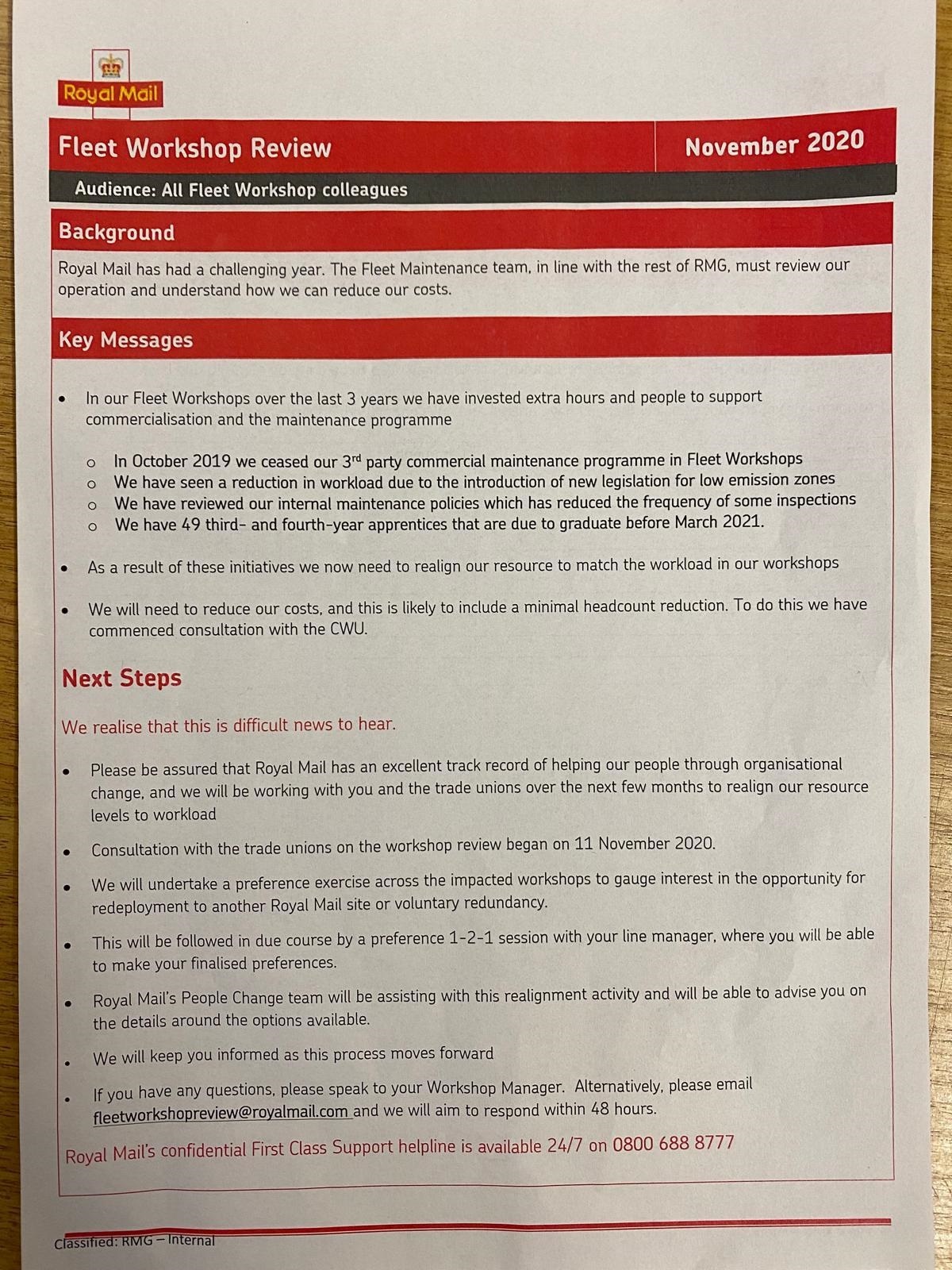
Re: Fleet Maintenance HR1 – Redundancy Notice/Consultation

Re: Fleet Maintenance HR1 – Redundancy Notice/Consultation

The Department have been made aware Fleet Maintenance have put out a
communication, attached at Appendix A, informing our members of potential
redundancies. We believe the reason the head of Fleet has put out this communication
is to create a state of fear and anxiety for our Fleet members.

Whilst we have received a legal HR1 notice for a headcount reduction of 45 full time
positions within Fleet Maintenance, the CWU do not accept there is a requirement for
the headcount reduction and will be opposing any unagreed reduction by all means
possible.

Fleet know they have not convinced the CWU of the need for the headcount reduction
as they have been unable to provide any information we have requested. The
information was requested in meetings prior to Fleet issuing the formal HR1 notice.
Fleet’s proposal is flawed, as they have been unable to provide the basic information
we have requested and we believe it is simply a cost reduction exercise.

The information requested which Fleet have been unable to provide includes:-

 Which external contractors they use
 How many vacancies we have
 How many agency workers we have
 Costings of external contractors and agency etc.
 Quality of service for Vehicles off Road
 How many hire vehicles we use
 What are the current productivity levels
 How much maintenance is outstanding

The fact Fleet have not been able to provide this information a week after it was
requested, shows their proposal is flawed. The full letter for information we
requested is attached at Appendix B. This is information which should have been
provided and considered as part of the proposal, not requiring us to ask for it.
Despite, not providing us with this information and to date, not engaging in the
formal consultation process, Sally Warren, Head of Fleet Maintenance, still saw
it as the right thing to do to go ahead and announce there will be redundancies
in Fleet.

This announcement comes at a time in the middle of the Coronavirus Covid-19
Pandemic, where no allowance is put into their proposals for the measures we
need to put in to keep our members safe.

Their proposal is also based across the current Monday-Friday. The union and
Royal Mail are discussing measures which will see vehicles used for longer during
the week and potentially at weekend. This will obviously mean more
maintenance, however, Fleet have not factored this into their proposal. At a time
when vehicles are going to be used more, requiring more maintenance, Fleet
put a proposal to reduce headcount!

We have written to Sally Warren giving our thoughts on her actions and
reminding Fleet of their legal responsibilities to negotiate with the Union. This
letter is attached at Appendix C.

We would prefer to be negotiating rather than sharing letters in the public arena.
However, Fleet decided to announce this without informing the Union and we
felt the need respond.

To date, we have had no response from Fleet on our request for information.
Our letters make it clear, if Fleet want to engage properly, we will consider their
proposal. If they do not, we will resist compulsory redundancy by all means
possible and conflict is inevitable.

Please ensure this LTB is circulated to our Fleet Maintenance Members. We will
keep branches updated.

All enquiries regarding the content of this LTB should be addressed to the PTCS
Department, quoting reference 404. Email address: khay@cwu.org.

Yours sincerely,

Carl Maden
Assistant Secretary (Acting) PTCS Department

20LTB555. Final

APP.A

APP.B

APP.C

TUC Health & Safety Reps Survey 2020:

TUC Health & Safety Reps Survey 2020:

This is the thirteenth biennial TUC Survey of Health and Safety Reps. It is designed to provide the TUC and individual unions with information about who Health and Safety Reps are, and what their experiences and needs are.

The TUC needs this information so that the TUC and unions can do more to help Safety Reps, and so that trade union Safety Reps’ views and experiences are better reflected in public policy debates and the work of the Health and Safety Executive (HSE).

The TUC will publish the results, and use them to campaign for better safety standards at work (including more rights for Health and Safety Reps).

Safety Rep responses are crucial to ensuring that this survey provides the information the TUC is seeking. Please answer as many questions as you can – but if they seem irrelevant to your experiences, ignore them.

This survey covers the last two years (from September 2018 to December 2020). Please answer the first half of the survey about your health and safety work in general over the whole period. The second half of the survey will ask specifically about the Covid-19 pandemic. Responses will help shape the future health and safety priorities of the TUC and refine how the TUC and affiliated unions support Safety Reps in future.

This survey will take approximately 15 minutes to complete. Your contribution is incredibly valuable, and it can only be used if you reach the end of the survey.

Survey Respondents will have the chance to be added into a prize draw:
1st Prize: a year’s subscription to Hazards Magazine plus a £150 Tesco e-Gift card
2nd Prize: a year’s subscription to Hazards Magazine

Collating the responses to this survey will be a time-consuming and expensive task, so the TUC cannot enter into correspondence arising from the survey. However, the TUC does want to know about any successes Health and Safety Reps have had in improving health and safety standards and if Reps want to send details, then please e-mail those details to: healthandsafety@tuc.org.uk.

Please complete the survey by 31 December 2020 when the survey will close.

The 2020 biennial TUC Survey of Health and Safety Representatives is now online so please complete the survey at:-https://www.surveymonkey.co.uk/r/HSReps2020

Yours sincerely

Dave Joyce
National Health, Safety & Environment Officer

20LTB554 TUC Health & Safety Reps Survey 2020

Royal Mail Area Representative & Royal Mail Area Representative Substitute Elections – 2020

Royal Mail Area Representative & Royal Mail Area Representative Substitute Elections – 2020

Branches will be aware that the Senior Deputy General Secretary is required to publish a standard election timetable for the RM Area Rep/Substitute positions. The timetable applies to positions that cover more than one branch area, i.e. those RM Area Rep elections, which are currently organised by the Regional Secretary. Accordingly the timetable for the 2020 RM Area Rep elections is as follows:

Nominations Open: 18th November 2020

Nominations Close:  9th December 2020 (3 week nomination period)

In line with the above policy I have asked Regional Secretaries to co-ordinate these elections and to contact branches and advise them of the arrangements for the positions which are subject to election within their respective areas.

Branches are reminded that candidates must have received the nomination of their own branch and if ballots are required we will advise the respective branches of the ballot timetable in due course.

Branches should also note that any ballots will be conducted on an individual member basis of those members eligible to vote and that the costs incurred for the ballots would have to be met from the relevant Branch(s) funds. The Regional Secretary will discuss the detail of this with the Branches.

Due to the current unprecedented circumstances we find ourselves in, branches should note that ballots for any elections that occur will be deferred into the New Year.

Also please note that it has been agreed that any candidates taking part in a ballot will be entitled to submit the following biographical and election information:

  1. Biographical Details up to a maximum of 100 words.
  2. An Election Statement of no more than 300 words.

Please note that the biographical details and election address will need to be provided to the respective Regional Secretary by the close of nominations on 9th December 2020.  Any information received after this date will not be included with the ballot information. 

In addition, any elections will be conducted in line with the attached Guidelines and I would also take this opportunity to remind branches and candidates that they have a responsibility to treat fellow candidates with respect and they must ensure that no election material is published that could be deemed as either offensive or abusive.

Please note that elections for Area Representatives that fall wholly within one Branch boundary are the responsibility of the Branch, however if required, assistance can be sought from the Regional Secretary regarding these elections.

Any enquiries regarding this LTB should be addressed to the Senior Deputy General Secretary’s Department on telephone number 020 8971 7237 or email address sdgs@cwu.org.

Yours sincerely,

Tony Kearns
Senior Deputy General Secretary

20LTB551

RM Area Reps Guidelines 2020

View Online

Royal Mail Group – Latest Updated Coronavirus/Covid-19 – Frequently Asked Questions and Answers Guidance Document (Version 66):

Royal Mail Group – Latest Updated Coronavirus/Covid-19 – Frequently Asked Questions and Answers Guidance Document (Version 66):

I attach for your information Version 66 of the Royal Mail Group, Managers’ Coronavirus/Covid-19 Frequently Asked Questions and Answers Guidance document, issued by the business on 10 November 2020.

At the commencement of the Coronavirus/Covid-19 outbreak, Royal Mail Group established a ‘Business Pandemic Team’ which includes all national heads of department and this team meets regularly to review the situation across Royal Mail Group and to issue update Questions and Answers information communications to all managers, which is cascaded throughout the business.

The Coronavirus Guidance, version 66 Q&A document has been shared with the Union’s Health, Safety & Environment Department and is hereby circulated for information and reference purposes for CWU Health and Safety and Branch IR Reps.

The Q&A documents are circulated to all RMG managers and are also available to access through a link on the Royal Mail Group ‘Intranet’, in the ‘Managers Update Messages’ section.

Please note that changes and additions from the previous version are highlighted in ‘Yellow’.

NOTE: Please also note that these Q & A documents are ‘Royal Mail Group’ advice documents and all the contents are not agreed with the CWU.

Contents List:

  1. HEALTH
  1. Prevention
  2. Self-isolation, testing and reporting
  3. Cleaning and consumables
  4. Travel
  5. Support and advice
  6. POLICY 
  1. General guidance
  2. Travel/and annual holiday
  3. Caring for dependants
  4. Sick pay
  5. Attendance process
  6. Vulnerable employees
  7. POST & PARCELS 
  1. General Ops advice
  2. NHS testing kits
  3. Operational processes and reporting changes
  4. Delivering and collecting from customers
  5. Fleet and vehicles

Any enquiries to this LTB or feedback on the RMG Q&A document should be directed to Dave Joyce CWU National Health, Safety & Environment Officer.

Yours sincerely

Dave Joyce
National Health, Safety & Environment Officer

20LTB553 Royal Mail Group – Latest Updated CoronavirusCovid-19 – Frequently Asked Questions and Answers Guidance Document (Version 66)

Coronavirus Guidance Questions and Answers v66

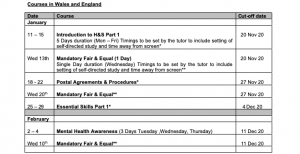
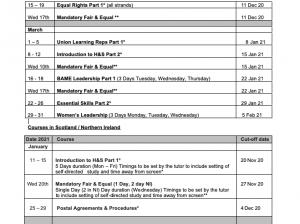
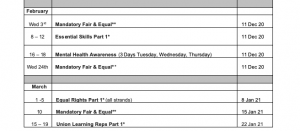
Virtual Classroom Courses – Interim Training Programme – REMINDER

Virtual Classroom Courses – Interim Training Programme – REMINDER

Your attention is drawn to the attached LTB where some of the closing dates conclude on Friday 20th November.

Introduction

As restrictions due to Covid-19 continue, we are aware of a growing need for education and training to be delivered.

To this end we have arranged for a number of online (virtual classroom) courses to be delivered regionally by our Further Education Partners in the devolved nations.

We will be reviewing this programme whilst it is being delivered to consider further provision in this way during the period of the pandemic.


Application Process

Authorised applications must be received by the cut-off dates.  Branches must send an email to courseadmin@cwu.org via the Branch Secretary only with the following information:

  • Title and date of course
  • Name of applicant
  • Branch
  • Membership number of applicant
  • Contact email address for the applicant
  • Contact mobile number
  • Any adjustments that require consideration

When applications have been received applicants MUST be registered as CWU Reps/Officers on the OLS system for applications to be processed. 

Attached is a guide on how to add Reps/Officers to the OLS for new Branch Secretaries.

The above is an interim online application procedure whilst a new process is in development.

IT, Infrastructure and learning differences

Having tested online delivery of samples of both accredited and unaccredited courses, it is crucial that the student is set up appropriately and in good time before the training commences.

The learner must preferably have access to a good PC / laptop.  Tablets can be used but have some limitation in our experience.  Attending training courses using a mobile phone is not acceptable.

There must be a stable internet connection from where the learning is taking place.

Colleges will also be in contact before the course to advise of any additional requirements.

We would appreciate Branches assistance in ensuring any applicants are prepared in line with the above points.  If any reps encounter difficulties getting set up with IT equipment in preparation for course attendance, please advise their Branch Secretary, Union Learning Rep or the Equality, Education & Development as soon as possible.

Additionally, upon application; please ensure that we are aware in good time of any adjustments that may need to be arranged such as issues relating to dyslexia or sight / hearing differences.

Release & Notice

Paid release should normally apply where the union is recognised and / or in line with any existing agreements.

Please forward any enquiries relating to this LTB to learn@cwu.org in the first instance.

Finally, we are sure that Branches appreciate that this is a particularly challenging time for all concerned, including our partner providers and therefore we acknowledge and thank you in advance for your patience with this approach.

Yours sincerely,

Kate Hudson

Head of Equality, Education & Development

LTB 552/20 – Virtual Classroom Courses – Interim Training Programme – REMINDER

OLS Advice

POST OFFICE: PAY CLAIM – STAGE 2 OF THE COLLECTIVE DISPUTERESOLUTION PROCEDURE

POST OFFICE: PAY CLAIM – STAGE 2 OF THE COLLECTIVE DISPUTE
RESOLUTION PROCEDURE

Further to LTB 542/20 dated 12th November 2020. Yesterday we met with Lee Kelly,
Employee Relations and Policy Director, in pursuit of our pay claim on behalf of our
members working for the Post Office. This meeting was held under the auspices of the
Collective Dispute Resolution Procedure (CDRP) and was effectively Stage 1 of this
process.

Whilst the meeting was cordial and constructive with a good exchange of views,
unfortunately no real progress was made with the Post Office simply reaffirming its
earlier offer which we have rejected as inadequate as it undervalues in any material
way the necessary recognition required for the exemplary role our members have
undertaken during the pandemic as Key Workers.

In relation to next steps, both parties acknowledge we now need to move to Stage 2 of
the CDRP in pursuit of an agreed way forward. Essentially the matter is now referred
to the Group Chief People Officer with a further meeting normally taking place within
ten working days. Consequently, we are awaiting an offer of a meeting date and would
expect to arrange this in the coming days.

The rejected pay offer remains “closed” at this stage so we are unable to provide further
details; suffice to say we are endeavouring to secure a more realistic offer that we
would be comfortable in recommending to our members.

We had hoped to make progress yesterday; however, despite being unable to do so
both parties remain committed to establishing an agreement. Accordingly, I am grateful
for the patience being shown by our members who no doubt understand that we are
seeking a settlement that is deserving of their efforts and commitment.

Further developments will be reported.

Yours sincerely,
Andy Furey
Assistant Secretary

LTB 549/20 – Post Office – Pay Claim – Stage 2 of the Collective Dispute Resolution Procedure

National Terms of Reference for The Deployment of a Hydrogen Powered Van Trial

National Terms of Reference for The Deployment of a Hydrogen Powered Van Trial

Branches are reminded of LTB 407/20 dated the 31st July 2020, advising of the trial of a CNG Iveco Van and the trial of gas powered motive unit at the Chorley Vehicle Operating Centre, both of which are trialling alternative fuels, as opposed to the various number of Electric Vehicles (EVs) on trial in deliveries.

The LTB further informed Branches that Aberdeen City Council has approached Royal Mail to trial a hydrogen powered commercial vehicle to use in the Altens Delivery Office, Aberdeen, free of charge. Hydrogen is high quality energy and is used to power fuel cell vehicles, unlike fossil fuels which mainly include petroleum and coal that provide for the major extent of energy needs around the globe today. Hydrogen, however, readily combines with other molecules and the most common way to liberate hydrogen is to use heat and catalysts to reform hydrocarbons. Hydrogen fuelled vehicles do not emit greenhouse gases or other pollutants, as during combustion hydrogen only produces water vapour, thus reducing the release of harmful gasses such as carbon dioxide and nitrous oxide into the atmosphere.

The vehicle to be deployed is a Euro 6 Ford Transit L3 H3 converted to run on hydrogen, which uses blends of hydrogen and diesel for performance and emissions reduction. The range of the hydrogen converted vehicle whilst running on hydrogen, is dependent on the specific duty cycle but has been estimated to be 120 miles. The Project as previously reported in LTB 407 is a result of the Council’s role within the EU funded ‘Civitas PORTIS’ project which looks at sets of sustainable mobility measures in port cities, to improve the attractiveness of the urban environment. The Council is committed to Aberdeen becoming a more maintainable, low carbon city. The Council want to encourage the uptake of low emission vehicles, particularly hydrogen vehicles within the private sector, as this is part of their solution to improving the city’s air quality and cutting carbon emissions which will have undeniably associated health benefits. The Council also want to continue to lead on hydrogen technology, with Royal Mail participating in the project; the intention will be to promote the involvement and willingness by the private sector to trial hydrogen vehicles.

Cross departmental discussions have therefore been undertaken in relation to an agreement to enable the activity to take place. The CWU will be fully involved in all aspects of the trial locally, to help promote the benefits and purpose of the trial. The trial will be jointly overseen and monitored by RM Fleet Innovation and Environment Manager, who will provide periodic reports to the CWU both locally and nationally. The activity will be the subject of a joint review six months after the commencement of the trial and periodically thereafter, as agreed by the Royal Mail Fleet Operational
Specification Group (RMFOS). Local Managers, CWU Representatives and drivers involved in the trial will also feed into this process. The attached visuals provide confirmation of the vehicle to be deployed in RM livery and branded with the cruciform, as well as a reference to hydrogen. Branding has now been signed off, including the safety documentation. The vehicle has also been checked for suitability of collection and delivery in Altens.

Any queries to the content of the above, please contact the Outdoor Department reference 300, email address: outdoorsecretary@cwu.org.

Yours sincerely,
Mark Baulch
CWU Assistant Secretary

LTB 548/20 – Deployment of a Hydrogen Powered Van Trial

Aberdeen Hydrogen Vehicle – Photo

Create a website or blog at WordPress.com

Up ↑