Royal Mail and CWU Joint Communication – Covid-19 Bespoke Weekend Priority Postbox Collections

Royal Mail and CWU Joint Communication – Covid-19 Bespoke Weekend Priority Postbox Collections

Branches and representatives will be aware that in April 2020 the Government selected Royal Mail Group and its unparalleled nationwide network to lead as the Prime Supplier on a number of products relating to Covid-19 Testing Kits. To date Royal Mail and the CWU have continued to work together to adapt to the changing demands from Government as the pandemic unfolds.

The Government recently requested that Royal Mail provide a Covid-19 Bespoke Weekend Priority Postbox Collection service to meet the demand for testing into the Autumn and Winter period. While a Joint Statement is yet to be concluded in relation to the activity, scoping activity has commenced in regard to the operational and resourcing elements of providing this bespoke service.

Joint Communications have now been concluded to provide an update and a copy is attached for your information.

Colleagues will note that whilst the collection routes will be based in the Mail Centre, expressions of interest are invited from employees from all functions across the Mail Centre catchment area. The CWU preference would be for our members to have the first opportunity to express an interest in performing this bespoke weekend work and as such we would request that this LTB is publicised at the earliest opportunity.

Any enquiries in relation to this LTB should be addressed to:

Processing/Distribution: Davie Robertson, Assistant Secretary, email: dwyatt@cwu.orgquoting reference: 014.14. 

Deliveries/Collections: Mark Baulch, Assistant Secretary, email: outdoorsecretary@cwu.org quoting reference: 600.

Yours sincerely

Davie Robertson                               Mick Kavanagh

Assistant Secretary                           Assistant Secretary (Acting)

LTB 472/20

Attachment 1 – Joint Comms COVID Bespoke Weekend Postbox Collections 28.09.20

Truth about Zane Campaign

Truth about Zane Campaign

Branches will be aware that the CWU is actively supporting the Truth about Zane campaign. The campaign is seeking to secure an independent enquiry into the death of Zane who may have died as a result of a deadly nerve agent in his home in Surrey following flooding in 2014.

On the 10th September 2020 the campaign took a significant step forward when the local Conservative council voted unanimously to back a motion which accused the Surrey coroner of a “cover-up”.

NEC Young worker member Luke Elgar who is liaising with the campaign on behalf of the CWU Nationally has recently written an article, which can be read on the CWU website, which updates branches on this important development:

https://www.cwu.org/blog/the-truth-about-zane-important-breakthrough-in-the-push-for-justice/

On the 21st October 2020 a memorial is being hosted by the Fire Brigades Union. The memorial is being held on Zane’s birthday and speakers include Matt Wrack, Sir Keir Starmer, David Lammy MP and Professor Bill Scraton (Hillsborough The Truth). Information regarding the Zoom memorial can be found using the link: http://bit.ly/justiceforzane

Any queries on the contents of this LTB should be addressed to jdunn@cwu.org.

Yours sincerely,

Dave Ward

General Secretary

LTB 470/20 – Truth About Zane Campaign

Global Day Of Climate Action – ‘Fridays For Future (FFF)’ – Friday 25 September 2020:

Global Day Of Climate Action – ‘Fridays For Future (FFF)’ – Friday 25 September 2020:

‘Fridays For Future (FFF)’

‘Fridays For Future (FFF)’, is a global climate change movement that started in August 2018, when 15-year-old Greta Thunberg began a school strike for climate change in Sweden.

In the three weeks leading up to the Swedish election, she sat outside Swedish Parliament every school day, demanding urgent action on the climate crisis. She was tired of society’s unwillingness to see the climate crisis for what it is – ‘a crisis’. She was joined by others and numbers grew leading to a school strike until the Swedish policies provided a safe pathway to keep global warming under 2°C, in line with the Paris Agreement. This marked the beginning of a global movement and their call for action sparked an international awakening, with students and activists uniting around the globe to join the campaign and organise protests. ‘Fridays for Future’ is part of a hopeful new wave of change, inspiring millions of people to wake up to the threat of climate change to the world’s future.

We live in the midst of a pandemic, but climate change is just as much of a crisis as it was before. During the last few months, the Covid-19 pandemic has forced activists to find new ways of protest and use digital activism to demand climate action, as marches have not been appropriate. Friday the 25th of September will be a focal point and the first global action day of the year.

The coming months and years will be crucial in ensuring a safe pathway to achieving a below 1.5°C increase in global mean temperature, a target stated in the Paris Agreement.

If the world is to minimise the risks of triggering irreversible chain reactions beyond human control, action is needed now. The FFF’s ‘Friday For Future’ day is designed to reinforce that vital message – that the climate crisis mustn’t get forgotten in the shadow of the Coronavirus/Covid-19 pandemic but must remain being regarded as a priority. ‘Fridays For Future’ aims to raise awareness and keep campaigning and protesting as long as exploitation of nature is allowed to continue. This year, during the pandemic and to prevent the spread of the virus, where physical protest is inappropriate, the campaign instead will turn to digital action.

“Fridays For Future (FFF)” state that no effective measures have been taken to lower worldwide greenhouse gas emissions in a sustainable and just manner as yet. In a statement launching the ‘Global Day of Climate Action’ the message from “Fridays For Future (FFF)” was “To actually experience the climate crisis makes you understand the urgency of the situation. Millions are losing their homes and livelihoods, this can no longer exist in a vacuum. We need world leaders to prioritise humanity over greed. The youth are going to come together, over and over again – each time more strategic and united than ever before”.

The Paris Agreement:

The Paris Agreement sets out a global framework to avoid dangerous climate change by limiting global warming to well below 2°C and pursuing efforts to limit it to 1.5°C. It also aims to strengthen countries’ ability to deal with the impacts of climate change and support them in their efforts. This is an agreement within the United Nations Framework Convention on Climate Change (UNFCCC), dealing with greenhouse-gas-emissions mitigation, adaptation, and finance, signed in 2015 with 196 Signatories. Under the Paris Agreement, each country must determine, plan, and regularly report on the contribution that it undertakes to mitigate global warming. The Paris deal is the world’s first comprehensive climate agreement.

Governments agreed to come together every 5 years to assess the collective progress towards the long-term goals and inform Parties in updating and enhancing their nationally determined contributions, to report to each other and the public on how they are implementing climate action and to track progress towards their commitments under the Agreement through a robust transparency and accountability system.

Earlier this year 189 UNFCCC signatories met for Governments to submit long-term climate 2050 plans as well as shorter-term 2030 goals. The long-term 2050 goals are to decarbonise their economies, and to set shorter term targets lasting until 2030. The only significant countries that are emitters of airborne toxins which were not party to this were Iran and Turkey.

EU’s role

The EU has been at the forefront of international efforts to fight climate change. It was instrumental in brokering the Paris Agreement and continues to show global leadership.

The EU’s nationally determined contribution (NDC) under the Paris Agreement is to reduce greenhouse gas emissions by at least 40% by 2030 compared to 1990, under its wider 2030 climate and energy framework. All key EU legislation for implementing this target was adopted by the end of 2018.

Global carbon dioxide emissions by jurisdiction.

  • China (29.4%)
  • United States (14.3%)
  • European Economic Area (9.8%)
  • India (6.8%)
  • Russia (4.9%)
  • Japan (3.5%)
  • Other (31.3%)

USA Position

On June 1, 2017, the US president announced that the USA would cease all participation in the 2015 Paris Agreement on climate change mitigation, and begin negotiations to re-enter the agreement “on terms that are fair to the United States, its businesses, its workers, its people, its taxpayers,” or form a new agreement adding that the Paris accord will undermine (the U.S.) economy,” and “puts (the U.S.) at a permanent disadvantage. Trump stated that the withdrawal would be in accordance with his America First policy. In accordance with Article 28 of the Paris Agreement, a country cannot give notice of withdrawal from the agreement before three years of its start date in the relevant country, which was on November 4, 2016 in the case of the United States. On November 4, 2019, the administration gave a formal notice of intention to withdraw, which takes 12 months to take effect. So, the earliest possible effective withdrawal date by the United States cannot be before November 4, 2020, four years after the Agreement came into effect in the United States and one day after the 2020 U.S. presidential election.

Climate Change Linked to Natural $1bn-plus disasters Last Year

With increasing global surface temperatures, the possibility of more droughts and increased intensity of storms will likely occur. As more water vapour is evaporated into the atmosphere it becomes fuel for more powerful storms to develop. The British charity Christian Aid reported that climate change amplified 15 extreme weather disasters which caused human devastation and at least a billion dollars in damage in each case, and seven of the events cost over $10 billion each. The charity state that the great tragedy of climate change is that it is the poorest and most vulnerable who suffer the most, despite doing the least to cause it. However as the disasters have shown, no continent is immune from global warming and its impacts as extreme weather including floods, storms, droughts and wildfires struck every inhabited continent in the past year, causing devastation and loss of life:

  • Australian Bushfires destroyed 700 homes ($100 billion)
  • California wildfires laid waste to farming areas. ($25 billion),
  • Typhoons Hagibis and Faxai in Japan($15 billion)
  • Flooding in the American Midwest($12.5 billion).
  • Cyclone Idai ($2 billion) – and ultimately cost 1,300 lives in southern Africa.
  • Cyclone Fani struck India and Bangladesh killing 1,900 ($18 billion)
  • Hurricane Dorian hit the US east coast killing 673. ($11 billion)
  • Typhoon Lekima in China ($10 billion)
  • Flooding in China ($10 billion)
  • This year over 7 tornados hit the US with devastation, deaths and floods ($11 billion)
  • Floods in Argentina and Uruguay in January this year forced 11,000 people from their homes.

Environmental Defence Fund (EDF)

The Environmental Defence Fund (EDF) based in the USA state that scientists are detecting a stronger link between the planet’s warming and its changing weather pattern. They say that though it can be hard to pinpoint whether climate change intensified a particular weather event, the trajectory is clear — hotter, dangerous, heat waves, drier droughts, bigger storm surges and greater snowfall. Higher temperatures also boost evaporation, which dries out the soil in summer — intensifying drought over many areas. As more evaporation leads to more moisture in the atmosphere, rainfall intensifies. For example, the rainfall from Hurricane Harvey was 15 percent more intense and three times as likely to occur due to human-induced climate change. The EDF state that we can expect to see a higher frequency of Category 4 and 5 storms, also, as temperatures continue to rise. Clouds that can dump a lot of rain are more common in a warmer atmosphere.

While scientists aren’t certain about whether climate change has led to more hurricanes, they are confident that rising sea levels are leading to higher storm surges and more floods.

Around half of sea-level rise since 1900 comes from the expansion of warming oceans, triggered by human-caused global warming. (Like all liquids, water generally expands as it heats up.) The rest of the rise comes from melting glaciers and ice sheets. There is more moisture in a warmer atmosphere, which can lead to record snowfall and may be linked to climate change. Scientists are studying a possible connection between a warming Arctic and cold spells in the eastern United States. The idea is that a rapidly warming Arctic can weaken the jet stream, allowing frigid polar air to travel farther south.

ClientEarth

ClientEarth and other environmental organisations are this month calling on members of the European Parliament to support ambitious measures in new EU climate laws, including an emission reduction target of 65%.

They are also challenging Europe’s largest and most climate-damaging power plant, this week launching a legal challenge against Europe’s largest power plant, Belchatow and two of its mines. Belchatow is a giant Coal plant in Central Poland, burning 45 million tonnes of lignite, the dirtiest form of coal, every year – an entire tonne every second.

Earlier this year ClientEarth in combination with residents, other environmental organisations and Polish farmers won a long legal battle to block the building of a new coal fired power station at Polnoc in Poland, after a ruling from the Polish Supreme Administrative Court.

ClientEarth lawyers have also launched a court fight to block a major new coal mine in Poland.  The Zloczew open-cast mine would be Poland’s deepest ever and, for the first time, use explosives to access the lignite (the dirtiest form of coal) beneath the surface. The process is set to displace seven billion tonnes of rock, putting the surrounding area at major risk of tremors – as well as serious water and air pollution. A project of state-owned energy company PGE, the Zloczew mine would result in the displacement and destruction of 33 villages, including highly specialised modern farms, homes, schools, shops, chapels and fire stations.

Greener Jobs Alliance

The Greener Jobs Alliance (GJA) was formed as a partnership body inclusive of trade unions, student organisations, campaigning groups and a policy think tank. It campaigns around the issue of jobs and the skills needed to transition to a low-carbon economy. The founding members of the GJA are the University and College Union, Trades Union Congress, Greenpeace, Friends of the Earth, National Union of Students, People & Planet, and the Institute of Public Policy Research. The GJA promotes skills training and job creation to meet the needs of Britain’s rapidly growing low carbon sectors and to green the whole economy.

The transition to a low carbon and resource efficient economy can drive sustainable economic recovery and job creation in every part of the country as well as making existing jobs more secure. But this requires a more strategic national and local approach to deliver the workforce skills needed and to stimulate demand for clean energy and energy efficiency services.

The Greener Jobs Alliance liaises at a national and local level to build the broadest possible support for the policies, investment, partnerships and commitments needed to drive the transition to a low carbon economy. The Greener Jobs Alliance liaises with training bodies, colleges, universities, employers, local and national government, trade unions, housing associations, campaign and community groups – to build the policies, investment and partnerships needed to drive the transition to a low carbon economy.

The GJA runs a number of ‘free’ courses on the environment for Trade Union Reps in different parts of the UK which have been attended by a number of CWU Reps.

The GJA came into existence as a result of funding from Battersea and Wandsworth TUC. The GJA Newsletter editor is Graham Petersen, also the GJA Secretary. Graham is well known to the CWU and has a long standing working relationship with the Union. He is a former TUC tutor and course designer who created Safety Reps’ training courses. He was the head of the Trade Union Studies Centre at South Thames College before retirement from the post. The GJA has a close working relationship with the CWU Health, Safety & Environment Department and CWU Safety Reps.

The Trade Union Clean Air Network (TUCAN)

The Trade Union Clean Air Network (TUCAN), has been set up to push for workers and trade unions to have greater recognition on air pollution issues. Alongside the dangers of climate change has been the damage caused by the unhealthy air that we breathe. With contaminants such as nitrous oxide, particulate matter from diesel fumes, ground level ozone and dusts such as silica from construction work, plastics and rubber, the workforce is being exposed to a toxic cocktail. This includes those who work in offices or shops with pollution that seeps into their workplace air, outdoor workers, and for the millions of workers commuting as part of their jobs.

TUCAN calls for all local, regional, national and international air pollution policies to include a commitment to address the occupational health dangers to both outdoor and indoor workers. Unions must be consulted on the risks and control measures needed. TUCAN’s Air pollution campaign is based on workers’ and unions’ input as the only way to ensure that any changes made won’t diminish the standard of living of anyone affected now or into the future. This type of change is called just transition and is necessary to ensure workers and their families don’t suffer the consequences from bad air or solutions that unfairly penalise them and to prevent workers and communities being dumped into economic misery in the name of progress. The Greener Jobs Alliance has produced an on-line training package on ‘Just Transition.’ TUCAN also has close working links with the CWU Health, Safety and Environment Department and CWU Safety Reps.

TUC and the CBI Urge Government to Invest in Creation of a Million New Green Jobs

Both the TUC and the CBI are urging the government to invest now to create over a million new green jobs in response to rising unemployment and the COVID-19 crisis. As the Tories’ ‘furlough scheme’ comes to an end, the TUC is calling for a new ‘Job Protection’ and ‘Upskilling’ Plan. New support for businesses must come with strings attached, unions say, to promote decent work, protect jobs and give union rights. Meanwhile, the CBI, the employers’ organisation, says we face ‘two seemingly separate yet fundamental problems: Covid-19 – the biggest health crisis in living memory – and climate change, the defining challenge of the modern era.’

Earlier this year, on 21 July, Prime Minister Johnson announced a £350m ‘green funding package’ to support efforts to drive down carbon emissions from heavy industry, construction, space and transport. He said it would “fuel a green, sustainable recovery from the Covid-19 crisis.” He added, “We’ve made great strides towards our net zero target over the last year.”

Meanwhile, out in the real world, the Committee on Climate Change says meagre progress has been made over the last year to build the foundations for the transition to a net zero emissions economy. Exhausted from trying to get the Prime Minister to act, the government’s independent advisers have now resorted to direct appeals to Ministers. On 8 July, the Chancellor announced a £3 billion ‘green stimulus’ package. But analysis reveals that the package provides a fraction of what’s required for a national home insulation programme. It is far less than for new road building, and is dwarfed by similar efforts in France and Germany. Johnson’s latest £350m pledge comes in small packages that innovators must bid for. Many of the projects are, of course, essential for a green future: £10m for work on more efficient electric motors; developing recyclable steel; innovative, greener materials in heavy industry; clean hydrogen power that doesn’t rely on methane for the hydrogen; and scaling up carbon capture and storage (CCS) technology. But competitive bids for small innovation packages is no substitute for government-led equity stakes in key businesses and technologies. Ministers Gavin Williamson MP (Education) and Alok Sharma MP (Business and Energy) have each had letters from the Greener Jobs Alliance asking how they intend to ensure green skills are mainstreamed into their departmental strategies.

TUC Report – “How to plan fair and successful paths to net zero emissions”

The TUC strongly supports the UK government target of a ‘net zero carbon’ economy by 2050, but we believe that meeting it requires a reset of the way we live and work, developing new, innovative industrial sectors and providing new jobs. Recognising that climate change is the most pressing existential threat facing the planet, the TUC has produced a report ‘Voice and Place: How to plan fair and successful paths to net zero emissions’ which demonstrates the expert knowledge of trade union full time and lay officials, using that knowledge to provide practical and achievable policy recommendations whilst also highlighting, yet again, why trade union voice should become an established feature of UK industrial policy, as it is in the industrial policies of so many of our continental neighbours on how to achieve a just transition to a net zero economy across the regions and nations.

Read the Report here

Wales TUC Report – ‘A Green Recovery and a Just Transition’ 

In their report, ‘A green recovery and a just transition’ the Wales TUC call for a massive economic stimulus and set out a plan to achieve a ‘just transition’ to a net-zero economy for workers and communities in Wales. Building the recovery from Coronavirus represents a once in a generation challenge. But it is also an opportunity to take the urgent action needed to build a greener and fairer economy in Wales. One that protects jobs, our health and the planet. Workers must have a central voice in planning the recovery and the transition to a net-zero economy to ensure this happens. The report sets out a five-point plan for a ‘just transition’ to net-zero, calling for:

  • A clear and funded pathway to net-zero that maximises the opportunities to protect and create jobs in Wales.
  • The workers most affected by the move to a net-zero economy to be given a central voice in planning the transition.
  • All new jobs in the green economy to offer ‘fair work’ with good pay, skills, pensions, health and safety and trade union recognition.
  • Workplace ‘transition agreements’ to be agreed between employers and unions to ensure a fair transition. Also support for union-led sustainability initiatives in every workplace.
  • Increased funding for learning and skills to prepare workers for the transition and provide a clear pathway to new jobs.

Research recently carried out for the Wales TUC by Transition Economics shows that almost 60,000 jobs could be created in Wales in the next two years through government investment in key infrastructure projects. Read the Report here:-https://www.tuc.org.uk/green

Links – Further Information:

“Fridays For Future(FFF)” Website For Further Information:-https://fridaysforfuture.org/september25/

Environmental Defence Fund:-https://www.edf.org

ClientEarth:- https://www.clientearth.org/climate/

Greener Jobs Alliance (GJA):- http://www.greenerjobsalliance.co.uk/

Trade Union Clean Air Network (TUCAN):- http://www.greenerjobsalliance.co.uk/air-pollution/

Yours sincerely

Dave Joyce
National Health, Safety & Environment Officer

LTB 468/20 – Global Day Of Climate Action – Fridays For Future (FFF) – Friday 25 September 2020

Royal Mail strike vote at Peterborough – union calls for ‘common sense’ from management

Royal Mail strike vote at Peterborough – union calls for ‘common sense’ from management

Postal, Royal Mail Group (EMP)  

Thursday 24th September 2020

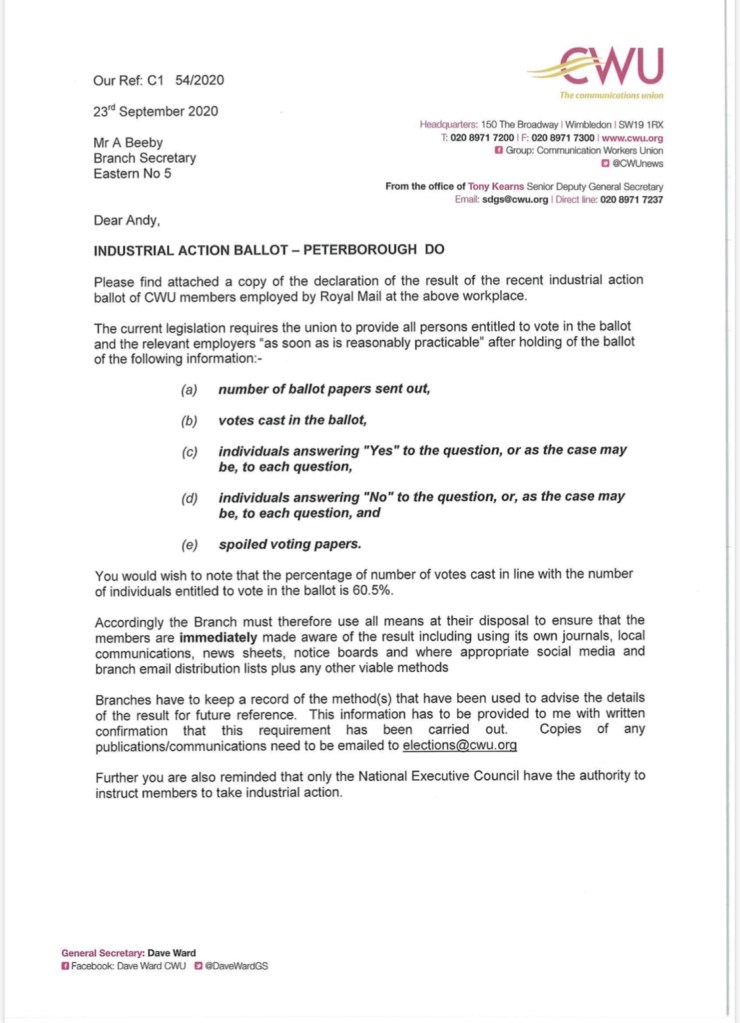
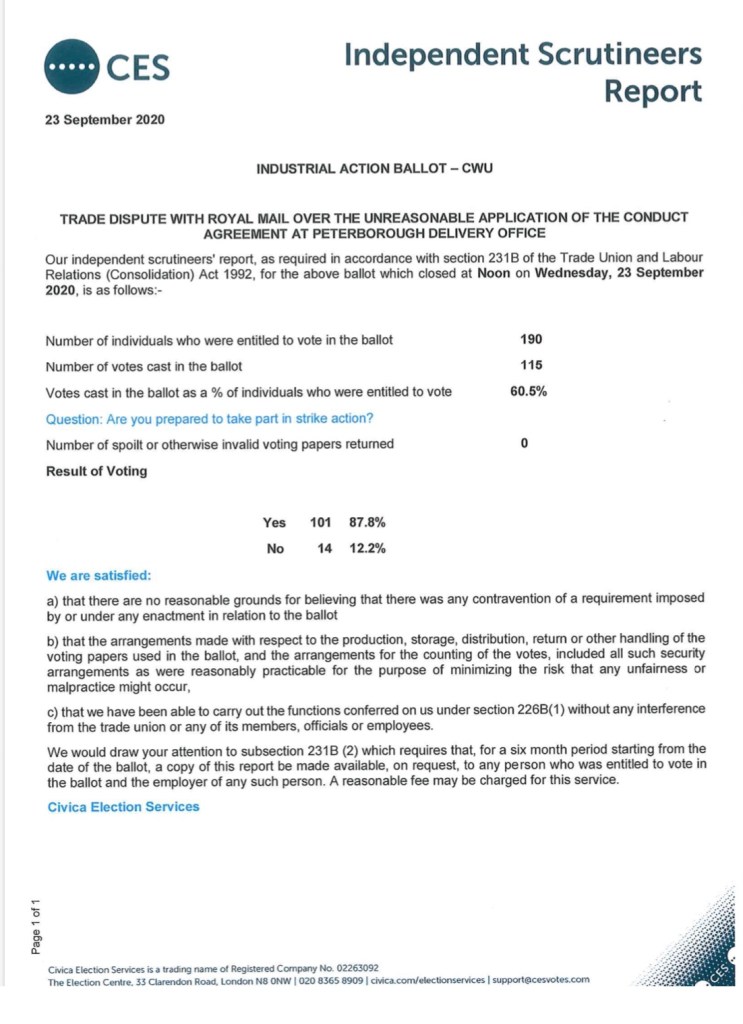
Branch and divisional officials are urging Royal Mail management to “think again and avoid a dispute,” after postal workers in Peterborough voted by 87.8 per cent for strike action to win the reinstatement of a sacked colleague.

The postman, who has worked several years for the business with no previous disciplinary record, was fired in July – action which, the union argues, both “breached” and “unreasonably applied” the company’s conduct agreement.

Branch secretary Andy Beeby (CWU Eastern No5) told CWU News: “The ballot result today shows the huge strength of feeling among members that this sacking was unfair and must be reconsidered.

“It’s their view and the view of this union that the allegations laid against our member here do not, in our view, warrant dismissal,” he explained.

“In fact, in the case we made to management, our divisional rep Steve Butts cited 13 previous cases of comparable incidents which did not lead to summary dismissals.”

In the union’s summary of reasons for the ballot, the CWU states its opinion that the dismissing manager in this case has made the decision to fire the member ‘based on what could have happened in different circumstances rather than the actual facts of what did happen on the day in question’.

“This is completely unacceptable, and we’re calling on the company to reinstate this member, with full pay, benefits and continuity of employment without loss,” Andy says.

The union is also seeking assurances that there will be no further ‘breaches’ or ‘unreasonable applications’ of the agreed conduct process going forward.

“We want this resolved without strike action, and this can be done if the company agrees to apply common sense here,” explains Andy.

“But if they refuse to budge, these members here have pledged that they will strike for their sacked workmate.”

In his reaction to the ballot result, CWU Anglia divisional representative Steve Butts said: “This vote is one of workers’ solidarity, the foundation that this union is built on.

“The dismissal itself is an unreasonable decision in my opinion. Statistics can reveal an unfair approach to the way CWU members are treated when it comes to discipline

CWU Union Learning Representatives Networking Event 2020 #CWULearn20 #NewChallenges

CWU Union Learning Representatives Networking Event 2020

#CWULearn20; #NewChallenges

This year’s networking event will take place on the 3rd – 4th November 2020.

Due to the ongoing Covid 19 situation this year’s event will be held over Zoom.

This event will ensure that our ULRs can discharge their legally recognised responsibilities to great effect
through networking with other educationalists.

Over the two days, delegates will explore new and innovative ideas on learning and enhance their skills so
that they can facilitate both new and ongoing learning opportunities in their workplaces.

This year’s theme is “New Challenges” and will focus heavily on keeping learning open to members
through the pandemic and beyond.

There will be opportunities:

· To meet with other CWU Union Learning Representatives
· To attend virtual workshops & stalls
· To hear from high profile guest speakers
· To learn about the latest CWU learning developments
· And to celebrate your achievements!

Registration
Branches are asked to book ULR delegate places by email to learn@cwu.org with contact details including
name, Branch, contact number and email.

We will send out Zoom links in the run up to the event.

In order to allocate delegates to workshops the deadline for applications is Thursday 29th October 2020.

Since there will be no travel or subsistence expenses we are hoping this will encourage branches to increase
their delegations this year. All ULRs and any branch officers or reps with an interest in education are invited
to attend.

This event is being supported by the CWU and the Union Learning Fund.

Release
This event should attract paid release for those accredited ULRs working for employers where the CWU is
recognised. The event is specifically designed to meet the aims of ULR legislation and is fully supported
through the Government Department for Business Innovation and Skills. The ACAS Code of Practice
applies.

Any enquiries regarding this LTB should be addressed to learn@cwu.org

Yours sincerely,

Kate Hudson
Head of Equality, Training & Development

LTB 467/20 – Union Learning Representatives Networking Event 2020

ELECTION OF CWU NATIONAL REPRESENTATIVES POSITIONS. CWU Young Workers Committee

ELECTION OF CWU NATIONAL REPRESENTATIVES POSITIONS

  • CWU Young Workers Committee

The above elections were scheduled to take place during May/June 2020 however as a result of the Covid-19 pandemic and the subsequent closure of CWU HQ it was not possible to conduct these elections in the usual way.

Following discussions between the GS Department, SDGS department and the National President and Vice President a document was placed before the September 2020 NEC which once agreed now allows the union to conduct the elections for the Young Workers Committee albeit with revised and specifically designed election arrangements.

Clearly the democratic principles of the CWU are founded on our ability to ensure that the elections are conducted in a fair and equitable way and specifically that members of the union, via their own branch nomination, are given the opportunity to put themselves forward as a candidate. These guiding principles have been included in the revised arrangements a summary of which is set out below in advance of the election process.

Election Timetable 

It is necessary for the election timetable to be significantly longer than normal to allow branches sufficient time to seek nominations from their members and to then subsequently agree on which candidates(s) they intend to nominate for election and, once the list of candidates is known to then decide which candidate(s) will receive the branch vote.

Nomination Process

In respect of seeking nominations branches will need to put in place a robust system and use all reasonable methods at their disposal to publish suitable notification throughout the branch area giving members the opportunity to submit their name for nomination to the position should they choose to do so.  Following this the branch would need to put in place arrangements to hold a membership meeting to decide which candidate(s) will receive the branch nomination.

On the basis that no face to face member meetings are currently allowed then this would need to be conducted via a suitable video conference platform such as Zoom or Skype, etc. that provides the opportunity for large numbers of members to take part if required.

Additionally branches will need to allow for members who do not have video conference capability to join the meeting by phone again if they choose to do so.

The timeline for the meeting would need to be agreed in advance and notification provided to members at least 7 days prior to the meeting taking place.

Dispatch and Return of Nomination Forms to CWU HQ

Nomination forms will be sent to branches electronically via an LTB and it will be our intention to set up a specific dedicated election email address where branches should return completed nomination forms to.

Nomination Forms will need to be returned by the advertised closing date to be included in the list of candidates. 

The revised system will avoid the necessity to return forms in the post system which of course may be subject to delay during the current Covid-19 crisis.

Dispatch and Return of Voting Papers

The respective constituency based voting papers will be sent by email direct to branches at the email address which we hold on file.  Branches should return the completed voting papers by email to the advertised CWU election email address.  Notification will be sent to branches confirming receipt of the voting paper, however it will the responsibility of the branch to ensure that voting papers are returned to the correct email address.

To be included in the ballot voting papers will need to have been returned by the advertised closing date and time.

Branch Voting Recommendations

Clearly we are in unique and challenging times and whilst branches would normally arrange mandating meetings to decide which candidates to vote for in the respective elections we do not believe that this is either practical or necessary during the current crisis.  Therefore, on this occasion this decision can be made by the Branch Committee and the decision subsequently notified to members of their branch accordingly.

Election Timetable and Term of Office 

The election timetable for the above will be as follows:

Nominations Open:                1 October 2020

Nominations Close:                 31 October 2020

Ballot opens:                              7 November 2020

Ballot closes:                              28 November 2020

The term of Office for the above positions will commence from 1st January 2021 for a period of 2 years.

Any enquiries regarding this Letter to Branches should be addressed to the Senior Deputy General Secretary’s Department on telephone number 020 8971 7237, or email address sdgs@cwu.org.

Yours sincerely,

Tony Kearns

Senior Deputy General Secretary

LTB 465/20

View Online

CAPITA TVL: FORMAL PAY OFFER REJECTED

CAPITA TVL: FORMAL PAY OFFER REJECTED

Further to LTBs 016/20 and 220/20 dated 10th January and 23rd April respectively.

Branches are advised that despite the obvious practical constraints due to Covid-19, we have continued our pay negotiations with Capita TVL management throughout the summer period.

The following Joint Statement has been agreed and published in respect of our ongoing pay negotiations and is designed to update members on the current situation. In this regard, there is a 2% offer on the table; however this has been rejected and further details are provided below.

Capita and CWU Pay Negotiations

We are mindful that an update on our pay negotiations is needed. Clearly, we are in the most abnormal year any of us have ever experienced and this has impacted on the traditional way we conduct negotiations. We do though have a good and constructive working relationship which has helped us considerably during our various discussions over the course of the pandemic.

Capita has made a formal 2% pay offer from 1 January 2020 for 12 months, which it believes to be fair in the circumstances. Capita has also introduced the Real Living Wage for the lowest paid staff from 1 April this year, although the policy means there is no pay award for those earning in excess of £28,000 p.a. The CWU, on behalf of its members, has however rejected this offer as it falls short on a number of levels. Despite both parties being keen to find a mutually agreeable way forward, unfortunately we are at an impasse.

Whilst some progress has been made, we are sorry we are unable to be more positive at this stage. We are considering next steps including raising this matter through the agreed Disputes Procedure.

However, at this stage the TVL team are not confident of any further offer being made. We know you will be disappointed by this news; however, both parties are doing what they feel is right in the prevailing situation. We are though committed to reaching an agreement. To this end, further discussions will be held to see if this is possible and of course your pay rise would be backdated to 1 January 2020.

Both parties would like to thank you for your patience in this matter and reassure you that we wish to establish an agreement that you would support as soon as possible.

Yours sincerely

Paul Johnston                                                         Andy Furey
Partnership Director                                             Assistant Secretary
Capita TVL                                                              CWU

As referenced in the Joint Statement, the current offer still falls short of our aspirations as it fails to address a number of the key components of our pay claim which are as follows:

• Improvements to the employers’ pension contribution rates

• A one hour reduction in the 37.5 hour net working week

• 3% minimum pay increase for those members who, on moving up to the Real Living Wage, would receive a pay rise of less than 3%

• 3% minimum pay increase for all members whose basic hourly pay rate is greater than the Real Living Wage

• The introduction of the Real Living Wage hourly pay rate of £9.30 from 1st January 2020 rather than 1st April 2020

• Capita TVL commits to automatically introducing further increases in the Real Living Wage each year to take account of the Living Wage Foundation’s recommendation.

For ease of reference LTB 016/20 which expands upon the above key components is attached.

Further developments will be reported following our additional discussions with management which are in the process of being scheduled. We are also in the process of arranging a meeting with our Capita Reps on the TVL contract as membership engagement going forward is critical.

Yours sincerely,

Andy Furey
Assistant Secretary

Attachment 1: LTB 464/20 – Capita TVL – Formal Pay Offer Rejected

Attachment 2: LTB 016/20 Capita TVL – Formal Pay Claim 1st January 2020

Save on life’s essentials with CWU Member Benefits

Save on life’s essentials with CWU Member Benefits

Dear Terence,

Take advantage of the offers below and enjoy your member savings through CWU Member Benefits.

Limited time offer: 20% off any complete glasses

Vision Express are offering CWU members 20% off any complete glasses, available online and instore between 10 September – 11 October2020*.

Find out more

3 years for 2 on TOTUM Pro membership

For a limited time only, CWU members can buy a two-year membership card and they’ll chuck in an extra year FOR FREE.

That means that if you can buy a TOTUM PRO 3-year membership for just £24.99, that’s a saving of a tenner over RRP*.

Find out more

LifeSearch – Life Assurance

CWU Member Benefits have teamed up with LifeSearch, one of the UK’s leading life insurance advisers, who will provide you with help, guidance and advice that you need to make sure you are properly protected in the event that you may no longer be around. Once your policy is arranged, you’ll automatically qualify for their ‘two months’ premium back’ offer* after 12 premiums have been paid.

View more information 

Financial peace of mind – make it happen!

You work hard for your money but is your money working hard for you? Maybe you know you should be doing something about your finances but don’t know who to turn to for practical advice you can trust. Yet the sooner you take action, the more likely you are to achieve your financial goals*.

All members of CWU are entitled to a complimentary initial consultation with one of Lighthouse Financial Advice’s professional financial advisers to see whether you could benefit from financial advice specific to you. 

Following the initial consultation, if you wish to appoint Lighthouse Financial Advice as your financial adviser they will explain and agree any charges with you before undertaking any work on your behalf.

View more information or call Lighthouse Financial Advice on 08000 85 85 90 and quote CWU

Lighthouse Financial Advice Limited is an appointed representative of Lighthouse Advisory Services Limited which is authorised and regulated by the Financial Conduct Authority.

Lighthouse Financial Advice Limited and Lighthouse Advisory Services Limited are wholly-owned subsidiaries of Lighthouse Group plc, which is part of the Quilter Group of companies. Registered address: 26 Throgmorton Street, London EC2N 2AN. Registered in England No. 4795080.

For details of how we use your personal information please read our privacy policy at www.lighthousegroup.plc.uk/privacy-policy

Get moving and save with MyActiveDiscounts

MyActiveDiscounts offers CWU members great savings on things that get you active and healthy such as footwear, sportswear and nutrition. You can also save money on adventure days, travel, spa breaks* and more!

Sign up to their weekly offers and save today.


Want to find out how much you can save with CWU Member Benefits? Try out our newly revamped Savings Calculator.

To take advantage of these and other fantastic deals visit the CWU Member Benefits Special Offers page today!

Formation of the CWU United Tech and Allied Workers (UTAW) National Branch

Formation of the CWU United Tech and Allied Workers (UTAW) National Branch

The purpose of this LTB is to inform branches of the formation of the new United Tech and Allied Workers (UTAW) branch of the Communication Workers’ Union, which seeks to represent and fight for workers interests in the expanding tech sector.

The CWU was approached by the London Branch of a group called the Tech Workers Coalition (TWC) earlier in the year with a request to discuss the feasibility of them joining the CWU. It is indicative of our high standing in the trade union movement and our innovative communications approach, that the TWC specifically approached the CWU as the union they wanted to join and work with to recruit and organise in the sector.

During initial conversations, the TWC outlined the background of their organisation, provided details on their current working environment, highlighted the issues that come with working in a sector where little to no union recognition currently exists, and made the case for why they wish to join as a standalone National Branch within the CWU.

Following subsequent work from the Recruitment & Organising Department – within which the feasibility, practicalities and potential of a new tech workers national branch have been explored and outlined – the CWU National Executive Committee approved the formation of the new branch.

The CWU has for some time been a viable option for workers in the tech industry looking to unionise, and already has members in the sector.

The formation of this new branch seeks to expand our existing membership in the sector and provide existing and potential members a place within which to organise and collectivise to support and empower one another as we fight against exploitative business practices in the industry and for the improvement of every member’s working conditions.

UTAW represents all tech workers: if you know someone who develops or deploys technology; if you have a family member whose workplace is owned by a tech company; if you have a friend whose labour is a necessary part of a tech companies’ operation; and if they are not currently a member of a trade union but would like to be – please encourage them to join us.

Any enquiries on the above LTB should be addressed to the Recruitment & Organising Department at rodept@cwu.org.

Yours sincerely,

Ray Ellis                                                       Dave Ward
Head of Recruitment and Organising   General Secretary

LTB 461/20 – Formation of the CWU United Tech and Allied Workers (UTAW) National Branch

Create a website or blog at WordPress.com

Up ↑