CWU MOTIONS TO LABOUR CONFERENCE 2019

CWU MOTIONS TO LABOUR CONFERENCE 2019

Please find attached to this LTB copies of the union’s two motions, as agreed by the NEC, to this year’s Labour Conference, which cover the future of Royal Mail and the wider world of work campaign for a four day/shorter working week.

The Future of Royal Mail Motion

 This motion is very timely given the major dispute we are currently involved in and outlines the union’s vision for Royal Mail in public ownership, building on Labour’s commitment to re-nationalise Royal Mail at the earliest opportunity, and expresses solidarity to CWU members in the current dispute.

As set out in the motion we are calling for: a new model of democratic public ownership for Royal Mail embedding the voice of the workforce and the public in decision-making; re-uniting it with the Post Office, with a new publicly owned Post Bank; maximum pay ratios of 20:1 which would end the huge pay packets being given to executives; a renewed commitment to the 6 day universal service and the legal protections banning insecure employment models and preventing the break-up of Royal Mail Group; and any surplus (profit) to be re-invested in Royal Mail to expand the role of postal workers and provide tailored services locally to address structural letter decline.

We believe the motion will resonate with our representatives and members, particularly with the ongoing dispute and it’s important they know that Labour supports them and has a positive vision for Royal Mail, the Post Office and the postal industry for the future.

The motion also sends the strongest possible signal to the Royal Mail Group Board and senior management, that in the event of a Labour election victory, the company will not only be renationalised but we will also see a fundamental shift in both its direction and the manner in which it is run.

The Wider World of Work Campaign for a Four Day/Shorter Working Week

This second motion calls for Labour to commit in its next manifesto to rolling out a four day, or 32

hour gross, working week with no loss of pay within a decade which we have policy to campaign on from CWU Conference.  We believe working-time is a major issue in the UK where we have longer hours, longer working lives and worse holiday entitlements than almost any other country in Europe.  All workers are under increasing pressure and given that we are on the cusp of the fourth industrial revolution, it is essential that workers gain a major benefit from the increased use of technology, automation and artificial intelligence.

Summary

Those who have been following the position the union has taken at the TUC and the leading role we are playing in the campaign for a new deal for workers, will see that the CWU is pursuing its strategy to connect our industrial and political agendas.

We would ask branches to debate and circulate these motions to all our representatives and any members who are planning on going to Labour Conference and ask them to support, and if possible speak on, these when they are there.

As we did at TUC, we will be using the union’s social media channels to provide updates from Labour and progress with these motions.

Any queries on the contents of this LTB should be addressed to gsoffice@cwu.org.

Yours sincerely


Dave Ward

General Secretary 

19LTB546 – CWU Motions to Labour Conference 2019

A four day week for a fairer, more sustainable country

Working-time is a major industrial and political issue in the UK. Compared to other countries in Europe, we have some of the worst public and statutory holiday entitlements; full-time workers have amongst the longest hours of any country; and with the forthcoming increase in the state pension age, we will have the longest working lives.

But this has not delivered benefits to workers: average pay is lower than before the financial crash; productivity lags significantly behind other countries; and in-work stress is at record levels.

Instead of building a country that works for everyone the Tories are building a country in which you work until you drop – and with the current imbalance of power in the economy, new technology and automation risk exacerbating this by continuing to intensify work, polarise terms and conditions and replace jobs entirely.

Conference believes that reducing the standard working week, with no loss of pay, must be a central pledge in the manifesto and a key aim of a Labour government. In particular, Conference believes this should be part of the strategy to address under-employment, build a more sustainable economy, boost productivity and ensure workers benefit from the 4th industrial revolution.

Conference believes Labour should go beyond the pledge to introduce four new public holidays and commit to setting out a plan to achieve a standard four day or 32 hour gross week with no loss of pay within a decade through sectoral collective bargaining and a new ‘UK Shorter Working Time Directive.’


The future of Royal Mail – the People’s Post

Conference notes the CWU is balloting over 110,000 postal workers for strike action in Royal Mail in a dispute that is an indictment of privatisation, with over £1bn in dividends paid out to private shareholders since October 2013 while pressure has been ramped up on its workforce.

Conference expresses solidarity with CWU members and reiterates the pledge to bring Royal Mail back into public ownership.

Re-nationalisation must be based on a new democratic model of public ownership putting workers and the public at the heart of decision-making.

On the future of Royal Mail, Conference calls for:

  • Royal Mail and the Post Office to be re-united in public ownership, with a new publicly owned Post Bank delivered through the Post Office network;
  • a new democratic model of governance to embed the voice of the workforce and public in strategic decisions;
  • a maximum pay ratio of 20:1;
  • a renewed commitment to the six-day universal service;
  • a commitment to honour legal protections agreed with the CWU in 2013, reaffirmed in 2018, that have prevented the introduction of insecure employment models and the break-up of the company;
  • Royal Mail not to become just a parcels business but instead, to address structural letter decline, the priority must be to innovate and develop an expanded role for postal workers in local communities and tailored services for the local business economy; and
  • any surplus to be reinvested in new services and operational decisions to be guided by growing and safeguarding Royal Mail as the People’s Post.


We are in the fight of our lives! Video from DGSP Terry Pullinger

We are in the fight of our lives! If you watch one video during this dispute, make sure it’s this one from DGSP Terry Pullinger This needs to be shared in every single office in the U.K. #WeRiseAgain

#WeRiseAgain

An update from the London Division

Ballot for Industrial Action

From 24th September 2019 you will be receiving an industrial action ballot paper asking you to vote yes for industrial action.


This communication is designed to provide you

with the reasons why there is no other choice but

to fight to protect your terms and conditions and to vote yes.


What is the dispute about?

The new Chief Executive, Rico Back, has clearly

decided that the way forward for Royal Mail is to

have a cheaper more flexible workforce.


This is why Royal Mail, under Rico Back’s leadership, has developed a strategy which is designed to marginalise the CWU in order to create a cheaper more flexible employment model.


What is Royal Mail’s strategy?

 Royal Mail want to review the legal guarantees which the CWU secured when Royal Mail was privatised. This means they want to review, and possibly change, the legal guarantees which stopped Royal Mail from outsourcing, franchising, breaking up thecompany, creating a two-tier workforce as well as stopping Royal Mail from recruiting zero-hour contracts.


 Royal Mail have also chosen to set up a separate profit and loss Parcelforce company which will require all Parcelforce staff to be TUPE over to the new company. If they get away with this then they could do the same with processing, distribution, collections, delivery, logistics, 

RDCs or International. It is important that members understand TUPE only protects terms and conditions for a year.


 Royal Mail want to separate larger parcels and stop them being processed in 37 mail centres and RDCs and 1,000 delivery offices.


 Royal Mail want to deliver the larger parcels in circa 300 LAT units. They would be delivered later in the day, up to 19:00. The plan Royal Mail want is that one walk in every six would become the late driver and the remaining five walks would absorb the duty which has moved to the late parcel driver.


 Royal Mail want to use PDA actuals to  resource and also as a revision tool even though they know it does not give a true reflection of an OPG’s duty.


 Additionally, Royal Mail want to introduce a system called resource scheduler which produces different duty sets for an officedepending on traffic variations and linked to PDA’s actual. This is a complete game changer.


 Royal Mail want to introduce automated hours data capture (automated signing in and out) and link it to what you are paid.


 Royal Mail want to cut 20,000 jobs.


 Royal Mail are not saying they will support the continuation of the USO (universal service obligation) when Ofcom reviews it next year. This possibly means the USO being cut to a five day service, and resulting in the loss of 20,000 jobs.


 Royal Mail are refusing to honour the commitment to a further hour off the working week in October. This refusal also stops part timers from achieving a 2.6% increase in pay. Instead Royal Mail wantunrealistic budgeting savings.


 Royal Mail’s unacceptable management actions are creating flash points in too many offices in the UK. It is essential we have a resolution to poor culture in the workplace.
 Royal Mail want 30-minute flexibility 6 days per week on start and finish times.


So what happens next?

 Royal Mail and the CWU are due to attempt to resolve these fundamental differences via external mediation later this month.
 All CWU members in Royal Mail/Parcelforce will be balloted forindustrial action from 24 September 2019

and the close of the ballot will be 15 October 2019.


What do I need to do as a member?

 As a CWU member it is vital that you cast your vote in the industrial action ballot.


 The Conservative Government in 2017 introduced new anti-trade union employment which stipulates that an industrial action ballot has to achieve at least 50% or over for it to be valid. This is why it is so important you vote in this industrial action ballot.


Why should I support the CWU?

The CWU have over many years not only defended members terms and conditions but also won significant new benefits for the members.


These benefits include:

Basic pensionable pay

London Weighting pay ranges

RRIS payments

Paid holidays

Paid meal reliefs

Shift allowances which are pensionable

5 day or less working

Sick pay

Christmas bonus


All of the above is because previous union

members have taken industrial action to achieve.


The CWU members have also stopped over many

years Royal Mail’s proposals on:

Monthly pay

Reducing sick leave

Cutting shift allowances

Introducing delivery duties from 09:00 in the

morning to 17:00 in the late afternoon

Introducing team working

Removing seniority

Removing MTSF


Only by voting yes will the CWU be in a strong

position to defend members terms and conditions.


Unless we get a massive yes vote then Royal Mail

will attack our hard-fought terms and conditions.


Vote Yes


Rise Up


Defend Your Future


Use Your Vote


Royal Mail hope to stop dispute by “ not talking about it”

Last week we discovered that Royal Mail have decided to cease all communications on the ballot for the next four weeks.

This is nothing but a sinister move to attempt to reduce the turnout. They know they’ve lost the battle on the yes vote and this is about them trying to reduce debate, interest and interaction with the ballot so people don’t vote.

In short, it won’t work. We’ve got a detailed plan this week and we’ll go for it like never before next week.

That said, there is no room for complacency. We need the meetings to continue in every workplace and particularly in offices where there’s no local rep or smaller offices – nowhere should be left out.

What we also know is once we’ve got the yes vote they will re-commence comms focused on pressuring people not to take strike action. We will deal with this as well. We’ve been there before many times.

In addition to this I have suspected for some time that we’ve been the victim of BOTS targeting our social media accounts. These are accounts which post anti-union comments but then when you check their profiles they are clearly fake accounts set up for solely this purpose.

Over the weekend we set a few traps on our social media pages and can confirm we deleted dozens of comments from fake accounts. There’s no links to suggest this is Royal Mail. It could be the same right wing organisations who target elections.

What it shows is we are once again up against a significant machine that does not want us to win this ballot. The only answer is for us to show our strength in the next couple of weeks. We will give you the resources but the reality is non of that matters unless we reach the frontline. Get out there, whip the membership into a frenzy and let’s deliver the biggest yes vote in the union’s history. We shall not be moved.

#WeRiseAgain

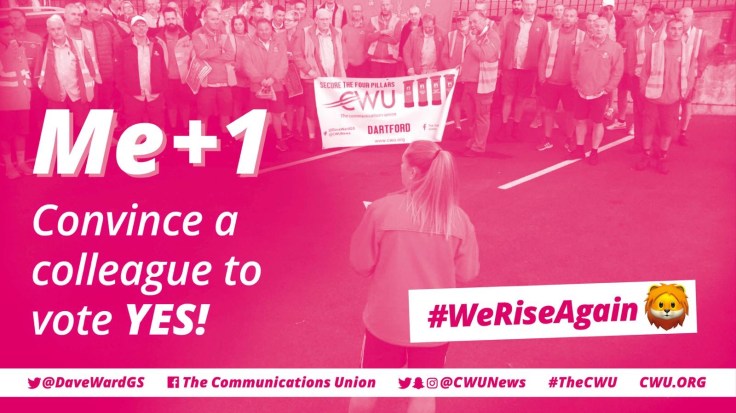
Get the Me+1 message out there

The Battle at Royal Mail By Dave Ward

The Battle at Royal Mail

By Dave Ward

At the end of August the Communication Workers Union (CWU) announced that we would be balloting 110,000 frontline postal workers for strike action in Royal Mail. The last time we did so, back in 2017, we delivered a huge 89% Yes vote on a 74% turnout. As one of the few truly national and strongly unionised employers in the UK, Royal Mail is heading towards one of the biggest industrial disputes we have seen in this country for years — and it’s a dispute that has its roots in the course of liberalisation and privatisation that began in October 2012. 

While the CWU ran a huge public campaign to prevent the sell-off in the first place, once it happened we needed to protect our members and the public from the inevitable attacks that private ownership would bring. All of the commentary from City investors in the run-up to Royal Mail being sold was that staff were being overpaid, and it needed to adopt the sort of bogus self-employment model that new parcel companies like Yodel and Amazon were relying on. Ditching the longstanding legal obligation to provide a mail service for six days a week, they said, would help realise billions in cost savings and profits. To the banks and hedge funds our 500-year-old public asset was little more than a get-rich-quick scheme. 

In the run-up to the sale we balloted our members and Royal Mail was forced to negotiate what was a groundbreaking legal agreement with the union, which restricted what the new private management could do. This prevented it from joining the race to the bottom on employment standards with a ban on the introduction of zero hours contracts; prevented any moves to water-down existing terms and conditions or to introduce a two-tier workforce; and brought in tight controls on the use of temporary, part-time, or agency work. These were significant wins for staff in Royal Mail. Alongside this, the agreement prevented the outsourcing or selling off of any part of the company and embedded the voice of the workforce through the union at both a local and a national level. 

Of course, this hasn’t prevented every problem from privatisation. Shareholders have still been able to take out over £1 billion in dividends and scale back services for the public. But it has blocked some of the worst attacks Royal Mail staff and those who rely on its services would otherwise have seen. So, inevitably, this agreement and the public ethos of Royal Mail have come under increasing pressure. In 2017, the union was again forced to ballot our members and we secured a fresh deal that built on the legal protections. This meant Royal Mail committed to a flightpath to taking four hours off the working week for full time staff. At a time when workers have been under increasing pressure across the board, these sorts of deals demonstrated the value of a strong workplace trade union. 

But now this is something Royal Mail wants to call time on. In 2018, it appointed a new CEO, Rico Back, who had previously been in charge of GLS — Royal Mail’s European parcel business. He’s no stranger to a decent pay packet, having received a £6 million ‘golden hello’ just for taking up his new job, not that the workforce he employed in GLS would know it. Like many parcel delivery companies in the UK, it has relied on bogus self-employment to pay frontline workers as little as €3-per-hour. Günter Wallraff, a journalist with German TV channel RTL, spent months working undercover in GLS. He exposed people working 14-hour days without a break, suffering harassment, and being ‘ruined physically, nervously, and financially’ by what he described as ‘modern slavery’ in the business.

The culture Rico Back has brought to the top of Royal Mail appears to regard these Victorian working practices not as a relic from the past but the model for the future. Meeting the union for the first time earlier this year, he told us that Royal Mail is his company, he can do what he wants with it, and he sees no reason to engage with the CWU. And he’s been true to his word. In the past four months alone there have been three major announcements that will significantly hit staff without any discussion with the union — despite our agreements requiring proper strategic engagement. 

The 2012 legal protections, which stopped the rapacious asset-stripping the private shareholders have been pushing for, are being torn up by the new management team. They have also made the first moves to separate, and ultimately break up and sell off, parts of the company — starting with Parcelforce this October. And, under their new plans, Royal Mail would scrap the protections for staff that have prevented a race to the bottom on terms and conditions. There appears to be no desire on Royal Mail’s part to honour our agreements and to give the union a say. 

Most worryingly for the public, it is also refusing to commit to the six-day universal service, with its legal obligation coming up for review by the regulator Ofcom. Not only is Royal Mail refusing to defend it, but its new strategy is designed to take profitable work away from the core service, which will inevitably make it unsustainable in the future. This is the beginning of the end for a daily postal service provided to all parts of the country, something that many small businesses and individuals rely on. For staff, the move to a five-day service will mean 20,000 job losses at a stroke.

These are crucial times for the future of the industry. But in the here and now too CWU members are making it clear that they are sick and tired of the relentless demands on daily workload, which has created a culture of bullying and constant cost-cutting, directly threatening the wellbeing of the workforce. As a result, we have seen a huge spike in conduct and attendance cases being used to target staff and union representatives.

And of course, technology is playing a role in this battle. Royal Mail is trying to track and monitor delivery staff every second of the day while they are out on their rounds. For postal workers — who once enjoyed the freedom to engage with customers and who were previously empowered whilst out on delivery — this all-too-often feels like wearing a prison tag. We understand the need for technology to improve services and as part of an agenda to grow the business, but this method of ‘modernising’ an industry will do neither.

So, once again, we find ourselves in a place where we have to take a stand. At the end of September the CWU will be balloting over 110,000 frontline workers in Royal Mail for strike action. Our reps are already holding gate meetings with members across the country in a show of strength that few unions in this country can match. And we are asking the public to back their postal workers in a dispute that goes to the very heart of how a company and a service should be run. 

So please show your support on social media. Our members are using the hashtag #WeRiseAgain to show their determination to fight for a better future for themselves and their customers. Let them know whose side you are on. This battle is not just for postal services — it’s a milestone in the fight to protect every service our communities rely upon from the corrosive impact of privatisation.

About the Author

Dave Ward is general secretary of the Communication Workers Union.

https://tribunemag.co.uk/2019/09/the-battle-at-royal-mail

Workplace Action on Mental Health – A Trade Union Guide – LRD Booklet 2019

Workplace Action on Mental Health – A Trade Union Guide – LRD Booklet 2019

Mental health and ill health may currently be high in the news agenda, but people experiencing mental health problems are still facing numerous difficulties at work. Recent figures show that 300,000 workers with long-term mental health problems are losing their jobs each year, and many more with intermittent problems are struggling in their work.

A new booklet from LRD gives practical advice to Trade Union Representatives on workplace policies and procedures on mental health. It covers the law and mental health, health and safety law and the equality act, mental health policies, victimisation and harassment, training Mental Health First Aid, avoiding the ‘resilience approach’, procedures in the workplace, attendance, discipline, capability, workplace reasonable adjustments etc.

The booklet aims to help Union Reps and Health and Safety Reps to work with employers to make workplaces supportive for individuals experiencing either long-term or short-term mental health difficulties and to ensure that mental health problems are not created by work itself. It contains best practice guidance on the sorts of policies and reasonable adjustments that can be made to support affected employees and prevent others from struggling, and includes examples of action already undertaken by unions around the country.

The CWU, Royal Mail and BT are covered on pages 33-36.

Single copies of the Booklet cost £8.95 but orders over 100 reduce the price to £4.92 a copy for Branches considering bulk orders.

Order Form attached.

Yours sincerely


Dave Joyce
National Health, Safety & Environment Officer

19LTB543 Workplace Action on Mental Health – A Trade Union Guide – LRD Booklet 2019

IMG Workplace Action on Mental Health


Create a website or blog at WordPress.com

Up ↑