Redesign – Revised Regional Constitution

Redesign – Revised Regional Constitution

Branches will be aware that following the rule changes agreed at the Special Rules Revision Conference held in Bournemouth on the 29th April 2019, it is necessary to revise the Regional Constitution in order to facilitate the introduction of the new Redesign Regional Structure.

The National Executive Council (NEC) meeting held on the 25th July, agreed the attached revised Regional Constitution.  Branches will note there is a need to elect a number of new Regional positions and arrangements are being made by Regional Secretaries for those nominations and elections to take place with the aim of introducing the new structure from 1st September 2019.

Any enquiries on the above LTB should be addressed to gsoffice@cwu.org


Yours sincerely


Dave Ward

General Secretary 

19LTB479-Redesign – Revised Regional Constitution

REGIONAL COMMITTEE CONSTITUTION


  1. NAME


The Committee shall be known as the CWU (Insert name) Regional Committee.


  1. COMPOSITION


  1. The Regional Committee shall be composed of Regional Chair, Regional Secretary, Regional Financial Secretary, Assistant Regional Secretary, Regional Executive Committee members and delegates from Branches (the delegation strength of each Branch shall be detailed in each Regional Committee Constitution).


  1. Branch delegates from Branches within the Regional Committee boundary in line with the following formula:


Up to 1000 members                         1 delegate

1001 to 2000 members         2 delegates

2001 and over members       3 delegates


  1. OBJECTIVES


The objectives of the Regional Committee shall be:


  • To work under the direction of the NEC and oversee all non-industrial work within the Region.
  • To support the development of the union’s work within the wider trade union movement, including building stronger links to TUC Regional Structures.
  • To support the development of the union’s political work, including building stronger links with the relevant Labour Party structures.
  • To support the development and delivery of the union’s Organising and Recruitment Strategy.
  • To support the development and delivery of the union’s Equality, Education, Learning & Training Strategy.
  • To support and oversee the work of our Branches and implement strategies such as the CWU measures of success.
  • To develop Regional priorities and campaigns that support the general strategies of the union.
  • To support the development of the union’s Communications and Engagement Strategy.


  1. AUTHORITY AND FUNCTIONS 


The Committee shall operate under the authority and directive of the General Secretary and in accordance with the CWU National Rules and Regional Constitution(s).  It shall be subject to the decisions of Annual Conference.


The authority and functions of Regional Committees shall be incorporated within the Constitution of the Regional Committees.


Regional Committees may only exercise such powers, perform such functions and discharge such duties as may from time to time be delegated to them or each of them by the NEC or General Conference.


Regional Committees shall not instruct, authorise or permit an Officer of the Regional Committee to do any act which is contrary to these Rules, or to refrain from doing any act which he/she is required under the Rules to perform.


No Regional Committee shall have read to it any unauthorised circular or address relating to the conduct of the Union or its business or to the conduct of its Officers or members.

A Regional Committee shall on receipt of an unauthorised circular or address send both the envelope and the circular to the General Secretary immediately.


Regional Committees will have an entitlement to submit items for General and Rules Revision Conferences.


  1. MEETINGS


  1. Regional Committee meeting shall meet 4 times a year. One of the Regional meetings will be a Regional Conference.  Branch attendance at Regional meetings will be mandatory.


  1. Decisions taken at all Regional meetings will be by a simple majority.


  1. Notice of meetings, the minutes of the previous meeting, the Secretary’s report and terms of any motions received will be dispatched not later than fourteen days prior to the date of the meeting.


  1. All meetings shall adopt the Standing Orders appended to this Constitution.


  1. REGIONAL OFFICERS


The Principal Officers of the Regional Committee shall be Chair, Secretary, Financial Secretary and Assistant Secretary. At least 2 of these positions should be held by women and no single individual can hold more than one of these positions at any one time.


The duties of the Regional Officers shall be detailed within the Regional Committee Constitution


  1. DUTIES OF REGIONAL OFFICERS


  1. Chair


The Regional Chair will preside over meetings of the Regional Committee and Regional Executive meetings. The Chair shall be responsible to the National Executive Council for the proper conduct of the meetings.

  1. Secretary


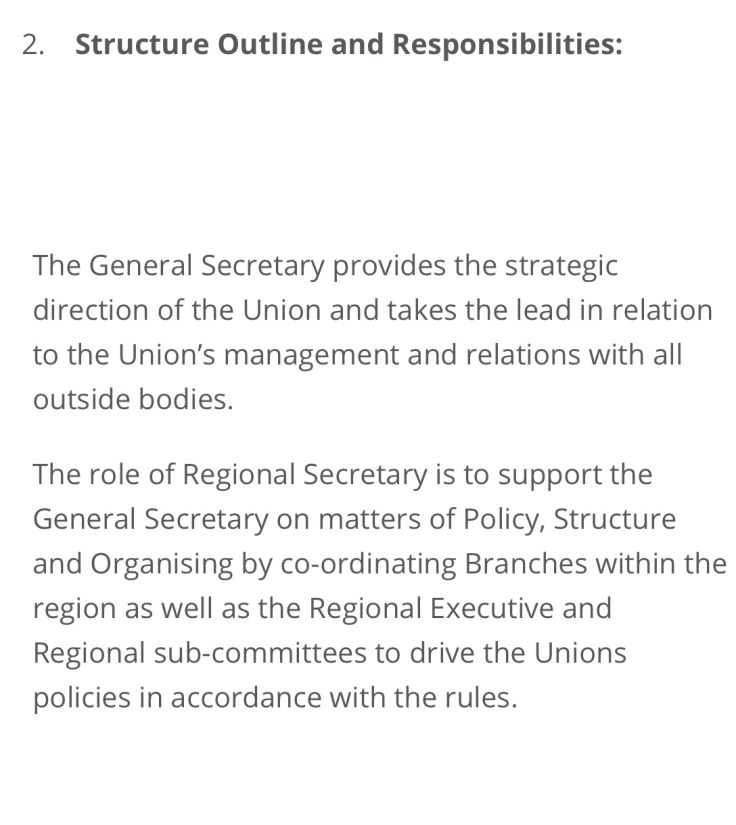
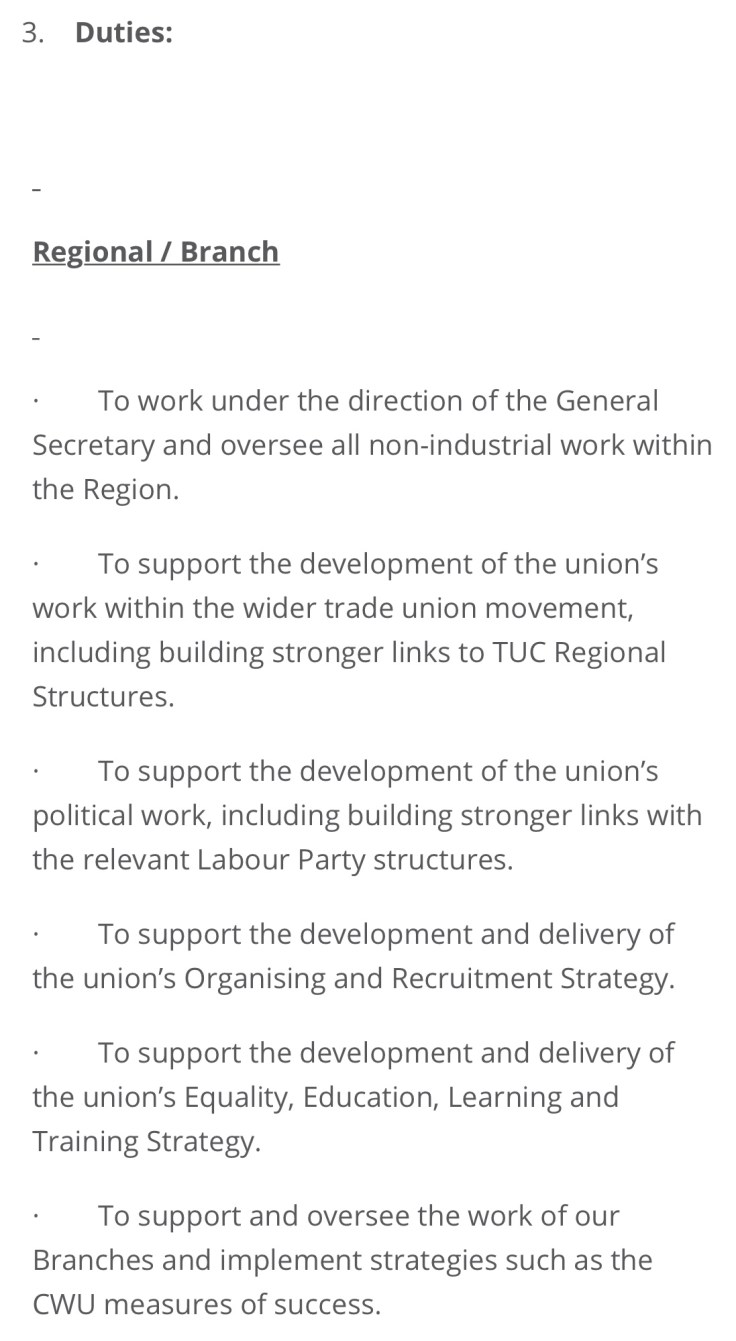
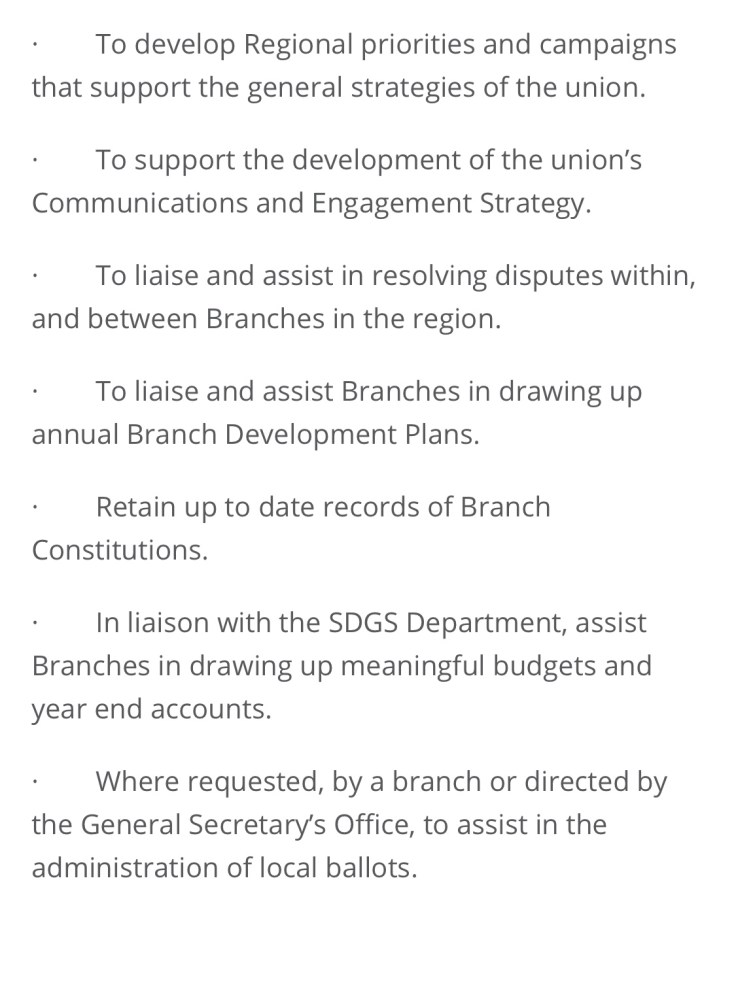
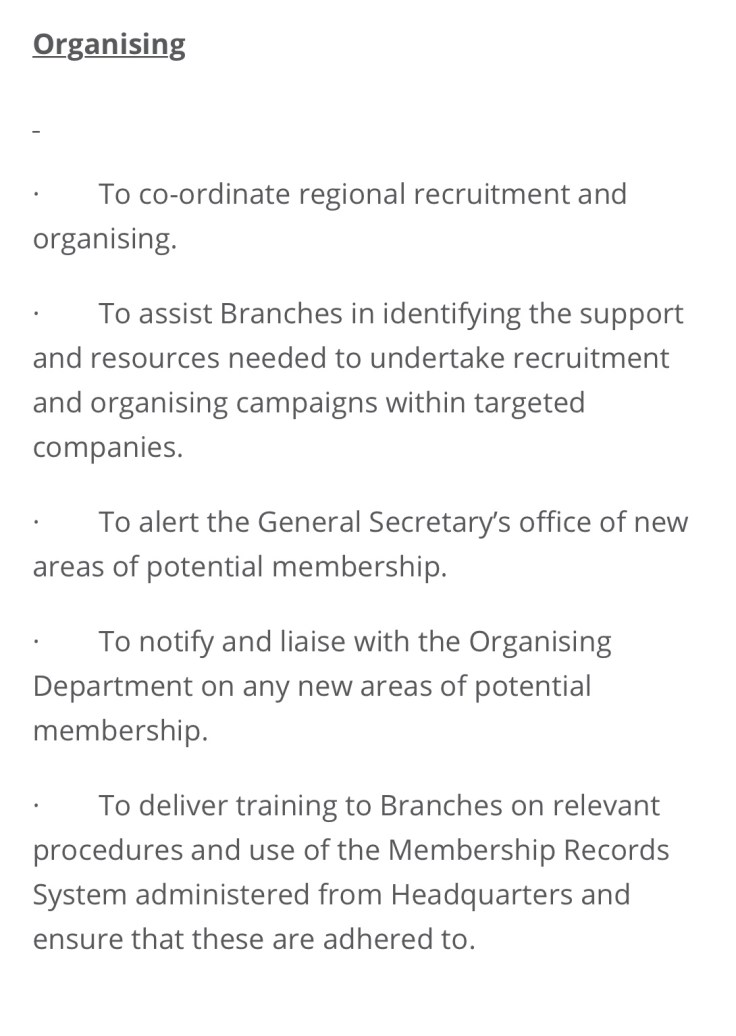
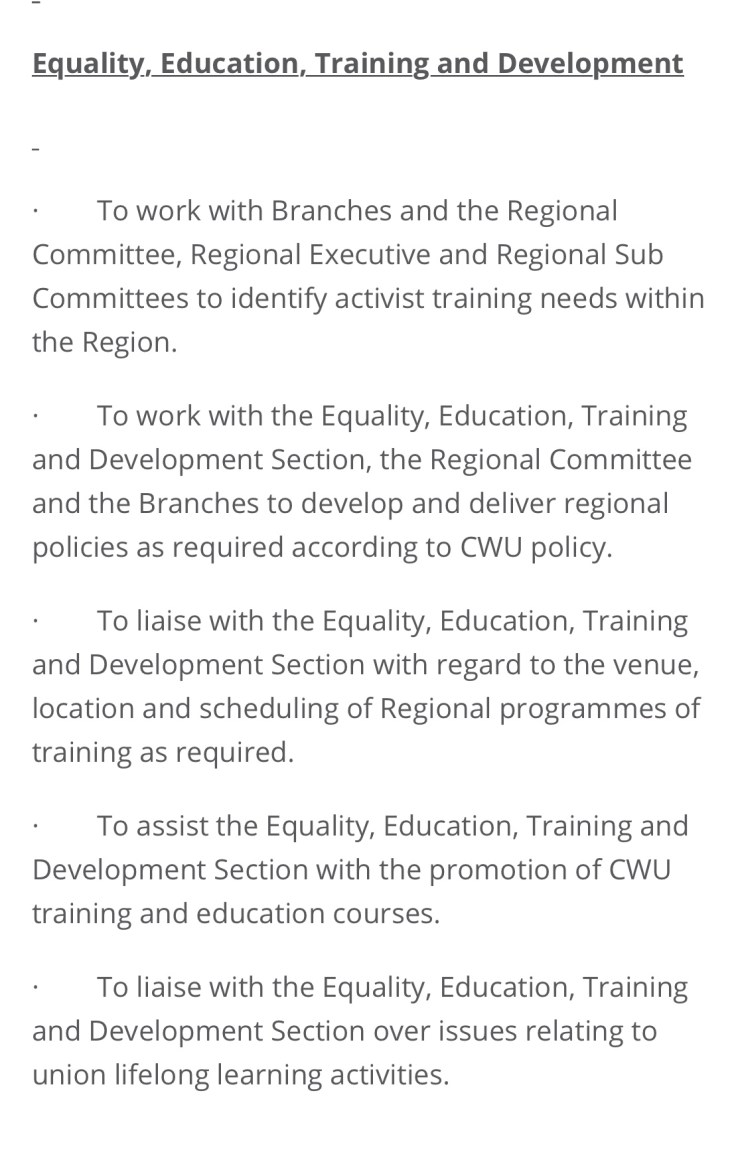
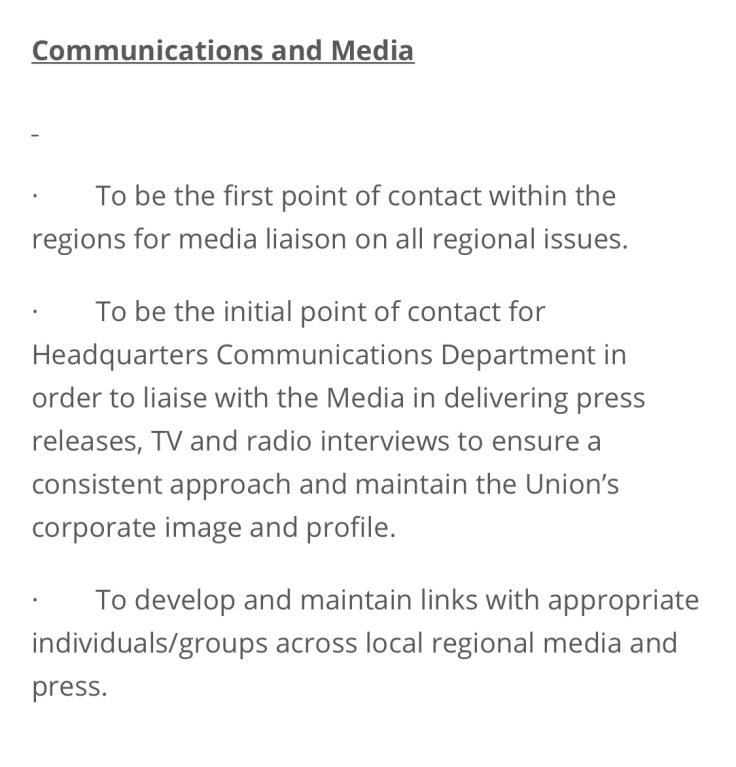
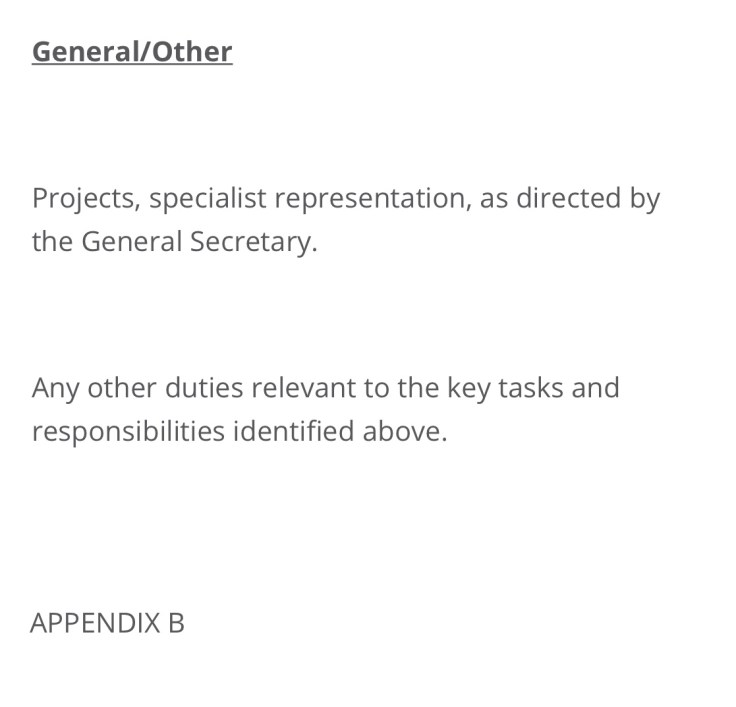
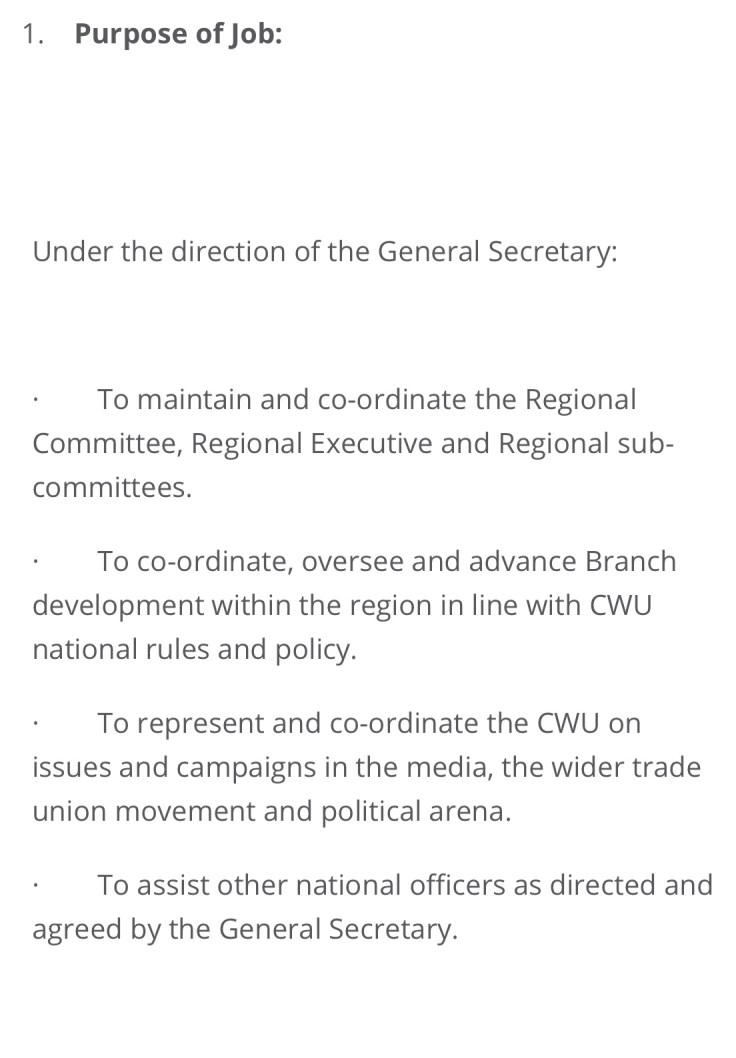
The Regional Secretary shall be the principal representative of CWU Headquarters in the Region and shall co-ordinate all activity in the Region.  The roles and responsibilities of the Regional Secretary, as agreed by the NEC, are attached as Appendix A.


Additionally, the Regional Secretary shall undertake correspondence on behalf of the Regional Committee and Regional Executive Committee.  The Regional Secretary will be responsible for the preparation of minutes of all meetings of the Regional Committee, Regional Executive Committee and Regional Sub Committee Meetings.


The Regional Secretary will be responsible for preparing written reports, the paragraphs of the reports to carry recommendations and the draft reports to be forwarded to the General Secretary’s Office not later than 28 days prior to the date of the meeting.


By right of office the Regional Secretary will be included as part of all Regional Labour Party delegations (except in Northern Ireland).  In the event that the Regional Secretary is not a member of the Labour Party the Assistant Secretary will take on this role, or the Regional Chair, if the Assistant Secretary is not a member of the Labour Party.

By right of office the Regional Secretary will be included on all Regional TUC delegations. The Regional Secretary for Scotland shall be included in the delegation for the STUC. The Regional Secretary for Wales and the Marches shall be included in the delegation for the Wales TUC. The Regional Secretary for Northern Ireland shall be included in the ICTU delegation however this will be subject to the provisions of National Rule 8.10.


A Regional Secretary, when not a Branch delegate, shall attend Annual Conference in an ex officio capacity, having the right of speech but no voting powers.  They may participate in the discussions at Conference at the specific request of a Branch within the Region.


  1. Assistant Regional Secretary


The Assistant Regional Secretary shall deputise for the Regional Secretary during absence.


Additionally the Assistant Regional Secretary will support the Regional Secretary and be the lead Regional Representative on Communications and Campaigns.


The Regional Assistant Secretary will be the Lead Representative for the Regional Equality Sub Committee.


  1. d) Regional Financial Secretary


The Regional Financial Secretary shall be responsible for the control and administration of the Regional Funds and for ensuring that the finances of the region are conducted in accordance with the rules and policies of the union


The Regional Financial Secretary shall prepare an annual financial statement that shall be placed before the Regional Committee for approval.


Additional the Regional Financial Secretary shall prepare and produce a financial statement for each Regional Committee meeting.


  1. REGIONAL EXECUTIVE COMMITTEE


There will be within each CWU Region a Regional Executive Committee who will oversee the work of the Region in between full Regional Committee meetings.


The Regional Executive Committee will meet 4 times per year in between full Regional Committee meetings.

The CWU Regional Executive Committee will comprise of the following elected representatives:


Regional Secretary

Regional Assistant Secretary

Regional Chair

Regional Financial Secretary

Regional Political Officer

Regional Lead – Women

Regional Lead – BAME

Regional Lead – LGBT

Regional Lead – Disability

Regional Lead – Young Workers

Regional Lead – Retired Members

Regional Lead – Health and Safety

Regional Lead – Education, Learning and Training


The Regional Executive Committee will also comprise of the following ex-Officio members:


Regional, Territorial and Field Industrial Leads

         Designated NEC Member


  1. ELECTION PROCEDURES


All elections for the Principal Regional Committee Officer positions and the Regional Executive Committee positions will be elected by Branches within the Regions on a one union basis.


The election for the Regional Secretary will be on an individual member ballot of all members in the Region.  The election period will be for two years.  The successful candidate shall be the individual who receives the highest number of votes cast.


Elections for the Regional Chair, Regional Financial Secretary and Regional Assistant Secretary, shall be conducted at the Regional AGM. The elections for these positions shall be conducted in the accordance with the following sequence:


1) Regional Chair

2) Regional Financial Secretary

3) Regional Assistant Secretary


The elections for the Regional Executive Committee positions will be conducted at the Regional AGM.

The Regional Secretary will be the returning officer for these elections.  All Branches shall be eligible to vote and will be allocated to vote in accordance with their membership size at the time of the elections.  The successful candidate(s) will be the individual(s) who receive the highest number of votes cast.


All candidates for Regional positions shall require the nomination of their own branch


  1. FINANCES


Regional Committees will receive 2% of Branch rebate which will be paid direct into the Regional Fund.


The Regional Fund will be distributed on the basis of a bidding system based on clear plans and clear measurable outputs.


When attending Regional meetings the Principal Regional Officers (Regional Secretary, Regional Chair, Regional Financial Secretary and Regional Assistant Secretary) will be entitled to travel and subsistence to be paid from the Regional Fund.


There shall be four Trustees: Regional Chair, Regional Secretary, Regional Assistant Secretary and Regional Treasurer, who shall be the signatories of the Fund.


The Regional Committee Fund shall be maintained at Unity Trust Bank, which will accept two of the four Trustees signatures for business transactions.


All Regions shall ensure that the finances of the Region are conducted in strict accordance with the Rules and Policies of the Union.


All expenditure including donations will require the approval of the Regional Committee and must be in accordance with the Union’s Rules, Policies and Objectives.


The Regional Committee Fund shall be audited annually by two Auditors elected at the Regional Committee AGM.  The account shall be submitted to, and subject to audit by, CWU headquarters and the Union’s professional Auditors.


  1. REGIONAL SUB COMMITTEES 


There shall be 6 Regional Sub Committees:


  • Regional Equality Sub Committee comprising of Branch Women’s Officers, Branch Equality Officers, Branch BAME Officers and other representatives from the 4 equality streams.
  • Regional Health and Safety Sub Committee comprising Lead Health and Safety Representatives from all Branches.
  • Regional Young Workers Sub Committee comprising of 1 delegate per branch.
  • Regional Retired Members Sub Committee comprising of 1 delegate per branch.
  • Regional Education, Learning and Training Sub Committee comprising of Branch Lead ULR’s and Branch Secretaries.
  • Regional Political Sub Committee comprising of Branch Political Officers.


Regional Sub Committees shall adopt and operate the Regional Sub Committee constitution approved by the NEC.


  1. STANDING ORDERS OF CWU REGIONAL COMMITTEE (S)


These standing orders shall also cover the meetings of the Regional Executive Committee and Regional Sub Committees:


  1. Order Of Business


  1. Adoption of Standing Orders.


  1. Minutes of Previous Meeting.


  1. Regional Secretary’s / Regional Lead Reports together with associated Amendments.


  1. Motions and Amendments.


  1. Any Other Competent Business.


  1. Motions


  1. Branches desiring to submit a motion for the consideration of the Regional Committee shall send it in writing to reach the Chair not later than 14 days before the meeting.


  1. No motion shall be accepted for the Agenda unless it has been submitted to and approved by the sponsoring branch committee.


  1. Motions which are accepted by the Chair shall be forwarded to the General Secretary not later than 7 days prior to the date of the meeting.


  1. Any motion submitted which deals with a subject covered by the Regional Secretary’s Report shall be treated as an amendment to the recommendation at the end of the relevant paragraph.


  1. Motions shall be circulated in advance of the meeting to Branches by the Regional Secretary.


  1. Amendments


  1. Any amendments to motions or recommendations contained in the Regional Secretary’s Report shall be sent in writing to reach the Chair not later than three days prior to the meeting.


  1. Such amendments accepted by the Chair shall be circulated to the delegates at the opening of the meeting.


  1. Order of Debate


  1. A delegate when speaking shall address the Chair and if two or more members indicate to speak at the same time, the Chair shall decide to whom priority shall be given.


  1. A delegate who speaks, shall direct his/her speech strictly to a motion under discussion, or to a question of order


  1. Motions or Amendments in the name of a Branch must be moved by a delegate of that Branch.


  1. Proposers for motions to amend reports shall be allowed eight minutes, but other speakers shall be limited to four minutes.


  1. Proposers of motions to amend reports shall be allowed four minutes and subsequent speakers, three minutes. Speeches shall be due to be completed within the times allowed.  An extension of time granted to a speaker shall not exceed that originally granted.


  1. Formal motions accepted, the mover of an original motion may reply to the discussion and shall confine themselves to answering previous speakers, and shall not introduce any new matter into the debate. No other delegate shall be heard a second time on any motion or amendment.


  1. No discussion shall be allowed on formal motions, such as “That the meeting be now adjourned” or “That the debate now be adjourned” or “That the meeting proceed to the next business”.


  1. A second motion, “That the meeting do now adjourn” or “That the debate be now adjourned” or “That the meeting now proceed to the next business” shall not be made within a period of one hour of meeting time unless it is suggested by the Chair.


  1. A motion or amendment once made and seconded shall not be withdrawn except by the majority consent of the meeting.


  1. If an amendment be carried, the motion as amended shall take the place of the original motion, and shall become the question upon which any further amendment may be moved.


  1. Points of order must deal with the conduct and procedure of debate.
  2. Suspension of Standing Orders


  1. Any one or more of the Standing Orders, in any case of urgency, or upon a motion made on notice duly given, may be suspended at any meeting in regard to any business at a meeting. The Standing Order of Orders involved must be specified in any such motion.  A motion for the suspension of Standing Orders will not be deemed carried unless a clear majority of the delegates present vote in favour.


  1. A second motion for the suspension of Standing Orders for the purpose of varying the order of business, shall not be accepted within a period of one hour of meeting time, unless it is suggested by the Chair.


  1. Voting


Decisions taken at all Regional meetings will be by a simple majority.

 APPENDIX A 


Regional Secretary Roles and Responsibilities 


Reports To:  CWU General Secretary
REGIONAL SUB COMMITTEES 


  1. Name


This Sub Committee shall be known as the CWU (insert name of region) Regional Sub Committee (insert name).


  1. Committee Composition


The composition for the Regional Sub Committee will be detailed in the Regional Constitution,


  1. Objectives


  1. To promote and actively campaign CWU Policy on (insert title).
  2. To encourage CWU Representatives and members to take a more active part in Branch affairs, the union in general, as well as political issues affecting the subject matter of the Sub Committee.
  3. To encourage CWU members to become Branch committee members and union activists.
  4. To report to the Regional Committee on matters raised at the Regional Sub Committee.
  5. To deal with issues and to pursue them through the Branch and Regional.

 
Elections


  1. Elections will be conducted in accordance with the Regional Constitution


  1. Regional Lead 


The Regional Lead for the respective Sub Committees will be:


Regional Equality Sub Committee – Regional Assistant Secretary


Regional Health & Safety Sub Committee – Regional Lead Health & Safety


Regional Young Workers Sub Committee – Regional Lead – Young Workers


Regional Retired Members Sub Committee – Regional Lead – Retired Members


Regional Education, Learning and Training Sub Committee – Regional Lead –

Education, Learning and Training


Regional Political Sub Committee – Regional Political Officer


  1. Regional Lead Duties


  1. Under the direction of the Regional Committee the Regional Lead will be responsible for developing and delivering the respective policies, aims and objectives relevant to the sub-committee of the Region in accordance with the Regional Development plan and the rules and policies of the union.


  1. To assist and support branches in regards to matters relevant to the sub-committee


  1. The Regional Lead will liaise with the relevant CWU National and Branch Representatives as appropriate.


  1. The Regional Lead will be responsible for dealing with all correspondence relevant to the Sub Committee.


  1. The Regional Lead shall prepare an annual report that shall be placed before the Regional Committee for approval.


  1. The Regional Lead shall prepare a report to be placed before each Regional Committee meeting for approval.


  1. It will be the responsibility of the Regional Lead to prepare the agenda and minutes of the sub- committee meetings and circulate them to the members of the Sub Committee (Regional Secretary and Branch Secretaries) to enable issues contained in the minutes to be pursued through the Branch and Region as necessary.


  1. Meeting Arrangements


  1. a) The Committee will meet 4 times per year.


  1. b) The quorum for the meetings shall be one third of Branches entitled to attend.


NICE Suicide Prevention Quality Standard Consultation – CWU Response

NICE Suicide Prevention Quality Standard Consultation – CWU Response

The CWU has submitted a written response to the UK National Institute for Health and Care Excellence (NICE) consultation on Suicide Prevention Quality Standards, a copy of which is attached for the information of Representatives, Branches and Regions.

The NICE suicide prevention quality standard will cover ways to reduce suicide, with an emphasis on local organisations combining their expertise and resources to implement a range of suicide prevention measures. Consultation responses will feed in to the development of the standard, which is expected to be published in September 2019.

We were very pleased to be able to participate in the Consultation and be putting forward a Trade Union voice, not commonly heard in NICE Consultations.

The NEC and the Mental Health Strategy Project Working Group believe this submission comes at an appropriate time as the Union continues to develop its Mental Health Strategy and following the carriage of Motion 1 at CWU General Conference 2019 on workplace suicide, which called for a campaign to:

  1. ensure that workplace suicide is recognised in legislation; and
  2. place the burden of proof on the employer to demonstrate that the suicide was not work-related.

We hope that NICE will take on board the comments from the CWU in drafting the quality standards, particularly as the CWU’s submission highlights the absence of employers and trade unions in the draft suicide prevention quality standard, and argues that employers and unions should be involved in supporting multi-agency suicide prevention partnerships.

The CWU Mental Health Strategy Project Team agreed the CWU should respond to this consultation which was endorsed by the NEC.  The response has been a joint piece of work between the Research Department and the Health, Safety & Environment Department before submission via the General Secretary.

The National Institute for Health and Care Excellence (NICE) 

The National Institute for Health and Care Excellence (NICE) is an executive non-departmental public body of the Department of Health in the United Kingdom, which provides national guidance and advice to improve health and social care. It publishes guidelines in four areas:- (a) the use of health technologies within the National Health Service (NHS) (such as the use of new and existing medicines, treatments and procedures) (b) clinical practice (guidance on the appropriate treatment and care of people with specific diseases and conditions) (c) guidance for public sector workers on health promotion and ill-health avoidance (d) guidance for social care services and users. Essential information is produced for key groups including NHS, GPs, local government, public health professionals and members of the public. The Institute aims to determine the clinical effectiveness of interventions and to help achieve improvements in the quality and delivery of health care. NICE appraisals are based primarily on evaluations of efficacy and cost-effectiveness in various circumstances. NICE was also established in an attempt to end the so-called postcode lottery of healthcare where treatments that were available depended upon the NHS Health Authority area in which the patient happened to live, but it has since acquired a high reputation internationally as a role model for the development of clinical guidelines.

Yours sincerely


Dave Joyce
National Health, Safety & Environment Officer

19LTB477 NICE Suicide Prevention Quality Standard Consultation – CWU Response

CWU Response NICE suicide prevention 23 05 19


ROYAL MAIL/DIMENSIONS UNIFORM ‘ROADSHOW’ WORKPLACE VISITS – ADDITIONAL DATES FOR 2019 (& ‘MINI-FOOTWEAR’ ROADSHOWS)

ROYAL MAIL/DIMENSIONS UNIFORM ‘ROADSHOW’ WORKPLACE VISITS – ADDITIONAL DATES FOR 2019 (& ‘MINI-FOOTWEAR’ ROADSHOWS)


Dear Colleagues,

Further to Letter to Branches 246/19, dated the 18th of April, Branches are advised that a further Uniform Roadshow event has now been added to those already planned to be held by Royal Mail and their uniform supplier Dimensions up to November.

The further workplace to be visited is:

North London Delivery Centre – 20th August (07:00am -10:00am)

Additionally, Royal Mail have been holding some ‘Mini-Footwear’ events during this month and plan to hold more of these events in the following Delivery Offices (noting that this may be subject to some short notice alterations):


Hull CDO – 7th August (07:30am-08:30am)

Dronfield DO – 9th August (07:30am-08:30am)

Sheffield South DO – 12th August (07:30am-08:30am)

Sheffield CDO – 13th August (07:30am-08:30am)

Chesterfield DO – 15th August (07:30am-08:30am)

Manvers DO – 16th August (07:30am-08:30am)

Sheffield West DO – 22nd August (07:30am-08:30am)

Sheffield South West DO – 23rd August (07:30am-08:30am)


These ‘Mini-Footwear’ workplace visits are simply to cover the current Royal Mail footwear range and both parties have agreed to review the benefits, or otherwise, of these events against the wider remit of the general Uniform Roadshows going forward.

As reported to Branches before, these Roadshow events have proven to be very successful and largely welcomed by members since they started last year and in addition to offering details on the current uniform range and addressing particular individual questions and enquires, they also aim to give members more information on such issues as how to self-order uniform, how to return unwanted items and the process to follow for orders which are over the individual’s members uniform allocation.

In setting out this further Uniform Roadshow workplace visit, it can be confirmed that a number of the previous listed Offices have been nominated by CWU Branches and Royal Mail have confirmed that further consideration will be given to any additional visit requests made. Therefore, if Branches wishes to request a Uniform Roadshow visit for a particular workplace, they are invited to do so by writing into the Outdoor Department. Equally, those workplaces which have already been nominated by Branches for such future visits have not been overlooked and will be added to the next phase of Roadshow events which will be planned once the Royal Mail uniform tendering contract process has been completed (details of which are set out in LTB 063/19).

Whilst the details of this LTB are hopefully self-explanatory, any enquires or requests for such Uniform Roadshow visits to a workplace should be directed to the Outdoor Department, reference 500, email address: outdoorsecretary@cwu.org.

Yours sincerely,


Mark Baulch                                      

CWU Assistant Secretary

LTB 474.19 – RM DIMENSIONS UNIFORM ROADSHOW WORKPLACE VISITS ADDITIONAL DATES FOR 2019


ROYAL MAIL REVIEW OF FUTURE CATERING PROVISION – QUADRANT JOINT VENTURE

ROYAL MAIL REVIEW OF FUTURE CATERING PROVISION – QUADRANT JOINT VENTURE

The department was recently contacted by Martin Gafsen, Royal Mail Group, Property and Facilities Director, in relation to instigating discussions on the future of catering provision and a meeting subsequently took place on the 31st July 2019. 

Historically in 1998 Quadrant became the subject of a Joint Venture between Royal Mail and Compass Group and have provided catering facilities since that time. The current Quadrant contract which commenced in 2015, was originally for three years, with a review point after two. In 2017 a two-year extension was agreed with the next review point due in September 2020.

Branches will be aware that over recent years the department has fought to champion the use of the Quadrant facilities by our Royal Mail members. However, despite our best efforts and support from Branches the trends with regard to footfall and sales continue to be negative.

As such the business has been reviewing the situation and has been in discussions with Quadrant on both the food offer and facilities. However, the Royal Mail Board has decided that the commercial contract should not be extended without the market being tested in respect of alternative options that may be available. Effectively this means that a commercial tender process for future Catering provision in Royal Mail is to be commenced.

During the meeting the business were at pains to assure the department that it is not their intention to cease subsidised catering and in fact may invite tenders for solutions beyond the scope of the current arrangements with Quadrant. They have also confirmed that Quadrant will be invited to submit a tender which will be considered with equal status.

The business has informed us that the tender process will commence in August – September 2019 and will follow three key stages:

1. August 19 – September 19 – Pre-Qualification Stage

2. September 19 – January 20 – Request for, and evaluation of, outline solutions stage

3. February 20 – April 20 – Request for Detailed Solutions

Quadrant has been informed of the intention to move to tender and we understand that they will be communicating with their employees, our members, today to inform them of Royal Mail’s decision.

Of course in any tender process there remains the possibility of a move to an alternate service provider and as such we have questioned what would happen to the Joint Venture in such circumstances. In response the business has indicated that they would look to dissolve the Joint Venture arrangement.

The department with the assistance of the CWU Research Department are currently undertaking analysis of the Joint Venture documentation to assess any direct implications for our members should such a scenario develop.

Clearly we appreciate and understand that regardless of any assurances, the fact that the business intends to move to commercial tender is extremely unwelcome and will be of great concern to our Quadrant members.

Discussions are therefore under way between the department and Royal Mail to develop a structure for engagement throughout the tender process to ensure that the union is fully engaged and can influence any final decision.

Our priority will be to ensure that our Quadrant member’s long term job and standard of living security is protected and that they are fully supported throughout what will undoubtedly be a very unsettling time.

Any enquiries in relation to this LTB should be addressed to Davie Robertson, Assistant Secretary, email: dwyatt@cwu.org or shayman@cwu.orgquoting reference number: 311.02

Yours sincerely


Davie Robertson

Assistant Secretary

LTB 475-19 Future of Catering Provision – 07.08.19


Update from Martin Walsh

Important Update to London Members

Dear All

We were called to a Joint PEC/ Divisional Reps meeting yesterday at CWU HQS.

We were given the following update

The officers seemed shocked that within the last week that all the following senior Directors have gone :

Steve Cameron

Anton Harding

Ian Jones

Ewan Mcmurdo

It would seem that Reco has decided to remove anyone who was involved in the Four Pillars Negotiations and subsequent agreement.

These have been replaced with either Directors from other companies or those who previously worked in continuous improvement projects.

It is clear the direction of the company is heading .

Terry Pullinger reported that Royal Mail were saying that some areas and offices were not holding the line on the shorter working week and were agreeing revisions. This was weakening the unions negotiating position.

Terry also reported that the company had written to the CWU asking to commence the review into the legal guarantees and that there is a belief that they will try and reduce some of those legal guarantees.

In addition we were told that Royal Mail wanted to set up a different profit and loss company for Parcelforce with staff possibly being TUPE over to a new company.

This is in our opinion the breaking of the legal guarantees which was that they could not break up the company.

In addition it was reported that Royal Mail believe that they could save thousands of hours and overtime if the union agreed to PDA actuals being used for resourcing revisions, AHDC being used for time recording and linked to pay and Resource Scheduler for clarifying how many duties you need on a weekly / monthly or seasonal basis.

Anyone who thinks the above is good and yes there are some , should also realise that Royal Mail want the CWU to sign up to continuous improvement on efficiency and resourcing.

The CWU and Royal Mail are in the process of agreeing the external mediator to review the differences between the Company and Royal Mail and has to be done before the union can ballot for strike action.

There is a meeting between Royal Mail and the CWU on Thursday but the CWU are not hopeful of much progress as some of Royal Mail’s chief negotiators have now been replaced.

It is clear that Reco Back and Achim Dunwald have decided that they are not interested in the key principles of the Four Pillars Agreement and want to introduce their 5 year strategy on the workforce without agreement.

It is therefore clear that we are likely to be heading for an industrial dispute in the Autumn 2019.

Let’s get the members ready , let’s get the membership addresses correct.

But most importantly let’s tell Reco your not running a non unionised GLS now !

Your dealing with the CWU who have had more National disputes in the last 25 years than any other union and has gained significant achievements in all of them.

The CWU must now rise up and say enough is enough! Either you negotiate on the following :

Parcel strategy

Stoping Real time recording

Improving culture n the workplace

Extending the Legal guarantees

Agreeing the Shorter working week

Or we will show that we can get 89% of our members to vote yes again to defend their jobs and futures !

A message from the London Divisional Committee

CWU Conference 2020 & 2021 

CWU Conference 2020 & 2021 

As Branches will be aware the decisions made at the Special Redesign Conference in November 2018 and at this year’s Rules Revision Conference means that General Conference 2020 will be 3 days in duration.  Adding in the Industrial Conferences means that next year’s event will be of 6 days in total.

The only venue and timescale that we are able to secure that could host CWU Conference over a 6 day period is the Bournemouth International Centre from Sunday 19th April to Friday 24th April.

We are aware that this date conflicts with the STUC but regrettably there are no other dates and venues available to host the size and duration of our event and as a result the NEC have agreed that CWU General Conference will be at the BIC from Sunday 19th April 2020 to Friday 24th April 2020.  Further details will be issued regarding the timetable, registration and submission of motions to the relevant conferences in due course.

The NEC were mindful in making this decision of the policy and views previously expressed by Branches of the need to rotate conference venues.  Accordingly the NEC have taken an in-principle decision that CWU General Conference 2021 will be held in Blackpool.

A new conference centre is nearing completion in Blackpool and is due to open in 2020 (it opens too late for it to be considered for our 2020 conference) alongside a number of new hotels.  The specifications for the centre show that it can accommodate our needs but the in-principle decision is subject to an on-site visit confirming this position.

We wanted to share this information now so as Branches can see that action has been taken to move our Conference away from the location we have used for a number of years i.e. Bournemouth.  Final confirmation will be forwarded to Branches once that visit has taken place.

Any enquiries regarding this Letter to Branches should be addressed to the Senior Deputy General Secretary’s Department on telephone number 020 8971 7237, or email address sdgs@cwu.org.

Yours sincerely,


Tony Kearns

Senior Deputy General Secretary

19LTB473


Sale of BT Fleet Ltd to Aurelius 

Sale of BT Fleet Ltd to Aurelius 

As you now will be aware BT has agreed the sale of BT Fleet Ltd to Aurelius with the transaction due to complete on 1st September 2019.

BT has stated that the sale forms part of its ongoing transformation strategy to “focus on converged connectivity and services” – namely full fibre and 5G.   BT Fleet management is arguing that a standalone business will have more control over how it can invest its profits in key areas such as “HGVs, accident management and vehicle funding”. Hence the sale to Aurelius who claim to specialise in acquiring “non-core” divisions of companies in need of operational support to transform them into standalone, sustainable organisations.

The CWU does not support the sale.  We believe that BT could find other ways to free up resources so it could invest in Fleet as well as fibre and 5G which were not fully considered.  Regrettably, however, it is extremely unlikely that we are going to be able to stop this sale.

It should also be noted that the Transfer of Undertakings Protection of Employment (TUPE) does not apply in this case as it is a “Share Purchase” sale not covered by the legislation. As BT Fleet Ltd is being sold as a legal entity then the employment contracts and contractual benefits will remain in place.

The CWU will be having discussions with BT over the coming days to ensure we reach a steadfast commitment to a full recognition agreement with the new company.   This will ensure we have full collective negotiation rights about future pay and working conditions. Although we have been informed by BT that there are no contractual changes, some non-contractual benefits may change given that they will separate away from BT. We will also be pressing BT on these issues and confirming the pension arrangements to be adopted by the new company and we will keep you appraised of our progress.

For information, I have attached to this letter copies of the “Frequently Asked Questions” (FAQs), a crib sheet and a slide presentation which BT will be using when dealing with members’ queries and at meetings.

This is obviously a stressful time for our members and I would encourage all branches with BT Fleet members to visit the affected workplaces within your area as soon as possible. We will keep both branches and members updated as the situation develops but in the meantime if   members have any questions that their local branch cannot answer then please email:  btfleet@cwu.org


Yours sincerely


Andy Kerr

Deputy General Secretary (T&FS)

471.2019


Royal Mail/CWU Road Safety Campaign – Mobile Phones – W/C Monday 12 August 2019

Royal Mail/CWU Road Safety Campaign – Mobile Phones – W/C Monday 12 August 2019

Background and Context 

The importance and aim of the August Road Safety Campaign is to raise awareness amongst our members who are drivers about the risks and dangers of using mobile phones, including ‘hands free’, whilst driving. The law and Royal Mail policy is applicable to all employees, including van drivers, HGV drivers and car drivers.

The campaign will concentrate on key messages to drivers and managers with the emphasis on how important it is for drivers to refrain from using their mobile phones including ‘hands free’, for any purpose while driving. We want all drivers to be safe, legal and not distracted whilst they are behind the wheel on the UK’s busy roads.

Dangers of Using Your Mobile Phone While Driving

Mobile phone use while driving is not only illegal but it is widely considered dangerous by road safety experts and road safety organisations and charities (e.g., Think, Roadpeace, Brake, RoSPA, RAC, AA, AIRSO, FTA, Police etc.,) due to its potential for causing driver distraction and crashes.

There have been many reported horror stories about the dangers of phone use and driving with today’s phone technology and the use of mobile phones in everyday life. Most of these warnings are about the specific risk of driver distraction that phones can present to drivers. Using a phone in any way while behind the wheel can distract anyone enough to cause an accident. Many people fail to realise that being on their phone while operating a vehicle endangers not only their life but the lives of everyone around them on the roads as well. Accidents caused by drivers distracted by mobile phones are accidents that can be avoided!

Hand-Held Mobile Phone Driving Offences

It’s an offence to use a hand-held mobile phone whilst driving a motor vehicle under current UK law. Driving includes being stationary if the engine is running, including in traffic queues and at traffic lights. Prosecutions for these offences are designed to promote UK road safety. This offence carries a standard fine of £200 and 6 penalty points, with a maximum of up to £1000 and 6 points on your driving licence (the fine can rise to £2,500 if you are driving a heavy goods vehicle, bus or coach. If a driver chooses to reject the fixed penalty and asks for a court hearing they will be at risk of higher fines and court costs but the points will remain the same.

Drivers can be prosecuted not just for having a phone in their hand and in use. It includes using the device for any telecommunication purpose, not just making or receiving calls. This includes texting while driving, using any other Apps, or messenger services that allow the driver to communicate with other people. This offence is not just using a mobile as a phone to talk to people while driving. If you get caught driving while using a mobile phone and if you were considered to be holding the phone, you will be at risk of 6 points and a fixed penalty or a summons to court.

Not Being in Proper Control of a Vehicle

It’s important to realise that even if a driver is using a ‘hands-free’ mobile phone device, if the police consider the driver is being distracted and it has affected their standard of driving, they will still be committing driving offences such as not being in proper control of their vehicle or careless driving or even dangerous driving. That’s why under Royal Mail’s own driving rules, all mobile phone use including ‘hands-free’ is strictly forbidden.

If a driver is involved in a road traffic accident and their telephone records show that they were using their mobile phone at the time of the incident, even via voice activation, it could have serious legal implications for them.

Mobile Phone and Royal Mail Policy

Royal Mail Group policy prohibits the use of mobile phones, PDAs or any other device including hands free that may cause distraction whilst driving on behalf of Royal Mail Group (Royal Mail, Parcelforce, RMSS, RMP&FS, RME, RM Fleet, etc.,) and by doing so is a breach of business standards.

Facts and Figures

  • Drivers talking on the phone are four times more likely to be in a crash that causes injury, even if using hands-free devices.
  • Having a telephone conversation takes focus off driving, and it is this mental distraction rather than any physical distraction, which causes the increased risk.
  • Distracted drivers have 35% slower reaction times and poorer lane control.
  • Drivers reading and sending text messages are 23 times more likely to crash than an attentive driver.
  • In the Department of Transport Annual report published in 2016, there were 83 cases where drivers were involved in a fatal accident related to using their mobile or being distracted while driving.  A further 459 drivers were involved in a serious RTC related to mobile phone use and distractions while driving.

CWU Area Health & Safety Reps Involvement

CWU ASRs are to be fully involved and consulted on joint Road Safety Week activities and attached is an ASR Road Safety Campaign task/activity guide and list to follow. This includes carrying out visits to units, safety inspections and speaking to drivers. ASRs full support is very much appreciated by Royal Mail Group and the CWU.

ASRs are asked to agree with Operational Managers, which units they plan to visit and jointly support during this Road Safety Campaign, and:

  • Assist the Front-Line Manager in delivering the WTLL (which will be published on Friday 9 August).
  • Carry out additional activities to increase awareness.
  • Remind drivers of LGV’s and HGV’s (where applicable) to carry out preparations checks in their cabs before they set out on their journeys.

Engage Drivers and Check that they have:-

  • Received the WTLL briefing on mobile phones (which will be published on Friday 9 August).
  • Seen the poster (copy attached).

And that they:-

  • Follow Royal Mail policy on mobile phones at all times whilst driving.
  • Put their phones in drive mode/silent before starting their journeys.

Also:-

  • There’s a pre-campaign mobile phone survey which will be sent out via the Workplace Platform next week, so please keep an eye out for the notification when it goes live.
  • The materials for the WTLL will be sent out to offices on Friday 9th August.
  • Please brief all other CWU Reps.
  • FINALY – REMIND DRIVERS THAT EVEN A MOMENT’S DISTRACTION CAN CAUSE AN ACCIDENT WITH DEVASTATING CONSEQUENCES. 

Ask Front Line Managers:

  • What activities have they completed for the Mobile Phone Road Safety Campaign?
  • Have they made all drivers aware of the actions they need to take?

Thanks for your support and assistance.

Yours sincerely


Dave Joyce
National Health, Safety & Environment Officer

19LTB470 Royal Mail CWU Road Safety Campaign – Mobile Phones – WC Monday 12 August 2019

Mobile Phone Poster – FINAL

Mobile Phones and Distractions – one-pager for logistics drivers – Augus.._

Mobile Phones August 2019 ASR – FINAL


The Regulatory Reform (Fire Safety) Order 2005 – Open Public Consultation & Call for Evidence: (Post Hackitt Report & Grenfell Tower Disaster)

The Regulatory Reform (Fire Safety) Order 2005 – Open Public Consultation & Call for Evidence: (Post Hackitt Report & Grenfell Tower Disaster)

Following the unimaginable tragedy of the Grenfell Tower fire disaster in June 2017 which killed 72 people, the Government announced that it was determined to do everything it could to stop it ever happening again.

Employers, businesses, organisations and trade unions were asked for their views on fire safety in workplaces as part of a Home Office call for evidence launched last month.

The Home Office public consultation requested feedback on the ‘Regulatory Reform (Fire Safety) Order 2005’, which underpins fire safety in business premises, offices, warehouses, shops and commercial workplace venues, to ensure it is fit for purpose.

The consultation and call for evidence followed publication last year of former HSE Chief Executive Officer, Dame Judith Hackitt’s Independent Review on Building Regulation and Fire Safety, which was commissioned by the Government after the Grenfell Tower fire.

The Hackitt Report warned that without changes to the regulatory system covering buildings, another “catastrophic event” and tragedy like the Grenfell Tower fire could not be ruled out and added that “unless we fix the system, we have no way of guaranteeing that there won’t be another catastrophic event”.

The report recommended:

  • A tougher, easier to follow regulatory system.
  • A Joint Competent Authority, comprising local authority building standards, fire and rescue authorities and the Health and Safety Executive to manage safety risks.
  • Specific requirements on ‘duty-holders’.
  • Stronger powers of enforcement to provide a greater deterrent to cost-cutting over safety.
  • Tougher penalties to also serve as an effective deterrent.

The ‘Regulatory Reform (Fire Safety) Order 2005’ places legal duties on those responsible for the safety of people using business premises. This is typically employers or business owners, who must carry out fire risk assessments and ensure the safety of staff and others.

The Government is progressing work on improving the safety of high-rise flats, and through this consultation is looking at the wider building safety landscape, including workplaces. The call to widen the review came from the TUC and trade unions including the CWU.

To help keep people safe at work, the consultation states that the Government wants to ensure the Fire Safety Order is fit for purpose and to do this, there is a need to understand how it is working on the ground and make informed decisions in the future.

The ‘Regulatory Reform (Fire Safety) Order 2005’ covers all non-domestic premises, as well as the parts of residential buildings used in common, such as corridors and stairwells.

Under the Fire Safety Order, those responsible for fire safety in regulated premises include employers, business owners, landlords, occupiers and anyone else in control of the premises, such as building and facilities managers.

The Fire Safety order also applies to anyone with paying guests, including those who run bed and breakfasts, guesthouses or let self-catering properties, as well as hotels.

These responsibilities include:

  • Carrying out a fire risk assessment of the premises and reviewing it regularly.
  • Telling staff or their safety representatives about the risks identified.
  • Putting in place and maintaining appropriate fire safety measures.
  • Planning for an emergency.
  • Providing staff with fire safety instructions, information and training.

This consultation runs alongside the Government’s consultation on building safety regulations, “Building a Safer Future”, which was launched simultaneously, led by the Ministry for Housing, Communities and Local Government. The consultation outlines how the Government proposes to take forward meaningful legislative reform in the building safety regulatory system.

The June 2017 Grenfell Tower fire caused the largest loss of life in a ‘residential fire’ in the UK in a century with 72 lives lost. It was avoidable and it should not have happened.

The CWU agrees with the Hackitt Report findings in regard to the weakness of the building safety system. During her review she was told by many experts quote: “We always knew something like this would happen.”

The CWU, TUC and other unions have campaigned against safety de-regulation and HSE cuts, warning of the consequences. After a decade of relentless government de-regulation, with safety standards characterised as no more than ‘burdensome red-tape’, combined with the chronic under-funding of the enforcement agencies; the Health & Safety Executive, the Fire and Rescue Services, Local Authority Building Control services, compromising their capacity and effectiveness, along with the number of pro-active safety inspections massively slashed, the outcome was inevitable. Those wanting to take shortcuts were free to do so – sadly, with a catastrophic outcome.

Our primary concern is to ensure that the Fire and Rescue Service has adequate resources in order to carry out regular inspections and audits of premises and to enforce the legislation at all premises that they inspect and audit, visiting as part of a programme of inspections, and responding to complaints from trade union health and safety representatives, workers or members of the public etc.

The CWU has always strongly believed through our Conference Policies that the prolonged and significant under-funding of the safety enforcement agencies; HSE, LA’s and Fire Services etc., has resulted in a lack of deterrents, enforcement and prosecutions under the Safety and Fire Safety laws.

We greatly value fire safety inspections and audits but the decline in enforcement has seen inspections fall by over 40% in recent years.

Attached please find a copy of the CWU response to the consultation for your information and attention.

Yours sincerely


Dave Joyce
National Health, Safety & Environment Officer

19LTB468 The Regulatory Reform (Fire Safety) Order 2005 – Open Public Consultation & Call for Evidence (Post Hackitt Report & Grenfell Tower Disaster)

The Regulatory Reform (Fire Safety) Order 2005 – Open Public Consultation


Create a website or blog at WordPress.com

Up ↑