JOINT STATEMENT BETWEEN ROYAL MAIL LOGISTICS (NETWORK) AND THE COMMUNICATION WORKERS UNION ON THE DEPLOYMENT OF POSTAL DIGITAL ASSISTANTS (PDA’S)

JOINT STATEMENT BETWEEN ROYAL MAIL LOGISTICS (NETWORK) AND THE COMMUNICATION WORKERS UNION ON THE DEPLOYMENT OF POSTAL DIGITAL ASSISTANTS (PDA’S)

Branches and representatives are advised that trial activity took place in 2015 in relation to the use of PDA’s by LGV drivers in a controlled trial in the National Distribution Centre (NDC), as a result of concerns that the business had in relation to revenue protection issues they had identified with major posting customers who are serviced by the Logistics LGV Fleet.

The trial finished in 2016 at which point it was believed that benefits had been achieved in relation to better controlling the access of mail and revenue protection, at that point next steps were to be considered.

There were however, no further developments until a recent request by the business to introduce the use of PDA’s into both the Logistics (Network) and Area Distribution functions. Royal Mail’s rationale for the proposal is that the introduction of the PDA’s will seek to build on the successes of the deployment of PDA’s in other functions and is also anticipated to provide benefits in relation to Revenue Protection, quality of service, customer service and assist the business in remaining competitive.

Discussions have therefore taken place in relation to agreements in both functions to enable the PDA to be deployed and attached for information is the Joint Statement which has now been concluded and endorsed by the Postal Executive in relation to Network.

Colleagues will note that we have achieved the usual safeguards around the use of the equipment in regard to conduct and performance management and H&S and have ensured appropriate release to enable full local CWU involvement in the deployment activity.

In addition, it has been agreed that drivers will be fully trained prior to full deployment taking place.

Training and deployment activity will be supported and monitored by the Network Working Group.

Any enquiries in relation to this LTB should be addressed to Davie Robertson, Assistant Secretary, email: dwyatt@cwu.org or shayman@cwu.orgquoting reference number: 231.06.


Yours sincerely


Davie Robertson
Assistant Secretary

LTB 506-19

Att LTB 506 Joint Statement PDA Deployment Network 21.08.19

JOINT STATEMENT BETWEEN ROYAL MAIL AREA DISTRIBUTION AND THE COMMUNICATION WORKERS UNION ON THE DEPLOYMENT OF POSTAL DIGITAL ASSISTANTS (PDA’S)

JOINT STATEMENT BETWEEN ROYAL MAIL AREA DISTRIBUTION AND THE COMMUNICATION WORKERS UNION ON THE DEPLOYMENT OF POSTAL DIGITAL ASSISTANTS (PDA’S)


Branches and representatives are advised that trial activity took place in 2015 in relation to the use of PDA’s by LGV drivers in a controlled trial in the National Distribution Centre (NDC), as a result of concerns that the business had in relation to revenue protection issues they had identified with major posting customers who are serviced by the Logistics LGV Fleet.


The trial finished in 2016 at which point it was believed that benefits had been achieved in relation to better controlling the access of mail and revenue protection, at that point next steps were to be considered.

There were however, no further developments until a recent request by the business to introduce the use of PDA’s into both the Logistics (Network) and Area Distribution functions. Royal Mail’s rationale for the proposal is that the introduction of the PDA’s will seek to build on the successes of the deployment of PDA’s in other functions and is also anticipated to provide benefits in relation to Revenue Protection, quality of service, customer service and assist the business in remaining competitive.


Discussions have therefore taken place in relation to agreements in both functions to enable the PDA to be deployed and attached for information is the Joint Statement which has now been concluded and endorsed by the Postal Executive in relation to Area Distribution.


Colleagues will note that we have achieved the usual safeguards around the use of the equipment in regard to conduct and performance management and H&S and have ensured appropriate release to enable full local CWU involvement in the deployment activity.


In addition, it has been agreed that drivers will be fully trained prior to full deployment taking place.


Training and deployment activity will be supported and monitored by the Area Distribution Working Group.


Any enquiries in relation to this LTB should be addressed to Davie Robertson, Assistant Secretary, email: dwyatt@cwu.org or shayman@cwu.org quoting reference number: 528.02.


Yours sincerely


Davie Robertson
Assistant Secretary

19LTB505

Att LTB 505 Joint Statement PDA Deployment Area Distribution 20.08.19


Royal Mail Group Trial of the ‘Whole Office’ Stress Risk Assessments – Using the HSE Work-Stress Survey Tool – Joint Statement/Communication:

Re: Royal Mail Group Trial of the ‘Whole Office’ Stress Risk Assessments – Using the HSE Work-Stress Survey Tool – Joint Statement/Communication:

Mental health problems are widespread, at times disabling, yet often hidden. Research as part of a 2018 study by the mental health charity the “Mental Health Foundation” found that three quarters of UK adults had felt ‘overwhelmed or unable to cope’ in the previous year, with one in three having suicidal feelings as a result of stress.

In line with Motion 37(2015), LTBs 166/16 and 595/2016 (copy attached) reported on the conclusion of negotiations between Royal Mail Group and the CWU for the introduction of a new revised Royal Mail Group, Work Stress, Safety, Health and Environment Standard, Guidance and Stress Risk Assessment Process as part of a new RMG ‘Stress Toolkit.’

As detailed in previous reports to Regional Health and Safety Forums and ASRs, after pressing for a review and overhaul of Royal Mail Group’s Stress Policy and Stress Risk Assessment process for some considerable time, in October 2016, RMG agreed with the CWU Health, Safety & Environment Department to jointly launch the Royal Mail Stress Toolkit, which included an individual Stress Risk Assessment (guided conversation) process and the online Stress Tool (available via the Royal Mail Group Feeling First Class Intranet site).

The HSE Stress Indicator Tool, Risk Assessment Questionnaire or Survey form which was also agreed to be part of the ‘RMG Stress Toolkit’ has not been utilised and so the Health, Safety & Environment Department has been vigorously pursuing a revised process for Stress Risk Assessing “Whole Workplaces/Offices/Depots/Plants/Groups of workers etc.”, utilising the HSE stress survey and analysis tool.

Motion 70(2017) and Motion 34(2019) carried at this year’s CWU Conference in fact endorsed our current approach and called for ‘a stress risk assessment/survey to be used in every workplace.

Building on the work done to date, Royal Mail has agreed with the CWU Health, Safety & Environment Department to now move to the next stage and to trial the introduction of a Stress Risk Assessment Survey Tool, developed by the Health and Safety Executive (HSE) as part of the HSE Stress Management Standards, which can be used to measure the workplace/workforce stress of groups of employees, teams or whole workplaces, including all staff in order to get a general picture of stress levels across all the workforce. This will be done using the HSE Stress Indicator Tool Risk Assessment Questionnaire (see copy attached).

HSE’s Work Stress Management Standards represent a set of conditions that, if present:

  • demonstrate good practice through a step-by-step risk assessment approach
  • allow assessment of the current situation using the survey tool and other techniques
  • promote active discussion and working in partnership with employees and the trade union representatives, to help decide on practical improvements that can be made
  • help simplify risk assessment for work-related stress by:
    • identifying the main risk factors,
    • helping employers identify and focus on the underlying causes and their prevention,
    • help employers to tackle the key causes of stress.

Through the Royal Mail Group five-year strategy ‘Because Healthy Minds Matter’ launched in 2017, Royal Mail Group (RMG) have committed to implement effective support strategies and tools that can make a positive difference to the workforce who are directly or indirectly affected by mental ill-health. Royal Mail Group has also committed to protect the health, safety and welfare of employees, recognising that workplace stress is a health and safety issue and acknowledge the importance of identifying and reducing workplace stressors. (See attached copy of Joint Statement).

The Royal Mail Group (RMG) 5-Year Mental Health Strategy to date has included:-

  • The signing of the Time to Change Pledge – jointly signed by RMG and CWU;
  • Development of 5 mental health support videos with the Mental Health Foundation;
  • Introduction of the Mental Health First Aid Awareness one day course for all Managers, Physical First Aiders and CWU Health & Safety Reps;
  • Launch of the Stress Toolkit;
  • Launch of the five-year strategy and underpinning plan ‘Because Healthy Minds Matter;
  • Creation of the ‘Because Healthy Minds Matter’ mental health e-learning;
  • Mental health support ‘z-cards’ with CWU sent into all units;
  • Launched a Mental Health Ambassador Pilot with CWU of 160 Mental Health Ambassadors;
  • Agreed with CWU an approach to upskilling 5,500 physical first aiders to include mental health first aid;
  • Increased promotion of RMG’s “Feeling First Class” and “Employee Assistance” programmes;
  • Continued activity through mental health charity partnerships including the ‘Everyday People’ video.

During July a ‘Joint Statement and Communication’ signed by Royal Mail Group, CWU and Unite/CMA plus a ‘Power-Point Slide Pack’ (copies attached), were sent to all managers and CWU Area Health and Safety Representatives in the agreed trial offices. Dan Clarke, Royal Mail Group Health & Wellbeing Development and Systems Manager invited those involved to participate in a series of conference calls which outlined the trial scope, approach and process as well as a question and answer session.

ASRs were requested to brief all IR Rep colleagues in trial offices, both Area Reps and Unit/Shift Reps about the trial details and invite them to participate in the conference calls if they so wished. Additionally, all Reps working together are requested to ensure we get maximum participation and survey form returns from the membership in order to get the most meaningful assessment and picture of stress levels and identification of the stressors and causes of stress.

The following offices nominated by CWU (6 DOs/MPUs, 3 Mail Centres and 2 PWW LDs) and nominated by Unite/CMA (1 Mail Centre and 2 Delivery Sectors) are participating in the three month trial of the Stress Risk Assessment Survey Tool concluding in September/October following which a joint national review will take place prior to national roll-out. The trial offices are:-

Nominated by CWU:

  • Taunton MPU (TA)
  • Crewe DO (CW)
  • Newcastle Under Lyme DO (ST)
  • Cheadle DO (ST)
  • Lincoln DO (LN)
  • Blair Gowrie DO (PH)
  • Cardiff Mail Centre (CF)
  • Northern Ireland Mail Centre (BT)
  • Exeter Mail Centre (EX)
  • Exeter LD (Parcelforce Worldwide) (EX)
  • Medway LD (Parcelforce Worldwide) (ME)

Nominated by Unite/CMA

  • Swindon Mail Centre Nights (Management team)
  • Manchester Delivery Sector (Management team)
  • ML/KA Glasgow Delivery Sector (Management team)

Attachments:

  • Joint Statement/Communication
  • HSE Stress Indicator Tool Risk Assessment Questionnaire
  • Stress Risk Assessment Power-Point Slide Pack
  • LTB 595/16 New Royal Mail Group Stress Risk Assessment Process and Guidance – Royal Mail Stress Toolkit:

A further report following the trial conclusion will be made in due course.

Yours sincerely

Dave Joyce
National Health, Safety & Environment Officer

19LTB504 Royal Mail Group Trial of the ‘WholeOffice’ Stress Risk Assessments

Trial of the Stress Risk Assessment Survey Tool Joint Statement-Communic.._

Stress – HSE Stress Indicator Tool – Risk Assessment Questionnaire

Trial of the HSE Stress Risk Assessment Survey Tool

16LTB595 New Royal Mail Group Stress Risk Assessment Process and Guidanc.._


POST OFFICE: NEW TRANSGENDER EQUALITY POLICY

POST OFFICE: NEW TRANSGENDER EQUALITY POLICY

I am pleased to advise Branches that the CWU, UNITE and Prism, (the Post Office LGBTQ+ advisory group), worked together to develop and agree a new Transgender Equality Policy and a Transgender Guidance for Managers and Employees. This is the first Transgender Policy being implemented in the Post Office.

The new policy is designed to ensure any member that is in the process of transitioning, or has transitioned, is supported and treated with dignity and respect. The aim is to increase consciousness of gender identity issues so that no current or prospective employees are subjected to discrimination or victimisation as a result of them being transgender.

To raise awareness of the policy and associated guidelines the Post Office, CWU and UNITE has issued the following Joint Statement:

Post Office Prism Group (PO LGBT+ Group), CWU and UNITE have worked together collaboratively to develop a set of transgender resources for employees to help support transgender people, managers and co-workers to feel more comfortable in the workplace. Stonewall, the charity for LGBT rights, also assisted in an advisory capacity.

The Post Office is fully committed to Diversity and Inclusion.   Respecting our transgender employees is important as they are a valued part of the team. We hope with the new guidelines and support every employee feels even more safe, valued and able to succeed based on their skills and contributions.

We have jointly developed a Post Office policy dedicated to transgender equality. The aim of the policy is to:

    • Support and sustain a positive working environment for any employee that is in the process of transitioning, or has transitioned. The policy also applies to a broad range of people whose gender identity is not expressed in ways that are typically associated with their assigned sex at birth. This includes those who have non-binary, non-gender or gender-fluid identities. 
    • To increase employees’ awareness of gender identity issues so that no current or prospective employees are subjected to discrimination or victimisation as a result of them being transgender. 

The resources developed include best practice guidance for transgender employees, managers, co-workers and HR professionals. It also provides advice on using people’s preferred names and pronouns, accessibility to restrooms, dress code, employee privacy, transitioning and much more.

All parties are committed to equality of opportunity for transgender people and believe it is important to provide a culture of inclusion and diversity in which employees feel free to disclose their gender status should they wish to do so. We want employees to feel comfortable being their “whole selves” at work.

We are also all committed to working together to ensure that the Post Office is a place that does not accept any form of discrimination, victimisation or harassment on the basis of a person’s gender identity, gender expression or transgender status.

Finally, I would particularly like to thank Lynn Simpson, Postal Executive Member and Fevzi Hussein, Policy Advisor – Equality Department, both of whom have supported this development and have had significant input in ensuring the Transgender Equality Policy is in line with current legislation and crucially with our values.

If you have any questions in relation to this LTB, please contact Lea Sheridan – lsheridan@cwu.org

Yours sincerely


Andy Furey

Assistant Secretary

19LTB503 – Post Office – New Transgender Equality Policy


House of Commons Transport Select Committee Road Safety Report – ‘Driving While Using a Mobile Phone’ Published

House of Commons Transport Select Committee Road Safety Report – ‘Driving While Using
a Mobile Phone’ Published:

In March 2019 the House of Commons Transport Select Committee of MPs launched an inquiry into road safety, looking at the Government’s current approach and considering what interventions would be most effective at reducing the number and severity of road traffic collisions in the UK. During the inquiry, the issue of driving while using a mobile phone was highlighted as a major area of concern. The Committee therefore focused part of its wider inquiry on the specific issue of road safety and mobile phones.

The Committee’s inquiry considered:-

  • Use of mobile phones by drivers and the risks this poses.
  • The adequacy of legislation relating to mobile phone use by motorists.
  • How enforcement and education around mobile phone use can be improved.

Key facts and statistics are:-

  • Driving while using a mobile phone impairs the ability to drive safely and increases the risk of a collision.
  • Using a hand-held mobile phone or other device while driving has been illegal since 2003, but the practice is still widespread and can have catastrophic consequences.
  • In 2017 there were 773 casualties, including 43 fatalities and 135 serious injuries, in road traffic collisions where a driver using a mobile phone was a contributory factor in the crash.

The Select Committee identified three key areas where the Government needed to take action:-

  • How the offence is defined in law and the penalties associated with it;
  • How the offence can be better enforced; and
  • How the public can be made aware of the risks and consequences of driving while using a mobile phone.

The central messages from the inquiry were that:-

  • If an offence is to be effective, it has to be well-defined and publicised so that motorists know what is and is not against the law.
  • Drivers need to understand the serious safety risk that driving while using a mobile phone poses to them and others.
  • The offence must be backed up with a high enough penalty for motorists to take it seriously.
  • There must be a serious prospect of offenders being caught.

Conclusions and Recommendations Summary:

The risks of using a mobile phone

Using a mobile phone or other device while driving impairs a person’s ability to drive safely and makes a road traffic collision more likely. This is true whether a device is hand-held or being used hands-free. The Government plans to publish an analysis of mobile phone use while driving, in order to help it decide what more needs to be done to tackle this activity. (Paragraph 13).

Legislative reform

The legislation defining the offence of using a hand-held mobile phone or other device while driving was drafted in 2003 and excludes activities that are known to create precisely the same risks as those covered by the legislation. The Committee recommend that the Government redefine the offence of driving while using a mobile phone or other device so that it covers all hand-held usage, irrespective of whether this involves sending or receiving data, whether for a communicative purpose or not as it’s just as dangerous, and it therefore does not make sense for legislation to distinguish between these things. (Paragraph 18).

The law currently only proscribes using a hand-held mobile phone or other device while driving. A hands-free device can be used lawfully, creating the misleading impression that hands-free use is safe. The evidence shows that using a hands-free device creates the same risks of a collision as using a hand-held device, and it is therefore inappropriate for the law to condone it by omission. The Committee recommend that the Government explore options for extending the ban on driving while using a hand-held mobile phone or other device to hands-free devices. (Paragraph 19).

Increasing the penalties for driving while using a mobile phone in 2017 appears to have changed behaviour in the short-term, but there is already evidence that bad habits are creeping back in. The Committee recommend that the Government should review the current penalties that apply to this offence and consider whether they should be increased to better reflect the serious risks created by drivers committing this offence and make clear to offenders that there are serious consequences to being caught. (Paragraph 22).

Enforcement

If motorists do not believe there will be consequences from breaking the law then many of them will continue to do so. Enforcing the law is essential to ensuring that motorists do not illegally use their mobile phone while driving. There must be a credible threat of offenders being caught. It is concerning that the number of offences resulting in Fixed Penalty Notices, driver retraining or court action have fallen by more than two thirds since 2011, while the number of people killed or seriously injured in collisions where mobile phone use is a factor in the collision has risen. The Committee recommend that the Government engage with Police forces and Police and Crime Commissioners to explore options for improving the enforcement of this offence including the use of technology alongside public awareness campaigns. (Paragraph 28).

Public Awareness

If using a mobile phone while driving is to become as socially unacceptable as drink driving, there needs to be a step change in the Government’s approach to public education. The Committee recommend that the Government set out a plan for devising and implementing a public education campaign about the risks of using a mobile phone while driving, and the penalties for being caught doing so. (Paragraph 34).

Government and public sector drivers

As well as setting policy and enacting legislation the Government can lead by example and encourage behaviour change across the public sector and Government supply chain. The Committee recommend that the Government demonstrate its recognition of the risks of using a mobile phone while driving whether hand-held or hands-free by producing guidance on the dangers of driving while using a mobile phone and instructing drivers directly in its employ not to use a mobile phone or other device whether hand-held or hands-free while driving, and explore the possibility of making this a requirement for the wider public sector and Government contractors. (Paragraph 37).

The Select Committee’s Report sets out its findings and recommendations in the above areas, for consideration by Ministers. A copy is attached for the information of Branches, Regions and Health and Safety Representatives.

Yours sincerely


Dave Joyce
National Health, Safety & Environment Officer

 19LTB501 House of Commons Transport Select Committee Road Safety Report – ‘Driving While Using a Mobile Phone’ Published

HoC Transport Select Committee Report – Road Safety Driving Whilst Using.._


NEW DEAL FOR WORKERS CAMPAIGN

NEW DEAL FOR WORKERS CAMPAIGN

The purpose of this LTB is to update branches and representatives on progress with our New Deal for Workers Campaign and set out our next steps as we move towards the Trades Union Congress in September.

As branches will be aware this campaign is a key strategy for the CWU and our union is leading a debate across the movement on how unions must act together to fundamentally shift the balance of forces in the world of work, reassert trade union values in society and deliver a bold new deal for workers.

The campaign is also designed to be relevant to our own members’ work place issues, in particular the growing pressure on frontline workers through the use of technology and low-cost employment models that constantly threaten CWU members’ terms and conditions.  We see examples of this in all the companies where the union is recognised. In Royal Mail Group and BT for instance, both employers are currently acting out strategies to break up their businesses; to maximise profits and executive pay; and to exploit the insecure forms of employment that have become the foundation of the UK economy.

In taking the New Deal campaign forward it is very important that all of us in the CWU recognise the connection between what is happening in our own industries, the wider world of work and how this is being shaped by the economic and political forces that stand in our way.

What’s becoming increasingly clear is that we cannot represent our members to the best of our ability without linking our own industrial strategies with those of the wider trade union and labour movement.

The approach that CWU has taken is to constantly push this issue within the TUC and its affiliated unions and to make the case that the real fight for workers’ rights will not be defined by Brexit but instead will be determined by our ability to make what’s happening in the world of work the defining political issue of our time.

To remind branches, our approach to date has been focused around the need for all trade unions to rally around the following key points:

  1. The need for unions to agree a common bargaining agenda across sectors of the economy to tackle insecure and low paid employment models.
  2. The CWU has been working hard to shift the focus of the TUC on this point and progress has been made on this both at the TUC and through the Labour Party and the CWU is also working closely with Laura Pidcock (Shadow Employment Minister) and the Institute of Employment Rights. A new comprehensive TUC paper on Sectoral Collective Bargaining will feature at this year’s Trade Union Congress.

  3. The need for greater co-operation (not internal competition) across the movement to agree a modern Bridlington style agreement that can pave the way to significantly increase union density across the UK.
  4. A Manifesto setting out what constitutes a New Deal for Workers. A TUC Executive paper which is attached to this LTB (Appendix A) has been worked up by all unions to be published in August as a New Deal Charter. This needs to be strengthened, but we should not underestimate the fact that all unions are now moving to the position of agreeing an overall Manifesto for workers and this will feature at September’s Trade Union Congress.
  5. A day of action to build the campaign. This is also getting traction within the TUC, although it will not go as far as we want without unions like ourselves pushing forward on this independently. At Congress this year, we will be calling for a day of action to take place on 1st May 2020 and we are starting to work towards this with other unions now.


TUC 2019

The Union is determined to raise the profile of the Campaign at this year’s Congress and we have submitted two motions setting out a clear plan with concrete measures to achieve this. The first motion sets out more ambitious demands for the new deal including: a four-day week by 2025; maximum pay ratios to start tackling inequality; a lower retirement age; worker ownership funds to transfer a stake in businesses to frontline workers; and controls over the use of technology at work. The second motion directs the whole movement on what must now be done to campaign for a New Deal, including a day of action in May 2020. A copy of these motions are attached (Appendix B) and they are being seconded by USDAW and by Unite and the GMB respectively.

Next Steps

In addition to our TUC motions, the NEC has agreed that we must build the campaign through the following:

  • We will be publishing a pamphlet on the New Deal just before TUC Congress.
  • We are building a narrative on the campaign which we believe will make it relevant to our members and all UK workers. As part of this we will look to develop and strengthen the demands in the TUC Charter.
  • We are developing a New Deal website with the ability to host a survey for all workers in support of the campaign.
  • We will develop the range of actions that unions can choose from on the day, including innovative ways of engaging workers who do not yet belong to trade unions.
  • We will commence discussions with the Postal and T&FS Constituencies to bring forward ideas on how we can make the campaign more relevant to our own industrial priorities and consider what actions the CWU could take, once a movement-wide day of action has been agreed.
  • We will utilise the new regional structures to widen the campaign and build networks across the UK with other unions, community groups and TUC and Labour Party Regional structures.


Summary

The CWU is clear that to support our own members and the priorities within our own industries and to shift the balance of forces in the wider world of work, unions must now operate in a more collaborative way and the campaign on a new deal for all workers is the focal point to achieve this.

In the coming weeks and months, we will explain the campaign in more detail to strengthen understanding of what we are trying to achieve within our own union and we will also continue to lead and influence this debate across the whole movement.  In the meantime, we will ask that Branches share the content of this LTB with all representatives and debate it at your next Committee meeting.

Any enquiries on the above LTB should be addressed to gsoffice@cwu.org


Yours sincerely


Dave Ward

General Secretary 

19LTB500 – New Deal for Workers Campaign


2019 National Young Workers’ Education Event, 18-20 October, Manchester

2019 National Young Workers’ Education Event, 18-20 October, Manchester

This is to inform branches that this year’s National Young Workers’ Education Event will take place over the weekend of Friday, 18th October through to Sunday, 20th October and will be held at Manchester Mechanics, Princess Street, Manchester, M1 6DD.

This weekend is the flagship Young Workers event of the year and it is absolutely vital that all branches send a delegation. We will be working with our Regional Secretaries to maximise attendance.

The event will start at 18:30 on Friday, 18th October and will end at midday on Sunday, 20th October.  A full agenda will be issued nearer the time as we aim to produce another dynamic and fresh event.

The cost to send a delegate will be £250. This cost, will include two nights’ accommodation (at Britannia Hotel, Portland St, M1 3LA) breakfast and buffet lunches and dinners.

This event will follow the National Mental Health event which is being held on the 17th October in Manchester. Branches are encouraged to send young workers to both events.

For more information and to secure places for the weekend branches should email delegate names to Marcia Murray mmurray@cwu.org as soon as possible.

Yours sincerely


Dave Ward

General Secretary

19LTB497 – 2019 National Young Workers’ Education Event, 18-20 October, Manchester

RM TV next possible WTLL session.(Propaganda)

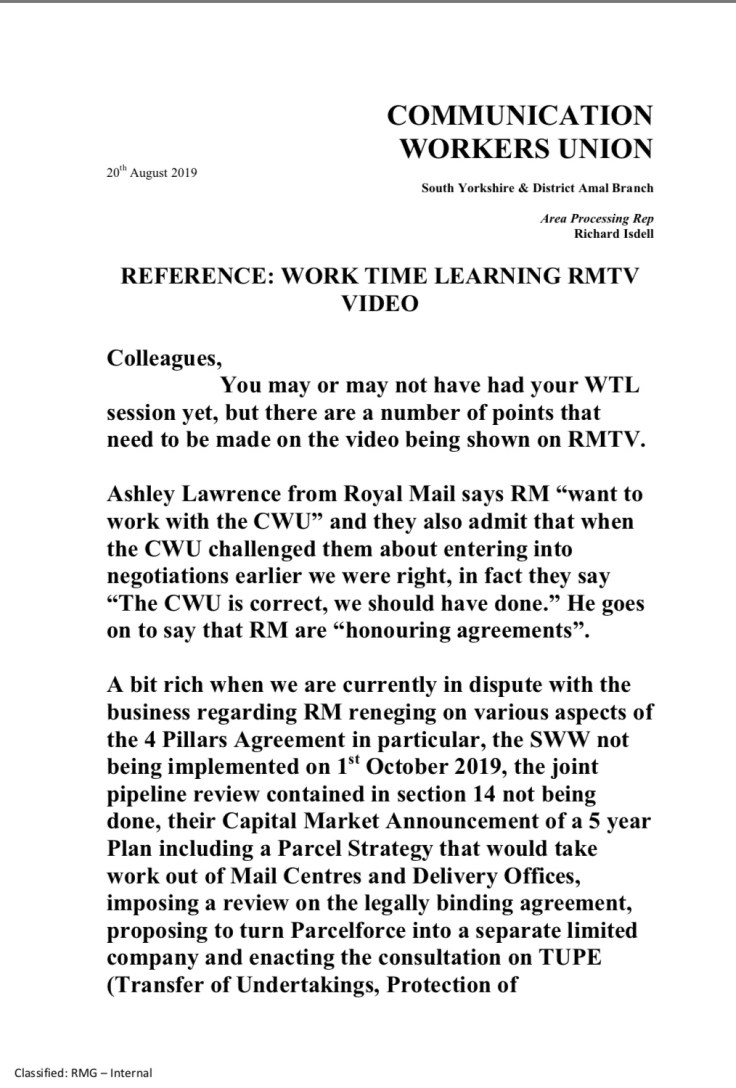
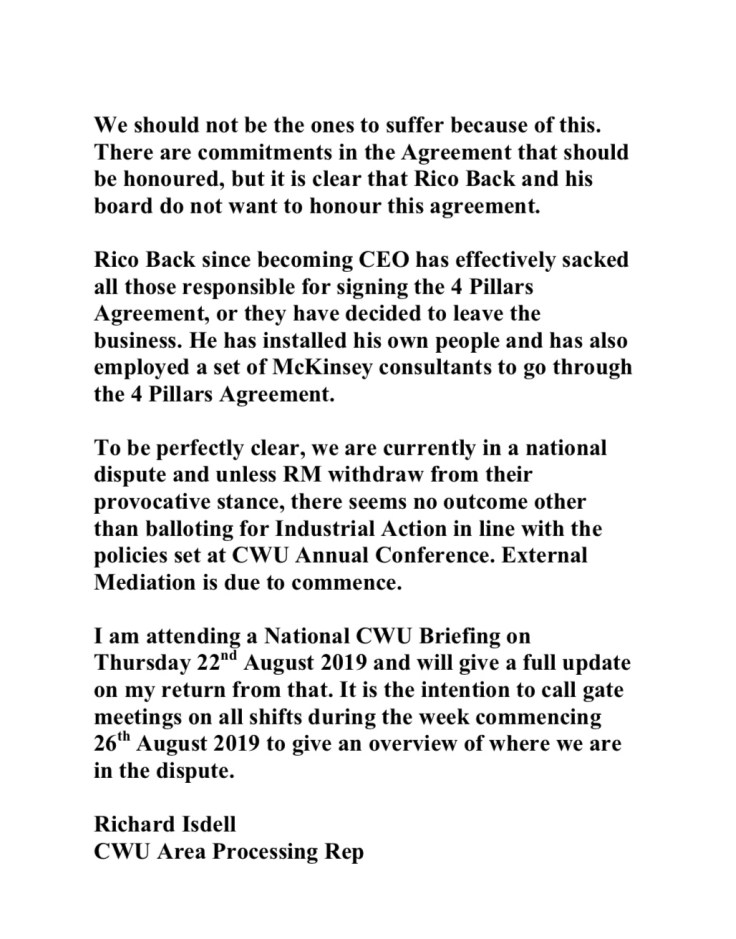
RM TV next possible WTLL session. Looks like they’re adapting a different approach. More of a nicely, nicely let’s work together one. Read between the lines, the message is the same, you need to work harder for less for our shareholders. As they say in the video “Our shareholders are feeling the pain, they are getting less for their investment” You earned your next hour for the shorter working week you should get this October but Royal Mail want to move the goalposts and don’t want to give it to you. Don’t be fooled by their propaganda TV. There is a CWU National Briefing this Thursday in Liverpool and a full report will be sent out to you our members. 👊🏻👍🏻 Rise Up!

Royal Mail’s latest video likely to be shown in WTLL this week. Their focus is on efficiency and change which undoubtedly means working harder for us all. The trials they wanted have failed and are reliant on our members to make things work. National briefings are taking place this week and more information will be available from there. There is no doubt we need to prepare for dispute and hope we don’t need to use it. https://www.myroyalmail.com/rmtv/rmtv-19-august-cwu-discussions

Create a website or blog at WordPress.com

Up ↑