Latest from the Branch

A message from DGSP Terry Pullinger urging members to use your vote

Royal Mail will this morning be asking members to hold onto their ballot paper for a few days until they receive more information from the company on pensions and other matters. This is a deliberate attempt to impact on our turnout.

We need to vote immediately. Let’s bring this home


Organ Donation Week 4-10 September – Thank You From NHSBT (NHS Blood and Transplant Service)

Organ Donation Week 4-10 September – Thank You From NHSBT (NHS Blood and Transplant Service)

To: All Branches

Dear Colleagues,

Further to LTBs 473/17 and 479/17, the attached message has been received from the NHSBT National Partnership Development Manager.

Yours sincerely


Dave Joyce

National Health, Safety & Environment Officer

17LTB503 Organ Donation Week 4-10 September – Thank You From NHSBT (NHS Blood and Transplant Service)

NHS 13 September 2017

The CWU is proud to again be supporting Gas Safety Week this year, 2017

The CWU is proud to again be supporting Gas Safety Week this year, 2017

Gas Safety Week is an annual safety week to raise awareness of gas safety and the importance of taking care of your gas appliances. It is coordinated by Gas Safe Register, the official list of gas engineers who are legally allowed to work on gas.

The week aims to raise awareness amongst householders and landlords, about the importance of having their gas appliances serviced on an annual basis. 5000 organisation across the UK signed-up last year pledging to work together to raise awareness of the dangers of poorly maintained Gas Appliances. Unsafe gas appliances can put lives at risk from gas leaks, fires, explosions and carbon monoxide (CO2) poisoning.

With 22 deaths and nearly 1,000 gas-related injuries in the last three years, it’s vital that people make sure their gas appliances are safety checked every year, by a Gas Safe registered engineer. Anyone working on gas appliances while not being Gas Safe registered is working illegally.

Check your gas safe appliances every year

Gas appliances should be safety checked once a year and serviced regularly by a Gas Safe registered engineer.

Check your engineer is Gas Safe registered

Agents, landlords and tenants can find and check an engineer at www.gassaferegister.co.uk or call 0800 408 5500

Check your engineer’s Gas Safe Register ID card

Make sure they are qualified for the work you need doing. You can find this information on the back of the card.

In supporting the 2017 Gas Safety Week, we are reminding Branches, Safety Reps and Members in a joint awareness campaign with RoSPA, HSE and the ‘Gas Safe Register’ to alert people of the importance of Gas Safety in the home. In the UK, 21 million households use gas for heating, hot water and cooking. There are approximately 7,500 unregistered gas fitters actively working in the UK today with 250,000 illegal gas jobs done every year by unregistered gas fitters.

Badly-fitted and poorly-serviced gas appliances can cause gas leaks, explosions, fires, and carbon monoxide (CO) poisoning. Dangerous gas work can kill and 22 people have died and 1000 have been injured in the last three years through Carbon Monoxide poisoning and other incidents. Carbon Monoxide symptoms can be mistaken for flu, food poisoning, viral infections and tiredness. A carbon monoxide alarm costs around £15 to £20 – every home should have CO Alarms and Smoke Alarms – but they are not a substitute for regular servicing.

The ‘Gas Safe Register’ is the government approved registration scheme for gas engineers in the UK, Isle of Man, and Guernsey. There are more than 120,000 Gas Safe Registered engineers. There are more than 60,000 Gas Safe Registered businesses. All gas appliances need regular servicing and a gas safety check every year (or in accordance with the manufacturer’s instructions). All landlords and housing associations are legally obliged to ensure that all gas appliances and related pipes and flues within their rental properties are checked every 12 months for safety. They must issue a copy of the certificate to the tenant within 28 days of the test and give a copy to any new tenants moving in.

Not all gas engineers can work on all gas appliances. Gas Safe Registered engineers carry an ID card that shows the type of gas work they are legally registered and qualified to do e.g. cooker, boilers, gas fires etc.

Dangerous DIY – One in three people would fit a gas appliance themselves to save money. This is extremely risky and dangerous.

Website: www.GasSafeRegister.co.uk/reportillegal

‘Gas Safe Register’ also offers technical support for registered gas engineers. Call the technical helpline on 0800 408 5577, or visit the ‘Gas Safe Register’ Website
at: www.GasSafeRegister.co.uk/engineers

‘Gas Safe Register’ replaced the ‘CORGI’ gas registration scheme as of April 9, 2009. Corgi ID cards are no longer valid. You can check card ID details instantly online. Only ‘Gas Safe Register’ registered engineers can work on gas and fit, fix and service boilers, gas fires and most types of gas cookers in your home – it’s the law. Keeping the public safe from dangerous gas work is ‘Gas Safe Register’s top priority. If someone other than a ‘Gas Safe Registered’ engineer carries out gas work in your home, you are risking the safety of both yourself and your family, other residents, visitors and your property.

Simple search and identity check

Finding a Gas Safe Registered engineer is easy. You can find an engineer in your area online at the ‘Gas Safe Register’ website: www.GasSafeRegister.co.uk – or by calling the free helpline: 0800 408 5500. Every engineer on the Gas Safe Register carries an ID card with their own unique licence number. The back of the ID card lists what gas appliances your engineer is qualified to work on. The message from Gas Safe Register is clear: Before you have any gas work done in your home, make sure you ask for the ID card and check the front and back.

Gas Safe Register’s top ten tips: GREAT ADVICE FOR GAS SAFETY WEEK 2017

If you suspect an illegal gas worker report it to Gas Safe Register:

Gas Safe Register PO BOX 6804 Basingstoke RG24 4NB

0800 408 5500

1 Have all your gas appliances, including boilers, gas cookers and gas fires, safety checked annually.

2 Always use a Gas Safe Registered engineer to fit, fix and check gas appliances in your home – it’s the law and will help keep you safe.

3 Always ask to see an engineer’s Gas Safe ID card and check the back of the card to ensure they are qualified to carry out the specific type of gas work you need.

4 To find a Gas Safe Registered engineer in your area, call the free helpline on 0800408 5500 or go to www.GasSafeRegister.co.uk.

5 Recognise the symptom so carbon monoxide poisoning-headaches, dizziness, nausea, breathlessness, collapse and loss of consciousness.

6 Check gasa ppliances for warning signs that they are not working properly e.g. lazy yellow flames instead of crisp blue ones, black marks or stains on or around the appliance and too much condensation in the room.

7 Buy an audible carbon monoxide alarm for your home and make sure it is located near to your gas appliances in accordance with the manufacturer’s guidance. Carbon monoxide can leak from appliances and kill.

8 Only use gas appliances for their intended purpose e.g. don’t use a gas oven to heat a room or use a gas barbeque inside the house.

9 Always ensure there is enough ventilation for your gas appliances to allow them to burn correctly and make sure you are not blocking any air vents that provide an air supply to the gas appliance.

10 Anybody working with gas has to be Gas Safe Registered by law. To report someone working without registration, call Gas Safe Register on the free phone number 0800 408 5500.

Did you know?

• Every year thousands of people across the UK are diagnosed with carbon monoxide poisoning. It is a highly poisonous gas. You can’t see it, taste it, or smell it, but it can kill quickly with no warning.

• Gas Safe Register found almost 5 million people across the UK are putting themselves at risk by employing illegal gas fitters who aren’t properly qualified. 65% of all gas jobs carried out by illegal fitters were unsafe, with 1 in 5 so dangerous they had to be disconnected immediately.

• 3 in 4 victims of illegal gas work hired the worker following a friend’s recommendation and 1 in 4 found them through an advert, wrongly assuming they were registered. In all cases the householder did not check the credentials of the worker before the work was carried out – you should always check the official Gas Safe Register.

• Although there is awareness that gas appliances need to be safety checked annually, 43% of Britons don’t do it, and 10% have gas appliances which have never been checked.
Further Information
Gas Safe Register 200 Cedarwood Chineham Park Crockford Lane Basingstoke Hampshire
RG24 8WD
Consumer enquiries
0800 408 5500 enquiries@gassaferegister.co.uk

Engineer enquiries: 0800 408 5577 register@gassaferegister.co.uk

Further Information:

Gas Safe Register 200 Cedarwood Chineham Park Crockford Lane Basingstoke Hampshire

RG24 8WD

Consumer enquiries

0800 408 5500 enquiries@gassaferegister.co.uk

Engineer enquiries:

0800 408 5577 register@gassaferegister.co.uk

Yours Sincerely,


Dave Joyce

National Health, Safety & Environment Officer

17LTB502 Gas Safety Week 2017 – 18–24 September 2017

Gas_Safety_Week_leaflet

Gas_Safety_Week_Poster

BRANCH ELECTIONS 2018/2020

BRANCH ELECTIONS

2018/2020

Please find below the timetable for the upcoming Branch Elections for term of office 2018 to 2020.

Display timetable 06/09/17

Nominations open (Set 1&2) 13/09/17

Nominations close (Set 1) 04/10/17

Nominations close (Set 2) 08/11/17

Ballot start (Set 1) 18/10/17

Ballots close (Set 1) 01/11/17

Result declared (Set 1) 03/11/17

Ballot opens (Set 2) 22/11/17

Ballot closes (Set 2) 06/12/17

Results declared (Set 2) 08/12/17

Nomination forms are available via your local Rep,Or the Branch Office. Tel 01733 382512 you can download the form from the Branch website http://www.cwue5.org completed forms should be returned to Amanda Hill, Branch Secretary, PO Box 438, Peterborough, PE4 5PE.

It is the responsibility of the current workplace rep to ensure this notice is clearly displayed.

Term of Office will run from AGM 2018 to AGM 2020

Any enquiries to

Amanda Hill, Branch Secretary.

Eastern 5 Branch

SET ONE ELECTIONS

Nominations open 13/09/2017

Nominations close 09/10/2017 10 a.m.

Branch Chair Branch Secretary

Branch Treasurer Branch Equality Officer

Branch Political Officer Branch Deputy Secretary

Branch Editor Branch Returning Officer Branch Women’s Officer Branch BAME Officer

Branch Youth Officer Retired Members Chair

Retired Members Secretary

Assistant Secretary (Legal & Medical)

Area Processing Representative

Area Distribution Representative

Area Delivery Representative

Area Health & Safety Representative

Lead Union Learning Rep

Branch Equality Committee (6 members)

Branch Women’s Committee (6 members)

Term of office will run from AGM 2018 to AGM 2020

Eastern 5 Branch

SET TWO ELECTIONS

Nominations open 13/09/2017

Nominations close 08/11/2017 10 a.m.

Unit and Shift Representatives

Health and Safety Representatives

Sectional Secretary (Letters)

Sectional Chair (Letters)

Mail Centre Secretary (APC Committee), Mail Centre Chair (APC Committee)

Substitute Unit and Shift Representatives

Substitute Area Processing Representative

Substitute Area Distribution Representative

Substitute Area Delivery Representative

Substitute Area Health & Safety Representative

Union Learning Reps

Term of Office will run from AGM 2018 to AGM 2018

Amanda Hill, Branch Secretary.

Royal Mail Group – Road Safety Communication Campaign September 2017 – Driver Health Issues – Driver Fatigue/Driving Tired/Driving Drowsy – Stress – Eye Health/Eye Tests and Fitness to Drive: NEW DATE: Week Commencing ‪Monday 18 September 2017‬

Royal Mail Group – Road Safety Communication Campaign September 2017 – Driver Health Issues – Driver Fatigue/Driving Tired/Driving Drowsy – Stress – Eye Health/Eye Tests and Fitness to Drive: NEW DATE: Week Commencing Monday 18 September 2017

To: All Royal Mail Branches

Dear Colleagues,

This is to update Branches and in particular ASRs and WSRs, further to LTB No. 488/2017 dated 7 September 2017.

LTB488/17 (copy attached for reference) reported to ASRs/WSRs and Branches that the Royal Mail Group – Road Safety Communication Campaign for September 2017, on the theme

of Driver Health Issues, including Driver fatigue/Driving Tired/Driving, Stress, Eye Health/Eye Tests would take place during the Week Commencing Monday 11 September 2017. Publicity on this important issue was given via that LTB and also on the CWU Website.

The Royal Mail Group Safety Health and Environment Driver and Road Safety Team had issued the two posters and Regional Messages in readiness for the campaign week.

At 09:30 on Monday morning 11 September, a communication was received from the Royal Mail Group Driver Capability and Behaviour Manager, informing CWU HQ Health, Safety & Environment Department that the Royal Mail Group Communications Team had decided at the eleventh hour to cancel and withdraw the National WTLL which in effect completely undermined the campaign and had the effect of cancelling out the Road Safety communications campaign week completely.

It’s fair to say that the RMG Safety Health and Environment Team were extremely disappointed and were as annoyed as the CWU/HQ Health, Safety and Environment Dept was at this totally irresponsible and unacceptable decision by RMG Communications.

A strong letter of complaint was immediately despatched to Shane O’Riordan RMG Director of

Strategy & Communications, copied to the Director SHE, RMG Chief Executive, RM Chief Operating Officer, RMG Director HR and other Directors.

A reply was received last night from the Director of Strategy & Communications, informing us that following discussions with the Director Safety, Health, Environment and Sustainabilty Shaun Davis, the Road Safety Communications Week will not now be completely cancelled and instead will go ahead next week – Week Commencing Monday 18 September 2017. See

attached correspondence for your information.

Would ASRs please note the after the September campaign, the next Road Safety Week in RMG will be the ‘Brake’ UK National Road Safety Week 20-26 November 2017, with the theme – “Speed Down Saves Lives”. Further information on that and associated communications and materials, LTBs etc will follow in due course and we will be seeking to ensure no repetition of what occurred with this month’s road safety campaign week, caused by RMG Comms.

A separate LTB and attachments, Posters, Leaflets, Fact Sheets will be issued by the Health, Safety & Environment Department on “Driver Fatigue and Road Accidents”, to support the Road Safety Campaign Week themes and help raise awareness amongst Driver Members of this crucially important issue.

Attachments:

LTB 500/17

17LTB488 Royal Mail Group – Road Safety Communication Campaign September 2017

RS Campaign Sept 2017 – Driver Health – ASR activity plan Final

WTLL – Driver Health FinalDriver Health

Poster 1

Poster 2

Correspondence

GET THE VOTE OUT – Resources

GET THE VOTE OUT – Resources

Show your support by downloading and using our campaign materials;

Vote YES posters and graphics

I’m voting YES A3 poster 

We’re voting YES A3 poster

I’m voting YES social media profile image

Use your vote!

Use your vote A5 flyer (PDF)

Use your vote graphic (jpg)

Support your Postal Worker

I support my Postal worker A3 poster (PDF)

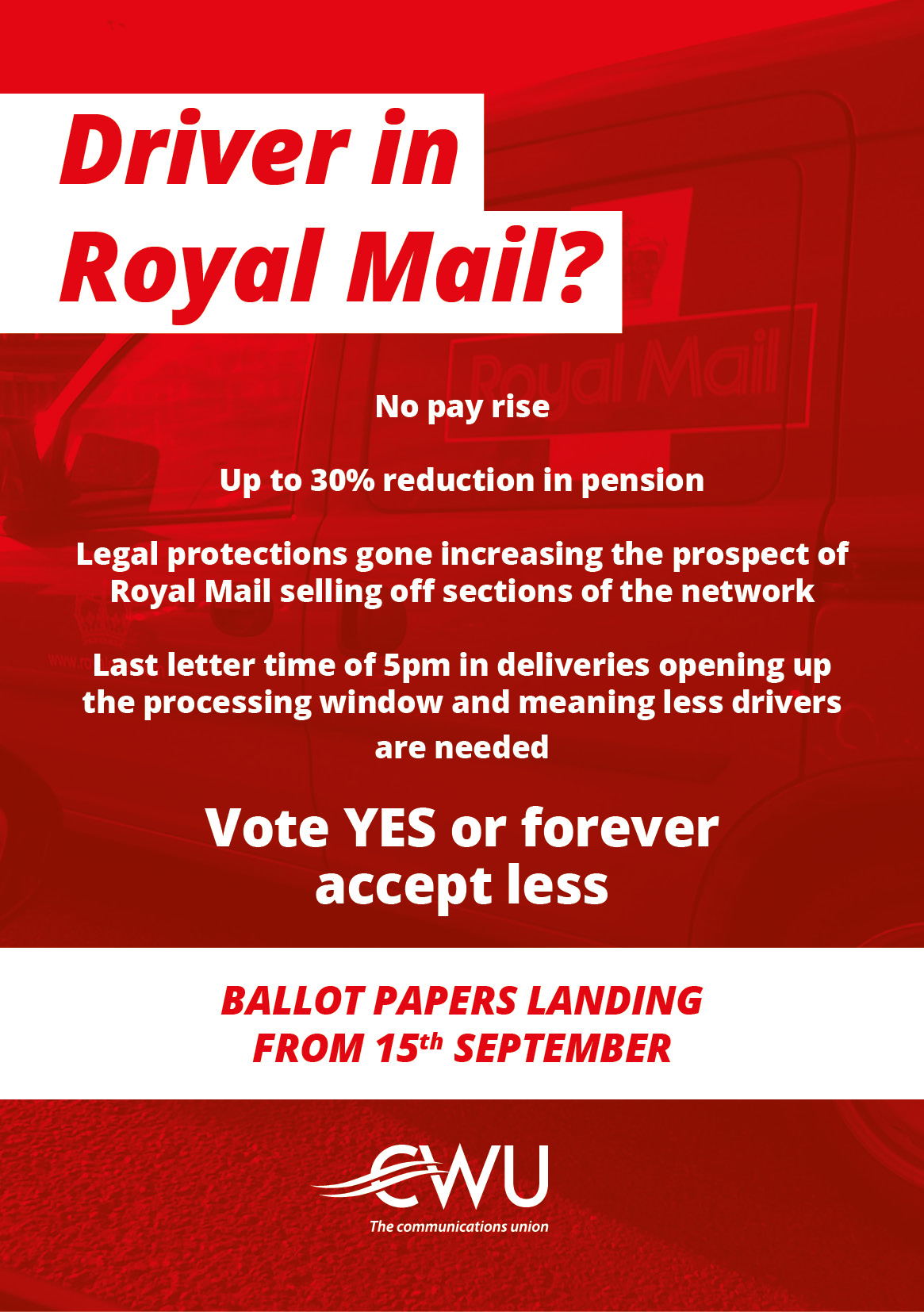
Drivers in Royal Mail?

A5 Flyer (PDF)
Graphic (jpg)

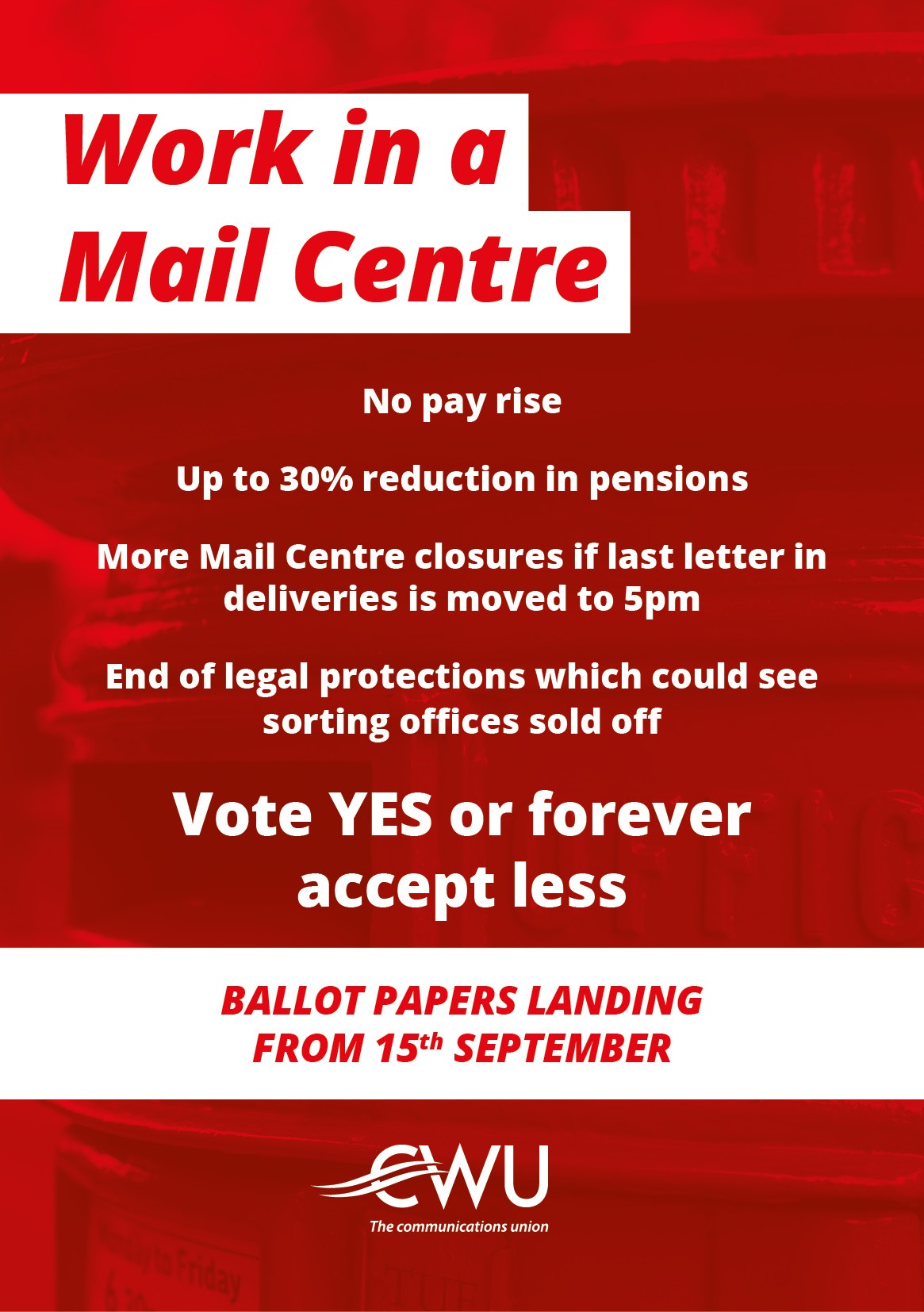
Work in a mail centre?

A5 Flyer (PDF)

Graphic (jpg)

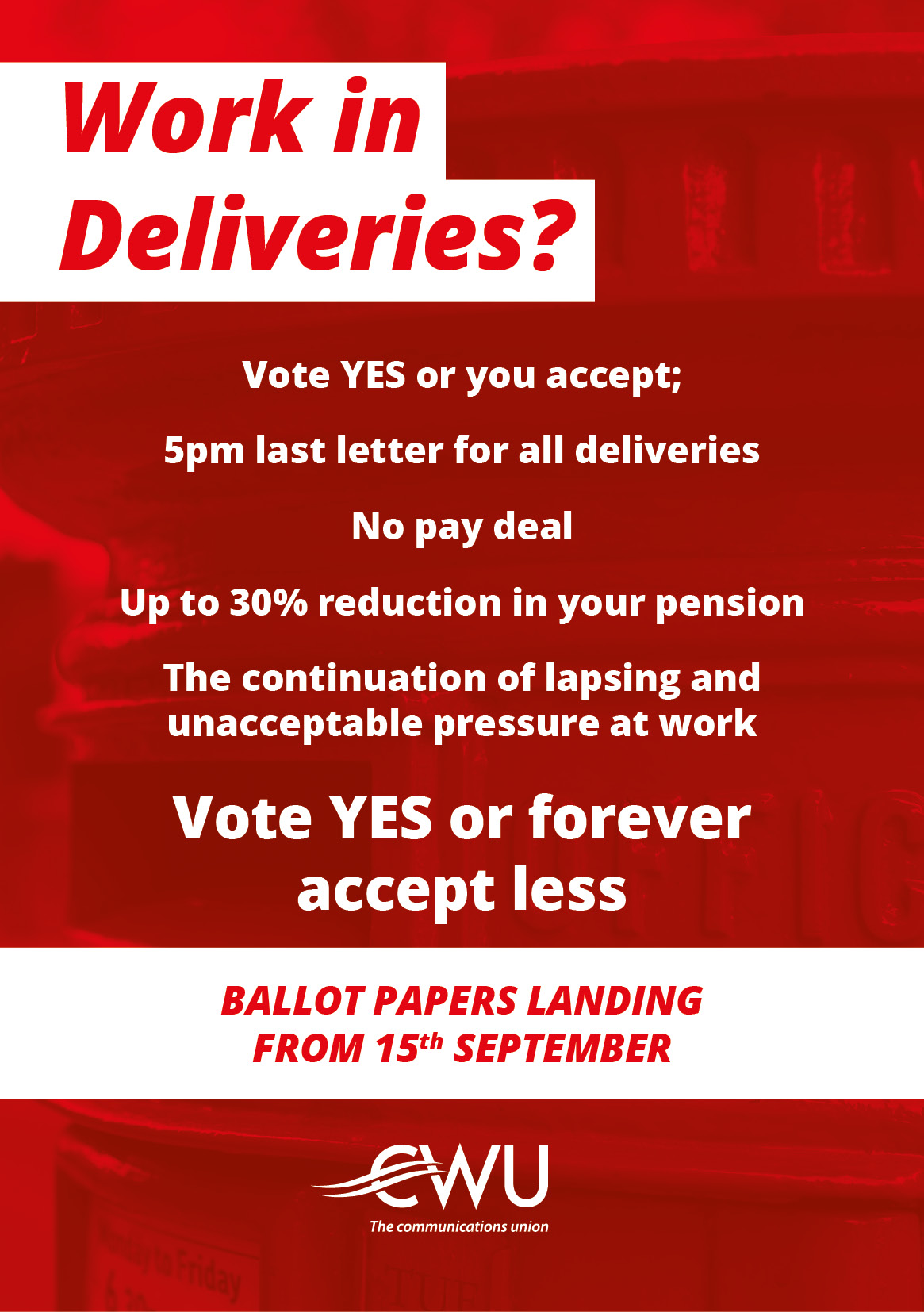
Work in deliveries?

A5 Flyer (PDF)

Graphic (jpg)

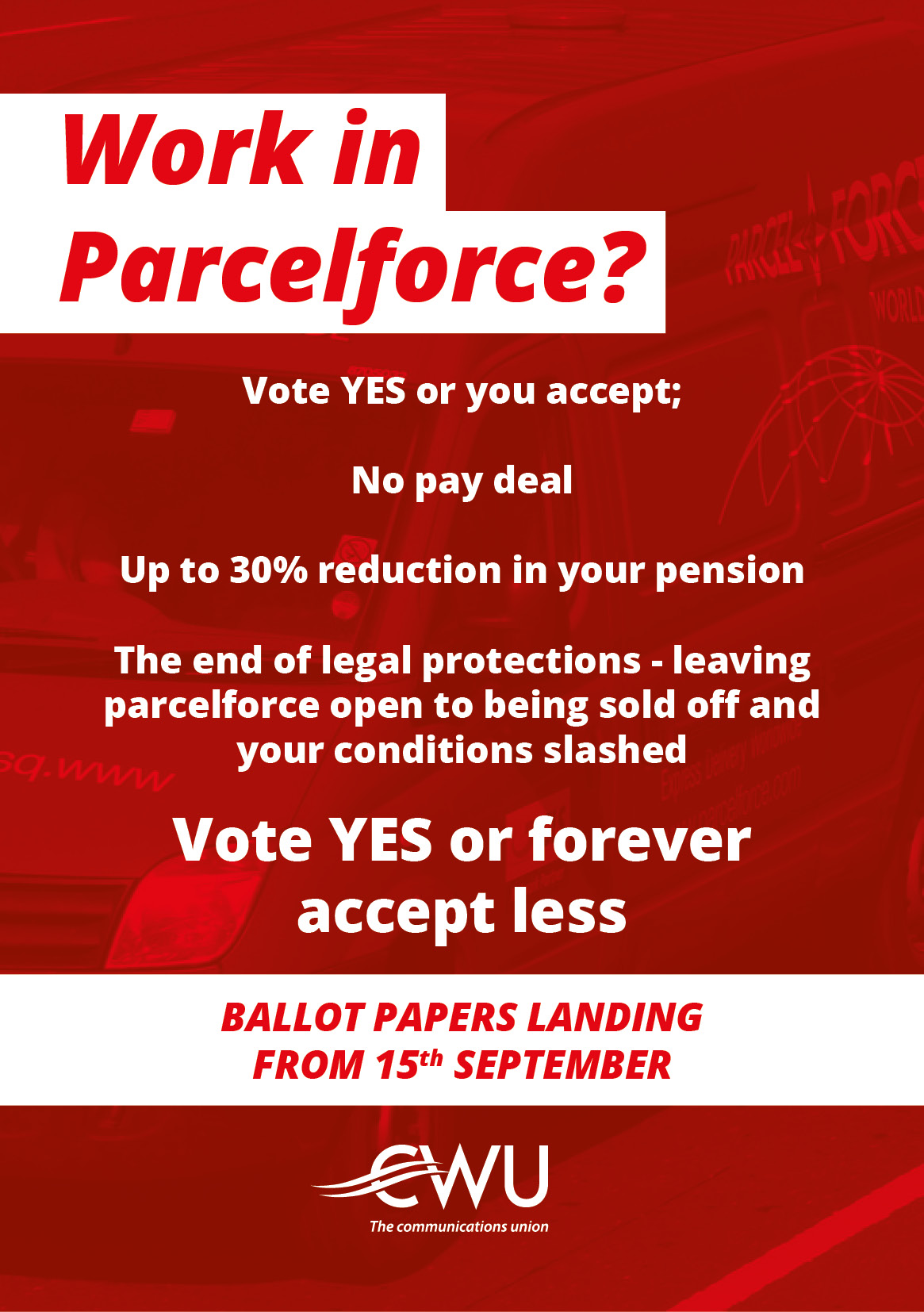
Work in Parcelforce?

A5 Flyer (PDF)

Graphic (jpg)

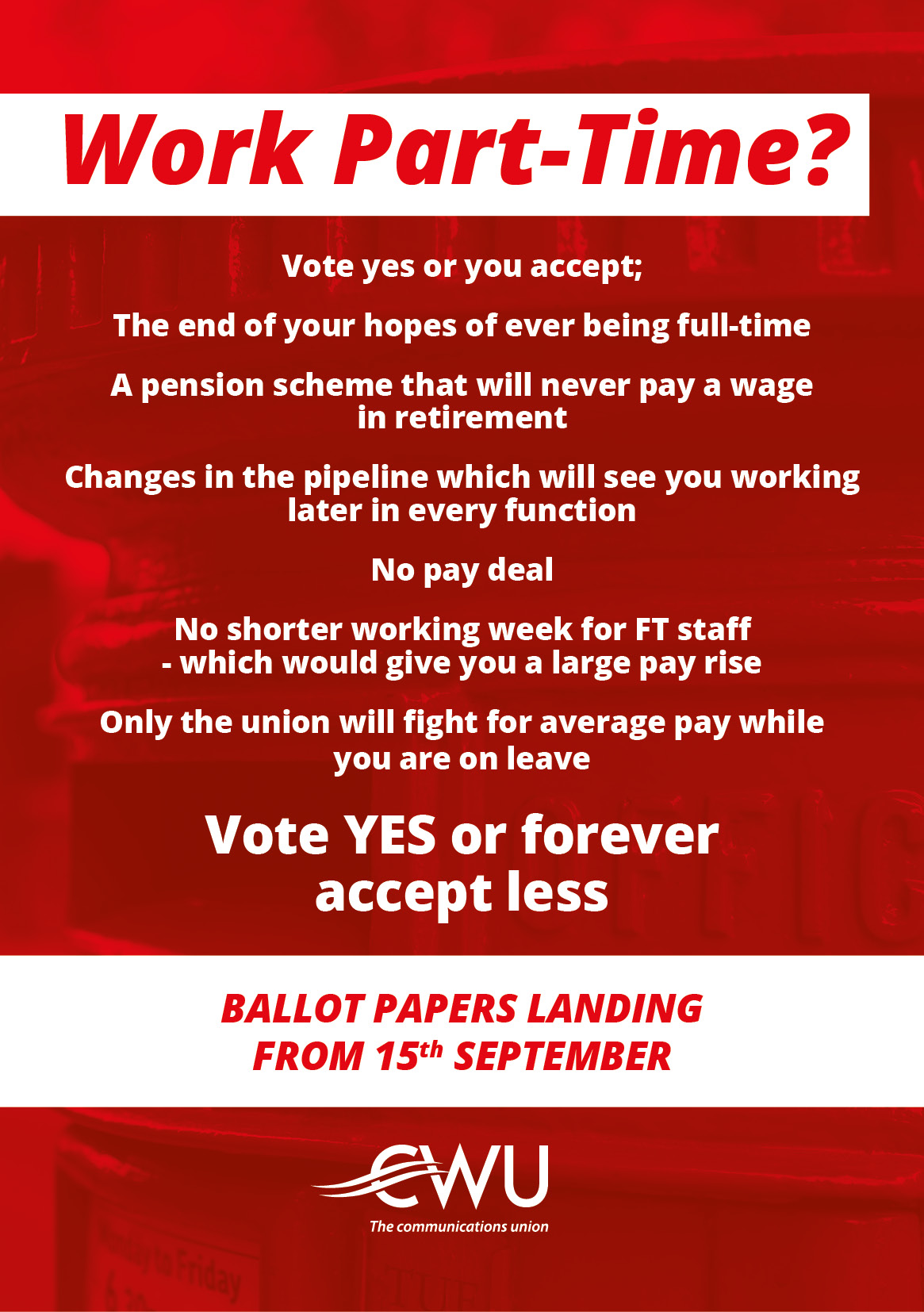
Work part time?

A5 Flyer (PDF)

Graphic (jpg)

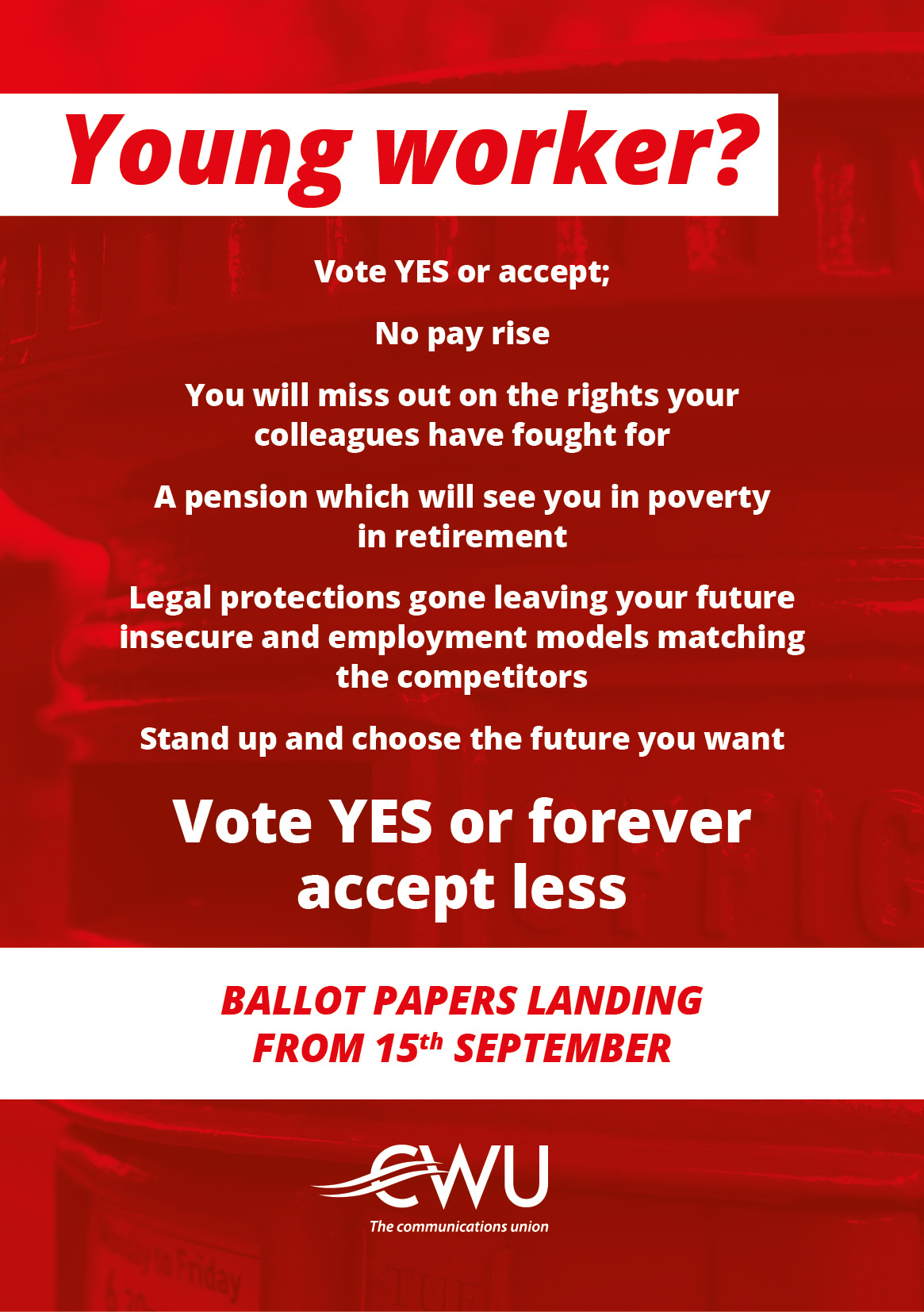
Young Worker?

A5 Flyer (PDF)

Graphic (jpg)

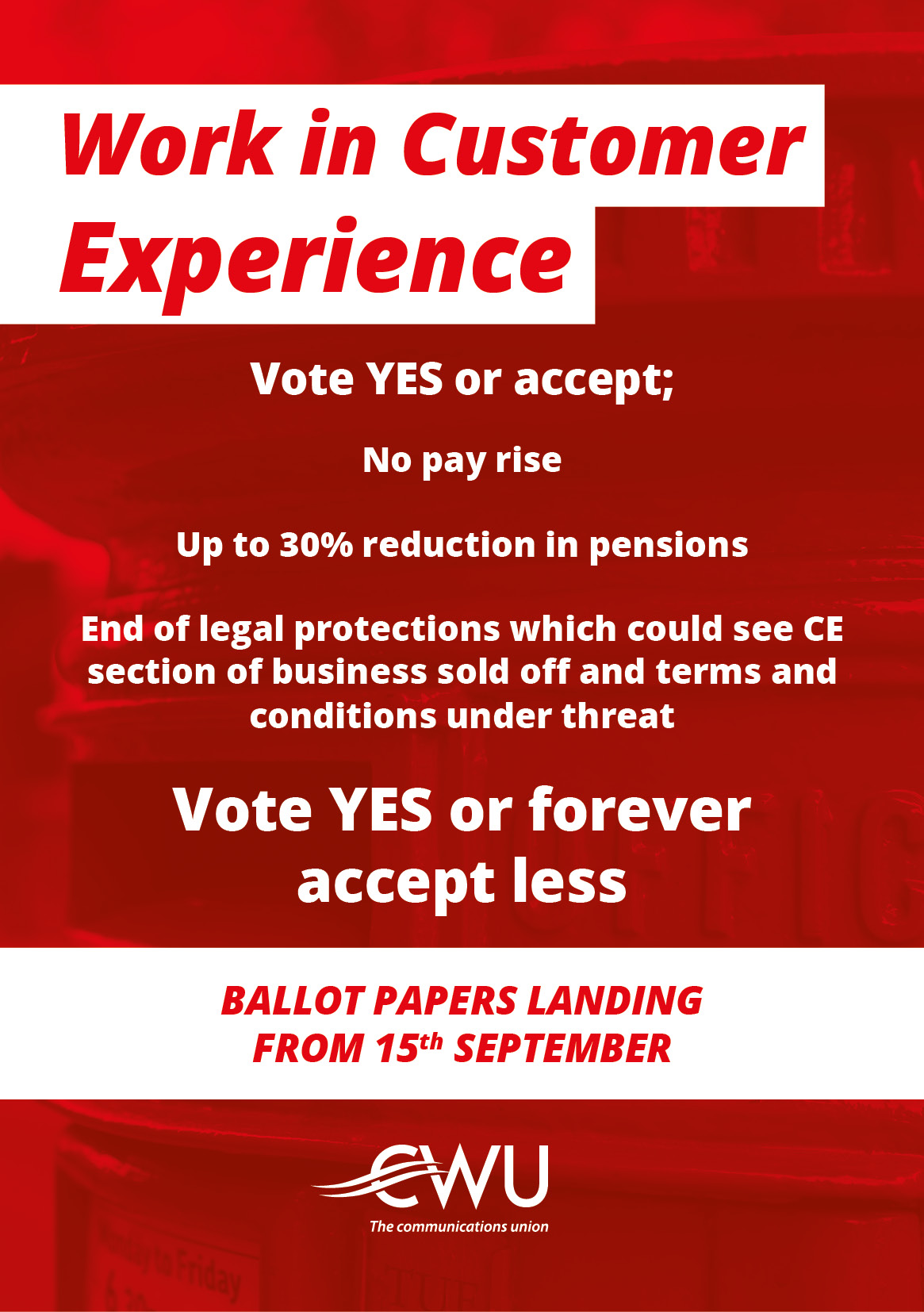
Work in customer experience?

A5 Flyer (PDF)

Graphic (jpg)

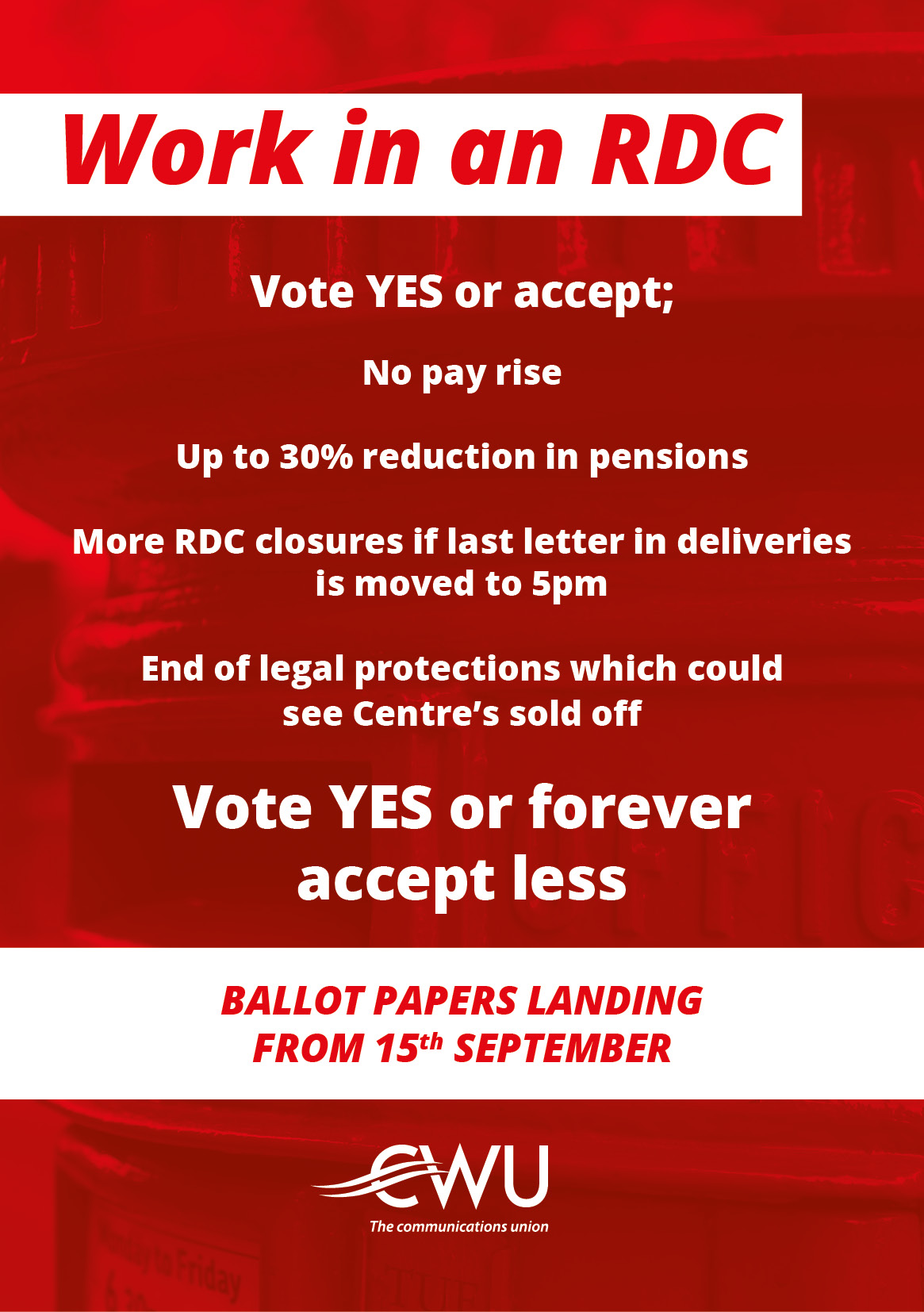
Work in an RDC?

A5 Flyer (PDF)

Graphic (jpg)

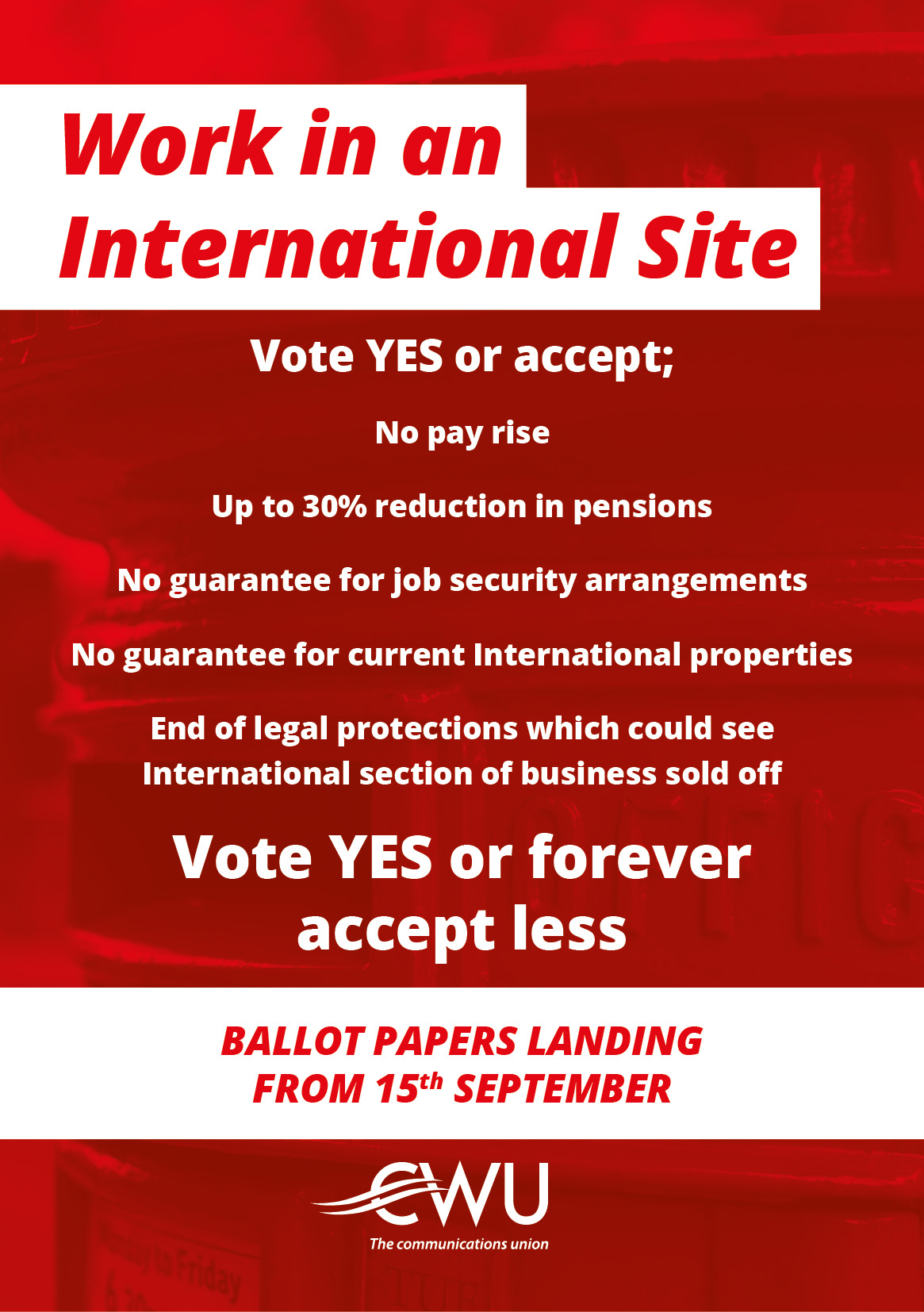
Work in an international site?

A5 Flyer (PDF)

Graphic (jpg)

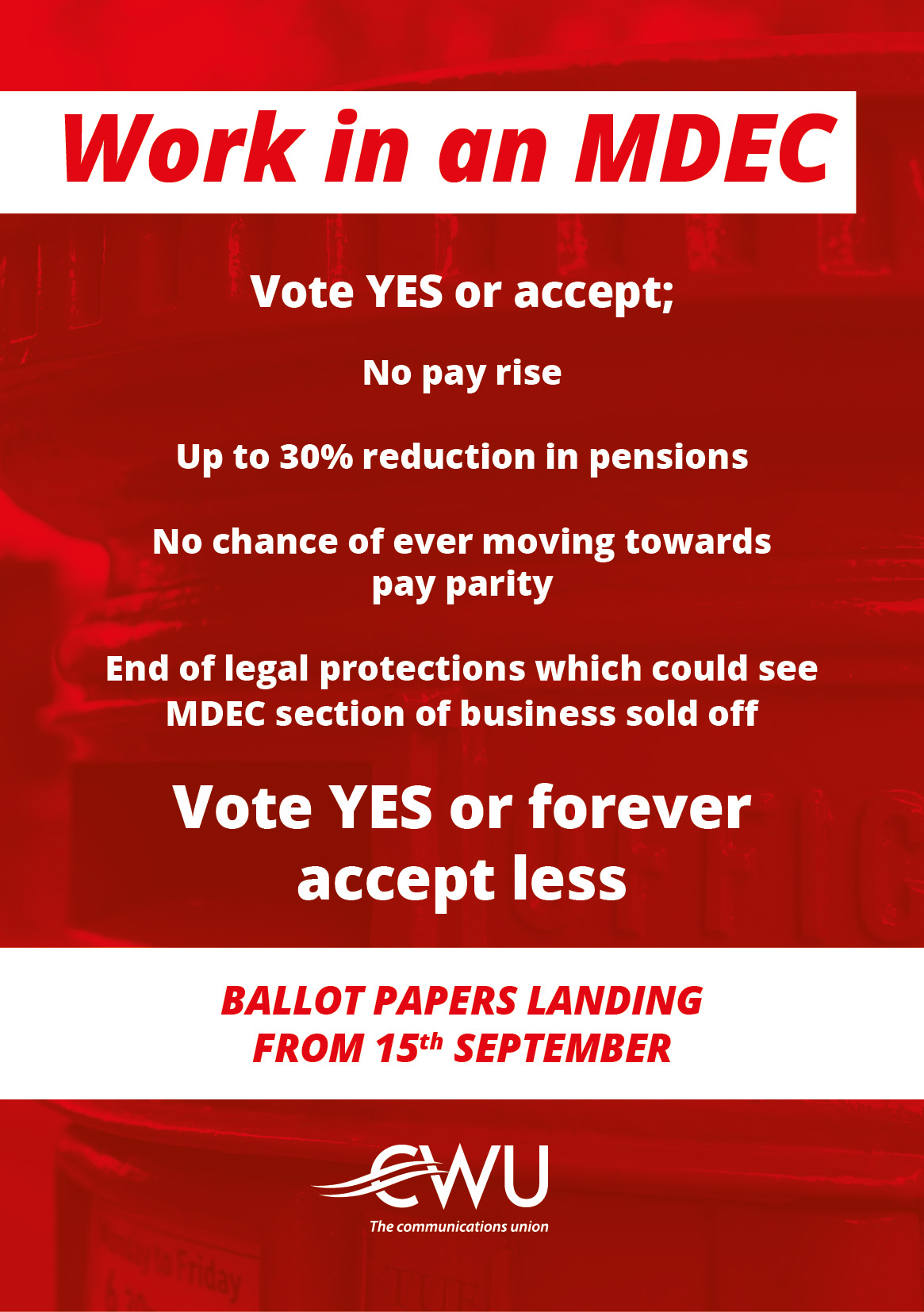
Work in an MDEC?

A5 Flyer (PDF)

Graphic (jpg)


Driver Fatigue and Road Accidents  

Driver Fatigue and Road Accidents


To: All Branches

Dear Colleagues,

Fatigue is a major contributory factor in crashes in the UK, with too little sleep radically affecting driver attention, awareness, reaction time and ability to control the vehicle.

Driver fatigue is a serious problem resulting in many thousands of road accidents each year. It is not possible to calculate the exact number of sleep related accidents but research shows that driver fatigue may be a contributory factor in up to 20% of road accidents, and up to one quarter of fatal and serious accidents.

These types of crashes are about 50% more likely to result in death or serious injury as they tend to be high speed impacts because a driver who has fallen asleep cannot brake or swerve to avoid or reduce the impact.

About 40% of sleep-related accidents involve commercial vehicles, drivers, often in the largest vehicles on our roads that can cause the most harm in a crash.

Sleepiness reduces reaction time (a critical element of safe driving). It also reduces vigilance, alertness and concentration so that the ability to perform attention-based activities (such as driving) is impaired. The speed at which information is processed is also reduced by sleepiness. The quality of decision-making may also be affected.

Experts tell us that it is clear that drivers are aware when they are feeling sleepy, and so make a conscious decision about whether to continue driving or to stop for a rest. It may be that those who persist in driving underestimate the risk of actually falling asleep while driving. Or it may be that some drivers choose to ignore the risks (in the way that drink drivers do). Studies have shown that drivers don’t fall asleep without warning. Drivers who fall asleep at the wheel have often tried to fight off drowsiness by opening a window, or by turning up the radio. This doesn’t work for long.

Signs of fatigue

Research shows normal sleep does not occur without warning, and most people recognise symptoms but underestimate the dangers of continuing to drive. Warning signs include:

• Increased difficulty concentrating;

• Yawning;

• Heavy eyelids;

• Eyes starting to ‘roll’;

• Neck muscles relaxing, making the head droop.

• ‘Microsleep’ occurs when someone nods off for a few seconds without realising orremembering it, known as head-nodding. This occurs when drivers are tired but trying to stay awake, a ‘THINK’ survey found one in three (31%) UK drivers surveyed admit having experienced a microsleep at the wheel. The driver may feel like they’ve just briefly nodded their head, but they have actually been asleep. In six seconds, a vehicle being driven at 70mph travels about 200 metres! The key facts

• Research suggests that almost 20%, 1 in 5 of crashes resulting in death on major roads are sleep or fatigue-related.

• Sleep-related accidents are more likely than others to result in a fatality or serious injury.

• Peak times for accidents are in the early hours between 2am and 6am and after lunch 2pmand 4pm.

• About 40% of sleep-related accidents involve commercial vehicles, drivers, often in thelargest vehicles on our roads that can cause the most harm in a crash.

• Research has shown motorways and dual carriageways are the most common roads forsleep-related crashes, due to the monotonous road environment and lack of interruptions or driver stimulation. Crashes caused by tired drivers are most likely to happen:

• On long journeys on monotonous roads, such as motorways.

• After having less sleep than normal.

• After drinking alcohol – (remembering the morning after effect).

• If taking medicines that cause drowsiness.

• After long working hours or on journeys home after long shifts, especially night shifts’.‘THINK!’, ‘Brake’ and ‘RoSPA’ Advice

• Plan your journey to include a 15-minute break every two hours.

• Don’t start a long trip if you’re already tired.

• Remember the risks if you have to get up unusually early to start a long drive.

• Try to avoid long trips between midnight and 6am when you’re likely to feel sleepy anyway.

• If you start to feel sleepy, find a safe place to stop – not the hard shoulder of a motorway.Drink two cups of coffee or a high-caffeine drink and have a rest or nap for 15 minutes to allow time for the caffeine to kick in.

• Remember, the only real cure for sleepiness is proper sleep. A caffeine drink or a nap is ashort-term solution that will only allow you to keep driving for a short time. WATCH THESE HARD HITTING VIDEOs:
THINK! ‘Don’t drive tired videos are at these links:
and
Think Posters – Attachments:

See attached pdf copies of ‘Think’ “Tiredness Kills Posters and Leaflet. Hard copies are being circulated to Branches and Regional Health and Safety Forums, as follows:-

1) Tiredness Kills – Poster (A4 and A3 sizes)

2) Wake Up To The Signs of Tiredness – Folded Leaflet

Other Resources/Attachments:

3) ‘THINK-RSSB’ – ‘Driving for Work: Managing Fatigue Risks, A Guide for Road Vehicle Drivers and their Manager (28 Page Guide). Pdf

4) ‘THINK’ – ‘Driving When Tired’ Fact Sheet.

Legislation on fatigue – Police investigations and penalties for killing someone due to

fatigue-related driving:

A tired driver who kills someone can be charged with death by dangerous driving (if the nature of their driving was perceived to be dangerous) or death by careless driving (a lesser charge for less dangerous driving). The maximum penalty for death by dangerous driving is 14 years imprisonment and the maximum penalty for death by careless driving is five years. The difference between ‘careless’ and ‘dangerous’ driving in the eyes of the law is slight and subjective: it’s the difference between someone’s driving falling below or well below what is expected of a careful and competent driver.

Commercial Vehicle Legislation

In the UK companies operating fleets of vehicles have a legal duty of care to “ensure, so far as is reasonably practicable, the health and safety of all employees while at work” and are responsible for what might happen if this is not done. This “applies to all on-the-road work activities as to all work activities”. Under the Management of Health and Safety at Work Regulations (1999) employers must assess the risks involved in staff use of the road for work and put in place all reasonably practical measures to manage driver fatigue. Employers need to assess which drivers and journeys are at risk and set schedules that do not require drivers to exceed recommended working limits and driver hours laws. Professional drivers of goods and passenger road vehicles must comply with the UK and EU Drivers Hours Rules or regulations which limit time at the wheel and specify that Drivers must legally take breaks. Heavy commercial vehicles have a tachograph, which records how long they have been driving and breaks taken. This information, along with any available telematics information from event data recorders, can be studied by Police if the vehicle is involved in a crash. Light Commercial Van Drivers are covered by the GB Domestics Drivers Hours Rules and Limits. These rules restrict a driving day to ten hours with a 30 minute break after 5.5 hours’ driving, or 45 minutes taken at times within an 8.5 hour driving shift.

Remind Drivers that it’s vitally important that they should always:

• Try to ensure they are well rested, and feeling fit and healthy before driving,

• Not take medication which advises against driving before starting long journeys,

• Make sure they take their rest breaks,

• Take extra care when driving at night, especially between 2am and 6am and when drivingbetween 2pm and 4pm (especially after having eaten a significant meal),

• Avoid drinking any alcohol and remember the morning after effect,

• If feeling sleepy or drowsy during a journey, take a break, grab a coffee and if need be takea short nap.

• Have regular eye tests or arrange a test if they’ve noticed any problems with their eyesight, (do the self-test of reading a number plate from 20 metres),

• If they have stress issues, request a stress risk assessment and request ‘feeling first class’support,

• Make sure they are aware of health conditions that may impair their driving and if unsure consult their GP.

• If they take any medication that may be affecting their ability to drive, speak to their GP,

• If they have a sleep disorder which may put them at higher risk, discuss it with their GP.Yours sincerely
Dave Joyce
National Health, Safety & Environment Officer
This LTB has been compiled in conjunction with “Think” – the Government Road Safety Information and Guidance Organisation, “Brake” the Road Safety Charity, “RoSPA” the

Royal Society for the Prevention of Accidents Charity” and the “DfT”. It

is being issued in conjunction with the Joint Royal Mail Group/CWU/Unite CMA Road

Safety Communications Campaign Week, September 2017.

17LTB499 Driver Fatigue and Road Accidents

Driving for Work Managing Fatigue Risks Guide (Think RSSB)

THINK! Advice – Driving When Tired – Factsheet

Tiredness Kills Poster (THINK)


CWU Lesbian, Gay, Bisexual and Transgender Conference – ‪Wednesday 22nd November 2017‬

CWU Lesbian, Gay, Bisexual and Transgender Conference – Wednesday 22nd November 2017

The CWU Lesbian, Gay, Bisexual and Transgender Conference will be held on Wednesday 22nd November 2017 in the Conference Hall, City Hall, College Green, Bristol, BS1 5TR.

Creche Facilities/Prayer Rooms/Seating

In order that we can cater for any delegate(s) with special needs such as seating, it is

important that you advise us in writing of the name of the delegate(s) and the particular requirement by return but no later than Tuesday 31st October 2017.

Crèche facilities will be available to delegates during the Conference and Branches should advise the SDGS Department in writing, by return, but no later than Tuesday 31st October 2017 if they require the use of this facility. Please ensure that the names and ages of the children, together with an appropriate address for sending the crèche form to for completion are included in this advice. It will not be possible to provide on the spot facilities to those delegates who have not informed us in advance.

Motions

Each Branch is entitled to submit one motion for consideration to be included on the agenda of the Conference. Motions should be submitted electronically to conferences@cwu.org using the template attached. Branches who do not have this facility may request paper motion forms by contacting Angela Niven on 020 8971 7256.

The LGBT Advisory Committee are entitled to submit up to three motions to the conference standing in their name.

Each Regional Equality Committee are entitled to submit one motion to the Lesbian, Gay, Bisexual and Transgender Equality Conference.

Motion forms must be returned by midnight on Tuesday 31st October 2017.   All sections of the form must be completed.

Branches and the Advisory Committee are reminded that the Standing Orders Committee will not alter or amend any of the motions submitted therefore it is important that motions are checked before they are submitted.

Motion forms must be returned by midnight on Tuesday 31st October 2017.   All sections of the form must be completed.

As with previous Equality Conferences, the agenda will be structured in such a way as to maximise debate and participation by delegates. There will be two sections to the agenda, one for motions which are eligible for consideration for submission to General Conference, and one for motions that in the view of the Standing Orders Committee would not be admissible to the General Conference agenda.

Branches will be aware that with the carriage of Composite Rule Amendment 126 at General Conference 2013, the LGBT Conference has the entitlement under the rules of the union to submit two motions to stand in the name of the conference to General Conference and one motion to the Postal Group and Telecoms Industry Conferences. It is therefore important that if branches wish their motions to be considered for General Conference they must contain policy that is capable of being discharged by the NEC, as opposed to either of the Industrial Executives.

As with previous Equality Conferences, the motions for submission to the General Conference, Postal Group and Telecoms Industry agenda will be decided from amongst those motions adopted at the Conference. A ballot to select the motions will be held at the Conference and further information will be contained within the conference standing orders.

Please note that all correspondence must be sent to conferences@cwu.org and no other personal email address.

Any enquiries regarding this LTB should be addressed to Angela Niven either by post to head office or by email to conferences@cwu.org


Yours sincerely,


A P Kearns

Senior Deputy General Secretary

17LTB496 – LGBT Conference

Create a website or blog at WordPress.com

Up ↑