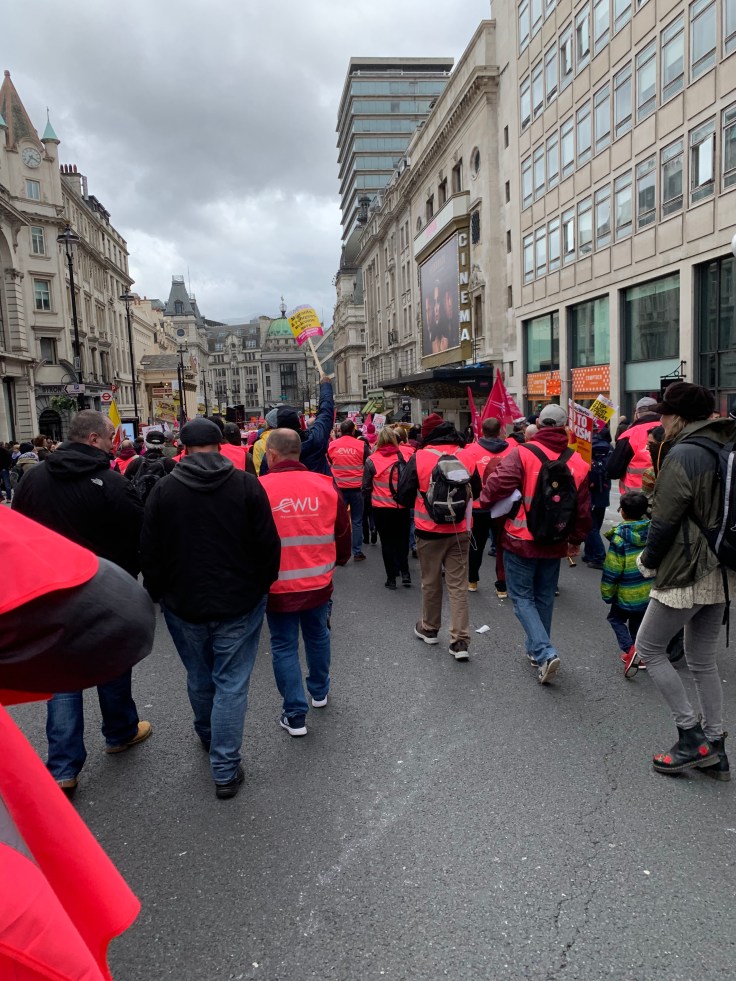
Here is the latest Delivery Podcast as Mark Baulch talks to us about Doing the job properly, lapsing, pensions and pay.
https://soundcloud.com/user-53225609/the-u-word-workplace-special-episode-3

Workers of the world unite; you have nothing to lose but your chains. Karl Marx.
Here is the latest Delivery Podcast as Mark Baulch talks to us about Doing the job properly, lapsing, pensions and pay.
https://soundcloud.com/user-53225609/the-u-word-workplace-special-episode-3
New Wage in Retirement Pension Scheme for all our Royal Mail Group Members
In the Four Pillars Guiding Principles Agreement we recognised that we had a unique opportunity to take a leadership position to influence the world of pensions and provide innovative new pension arrangements. Against that backdrop, we agreed with Royal Mail Group a new Wage in Retirement scheme to replace the DB and DC schemes.
There has been many recent enquires regarding the progress of establishing the required legislation to allow our scheme to be introduced and today the Government’s Department of Work and Pensions released its response to the recent consultation.
This, along with the Government’s Press Release (please find attached both documents) represents a major milestone of progress and clearly demonstrates that the legislation to enable our scheme will now be drafted and introduced.
The consultation response clearly confirms that we are the pioneers in driving new forms of collective pension arrangements and that our scheme will be the first introduced, making history in this country. Without doubt our best day will be when our scheme opens but this is still a significant moment.
This is extremely positive progress and an important moment to remind all our Representatives and members that none of this would have been achieved without their support and our brand of strong workplace trade unionism.
Any enquiries in relation to the content of this LTB should be addressed to the DGS(P) Department.
Yours sincerely,
Terry Pullinger
Deputy General Secretary (Postal)
19LTB165 New Wage in Retirement Pension Scheme for all Our Royal Mail Group Members
TUPE Transfer to ISS – Security Officers & Receptionists Pay Arrangements
BTFS has informed the CWU regarding changes to the first pay date for Security Officers and Receptionists transferring to ISS on 1st April.
They are now going to be paid on 24th April for 15th March to 14th April. They will then move to fortnightly pay from May.
The reason given is due to the timelines being too tight for BTFS payroll to get all the adjustments included to meet their payroll cut off for 14th April.
Any queries should be addressed to Sally Bridge sabridge@cwu.org.
Yours sincerely
Sally Bridge
National Officer
Here is the latest episode of our Podcast – Women in the movement. It’s a great episode – please share it as widely as possible #TheCWU
TARIFF INCREASE – QUADRANT CATERING
Dear Colleagues
The department was recently made aware from the field of a change in the Quadrant tariff, which we had not received any prior notification of from the business.
We have now clarified the position with the business and they have provided us with details of the tariff changes that took place on 28th January 2019, following a review agreed with Royal Mail.
Branches should note that the Union does not set, agree or endorse Quadrant tariff changes.
Colleagues will be aware that Quadrant has not increased their tariff since January 2018.
The attached gives some examples and indicates that some prices have being held and others have been increased.
They have also pointed out that they continue to run their “money off” promotions to provide value for money and to offset some of the new prices.
Any enquiries in relation to this LTB should be addressed to Davie Robertson, Assistant Secretary, email: dwyatt@cwu.org or shayman@cwu.orgquoting reference number: 312.01
Yours sincerely
Davie Robertson
Assistant Secretary
Unit Representative Briefings – London Division – Confirmation of Venue
Further to LTB 107/19, I am writing to advise you that a venue has now been confirmed for the rescheduled London Divisional Representative Briefing taking place on Tuesday 16th April 2019.
The details of the meeting are as previously advised (11am until 3pm) and the venue will be Hamilton House Conference Centre. The full address is detailed below:
DATE DIVISION VENUE
Tuesday 16th April
11:00am – 03:00pm
London
Hamilton House Conference Centre
Mabledon Place
London
WC1H 9BD
Any enquiries in relation to the content of this LTB should be addressed to the DGS(P) Department.
Yours sincerely,
Terry Pullinger
Deputy General Secretary (Postal)
Royal Mail Logistics – Accident Near Miss & Hazard Reporting Process “STAR” (Stop, Think, Act, Report) – National Roll-Out:
LTB No. 452/2018 dated 8 August 2018, announced the trial of a new “near miss and hazard reporting” process which had been developed jointly between Royal Mail Logistics and the CWU Health, Safety and Environment Department for use in Logistics, aimed at helping to improve safety standards and better manage safety in the workplace. After reviewing the Trial outcome, it has been agreed to roll out nationally the Accident Near Miss & Hazard Reporting Process called “STAR” (Stop, Think, Act, Report) across the UK in all Royal Mail Logistics, Distribution and Fleet Services Units and operations. WTLL briefing sessions will be completed in all units prior to introduction in that unit.
The simple, easy to use ‘STAR’ system enables Logistics workers to report incidents via a simple report card and collection box process. The CWU Health, Safety and Environment Department have been fully involved in the development planning to introduce the “near miss and hazard reporting” process and we fully endorse and support this approach.
The Health and Safety Executive (HSE) estimated that if every single reportable incident not at present investigated by employers was investigated and acted upon, this could save UK society up to £2 billion per year in preventable accidents and incidents.
Near misses are warnings of failings or gaps in safety management systems, and can identify potential accidents before they actually happen. In doing so personal injury, pain, loss and suffering plus damage to plant, equipment, property and loss of productivity can all be avoided with thorough reporting, investigation, root cause analysis and remedial action.
History has shown repeatedly that most serious and catastrophic accidents and events were preceded by warnings or near miss incidents. Recognising and reporting hazards and near miss incidents can significantly improve worker safety and enhance the organisation’s safety culture. The HSE state that there is a direct correlation between the number of near misses and accident rates.
The intention of this new scheme is to proactively encourage staff to support and utilise the process in a “blame-free” culture by reporting all hazards they see and all near miss incidents they observe or are involved in, so as to ensure there’s a full investigation in to the hazard or how the incidents happened, how the risks arise and how they might be prevented in future.
The findings and conclusions can then be taken into account in revising the workplace risk assessments, working methods, dealing with accommodation issues, plant, equipment etc., so ensuring they are safe and fit for purpose.
If an incident occurs which does not result in an injury, but which clearly could have done, then it’s a ‘near miss’, and jointly Royal Mail and the CWU want to encourage every individual staff member to report it. Reporting incidents will be encouraged and not frowned upon.
Effective identification and reporting of near misses and hazards means preventative measures and controls can be introduced, reducing the likelihood of an accident occurring.
The near miss/hazard report cards will be accessible to all Logistics staff on the site.
The message to all Logistics staff is ‘please take the opportunity to submit any hazards you spot or near miss incidents you have , however minor you think they are’. Because if we don’t know where the real problems are, how are we going to prioritise our efforts? An effective near miss reporting process can be a fundamental element of a thriving safety culture. A near miss is a golden opportunity to prevent an accident. The idea is to get the information reported quickly. This allows an investigation to take place to identify root causes of potential accidents and to then assist with follow-up and corrective action so that ultimately lower accident and injury rates result. The hope is that staff will learn the importance of near miss and hazard reporting and begin helping deploy a sustainable reporting program that’s unique to their work and operations. The information will be collected and analysed for appropriate attention and discussed at the local joint Health and Safety Committee.
The National Logistics Safety Management Team will feed back to the CWU/HQ Health, Safety and Environment Department and to the RM Logistics/Trade Unions National Joint Health & Safety Committee.
The support of all CWU Area and Workplace Health and Safety Reps plus Distribution and Drivers Reps would be appreciated in encouraging local members to report any hazard or near miss.
The joint intention of Royal Mail Logistics and CWU remains that we work in a positive safety culture. To improve safety and encouraging openness, recognising issues and implementing controls.
In line with HSE strategy, Royal Mail will pro-actively involve, consult and inform CWU Safety Representatives in good time.
The intention of this new ‘STAR’ scheme is to proactively encourage staff to support and utilise the process in a “non-punitive”, “blame-free” culture by reporting all hazards, incidents, near misses, so as to identify issues early, ensure there’s a full investigation in to how the hazards or incidents happened, how the risks arise and how they might be prevented in future, so that we can stop accidents from happening. This gives employees a voice to help resolve safety related issues, helps us jointly develop an open culture whereby everyone shares and contributes in a responsible manner to their own safety and that of their fellow workers – NO BLAME!
Remember “STAR” is the right course of Action!
S = STOP.
T = THINK.
A = ACT.
R = REPORT.
Hazard definitions
The PiC (Person in Charge) and Management are tasked with trying to resolve the issues and will regularly communicate updates through a ‘STAR’ Notice Board and via the Joint Health and Safety Committee Meetings and in consultation with CWU Health and Safety Reps. It may be that some issues take a while to resolve – staff can escalate issues through their CWU Reps if they don’t feel that Managers are taking the issue seriously enough.
The following Message and assurances to all employees is given by Royal Mail Logistics:
Attachments:
Note: It has been agreed that once stocks are exhausted a re-designed, improved Near Miss/Hazard Report Card will be introduced.
Yours sincerely
Dave Joyce
National Health, Safety & Environment Officer
Near Miss Presentation Managers briefing (2)
Near Miss Presentation Staff briefing (2)
RM Logistics-CWU-STAR-Joint Statement
Marie Curie’ – ‘Great Daffodil Appeal’ March 2019 – Supporting People With Terminal Illness
‘Marie Curie’ is a registered charitable organisation in the United Kingdom which provides care and support to people with terminal illnesses and their families. It was established in 1948, the same year as the National Health Service.
Each year the charity provides care to 40,000 terminally ill patients in the community and in its nine hospices, along with support for their families. More than 2,700 Marie Curie nurses, doctors and other healthcare professionals help provide this care.
At the nine ‘Marie Curie Hospices’, quality of life for patients is actively promoted as is providing much needed support for their carers. Marie Curie provides the largest number of hospice beds outside the National Health Service.
The ‘Great Daffodil Appeal’ is Marie Curie’s biggest annual fundraising campaign and takes place every March. Millions of people across the UK support this fundraising event by giving a small donation to wear a daffodil pin. This makes it one of the UK’s most recognisable charity appeals. Money raised through the appeal helps Marie Curie provide free care and support to people living with a terminal illnesses.
Research
Marie Curie is a leading funder of palliative care research to find better ways of caring for people with terminal illnesses. The charity supports and funds the work of three long term Palliative Care Research Facilities across the UK – The Marie Curie Palliative Care Research Unit, London; The Marie Curie Palliative Care Institute, Liverpool; and The Marie Curie Palliative Care Research Centre, Cardiff. Marie Curie awards research project grants in open competition to the Marie Curie Cancer Care Research Programme annually and also funds an ongoing portfolio of grants from the Dimbleby Marie Curie Cancer Care Research Fund. Marie Curie encourages research across its hospices and nursing service. To help achieve this, three posts are held through its Research Facilitator Programme at Marie Curie Hospices in Belfast, Edinburgh and the West Midlands. Marie Curie hosts an annual research conference jointly held with the Palliative Care Section of the Royal Society of Medicine. The aim of the conference is to support the translation of research findings into practice.
Fundraising
Marie Curie adopted the daffodil emblem in 1986; it is also the emblem of leading cancer charities in Australia, New Zealand, Canada and Ireland. Marie Curie Cancer Care’s biggest fundraising campaign is called The Great Daffodil Appeal and takes place throughout March each year.
Please give your support to the Marie Curie Great Daffodil Appeal during March 2019. Thanks for your support.
Yours sincerely
Dave Joyce
National Health, Safety & Environment Officer
19LTB157 Marie Curie – Great Daffodil Appeal March 2019 – Supporting People With Terminal Illness
GDPR
Branches will recall LTB 077/19 issued on the 1st February 2019 which provided an update on the agreed Code of Practice around how both RMG and the CWU will move to a new process of data sharing that is unambiguous and not open to local interpretation. The LTB further advised that CWU Representatives who need to receive data from RMG will be required to provide confirmation through a simple statement (attached) that allows Representatives to use their own device on accounts such as btinternet/hotmail/gmail etc. Completed statements were to be forwarded to Laura Fleming at;
Royal Mail
Fourth Floor
185 Farringdon Road
London EC1A 1AA
Email: laura.fleming@royalmail.com
Further to this advice, RMG have since informed the Department of a change to the way in which electronic invoices are sent out for any ‘unpaid’ Union leave taken by branch members. Both RMG and the CWU have agreed that in order to ensure Branch Secretaries and authorised substitutes continue to receive electronic invoices it will be necessary for those individuals to also sign the attached declaration to ensure that the two parties remain compliant with our obligations under GDPR. Until the declaration is signed, Branch Secretaries will only receive a hard copy of the invoice.
The above process is to protect the personal details of CWU members taking Union leave and will further ensure we are fully GDPR compliant. If you have not already received this, we anticipate a communication being sent out by Laura Fleming in the next few days seeking authorisation.
Any enquiries in relation to this LTB should be addressed to the DGS(P) Department quoting reference 10020.
Yours sincerely,
Terry Pullinger
Deputy General Secretary (Postal)