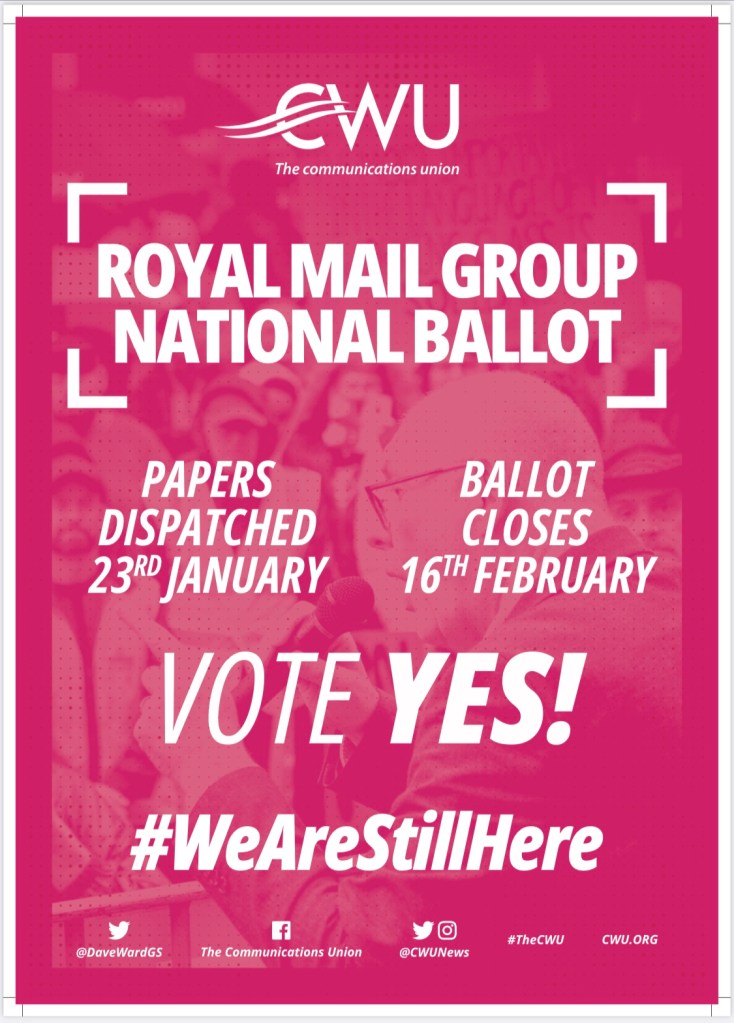
2022 Dispute Relating to Royal Mail Group Breaking the “Pathway to Change” and Associated National Agreements and Protections for CWU Represented Grades Employed by Royal Mail Group Consisting of Royal Mail, Parcelforce and Fleet
Branches and Representatives will know that negotiations are continuing with Royal Mail Group on our disputes, however in order to keep the pressure on it was important that the union today served the statutory notice of discontinuous strike action to RMG.
The strike will cover all duties and scheduled attendance commencing between the period at or after 04:00 on Wednesday 30th November 2022 and before 04:00 on Friday 2nd December 2022. The industrial action will be discontinuous.
The Postal Executive has also endorsed a further programme of strike action throughout December 2022 and this will be communicated to Branches and Representatives in due course.
Any enquiries in relation to the content of this LTB should be addressed to the DGS(P) Department.
Yours sincerely,
Andy Furey
Acting Deputy General Secretary (Postal)
‘Brake’ National Road Safety Week – ‘Safe Roads For All’ Campaign 14-20 November 2022 – ‘Everyone’s Life Matters On The Roads’ (Materials Further To LTB 447/2022)
Further to LTB No. 447/2022, see attached additional campaign materials issued by RMG this morning. Please find attached a copy of the RMG specific plasma screen slides that will be used on the ‘plasma TV screens’ across all Royal Mail Group units as well as on RMTV and the RMG website and intranet etc., to promote Brake Road Safety Week. Also attached as issued with LTB 477/2022 is a copy of the Huddle Message that will be delivered across all units this week to promote ‘Brake National Road Safety Week’. There will also be a film on RMTV that will be running on plasma TV screens and on the social media ‘Workplace’ site.
LTB 477/2022 should be read in conjunction with this additional short LTB.
All ASRs Deputy/Sub ASRs and WSRs are asked to support the road safety campaign and ensure that PiCs and managers deliver the messages and materials and ensure members are aware of the campaign week and see the materials.
Yours sincerely
Dave Joyce
National Health, Safety & Environment Officer
22LTB449 ‘Brake’ National Road Safety Week 14-20 November 2022 – (Materials Further To LTB 447-2022)
An update on the talks.
Facebook https://fb.watch/gKe5Mi7Pen/
Twitter https://twitter.com/cwunews/status/1591112516347699200?s=46&t=Z3raJ3itVMM94jAQ4cHjSQ
RMG Disputes 2022 – Claims for Unlawful Deductions from Pay and Trade Union Detriments – Online Claim Form
Further to LTB 379/22 that was sent to Branches and Representatives on 22ndSeptember 2022 and LTB 383/22 that was circulated a day later, Branches will be aware that the DGS(P) Department and industrial Officers have received a number of reports across the country that Royal Mail managers are targeting CWU members in different ways because they have taken strike action and/or due to them being union members. Examples include:
To assist members in challenging this treatment and to build on the information that was circulated in the aforementioned LTBs, the Union is now circulating an easily accessible online link, where members can input their details to begin the process of registering a claim. This link also contains full details of the process members must follow, as per the flowchart attached to LTB 379/22 and the ‘Grounds of Complaint’ in LTB 383/22. This form takes less than 5 minutes to fill in.
We would ask Branches to circulate this link to all CWU Representatives and members.
The responses will be gathered from these forms centrally and then circulated to Branches. The Branch Secretary or Legal & Medical Secretary will then need to submit the details gathered to Acas for early conciliation as soon as possible. All the details required for Acas will be provided on the form. Postal Executive members Rob Wotherspoon, Saf Khan and Luke Elgar will be acting as the liaison points between the DGS(P) Department and Branches and providing assistance where required.
The legal avenue will hopefully provide members with more confidence that all of these unacceptable behaviours from the employer can be challenged individually as well as through our collective procedures. In advance, I would like to thank all Branches and Representatives for their support in assisting these members to lodge claims.
Any enquiries in relation to the content of this LTB should be addressed to the DGS(P) Department.
Yours sincerely,
Andy Furey
Acting Deputy General Secretary (Postal)
Brake’ National Road Safety Week – ‘Safe Roads For All’ Campaign 14-20 November 2022 – ‘Everyone’s Life Matters On The Roads’:
Introduction
The ‘Brake’ National Road Safety Week campaign takes place next week 14-20 November and is again being supported by Royal Mail Group (RMG) and the CWU jointly. The RMG materials arrived only yesterday so our apologies for the late notice.
Road Safety Week is the UK’s biggest road safety event. Every year, thousands of companies, fleet operators, schools, organisations, trade unions and communities get involved to shout out for our right to make safe and healthy journeys on the UK’s roads every day. ‘BRAKE’ announced that the theme of Road Safety Week 2022 is ‘Safe Roads For All’ – ‘Everyone’s Life Matters On The Roads’. Celebrating the heroic work of road safety professionals and those driving safely plus explaining how we can all play a part in making journeys safer for everyone.
‘Brake’ is a road safety charity working with communities and organisations across the UK to stop the tragedy of road deaths and injuries, make streets and communities safer for everyone, and support people bereaved and seriously injured on roads. ‘Brake’ has been working since 1995 to make a difference across the UK.
Royal Mail Group, the CWU and Unite/CMA will be supporting the 2022 ‘Brake’ Road Safety Charity’s annual national Road Safety Campaign again this year which takes place next week from 14-20 November. The idea is all about raising awareness of road safety to all drivers in Royal Mail, Parcelforce, RMP&FS, RMSS and RM Fleet etc. Royal Mail operate one of the largest vehicle fleets in the UK and Europe and as such are a key player.
The 2022 campaign will concentrate on a number of key messages to drivers and managers to raise awareness of key areas of road safety, including safe vehicles and speeds, the recently updated Highway Code and driving laws and the importance of inclusivity to keep us all safe on the roads, no matter who we are or how we travel, emphasising how important it is for drivers to ensure that they always drive safely and make road journeys safe for everyone.
The theme, in keeping with the safe system approach to road safety, helps support UK Government objectives to invest in measures to enable people to make safe, healthy and sustainable journeys, including measures to encourage more people to move more often in active ways, such as cycling.
The theme was set following discussions with representatives from community groups, the police, Government, businesses, educators and other charities.
Employers and fleet operators can help employees or members understand how to protect themselves and other road users through good policies, procedures, training and education.
The Road Safety Week campaign is supported by funding from the Department for Transport’s Think! campaign and sponsors.
In their launch statement ‘Brake’ stated: “We all use roads and deserve to feel safe when we move around, whether we walk, ride, drive or use public transport. Everyone’s safety on roads matters, whether we are young or old, wherever we live and whatever our ability. ‘Safe Roads for All’ recognises that there are lots of different road users, from HGVs to vans and cars, to motorcyclists, horse riders, cyclists, and pedestrians. We are all just trying to get somewhere and none of us want to get hurt or hurt someone else – there is no ‘them and us’, we’re all in this together. We also all have the right to breathe clean air and be able to move around our communities and between places in ways that are safe and healthy for us and the planet. This is at the heart of this year’s campaign and ‘Brake’ would encourage everyone to take part by visiting the Road Safety website for more information and to sign up.
The Statistics
Last year 1,558 people were killed on UK roads, 50% of whom were either motorcyclists, cyclists, or pedestrians. This year Brake are campaigning for ‘Safe Roads for All’.
The Campaign Messages on Speeding, Distraction and Impairment
Next week Royal Mail, Parcelforce and all other parts of Royal Mail Group will be asking drivers to concentrate on and think carefully about these areas. Following the advice and rules will help to protect drivers, passengers, other road users and pedestrians against the main causes of road deaths. They will keep drivers safe at work, and also help to keep drivers and their family and friends safe when away from work. You might never know it, but you may just save a life! – Thank you, and Safe Driving!
Speeding
Excessive speed is a contributory factor in one-third of fatal collisions.
At lower speeds, drivers have better control over their vehicle, better observation, and more time to react to if something happens. Being in a low speed collision means the forces are much lower. An average speed reduction of just 1mph, reduces collision frequency by 5% – drivers need to remember that when travelling at ‘just a few mph’ over the limit.
Remember, it’s a limit, not a target – drive to the conditions, reducing speed according to the weather and the road.
‘20 is plenty’ in many urban and residential areas, even if the limit is 30mph. Nobody is saying to drive everywhere at 20mph but use your judgement to consider when and where this is appropriate. A vehicle driven at 20mph could be stopped in time to avoid a child running out three car-lengths in front. The same vehicle driven at 30mph could not stop in time and would hit the child at 27mph. This is roughly the same impact as a child falling from the third floor of a building!
Distraction
Safe driving requires a driver’s full focus, with their eyes and their mind on the road. Anything which takes attention away from driving increases the risk of a collision – do not use a mobile phone, eat whilst driving, programme the sat-nav, read addresses etc.
RMG policy is clear that drivers must not use a mobile phone or other mobile device (including PDAs) whilst driving, including hands-free. Speaking on a mobile phone increases the risk of a collision by four times, and hands-free use is no less risky. Drivers can follow a sat-nav (or RON) provided it’s been programmed in advance and drivers must not try to change it whilst driving.
Impairment
When carrying out pre-use vehicle checks, drivers should take a moment to check that they are safe to drive and speak to their manager if they aren’t.
Don’t drive tired – falling asleep at the wheel has obvious consequences but driving whilst excessively tired also affects a driver’s ability to concentrate and increases reaction times. Drivers should ensure that they are well rested before work, take their breaks and do not exceed drivers’ hours rules.
Avoid drugs and alcohol – there are strict legal limits for drugs and alcohol, above which drivers face receiving a driving ban and a hefty fine. However, even small levels can significantly affect the ability to drive safely, so the best approach is not to take any drugs or alcohol if planning to drive – not a drop, not a drag.
Check any medical conditions – lots of medical conditions can affect a driver’s ability to drive safely and drivers must report to DVLA (DVA in Northern Ireland) if they develop certain conditions or if existing conditions worsen. Details can be found on the DVLA website. Drivers must also report any of these conditions to their manager immediately. Be aware that many prescriptions or over the counter medications can make a person drowsy and/or unfit to drive – always check with the pharmacist if not sure.
Case Study
In 2008, postman Chris Robbins was seriously injured when he was hit by a speeding driver. You can hear his story and the impact it had on him and his family, on RMTV. Chris calls for drivers to drive within the speed limit, to focus on the road, avoid distractions and never drive tired. If everybody was to do this all the time, then road casualties would decrease sharply.
RMG Campaign and Staff WTLL/Huddle
See attached RMG Staff WTLL/Huddle for next week’s National Road Safety Week. In RMG the campaign will be supported by plasma screen slide messages and TV screens will be used to promote ‘Brake National Road Safety Week.’ The attached Road Safety Week Huddle message will be delivered to promote the campaign and there will be a short video/film on RMTV and plasma TV screens and on social media. The RMTV campaign has been built around an interview with a ‘case study’ involving Chris Robbins, a postman from Bradford who was seriously injured when hit by a speeding motorist in 2008. The interview has been filmed for RMTV and will be included in the programme for road safety week.
Benefits of the Campaign:
CWU ASR Support and Participation:
Further information on the ‘Brake’ Road Safety Week can be found on their website: https://www.brake.org.uk/road-safety-week
Attachments:
Thanks for your support and assistance.
Yours sincerely
Dave Joyce
National Health, Safety & Environment Officer
OPENREACH Ltd and Openreach Northern Ireland – L&D Changes to the Apprenticeship Programme
The Openreach National Team (NT) has recently met with the company to discuss the current Apprenticeship Programme and what the future model will look like.
The current apprenticeship programme covers Fibre Jointing, Fibre Cabling and SD Copper. The current apprenticeship model follows the new apprenticeship standard which was developed by Openreach and other telecom companies and introduced in August 2021. The new standard is a 12 to 15-month programme which requires facilitation and learning interventions (10 workshops) which are delivered through the assessors. In parallel, the apprentices need to complete functional skills which is English and Maths Level 1 and Level 2.
Following the successful completion of all workshops and functional skills, individuals will reach their End Point Assessment (EPA). This is where they need to demonstrate their learning through a 3-part assessment covering knowledge, skills and behaviours. In the current model, each apprentice assessor manages 30 to 40 recruits through the process.
In total the Apprentice team is supported by a team of 71 people – a combination of 61 team members and 10 managers. The Team Member population has a mixture of C3’s and B2’s depending on their role.
Going forward, Openreach will bring any telecoms engineer, both field and desk recruits, in as ‘Trainees’ rather than ‘Apprentices’. This will also affect Openreach Northern Ireland who have previously always followed an Apprenticeship model.
The company’s rationale is that declining volumes are significantly reducing the need for apprenticeship delivery resource. In 2020/2021 apprentices were at a peak with 4000 coming through. This number has been reducing year on year ever since and the company have forecasted the volumes for 2023/2024 to be potentially less than 200. Currently Openreach still have c3000 apprentices, which will continue to be fully supported through their journey. The programme will be wound down gradually over the next 12 months and the training will continue to be delivered by the L&D training team.
Openreach’s main recruitment going forward will be into Civils, Poling and FTTP Provision, which currently are not brought in through an Apprenticeship. Commitments given to us by the company are;
With the 61 Team Members (TM’s), this includes 12 TM’s who are secondees and will be going back to their roles at the end of March as per their existing agreements. As the Apprenticeship programme runs through to completion, Openreach propose to redeploy the apprenticeship team into alternative roles or provide the option of Flexible Voluntary Paid Leaver.
The company have indicated that individuals will have priority candidate status and will receive pay and pension protection (PPP). Openreach have already identified a number of options which may be of interest for different people, depending on the grade, skills and location; this includes trainer, planner and designer roles in the wider L&D function, as well as field roles. The CWU Openreach National Team has clarified with the company for those who are C3 and B2, if they find an alternative role within a ‘mixed graded role’, i.e. FBC which has a mixture of C3’s and TMNE3 they will remain at C3 with no PPP.
An Expression of Interest (EOI) will be offered to our members. The EOI will include the option of moving to an alternative role within the business or considering a voluntary paid leaver package with a latest leaving date of 31 July 2023. There will be the option to extend to the latest 31 October 2023 by exception, depending on the people remaining on programme. At any point should an individual who has opted for VPL secure another permanent role internally they will have the opportunity to withdraw their voluntary paid leaver application, rescinding their leaver payment. They also have the ability to bring their leaving date forward, and still receive their leaver payment, should their personal circumstances change or they secure a role externally. This is based on sufficient notice being given (minimum 4 working weeks excluding annual leave notice period).
Any enquiries regarding this LTB should be sent to Davie Bowman’s office in the first instance.
Yours sincerely,
Fiona Curtis on behalf of
DAVIE BOWMAN
Assistant Secretary
2022 Dispute Relating to Royal Mail Group Breaking the “Pathway to Change” and Associated National Agreements and Protections for CWU Represented Grades Employed by Royal Mail Group Consisting of Royal Mail, Parcelforce and Fleet
The purpose of this LTB is to inform Branches and Representatives that the Union has today served the statutory notice of discontinuous strike action to RMG.
The strike will cover all duties and scheduled attendance commencing between the period at or after 04:00 on Thursday 24th November 2022 and before 04:00 on Saturday 26th November 2022. The industrial action will be discontinuous.
Any enquiries in relation to the content of this LTB should be addressed to the DGS(P) Department.
Yours sincerely,
Andy Furey
Acting Deputy General Secretary (Postal)
National Stress Awareness Month 2022:
Last month World Mental Health Day took place in October when the theme was the ‘Number One’ campaign – asking everyone to make their mental health and wellbeing their number one priority.
Continuing on from that, this month we have CWU National Stress Awareness Month, building on National Stress Awareness Day 2022. With various organisations choosing different awareness days and the fact that these are not one-day issues but are on-going long-term problems, the Health Safety and Environment Department at CWU HQ continues to prioritise and spotlight mental health, wellbeing, anxiety and stress as key issues. Working with some of the key organisations and charities, we will be presenting some great resources and useful information to put to good use.
We will be highlighting the ways that stress can affect people and what you can do to manage your stress before it becomes a problem and how CWU Reps can help members. Millions around the UK experience stress and it is damaging to our health and wellbeing.
We know what it is like to feel stressed and being under pressure is a normal part of life. But becoming overwhelmed by stress can lead to depression and mental health problems or make existing problems worse. Throughout November, we will be highlighting the ways that stress can affect people and what you can do to manage your stress before it becomes a problem and how CWU Reps can focus on this crucial issue and can support members who are affected by stress or are in crisis.
Millions around the UK experience stress and it is damaging to health and wellbeing. For example, at some point in the last year, 75% of the population felt so stressed that they felt unable to cope (Mental Health Foundation).
Overview
About – What is stress?
Stress is the feeling of being under too much mental or emotional pressure. When you are stressed, your body releases stress hormones such as adrenaline and cortisol.
Stress is your body’s reaction to help you deal with pressure or threats. This is sometimes called a “fight or flight” response. Your stress hormone levels usually return to normal once the pressure or threat has passed.
A small amount of stress can be useful. It can motivate you to take action and get tasks completed. It can also make you feel alive and excited. But too much stress can cause negative effects such as a change in your mood, your body and relationship issues.
Signs and causes of stress
Stress affects different people in different ways. Below is a list of some of the common signs. Some of these things will not apply to you. You may have other signs of stress that are not listed – these are common examples provided by the ‘ReThink Mental Health’ Charity.PhysicalMentalBehaviourHeadachesWorry about future or pastCryingSweatingImagining the worstEating more or lessStomach problemsBeing forgetfulBiting your nailsMuscle tension or painNot concentratingAvoiding othersFeeling tired or dizzyFeeling irritableSleep problemsSexual problemsRacing thoughtsRushing tasksFast heartbeatGoing over and over things in your mindDrinking or smoking moreDry mouthMaking mistakesBeing irritableShort of breathFeeling lowBeing snappy
Almost anything that affects your daily life, work or relationships can cause stress. Even seemingly small issues can cause stress if they go on for a long time. Some people are more affected by stress than others. It can depend on factors such as your personality, upbringing, your work and home life.
Situations or events that seem positive can cause stress, such as having a baby or getting married. If you feel stressed in these situations you may struggle to understand why. You may not feel that you can talk to anyone about your feelings or struggle with guilt. But feeling stressed in these situations is very common.
Below are some examples of things than can cause stress (ReThink Mental Health).SituationEventNot having a jobGetting married or divorcedNot sleeping wellBeing diagnosed with an illnessMoney worriesMoving houseWork problemsHaving a job interviewBeing bulliedSomeone close to you passing awayProblems looking after childrenBeing evicted from your homeHealth issuesLeaving hospital after a long stayFamily or relationship problemsGoing to courtNot having a routineGoing to a benefits assessment
Are stress & mental illness linked? And Can mental illness cause stress?
Having a mental illness could cause stress for many reasons such as:
Can stress cause a mental illness?
Stress is not an illness itself, but it can lead to you becoming unwell. For example, if stress lasts for a long time it can lead to anxiety and depression. Experiencing a very stressful or traumatic event could cause post-traumatic stress disorder (PTSD).
Stress can make an existing mental illness worse, such as causing a psychotic relapse.
You may use alcohol or drugs to deal with your stress. But if you do this on a regular basis you may need to seek support. Using alcohol or drugs in the short-term may help you to cope. But it may make your mental health worse in the long term.
Self-help – How can people help themselves?
There are things that people can do to help reduce the symptoms of stress. This is also known as self-care. There isn’t a set process for where you should start, or what you should do, everyone is different. You may need to try different things until you find what works for you.
Stress diary
If you don’t know what is causing your stress, it might help to keep a ‘stress diary’ for a few weeks. It may help you to identify things that you may be able to change.
You could write down when you feel stressed. You should include what happens just before or after you feel stressed.
It could also help you to identify things which can make you unwell. These things are known as ‘triggers.’ Identifying your triggers can help you to have more control over your stress levels.
Get practical advice
You may be able to take steps to change the cause of your stress. There are lots of places you can get practical advice on different issues. An advice service may be a good place to start. They may be able to support you and give advice to solve an issue. There are details of different organisations that give practical advice and ‘Useful contacts’ below.
Manage your money
Money can cause many different issues such as poverty, debt and relationship problems.
Making a budget sheet could help. This will help you work out what you can afford to pay.
If you are worried about your debts, there are places that you can get advice and support, such as StepChange, Citizens Advice and National Debtline. Their contact details can be found below.
Plan your time
If you plan your time this can make you feel more in control of things. Here are some ideas that could help you do this:
Talk to someone – ‘Let’s Talk’
Telling someone how you are feeling may help with stress. It can help to ‘offload’ your worries. You may feel comfortable talking to someone you know. Or you might prefer to talk to someone who doesn’t know you. You could call an emotional support line or see a counsellor. There are some emotional support lines at the bottom of this page.
Stress risk assessment
Employers have a legal duty to protect employees from stress at work by doing a stress risk assessment and acting on it. The CWU has national agreements with all the major
employers on both individual and group stress risk assessments. Members suffering the effects of stress are encouraged to ‘talk’, approach their Union Rep, Safety Rep, Mental Health First Aider or Ambassador to seek help, support and assistance without delay should they need help at work of feel in crisis.
Make lifestyle changes
Limit your caffeine intake
Coffee, tea, energy drinks and chocolate contain caffeine. Reducing your caffeine intake could help you sleep better. Especially if you reduce it in the evening. You could have herbal tea, a warm milky drink or warm cordial instead.
Exercise
Exercise can relieve stress. It can also help you to stay healthy. There are lots of ways to exercise, and people enjoy different things. You could try cycling, walking, running, team activities or going to the gym. Doing housework or gardening is also a way to exercise.
Get enough sleep
If you’re dealing with stress you may struggle to sleep well. If you don’t get enough sleep this can cause problems such as poor concentration and low mood. Long term sleep issues can lead to mental health problems such as anxiety and depression.
If you struggle with sleep, you can try to:
Sleep hygiene means things like:
Eat a balanced diet
Eating a healthy balanced diet is good for your mental and physical health.
You can get more information on exercising, sleeping and eating a balanced diet from the NHS. You can find this by following this link: www.nhs.uk/live-well/
Do something nice for yourself every day
It is important to do some things because you want to, not because you have to. This could include reading a book, watching a film or eating something you enjoy.
Online resources
There are websites which give information about how to manage your mental health. There are also websites which explain how you can use cognitive behavioural therapy (CBT) techniques to improve and manage your mental health. These can also be used for dealing with stress.
Practice mindfulness
Mindfulness is a type of meditation to help you to be aware of the present moment and pay attention to it. This can help to deal with symptoms of stress, depression and anxiety. You may be able to find online mindfulness courses through YouTube or apps.
Use relaxation techniques
Relaxation can help you to deal with stress and stop you from getting stressed. Some people relax using meditation, aromatherapy or yoga.
Can the doctor help?
You can speak to your GP if you are struggling to cope with stress. Struggling to cope with stress may include the following:
It may help you to write down a list of the main points and questions that you want to discuss with your GP. This can be helpful if you are feeling anxious or worried.
If you have kept a stress diary you could take this with you. See the previous section for more information about a ‘stress diary.’
Your GP could offer:
Further reading – Books
You can find books about how to manage stress from your local library. Or you can buy books or audio books from online websites such as Ebay or Amazon. If you are not sure what books to try you could read customer reviews. This may help you to decide where to start.
Further Information, advice, guidance and support – See the following A-Z List of organisations for Stress, Anxiety and Mental Health
Alzheimer’s Society
Provides information on dementia, including factsheets and helplines.
Telephone: 0300 222 1122 (Monday to Friday, 9am to 5pm and 10am to 4pm on weekends)
Website: www.alzheimers.org.uk
Anxiety UK
Charity providing support if you have been diagnosed with an anxiety condition.
Telephone: 03444 775 774 (Monday to Friday, 9.30am to 5.30pm)
Website: www.anxietyuk.org.uk
Bipolar UK
A charity helping people living with manic depression or bipolar disorder.
Website: www.bipolaruk.org.uk
CALM
CALM is the Campaign Against Living Miserably, for men aged 15 to 35.
Telephone: 0800 58 58 58 (daily, 5pm to midnight)
Website: www.thecalmzone.net
Men’s Health Forum
24/7 stress support for men by text, chat and email.
Website: www.menshealthforum.org.uk/beatstress.uk
Cruse Bereavement Care
Telephone: 0808 808 1677 (Monday to Friday, 9am to 5pm)
Website: www.cruse.org.uk
Rape Crisis
To find your local services phone: 0808 802 9999 (daily, 12pm to 2.30pm and 7pm to 9.30pm)
Website: www.rapecrisis.org.uk
Mental Health UK
They provide information on managing work related stress. You can find this by following the link: www.mentalhealth-uk.org/best-working-life/
Mental Health Foundation
Provides information and support for anyone with mental health problems or learning disabilities.
Website: www.mentalhealth.org.uk
Mind
Promotes the views and needs of people with mental health problems.
Telephone: 0300 123 3393 (Monday to Friday, 9am to 6pm)
Website: www.mind.org.uk
No Panic
Voluntary charity offering support for sufferers of panic attacks and obsessive compulsive disorder (OCD). Offers a course to help overcome your phobia or OCD.
Telephone: 0844 967 4848 (daily, 10am to 10pm). Calls cost 5p per minute plus your phone provider’s Access Charge
Website: www.nopanic.org.uk
OCD Action
Support for people with OCD. Includes information on treatment and online resources.
Telephone: 0845 390 6232 (Monday to Friday, 9.30am to 5pm). Calls cost 5p per minute plus your phone provider’s Access Charge
Website: www.ocdaction.org.uk
OCD UK
A charity run by people with OCD, for people with OCD. Includes facts, news and treatments.
Telephone: 0333 212 7890 (Monday to Friday, 9am to 5pm)
Website: www.ocduk.org
PAPYRUS
Young suicide prevention society.
Telephone: HOPElineUK 0800 068 4141(9am to midnight, every day of the year)
Website: www.papyrus-uk.org
Refuge
Advice on dealing with domestic violence.
Telephone: 0808 2000 247 (24-hour helpline)
Website: www.refuge.org.uk
Relate
They are a charity who provide relationship counselling. They can provide counselling over the phone, live chat, webcam or face to face. You have to pay a fee to use Relate. If you want to contact them with a general enquiry or book an appointment, you will have to find your nearest Relate and give them a call through their website.
Website: www.relate.org.uk
Rethink Mental Illness
Support and advice for people living with mental illness.
Telephone: 0300 5000 927 (Monday to Friday, 9.30am to 4pm)
Website: www.rethink.org
Samaritans
Available 24 hours a day. They provide confidential support for people in emotional distress or despair. They offer a non-judgemental service and can be contacted by telephone, letter and e-mail. There’s also a face-to-face service available at their local branches.
Telephone: 116 123
Email: jo@samaritans.org
Website: www.samaritans.org/
SANE
UK mental health charity aiming to improve the quality of life of anyone affected by mental illness. Emotional support, information and guidance for people affected by mental illness, their families and carers.
Telephone: 0300 304 7000. 4:30pm -10:30pm everyday
Email: through the website
Website: www.sane.org.uk
Textcare: comfort and care via text message, sent when the person needs it most: www.sane.org.uk/textcare
Peer support forum: www.sane.org.uk/supportforum
Support Line
Offers help to people on any issue. They provide non-judgemental, confidential support and advice to help you to find ways of coping with a particular problem. They can also be contacted by post and email. Helpline opening hours vary.
Telephone: 01708 765200
Email: info@supportline.org.uk
Website: www.supportline.org.uk
YoungMinds
Information on child and adolescent mental health. Services for parents and professionals.
Telephone: Parents’ helpline 0808 802 5544 (Monday to Friday, 9.30am to 4pm)
Website: www.youngminds.org.uk/
Abuse (child, sexual, domestic violence)
Wellness Recovery Action Plan (WRAP) Plus. (Formerly living without Depression and Manic Depression)
The Wellness Recovery Action Plan® or WRAP® is a self-designed wellness process. You can use a WRAP to get well, stay well and make your life your own. It was developed in 1997 by a group of people who were searching for ways to overcome their own mental health issues and move on to fulfilling their life dreams and goals.
Website: www.mentalhealthrecovery.com
Alcohol misuse
Alcoholics Anonymous
A free self-help group. Its ‘12 step’ programme involves getting sober with the help of regular face-to-face and online support groups.
Telephone: 0800 917 7650 (24-hour helpline)
Website: www.alcoholics-anonymous.org.uk
Al-Anon
Al-Anon is a free self-help ‘12 step’ group for anyone whose life is or has been affected by someone else’s drinking.
Telephone: 0800 0086 811 (daily, 10am to 10pm)
Website: www.al-anonuk.org.uk
Drinkline
A free confidential helpline for people worried about their own or someone else’s drinking.
Telephone: 0300 123 1110 (weekdays 9am to 8pm, weekends 11am to 4pm)
National Association for Children of Alcoholics
Providing information, advice and support for everyone affected by a parent’s drinking.
Free Helpline: 0800 358 3456
Email: helpline@Nacoa.org.uk
Website: https://nacoa.org.uk/
SMART Recovery UK
SMART Recovery UK face-to-face and online groups help people decide whether they have a problem with alcohol and drugs, build up their motivation to change, and offer a set of proven tools and techniques to support recovery.
Telephone: 0330 053 6022 for general enquiries about SMART Recovery UK (9am to 5pm, Monday-Friday)
Website: smartrecovery.org.uk
Debt
National Debtline
Provides free, independent and confidential advice about debt. You can contact them over the telephone, by e-mail or letter.
Telephone: 0808 808 4000. Monday to Friday 9am to 8pm and Saturday 9.30am to 1pm
Address: Tricorn House, 51-53 Hagley Rd, Birmingham B16 8TP
Webchat: through the website
Website: www.nationaldebtline.org
StepChange
Provides free, confidential advice and support to anyone worried about debt. You can contact them over the telephone or online.
Telephone: 0800 138 1111. Monday to Friday 8am to 8pm and Saturday 8am to 4pm
Address: Wade House, Merrion Centre, Leeds, LS2 8NG
Webchat: through the website. Monday to Friday 8am to 8pm and Saturday 9am to 2pm
Email: through the website
Website: www.stepchange.org
General
Citizens Advice
Offers free, confidential, impartial and independent advice. They advise on benefits, housing, debt and other issues face-to-face or over the phone or webchat. Most areas of the country have a local Citizens Advice service. Search on their website for your local service.
Telephone England: 03444 111 444
Telephone Wales: 03444 77 20 20
Website: www.citizensadvice.org.uk
Attachments:
Yours sincerely
Dave Joyce
National Health, Safety & Environment Officer
22LTB443 National Stress Awareness Month 2022
Workstress Handbook – UK National WorkStress Network
stress-how-to-cope-rethink-mental-health-guide-booklet
Zero-Suicide-Alliance-Booklet-talking-to-someone-who-might-be-suicidal