Health and Safety Update Conference 2016 – A One-Day Conference on Tuesday 18 October 2016, 9.30am to 3.30pm – Organised by The Institute of Employment Rights(IER) at the Diskus Room, Unite the Union, Theobald’s Road, London WC1X 8TN:

Health and Safety Update Conference 2016 – A One-Day Conference on Tuesday 18 October 2016, 9.30am to 3.30pm – Organised by The Institute of Employment Rights(IER) at the Diskus Room, Unite the Union, Theobald’s Road, London WC1X 8TN:
To: All Branches
Dear Colleagues,
The Health, Safety & Environment Department has been notified of two one-day Health and Safety Conferences being organised by the IER which we are pleased to support and bring to the attention of Branches, Health and Safety Reps and Regional Health and Safety Forums.
Two separate LTBs are being issued on the London and Liverpool events.
About the conference 

Since the coming to power of the Conservative led Coalition government in 2010 the myths that workplace health and safety is only about red tape and is a barrier to productivity have been officially promulgated. Pro-business newspapers have in turn reinforced these messages in order to manufacture consent for an agenda involving the downgrading of health and safety regulation, with all that this means for worker protection and well-being. Concrete actions have also been taken to support this deregulatory and anti-worker agenda. HSE resources have been cut, workplace inspections slashed across much of the economy, important regulatory provisions have been repealed, and worker access to compensation for employer generated health and safety harms reduced. This is despite the unacceptable levels of work-related harm that continues to be experienced by workers as they go about the task of earning a living. It is also despite the continuing expansion of more precarious and insecure forms of employment which means that growing numbers of workers are working in contexts where risks to their health and safety are likely to be poorly managed. At this conference expert speakers from trade unions, academia and the legal profession provide an update on these problematic developments while also highlighting what can be done to reverse their harmful effects. More specifically, those attending will hear contributions covering such issues as the nature of HSE’s new strategy for workplace health and safety, how post-2010 governments have acted to reduce workplace inspections, worker experiences of pursuing claims for compensation, recent legislative changes, how other European countries approach the issue of health and safety inspection as well as workplace inspection, and developments in the construction industry relating to worker engagement and mental health.
Programme (London)

09:30 Registration 

09:50 Welcome from the Chair Carolyn Jones, Director IER 

10:00 Blacklisted Dave Smith, Blacklisting support group 

10:30 Labour inspection and OSH in Europe and UK Professor David Walters, Cardiff University 

11:00 Questions and discussion 

11:15 Break 

11:30 Small Claims Big Impact Tom Jones, Thompsons Solicitors 

12:00 Worker Engagement, Health and Mental Health in Construction Peter Wilson, UCATT 

12:30 Q&A 

12:45 LUNCH 

13:45 H&S, challenges and opportunities in the workplace Susan Murray, Unite 

14:15 Making ‘Better Regulation’: the assault on health and safety protection Steve Tombs, Open University 

14:45 Will there be any health, safety or justice at work by 2020? Hilda Palmer, Hazards 

15:15 Questions and discussion 

15:30 Close
Cost

£75 for IER Subscribers (CWU is an IER Subscriber). £90 Trade Unions and £220 Commercial Organisations. Those paying by invoice will pay £80/£100/£240 respectively. Payment can be made by cheque, credit card or PayPal.
Further Information From:

James Harrison

National Coordinator

Institute of Employment Rights

4th Floor Jack Jones House

1 Islington

Liverpool L3 8EG

Tel: 0151 207 5265

Email: office@ier.org.uk

Flyer/Application Form

See attached Official Flyer/Application Form.
Yours sincerely
Dave Joyce

National Health, Safety & Environment Officer
Email Attachments – Click to download
Attachment 1 – 16LTB490 IER Health and Safety 

Attachment 2 – IER HS Update Conference 18.10.16 London Flyer.pdf

Huddersfield Dog Attack Tragedy – UK’s 33rd Dog Attack Death:

Huddersfield Dog Attack Tragedy – UK’s 33rd Dog Attack Death:
To: All Branches
Dear Colleagues,
Reproduced below is the press release issued yesterday following Monday’s Dog Attack Death in Huddersfield.
The CWU, which represents the largest number of dog attack victims in the UK, has today expressed its condolences and deepest sympathies to the friends and family of the latest dog attack fatality in Huddersfield, which came just week after one of its members was savaged and severely injured in a dog attack in the same area.
A 52 year-old man was killed this week while trying to protect his own small dog after the attack was launched in the Sheepridge area of Huddersfield on Monday. The owner a 31 year-old man has been arrested.
Not far from the location of Monday’s fatality, a postman was attacked and received very serious arm injuries requiring emergency treatment and plastic surgery, when a dog leapt a garden fence and attacked him while on his rounds in the Meltham area of Huddersfield on 22 July.
Dave Joyce, CWU National Health and Safety Officer, who spearheaded the union’s successful ‘Bite-Back’ campaign to revise the UK’s dangerous dogs laws, said: “This is another tragic loss of life and a big concern to our union.”
Dave added: “The CWU sends condolences to the family and friends of the victim, but we’ve done this on too many occasions now.”
“Although our campaign succeeded in changing and toughening up the law and sentences, this latest death, the UK’s 33rd Dog Attack Death and the 30th since 2005, this again highlights the danger posed by dogs and the need to tackle irresponsible ownership.”
“Whilst a lot of talk centres on the breed of the animal, the problem is ‘on the other end of the lead’. How many more lives must be lost before more effective action through adequate resources and controls are put in place? We still get 3,000 to 4,000 attacks on CWU members every year and this must stop. The breed and type of dog is secondary to the bad ownership problem. These people shouldn’t have dogs at all.”
The CWU has been campaigning for changes to the UK’s dog control laws through its ‘Bite Back’ campaign, which was set up in 2008 following near-fatal attacks on two postal workers in Sheffield and Cambridge. The CWU’s campaign has achieved new Dangerous Dogs Act Laws across the UK.
The CWU campaigned for seven years to get the law changes in Scotland, then Northern Ireland in 2011 and finally in England and Wales in 2014. Over that period, 30,000 postmen and women and hundreds of telecom engineers were attacked by dogs, with many seriously injured.
Some 70 per cent of these attacks take place on private property where irresponsible owners were previously immune from criminal prosecution. The changes extended the law to apply everywhere plus introduced extended police seizure powers and tougher sentences of up to 14 years in jail and unlimited fines. Recently an Essex Dog Owner was fined £8,800 when his dog bit off the fingertips of a Postwoman, signalling a big increase in fine levels following new Court Sentencing Guidance from the Sentencing Council.
Dave Joyce added: “More police dog legislation and officer and dog warden resources are needed and an injection of resources into public awareness campaigns, training and ownership controls need examining.”
“We cannot allow this situation of dog attack deaths to continue at the present rate – it’s not acceptable in a civilised society.” 
-Press Statement Ends-
NOTE:
The 33 Deaths are made up of 17 Children and 16 Adults, occurring in the following years.
Year
Deaths
1989
1
1990
0
1991
1
1992
0
1993
1
1994
0
1995
0
1996
0
1997
0
1998
0
1999
0
2000
0
2001
0
2002
0
2003
0
2004
0
2005
1
2006
1
2007
2
2008
1
2009
5
2010
2
2011
0
2012
3
2013
4
2014
6
2015
3
2016
2
Attachments:-
Dog Attack Deaths in the UK details.

Press Reports on the recent Huddersfield Dog Attack fatality.

Yours sincerely
Dave Joyce

National Health, Safety & Environment Officer
Email Attachments – Click to download
Attachment 1 – 16LTB487 Huddersfield Dog Attack Tragedy – UK’s 33rd Dog Attack Death.docx

Attachment 2 – Dogs – Those Killed in Dog Attacks in the UK (August 2016) Total 33 (17 ….docx

Attachment 3 – Doc1.docx

Beating Bowel Cancer – The Five Warning Signs:

Looking into the toilet bowl after you’ve been is not the most pleasant of experiences, but knowledge of your poo habits might just save your life. 
Bowel cancer is currently the UK’s second deadliest cancer, with someone dying of the disease every half an hour. But if it’s caught early it is treatable. 
Charity “Beating Bowel Cancer” state that it’s known that nine out of 10 cases of bowel cancer can be treated successfully if diagnosed early. 
Paramount to this early diagnosis is that people are aware of what’s going on with their poo, and that any persistent changes in the normal routine and any signs of blood are checked out immediately.
Well know TV Actor Ben Richards has revealed this week how he dismissed his bowel cancer symptoms as a reaction to spicy food he ate while on holiday in India. He said he was a typical bloke, he self-diagnosed and was convinced it was due to the spicy food he’d been eating in India. Besides that he was pretty healthy and in good shape and he looked after himself. However his partner finally convinced him to see his doctor and the actor was diagnosed with bowel cancer after his doctors then discovered a 6cm long tumor in his bowel. He underwent radiotherapy as well as taking chemotherapy tablets. Ben has now been clear of cancer for four years.
Bowel cancer warning signs:
Here’s exactly what you need to know about poo and bowel cancer:
Warning sign 1: Stools with blood 
Very often, blood in stools is from piles (haemorrhoids), especially if it is bright red, fresh blood – this is because piles are basically swollen veins in the back passage which can easily get damaged when you poo, causing a small amount of bleeding. But if the blood seems darker, it could be a sign of cancer higher up in the bowel, which has time to go darker as it moves through the bowel. Your stool will be very dark, almost like tar. It could also be bleeding from an ulcer, but either way, you need to see the doctor and get it checked.
Warning sign 2: Looser stools 
Everyone can have the odd bout of diarrhoea, from dodgy food, stress or (for women) that time of the month. But if you notice a change to your normal bowel habits that last longer than four to six weeks (though some experts say three), it needs to be checked. This is particularly the case if your stools are looser.
Warning sign 3: More frequent stools 
Similar to above, if you notice you’re needing to go a lot more often (and haven’t really changed your diet), it could be an early sign that something’s up.
Warning sign 4: Straining to poo 
Constipation, like diarrhoea, is something everyone might have occasionally, but like diarrhoea, if it’s ongoing, you need to be aware. Sometimes the cancer tumor can block the bowel, leading to symptoms of intense pains in the abdomen, bloating, being sick, and being constipated. 
Warning sign 5: Straining to poo but not actually ‘going’
Sometimes, feeling like you need to go, even though you don’t, can be an early symptom of bowel cancer.
5 other symptoms of bowel cancer
Remember not all these symptoms always mean cancer; and not all people will suffer the same symptoms. If you’re worried, see your doctor immediately.
Losing weight – without dieting, maybe due to having a reduced appetite, or feeling bloated or sick

Pain in your abdomen or back passage – constant or intermittent pain that may be linked to going to the toilet or might come and go

Unexplained tiredness

Breathlessness

Dizziness

For more information on symptoms or anything else about bowel cancer you’re worried about, contact ‘Beating Bowel Cancer’ or visit their website:-
Beating Bowel Cancer 

Harlequin House 

7 High Street 

Teddington

TW11 8EE

Main Telephone number:- 020 8973 0000

Contact the ‘Beating Bowel Cancer’ Nurses for Expert Advice:- 020 8973 0011

Email:- nurse@beatingbowelcancer.org

Website: http://www.beatingbowelcancer.org
Attachments
Bowel Cancer – Detect and Diagnose Booklet

Bowel Cancer Symptoms Poster

Yours sincerely
Dave Joyce

National Health, Safety & Environment Officer


Email Attachments – Click to download
Attachment 1 – 16LTB485 Beating Bowel Cancer – The Five Warning Signs.docx

Attachment 2 – Bowel Cancer – Detect And Diagnose Booklet.pdf

Attachment 3 – Bowel Cancer – Symptoms of Bowel Cancer Poster.docx

Labour Leadership Election

Labour Leadership ElectionSince the result to leave the European Union was announced, and some may say before the result the Labour Party has been what only can be described as being in crises, we have seen the Parliamentary Labour Party (PLP) try to oust Jeremy Corbyn as leader of the party, we have seen a number of the shadow cabinet resign and those who have been offered a place in the cabinet refuse.

Angela Eagle and Owen Smith both launched leadership bids to oust Corbyn, Angela Eagle failed to get sufficient support from MP’s so she pulled out of the race leaving Owen Smith the only challenger,

We have seen 5 new members of the party take Labours National Executive Committee to the high court, to contest its decision to stop 100,000 new members who have joined the party since the referendum, but who signed up after Tuesday, January 12, not being eligible to vote in the leadership election, following the hearing the high court ruled in favour of the new members. You would have thought this would be the end of the saga, but the NEC appealed the decision and won.
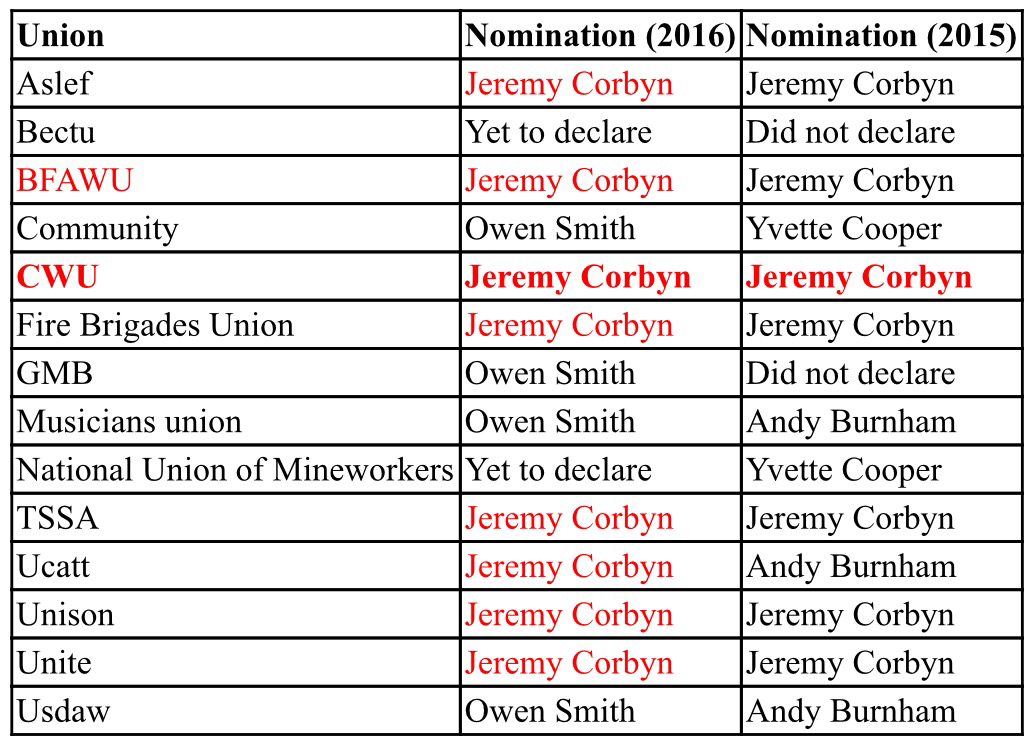
Which unions have backed Corbyn or Smith in the Labour leadership contest
Most of the major trade unions have now named their preferred winner in the Labour leadership contest. The CWU have once again shown support for Jeremy Corbyn, this was announced at a National Political briefing and press conference on Monday 1st August.

Below is a run-down of Trade Union endorsements, alongside their 2015 nominations.


The RMT and the Prison Officers’ Association, which are not affiliated to Labour, both supported Corbyn last year. The RMT has backed Corbyn again this year along with the POA. The FBU affiliated to Labour in November last year, meaning it did not have a formal link with the party when it made its nomination last summer.

Constituency Labour Party’s (CLP’s)

Jeremy Corbyn has secured the backing of almost 300 Constituency Labour Parties (CLPs), in the latest sign that the favourite remains in pole position to be re-elected leader next month.

Supporting nominations closed in the leadership contest on 15th August, with 285 CLPs giving their support to Corbyn, and 53 going to Owen Smith. Corbyn. These nominations will not affect the final result by themselves, but in the past have been a useful guide to determining the rough levels of support for candidates.  

Peterborough CLP Backs Corbyn

The Labour Party in Peterborough has re-affirmed its support for Jeremy Corbyn by overwhelmingly backing him to remain as leader. The constituency branch of the party voted 42 to eight to back Jeremy Corbyn in the Labour leadership election where he is taking on Owen Smith.

The local Labour group has supported Jeremy Corbyn since he first stood for the party’s leadership last year. And in June Councillor Mohammed Jamil, leader of the city’s Labour group on Peterborough City Council, said its members were “saddened” that MPs had passed a motion of no confidence against him.

Cllr Ansar Ali, press officer for the Labour Group on Peterborough City Council, who was present at the Peterborough CLP nomination, said: “We had a very healthy debate with speakers speaking on behalf of both leadership candidates.“ Following the extremely constructive debate members voted overwhelmingly to endorse Jeremy Corbyn.”Labour members will receive ballot papers later this month with the result announced on September 2nd

Other CLP’s within the branch that have declared support for Corbyn are North East Cambs, Boston & Skegness and North West Norfolk.

Who can vote in the election

All CWU members who pay the political levy and who joined the union before 12th January 2016 – will be able to vote in the Labour leadership election provided they register on line as an Affiliated Supporter.

Those CWU members who pay the political levy and already registered in 2015 as Affiliated Supporters are eligible to vote in the election and do not need to sign up again this time round.

Finally, it should be noted that in order to register as an Affiliated Supporter, individuals will need to sign up to the following statement:-
I support the aims and values of the Labour Party, am not a supporter of any organisation opposed to it and pay a political subscription to my trade union from which affiliation fees are paid on my behalf.
• Those registering as Affiliated Supporters will be subject to a vetting process by the Party to ensure that individuals are on the electoral register in the UK, and support the statement as detailed above. The Party will contact individuals directly by email if there is any problem with their registration.

I hope that this has explained the situation regarding the Leadership election, hopefully once the result is known the party can unite behind whoever is the leader and concentrate on winning the 2020 general election.

Andy Beeby

Branch Political Officer

CWU Eastern Number Five Branch  

Organ Donation Saves Lives – Campaign to Increase Numbers Signing the Organ Donor Register and to Increase Blood Donor Numbers:

Organ Donation Saves Lives – Campaign to Increase Numbers Signing the Organ Donor Register and to Increase Blood Donor Numbers:
To: All Branches
Dear Colleagues,
In line with CWU Conference, the Health, Safety & Environment Department is once again promoting organ and blood donation and the aim is to raise awareness of the need for more new donors to save lives and to get people to talk about it and to sign on to the NHS Organ Donor Register (ODR). Attached are some Posters and a leaflet to download and print off for distribution and display.
There are some simple messages:
Three people die every day in the UK in need of a transplant.

You can help save lives after your death – one organ donor can save and transform up to nine lives.

Tell your loved ones you want to be an organ donor so they know you have made a decision to donate if and when you can.

Anyone can register. There are no barriers to joining the ODR.

Even if you carry a donor card you should sign onto the NHS Organ Donor Register to make a lasting record of your wishes.

To register or find out more call the Organ Donor Line (See below contact details).

1,000
On average one thousand people each year in the UK, that’s 3 a day – will die because there are not enough organs available!
30%
Less than 30% of us have joined the Organ Donor Register! – why not sign-up TODAY?
90%
Over 90% of families will agree to Organ Donation if a loved one is registered AND has discussed their wishes. This drops to 40% if donation wishes are not known!
96%
Over 96% of us would take an Organ if we needed one – so why not help ensure those organs are available by signing the Organ Donor Register?
Registration is Easy
The on line form takes about 2 minutes to complete by going to the following link:- http://www.organdonation.nhs.uk/register-to-donate/ or pick up a leaflet from your GP, Medical Centre, Hospital or by contacting NHS Blood and Transplant (NHSBT) Phone – 0300 123 23 23 or go to:- http://www.nhsbt.nhs.uk/ and http://www.organdonation.nhs.uk 
Those Waiting Now Top 7,000
Currently there are over 7,000 people on the UK national transplant waiting list and last year, around 1,500 people died whilst on the waiting list for a transplant.
National Transplant Campaign
Aims to encourage people to sign the NHS Organ Donor Register and encourage everyone to have a conversation with their family about their Organ donation wishes, so that more lives can be saved. By agreeing to give your internal organs up for donation (when you no longer need them), you can save people’s lives.
NHSBT (NHS Blood & Transplant)
NHSBT is a special health authority within the NHS and is the organ donation organisation for the UK with responsibility for matching and allocating donated organs. NHSBT promote organ donation and also maintain the NHS Organ Donor Register, a secure database that records the details of people who have registered their wishes to be an organ and/or tissue donor after their death. Their remit also includes the provision of a safe, sufficient supply of blood and plasma to the NHS. To find out more, visit:- http://www.blood.co.uk
Why give blood
Giving blood saves lives. The blood you give is a lifeline in an emergency and for people who need long-term treatments. Many people would not be alive today if donors had not generously given their blood. 6,000 blood donations are needed every day to treat patients in need across England. Which is why there’s always a need for people to give blood. Each year approximately 200,000 new donors are needed, as some donors can no longer give blood. Most people between the ages of 17-65 are able to give blood. Around half the current donors are over 45. That’s why more young people are needed (over the age of 17) to start giving blood, so there is enough blood in the future. Blood donations from Black, Asian and Minority Ethnic communities are particularly needed.
What is donation?
Donation is giving an organ or tissue to help someone who needs a transplant. Transplants can save or greatly enhance the lives of other people. But this relies on donors and their families agreeing to donate their organ or tissue.
Types of donation
There are three different ways to donate. These are:
Brain stem death – This is where a person no longer has activity in their brain stem due to a severe brain injury. They have permanently lost the potential for consciousness and the capacity to breathe. This may happen even when a ventilator is keeping the person’s heart beating and oxygen is circulated through their blood.  
Circulatory death – Is the irreversible loss of function of the heart and lungs after a cardiac arrest from which the patient cannot or should not be resuscitated. It can also be the planned withdrawal of life-sustaining treatment from a patient within the Intensive Care Unit or the Emergency Department. 
living donation – Whilst you are still alive you can choose to donate a kidney, a small section of your liver, discarded bone from a hip or knee replacement and also your amniotic membrane (placenta). 
Consent
The NHS will only use organs and tissue from a donor with their consent or with their family’s consent after they die. People can give consent by:
Joining the NHS Organ Donor Register, or telling a relative or close friend about your decision to donate. Everyone can join the NHS Organ Donor Register regardless of age, as long as they are legally capable of making the decision, and live in the UK.
Medical conditions
Having a medical condition does not always prevent you from becoming an organ or tissue donor. At death, a qualified doctor responsible for your care will decide whether some or all organs or tissue are suitable for transplant. But, there are a few conditions that will exclude someone from donating organs and tissue. You cannot become an organ donor if you have:
HIV, (in some circumstances people with HIV can donate to another person who already has HIV), or Creutzfeldt-Jakob Disease (CJD), or Cancer that has spread in the last 12 months.
What can I donate?
A donation can help someone when their organs are not working properly and they need a transplant. You can donate:
Kidneys,

Heart

Liver

Lungs

Pancreas

Small bowel

Corneas

Tissue

How to become a donor
You can choose which organs you would want to donate by ticking the specific box on the NHS Organ Donor Register, or by letting your family and friends know what you want to donate.
Organ donation is against my religion.
The major religions in the UK support the idea of organ donation and transplant. This includes:
Christianity, Islam, Judaism, Buddhism, Hinduism and Sikhism. Those unsure of or uncomfortable with their faith’s position on donation should ask their religious leader or teacher.
People can buy and sell organs.
This is not true. The transplant laws in the UK forbids selling human organs or tissue.
How to become a donor
Join the NHS Organ Donor Register, or Call the numbers below.
Organ donation and ethnicity
More donors from Black, Asian and minority ethnic (BAME) groups are needed because some blood and Human Leukocyte Antigen (HLA) types are more common among some ethnic groups. Some ethnic groups are more likely to develop medical conditions that need blood, organs or tissue donations. People needing bone marrow are more likely to find a match with someone with a similar ethnic background. Patients from Black, Asian and minority ethnic communities are more likely to need an organ transplant than the rest of the population as they are more susceptible to illnesses such as diabetes and hypertension, which may result in organ failure and the need for a transplant. On average, patients from the Black, Asian and minority ethnic communities will wait a year longer for a kidney transplant than a white patient, due to the lack of suitable organs. Blood and tissue types need to match for a successful transplant and organs from people from the same ethnic background are more likely to be a close match.
Giving blood in the UK
England:- http://www.blood.co.uk Tel: 0300 123 23 23

Welsh Blood Service:- http://www.welsh-blood.org.uk Tel: 0800 25 22 66

Scottish Blood Service:- http://www.scotblood.co.uk Tel: 0345 90 90 999 Northern Ireland Blood Service:- http://www.nibts.org/index.html Tel: 028 9032 1414

Attachments
Sign-Up To The NHS Organ Donor Register Poster

Organ Donor Card Image

Organ Donor Register Leaflet

Be A Thinker, Be A Do-er, Be A Donor Poster

Motion 85(2011)

Yours sincerely
Dave Joyce

National Health, Safety & Environment Officer
Email Attachments – Click to download
Attachment 1 – 16LTB484 Organ Donation Saves Lives

Attachment 2 – Doc1.docx

Attachment 3 – Doc2.docx

Attachment 4 – Doc3.docx

Attachment 5 – Join-Us Blood Organ Donation Poster (1).pdf

Attachment 6 – ODR_Leaflet.pdf

LABOUR PARTY CONFERENCE 2016: LIVERPOOL #TheCWU

LABOUR PARTY CONFERENCE 2016: LIVERPOOL
The 2016 Labour Party Conference will be held from Sunday 25th to Wednesday 28th September 2016 at the Arena and Conference Centre (ACC) in Liverpool.
The union will be holding an event on Monday 26th September 2016, the details of which are as follows:- 
DATE: MONDAY 26TH SEPTEMBER 2016

TIME: 6.30PM – 8.30PM

VENUE: HALL 2C – ACC LIVERPOOL (CONFERENCE CENTRE)

ADDRESS: LOWER LEVEL, KINGS DOCK, LIVERPOOL, L3 4FP

If any branch has individuals attending conference as a delegate or observer who would wish to come along to the event, please could you email details to cwuevents@cwu.org.
The ACC is located in the secure area so those local branch officers who would wish to attend will need to apply for security access. The General Secretary’s Office will contact branches in the area separately on this matter.
If you have any enquiries on this LTB, these should be addressed to the General Secretary’s Office at gsoffice@cwu.org quoting the reference GS14.12/LTB 483/16.Yours sincerely
 
 
Dave Ward
General Secretary
Email Attachments – Click to download
LTB 483/16 – LABOUR PARTY CONFERENCE 2016: LIVERPOOL

JOINT STATEMENT BETWEEN ROYAL MAIL AND THE CWU COVERING THE DEPLOYMENT OF GRAVITY ROLLERS FOR LARGE PARCEL SORTING IN THE MAIL CENTRE NETWORK

JOINT STATEMENT BETWEEN ROYAL MAIL AND THE CWU COVERING THE DEPLOYMENT OF GRAVITY ROLLERS FOR LARGE PARCEL SORTING IN THE MAIL CENTRE NETWORK

Dear Colleagues
Branches and representatives will be aware that LTB 420/16 communicated a Joint Statement in relation to The Deployment Of Gravity Rollers For Large Parcel Sorting In The Mail Centre Network.
The business has now informed the department that funding has been secured to extend the standard method developed in Peterborough Mail Centre to the following Mail Centres:
South Midlands

Birmingham

Greenford

Nottingham

Jubilee

Romford

Leeds

London Central

Bristol

HCN

Edinburgh

Newcastle

Deployment is due to commence in a few weeks’ time and will take place on a rolling basis at the sites listed above. 
The business has informed the department that their project teams will ensure the local CWU are involved in the deployment activity.  
Representatives should therefore ensure that the full terms of the agreement for deployment are adhered to, that timely local negotiations take place with management and that CWU IR Representatives, Engineering and H&S Reps are fully involved in all aspects of the planning for and actual deployment of the required new arrangements.
Any enquiries in relation to this LTB should be addressed to Davie Robertson, Assistant Secretary, email: dwyatt@cwu.org or shayman@cwu.org quoting reference number: 711.02
 
Yours sincerely
 
Davie Robertson

Assistant Secretary
 
Email Attachments – Click to download
LTB 478/16 – Joint Statement – Covering the Deployment of Gravity Rollers for Large Parcel Sorting in the Mail Centre Network

KEN MCKENZIE AWARD FOR LIFELONG LEARNING 2016

KEN MCKENZIE AWARD FOR LIFELONG LEARNING 2016
Dear Colleagues,
Branches will be aware of the policy adopted at General Conference 2010 to present the “Ken McKenzie Award for Lifelong Learning” which is presented to a ULR (Union Learning Representative) or group of ULRs who have made a significant contribution to lifelong learning within the CWU. The award is presented each year at our CWU ULR National Networking Event. This year will follow tradition and be part of the agenda at this year’s event scheduled to be held at St. James’ Park, Newcastle over two days on the 16th and 17th November 2016.
Last year the accolade was awarded to Darren Rowbotham (Western Counties) and as usual we received a good number of nominations of a very high quality. Darren and George White (Mount Pleasant Branch) went on to receive awards from the TUC this year.
I am now inviting applications from Branches for the 2016 Annual Ken McKenzie award for lifelong learning. The award will be made in recognition of exceptional achievements and contributions to lifelong learning by a CWU ULR or a group of CWU ULRs. Nominations can be made by Branches, Regional Learning Committees or Regional Committees by completing the attached nomination form.
Completed nominations should include a detailed précis of the nominated ULR or group of ULRs endeavours and achievements and be sent to:
Michelle Simpson, Education and Training Department, CWU, 150 The Broadway, Wimbledon, London, SW19 1RX or email learn@cwu.org

The closing date for nominations will be FRIDAY 7TH OCTOBER 2016.
Any queries relating to this LTB should be addressed to me via the Education and Training Department at learn@cwu.org

Yours sincerely,
 
TRISH LAVELLE

HEAD OF EDUCATION & TRAINING
Email Attachments – Click to download
LTB 476/16 – KEN MCKENZIE AWARD FOR LIFELONG LEARNING 2016

Nomination Form

MARCUS SZABO – FUNERAL ARRANGEMENTS 

MARCUS SZABO – FUNERAL ARRANGEMENTS 
Further to LTB 472/16 in which I advised branches of the very sudden passing of Marcus Szabo, Deputy Area H&S Representative of the Essex Amal Branch. 
I can now advise branches that the funeral arrangements are as follows:- 
DATE: Wednesday 17th August 2016

TIME: 10.30am

PLACE: Chelmsford Crematorium

ADDRESS: Writtle Road, Chelmsford, Essex, CM1 3BL 
The family has requested no flowers but donations are welcome to either the British Heart Foundation or the Essex Wildlife Trust. 
If you have any enquiries in relation to this LTB, these should be addressed to the General Secretary’s Office at gsoffice@cwu.org quoting the reference GS1.1/LTB 477/16. 
Yours sincerely 
 
Dave Ward

General Secretary
Email Attachments – Click to download
LTB 477/16 – Marcus Szabo – Funeral Arrangements

EU Referendum Result – Where are We Now on Health and Safety Laws and the Future of the UK Health and Safety System Post British Exit of the EU:

EU Referendum Result – Where are We Now on Health and Safety Laws and the Future of the UK Health and Safety System Post British Exit of the EU:
To All CWU Branches

All CWU Regional Health and Safety Forums

All CWU Health and Safety Reps
Dear Colleagues,
Overview – What Happens Now

The Health, Safety & Environment Department has received a number of enquiries regarding the impact of the EU Referendum Result on UK Health and Safety Laws both presently and in future and this LTB is to set out the position.
The UK decision to leave the European Union has prompted the question of whether current EU Health and Safety regulations could be revoked immediately.
This is not the case. Many EU Health, Safety & Environmental directives have been transposed into UK Law so currently nothing changes until the UK government puts in place mechanisms for further deregulation. However post-Brexit it is highly likely that the UK will have less influence over EU Law and in the development of further EU Law up to the time we leave the EU, which could be as long as two years.
Throughout the UK membership of the EU the Health and Safety at Work etc. Act (HASWA) has been in place and effective. Without doubt we should continue to apply our successful risk-based management systems. Many UK organisations will want to continue to work and trade within the EU and it will be in their interest to continue maintaining compliance. The UK has been a leader in influencing other EU nations and regulators in developing strong foundations for future health, safety and environmental laws. 
The CWU along with the TUC, UK Hazards Campaign, Safety Professional bodies such as IOSH, IIRSM have all stated that they will continue to promote and actively support effective health, safety and environmental standards, risk management and agreed international standards as well as to defend against any erosion of health and safety protections for workers and the public. As UK organisations will want to continue to trade with Europe, it will be in everyone’s interest to maintain the status quo. The UK has already helped to influence sound foundations for European health and safety and beyond and our expertise and input should continue to be valued. In summary:-
• Nothing formal can happen until the UK Government gives formal notice (Article 50)

• The Government says it will not give notice until next year (very possibly even longer)

• The TUC does not want an early triggering of Article 50. 

• It will be Two years from then before withdrawal (this can be extended)

• meanwhile all existing H&S regulations apply

• It is unclear what role the UK will be able to play during the notice period.
Background

In the United Kingdom there are many regulations relevant to health, safety and welfare at work. Many of these give effect to European Union directives which are transposed into UK Regulations and introduced as Law.
TUC/CWU Campaign

The TUC, CWU and most Trade Unions campaigned against withdrawal from the European Union, by emphasising that many positive changes for workers in the UK have happened directly as a result of EU membership and making a strong case for a social Europe. In recent years, EU-led improvements in health and safety protection have been more limited than in the past, but the overall contribution of EU regulations on health and safety to the UK workforce is substantial. As shown by a recent evaluation of EU regulations, the overall package of directives is practical, fit for purpose, and, more importantly, effective. It is clear that EU membership continues to deliver wide-ranging protections to UK workers, and 

therefore UK Trade Unions wanted to continue to be part of the European process, be more actively engaged and support an improved and revitalised package of measures aimed at tackling the huge burden of occupational illnesses that are being experienced both in the UK and across the EU.

EU/UK Health & Safety Law History

In recent years much of Britain’s health and safety law has originated in Europe.
Proposals from the European Commission may be agreed by Member States, who are then responsible for making them part of their domestic law. Modern health and safety law in this country, including much of that from Europe, is based on the principle of risk assessment.
The UK joined the EU in 1973.
The 1986 Single European Act led to a significant increase in the volume of health and safety Directives. Amongst other things that Act abolished national vetoes in a host of areas and increased the legislative powers of the European parliament so creating a “European Union”.
For Health and Safety, the biggest change was the Health and Safety Framework Directive (89/391/EEC) and five “daughter” directives1 which established broad-based obligations on member states to ensure that employers evaluate, avoid and reduce workplace risks in consultation with their workforce.
At the time, the UK already had in place a legislative system which met most of the requirements of the Directive. The UK had previously introduced the 1974 Health and Safety at Work (HSW) Act as well as Regulations that had been made under it such as the Safety Representatives and Safety Committees Regulations 1977.
Although, in the UK, the HSW Act was considered adequate as a means of achieving the appropriate standards, the EU H&S Directives were more prescriptive and detailed and thus it was necessary to extend the law. Carefully avoiding any disruption to the HSW Act, six new sets of regulations (called the ‘six pack’), together with Approved Codes of Practice and Guidance Notes were enacted on 1 January 1993. A central principle was the requirement of assessing and managing risk, as well as the legal duties of employers.
Since then, the UK Government has had to make a number of modifications to bring UK legislation in line with the provisions of the Framework Directive, including the Health and Safety (Consultation with Employees) Regulations 1996 which arose from the threat of infraction proceedings and extended worker representation to non-unionised workplaces. In addition the Government had to change the law to ensure that the police were covered by health and safety legislation. A range of other health and safety directives, implemented through national regulations have also come about as a result of EU regulation. These cover the management of specific workplace risks such as noise or work at height, as well as the protection of specific groups of workers (such as new or expectant mothers, young people and temporary workers). Specific regulations cover areas such as construction work, asbestos, chemicals, off-shore work, etc. Although the pace of activity peaked soon after the Single European Act with the introduction of the ‘six-pack’, legislative activity has continued and health and safety regulation in the UK is now firmly driven by the EU.
41 out of the 65 new British health and safety regulations introduced between 1997 and 2009 originated in the EU.
UK Referendum Brexit Result and Health and Safety Rights and Protection

On the 23 June the UK voted by 52% to 48% to leave the European Union (EU). Prior to the vote the TUC, CWU and other major Unions warned that vital health and safety at work rights from EU-driven laws could be under threat if he nation voted in favour of leaving the European Union (EU).
There is now a real and serious danger that the final outcome could mean that the UK loses much of the Health and Safety protection that EU membership has given the UK by way of Workplace Health, Safety and Employment rights, which are all now at risk in the long term and much will depend on the negotiations that will take place between the UK and the EU and it could be years before this process is concluded but in the meantime, all European directives and obligations continue to apply.
The outcome of the negotiations is hard to predict but from the UK side, talks will be led by an anti-Health and Safety, anti-Workers’ Rights Tory Government that has spent six years undermining health and safety law and enforcement in the UK, despite EU Legislation and many Conservatives want trade deals and benefits with Europe and further afield without the employment and safety protections that come with it via the EU. If a deal is eventually reached whereby the UK is no longer covered by EU Regulations on health and safety then the UK Tory Government will be able to reduce standards to whatever they want or remove them completely.
Prominent leave campaigners have called for a halving of regulations derived from EU law, or flexibility in interpreting rights, claiming that they are a burden on British businesses who would benefit from a reduction in so called ‘Red Tape’ – which is really the rights and protections of millions of working people they want to remove:-
• Boris Johnson MP (Conservative) stated “We must scrap the Social Chapter, Employment Regulations, the Collective Redundancies Directive, the Atypical Workers Directive, The Working Time Directive and a Thousand More!”

• Priti Patel MP (Conservative) and now Work & Pensions Minister said “There is a need to halve the burdens of the EU Social and Employment Protection Legislation.”

• John Redwood MP (Conservative) said “We must opt-out of the Social Chapter” 

• Chris Grayling MP (Conservative) said “EU H&S laws are Red Tape”

• Michael Gove MP (Conservative) said “The battery of European measures from the Working Time Directive, to the Social Chapter need to go.”
Three of these are now in the Prime Minister Theresa May’s cabinet.
The current government had already drawn up an agenda of health and safety laws it wished to change before the referendum result. These included a watering down of the DSE Regulations, Working Time Regulations, Construction Design Management (CDM) Regulations, Optical Radiation Directive and Chemical Directive. The Tory Government also want to remove Risk Assessment requirements from more small businesses. This list was drawn up as a shopping list for change within the EU. Once outside the EU other changes are possible without discussion with the EU. Likely long term targets will be Safety Reps and Consultation, PPE Regulations and Temporary Workers.
During the period in the run up to the UK’s exit from the EU, the UK will have little involvement on Health and Safety developments. There will be a full evaluation of all of the H&S directives by the EU with little UK involvement. There are current recommendations for new action on Stress and MSDs at EU level. New EU exposure limits on Carcinogens will not apply automatically in the UK, or the REACH improvements. UK Trade Unions will certainly have no say in EU negotiations on H&S, even if new regulations do apply.
The TUC/CWU ‘Protect Health & Safety’ Campaign Continues. We cannot have a system which gives equal treatment to bankers, manufacturers, employers and those providing services, while workers are denied the same rights. It’s going to be important that the Unions oppose these cuts to rights that workers and their Unions fought so hard to win. It’s going to be important to ensure that MPs, particularly Conservative MPs – get the message that crucial protections are not up for grabs when the time comes and the debate commences.
It’s vital the UK continues to apply the current risk-based health and safety system, which includes laws from EU directives, because it’s been found to be fit for purpose by several independent reviews E.g. the Tory Governments commissioned; 2011 ‘Lofstedt’ Independent Review of UK Health and Safety Legislation and the 2014 ‘Temple’ Independent Triennial Review of the HSE’ lead by Martin Temple who has now been appointed HSE’s new 

Chair (2016):-

Professor Ragnar Lofstedt’ concluded: “There is no case for radically altering current health and safety legislation in the UK.”

• ‘Martin Temple CBE’ concluded: “There is a continuing need for the functions that HSE delivers, and a very strong case for those functions to continue to be delivered by an arms-length body.”
TUC Action Plan

The TUC has drawn up a new ‘Action Plan on Health and Safety’ as follows:-

• New TUC campaign on protecting workers rights and H&S

• Renew campaign for UK to ratify all ILO labour conventions on H&S

• Ensuring that BME and migrant workers are protected from abuse and violence at work

• Revisit and intensify work on core issues such as stress, carcinogens etc. 

• Retain links with fellow Trade unionists through ETUC and ITUC

• Continue H&S organising campaign

• Use the H&S rights we have
Attachments:

• EU Membership and Health and Safety TUC Report

• Protecting Health and Safety after ‘Brexit’ – Protecting Rights – Building Unions TUC
Yours sincerely
Dave Joyce

National Health, Safety & Environment Officer
Email Attachments – Click to download
Attachment 1 – 16LTB475 Future of the UK Health and Safety System Post British Exit of the EU.docx

Attachment 2 – EU Membership and Health Safety – TUC Report 2016.pdf

Attachment 3 – Protecting Health and Safety after ‘Brexit’ – Hazards plenary- July2016.ppt

Create a website or blog at WordPress.com

Up ↑