Pillars of Security and Pay Negotiations

Pillars of Security and Pay Negotiations

Dear Colleague,
Further to LTB 403/17 regarding Royal Mail’s position on pensions, the Postal Executive at its meeting on 18th July 2017 discussed management’s current communication and actions and how it relates to Emergency Motion E5 which was unanimously carried at this year’s Annual Conference (copy attached for ease of reference).
Clearly the Motion represents the determined position of the CWU to resist management’s current approach and secure the best possible agreement for our members. However, we are fast approaching the deadline for those negotiations and yesterday the Postal Executive took the decision to assess progress at the next PE meeting scheduled for 15th August, and if sufficient progress has not been made it will then agree a timetable for a national industrial action ballot.
In respect of pensions, you will also note that Emergency Motion E5 also carried the policy that if Royal Mail choose to introduce any of their policies by executive action then an immediate ballot for industrial action should commence. On Friday 14th July 2017 Royal Mail Group issued an alert in a Commercial Organisation press release which strongly suggested that talks with the CWU on a new pension solution had ceased and that they would, by executive action, be offering our members a choice between their latest proposal of a mutant DC cash out at the point of retirement saving scheme, or the current Defined Contribution scheme.
The timing of this announcement also coincided with the news that Unite (who represent the managerial grades) will be holding a consultative ballot on Royal Mail’s latest proposal. Whilst it should be noted that Unite are not recommending the managerial offer they have said that the offer represents the best position achievable and are positive in regard to its Defined Benefit nature.
To be clear, we (the CWU) have totally rejected the offer as being anything like an acceptable solution to replace the pension promise and deferred wages in retirement offered by our current DB scheme and which both parties agreed was a key element of the reward package for our members in the Growth and Stability/legally binding agreement.
Whilst Royal Mail’s released update and their published communications with Unite would imply that the talks have concluded, they are also taking actions which suggest that the talks will continue. For example, on 18th July they released their latest trading update in which they state that the managerial union (Unite/CMA) believe that Royal Mail’s latest offer is the best position available but they are continuing to discuss future pension arrangements with the CWU. Equally, on Monday 17th July, Jon Millidge, (RM Group HR Director) contacted the DGSP Department seeking further meetings on the pension issue and I can report that a meeting has been arranged between Royal Mail, the CWU and our advisors, First Actuarial, for Tuesday 25th July.
This activity would suggest that they have not ceased negotiations on an acceptable pension solution but we will be seeking a straight answer before the meeting on 25th July to clarify if the company has ceased negotiations or are genuinely prepared to continue talks to find an agreed settlement.
In a final effort to try and reach an agreement on all aspects of the Four Pillars of Security and pay, the Postal Executive have also decided to write to the business offering a meeting between their lead negotiators and the CWU Officers, in an attempt to reframe the negotiations and understand if there is any meaningful desire to move all the issues forward and reach an agreement.
It is imperative that everyone understands that we are now at a very serious stage of these negotiations and that unless there is a substantial breakthrough prior to the PE Meeting on 15th August, the Postal Executive will have no option or hesitation to carry out the terms of Emergency Motion E5 and set a timetable for a ballot of our membership on industrial action.
Yours sincerely
Terry Pullinger
Deputy General Secretary (Postal)

The Importance of Workplace Fire Drills – RMG Fire Safety Week

The Importance of Workplace Fire Drills – RMG Fire Safety Week
To: All Branches with RM Members
Dear Colleagues, 
What is a fire drill and why are they necessary?
A fire drill is a simulated emergency procedure which aims to emulate the processes which would be undertaken in the event of a fire or other similar emergency. It involves creating a situation which replicates what would happen if a real fire were to occur, with the inclusion of fire alarms, and requires all employees, and anyone else who may be within the property at the time, e.g. visitors, customers, contractors to evacuate. 
Fire drills are an important part of workplace fire safety procedures for many reasons. Preparation is the key to effective response to workplace fires. Fire drills help ensure that the workforce responds quickly, calmly and safely and that all staff, customers and visitors to the premises understand what they need to do if there is a fire. They also help to test how effective the fire evacuation plan is and are used to improve certain aspects of fire provisions. Along with fire alarms, fire exits, fire doors, fire extinguishers and fire safety signs, Fire Drills are an indirect, but equally significant, form of fire protection and aim to protect everyone who works within a Workplace building from the devastating consequences of fire. 
As well as testing that the fire alarms are working, carrying out a full fire drill will help to check other equipment such as fire doors, which are used when a fire alarm sounds. Checking that Emergency Lighting works effectively can also be carried out during the fire drill. If there are problems or weaknesses discovered with the emergency evacuation plans then the Person in Control (PiC), along with the Management team, Safety, Health and Environment (SHE) Team, in consultation with Union Health and Safety Reps can work together to improve it. Additionally, immediate steps can be taken to rectify any problems with the building’s equipment, getting it fully checked out, repaired or replaced. If it’s found that Fire exits and routes are blocked, or too narrow for employees to quickly escape, remedial action can be taken. 
Fire Drills can often be viewed as an inconvenience by Managers and the Workforce alike. Not only do they disrupt the day and distract from valuable working time, they can also be perceived as a nuisance to staff and are often greeted with distain so it’s important to communicate the value and reasons for Fire Drills and that, in a real life situation, not knowing what to do may be putting their lives in danger. 
The intention is to make an evacuation in the event of a fire as simple, efficient and effective as possible, it involves running employees through the evacuation procedures, ensuring they are familiar with the plan and are able to get out quickly and safely. It is also intended to make sure relevant fire wardens know exactly what they are doing and can assist if their support is ever really needed. 
Fire Drill Frequency 
In Royal Mail Group there will be a minimum of one Fire Drill or (Fire Evacuation Practice) per year, per shift in each operational building. 
If a Unit Manager, in consultation with the RMG SHE Team and Union Health and Safety Reps decides to carry out further Fire Drills, more frequently than above, for operational of risk assessment reasons within the Office, e.g. due to the number of staff, size of the building, diversity of operations, joint user sites or other complexities, this is acceptable to RMG. 
Who is responsible for a fire drill and how often should be they undertaken? 
According to Fire Safety Laws in the UK, the person responsible for all aspects of fire safety in commercial and non-domestic premises is the owner, occupier or manager. Legislation refers to this person as the ‘responsible person’ (Person in Control – PiC) and, as such, they are in charge of ensuring all fire safety regulations, as required by law and enforced by local fire and rescue authorities, are fully complied with. 
The PiC, as the ‘responsible person’ has a number of duties, including planning for an emergency and providing staff with information, fire safety instruction and training. Therefore, they must make sure regular fire drills are carried out and conducted effectively, putting into place any remedial actions which must be taken as a result of the drill’s evaluation. 
In order to fulfill the legal obligations, and in accordance with fire safety regulations, fire drills should be conducted at least once a year (more often in environments such as schools and nurseries and high risk workplaces) and the results should be recorded and kept as part of the fire safety and evacuation plan. Additionally, all new staff should be informed of the fire evacuation procedures as soon as they start work and if a new fire risk is ever noted or recognised all employees should be informed. 
Regulatory Reform (Fire Safety) Order 2005 
In the United Kingdom fire safety was covered by about seventy pieces of fire safety legislation, the principal ones being the Fire Precautions Act 1971 and the Fire Precautions (Workplace) Regulations 1997/1999. In 2001 it was therefore decided the legislation needed to be to simplified. This was achieved with:-
England and Wales – the Regulatory Reform (Fire Safety) Order 2005.

Scotland – the Fire Safety (Scotland) Regulations 2006.

Northern Ireland – the Fire Safety Regulations (Northern Ireland) were introduced in 2010. 

[Note: The contents of this LTB have been agreed by the Royal Mail Group Property and Facilities Solutions National Fire Risk Manager] 
Yours sincerely
 
Dave Joyce

National Health, Safety & Environment Officer
Email Attachments – Click to download
LTB 404/17 The Importance of Workplace Fire Drills – RMG Fire Safety Week

Eastern 5 Four Pillars members meeting with Tony Bouch

16th July Members Meeting Report with Tony Bouch


Tony opened the meeting by informing people that Royal Mail on Friday 14th July 2017 had shifted their stance on Pensions and submitted an improved offer to the Union. He wanted to make it clear, the business has shifted their position twice now regarding Pensions, purely on the strength of CWU members support for the Four Pillars Campaign. The new offer from the business will see them pay in 13.6% contributions (currently stands at 17.1%). This new scheme proposed by the business will see each individual with 3 separate schemes running alongside each other. It is the CWU view that this is a deliberate attempt by the business to confuse people into not understanding how much money they will be losing.

Tony went on to explain that on 28th June 2017 the national officers of the CWU met with 20 financial experts from around the UK including MPs, business owners and media executives to outline the CWU counter proposal on Pensions. The union wish to expose the business and will use all media outlets when the time comes if national talks break down.

The business pay offer of £250 plus 30 minutes reduction in the working week (if all other proposals are accepted) Tony said was an absolute insult to delivery members, who walk up and down 29 million paths in all weathers 6 days a week. Some of these proposals include…

Monthly pay, removal of election payments, Christmas bonus payment linked to performance, attendance procedure reviewed (no appeal at stage 1 and 2) and a professional manager i.e. legal expert to undertake the stage 3 dismissal interview. This is for one reason only, to make sure the case is water tight should a tribunal be raised. There are currently 285 national agreements in place and it is the business’ wishes to review these and reduce in order to make it easier for managers to control.

The business also made it their intention for all new starters to only be on 80% of the pay of full time employees and with no shift allowance applicable to them. Under the business’ plans it will take a new starter 4 years to reach the same pay as an existing employee. This contradicts the 2014 national agreement ‘agenda for growth’ which the business signed up to a no 2 tier workforce.

As for deliveries Tony said the business has made it clear to the union, it is their intention for delivery finish times to finish 2 hours later and the USO moved from 1500 hours to 1700 hours. The union counter argument is come the winter months, in some parts of the country it is near darkness about 16:00 hours and our member’s health and safety will never be compromised. The business said 25% of all UK deliveries are not completed within their duty times and their plans are for Postmen/women to ‘have route ownership’ of their rounds, which each person would have to agree to never extend or cut off. They have also plans for individuals to work in groups where they would be responsible to cover annual leave and sickness. Data capture chips and swipe cards were another one of the contentious issues the business has put forward. Their wish is for chips to be blue toothed to various points around the local office in order for managers to track employees within a 5 metre radius. It is the CWU belief these plans are just to get members put on the conduct code.

Most of the business’ proposals are completely unworkable as any delivery member reading this will understand. The general feeling amongst CWU national officers is that the business have not thought any of their plans through. Tony said that across the country the business has some very good managers and directors who understand how things work, but these people are not what the business want. To confirm this Tony said the chief negotiator for Royal Mail in direct talks with himself and Mark Baulch CWU Outdoor Secretary has only been employed by the company for 3 years and has never undertaken a delivery in his life.

This dispute is not about improving the service or efficiency, it’s purely about saving money and cost cutting. This union will get this exact message out to the general public through various media contacts and members. Please continue to support your reps and turn up at gate meetings and spread the message in the workplace. With our members support, the business will have no option but to come to its senses and get an agreement with your union. Members doing nothing will only strengthen the business’ hand in bringing in all the ridiculous points raised above.

Cheers, Lee Walsh

Peterborough Deliveries Sub Rep

UNITE AGAINST FASCISM RALLY – SATURDAY 22ND JULY, ROCHDALE

UNITE AGAINST FASCISM RALLY – SATURDAY 22ND JULY, ROCHDALE
The purpose of this LTB is to ask all CWU Branches to join and support the above rally which has been organised by Unite Against Fascism to counter the Britain First rally. 
 
The Unite Against Fascism rally details are as follows:
Date: Saturday 22nd July

Time: Meeting at 12 noon

Venue: The Butts opposite Weatherspoons, Rochdale Town Centre, OL6 1ES 
 
For further information please see links to social media and UAF site:
https://www.facebook.com/Unite-Against-fascist-Britain-First-in-Rochdale-1359389044138690/
http://uaf.org.uk/2017/07/protest-no-to-fascist-britain-first-in-rochdale-july-22/
Any enquiries regarding this Letter to Branches should be addressed to the Senior Deputy General Secretary’s Department on telephone number 020 8971 7237, or email address sdgs@cwu.org.
Yours sincerely,
 
TONY KEARNS

SENIOR DEPUTY GENERAL SECRETARY
 
Email Attachments – Click to download
LTB 405/17 – Unite Against Fascism Rally – Saturday 22nd July, Rochdale

Eastern No 5 Four Pillars Members Meetings Video

Proud of the work the reps have put into delivering the 4 Pillars message to our members. Proud of the members for standing together to defend our terms and conditions. CWU and Proud! #4pillars #TheCWU #cwueastern5 

Peterborough Four Pillars meeting


Today Sunday 16/07/17 Eastern No5 Branch held a FourPillars members meeting at Peterborough bowls club. Big thanks to Tony Bouch for coming up and explaining the issues and setting out the CWU alternative to the Royal Mail slashing of pay and Terms and conditions..


This slideshow requires JavaScript.

Royal Mail Pensions 

Royal Mail Pensions Royal Mail has today announced that they have effectively broken off talks with the CWU and decided to close the Defined Benefit scheme to future accrual from March next year and give RMMP members the “choice” of going into one of two vastly inferior alternatives. The company’s decision to take executive action without CWU agreement is a clear rejection of our mutual interest approach. While the decision to impose change is not surprising given the company’s repeated threats to do so, it is clearly unacceptable when our pension agreement commits both parties to seek agreement and jointly develop future pension strategy. The CWU have never accepted the closure of the DB scheme but have pragmatically proposed a solution that meets the company’s concerns about managing long term risk, responds to the inadequacies of the DC scheme, would end two-tier provision and provide a ‘wage in retirement’ for all on a more cost efficient basis than either the company’s DC or cash balance alternatives. Despite accepting that our wage in retirement scheme is sound and workable they have never responded seriously to our proposal and from the outset of talks have been determined to introduce cheaper less favourable cash out schemes. However the company tries to dress them up, the fact is that both their cash balance and DC schemes will mean tens of thousands of CWU members will face huge losses in their future pension benefits – with the biggest hit falling on the youngest. In relation to their cash balance scheme, the illustrations now provided by Royal Mail reveal that a Section C member age 50 at 2018 with 30 years’ service, retiring at 65, will see their pension benefits reduced by 22.3%. The same member in Section B will see their benefits reduced by 19% while a Section C member age 30 at 2018 with ten years’ service, retiring at 65, will see their pension benefit cut by a staggering 51.6%. For those going into the DC scheme, the average losses will range from 20% for those retiring at 60 to 30% for those retiring at 65.   

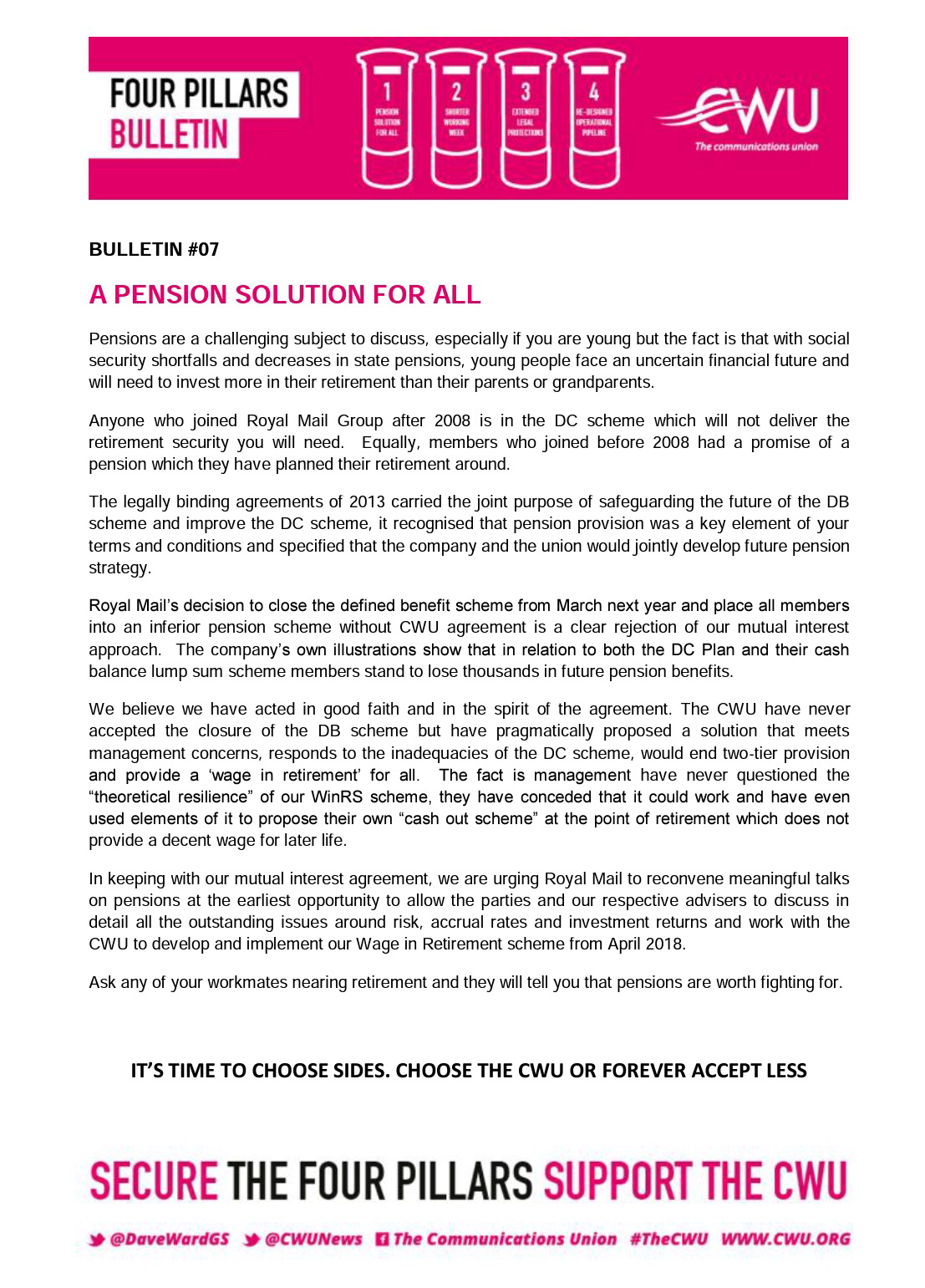
In line with our Four Pillars policy and campaign, the CWU are calling on Royal Mail to withdraw their proposals immediately and in accordance with the spirit and intent of our agreement to enter into serious, meaningful talks on pensions with the union around the introduction of our WinRS scheme to allow us to address all the outstanding issues between us and secure a settlement agreeable to both sides. We equally believe that taking executive action would be a breach of the legally binding agreement on pensions and we will be seeking advice in this regard. Should that not be an option then we will be forced to consider acting on the union’s policy to ballot for industrial action consistent with our efforts to reach agreements on all aspects of our ‘Four Pillars of Security’ and pay claim. Attached to this LTB is Bulletin 7 which sets out the union’s case for a wage in retirement scheme and the inadequacy of Royal Mail’s proposed alternatives. Further updates will be provided in due course. 

Any enquiries relating to this LTB should be addressed to the DGS(P) Department.

 Yours sincerely Terry Pullinger 

Deputy General Secretary (Postal) 
Royal Mail Group (RMG) Safety, Health and Environment (SHE) Standard 2.7 “Management of Dog Attack Risks

Royal Mail Group (RMG) Safety, Health and Environment (SHE) Standard 2.7 “Management of Dog Attack Risks”:
To: All Branches
Dear Colleagues,
This LTB is to raise awareness amongst ASRs and Regional Health and Safety Forums of Royal Mail Group (RMG) Safety, Health and Environment (SHE) Management System Standard 2.7 “Management of Dog Attack Risks”. The Health Safety & Environment Department wishes to raise awareness of the requirements of the Safety Standard and ensure compliance as we come to the end of the 2017 RMG/CWU Dog Awareness Week.  
The Standard applies across the whole of RMG and sets out the arrangements for addressing and managing the risks of dog attacks on collections and delivery members. Inherent in the standard is the belief that workers should be able to undertake their work without being subject to dog attacks. As a result it is agreed that the approach taken to manage the risk will be focused on prevention of dog attacks with the arrangements for handling an attack considered as necessary but a secondary approach to the overall approach.
Managers of Collections and Delivery will ensure that the appropriate Workplace Offsite Risk Assessment (E.g. WRAP) is completed and up to date for all duties under their control (See SHE Standard 2.4 – Off Site Workplace Risk Assessment).
The RMG SHE Team will maintain a procedure for the management of Dog Attack Risks. These are maintained in the Management of Dog Attack Risk Guidance (Appendix 1).
All incidents will be recorded using the Dog Attack Risk Template ‘DART’ Form (Appendix 2).
All incidents will be considered by the SHE Team for ‘Private Prosecution’ using the Dog Attack Report Programme (DARP) where the Police and CPS decide not to prosecute. To date around 12 such cases of dog attacks ending in CWU Members being attacked and injured have been taken via this route and all have successfully ended in the dog owner being prosecuted.
There is a Dog Attack Risk Control Matrix at Appendix 3 to provide guidance on suitable control measures.  
The standard sets out Royal Mail’s Zero Tolerance Approach to significant dog risks and confirms that under circumstances where the risk of a dog attack is unacceptably high, managers are supported in suspending deliveries or collections to the relevant premises or locations until such time as the risk has been controlled appropriately or eliminated.
It’s up to every collections and delivery worker to ensure that dog-related information for their duty is up to date and to adopt the control measures specified by their manager.
CWU ASRs will be fully involved and consulted on Walk Risk Assessments completion and in discussions on risk levels and the development and deployment of appropriate control measures to reduce and control the risk of dog attacks. Managers will monitor and review delivery and collection risk controls jointly with the ASR and where a Dog Attack takes place the manager will provide a copy of the Dog Attack Report Template Form to the ASR.
The Standard document and Guidance cover:- Routine Monitoring, Incident Investigation, Post Incident Actions, Controls, Analysis, Prosecutions and Private Prosecutions, Criminal and Civil Prosecutions, Communications and Auditing with the Guidance Document going into greater detail and it includes the DART Report Form.
This standard sets out the agreed Royal Mail policy approach which in summary is:-
“Royal Mail Has a Zero Tolerance Approach To Dog Attacks”

“Delivery and Collections Staff are supported in not completing a delivery or collection to premises where they find, as a result of their own assessment, on arrival at the premises that there is an unacceptable risk of a dog attack.”

“At the earliest opportunity, exposure to a dog threat or dog attack incident should be reported to the Manager”

Where there are Dog Attack Risk issues on a duty the manager must consult the CWU ASR to discuss the level of risk and the development and deployment of control measures.

Once measures are deployed they must remain in place as long as required and they must be monitored and regularly reviewed with the CWU ASR.

When a Dog Attack takes place the Unit Manager must share a copy of the ‘DART’ Report form with the CWU ASR and the victim.

IMPORTANT:
Too many dog attacks and dog incident near misses go unreported and that situation is unhelpful in many respects. THE MESSAGE TO MEMBERS IS TO REPORT ALL DOG INCIDENTS NO MATTER HOW MINOR. IT COULD BE FAR WORSE NEXT TIME!
Attachments:
RMG SHE Standard 2.7 “Management of Dog Attack Risks”.
RMG SHE Standard 2.7 “Management of Dog Attack Risks” – Guidance.
RMG ‘StaySafe’ Dog Attack Risk Control Matrix (App3).
‘DART’ Report Form (App2)
Yours sincerely
Dave Joyce

National Health, Safety & Environment Officer
Email Attachments – Click to download
Attachment 1 – LTB397/17 Royal Mail Group (RMG) Safety, Health and Environment (SHE) Standard 2.7 “Management of Dog Attack Risks”:

Attachment 2 – Standard 2.7 Management of Dog Attack Risks (v 1.3)

Attachment 3 – Management of Dog Attack Guidance (v 1.3)

Attachment 4 – StaySafe – Dog Attack Risk Control Matrix (Appendix 3) (v2 2)

Attachment 5 – Copy of DART_(Appendix_2)_(v1.0)

Royal Mail Group – Fire Safety Week 17 to 23 July 2017 – Campaign to Raise Awareness of Fire Safety Management

Royal Mail Group – Fire Safety Week 17 to 23 July 2017 – Campaign to Raise Awareness of Fire Safety Management:
To: All Postal Branches

All Branch Area Safety Representatives

  All Regional Health and Safety Forums 
Dear Colleagues, 
Here are the final confirmed details of the 2017 Royal Mail Group, Fire Safety Week.
RMG Fire Safety Week is being deployed this year with the full support of the CWU and will therefore have the full involvement of Area and Workplace Safety Representatives who should now be proactively making contact with PiCs (Person in Charge) and Area Safety, Health and Environment (SHE) Advisors to plan support and involvement during the week. See attached RMG Royal Mail Property & Facilities Solutions/CWU Joint Statement. 
CWU Safety Reps are entitled to be involved, consulted and to input in, Fire Risk Assessment Reviews, Fire Evacuation Plans, Fire Drills etc. 
CWU support has been welcomed by the Royal Mail Group Property & Facilities Solutions National Fire Safety Manager, so please make it happen locally. 
The purpose of Fire Safety Week is to raise or keep fire safety in focus and ensure fire safety is understood and supported throughout Royal Mail Group. 
Royal Mail must carry out fire safety risk assessments for their premises and keep it up to date. This shares the same approach as health and safety risk assessments. Based on the findings of the assessments, Royal Mail needs to ensure that adequate and appropriate fire safety measures are in place to minimise the risk of injury or loss of life in the event of a fire. The assessments need to be reviewed and kept up to date. 
The purpose of this forthcoming campaign is to help raise awareness of the role and responsibilities of RMG Persons in Control (PiCs) who play an important role when it comes to managing fire safety within the areas under their control. 
This is to ensure RMG’s legal requirements are met and to ensure the workforce and visitors to the properties/offices are kept safe at all times. 
“Fire Safety Week” will take place during Week Commencing 17 July and with it there will be a series of tasks that the Person in Control will need to complete as part of the SHE Task Calendar and associated PiC Task List. A Fire Safety Pack is being deployed across RMG for PiCs information and a copy is attached for ASRs, WSRs and Branches to cascade to Reps.
PiCs are required to complete three key tasks:-
Update and close out the Fire Risk Assessment Actions.

Check Fire Evacuation Plans and Personal Evacuation Plans.

Ensure that all Employees have received their fire training and test this by carrying out fire alarm evacuation exercise.

NOTE: Where Unit Managers are not the nominated Person in Control (PiC), then it is the responsibility of the Unit Manager to ensure the PiC is aware of Fire Safety Week and support them with completion of the tasks required of them. 
PiCs will involve and consult with CWU Area and Workplace Safety Reps about: –
fire Risk assessments,

proposals for improving fire safety,

informing and instructing staff on fire risks and precautions,

nomination of Fire Wardens,

any issues or risks identified which might affect the safety of the employees and proposed remedial action.

Work time learning should be used to ensure employees and building users understand their duties and responsibilities toward fire safety, for example: understand emergency evacuation procedures, good housekeeping or where unacceptable working practices have been identified. Tasks already undertaken may mean that staff only require a brief update and communication across the building users.
Any non-RMG occupants e.g. Quadrant, external tenants should be briefed on any changes of a joint fire evacuation plan.
Attachments:
RMPFS Fire Safety Week Pack (Includes: RMTV Fire Safety Summary, Fire Safety Week Task List and Guide, Fire safety Week WTL, Programme Summary, Fire Safety Weeks Opps Briefing, FSW Overview, SHE Task Calendar).

RMG Fire Precautions Guide.

Fire Safety Good Practice Guide.

Fire Safety Check List.

RMG Induction to Fire safety.

RMG Fire Safety Week 2017 Joint Statement.

Raising Faults or Queries
Raise faults or queries by contacting the Property & Facilities Helpdesk on 0844 800 9191
Fire Related Queries and Further Assistance
Any Fire related queries and further assistance can be obtained by email to: fire.safety@royalmail.com
Yours sincerely
 
Dave Joyce

National Health, Safety & Environment Officer
Email Attachments – Click to download
RMPFS Fire Safety Week Pack (ZIP)

17LTB392 Royal Mail Group – Fire Safety Week 17 to 23 July 2017 – Campaign to Raise Awareness of Fire Safety Management

Fire Precautions Guide

Fire Safety Check List

Fire Safety Good Practice Guide

Induction Hand Out Notes

RMG FIre Safety Week 2017 Joint Statement

The Taylor Review – World of Work – CWU Response

The Taylor Review – World of Work – CWU Response
The purpose of this LTB is to set out the union’s response to the government-commissioned Taylor Review of Modern Working Practices, which was published today, and to reaffirm the CWU’s key strategy of calling for a new deal for all workers. 
While the Review does include a significant recommendation to abolish the Agency Workers loophole, which the CWU has lead the way in campaigning for over a number of years, on the whole it falls well short of putting forward the solutions that are needed to change the balance of forces in the world of work and address the problems in the UK labour market. 
The CWU has issued the attached press release in response to the Review. While our criticisms of the Review’s shortcomings have been echoed across the labour movement, crucially we go on to state that it is now incumbent on the entire trade union movement to do something about it and we then set out an appropriate course of action. 
This is consistent with the position the CWU has taken over the last two years and in our work at the TUC and within the Labour Party. In the coming weeks we will be stepping up our activities to work towards a stronger response from the trade union movement. 
Specifically, the CWU is calling for a concerted TUC campaign to end insecure employment and in-work poverty. This includes all TUC affiliated unions agreeing a common bargaining agenda and the publication of a TUC manifesto on what constitutes a new deal for workers, alongside a proper plan – including deliverable action – to achieve it. 
These proposals have already been the subject of CWU motions to recent TUC and Labour Party conferences and we will be submitting further motions this year to strengthen the response from the whole labour movement. 
As we continue to take a lead in calling for action from the wider movement, the union must now also look at new ways to root out insecure employment models in our own industries and sectors. At its meeting on 29th June, the NEC agreed that we will bring back a comprehensive paper in the near future fleshing out the detail of what a new deal for workers should look like and what we must now do to achieve it. 
In summary, it is very important that branches recognise the overall direction the union is taking and how we are determined to join up our industrial and political agendas, with the objectives we have set for redesign. 
With the general election result and Labour offering a transformative manifesto, it is time for the trade union movement to deliver a new kind of trade unionism and we will be working to ensure that CWU is at the forefront of reasserting trade union values and organisation across the UK. 
Finally, the link to download the Taylor Review can be found here: https://www.gov.uk/government/uploads/system/uploads/attachment_data/file/626772/good-work-taylor-review-modern-working-practices.pdf 
Further information will be sent out in due course. Any enquiries regarding this LTB should be addressed to the General Secretary’s Office at gsoffice@cwu.org quoting the reference GS1.1. 
Yours sincerely
 
Dave Ward

General Secretary
 
Email Attachments – Click to download
Attachment 1 – LTB 396/17 The Taylor Review

Attachment 2 – CWU Press Release

Create a website or blog at WordPress.com

Up ↑