
A video message to all our Parcelforce members from National Officer Davie Robertson Please SHARE #FourPillars #TheCWU
Very important video update from DGSP Terry Pullinger on our dispute with Royal Mail Group
Please WATCH & SHARE this latest and very important video update from DGSP Terry Pullinger on our dispute with Royal Mail Group #FourPillars #TheCWU
UNI Europa Youth Conference 2019

UNI Europa Youth Conference 2019
Further to LTB 455/19 dated 26th July 2019, at the close of nominations on the 12th August 2019 the following have been received:
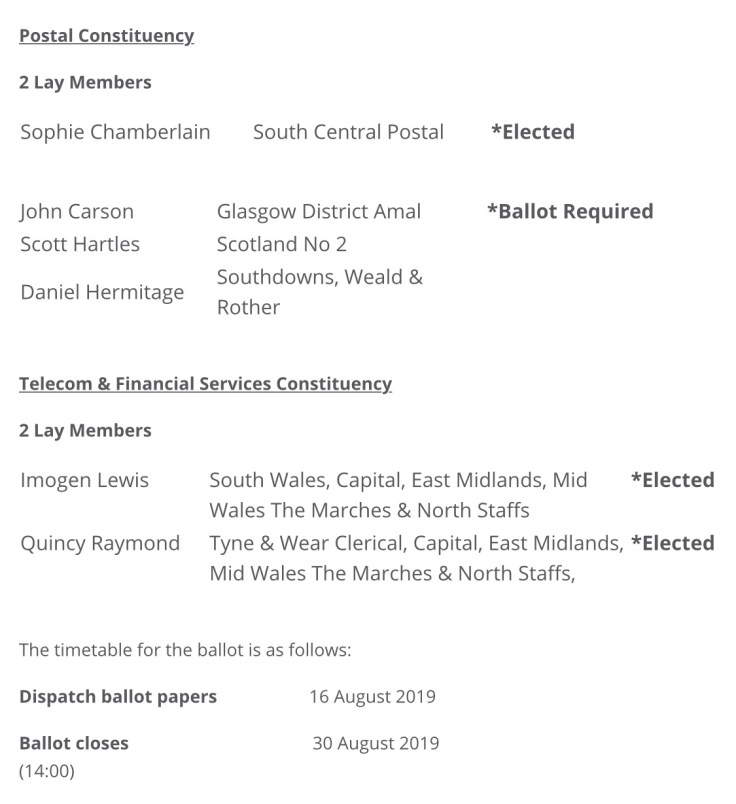
Any enquiries regarding this Letter to Branches should be addressed to the Senior Deputy General Secretary’s Department on telephone number 020 8971 7237, or email address sdgs@cwu.org.
Yours sincerely,
Tony Kearns
Senior Deputy General Secretary
CWU Head of Equality, Training, Education AND DEVELOPMENT
CWU Head of Equality, Training, Education AND DEVELOPMENT
Following Trish Lavelle’s decision to leave the union and after an open resourcing process and subsequent interviews with a number of external and internal candidates, I can confirm that Kate Hudson, Midlands Regional Secretary, has been appointed to the new position of CWU Head of Equality, Training, Education and Development.
Kate will officially take up the role on the 2nd September 2019 and I am sure Branches and Representatives will want to wish Kate every success for the future.
Any enquiries on the above LTB should be addressed to thegsoffice@cwu.org.
Yours sincerely
Dave Ward
General Secretary
19LTB488 – CWU HEAD OF EQUALITY, TRAINING, EDUCATION AND DEVELOPMENT
Midlands Division Defending The 4 Pillars Agreement – August 2019
Midlands Division
Defending The 4 Pillars Agreement – August 2019
Members will be aware that following the announcement of Royal Mail’s 5 year business plan the CWU has registered a National Point of Principle Disagreement with the company. The disagreement raises our serious concerns that Royal Mail is no longer committed to the 4 Pillars Agreement, and specifically the legal protections we have secured.
Below is a summary of the key issues that need to be resolved if we are to avoid a national dispute with Royal Mail.
Key Issues
• Royal Mail’s 5 year business plan includes up to 20,000 job losses. Job creation and job protection is at the core of everything the CWU stands for.
• The business intends to open at least 3 parcel sorting centres. This will result in parcel traffic and duties being removed from Mail Centres.
• The business intends to introduce dedicated parcel deliveries in Delivery Offices. This will remove parcel traffic and duty hours from current deliveries.
• Royal Mail has not agreed to implement the 1 hour reduction in the working week contained within the 4 Pillars Agreement that is due to commence in October 2019.
• The culture in many offices remains unacceptable.
It is vitally important that we resolve all of these issues andensure that we manage this change based on job security for members.
Additionally Royal Mail has written to the CWU advising of their intention to commence a formal review of the existing legal protections we have secured.
Below is a reminder of the key legal protections, now under threat.
Current Legal Protections
✓ ‘The Employer will remain a provider of end to end service namely the collection, transportation, sorting and delivery of letters and parcels.’
✓ ‘The Employer will not outsource, sell or transfer to a company outside of the Royal Mail Group any part of its business..’
✓ ‘The Employer will not franchise out any part of its business..’
✓ ‘The Employer will not engage any new Employee on terms and conditions which are inferior to existing Employees..’
✓ No Employee will be engaged on zero hour contracts.’
✓ ‘The overarching objective will be for the Employer to deliver all future change without recourse to compulsory redundancy.’
✓ ‘Employees will be employed on permanent contracts, except where there is genuine short term need..’
✓ ‘The overall resourcing model will continue to be based predominantly on full time employment..’
✓ ‘Employees will not be employed on Temporary contracts exceeding two years…’
✓ ‘Part Time contracts will be reviewed every 6 months and where appropriate increased contracts will be offered to reflect hours actually worked and planned.’
This set of comprehensive legal job security protections are without doubt the finest ever achieved within the Trade Union movement and worthy of defending.
The fact that Royal Mail now wishes to review these protections is of great concern.
But equally of concern is the fact that in the last few days Royal Mail has culled a number of senior national managers who have been heavily involved in the 4 Pillars agreement and may have been committed to the agreement. These national managers have been replaced by others who may not have any such commitment.
Next Steps
National negotiations on Royal Mail’s business plan and its implications for CWU members are ongoing. Terry Pullinger, Deputy General Secretary is leading the negotiations for the CWU.
In accordance with the agreed national Dispute Resolution Processes if these negotiations do not produce an agreement in the near future, then both parties will enter into National Mediation. If National Mediation does not produce an agreement then a national dispute is likely to be called.
The CWU seeks an agreement on all of these issues, but we cannot allow Royal Mail to ride roughshod over the 4 Pillars Agreement and the protections we have fought for and secured for members.
We will ensure we keep member fully informed of developments.
BT Sell-off of BT Fleet Solutions Ltd – Branch Forum
BT Sell-off of BT Fleet Solutions Ltd – Branch Forum
Since BT’s announcement on Monday 5th August that they had sold BT Fleet Solutions to Aurelius we have been making strong representations to the company. We have made it absolutely clear that the CWU does not support this sale and that they have totally disregarded their loyal and dedicated BT Fleet Solutions employees some of whom have given decades of service to the company.
This sale did not need to happen – BT Fleet is a profitable company which although we all agree it will need further investment now and in the future – that investment could have been found elsewhere. The BT Board took from their perspective the easiest route – for example, rather than cutting the dividend to fund investment they decided to dispense with circa. 950 loyal employees. This is a disgrace and those responsible should be ashamed as their decision has caused considerable stress and anguish to our members.
Despite our anger which I can assure you has been made absolutely clear to BT, we have sought to secure an agreement with the company in four key areas:
- A guarantee that all current contractual terms are transferred to the new company
- Confirmation of what non-contractual terms transfer and agree where possible transition arrangement for those that are not able to transfer e.g. Broadband and BT Vision
- An agreement on pension arrangements for all employees whether they are members of the BTRSS, BT Hybrid Scheme or Section A members of the BTPS.
- A full CWU recognition agreement with the new company which will ensure that we have collective negotiating rights for all of the above including future pay, terms and conditions and representation in the workplace.
We will be meeting with the company on Wednesday 14th August with the intention of resolving all of the above issues.
In order to fully update branches we are holding a BT Branch Forum on Thursday 15th August 2019from 12.00 until no later than 15.00 in order that we can report on progress made and we would urge all branches to send a representative especially those with BT Fleet members. The Branch Forum will be held in CWU Head Office, Conference Rooms 1 and 2.
We have also sent a further communications direct to all BT Fleet Solutions members which I have attached for information.
Yours sincerely
Andy Kerr Brendan O’Brien
Deputy General Secretary (T&FS) Assistant Secretary (T&FS)
Election of CWU Regional Secretaries – 2019
Election of CWU Regional Secretaries – 2019
Further to LTB 464/19 dated 31st July 2019.
Please find attached a copy of the detailed branch analysis for the above elections.
This is being sent to the branches in electronic format only. If any branch requires a paper copy of the branch breakdown, then this can be obtained from the Senior Deputy General Secretary’s Department.
Any enquiries regarding this LTB should be directed to the Senior Deputy General Secretary’s Department for the attention of Peter Metcalfe:
Telephone: 0208 971 7368
Email: pmetcalfe@cwu.org
Yours sincerely,
Tony Kearns
Senior Deputy General Secretary
Regional Secretaries Branch Analysis 2019
National Officer, NEC, Industrial Executive Elections – 2019
National Officer, NEC, Industrial Executive Elections – 2019
Further to LTB 464/19 dated 31st July 2019.
Please find attached a copy of the detailed branch analysis for the above elections.
This is being sent to the branches in electronic format only. If any branch requires a paper copy of the branch breakdown, then this can be obtained from the Senior Deputy General Secretary’s Department.
Any enquiries regarding this LTB should be directed to the Senior Deputy General Secretary’s Department for the attention of Peter Metcalfe:
Telephone: 0208 971 7368
Email: pmetcalfe@cwu.org
Yours sincerely,
Tony Kearns
Senior Deputy General Secretary
CWU MENTAL HEALTH STRATEGY – NATIONAL EVENT 17TH OCTOBER 2019
CWU MENTAL HEALTH STRATEGY – NATIONAL EVENT 17TH OCTOBER 2019
Branches will be aware that following a decision of General Conference a national Mental Health Group has been set up and has been busy working on a unique strategy which seeks to raise awareness, develop a dedicated web page, train and support representatives as well as campaign and lobby opinion formers and politicians.
We are delighted to announce that film Director Ken Loach will be joining us.
This ambitious strategy will be launched at the national event where we hope attendees will be informed, inspired and entertained. Colleagues should be aware the venue holds 500 people.
Since notifying Branches of the event in LTB 396/19 we have received a number of queries requesting details of how to register. To this end please find attached a registration form which should be completed and sent to CWUMHS19@gmail.com. Confirmation of registration will be sent by return.
We would urge Branches to inform and make arrangements for interested members to attend what we hope to be a hugely successful event.
Any enquiries on the above LTB should be addressed to thegsoffice@cwu.org.
Yours sincerely
Dave Ward
General Secretary
19LTB480 – CWU Mental Health Strategy National Event 17th October 2019
 CWU Eastern No5 Branch