CWU Conference 2018 – Health, Safety and Environment Department Fringe Meeting Monday 23rd April 2018:

CWU Conference 2018 – Health, Safety and Environment Department Fringe Meeting Monday 23rd April 2018:

To: All Branches

Dear Colleagues,

Over one hundred and twenty Communication Workers Union health and safety reps and branch officials packed the Health, Safety and Environment Fringe Meeting at the CWU’s Annual Conference in Bournemouth on Monday 23rd April 2018.

This year the delegates were delighted to hear from the excellent guest speaker Andrew Kingscott from the HSE Transport and Public Services Unit, Engagement and Policy Division at HSE Headquarters.

Opening the meeting, CWU NEC Health, Safety and Environment Committee Chair Shelly Banbury introduced CWU Health Safety and Environment National Officer Dave Joyce and Andrew Kingscott from the Health and Safety Executive HQ.

Dave Joyce started off by saying that we were celebrating 40 years of Trade Union Safety Representatives and the introduction of the SRSC Regulations. He said that Trade Unions came out of the struggle for proper Health and Safety at Work and that the Health and Safety at Work Act was one of the most important pieces of legislation ever to be introduced.

Dave also reminded the meeting that Workers Memorial Day would take place after Conference on Saturday 28th April and called for delegates to support Workers Memorial Day events, remembering those killed at work and committing ourselves to fight for the living and to protect health and safety.

Dave also informed the meeting of health and safety fines recently imposed. Although high – they were nowhere near as significant as those imposed on Royal Mail and BT, both £40 Million plus for regulatory offences. He said there were big gaps that needed to be addressed by the courts.

Dave informed the meeting that the HSE has just published its 2018/19 Business Plan which follows the HSE 5-Year Strategy “Helping Great Britain Work Well” and outlined the priority areas in the strategy which he pointed out were very relevant to CWU members; Work Stress, MSDS and Lung Disease. He then introduced the guest speaker.

Andrew Kingscott then addressed the meeting and gave a power point presentation.

Andrew said that he enjoys working with Trade Unions and has 26 year’s experience as an operational Health and Safety Inspector with the HSE with a good knowledge of the HSE front line work.

He is now in HSE Headquarters leading on sector based work and was previously involved in the HSE’s first Corporate Manslaughter prosecution. He said that the HSE was not scared to enforce the law.

Andrew said that we don’t tend to celebrate our successes and that there are pockets of good practices that he seeks to share with others.

All HSE strategies are on the HSE website covering 21 sectors.

He praised the good publications that the CWU had made available to the fringe meeting.

Andrew then talked about the strategy for Helping Britain Work Well. He spoke about tackling ill health and a Health Priority Plan with three priorities:

• Occupational Lung Disease;

• Musculoskeletal Disorders (MSD) and

• Work-related Stress.

Andrew spoke about the Utilities Sector Plan where the HSE will lead and engage with others to improve workplace health and safety by supporting and promoting strategic industry initiatives that show leadership in tackling key problems and also work with key stakeholders, such as BT and Openreach and the Mast and Tower Safety Group.

On the HSE Transport Sector Plan he said this would include improving poorly secured loads, reducing the rate of ill health caused by MSDs and increasing engagement with work-related road risk.

The Chair then invited questions from the Delegates as follows:

Question: Are HSE inspections proactive or reactive?

Answer: Some are proactive but the HSE needs to know they are going to the right place. There are high risk areas such as food, agriculture and construction that are visited more. Much work is done on the back of reactive work.

Question: There is a big disparity between fines for Health and Safety breaches and financial ones. An example of an incident in Falmouth was given where very small fines were given when the matter came to court which was a serious injustice.

Answer: A lot of training goes into HSE inspectors to make sure that evidence is gathered and a good job is done. It was now more down to prosecution to make a submission of culpability and there are set tariffs on fines. He would have a look at that example of Falmouth.

Question: On proactive inspections, 10 years ago the HSE audited Royal Mail systems such as dog attacks, this no longer takes place and the feeling is that the HSE is failing.

Answer: Andrew said he would take that on board. The need was to balance priorities. He would take away the CWU publication on dogs to look at this situation.

Question: Where is the HSE going post Brexit?

Answer: Andrew doesn’t see any step backwards on Health and Safety legislation. No one was working on this.

Question: On HSE re-inspections why doesn’t the HSE inspector ask for a CWU Rep to be present?

Answer: Unfortunately this can happen but it is wrong, Andrew ensures that inspectors know to talk to safety reps on site.

Question: Does the HSE self-fund?

Answer: The HSE as a regulator does self-fund and seeks to recover costs through Fee For Intervention (FFI). It works on the same principle as “polluter pays”.

Dave Joyce summed up the meeting and thanked Andrew Kingscott for attending and for his interesting and informative talk to the CWU Health and Safety Fringe meeting.

On the question of Brexit, Dave hoped that Health and Safety legislation doesn’t change but he warned that Unions and the TUC will need to be ready for a battle to protect Health and Safety legislation.

Dave also said that the best way to achieve health and safety compliance is through enforcement and regulation and that the CWU will continue to support the return to a pro-active enforcement strategy by the HSE.

Dave also said that HSE funding had been slashed by Government and it was ridiculous that the HSE had to become a ‘commercial organisation’ to raise their own funds.

On the question of fines Dave said that progress had been made on increasing health and safety fines because of pressure by the Unions but were still too far short of competition and regulatory fines. The CWU would continue to campaign for appropriate fines.

Dave concluded that yet again the Health Safety and Environment Department’s Fringe Meeting had been the best attended fringe meeting at CWU conference and he thanked all the delegates for their support and participation.

The Chair closed the meeting by thanking everyone for attending.

[Report by Steve Mann Policy Assistant, CWU Health, Safety & Environment Department]

Yours sincerely

Dave Joyce
National Health, Safety & Environment Officer

18LTB249 CWU Conference 2018 – Health, Safety and Environment Department Fringe Meeting Monday 23rd April 2018

HSE – AC presentation CWU – Utilities incl 23 April edit

View Online

Postal Conference 2018 Day one report by Lee Walsh

Terry Pullinger opened conference by obviously thanking all the members for backing their Reps and giving them the mandate to take on the business who let’s make if very clear were only intent on worsening all our terms and conditions and destroying our union. there is no doubt we stood together as one and won the fight and we should rightly be proud of ourselves in telling everyone were part of the CWU.

There was a debate about people getting older in deliveries and having to do more and more walking. The average age of a person in deliveries is 48 and a speaker from the rostrum commented on how many people were hobbling up to the rostrum to speak. debate about whether an ageing workforce should be given less delivery work or would this break the law on ageism. 

1024 delivery staff were Ill health retired last year but Ray Ellis said paragraph 19.3.1 of the new national agreement covers this off and will ensure the business is fair and considerate in resource meetings and subsequent workload

A one day resourcing course is to be rolled out to all reps by the education department as this agreement is all about getting the resourcing right and making sure employees are working without undue pressure.

Wessex South central moved a motion instructing conference to agree policy with the business around the streaming of mail to hit targets and yet still ensure absorption/lapsing is done on a daily basis. Mark Boulch outdoor secretary said royal mail’s aborhant attitude to the failing of mail and the uso will change with this agreement. paragraph 7 section 9 instructs the business to delivery all mail on hand every day and mark said the CWU are intent on making the business follow this agreement. 

Ernie Area processing rep from our branch got up to move motion 29 regarding the business abusing the attendence procedure by dishing out “line in the sand” letters to members who are covered under the equality act telling them any further absences will not be discounted. Ernie spoke about managers not making decisions on their own merits but instead taking advice from “faceless ” advisors from royal mail HR only interested in removing our members from off the pay roll.

Following on from that motion Carl maden PEC member CWU HQ  advised all reps whose members were being given stage reviews but were covered under the equality act, to put in an employment tribunal against the business. 

cheers lee

GENERAL CONFERENCE: SUNDAY/ MONDAY 22nd 23rd April Report by Lee Walsh

CONFERENCE REPORT :

GENERAL CONFERENCE: SUNDAY/ MONDAY 22nd 23rd April.

The first two days of conference were about the union as a whole and the way we are going forward and manovering ourselves to meet the challenges ahead in this ever changing society. The 4 pillars campaign proved communication is king amongst members and we must build on that and engage as a union. But only half of our branches have a website which shows how much more work we need to be doing going forward.

Only 23% of the workforce are members of a trade union in the UK and it’s expected the CWU will lose approx 3000 members in 2019. The CWU will be going through a redesign this year and attempting to streamline their finances and make the union more efficient, whilst keeping the strenght to enable us to tackle the employer. The 4 pillars campaign alone cost over 1 million pounds to fund and as subscriptions haven’t gone up in 3 years we need to save money to fund such campaigns. The salary bill in CWU HQ has been reduced by £900,000 a year due to EVR packages and streamlining of staff. HQ are asking every Branch to look at the ways they are spending money to come up with ways of being more efficient financially. We are a cash poor but asset rich union and need to continually invest in training for our Reps. The ultimate goal is to have a Rep in every workplace fighting for members and changing and shaping the business for the better. THIS COSTS MONEY.

CWU HQ are maybe looking to sell Wimbledon HQ, Alverscot training centre and the elstead hotel in Bournemouth it owns to release cash. There will be a redesign conference in November this year.

Jeremy Corbyn was a guest speaker at conference Monday and got a rousing reception as expected. He said in the last 8 years alone £37 BILLION POUNDS HAS BEEN PAID OUT IN DIVIDENDS BY COMPANIES PREVIOUSLY IN THE PUBLIC SECTOR.

He said under a Labour government royal mail would be put back into the hands of the public where it belongs and run firstly and foremost as a public service.

The company is profit first only and these stats glaringly hilight this:

Last year the Royal mail were fined 40 million pounds and BT 42 million pounds for failing to comply to the regulator regarding price fixing.

Royal mail were fined 1.6 million pounds and BT only £900,000 for health and safety failures.

MAKES YOU WONDER IF HEALTH AND SAFETY IS ACTUALLY TOP OF THEIR AGENDA?

Tuesday onwards is postal conference which where  everyday workplace issues will be discussed and debated. The issues that effect us all at work every day as members of a trade union.

I will be hoping to do some more reports to keep you all up to date.

cheers Lee

HSE Business Plan 2018/19

HSE Business Plan 2018/19

Dear Colleagues,

The HSE has published their Business Plan for 2018/19, signed off by HSE CEO Richard Judge and HSE Chair Martin Temple.

The Business Plan 2018/19 (copy attached) brings together the HSE’s key actions and priorities as the national regulator for health and safety, drawing on the recently published HSE ‘Helping Great Britain Work Well 5-Year Strategy’ and its Industry Sector Plans. The Plan highlights specific priorities, reinforces the HSE’s ongoing commitment, brought together under the four themes:

• Lead and engage with others to improve workplace health and safety. Leading and engaging those who undertake or influence health and safety, for example through engagement with stakeholders on priorities like health at work or through award-winning campaigns;

• Provide an effective regulatory framework. Ensuring the regulatory framework remains effective, bringing a greater focus on supporting small firms and helping duty holders understand how to manage the risks they create in a proportionate way;

• Secure effective management and control of work-related risks – through a range of proportionate approaches including face-to-face contact, licensing regimes in certain higher-risk sectors, dealing with reported concerns efficiently and effectively, and holding people to account by enforcing the law in a firm but fair way;

• Reduce the likelihood of low frequency, high-impact catastrophic incidents. Continuing to promote leadership throughout the higher-hazard industries and projects, as well as dealing with emerging risks such as cyber security.

The Business Plan framework and approach is consistent with previous years which aim to help show how HSE approaches develop over time. The plan aims to gives a sense of balance across the breadth of HSE work – from leadership & influence through to direct interventions. The contents reflect priorities set out in the core strategic Strategy “Helping Great Britain Work Well”, Sector Plans, and the Health and Work programme.

The plan doesn’t attempt to capture everything that the HSE does. Instead, it focuses on priorities where specific action or attention is needed. However, this year the HSE has expanded the overview and priority section for each theme to give a better sense of the total activity. This is based on feedback about what is expected in the Business Plan.

The HSE response to the Government Spending Review settlement is covered. The HSE states that they intend to continue to address the reduction in taxpayer funding through a combination of enhanced cost recovery, commercial growth and efficiencies to support the delivery of the Plan.

The Plan again sees the HSE claim that Great Britain has a health and safety record to be proud of and Great Britain is one of the safest places in the world to work in. Nonetheless, the Plan states that health and safety statistics have plateaued and so this is a stark reminder of the safety and health challenges in the world of work with the impact of work-related injuries and ill health costing the nation£14 Billion a year. This Plan outlines what the HSE will deliver in 2018/19.

The HSE states that the year ahead will also be significant in terms of supporting the Government in its preparations for the UK’s exit from the European Union and any changes that may follow the Grenfell tragedy. It also refers to supporting the Government’s regulatory agenda and business improvement. The CWU, TUC and other Unions will be watching carefully to ensure that doesn’t mean weakening regulations and protections at work.

It concludes that the HSE leads the way, but doesn’t act alone. Everyone has a part to play – Employers, Trade Unions, Trade Associations, Professional Bodies, Academics and others and the HSE thanks them for the commitments they have made to improve health and safety standards, and the HSE welcomes fresh action in the year ahead.

Yours sincerely

Dave Joyce
National Health, Safety & Environment Officer
18LTB245 HSE Business Plan 2018-19

HSE Business Plan 2017-18

View Online

UK National Work Stress Network – New ‘Work Stress Guide Handbook’

UK National Work Stress Network – New ‘Work Stress Guide Handbook’

Dear Colleagues,

The UK National Work Stress Network is a voluntary organisation that campaigns to secure proper recognition of the damage caused by work-stress and to prevent work-related stress. They aim to educate and raise awareness of work-stress and to improve legislation on health, safety and employment rights in the UK and Europe. The organisation is part of the ‘Hazards Campaign’ and has close links to the Trade Union movement. The UK National Work Stress Network consists of unpaid volunteers, bringing together workplace trade union and health and safety representatives, academics, safety professionals and others to campaign for the better protection of workers against stress-related mental and physical illnesses caused by poorly controlled workplace psycho-social hazards.

The UK Work-Stress Network has been fighting for years alongside Trade Unions and the Hazards Campaign for the protection of Health and Safety in the workplace, action on Stress and Mental Health. The organisation, Trade Unions and the TUC, now have major concerns about the outcome of any shift of EU-based health and safety law into UK law and the very likely future diminution of Health and Safety and other associated laws.

The latest edition of “Work Stress Guide” handbook has been published with the CWU being one of the publication’s sponsors, along with several other Unions; FBU, FDA, GMB, NASUWT, UNISON, Unite and both the Hazards Campaign and Scottish Hazards.

The New handbook examines:

The problem:

• The extent of work-related stress illness.

• The cost of work-related stress illnesses to the individual, society and the economy.

• The causes of work-related stress.

• The effects of stress on the mental and physical health of workers.

• Obstacles to progress.

• The law.

• The solution.

• Preventing work stress (the role of Government, employers, Trade Unions and individuals).

• Conducting a risk assessment.

• Dealing with individual stress.

Appendices

• WorkStress (UK National Work Stress Network).

• Fit notes.

• Sample workplace audit forms.

• The European dimension.

• Useful sources of information.

• References.

The Appendices give further information about the WorkStress Network, examine how other European countries are tackling the problem of psycho-social workplace hazards, give some examples of Workplace Audit Forms and lists some further sources of information.

The handbook should be of use to many, including:

• Employers, managers and human resources staff.

• Trade Union Health and Safety Representatives and Union Reps.

• Trade Union tutors and students.

• Professionals in the field of mental health and occupational health.

• Academics.

• Employees with personal experience of workplace stress and its effects.

Handbook pdf Download Copy:

A pdf copy of the handbook is attached and the Health, Safety and Environment Department will be distributing hard copies of the books to Senior Health and Safety Reps via Regional Health and Safety Forums and there will be copies available at Annual Conference at the Health and Safety Fringe Meeting. Bulk copies can also be purchased by Branches (details below).

Problem and Extent of Workplace Stress-Related Illness:

The Health and Safety Executive (HSE) defines stress as “the adverse reaction people have to excessive pressure or other types of demand placed upon them. Too many workers are trapped in highly stressful environments as a result of poor work organisation and negative behaviours in the workplace. As a result, levels of stress-related mental and physical illness caused or made worse by work are very high. Those at the bottom of the workplace pecking order are often the major victims of stress-related illness. Sufferers are not weak individuals who are incapable of coping with the normal demands of working life. The reverse is often the case, and it can be those who refuse to bend under these pressures and who refuse to admit to themselves that they are being overwhelmed who often succumb to incapacitating stress-related illnesses.

Highly stressful workplaces are ‘dysfunctional’ because they work to the benefit neither of the employee nor of the employer. The former can suffer from a range of stress-related mental and physical illnesses and the latter reaps this harvest in terms of low productivity, low employee morale and rapid staff turnover. Instead of taking measures to prevent this epidemic of injury, too often managers or employers make excessive demands, neglect their common-law duty of care and clearly ignore the cost to their organisations of sick pay, long-term absence, reduced productivity and potential claims for compensation by workers made ill by their negligence. However, it is the human cost of work-related stress, in terms of wrecked lives and relationships, debilitating mental and physical illness and sometimes, tragically, death that should concern us most.

No one should leave work at the end of the day less healthy than they were when they started. All too often we hear of workers trapped in highly stressful environments, often also the subject of bullying, victimisation and harassment or discrimination. When we see how many people are affected by their work (and sometimes by fellow workers), it is heartrending to say the least. We learn that their managers or employers make excessive demands, neglect their common law duty of care and clearly ignore the cost to the organisation through sick pay, long-term absence, reduced production and potential compensation for making their workers ill.

Stress is a major cause of sickness absence in the workplace and costs over £5 billion a year in Great Britain. It affects individuals, their families and colleagues by impacting on their health but it also impacts on employers with costs relating to sickness absence, replacement staff, lost production and increased accidents.

The UK National Work-Stress Network is committed to the eradication of the causes of work-related stress and associated illnesses. They campaign to advance this aim through involvement with the Hazards Campaign and in conjunction with the TUC, UK trade unions and European organisations.

The Network consists of many hundreds of like-minded people, some of whom have suffered the consequences of work-related stress. Amongst their numbers are experienced caseworkers, counsellors, occupational health workers, Trade Union officials, and those who are just determined to see effective management which recognises the needs of the workforce as well as of business.

The UK National Work-Stress Network’s website (www.workstress.net.) regularly receives over 40,000 visits each month and is the basis for the information they provide. They also produce three or four electronic newsletters each year. All documents on the website are free to copy and circulate. In addition, they facilitate workshops and seminars as requested and play a significant role at Hazards Conferences in the UK and Europe.

The UK operates in a climate of uncertainty and job insecurity, as the rights of employees have been regularly eroded in favour of a ‘business and enterprise culture’. Short-term and temporary contracts, zero-hours contracts, casualisation, privatisation, the conversion of public services into ‘businesses’ in which a smaller number of workers are expected to deliver the same amount of work, and increased lone working – have all increased pressure on the worker, thus changing the face of employment. Excessive target-setting, bureaucracy and performance measurement now pervade many aspects of work, applying additional pressures to workers, at every level. Coercive management practices (bullying) flourish as pressure increases to cut costs, and to meet targets, often with reduced staffing. This profit-motivated attitude has led to an unacceptable rise in the reported cases of stress-related workplace illness.

The UK National Work-Stress Network calls for:-

• Employers, company directors and managers at all levels to acknowledge their duty of care and their acceptance of their health and safety responsibilities to the workforce.

• Legislation and enforcement procedures to outlaw all forms of workplace stress, bullying and victimisation; also to ensure full corporate liability for workplace injury.

• The creation of a caring supportive workplace culture with ‘Dignity at Work’ and worker-sensitive procedures for all.

• Specific regulations or an Approved Code of Practice (ACOP) or giving clear instructions to management on the necessary actions to remove stress related illness from the workplace, regulations in which the right of people at work to be treated with dignity and respect is explicitly stated to prevent the abuse of hierarchical position, which creates a bullying culture.

The UK National Work-Stress Network provides speakers for local and national events and facilitates workshops and seminars for Trade Union and human resources groups. The Network continues to be closely involved with the Hazards Campaign and takes an active part in both UK and European Hazards conferences.

Purchasing Bulk Copies Of The Work-Stress Guide Booklet

Copies of the Work Stress Guide Booklet can be purchased as follows:-

A box of 55 copies comes at a charge of £1 per copy plus admin and p&p = £80. Orders can be processed via:

Bob Woods (Network Coordinator)

UK National Work Stress Network

Mobile: 07590 598587

Email: ukstresscoordinator@gmail.com

The UK National Work-Stress Network Annual Conference

The UK National Work-Stress Network holds an Annual Conference in November each year at the Hillscourt Conference Centre, Rednal, Birmingham B45 8RS. When details are confirmed and application forms are available, full details will be published via an LTB to Branches, Safety Reps and Regional Health and Safety Forums.

Yours sincerely

Dave Joyce
National Health, Safety & Environment Officer


In order that people may be happy in their

work these three things are needed…

■ they must be fit for it;

■ they must not do too much of it; and

■ they must have a sense of success in it.

(John Ruskin, 1871)

18LTB247 UK National Work Stress Network – New ‘Work Stress Guide Handbook’

UK Work-Stress Guide-Handbook

How to Identify Stress CWU Factsheet

View Online

Safe & Well – April 2018

Safe & Well – April 2018

Dear Colleagues,

Please see attached the April edition of Safe and Well newsletter with contributions from our USRs and field teams. This edition has a focus on various aspects of power plus the launch of the new eyewear range. May’s edition will focus in on summer safety topics to raise awareness.

Yours sincerely

Dave Joyce
National Health, Safety & Environment Officer

18LTB246 Safe & Well – April 2018

Safe and Well Issue 57 April 2018

View Online

Dog Attacks On Postal Workers CWU ‘Bite-Back’ Campaign Booklet (Version 8): WARNING – INCLUDES GRAPHIC IMAGES OF EXAMPLE CASES

Dog Attacks On Postal Workers CWU ‘Bite-Back’ Campaign Booklet (Version 8): WARNING – INCLUDES GRAPHIC IMAGES OF EXAMPLE CASES

To: All Branches

Dear Colleagues,

Figures from NHS England show that hospital admissions for dog attack injuries have risen to a record all time high of 7,673 last year, an increase of 22% in three years. A quarter of these were children. This rise in dog attacks has occurred in spite of CWU prompted Government legislative initiatives aimed at curbing dog attacks and promoting responsible dog ownership.

There has been a 76% increase in dog attack hospitalisations over the last 10 years in England. Emergency admissions to Scottish hospitals after a dog attack rose 80% over the same 10 years period, according to NHS Scotland figures. Figures for Wales show a 20% increase over the last 12 months alone.

7,000 Dogs have been seized by police and put in kennels over the last five years with £5m spent on kennelling.

In 1991, the most substantial piece of this legislation, the ‘Dangerous Dogs Act (DDA)’ was introduced. Following the CWU’s 7 year ‘Bite-Back’ Campaign, the laws covering England, Scotland, Wales and Northern Ireland were extended to Private Property where 70% of the attacks on Postal Workers occurred and owners were previously immune from prosecution. The amendments made included the extension of dangerous dogs legislation to private property, introduction of tougher sentences, compulsory micro-chipping and new police seizure powers thanks to the Union’s concerted efforts. That has seen a welcomed and marked increase in criminal dog owner prosecutions.

Worryingly however, dog attacks continue to rise despite the current, strengthened, legal framework for protecting Postal Workers and the public. The effectiveness of the dog control laws and their enforcement therefore remains in question.

UK Governments need to review the current strategy and initiatives for dealing with dangerous dogs and discuss the benefits of alternative multi-agency approaches that raise public awareness and strongly promote responsible dog ownership. This includes working with dog owners and schools to increase awareness of safe and appropriate behaviour around dogs and cracking down on irresponsible dog owners and dog breeding through consistently enforced Laws and tenancy agreements. The Courts also need to use the full range of sentencing penalties and orders available to them, dealing firmly with offenders.

The CWU’s ‘Bite-Back’ Campaign, driven and spearheaded by the Health, Safety & Environment Department, aims to continue to raise awareness about irresponsible dog ownership and call for a post-implementation review of the new, existing dog control laws in place and its enforcement or lack of by certain Police forces, Local Authorities and the Courts, that need to use the tools available to them and take tougher legal sanctions against the owners of dangerous dogs. We believe that the statistics show that law and order is still failing to prevent dog attacks and failing to prevent workers becoming dog attack victims. An examination of the whole approach to effectively control dangerous dogs, including collaborative action between local authorities, the Police and courts is urgently needed. Dog Control in the UK is still out-of-control.

Three recent horrific dog attack cases on Royal Mail Delivery Postal Workers/CWU Members, for example, in Newquay, Boston and Wrexham on Postwomen could easily have ended in fatalities had it not been for the intervention of good Samaritans and/or the owner in the nick of time.

The CWU estimates that up to 3,000 Postal workers and around 100 BT engineers are attacked by dogs each year, including those not reported. These range from minor injuries to life-changing, life-threatening incidents, suffered by ordinary postmen and women going about their jobs.

And it’s not only Postal and BT CWU members at risk – gas, water and electricity workers, refuse collectors, council workers, NHS staff, district nurses, home helps, health visitors, care workers, meals on wheels volunteers and many others are all vulnerable.

It’s outrageous that hard-working and conscientious people, providing vital postal delivery services are still running the daily gauntlet of out of control dogs and irresponsible owners. New efforts need to be made, reviewing the laws and their enforcement to protect victims and in raising public awareness, promoting responsible dog ownership to prevent attacks taking place.

This booklet contains 30 example cases of Dog Attack Victim Postal Workers and CWU Members who have kindly agreed to have their injury photos and case study summaries included in order to raise awareness of the issue amongst fellow Postal Workers and amongst dog owners, the general public, the media, Police, Local Authorities, Courts, Politicians and Law Makers, to help avoid and reduce the number of further attacks on CWU members, children and the public and to combat the daily menace of irresponsible and criminal dog owners which sees around 8 Postal workers bitten by dogs every working day of the year. Read more in the booklet.

The CWU ‘Bite-Back’ Campaign was a huge success in achieving very significant law changes, amending the Dangerous Dogs Act 1991, in England, Scotland, Wales and Northern Ireland, the result of which has seen a significant increase in prosecutions of irresponsible dog owners. However, worryingly the problem continues and a number of problems exist with the enforcement of the Law, by certain Police forces and Local Authorities and with the interpretation and prosecution of the Law, certain Crown Prosecution Services and Courts. The Union therefore finds itself in a situation of campaigning once again in an effort to address the problems identified and now coming to the fore, the details of which are detailed in the latest booklet which I hope you find very informative and useful within Branch areas.

Hard Copy Orders of the Dog Attacks Booklet

Branches and Regions can either download and print their own copies of the booklet or order bulk copies from CWU/HQ as follows:-

Contact:

Debby Ackerman

Print Services Manager

E: dakerman@cwu.org
T: 0208 971 7218

Cost Per Booklet: £1.06

Postage:

Core Education & Training Programme (RESIDENTIAL) 2018/19

Core Education & Training Programme (RESIDENTIAL) 2018/19

I am pleased to report that the National Executive Council has endorsed the attached CWU Education & Training Programme for residential training courses to be held during the Academic Year 2018/2019.

Branches are reminded that the majority of courses referred to in the core programme may be delivered locally / regionally via request from Regional and Regional Sub Committees, Regional Organising Committees and Branches through the Education & Training Department.

If assistance in developing a forward looking training plan is required, please also contact the CWU Education & Training Dept. in the normal way.

It is important to note that to remain consistent within the CWU, the following courses have been updated and split as “Parts 1 & 2”.

Applications to attend courses authorised by the Branch Secretary should be submitted to Maxine Todd (CWU Course Administrator) and both weeks 1 & 2 (where applicable) should be applied for at the same time.

• Essential Skills

• Advanced Skills

• Equal Rights in the CWU

• Introduction to Health & Safety

Release protocols for attendance on the listed courses remain unchanged.

Any enquiries in relation to this LTB should be addressed to Lee Wakeman (lwakeman@cwu.org) or Maxine Todd (mtodd@cwu.org).

Yours sincerely,

Trish Lavelle

Head of Education & Training

18lTB242

Programme Aug 18 – July 19

View Online

MARY WHEELER – FORMER MEMBER OF STAFF AT ALVESCOT LODGE

MARY WHEELER – FORMER MEMBER OF STAFF AT ALVESCOT LODGE

It is with great sadness that I must advise branches that Mary Wheeler passed away suddenly at home on Thursday 19th April 2018.

Mary commenced employment for the POEU in 1978 and was the face of Alvescot Lodge until her retirement in 2014.

During her 36 years service, Mary made a huge contribution over these many years to both the CWU and its predecessor unions. Her warmth and dedication in making our students attending Alvescot Lodge feel welcome and at ease from day one will be appreciated by all those who met her. Mary was at the heart of our residential education centre and she will be greatly missed by her friends and ex-colleagues in the union.

At this sad time our thoughts are of course with Mary’s family, especially her daughter – Tracey Bushrod, who you will know heads up the Catering and Domestic department at Alvescot.

On behalf of the CWU, I convey our deepest sympathy and condolences to Tracey and other family members.

Mary’s funeral arrangements will be announced in due course.

Any enquiries in relation to this LTB should be addressed to Lee Wakeman (lwakeman@cwu.org)

Yours sincerely

Dave Ward

General Secretary

18LTB241-MARY WHEELER – FORMER MEMBER OF STAFF AT ALVESCOT LODGE

View Online

SPECIAL REPORT CWU BCC Meeting 17th April 2018

SPECIAL REPORT

CWU BCC Meeting 17th April 2018

Anglia Divisional Representative Report – Final

Report prepared for Anglia BCC of 17th April 2018

DR18/1 CWU Campaigns & Organising

CWU Redesign – Following the recent Manchester National briefing, branches will now be aware of the need to enter into the consultation process, by answering the laid–down specific questions. Also time will be allocated inside General Conference to provide further updates. A special conference is planned for November to conclude the project.

Industrial redesign consultation is due to be launched in the near future, as a committee it is important that we collectively feature this in our forthcoming committee meetings.

TUC Campaign – On 12th May in London the TUC has organised a workers’ march, our GS Dave Ward has been a leading voice inside the TUC for this event. Given that we were principal architects for this march, we have been given the lofty position of second union group in the march. This unique position for us does bring along other pressures to ensure we have an excellent turnout.

Paul Moffat Eastern Regional Secretary will provide an update on the two above issues, also if the branches could be prepared to give quick report on their plans for 12th May, this would be helpful.

Paul Moffat was unable to attend the meeting so Chris Webb CWU Head of Communications took his place, concentrating mainly on the TUC campaign on the 12th May. He said it is important there is a large turnout of CWU members at the event because it was the CWU who have instigated this march with a motion we took to the TUC conference two years ago and again last year when the first one was not acted upon. Chris would expect most area reps and a good percentage of branch officers and as many members as possible from all branches across the country to attend. Chris was congratulated on the work his department put into the four pillars campaign. His reaction was he is determined to maintain the momentum going forward with the communications to our members.

Organising – Paul Malyan will supply a report to the committee on the day

Recommendation; the paragraph be ongoing.  AGREED

DR18/2 Four Pillars of Security

The agreement has now been accepted by our membership as branches will now know.

Pensions – Now that the Defined Benefit scheme is closed and we have moved into the Transitional arrangements, this has had an impact upon Ill Health Release (Pension) and VR.  In respects to both the ill health benefits in the pending CDC and DBCB transitional scheme the in-depth detail is shared in the reference files section of this report– verbal update to be provided

Whilst the pension is in the transitional phase there is not the opportunity to take enhanced pension with ill health retirement. The terms and conditions of the Four Pillars of Security and Pay National Agreement will apply in this circumstance.

Operational – There is a number of activities underway across each function, this involves LAT’s. The outcome will result in the need for cross-functional working to deal with such challenges. verbal update/report to be provided

The business has introduced Latest Acceptance Time (LAT) for tracked 24 items, to attract more traffic. They have extended the delivery time to 1900 for these items. Sprinter vans are being used throughout the network to transport the work. Some Delivery Offices throughout the country have had proposals to change their start times to a later start.  We are challenging the business proposal to move PE delivery office start time forward under LAT.

Pay – The date for back-pay has now been established for w/c 30th April, making weekly paid members getting the pay increase and back-pay on Friday 4th May 2018. Monthly paid, will get it on Monday 30th April 2018.

Recommendation; that the paragraph be ongoing.  AGREED

DR18/3 RM Recruitment & Resourcing

It is now key that we start to press to ensure that weekly resourcing meeting are held in our offices. The new agreement supports this and goes further to direct that in delivery, where no

local rep is in place, then the requirement defaults to the area rep. This may be a chance to discuss with area managers, the need for support in completing this requirement. The agreement has also set out the need to hold 6-monthly reviews each March and September, therefore in pending area liaison meetings this should be included as an item to discuss in preparation for the forthcoming September. We will work on what we can do to support area reps with this task in the coming weeks. The resourcing checklist once revealed may also help in this regard.

There was no debate on this paragraph.

Recommendation; that the paragraph be ongoing.  AGREED

DR18/4 Delivery

PDA actuals is the hot topic of the moment; the reports back indicate some difficulty with the National parties following the trial in the North-West/Cheshire – this paragraph will be supplemented by verbal commentary

Directors are trying to advance the use of the PDA actuals for revision activity. THERE ARE NO NATIONAL TERMS OF REFERENCE OR AGREEMENT ON THE USE OF PDA ACTUALS AS YET. Therefore , no one should be using them.

Recommendation; that the paragraph be ongoing.  AGREED

DR18/5 Processing & Collections

A number of Joint Statements have been brought in over the last month or so, concerning trialling of new kit. We need to watch on these move from this stage to implementation.

Following a number of stage 3 disagreements raised due to proposals to change start times in a several of the IP DO’s. The source of these are all due to mail arrival profiles following inward migration. One of the actions is now for a meeting with the Migration team, Mail Centre Manager and Processing Director Rob Jenson, of course we will be having our key functional Reps to be part of this meeting – Verbal update to be given

Barry Jennings raised the issue we’ve had at the mail centre over the trial of processing small parcels on the gravity rollers. Ian McMullon raised the issue of MOD plates on new equipment. Engineers are not allowed to do maintenance on equipment if it hasn’t been fitted with a MOD plate.

Recommendation; that the paragraph be ongoing.  AGREED

DR18/6 Network, Distribution & Logistics

Guidance Document – Agreement between Royal Mail Logistics and the CWU on Resourcing Guidelines for the Deployment of the Network Revision 2018 was issued as part of LTB 192/18. As part of this it contains an Auto RSL ability. Alongside of this is guidelines to assist in planning of waves and LAT connections.

There was no debate on this paragraph.

Recommendation; that paragraph be ongoing.  AGREED

DR18/7 Personnel Processes/Procedures & Contractual issues

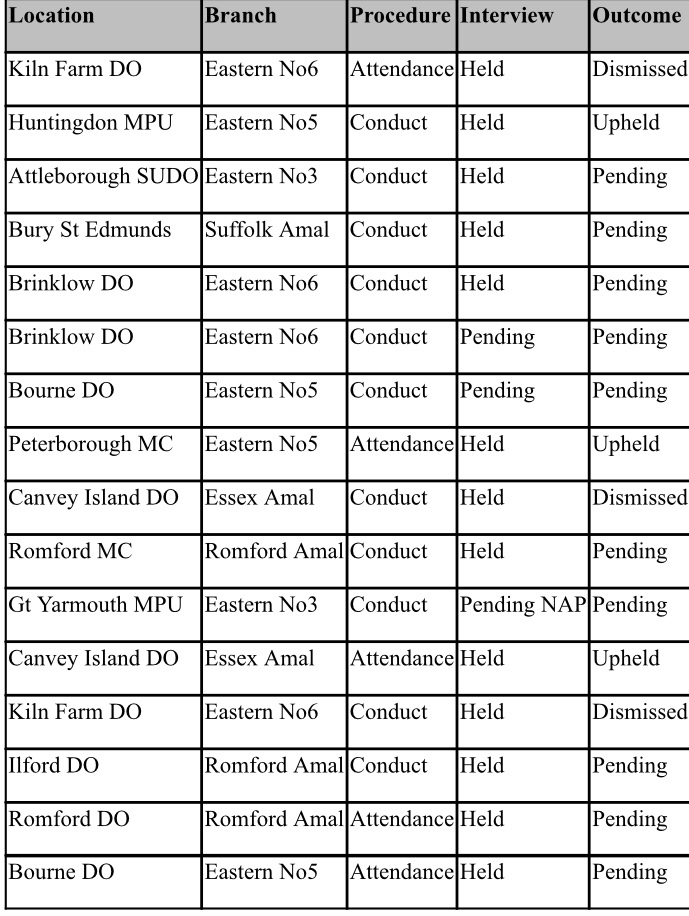
Conduct – The record of appeals below is testament that this procedure is the one that leads to the greater number of dismissals.

Attendance Procedure – The main issue that is being reported back is the difficulty in getting referrals to Employee Health Services, this has been relayed to the PTS Department and is going to feature in the ongoing review. We have also provided report to the department on the lack of clear written information when a stage 2 notification is awarded, insofar as it does not

make any reference to the ability to automatically (via PSP) re-issue a stage 1 notification when one absence of more than 4, but less than 10-day absence occurs.

Appeals – listed below are Appeals that are pending or have been heard since the start of 2018. Due to the pending changes to data protection in May 2018, we will need the help from Area Reps/Branches to get the member who has an appeal pending to sanction the release of the case bundle to ourselves, so we can do preparation work in advance of the appeal.

Overpayments/underpayments –There have been a number of disagreements recently concerning overpayments which have and some are being progressed via the IR framework.

Grievance Procedure – The new procedure is now live – At the meeting we will be seeking feedback from Reps/Branch’s on how its going.

We made aware, if a member takes out a grievance under the new procedure, for example an issuing of an AR1/2 then you have 3 months less 1 day from the date of the decision to proceed to an employment tribunal. This would also include the ACAS mediation process.

Recommendation; that the paragraph be ongoing.  AGREED

DR18/8 Industrial Relations

Mediation – We have a number of cases on the go at present including, Bedford, Ely, Bury St Edmunds and Manningtree.

IR Framework – We held a meeting with Terry Pullinger and some of the Officers on 27th March, this was for general discussion and update. The output was our meeting with Terry and the Officers in May was moved by a week, hence the changed of date already advised. This meeting has been extended by half-day, one of the issues is for each Division to present a report beforehand on how their Division operates in a BAU situation. This has got to be completed 19th April 2018.

In the reference files section of this report is a record of the disagreements we’ve got recorded to date and Terry’s letter to us concerning the request for a report. – this paragraph will be supplemented by verbal commentary

Royal Mail are changing the boundaries of their regions again. Rob Jenson will be the new processing director for the East.

The Divisional reps have been asked to compile a report for Terry Pullinger on how we use the IR Framework in the Anglia Division.

Recommendation; that the paragraph be ongoing.  AGREED

DR18/9 Training

The union has committed to launch training so we have pension experts out in the field, not to provide individual pension advice, but to broaden members understanding of how occupational pension work within Royal Mail. In the interim, we can do a 30 min overview on current pensions and link that with the Ill health presentation below To remind branches, that we still are able to arrange training on CWU one-day IR. We’ve also built our own Ill Health Training course, that we can deliver in a 2-hour slot during area liaison meeting time. To date we’ve only had two branches that have taken up this offer.

Refreshers on conduct and attendance are also available – this paragraph will be supplemented by verbal commentary.

There is a two-hour Ill Health Retirement training package the Divisional Reps want to roll out at liaison meetings.

Recommendation; that the paragraph be ongoing.  AGREED

DR 18/10 Health & Safety

No report.

Recommendation; that the paragraph be ongoing.  AGREED

DR18/11 Royal Mail Cleaners – Nothing new to report

There was no debate on this paragraph.

Recommendation; that the paragraph be ongoing.  AGREED

DR18/12 Quadrant – Nothing new to report

There was no debate on this paragraph.

Recommendation; that the paragraph be ongoing.  AGREED

DR18/13 LA’s – Nothing new to report

There was no debate on this paragraph.

Recommendation; that the paragraph be ongoing.  AGREED

DR18/14 Conference – As per advice in the email circulated on 28th March, we are seeking the Committee’s support to with draw our Motion 84. Our reasons are that following the release of LTB 166/18 which contained a Joint Statement on Professionalising our Customer Service Points (Enquiry Offices) Resourcing, it is ate view that this Joint Statement meets the terms of the submitted motion.

Recommendation; the committee agrees the withdrawal of motion 84 in the name of the Anglia Divisional Committee  AGREED

Concludes Report

EJ Orviss

Area Processing Representative

Area.processing@cwue5.org

Date 20th April 2018

Create a website or blog at WordPress.com

Up ↑