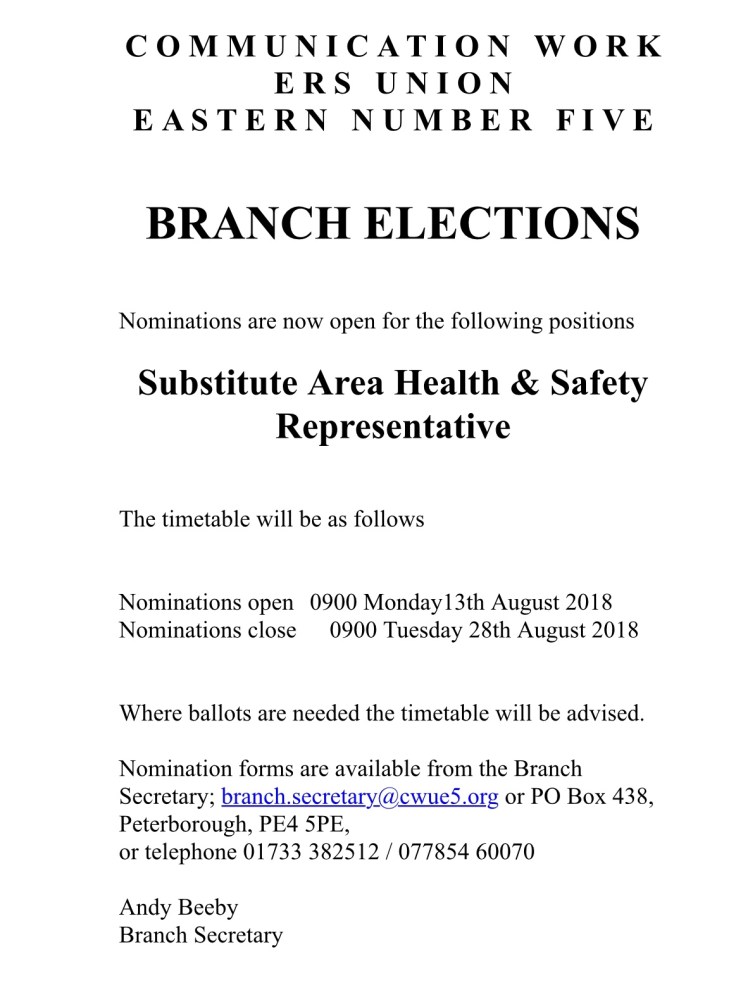
Branch Election: Substitute Area Health & Safety Representative


Workers of the world unite; you have nothing to lose but your chains. Karl Marx.

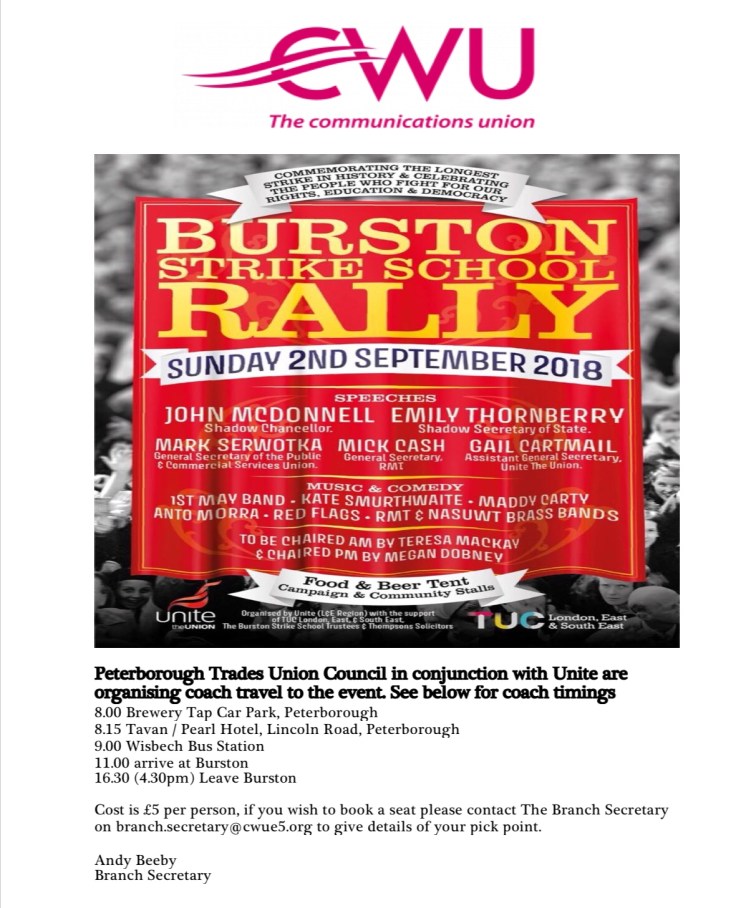
Peterborough Trades Union Council in conjunction with Unite are organising coach travel to the event. See below for coach timings
Special Conference Redesign – 3rd/4th November 2018
Following LTB 321/18 Branches will wish to know that a number of meetings have been held between the President, GS Office and the union’s Standing Order Committee (SOC). The agenda of these meetings was to discuss the format and structure of the Special Conference in November.
Work is continuing on the Redesign papers and the aim is to publish all the Redesign papers to Branches on the 28th August 2018. The SOC are currently working on the conference timetable for motions, delegations, etc and further LTBs will be sent in due course.
Finally, after careful consideration and recognising the limited conference time available, it has been agreed by the NEC that the Special Conference in November will deal with motions and extensive policy papers. Any subsequent rule changes will be dealt with next year at a Special Rules Revision Conference.. Further information relating to these matters will be sent to Branches in due course.
Any further enquiries regarding this LTB should be addressed to the General Secretary’s Office at gsoffice@cwu.org quoting the reference GS 29.0.
Yours sincerely
Dave Ward – General Secretary
Tony Kearns – Senior Deputy General Secretary
18LTB455 – Special Conference Redesign – 3rd 4th November 2018
CWU National Organ Donation Campaign – Government Publish Response to Organ Donation Consultation:
To: All Branches
Dear Colleagues,
Motion 85 was carried at CWU Conference in 2011 and CWU has been supporting Organ Donation Week ever since as well as campaigning to raise awareness of the need for more organ and blood donors. In 2016 the TUC Congress carried Motion 47 on the subject of Organ
Donation and called for the TUC and Trade Unions to campaign to increase the number of organ donors. The Motion was carried with CWU Support.
Letters to CWU Branches and Regions have been issued annually by the Health, Safety & Environment Department as well as distributing materials and resources to our Branches, Regions and Officers and Reps across the UK as well as CWU Voice coverage and the Union has challenged CWU Reps to sign up to be an organ donor/blood donor and get other Reps and members to sign up.
The CWU signed up to a campaign partnership with NHSBT (NHS Blood & Transplant) in 2016 and NHSBT (NHS Blood and Transplant) issued a statement to the effect that it was pleased to be working with the Communications Workers Union, one of the UK’s major Trade Unions that takes the health, safety and wellbeing of its large membership and families very seriously and places such matters high on the agenda.
The Union has also worked jointly with employers to run joint health awareness campaigns of which organ and blood donation is included through their campaigns.
The CWU Health and Safety Department has additionally concentrated campaigning efforts to spread the message of donation across the Union, seeking to promote blood and organ donation amongst its Black and Asian members where only 1.4% of those on the Organ Donation Register are from these communities.
This week the Government published its response to the Organ Donation Consultation which took place in England between December 2017 and March 2018 and which the CWU engaged with.
The Government is proposing the introduction in England of a new system (commonly known as ‘deemed consent’ or ‘opt-out’) in which everybody would be considered as a potential organ donor unless they have either added their details to the NHS Organ Donor Register to opt out of donation or are in one of the groups excluded within the legislation. A similar system came into force in Wales in December 2015.
The Government believes that this new legislation will support more organ donors and help to save the lives of more people on the Transplant Waiting List. As ever the NHSBT (NHS Blood & Transplant) role is to support whatever legislation is in place and to work to make the Government’s ambition a reality. However as with any legislative change this will take some time to come into legal effect. The Government estimate is that the new law will commence in Spring 2020. NHS Blood and Transplant will be working closely with the Government to ensure that the changes are implemented successfully.
NHSBT (NHS Blood & Transplant) has written to the Union expressing its thanks for the support of the CWU stating “Your organisation has contributed significantly in the past by helping to promote the benefits of organ donation with us.”
NHSBT (NHS Blood & Transplant) have additionally stated that it is going to be very important that people living across the country understand how the system is going to change in England and that people continue to share their decision about organ donation with their family. They have asked the CWU to continue to support their work by helping to educate and inform our members about organ donation and by encouraging them to talk to their family about donation.
In fact, this year’s Organ Donation Week is coming up soon – it’s taking place from 3rd to 9th September and the CWU will be supporting the week again. NHSBT (NHS Blood & Transplant) have asked us to help encourage people to talk to their families about organ donation during the week. We will be circulating further details and materials and assets in due course once available.
NHSBT (NHS Blood & Transplant) concluded their message to the CWU stating that together we can ensure that as many people as possible, who want to be organ donors and who die in the circumstances where donation can be considered, can save the lives of patients across the UK in need of a transplant.
Branches, Regions and members will no doubt welcome the Government’s decision and I’m pleased to be able to communicate it to you.
Yours sincerely
Dave Joyce
National Health, Safety & Environment Officer
Royal Mail Logistics – Accident Near Miss & Hazard Reporting Process “STAR” (Stop, Think, Act, Report):
To: All Branches
Dear Colleagues,
As part of a joint programme of work to improve safety standards and better manage safety in the workplace, a “near miss and hazard reporting” process has been developed jointly between Royal Mail Logistics and the CWU Health, Safety and Environment Department for use in Logistics. This will be launched on Monday 13 August in an agreed number of pilot/trial offices, enabling Logistics workers to report incidents via a simple report card and collection box process. This process is to be used as part of a 3 month pilot/trial to assess the system, the volumes, categories, hazards and near miss trends prior to national roll out in all RM Logistics operations across the UK.
The CWU Health, Safety and Environment Department have been fully consulted and involved in the planning to introduce the “near miss and hazard reporting” process and we fully endorse and support this approach.
The Health and Safety Executive (HSE) estimated that if every single reportable incident not at present investigated by employers was investigated and acted upon, this could save UK society up to £2 billion per year in preventable accidents and incidents.
Near misses are warnings of failings or gaps in safety management systems, and can identify potential accidents before they actually happen. In doing so personal injury, pain, loss and suffering plus damage to plant, equipment, property and loss of productivity can all be avoided with thorough reporting, investigation, root cause analysis and remedial action.
History has shown repeatedly that most serious and catastrophic accidents and events were preceded by warnings or near miss incidents. Recognising and reporting hazards and near miss incidents can significantly improve worker safety and enhance the organisation’s safety culture. The HSE state that there is a direct correlation between the number of near misses and accident rates.
The intention of this new scheme is to proactively encourage staff to support and utilise the process in a “blame-free” culture by reporting all hazards they see and all near miss incidents they observe or are involved in, so as to ensure there’s a full investigation in to the hazard or how the incidents happened, how the risks arise and how they might be prevented in future.
The findings and conclusions can then be taken into account in revising the workplace risk assessments, working methods, dealing with accommodation issues, plant, equipment etc., so ensuring they are safe and fit for purpose.
If an incident occurs which does not result in an injury, but which clearly could have done, then it’s a ‘near miss’, and jointly Royal Mail and the CWU want to encourage every individual staff member to report it. Reporting incidents will be encouraged and not frowned upon.
Effective identification and reporting of near misses and hazards means preventative measures and controls can be introduced, reducing the likelihood of an accident occurring.
The near miss/hazard report cards will be accessible to all Logistics staff on the site.
The message to all Logistics staff is ‘please take the opportunity to submit any hazards you spot or near miss incidents you have , however minor you think they are’. Because if we don’t know where the real problems are, how are we going to prioritise our efforts? An effective near miss reporting process can be a fundamental element of a thriving safety culture. A near miss is a golden opportunity to prevent an accident. The idea is to get the information reported quickly. This allows an investigation to take place to identify root causes of potential accidents and to then assist with follow-up and corrective action so that ultimately lower accident and injury rates result. The hope is that staff will learn the importance of near miss and hazard reporting and begin helping deploy a sustainable reporting program that’s unique to their work and operations. The information will be collected and analysed for appropriate attention and discussed at the local joint Health and Safety Committee.
The National Logistics Safety Management Team will feed back to the CWU/HQ National Health, Safety and Environment Department.
The support of all CWU Area and Workplace Health and Safety Reps plus Distribution and Drivers Reps would be appreciated in encouraging local members to report any hazard or near miss.
The joint intention of Royal Mail Logistics and CWU remains that we work in a positive safety culture. To improve safety and encouraging openness, recognising issues and implementing controls.
In line with HSE strategy, Royal Mail will pro-actively involve, consult and inform CWU Safety Representatives in good time.
The intention of this new ‘STAR’ scheme is to proactively encourage staff to support and utilise the process in a “non-punitive”, “blame-free” culture by reporting all hazards, incidents, near misses, so as to identify issues early, ensure there’s a full investigation in to how the hazards or incidents happened, how the risks arise and how they might be prevented in future, so that we can stop accidents from happening. This gives employees a voice to help resolve safety related issues, helps us jointly develop an open culture whereby everyone shares and contributes in a responsible manner to their own safety and that of their fellow workers – NO BLAME!
Remember “STAR” is the right course of Action!
S = STOP.
T = THINK.
A = ACT.
R = REPORT.
Hazard definitions
• An Unsafe condition is defined as an unsatisfactory physical condition that exists at the workplace which could be a major contributor to an accident occurring if not rectified e.g. damaged equipment, pot holes etc.
• An Unsafe act is any act that deviates from a generally recognised safe way or specified method of doing a job and which increases the probabilities for an accident. It must contain an element of unsatisfactory behavior immediately before an accident that was significant in initiating the event.
• If an incident occurs which does not result in an injury, but which clearly could have done, then it’s a ‘near miss’.
The PiC (Person in Charge) and Management are tasked with trying to resolve the issues and will regularly communicate updates through a ‘STAR’ Notice Board and via the Joint Health and Safety Committee Meetings and in consultation with CWU Health and Safety Reps. It may be that some issues take a while to resolve – staff can escalate issues through their CWU Reps if they don’t feel that Managers are taking the issue seriously enough.
The following Message and assurances to all employees is given by Royal Mail Logistics:
• The message to all employees is ‘please take the opportunity to submit any hazards you identify, however minor you think they are’. RM Logistics wish to promote a culture of reporting with the support and help of all managers and supervisors.
• The support of all CWU Representatives is appreciated in encouraging employees within Logistics to report any hazards through the ‘STAR’ reporting process.
• The joint intention of Royal Mail and CWU remains that we work in a positive safety culture. To improve safety and encouraging openness, recognising issues and implementing controls in a ‘no blame culture’.
• In line with HSE strategy, Royal Mail will pro-actively involve, consult and inform CWU Safety Representatives in good time.
• The ‘STAR’ scheme intends to raise awareness, encourage employees to identify and report hazards, that can be jointly investigated, how the incidents happened, how risks arise, and how they might be prevented in future.
• The ‘STAR’ scheme is an essential piece of joint working, demonstrating a clear intention to improve and sustain safety performance in the workplace, that will significantly reduce and sustain accidents levels, in a “blame free” safety culture.
• ‘STAR’ was designed to give members a voice on safety issues and was not designed for disciplining individuals who raise issues and an anonymous option has been included in the reporting process to back this up. RM Logistics want all hazards and near misses to be identified, so remedial action can be implemented and prevent accidents from happening.
• In addition the Director of RM Logistics will be sending a letter to all managers requesting their personal commitment to ‘STAR’ and expressing his expectation of them which is to: lead by example; maintain and improve safety; not “walk by” and ignore issues; be respectful and trusting; promote an open, feedback-rich culture amongst the workforce; react swiftly to the discovery of unsafe acts or conditions; be transparent and fair; thoroughly investigate all accidents to identify the true root causes, looking beyond the individual’s actions i.e., systems, processes and management activities.
The Four Pilot/Trial Offices are:
• Mount Pleasant Distribution/Logistics (co-located on Mount Pleasant MC site)
• Swansea Logistics Distribution/Logistics VOC (Co-located on Swansea MC site)
• South Midlands Distribution/Logistics (co-located on South Midlands MC site)
• Sheffield Fleet Services Workshop
Attachments:
1 ‘STAR’ WTLL Briefing
2 ‘STAR’ Poster
3 ‘STAR’ Near Miss/Hazard Report Card
4 ‘STAR’ Staff Briefing PowerPoint Slides
5 ‘STAR’ Management Briefing PowerPoint Slides
6 ‘STAR’ RM Logistics/CWU Joint Statement
Yours sincerely
Dave Joyce
National Health, Safety & Environment Officer
18LTB452 Royal Mail Logistics – Accident Near Miss & Hazard Reporting Process STAR
Near Miss Presentation Managers briefing (2)
Near Miss Presentation Staff briefing (2)
Sentencing Council New Guidelines for Manslaughter, Including Gross Negligence Manslaughter Introduced:
To: All Branches
Dear Colleagues,
The Sentencing Council has published new guidelines for how offenders convicted of manslaughter should be sentenced in England and Wales.
LTB 580/17 reported on the Sentencing Council Public Consultation on Gross Negligence Manslaughter and the CWU Response.
The CWU Health, Safety & Environment Department along with the TUC and other Unions have welcomed the new guidelines which increase sentences and establish consistency from all courts and judges. However, our response included reference to the rare cases where individual workers are convicted of Gross Negligence Manslaughter, and we stressed that those concerned should face less severe punishment than employers, directors and senior managers, if in mitigation, the evidence shows that stressful working conditions and repressive management contributed to their actions, or if their employer’s management organisation and procedures were inadequate. I’m pleased to report that our submission has been taken into account and the new guidelines state in the Gross Negligence Manslaughter Section, Factors indicating lower culpability, that: “The offender was in a lesser or subordinate role if acting with others in the offending.”
The Consultation Document (CD) did not include the charge of “Corporate Manslaughter” (Corporate Homicide in Scotland) which was introduced in 2007 and is a criminal offence committed by a company or organisation, for serious health and safety management failures, resulting in gross breach of duty of care, leading to a fatality or fatalities. The offence was created to provide a means of accountability for serious health and safety failures across a company or organisation. This offence is intended to work in conjunction with other forms of health and safety accountability and offences such as “Gross Negligence Manslaughter” for ‘individuals’ (Directors, Senior Executives and Managers etc.,) and other health and safety law offences. The Sentencing Council introduced new guidelines for those convicted of “Corporate Manslaughter” in November 2015 bringing in higher penalties, particularly for large organisations committing this and other serious health and safety offences. (See LTB Number 716/2016 and subsequent LTBs 142/2017 and 449/2017).
The CD stated that in 2014, 16 offenders were found guilty and sentenced for Gross Negligence Manslaughter. All of them were sentenced to imprisonment with custodial terms ranging from 9 months to 12 years, 4 of which were suspended sentences. The average was 4 years.
The Sentencing Council has now published its definitive new guidelines to Courts on how offenders convicted of manslaughter should be sentenced in England and Wales and this is the first time that guidelines have been drawn up for these very serious and difficult cases which include workplace fatalities caused by employers’ gross negligence.
The publication marks the first time that comprehensive guidelines have been drawn up for these very serious and difficult cases, which could range from an unintended death resulting from an assault, to a workplace fatality caused by a negligent employer.
The serious nature of manslaughter, combined with the great variation in cases, and the fact that cases do not come before individual judges very frequently, means the introduction of guidelines will be particularly useful in promoting consistency in sentencing and transparency in terms of how sentencing decisions are reached.
Overall, the guideline is unlikely to change sentence levels but it is expected that in some gross negligence cases sentences will increase. This could be in situations where, for example, an employer’s long-standing and serious disregard for the safety of employees, motivated by cost-cutting, has led to someone being killed. Current sentencing practice in these sorts of cases is lower in the context of overall sentence levels for manslaughter than for other types.
The types of manslaughter covered by the guideline are:
Unlawful Act Manslaughter – this is the most commonly prosecuted form of manslaughter and includes deaths that result from assaults where there was no intention to kill or cause very serious harm. It can vary greatly. For example, it could involve a situation where two friends briefly argue and one pushes the other causing him to fall and hit his head with fatal results. It could involve someone going out looking for a fight and attacking someone forcefully but not intending to kill. It could also include unintended deaths that result from other crimes, such as arson or robbery. 105 offenders were sentenced for this offence in 2016.
Gross Negligence Manslaughter – this occurs when the offender is in breach of a duty of care towards the victim which causes the death of the victim and amounts to a criminal act or omission. The circumstances vary greatly. In a domestic setting it could include parents or carers who fail to protect a child from an obvious danger. In a work setting, it could cover employers who completely disregard the safety of employees. 10 offenders were sentenced for this offence in 2016.
Manslaughter by reason of loss of control – This arises if the actions of an offender, who would otherwise be guilty of murder, resulted from a loss of self-control, for example arising from a fear of serious violence. 12 offenders were sentenced for this offence in 2016.
Manslaughter by reason of diminished responsibility – Someone guilty of this offence would have been suffering from a recognised mental condition that affected their responsibility at the time of the offence, without which they would have been convicted of murder. 26 offenders were sentenced for this offence in 2016.
The guideline ensures comprehensive guidance where previously it was very limited. Until now, there has been a guideline only for Corporate Manslaughter, which comes under the Council’s health and safety offences guideline, and a guideline by the Council’s predecessor body for manslaughter by reason of provocation, which is now out of date following legislative changes to the partial defences to murder.
Manslaughter offences vary hugely – some cases are not far from being an accident, while others may be just short of murder. While no sentence can make up for the loss of life, this guideline will hopefully help ensure sentencing that properly reflects the culpability of the offender and the unique facts of each case.
Manslaughter is an extremely serious offence, causing immeasurable pain to families who lose their loved ones. So it is vital our courts have clear, consistent guidance in these often complex cases – such as when both individuals and employers are involved. These guidelines aim to make sure sentences reflect the severity of the crime, helping protect workers and keep communities safe.
A copy of the new Sentencing Guidelines is attached.
Yours sincerely
Dave Joyce
National Health, Safety & Environment Officer
Royal Mail Group (SHE) Safety Alert – Storage of Oil Barrels at Delivery Offices
To: All Branches
Dear Colleagues,
For the urgent attention of Royal Mail Area Safety Reps. Please see attached copy of RM SHE Alert GPSA0004 entitled ‘Storage of Substances’.
The SHE Alert was generated following a Safety Inspection carried out by a Local Authority Environmental Health Officer at the Royal Mail Gloucester North Delivery Office. The Enforcement Officer found that engine oil barrels were not being stored correctly and added that the issue needed to be rectified immediately to avoid an enforcement notice being served on Royal Mail. Local Management responded immediately to correct the non-compliance and so no formal action was taken.
Following the Enforcement Officer’s intervention, the attached alert has been issued reminding all Persons in Charge (PiCs) and their deputies of the importance of storing substances, including new and used engine oils in a safe and compliant manner to avoid risks to health and the environment.
Key Messages in the Alert
• Ensure that oil/grease drums are properly stored in ‘bunded’ containers or on ‘bunded’ pallets and kept dry.
• Ensure that spill kits are available and that staff are trained to use them in the event of a spill.
• Ensure that in the event of a spill the Property and Facilities helpdesk is contacted for specialist support to clean up.
• Ensure that substances such as cleaning materials are kept in locked cabinets/cupboards when not in use.
(Note: A Bund is an item or structure with a wall surrounding an industrial oil or fuel tank which acts as a safety container to capture any leaks).
Would all ASRs check this issue when carrying out their Safety Inspections or carry out additional spot checks to ensure Delivery Offices are compliant. If any non-compliant Delivery Offices are found, please complete a Safety Inspection Report and submit the report without delay, requesting immediate attention from the PiC.
Yours sincerely
Dave Joyce
National Health, Safety & Environment Officer
18LTB447 Royal Mail Group (SHE) Safety Alert – Storage of Oil Barrels at Delivery Offices
Royal Mail Delivery Office Recruits – New Starters Interim Weatherproof Protective Coat/Jacket Trial:
To: All Branches
Dear Colleagues,
This is an update to Branches, Regional Health and Safety Forums and Area Health and Safety Reps further to my 4 June communication to Area Health & Safety Reps and Regional Health and Safety Forums.
As you will know, getting new starters their appropriate protective cold and wet weather clothing before going out on delivery in severe inclement weather has always been an issue for ASRs. The Health, Safety & Environment Department has been challenging this continually for a number of years with the Royal Mail Safety, Health and Environment Team, Occupational Health and Assets teams as well as raising the matter with the HSE.
The current business standard for new starters is that they are entitled to a basic uniform (which does not include a weatherproof, storm-proof jacket). Once they have been employed for 6 weeks and providing they’re going to be employed for 13+ weeks they get their job title changed from new starter to walking delivery for example and a weatherproof, storm-proof jacket is provided as part of their full allocation. (Note: The Postal Outdoor Department is currently reviewing the Uniform Agreement with Royal Mail, covering all standard clothing).
The Health, Safety & Environment Department’s position is that the Personal Protective Equipment (PPE) Regulations 1992 requires the provision of protective clothing, free of charge, and that PPE is “All equipment (including clothing affording protection against the weather) which is intended to be worn or held by a person at work and which protects them against one or more risks to their health and safety”. We have further argued that Royal Mail is not compliant with the regulations in respect of new recruits during their initial period of employment.
As notified to Branches earlier this year and as displayed at CWU Annual Conference, I’m pleased to say that Royal Mail Assets has proposed a New Starter ‘interim weatherproof coat/jacket’ which the RM Assets and the Dimensions (Royal Mail Group Clothing and Footwear Supplier) team had at CWU Conference for delegates to view this year.
It has been agreed that it’s now time to trial and test the coat/jacket. The idea is that if successful, new starters would get the jacket on day one and receive their standard normal full clothing allocation after 6 weeks in the job as is standard practice now.
In my 4 June communication, I invited ASRs to nominate Delivery Offices in their areas as trial sites. Both Royal Mail and the CWU Health, Safety and Environment Department were particularly keen to include offices in parts of the country that experience high levels of rain and inclement weather. Having said that, in recent years various parts of the country have been hit with localised heavy rain storms and resultant flash floods.
Incidentally, the Met Office recently reported that the wettest place in the UK is Snowdonia in Wales (average annual totals exceeding 3,000mm of rain a year), followed by the Highlands of Scotland, the Lake District, the Pennines and the moors of South West England.
We’ve had a great response from ASRs to the proposed New Recruits Interim Weatherproof Coat/Jacket trial. I’ve spoken to many Reps since Conference around all the regions and have received well over 100 Delivery Offices nominations to participate in trials of the coat where new recruits have recently been employed or are due to start. I would like to thank all ASRs for the great response. The National Royal Mail Uniform Manager and Head of Assets have also asked me to convey their thanks to ASRs for the great response and support. However Royal Mail only have 25 trial coats to test at this stage and so selection of trial sites has been made by geographical location.
Following consideration of the Delivery Office sites nominated by CWU Area Health and Safety Reps, Royal Mail Assets has confirmed the selected sites and individuals for the 25 New Starter Interim Weatherproof Coats to be trialed.
The jackets are class 3 for waterproof and breathability and class 2 for high viz. The trial will need to test design, comfort, wearability and breathability qualities as well as waterproofness and insulation.
The jackets should arrive from the manufacturer in the next 2/3 weeks and confirmation will be sent to the relevant Delivery Office Managers just before the trial coats are delivered to the units in order to confirm those selected are still employed with Royal Mail at the same site.
The fact is that the weather has been far too hot recently to realistically expect staff to wear a weatherproof, storm proof jacket and it may seem to some a bit of a joke that this trial is being announced just now, however intermittent rainstorms have hit various parts of the country of late and we have agreed to trial the coats for 3 months which will take the trial into the winter months and a trial extension can be considered at the review point if agreed its needed all round.
It’s really important that feedback is obtained from all 25 members trialing the coats and Area Health and Safety Reps covering trial sites are asked to monitor the trial garments with those individuals concerned to ensure feedback is received from the individuals and indeed the Reps if they wish to input. All feedback and input is very welcome. The feedback will enable Royal Mail and the CWU to make an informed decision as to whether Royal Mail provides this coat from day 1 for all new starters and also the comfort, design, suitability, robustness and longevity of the garment all need to be tested.
Further information as to when the coats arrive and when they will be dispatched to the trial sites will be provided by Royal Mail Assets in due course and this will be passed to ASRs.
List of final Trial Delivery Offices:-
• Skye SPDO
• Dundee DO x 3
• Stornaway DO
• Barvas SPDO
• Forres DO
• Portsmouth MPU x 4
• Bognor DO
• Gosport DO x 2
• Newport (IOW) x 2
• Barnstable DO
• Exeter DO x 4
• Dungannon DO x 3
• West London DC
The current Stormproof/Weatherproof Coat is part of the RMG PPE Matrix. The ‘interim’ coat will be treated the same, should it be retained, and will be included in the PPE Matrix review and update which the Health, Safety and Environment Department will be undertaking with the RMG SHE team at the appropriate time taking account of the trial outcome.
LTB720/15, dated 16 November 2015, entitled ‘Royal Mail Group/CWU Joint Statement and New Personal Protective Equipment (PPE) Safety Standard’ refers.
Yours sincerely
Dave Joyce
National Health, Safety & Environment Officer
TERMS OF REFERENCE BETWEEN ROYAL MAIL AND THE CWU FOR THE TRIAL OF RESOURCE SCHEDULER IN MAIL CENTRES, PRDC AND DELIVERY OFFICES
Dear Colleagues
Branches and representatives will be aware that Section 16.1.2 and Section 16.4 of the Guiding Principles of Employment Security and Mutual Interest Approach to Future Challenges and Opportunities Agreement committed to the trial of Resource Scheduler, as part of the activity to achieve the 1st hour of the Shorter Working Week.
Resource Scheduler is a commercially available system, which the business believes may enable the standardisation and simplification of existing resourcing processes by replacing the various current spreadsheets and systems in resourcing with a single system. The business view is that the system capabilities will enable more strategic planning on matching resource to workload including:
▪ Better alignment of scheduling resource to forecast workload at different time horizons: tactical planning (up to 3/2 weeks out) and possible on the day adjustments.
▪ Providing people with improved and advanced clarity of their work schedules factoring in their selected local arrangements.
▪ Provide greater insight into skills planning.
▪ Greater compliance to labour laws and the Working Time Directive, recognising the current respective RM/CWU position regarding this aspect.
▪ Standard resourcing system and process across the business.
Cross departmental discussions have therefore been taking place with the business in relation to a framework to enable the activity to commence. Discussions have now concluded and a Terms of Reference has been agreed, a copy of which is attached for your information.
The document includes a generic Terms of Reference for the trial with supporting detailed Annexes for the Delivery and Processing Functions. Staff in all other Royal Mail functions at the trial sites, i.e. Logistics Drivers (Network and Area Distribution), Collections, Revenue Protection, Engineers, RMPFLS Cleaners and Quadrant will not be included in the trial activity and resourcing for those functions will continue to follow current agreed arrangements.
The agreed activity will be confined to a “Proof of Concept” trial, in order to test the capabilities of the system. During the trial all Resourcing arrangements will continue to strictly adhere to all relevant
National agreements and in addition colleagues will note that attendance times, duty patterns and SA levels will be fixed and protected at all trial sites.
The activity will be overseen by a Joint Working Group (JWG) which will include respective National leads, nominated managers and CWU Divisional, Area and local representatives covering the trial sites. The trial activity will commence on the 6th August 2018 and is initially expected to last for a 2 month period and will be conducted in 5 operational units:
▪ Greenford Mail Centre.
▪ Warrington Mail Centre.
▪ PRDC.
▪ Hemel Hempstead DO.
▪ Northwood DO.
To support this activity, joint events will be organised for Managers and CWU Representatives representing the trial sites to ensure that the aims and Terms of Reference for the trial are fully understood. Training materials for employee briefings will also be jointly developed and delivered as soon as possible.
Any extension of the Resource Scheduler trial, either beyond the listed trial sites or to other business functions will be subject to National agreement and a new Terms of Reference.
Branches and representatives will be aware that four of the trial sites are also part of the AHDC trial. However, to ensure that there is a uniform approach across all sites it has been confirmed that AHDC data will not be used as part of the Resource Scheduler trial.
Significant protections have been added with regard to Bookroom staff in Processing due to the potential impact in that function.
Discussions in relation to a TOR have been delayed by technical issues. Given this it is very likely that trial activity will continue beyond the October 2018 date for the deployment of the first hour reduction in the working week. As such it has been agreed that the SWW will not be dependent on the completion of the trial and the agreement of a deployment plan. Instead the document now commits to a joint report from the JWG after one month confirming progress to date, which would be the enabler for the SWW.
Following the trial activity any onward deployment of Resource Scheduler would be subject to further discussions and agreement at National level.
Any enquiries in relation to this LTB should be addressed to:
Processing: Davie Robertson, Assistant Secretary
Email Address: dwyatt@cwu.org or shayman@cwu.org quoting reference: 730.13.
or
Deliveries: Mark Baulch, Assistant Secretary
email: outdoorsecretary@cwu.org quoting reference: 230.03.
Yours sincerely
Davie Robertson – Assistant Secretary
Mark Baulch – Assistant Secretary
Royal Mail Share Incentive Plan Partnership and Matching
The DGS(P) Department has received a number of enquiries regarding material Royal Mail has issued concerning a new Partnership and Matching Scheme which, in the Company’s words offers “a flexible way to invest in Royal Mail shares”.
Partnership and Matching is a new element of the Royal Mail Share Incentive Plan that allows employees to use their pre-tax pay to purchase Royal Mail shares ‘Partnership Shares’ on a monthly basis. Royal Mail will then add to the shares by giving you ‘Matching Shares’ for free. Those interested need to apply by Friday 17th August by logging on to the Employee Share Plan portal http://www.royalmailemployeeshares.co.uk or by calling the Employee Shares Helpline on 0800 012 12 13.
The new share arrangement offers similar tax advantages to SIP free shares which were first allocated to eligible employees at the time of privatisation in 2013. In October of this year, those owning free shares allocated in October 2013, will for the first time, be free to sell these shares without incurring any tax or national insurance deductions.
Branches will be aware that the CWU opposed Royal Mail privatisation in 2013 and that Union policy is to support full renationalisation of Royal Mail Group and reintegration of the Post Office.
The CWU has never agreed the share scheme or negotiated over its operation. What members therefore choose to do in relation to these shares is entirely a matter for the individual concerned.
The Union is not in a position to offer any financial advice and any questions about the operation of the share scheme should be addressed to Royal Mail and/or the scheme administrator Equiniti.
Any enquiries in relation to the content of this LTB should be addressed to the DGS(P) Department.
Yours sincerely,
Terry Pullinger
Deputy General Secretary (Postal)
18LTB440 Royal Mail Share Incentive Plan Partnership and Matching

