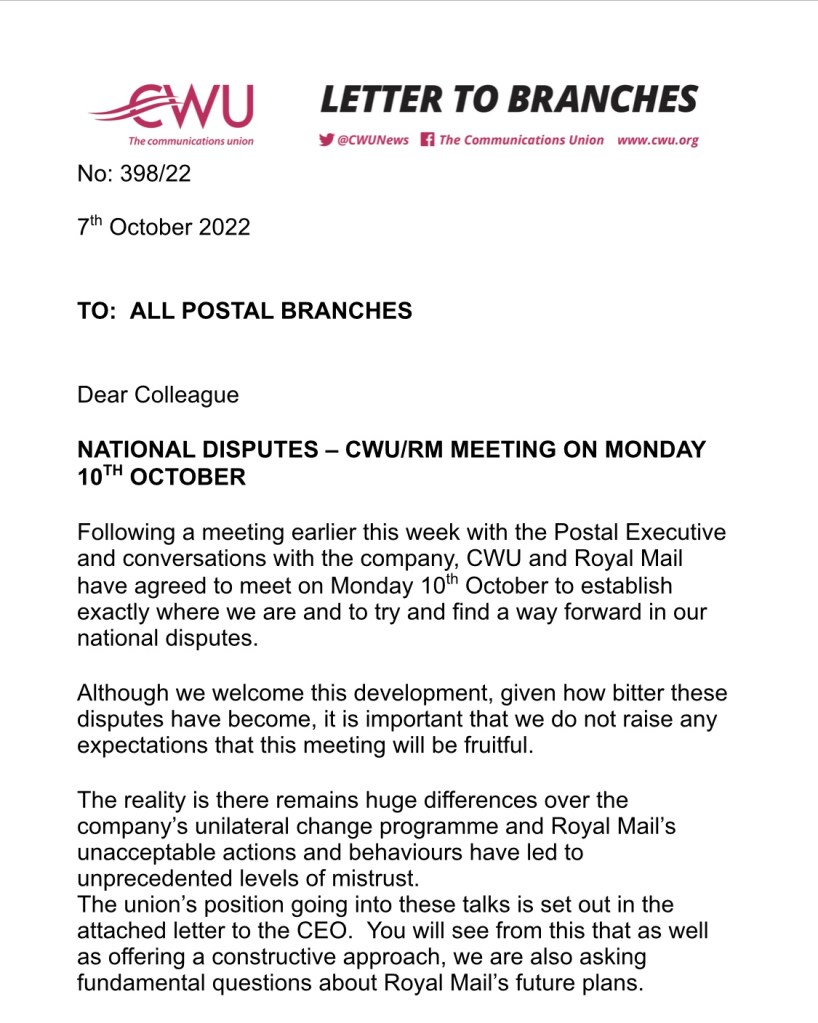
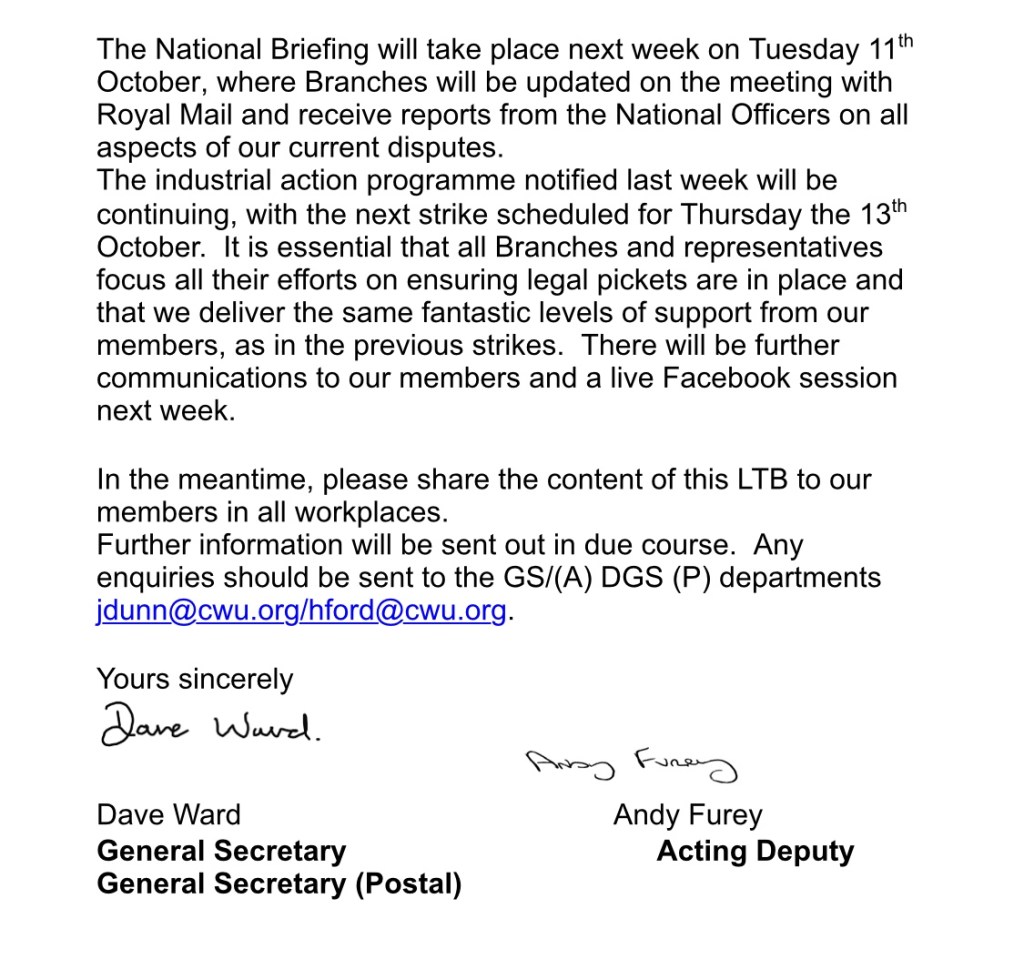
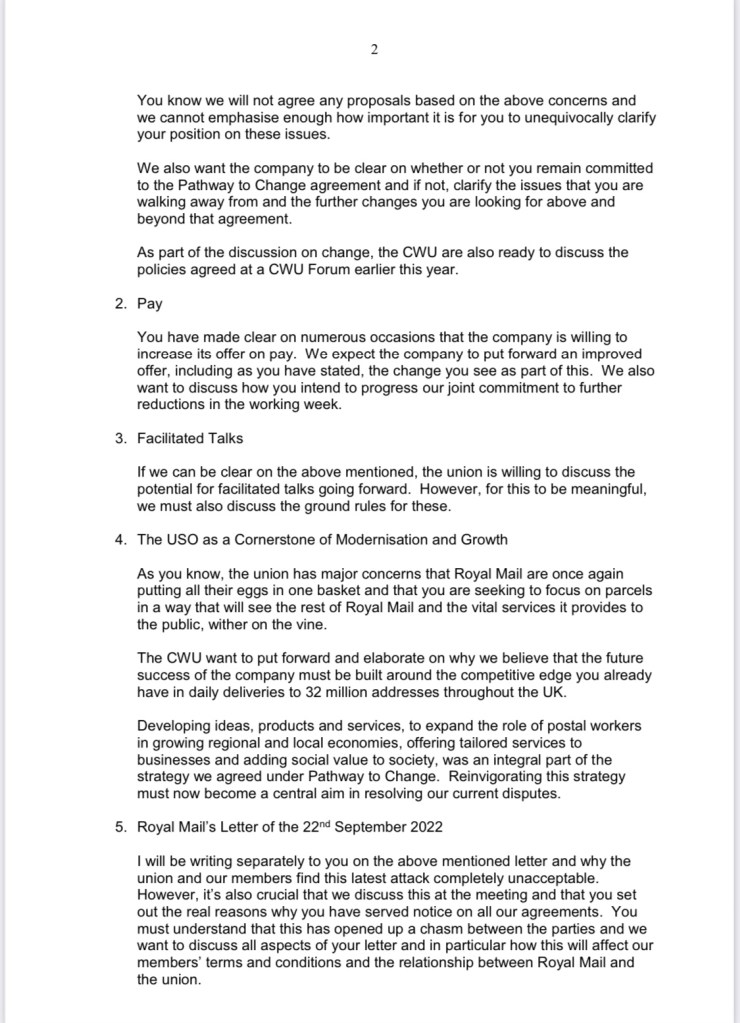
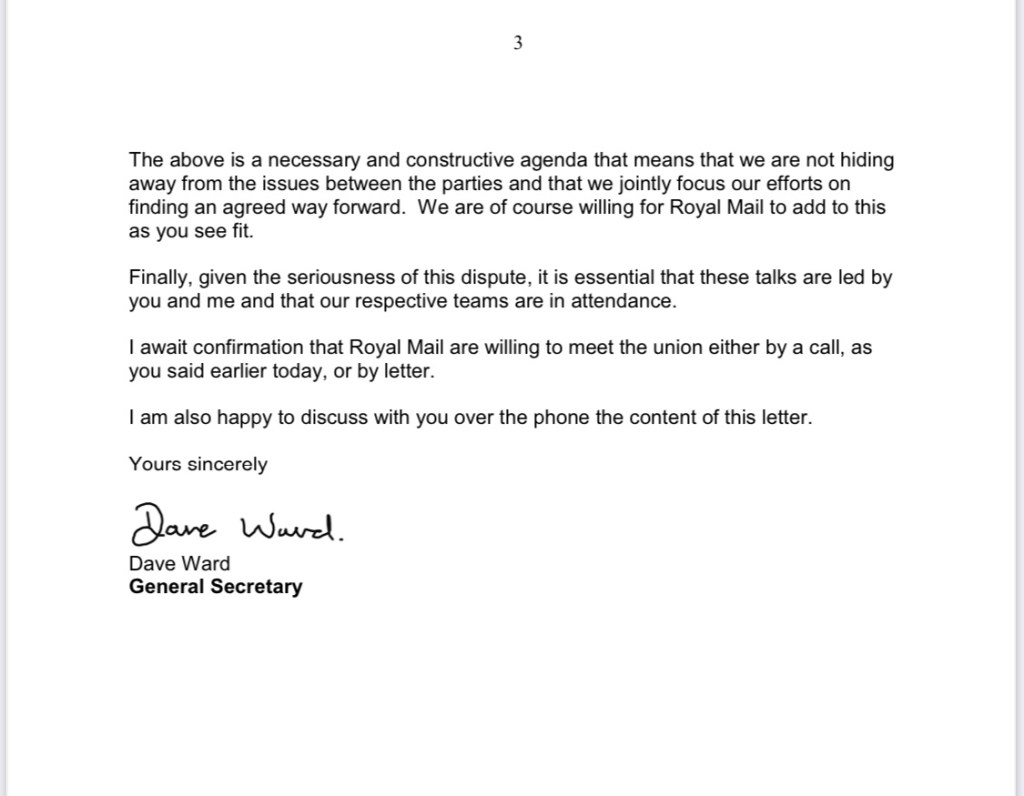
CAPITA TVL: PAY 2022 – ACAS DISCUSSIONS: JOINT STATEMENT

Further to LTBs 250/22 and 290/22 dated 7th and 29th June respectively.  Branches are advised that the meeting at Acas in relation to the pay dispute took place on Monday 4th July.  I was accompanied by Saf Khan, Postal Executive and Lorna Pearson, Policy Advisor.  The parties once again discussed in a constructive manner the key areas.  Another meeting has been arranged for Thursday 21stJuly.

The following Joint Statement has been agreed:

Further to our previous Joint Statement dated 7th June, a pay meeting was held at Acas on Monday 4th July which was both cordial and constructive. Productive discussions took place around a number of areas including pay and terms & conditions. Both parties committed to take a number of issues away for further consideration and agreed to meet again at the earliest opportunity. Due to annual leave and Acas’ availability, the next available date for a joint meeting is Thursday 21st July.

We would like to thank you once again for your patience while we endeavour to find a mutually agreeable resolution to pay 2022 and will update you further following the next meeting at Acas.

Kind regards

Paul Johnston                                                     Andy Furey

Capita TVL Managing Director                              CWU Assistant Secretary

We also met with our Capita Reps on Tuesday 5th July to update them on the Acas discussions and everyone was supportive of the approach we are taking as evidently the rejected pay offer is simply not good enough with today’s cost of living crisis.

Further developments will be reported.

Yours sincerely

Andy Furey
Assistant Secretary

22LTB300 Capita TVL – Pay 2022 – Acas Discussions – Joint Statement

View Online

Update from DGSP Terry Pullinger on his meeting with Royal Mail Group CEO Simon Thompson 7/6/22

A short update from DGSP Terry Pullinger on his meeting with Royal Mail Group CEO Simon Thompson.

Get the vote out #HomeToVote

Facebook https://fb.watch/e6Dv1hFiDA/

Twitter https://twitter.com/cwunews/status/1545042734355861504?s=21&t=YunoX3EoZwCS94x-L8aUYg

Royal Mail’s Position Regarding Year Two Productivity Targets & Revision Activity in Delivery

Royal Mail’s Position Regarding Year Two Productivity Targets & Revision Activity in Delivery

We have received a number of enquiries from Branches concerning Royal Mail’s position in regards to ‘Year-Two’ productivity targets for both Table Top and Structural Revision units which are being outlined by them as part of the Productivity Section of the Pathway to Change Agreement.

The purpose of this Letter to Branches is to advise Branches of these developments and to confirm the current position in terms of our agreement on productivity under the Pathway to Change.

Table Top Revision Units

The Pathway to Change Agreement set out a joint commitment around delivery revision activity for 2021. The bulk of these revisions were based on Table Top activity and a measured step change improvement on WIPWH (Weighted Items Per Work Hours) against an agreed reference period, or to maintain the current level if at or above standard performance (196 WIPWH).

Whilst Royal Mail wrote to the CWU with their position around the year-two improvement plans for table top revisions in May 2022, there has been no direct engagement or meaningful discussions with the CWU Nationally as Royal Mail have taken an arbitrary approach, which is reflective of the wider current industrial relations climate, along with their unacceptable stance towards the Union and our National Agreements.

Royal Mail’s year-two improvement plan is outlined as follows:

  • Royal Mail have referred back to the 2019 original productivity reference starting point period (week’s 27-30) and have removed the unmeasured work hours.
  • Royal Mail have also reviewed each delivery unit’s WIPWH performance level based on week 1- 52 of 2021/22, minus bank holidays and peak weeks.
  • Royal Mail now want to establish a new year-two target for table top units that would be based on whatever of the two mechanisms (set out above) report as the highest productivity level.

Notwithstanding that this position by Royal Mail totally ignores that offices have made a year-one improvement target, it is now very clear that the impact of unmeasured hours being removed from the unit’s WIPWH performance will been significant. This confirms that for many years Royal Mail have seemingly been under reporting true productivity level within the delivery function.

In order to demonstrate the impact of removing unmeasured hours, in 2019 some 47 units had been reported as at or above 196 WIPWH. The removal of unmeasured hours has now resulted in 376 units being at or above 196 WIPWH, which is circa 42% of the delivery units that performed table top revisions.

Therefore, and to be clear for Branches and Representatives the main issues we have with Royal Mail’s proposals are as outlined (but not exhaustive):

That Royal Mail have ignored year-one targets and improvements made in delivery units and now seek to reset the original (weeks 27-30) 2019 reference period with the removal of unmeasured hours.

Royal Mail are now suggesting that for the most productive delivery units, that they must have a target set above that of standard performance, which is contrary to the Pathway to Change Agreement. However, for all remaining offices they have claimed that their target is standard performance of 196 WIPWH.

Over many years we have consistently pushed Royal Mail back on their mantra of “continuous improvement” and we have always maintained the position that if there is to be a standard level of productivity then that should be the end-state, and it is unacceptable and unsustainable for units to be expected to work beyond that. However, Royal Mail’s position is that there are 376 units above 196 standard performance and several over 240 WIPWH, and this will now be these units’ expected WIPWH levels to maintain going forward, contrary to the agreed level of standard performance set out in the Pathway to Change Agreement.

In addition to the above, the impact from the cost-of-living crisis and drop in traffic will have an impact on productivity, especially as the loss of larger parcels has a heavier ‘weighting’ impact on units WIPWH reported levels. Equally, Royal Mail’s unacceptable announcement to the CWU of executive action of their plans to deliver format 3 & 4 parcels in circa 346 Delivery Offices will also have a massive impact on the productivity of the remaining 940 units.

To confirm, the current position remains that units that underwent table top revisions in 2021 should only apply the agreed year-one WIPWH levels as set out in previous Joint Statements and Agreements.   

Structural Revisions units – Flightpath Calculator  

The Pathway to Change agreement set out a 2021 Structural Revision programme for some 400 units, over and above the Table Top revision activity.

It was anticipated that any unit that performs a structural revision in line with this revision programme was likely to see a difference in the hours generated from GeoRoute (the revision outdoor planning tool) to that of the unit’s Outdoor Workload Model (which is the current system used by Royal Mail to calculate the outdoor delivery workload and productivity under WIPWH).

To seek to address this anomaly between GeoRoute and the Outdoor Workload Model (OWM) the Flightpath Calculator was developed to ensure that the GeoRoute hours are used to define the units overall WIPWH level against the Model Week baseline for the outdoor and to ensure the unit’s local productivity target is ‘adjusted’ accordingly.

Additionally, the Flightpath Calculator was also designed in order to assist units that performed a structural revision to set out their ‘flightpath’ towards the local unit’s productivity target.

Whilst it was always understood that the initial Flightpath Calculator process issued alongside structural revisions would be subject to ongoing review in line with wider developments around WIPWH and further joint recommendations for the RM/CWU Productivity Joint Working Group, there are two major factors that have now developed.

Firstly, the Outdoor Department has received reports of units being presented with revised WIPWH targets which are not the same as that set out under the Flightpath Calculator (both for the flightpath and end-state WIPWH target).

These revised WIPWH targets are seemingly based on the same approach outlined for table top units. In that Royal Mail have re-run the 2019 original productivity reference starting point period based on the removed unmeasured work hours; and also reviewed each delivery unit’s WIPWH performance level based on reported levels from 2021/22. Again, whatever is the higher productivity level from the above two mechanisms is then being presented by Royal Mail as a new year-two level to replace the target from the revision’s Flightpath Calculator.

Additionally, there remains a jointly recognised outstanding issue in relation to the difference between how the Flightpath Calculator outlines a unit’s target to that of how WIPWH is currently reported weekly at local level.

In short, the Flightpath Calculator has already removed a number of unmeasured workload hours, (hours linked to Meal Reliefs, WTLL, Dedicated Collection Routes, Delivery Support etc.). Despite the wider joint recommendations for the Productivity JWP to remove these unmeasured hours from the weekly reported figure in April of this year, this has not happened and as such, there is a clear discrepancy between the two systems.

This means that a unit’s weekly reported WIPWH level will include these additional hours and therefore report a lower level of productivity against that set out in the Flightpath Calculator and relevant flightpath targets.

To confirm, there is no agreement in place to change a unit’s structural revision Flightpath WIPWH target (noting it is agreed that there is a need to review the Flightpath Calculator based on the outputs of the PJWG).  

Equally, weekly reported WIPWH levels are not reflective of how the Flightpath Calculator establishes a Unit’s structural revisions WIPWH level and any current highlighted gaps in reported productivity between the two will need to take account of this factor. 

We have already written to Royal Mail nationally on these wider points over the past few weeks and have made it clear that we expect our National agreements to be jointly honored and that these issues are part of the wider National Dispute Resolution Procedure. 

Branches and Representatives are advised to progress any savings or revision proposals which are not in line and consistent with our National Agreements through the IR Framework and the dispute resolution process. From a National CWU perspective and to be absolutely clear we have not agreed to any Revision proposals or programme of revisions activity, either through a structural or table top approach. Neither have we agreed on any year-two revised WIPWH productivity levels.

Any queries to the content of the above please contact the Outdoor Department reference 555, email address: njones@cwu.org

Yours sincerely,

Mark Baulch
CWU Assistant Secretary

LTB 299-22 – Two Year Productivity Targets – 07.07.22.

View Online

Update for Royal Mail Group members on managers strike, pay ballot and change negotiations 6/6/22

Update for Royal Mail Group members on managers strike, pay ballot and change negotiations. Please share as widely as possible.

https://fb.watch/e5owpzLJfq/

Health and Safety Executive (HSE) Publish New 10-Year Strategy 2022-2032 ‘Protecting People and Places’

Health and Safety Executive (HSE) Publish New 10-Year Strategy 2022-2032 ‘Protecting People and Places’:

Introduction:

The HSE have published their new 10-year strategy entitled ‘Protecting people and places’. The strategy sets out HSE’s strategic direction for the next decade, stating that protecting people and places will be at the heart of everything it does as a regulator. The HSE describe the new 10-year strategy as one that reflects HSE’s role at its broadest. A role that goes beyond worker protection, to include public safety assurance on a range of issues. HSE state that their new strategy is designed to keep HSE focused on tackling both new and traditional risks, at the right time and in the right way by setting out clear objectives and themes, guiding their future interventions and regulatory activities.

The core principle of the new strategy remains to ensure that those who create risks take responsibility for controlling risks and those who fail to do so will be held to account and bear the cost. The new strategy sets out a refreshed set of priorities for HSE that also reflect the organisation’s added role and responsibilities, including establishing the Building Safety Regulator, extending its role in chemical regulation and supporting sustainable, healthy, workplace practices.

The strategy key objectives – overview

The core principle of the new strategy remains to ensure that those who create risk take responsibility for controlling risk; those who fail to do so will be held to account and bear the cost. The key strategic objectives are:

  1. Reduce work-related ill health, with a specific focus on mental health and stress.
  2. Increase and maintain trust to ensure people feel safe where they live, where they work and, in their environment.
  3. Enable industry to innovate safely to prevent major incidents, supporting the move towards net zero.
  4. Maintain Great Britain’s record as one of the safest countries to work in.
  5. Ensure HSE is a great place to work, and that it attracts and retains exceptional people.

These objectives succeed those in the previous five-year strategy published in 2016, in which attention was given to promoting broader ownership of health and safety, supporting small employers, and sharing the success of Britain’s health and safety regime abroad. There was no mention of mental health or efforts to reach net-zero in the previous strategy, which clearly mark the new focus of the new strategy.

Addressing the mental health and work-stress crisis:

Building on past guidance for dealing with stress in the workplace, the HSE has identified mental health and stress as a distinct type of work-related ill health and has committed to focus on this in the next ten years. The strategy identifies that, in contrast to most other types of injury, work-related mental health issues are on the increase, with the most commonly reported causes of work-related ill health now being stress, depression, or anxiety. Every sector of society is impacted by this issue, and HSE analysis calculates that it may be costing the economy up to £11.4 billion per annum. The strategy indicates the HSE’s commitment to support businesses and employers to keep staff mentally healthy and focus its enforcement action on those who culpably fail to do so.

Physical health can be managed in ways that are far more tangible; mental ill health can be equally damaging but perhaps not so simple to manage. Businesses and employers also need to recognise that employees working from home still need to be protected against work-related harm. The risk of injury in a work premises may be reduced, but isolated workers in less regulated home offices may suffer from other harms which are equally the employer’s responsibility.

Clearly, employers, particularly those with high-stress workplaces will need to review work-stress policies and procedures to assess and determine which workers are at risk and consider employee support such as counselling, help-lines, mental health first-aiders as a first point of contact for those who need help and signposting etc. Mental health and stress policies will need to be implemented to document and evidence what the company does to help manage and support worker stress levels. The indication from this is that companies may face HSE prosecution and substantial fines for failing to take the required work-stress and mental health measures.

Supporting the transition to net-zero:

The HSE also identifies in the new strategy that it has an important role to play in the safe delivery of the government’s commitment to achieve net zero greenhouse gas by 2050. It is anticipated that new and potentially dangerous technologies will be crucial to making the transition.

The strategy is keen to highlight that the HSE will not unnecessarily impede innovation through its enforcement of health and safety legislation, though clearly this needs to be balanced against making sure these technologies are developed, tested and implemented in a way that does not put people in danger. This objective is a clear sign that the HSE want to work with developers of these technologies and suggests that its involvement should not be feared as government red-tape, but seen as a collaborative approach to help build public assurance in the safety of these products as they begin to transform society.

Becoming the Building Safety Regulator (BSR):

Alongside its considerable existing duties, the HSE will soon have additional responsibilities as the Building Safety Regulator (BSR) in England. The tragic Grenfell Tower fire disaster in 2017, and the Public Inquiry into it, has put fire safety at the forefront of discussion, and the government’s response has been to introduce the Fire Safety Act 2021 and the Building Safety Act 2022.  The latter piece of legislation will impact every stage of a higher-risk building’s life, and will be policed by the HSE as the designated BSR. The Building Safety Act heavily extends the scope of power to enforce compliance, and places much of that power in the hands of the HSE in its new role of BSR.

HSE Government Funding – A key issue:

Without substantial additional funding, it is hard to see how the HSE will commit sufficient resources to this significant expansion of its remit without directing focus away from some of its usual and limited health and safety inspection work. Since 2010 the budget of the HSE has been cut by over 50% in real termsThe HSE’s Business Plan for 2016/17 showed that HSE funding received from central government would be over £100 million less by 2019/20. To fund this expansion of the HSE’s role as the BSR, it will be requesting £201 million from the government, an increase of £28 million from the sum requested in 2020/21. This is alongside £100 million to be recovered through cost recovery and externally funded income which is up from £77 million in 2020/21. It is clear from the strategy that launching the BSR and enforcing the new requirements in the Building Safety Act will be a substantial and long-term project for the HSE; which is why it requires the attention of being a key objective in the 10-year strategy.

Conclusion:

As a broad set of objectives, the HSE 10-year strategy does not uproot any health and safety principles, but it does show the regulator’s direction of travel has changed to keep up with the biggest risks to health and safety in our society today.

Physical health has long been the focus of the HSE, now mental health will be taking more of the regulator’s attention. This will require engagement with employers and trade unions to understand how they can help protect workers from this different kind of harm. Duty holders under the Building Safety Act, will also need to review their working practices to ensure they are ready for the HSE’s new agenda.

Many workplaces have changed significantly over last decade and will continue to do so over the next 10 years covered by the HSE strategy. Businesses and employers need to continue to be vigilant in delivering their HSAW Act General Duties and how they protect the health of the workforce and those affected by their operations. HSE need to step up enforcement activities and inspector resources if the strategy’s objectives are to be fully realised and delivered effectively. Trade Union Safety Reps have a key role to play in this and the HSE need to fully embrace that aspect.

TUC and CIEH response:

Both the TUC on behalf of all UK Trade Unions and the Chartered Institute of Environmental Health (CIEH) which represents Environmental Health Officers have called on the HSE for more engagement, increased collaboration and joint working as more detailed plans are developed on the back of the new strategy.

Attached:

  • Health and Safety Executive (HSE) Publish New 10-Year Strategy 2022-2032 ‘Protecting People and Places’

Yours sincerely

Dave Joyce
National Health, Safety & Environment Officer

22LTB298 Health and Safety Executive (HSE) Publish New 10-Year Strategy 2022-2032 ‘Protecting People and Places’

HSE-Strategy-2022-2032-Protecting-People-and-Places

View Online

RM/CWU National Dog Awareness Week, 4 – 10 July 2022 – RMG Dog Attack Statistics by Postcode and by Delivery Office

RM/CWU National Dog Awareness Week, 4 – 10 July 2022 – RMG Dog Attack Statistics by Postcode and by Delivery Office:

The top 10 postcode areas for dog attacks 2021/22 Summary: 

The S (Sheffield) postcode area had the most incidents of reported dog attacks during the year, with 51 postmen/postwomen suffering dog attacks. This is a similar number to last year – 55 in 2020/21. The S postcode area has appeared in every one of the Top 10 Lists for dog attacks on postal workers since the inaugural Dog Awareness Week in 2013. There have been 557 recorded dog attacks since 2013/14.

The BT (Belfast- Northern Ireland)postcode area placed second this year with 50 attacks. The BT postcode area is another area that has appeared in every Top 10 List since Royal Mail began releasing Dog Awareness Week figures on yearly attacks in 2013/14. It has topped the list for attacks four times. 567 recorded dog attacks since 2013/14.

The TN (Tunbridge Wells) postcode area, with 44 attacks on postal workers, again made the top 10 in third place. The TN area recorded 39 dog attacks last year and placed sixth.  The TN postcode area has featured in the Top 10 List for dog attacks for eight consecutive years.  453 recorded dog attacks since 2013/14.

The BN (Brighton), NG (Nottingham) and SA (Swansea) postcode areas are in joint fourth spot this year with 37 dog attacks in each area on postal workers. This is the sixth consecutive year that the BN postcode has placed in the Top 10 List for dog attacks on postal staff. It’s the second consecutive year that the NG postcode area has appeared in the Top 10 and the SA postcode makes the Top 10 List for dog attacks for the first time. The SA area saw the number of dog attacks treble this last year. 456 recorded dog attacks since 2013/14.

The NE (Newcastle) and OX (Oxford) postcode areas are joint seventh place with 35 attacks. This is the first time since 2015/2016 that the NE postcode has appeared in the Top 10 and the first time the OX postcode has appeared in the Top 10 since Dog Awareness Week began and national stats were released in 2013. NE – 347 recorded dog attacks since 2013/14. OX – 264 recorded dog attacks since 2013/14.

The PO (Portsmouth) postcode area is in ninth place with 34 dog attacks. This is the fifth consecutive year the PO postcode are has featured in the Top 10. 406 recorded dog attacks since 2013/14.

In 10th place is the EX (Exeter)postcode area with 32 reports of attacks on Royal Mail staff. The EX postcode area last appeared in the Top 10 in 2019/2020, when it took fifth spot. 306 recorded dog attacks since 2013/14.

Highest Number of attacks by postcode area – Top 60 – All areas in double figures:PositionPOSTCODE

AREA2021/2022

No. of attacks1.    S512.    BT503.    TN444.    BN375.    NG376.    SA377.    NE358.    OX359.    PO3410. EX3211. PL3112. SN3013. GU2914. BS2715. DE2816. DN2617. GL2618. CM2419. CF2320. CO2321. ME2122. CT2123. NN2124. RG2125. NP2026. LS2027. LE2028. RH1929. IP1930. PE1831. G1832. CH1833. ST1834. EH1635. SY1536. SO1537. IV1538. HU1539. LN1540. TS1541. SG1442. CV1443. CB1444. LL1445. FK1346. KT1347. WF1348. SS1249. SE1250. KA1251. CW1252. DA1153. DD1154. LA1155. TR1156. YO1157. CA1058. L1059. PA1060. PH1061. TQ10

Find attached a full excel spreadsheet list of all delivery offices and all postcode areas with recorded dog attacks by unit and by postcode area.

IMPORTANT: The CWU HQ Health Safety & Environment Department estimates that around a thousand dog attacks go unreported each year, mostly minor attacks. Dog attacks are a criminal offence in public places and on private property. The CWU fought for and won the battle to make this the law in the UK through our ‘Bite-Back’ Campaign. Please give full support to Dog Awareness Week. Please ensure that all dog attacks are reported to the manager, and to the Police (obtaining a crime number) and to the Royal Mail Security Helpdesk – This is the only way to help stop future dog attacks happening.

Yours sincerely

Dave Joyce
National Health, Safety & Environment Officer

22LTB297 RM CWU National Dog Awareness Week 4 – 10 July 2022 – RMG Dog Attack Statistics by Postcode and by Delivery Office

Copy of Attacks by Postcode

View Online

RM/CWU National Dog Awareness Week, 4 – 10 July 2022 – Royal Mail Group Press Release & CWU Letter To Government Minister, DEFRA Secretary of State George Eustice

RM/CWU National Dog Awareness Week, 4 – 10 July 2022 – Royal Mail Group Press Release & CWU Letter To Government Minister, DEFRA Secretary of State George Eustice:

Further to LTB 292/22 issued on 30 June, see attached copy of the Royal Mail Group ‘Dog Awareness Week 2022’ launch press release.

Launching the 2022 ‘National Dog Awareness Week’, Royal Mail Group issued the attached Press Release yesterday in conjunction with the CWU National Health, Safety and Environment Department.

The CWU has called upon UK dog owners to be more responsible and keep their animals under control and we have called on the Government to further toughen up the dangerous dogs laws and enforcement.

Dog attacks remain a major safety hazard and concern for postmen and women across the UK and the scale of the problem shouldn’t be underestimated:

  • 33,000 postmen and women attacked by dogs in the last decade!
  • 6 dog attacks on postal workers across the UK every day.
  • 32 dog attacks on postal workers every week.
  • 1,700 reported dog attacks on postal workers in 2021/22.
  • 400 dog bites through the letterbox every year.
  • 500 postmen and women have had a finger or part finger bitten off through the letterbox in the last 5 years.
  • 80% of dog attacks on postal workers took place at the front door or on the garden path, driveway or yard.
  • The UK dog population has surged by 3 million in the last 4 years according to the RSPCA.
  • 10,000 people need hospital treatment following a dog attack according to the NHS.
  • £75 million a year is the cost of NHS hospital treatment for dog attack injuries.

The CWU is very concerned about the continuing dog attack epidemic. The number of people admitted to hospital for dog bites has tripled in the last 20 years and apart from the personal costs, pain, suffering and disablement caused by dog attacks, it costs the NHS and UK taxpayers over £75 million a year, treating more than 10,000 patients, including innocent postal worker victims.

There have been 57 recorded dog attack deaths in the UK from 1986 to 2022 and 6 people have already been mauled to death by dogs this year so it’s a big concern for postal workers.

The unacceptably high prevalence, scale and volume of dog attacks plus the impact on victims, which can be life changing, is nothing less than a ‘national crisis’.

The key objectives of Dog Awareness Week are primarily to remind the public to be aware of their legal and moral responsibilities to control their dogs and prevent dog attacks on postal workers who have been heroes, working through the pandemic as essential workers, delivering the mountain of goods to the public, ordered on-line during the high street lockdowns and also a reminder to all our postmen and women members to be vigilant, keep safe and take no risks – and don’t put your fingers through the letterbox!

A letter has been sent to the Government Minister, DEFRA Secretary of State George Eustice calling for a meeting to discuss what more the Government and Police can do to toughen up the dog control laws and enforcement – such is the concern of the CWU. A response has been received and a meeting is being arranged, see copy attached.

The Scottish Government established a Government led Dangerous Dogs Legislation Review Group which commenced work in March meeting monthly. The Scottish Government appointed the CWU National Health, Safety & Environment Officer to the Group which is discussing in fine details all aspects of dog control law and enforcement with the aim of progressing the production of a report and recommendations to the Scottish First Minister and Scottish Government at the end of the year.  See copy of the attached announcement regarding the establishment of the group and CWU involvement.

Attachments:

  • RMG 2022 Dog Awareness Week Press Release
  • CWU Letter to Government Minister, Defra Secretary of State George Eustice
  • Scottish Government Appoints CWU’s Health and Safety Officer Dave Joyce to their Dog Control and Dangerous Dogs Law Review Group

Yours sincerely

Dave Joyce
National Health, Safety & Environment Officer

22LTB296 RM CWU National Dog Awareness Week 4 – 10 July 2022 – Royal Mail Group Press Release and CWU Letter To Government Minister

RMG 2022 National Dog Awareness Week (10th Annual Campaign)

Letter to DEFRA Sec.of.State George Eustace -Dangerous Dogs National Crisis Legislation and Enforcement Failure-25.05.22

Scottish Government Appoints CWU’s Dave Joyce to Dangrous Dogs Law Revie…

View Online

RM/CWU National Dog Awareness Week, 4 – 10 July 2022 – Ordering Campaign Resources – ‘Door to Door’ Postcards, ‘Dog Behind The Letterbox’ Warning Cards and ‘Posting Pegs’

RM/CWU National Dog Awareness Week, 4 – 10 July 2022 – Ordering Campaign Resources – ‘Door to Door’ Postcards, ‘Dog Behind The Letterbox’ Warning Cards and ‘Posting Pegs’:

Further to LTB 292/22 issued on 30 June, find attached ordering process for:-

  • Royal Mail/Parcelforce/CWU – ‘Dog Awareness Postcards’ – for customer ‘door to door’ drop, awareness raising campaigns.
  • Royal Mail ‘Dog Behind The Letterbox’ Cards – for delivery prep sorting frame, dog hazard address slots and delivery bundles.
  • Posting Pegs – to avoid fingers through the letterbox dog bite risks.

Images of all three items are attached. Details as follows:

  • ‘Do You Have A Dog’ – ‘Door to Door’ Post Cards

Dalmatian image postcard which is designed to be posted to all households in an area as part of Dog Awareness Week to ask customers to ensure their dogs are kept secure and under control when the postman/woman calls. CWU ASRs and Reps should organise this locally with COMs, OPLs and RODs. The budget for printing these cards lies with the Regional Operations Manager. They are not a standard stores item.

  • ‘Dog Behind The Letter Box’ Warning Cards 

This is the red coloured Alsatian image Warning Card/Leaflet which is used to identify to the postman/woman where a known dog resides. The card/leaflet is placed in the frame when prepping and can then be put with bundles as a reminder when going out on the round. Also useful to use in raising awareness of the dog bite through the letterbox hazard and reminding postmen and women – DON’T PUT YOUR FINGERS THROUGH THE LETTERBOX. Remembering that 450 postmen and women are bitten through the letterbox every year. 1000 postmen and women have had a finger or part of a finger bitten off through the letterbox in the last 5 years.

  • ‘Posting Pegs’

Plastic red coloured peg for posting flat letter and postcard mail through letter boxes in order to help avoid dog bites through the letter box. The posting peg isn’t suitable for every type of mail item members deliver but works well for the items that can be delivered using this safety tool. If members can’t safely deliver mail to addresses with dogs, through the letterbox using a posting peg then they should report the matter to their manager BUT DON’T PUT YOUR FINGERS THROUGH THE LETTERBOX – is the message to members.

See attached ordering process. Would all ASRs ensure stocks of the above are ordered and local campaigns organised, concentrating attention particularly on high risk dog attack areas.

(*IMPORTANT: Dog Attacks are a criminal offence in public places and on private property. The CWU fought for and won the battle to make this the law in the UK through our ‘Bite-Back’ campaign. Please give full support to Dog Awareness Week. Please ensure that all dog attacks are reported to the manager, to the Police (obtaining a crime number) and to the Royal Mail Security Helpdesk – This is the only way to stop future dog attacks happening).

Yours sincerely

Dave Joyce
National Health, Safety & Environment Officer

22LTB295 RM CWU National Dog Awareness Week 4 – 10 July 2022 – Ordering Campaign Resources

Process For Ordering Dog Posting Cards and Pegs 2022

023790_ROYAL MAIL_DOG POST CARD Proof 1

DBLBOX-10k English (3)

View Online

NATIONAL YOUNG WORKERS FORUM, 25TH AUGUST– 26th AUGUST 2022, BIRMINGHAM

NATIONAL YOUNG WORKERS FORUM, 25TH AUGUST– 26th AUGUST 2022, BIRMINGHAM

The National Young Workers Forum will be held on Thursday 25th Augustand Friday 26th August at the offices of CWU Birmingham District Amal Branch, 47 Summer Lane, Hockley, Birmingham, B19 3TH.

This is set to be an exciting and dynamic few days with presentations and guest speakers. For this reason, branches are encouraged to send their young workers as delegates to this event.  A timetable for the event is attached.

In order that we know the numbers of those in attendance, branches are asked to register their delegates that will be attending by emailing eventsregistration@cwu.org providing name, branch, position held and membership number by Wednesday 27th July 2022.

Accommodation for delegates will need to be booked directly with hotels but the nearest hotels to Summer Lane are as follows:

Holiday Inn Express Snow Hill, 1 Snow Hill Plaza, B4 6HY:

Hampton By Hilton:

A letter is also attached from the Young Workers Committee which is self-explanatory.

Any enquiries regarding this LTB should be addressed to conferences@cwu.org

Yours sincerely,

Dave Ward
General Secretary

22LTB294 – National Young Workers Forum, 25th – 26th August 2022, Birmingham

Letter from NYWC for Forum 2022

View Online

RM/CWU National Dog Awareness Week 2022 – Monday 4 July – Sunday 10 July 2022

RM/CWU National Dog Awareness Week 2022 – Monday 4 July – Sunday 10 July 2022:

Introduction:

Dog attacks remain a major safety hazard and concern for postmen and women across the UK.  As Royal Mail returns to ‘business as usual’ on deliveries, the trend is that dog attacks are on the increase with a number of serious attacks occurring in recent weeks and months. The key objectives of RMG/CWU Dog Awareness Week are to remind both the public to be aware of their responsibilities as a responsible dog owner and to remind our postal worker members not to drop their guard, to be alert to dog risks and be vigilant, keeping safe and taking no risks plus, not putting their fingers through the letterbox. The scale of the dog attack and dog bites through the letterbox problems across the UK should never be underestimated! Never think it’ll never happen to you! Too many CWU members have suffered the devastating, terrorising and painful effects of a savage dog attack. The physical and psychological injuries stay forever and many victims are no longer working on deliveries as a direct result of a serious, savage dog attack.

Shocking Statistics:

  • 33,000 dog attacks on postmen and women in the last 10 years.
  • 6 dog attacks on postal workers across the UK every day.
  • 32 dog attacks on postal workers every week.
  • 1,700 reported dog attacks on postal workers in 2021/22.
  • 450 dog bites through letterboxes every year.
  • 1000 postmen and women have had a finger of part fingers bitten off through the letterbox in the last 5 years.
  • 80% of dog attacks take place at the front door or on the garden footpath or drive.
  • Animal welfare experts have warned of an epidemic of dog attacks as the number of adults admitted to hospital for dog bites has tripled in the last 20 years and costs the NHS £75 million a year.
  • NHS data shows that more than 10,000 people a year need hospital treatment after a dog attack.
  • Alder Hay Hospital in Liverpool reported that the number of children admitted for dog attack injuries had surged by over 70%. 
  • The RSPCA are concerned that the number of dogs in the UK has surged by 4 million over the last three years.
  • There have been 56 recorded dog attack deaths in the UK from 1986 to 2022 and 5 people have already been mauled to death by dogs this year.

UK Dog Population – Dramatic Increase Report Researchers!

Recently published research and data has reported the proportion of UK people buying or
adopting dogs has increased dramatically. The Pet Food Manufacturers’ Association (PFMA) and ‘Statista’ Research and Analysis report that the UK dog population has substantially increased, confirming that around 3.5 million additional households in the UK have acquired a pet during the two-year pandemic period. Both organisations state that the population of dogs kept as pets in the United Kingdom (UK) is now estimated at 13 million in 2022, which constitutes a marked increase from a decade earlier in 2012, when the dog population in the UK was around 8 million.

Potentially Aggressive Dogs and Irresponsible Dog Owners

The worrying indications from this research are that over half of these animals have been isolated. Many of these dogs haven’t been trained or socialised, never having left their home and never having met other humans outside their own households. Many of these new dog owners now regret buying a dog and many want rid of them. These new dogs can be a risk to postal workers. Fear and nervousness towards strangers can result in aggression. More than a third (33%) of people who bought a dog during lockdown fear their dogs may bite a stranger as these dogs meet new people for the first time.

As we in the CWU know well – without responsible dog owners and without proper socialisation and training, these dogs can have serious behavioural problems, such as nervous behaviour, bad temperament, aggression and the risk of attacking people and postal workers is very real.  There could therefore be major consequences for CWU  members/postal workers making deliveries to homes and companies with these potentially aggressive dogs in the hands of irresponsible owners failing to control them – time will tell.

CWU Reps Actions, Activities and Messages to Members During The Week

The Health, Safety and Environment Department is calling on all CWU Reps to fully engage with and support the forthcoming 2022 ‘RM/CWU Dog Awareness Week’ to ensure that awareness is raised amongst our delivery workforce members regarding the very evident dangers out there in gardens and behind the street doors of millions of addresses across the UK and the growing risk of dog attacks and dog bites through the letterbox which is an area we are focusing on during Dog Awareness Week.

The key message to members needs to be loudly reinforced, reminding them that they must stay alert and vigilant at all times, be aware of dangerous dog hazards, take no risks and avoid any contact and interaction with dogs. Plus – ‘Don’t put your fingers through the letterbox!’ and follow the ‘AVOID’ approach.

The ‘AVOID’ Message to Members

During the week, the CWU HQ Health, Safety & Environment Department want all CWU Reps, especially Safety Reps and Delivery Reps campaigning hard to reinforce the messages to members to follow the Safe System of Work and the ‘AVOID’ principles at all times:

‘AVOID’ and Stay Safe

  • Avoid interacting with any dogs. Over 80% of dog attacks happen at a customer’s door
    or in their garden so take no risks. Don’t enter a premises if dogs are running lose and never put your fingers through a letterbox.
  • Never accept a dog owner’s assurances – always ask owners to restrain their dogs
    and step away.
  • Value yourself – it could happen to you – don’t think it can’t!
  • Observe – check your Walk Log and mark your frame with yellow dots.
  • Inform – report all new dogs to your manager. Report all incidents involving dogs no
    matter how minor.
  • Defend – use your delivery equipment (pouch or trolley) to form a barrier and defend
    yourself if necessary.

Dog Awareness Week SHE WTLLs/Huddles

See attached three SHE WTLLs/Huddles which will be briefed to the workforce during Dog Awareness Week. These are:

  • SHE Huddle FY22 039 – For the Delivery and Collection Workforce with five daily messages (Fingers through the letterbox, At the doorstep, In the garden, On the street and Reporting Dog hazards).
  • SHE Huddle FY22 039b – For the Processing and Distribution Workforce asking these members to support the campaign aims and assist with awareness raising and communicating the key campaign messages to customers.
  • SHE Huddle FY22 039c – For the Parcelforce Delivery and Collection Workforce with five daily Messages (Fingers through the letterbox, At the doorstep, In the garden, On the street and Reporting Dog hazards).

Plasma Screens

During Dog Awareness Week, 7 different campaign slides will be shown across the UK in every unit.  Copies are attached.

Campaign Posters

Two Dog Awareness Week campaign posters have been produced. One for internal use for display in units, focusing on the ‘Dog Bite Through the Letterbox’ – strongly promoting the message “Never Put Your Fingers Through The Letterbox” with some hard hitting images and statistics.

The external poster with a combination of customer advice and warning messages: – Firstly, “Please Help Prevent Dog Attacks on RM Staff.” Secondly, “What Could Happen To The Postie.” Thirdly, “What Could Happen To The Customer” – delivery suspension, prosecution, dog destroyed.

Dog Awareness Week Postmark

To support the Dog Awareness Week campaign, Royal Mail will again this year be franking all mail with a special ‘Dog Awareness Week’ postmark.

Dog Behind The Letter Box Warning Card

See attached copy of the ‘Dog Behind the Letterbox’ Warning Card which has several uses; firstly, to place in prep sorting frame slots to warn delivery staff of addresses with dogs, secondly, to put with bundles due to be delivered where dog hazards reside and thirdly, as handouts to warn, remind and raise awareness of delivery members of the message “DON’T PUT YOUR FINGERS THROUGH THE LETTERBOX” A copy is attached.

Dog Awareness Week Support Video by Dr Carri Westgarth Liverpool University Dog Expert:

Dr. Carri Westgarth BSc MPH PhD is a Senior Lecturer in Human-Animal Interaction at the University of Liverpool and is an expert in the field of ‘contact between dogs and people’. She is the author of the book ‘The Happy Dog Owner’ (2021). Dr. Westgarth is a member of the Association of Pet Behaviour Counsellors and teaches dog training classes. Dr. Westgarth is also a member of the ‘Merseyside Dog Safety Partnership’ and works with Merseyside Police, local authorities and the CWU and Unite/CMA across Merseyside and Cheshire. Watch a short video by Dr. Westgarth talking about Royal Mail Group/CWU Dog Awareness Week and supporting the messages we are communicating to dog owning customers:

Volunteers Wanted To Engage The Local Community And Schools

The SHE Huddles/Briefings will also appeal for volunteers who are prepared to engage with their local community. There is a Schools Presentation which is available to access and use. It can be used in local primary schools to raise awareness of responsible dog ownership and what our customers can do to help protect Royal Mail and Parcelforce workers. This is something CWU Reps may consider taking up. There is a link in the Huddle documents.

Dog Awareness Week Resources

  • SHE Huddles x 3
  • Plasma Screen Slides – Screen Shots x 7
  • Posters x 2 (One Internal use and One External use)
  • Dog Behind The Letter Box Warning Card

Dog Awareness Week Campaign Messages Summary:The Message for Customers is:

  • Help us prevent dog attacks on postal workers.
  • Be considerate and a responsible
    dog owner and work with Royal Mail
    and your local postman or
    postwoman.
  • Postal workers have been heroes
    during the pandemic – keeping the
    postal service going and keeping the
    country connected.
  • Put the dog in another secure room
    before opening the door to collect
    the mail and parcels. Never open the door with the dog behind you or running lose in the house as you can’t see what it’s going to do and you may not be able to react quick enough.
  • Occupy the dog with food or a toy whilst the mail is being delivered.
  • Don’t let children open the door, the
    dog can push past them and attack
    the postman with the child having
    little chance of controlling the dog.
  • Don’t let the dog roam free in the
    garden when the mail is being
    delivered – if you must do this then
    fit a postbox on the perimeter gate
    or fence.
  • If your dog attacks or snatches the
    mail when it comes through the door
    fit a letterbox cage to protect the
    postman’s fingers and protect your
    mail.
  • Finally – ensure your dog is
    microchipped and wears a collar and
    tag – it’s a legal requirement and
    you can be fined up to £5000 if you
    don’t.

The Message to Delivery Staff is:

  • Follow ‘AVOID’.
  • Take no risks – zero tolerance
    is the policy of Royal Mail and the
    CWU and we will pursue the
    prosecution of any owner who’s dog
    attacks and injures a postal worker.
  • The Dog population has increased to
    13 million during the pandemic and
    many of the dogs are with new
    owners and haven’t been socialised
    and could pose a risk – we don’t yet
    know where they all are.
  • Never assume a dog won’t bite.
  • Never take the word of an owner
    that the dog won’t bite either.
  • Step back when delivering a parcel
    or packet.
  • At the Delivery Office make sure
    that all dog hazards are on the Walk
    Risk Assessment Platform (WRAP)/Offsite Risk Assessment(ORA)
    and that the Walk Log is up to date
    and check it!
  • Mark the preparation sorting frame
    with yellow dots indicating the
    addresses where there are dogs.
  • Mark the mail with a ‘D’ to remind
    you of addresses with dogs that
    could be a problem whilst you are on
    the delivery round.

(*IMPORTANT: All Dog Attacks Must Be Reported to the Manager, Police and Royal
Mail Security Helpdesk – This is the only way to stop future dog attacks happening).

Yours sincerely

Dave Joyce
National Health, Safety & Environment Officer

22LTB292 RM CWU National Dog Awareness Week 2022 – Monday 4 July – Sunday 10 July 2022

SHE Huddle FY22 039 Dog Awareness Delivery and Collections

SHE Huddle FY22 039b Dog Awareness Non-Ops Colleagues

SHE Huddle FY22 039c Dog Awareness Parcelforce

AVOID Plasma Screen Slides

699949_04_RM_Dog Awareness Week 2022_Poster_1_A4_v1

699949_04_RM_Dog Awareness Week 2022_Poster_EXTERNAL_A4_V1

DBLBOX-10k English (3)

View Online

Create a website or blog at WordPress.com

Up ↑