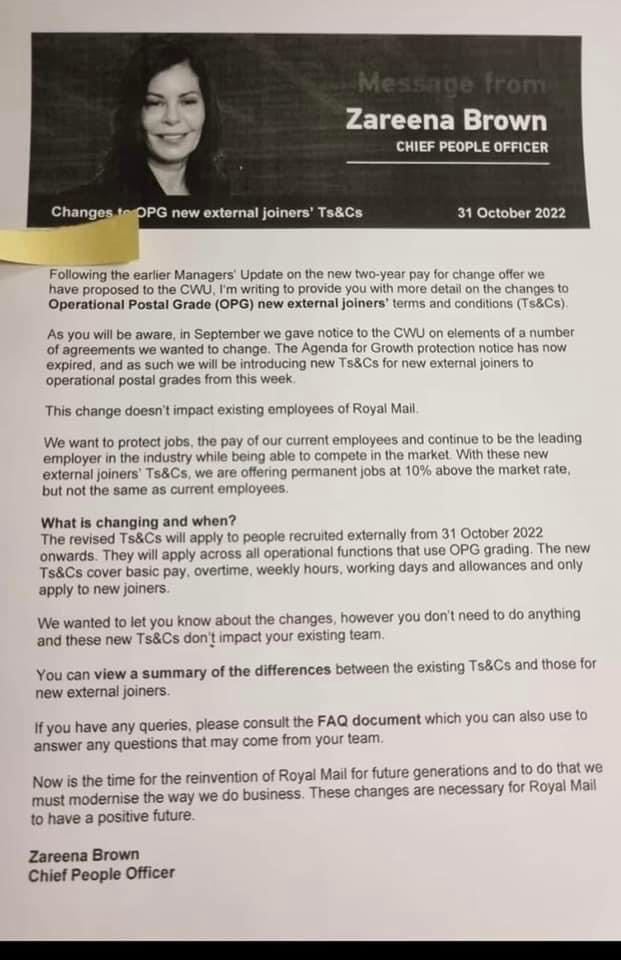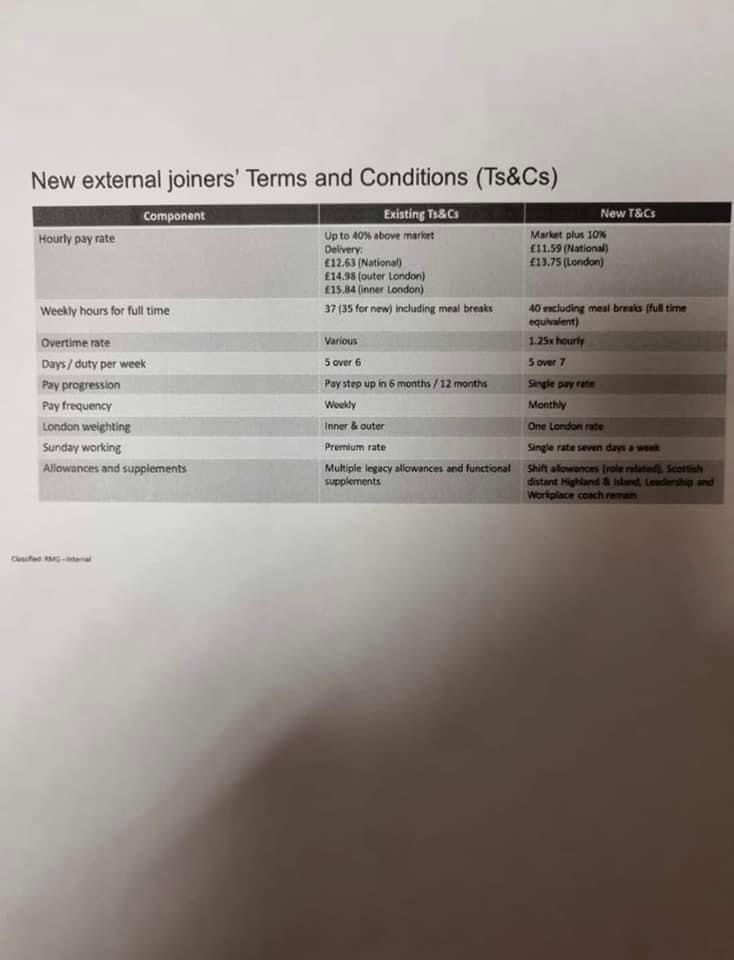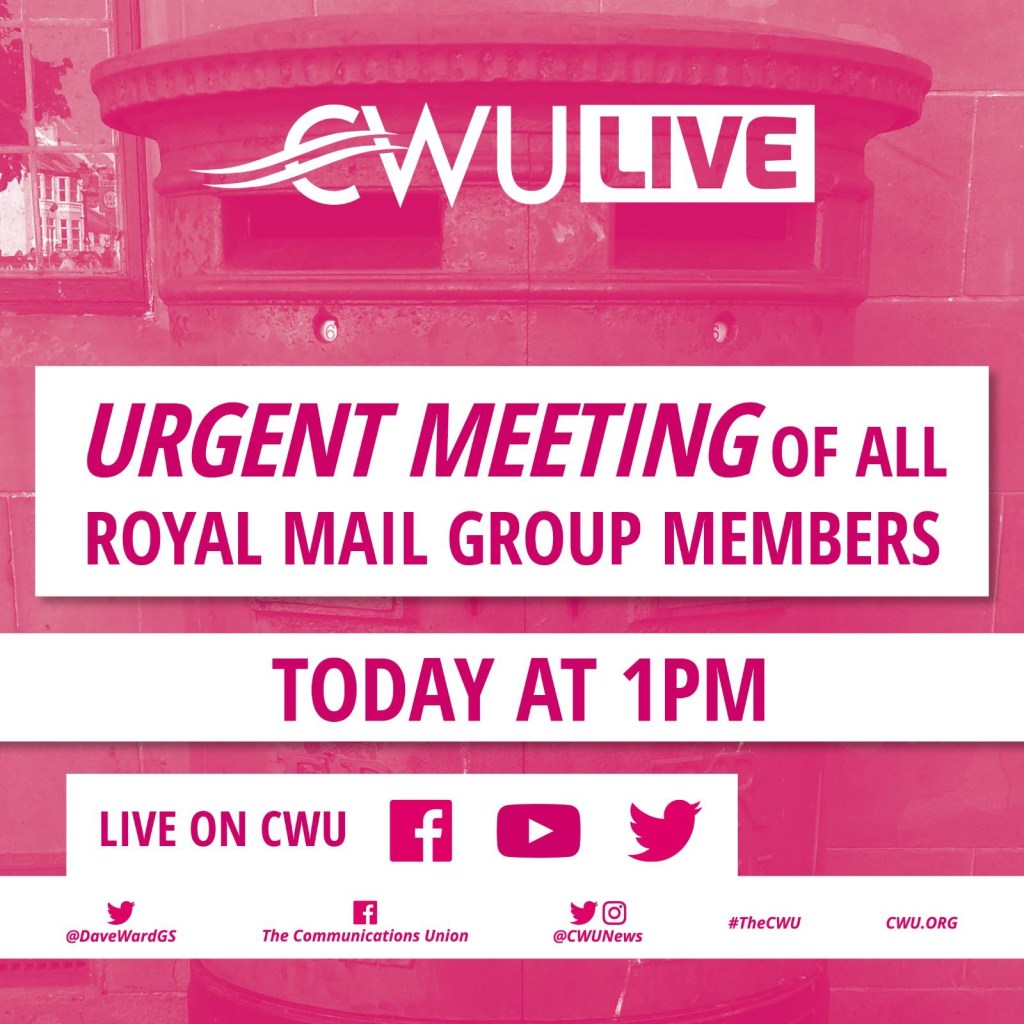
DGSP Terry Pullinger lays it on the line

🚨 DGSP Terry Pullinger lays it on the line. We are facing an unprecedented attack on us as workers and the demise of this great public serve. This is the fight of our lives.

It’s time for the whole country to stand up for us and we will be taking the message out there.

Vote YES – this is the most important ballot of your working lives.

Vital session for Parcelforce members with Davie Robertson

Vital session for Parcelforce members with Davie Robertson. Please share as widely as possible.

Facebook https://fb.watch/eHwlSSEOJG/

YouTube https://youtu.be/c-GlbVz-PEs

Twitter https://twitter.com/cwunews/status/1555147158860341249?s=21&t=GjJfh9rAmk3X097iPEeHTg

A vital session on deliveries with Mark Baulch 4/8/22

A vital session on deliveries with Mark Baulch. Covering the talks, executive action and why every member needs to vote yes in the ballot.

Facebook https://fb.watch/eHnfVsANUu/

YouTube https://youtu.be/AnddSIWZtQc

Twitter https://twitter.com/cwunews/status/1555132696073887745?s=21&t=I7v6OMDlMIGrY0Z3xAde3w

Sunlight UV Ray Protective Properties Test Results on the New Royal Mail/Parcelforce Uniform Range Fabrics

Sunlight UV Ray Protective Properties Test Results on the New Royal Mail/Parcelforce Uniform Range Fabrics

As Branches will know, Royal Mail is currently rolling out the new uniform for postmen and women, OPGs, Parcelforce staff, Engineers and Fleet – in the first Uniform change in a decade. The new-look uniform, which includes walking trousers and shorts, tops, jackets, coats, gilets and headwear, has been based on discussions with the Union’s postal department and the health and safety department in relation to Uniform safety aspects and clothing, garments and footwear classed as ‘personal protective equipment’ under health and safety regulations. Frontline feedback from CWU members has also been taken fully into account in the re-design of the new Uniform and Footwear range. The uniform has been created to reflect the physical demands of the daily delivery round outdoors plus indoor, driving and technical worker duties. The new Uniform has been developed with the input of an experts in design, fabrics biomechanics and product development. The national rollout follows national joint trials.

With regards to outdoor workers, the health and safety department was extremely keen to obtain confirmation that the UPF (Ultraviolet Protection Factor) rating of the new Uniform garments/fabrics matched or surpassed the previous clothing range by providing effective shielding from harmful Sun UV rays, and as such preventing the rays from reaching the skin.

Garments with UPF 50 rating, for example, offer very good protection, allowing just 1/50th of the sun’s UV rays to reach the skin whereas a thin cotton T-shirt with a UPF of around 5, allows a massive 1/5th of the sun’s UV rays to reach the skin.

One of the most important things to always bear in mind when it comes to sun protection is that ‘covering up’ is the most effective way of blocking the sun’s potentially harmful Ultraviolet ‘UV’ rays. Choosing the right kind of clothing fabrics to use as a ‘cover-up’ is key to helping keeping outdoor workers protected in the sun.

What many people don’t realise, however, is that not all clothing is made equal when it comes to sun protection. Some fabrics, colours, and cuts of clothing do not give the protection people might expect, which can cause our skin to be exposed to high levels of UV without us even realising. Choosing the right kind of clothing and fabrics to use as a cover-up is key to helping ensure outdoor workers are protected in the sun’s potentially harmful UV rays. There’s no point in covering up from head to toe if the clothing materials/fabrics won’t block out and protect wearers from the sun.

Looser weaves of fabric will give lower protection against the sun’s UV rays, as the gaps in the weave let the rays through. The type of thread, weave style, and even the finish of a fabric will all affect how much UV is reflected or absorbed by it.

At the request of the CWU Health and Safety Department, All the new Uniform fabrics have been ‘independently’ tested to the BS EN 13758-1 standard where the requirement is a minimum of 40 UPF, all fabrics have exceeded the British UPF (Ultraviolet Protection Factor) rating.

I have attached the test reports for your perusal which shows the image of each product the test relates to, where products have a shared fabric base, Royal Mail Group have only tested it once. For example the image for the base layer fabric only shows the bottoms but the tops are also covered as they are made from the same fabric.

We just now need the business to agree to provide high factor (SPF) Sunscreen/Sunblock to the outdoor workforce to protect any exposed skin in weather like the current hot, sunny, high UV ray conditions where postal workers, working outdoors for many hours, should cover up exposed skin but will naturally want remove clothing layers to help achieve thermal comfort. A fresh claim for the provision has been submitted to Royal Mail Group for the provision of sunscreen to the outdoor workforce.

SEE ATTACHED PDF FILE COPIES OF THE “STAY SAFE IN THE SUN” (RM/PFWW/CWU/IOSH) POCKET CARD INFORMATION GUIDE AND POSTER.

Yours sincerely,

Dave Joyce
National Health, Safety & Environment Officer

22LTB327

394536 polo fabric

394537 shirting fabric

394538 base layer fabric

394539 trouser & short fabric

394540 lite trouser fabric

394541 sun hat fabric

394542 baseball cap fabric

394543 beannie hat fabric

Stay-Safe-in-the-Sun-Cards-3

Sun-Safety-Poster

View Online

CWU’s Jamie McGovern Wins TUC Safety Representative Award 2022

CWU’s Jamie McGovern Wins TUC Safety Representative Award 2022

Jamie McGovern (Greater Mersey Amal Branch) has won the 2022 TUC Safety Representatives award, to be presented at the TUC Congress 2022 which takes place in Brighton, 11 – 14 September.

The TUC annual Congress is a key event in the TUC’s calendar, attended by delegations from all Unions and where reports and motions are proposed and discussed which then form the policies and basis of the TUC’s work for the following year. Congress 2022 will attract an estimated 4000 visitors to Brighton during the week.

The TUC Judging panel recently announced the result of the TUC Safety Representative of the Year award for 2022, after considering entries from a number of the TUC’s 50 affiliated Unions who represent 6 million workers and in line with the practice for all TUC awards there is one overall winner.

In a letter to the Union, the TUC Health & Safety Officer Shelly Asquith informed us that there was a very high standard of entries this year – with Jamie’s entry finally impressing the judges as the one demonstrating the greatest achievement as a Safety Rep.

The TUC Safety Representatives annual Award is now in its nineteenth year and was introduced by the TUC General Council to demonstrate and acknowledge the range of work currently undertaken by Safety Representatives on behalf of their Union, its members and the community, recognising the contribution made by Safety Representatives in promoting health & safety in the workplace.

The TUC make the award to a trade unionist who represents the best aspects of being a Safety Representative and who in the view of the TUC has made an exceptional contribution in the role and has demonstrated commitment to working to improve workplace health and safety.

The CWU Health, Safety & Environment Committee has given the award scheme its full backing over the last decade and has a record second to none in the achievements and recognition of the work of the department and our field force of Safety Reps across the Union.

Jamie McGovern has been a CWU Area Safety Representative in Royal Mail for the members of this Union since 1995, for over 27 years. He’s done some great work as a CWU Area Health and Safety Rep.

Jamie was at the forefront of supporting members during the pandemic, carrying out workplace inspections and ensuring safety and infection controls were maintained, working with Covid compliance teams to keep workplaces Covid-Secure. His work was recognised by the Lord Lieutenant of Merseyside.

Jamie became a Mental Health First Aider and subsequently an Instructor. He has trained over 100 delegates, taking them through the 2-day MHFA training course. He has also been part of the group that set up the Mental Health networks in Merseyside and in the North West Region. Jamie recently won the national ‘Inside-Out’ award for his work on Mental Health and Stress.

Jamie is a member of the International Workers Memorial Day Organising Committee in Merseyside and a founder member of the Merseyside Dog Safety Partnership working with Police, Local Authorities, Animal Charities, Liverpool University and other organisations to deal with Dog Attacks and Dangerous Dog control in the area. Through his work on disability, over 200 Members have been assisted with reasonable adjustments in the workplace due to physical or mental health disabilities. On Road Safety Jamie Worked with the Wirral Road Safety Partnership, working with police, road safety experts and organisations to bring road and driver safety initiatives into the Workplace resulting in a 31% Road Traffic Accident reduction. As a result of this work, Jamie with his Deputy Mark Evans won the ‘Mind Your Business Road Safety Award’.  Jamie also became a leading campaigner in the “Tyred” Campaign created by the Frances Molloy mother of coach crash victim Michael Molloy and the campaign supported by CWU Health, Safety and Environment Department achieved a road law change banning tyres on coaches over 10 years old.

Jamie represents the best aspects of undertaking a CWU Health and Safety Rep’s role.

I am delighted that the dedication and commitment of CWU health and safety representatives has been recognised and applauded by the Trade Union Congresses across the UK. These awards recognise the important role that Safety Representatives can and do play in contributing to ensuring higher standards of health and safety in many workplaces.

Health and Safety Representatives are dedicated and committed trade union activists who strive to make workplaces safe for all workers. The opportunity to salute all CWU health and safety representatives through these awards is welcome and deserves to be celebrated. Workplace health and safety management requires a combination of strong commitment by management and active Trade Union Safety Reps input and engagement.

Safety Reps are the best and sometimes the only defence workers have, making sure that health and safety risks are managed properly by operational managers and employers. We know Union Safety Reps cut the rate of serious injury at work by more than 50 per cent, and over the years they’ve saved many lives and prevented many injuries by diligence, hard work and commitment. The fantastic work done by CWU Safety Reps in all of our branches up and down the country is helping to improve the lives of our members every year. The time, effort and work these people put in to help their colleagues often belies the time and resources they have available. I am delighted that the TUC, have recognised our CWU nominee as the best and I am sure the whole Union will join me in recognising the fine work of our Health and Safety Reps collectively and these achievements individually. Jamie is a deserved winner as were other previous CWU winners.

This of course is great news for the Union with Jamie adding to the growing list of Health and Safety Awards won by the CWU and its Health and Safety Reps over recent years. The CWU has now won the TUC award more than any other Trade Union and became the first Trade Union to win the full set of UK Trade Union Safety Representative of the Year Awards (England, Wales, Scotland and Northern Ireland) in one year 2008/9. The growing list of awards won by CWU and its Safety Reps is due recognition of the Union’s work and achievements in the field of Health and Safety.

The Union has now won the TUC Safety Rep Award on 5 occasions, demonstrating the strength of the Safety Organisation within the CWU and the commitment of CWU Safety Reps. The CWU also became the first Trade Union to win prestigious National Awards presented and sponsored by the IOSH (Institute Of Occupational Safety & Heath), RoSPA (Royal Society For The Prevention of Accidents) and MHFA (Mental Health First Aid) England and the National ‘Inside-Out’ Mental Health Awards.

Jamie and our other award winners over the years are some of many excellent CWU examples of how important our people value health and safety in the workplace. The presence of union safety reps prevents thousands of major injuries at work every year and there’s an army of them out there doing a great job for our Union.

Opinion polls indicate that health and safety is considered one of the key areas people at work regard as a priority and an important topic for trade union action.

Unions campaign tirelessly for health and safety to remain a priority where members are employed. It is so easy to forget that the rights Safety Reps of today were won by years of struggle. We must not let this government take away rights from future generations so hard won by our predecessors. Health and Safety has come under fire in recent years, having been misrepresented in the press and media through a medley of mythical tales and by Tory government ministers who have no general support on this issue within the Safety Profession or amongst Safety Reps and Trade Unions that have to pick up the pieces after injuries, deaths and diseases at work. However what is universally recognised is that workplaces where Union Safety Reps are active and present are significantly safer than those without them.

HSE and TUC surveys show that Union Health and Safety Reps:

  • help reduce injuries at work
  • lead to reductions the levels of ill-health caused by work
  • encourage greater reporting of injuries and near-misses
  • make workers more confident
  • help develop a more positive safety culture in the organisation
  • save the employers and the economy many millions of pounds.

CWU Role of Honour – Major Health and Safety Awards

TUC Safety Rep of the Year Award

2005 – Barry Gapes of CWU London City West Branch

2007 – Pete Eggleston CWU Birmingham Branch

2008 – Chris Wesson CWU Birmingham Branch

2013 – Andy McArthur CWU Eastern No 6 Branch

2022 – Jamie McGovern CWU Greater Mersey Amal Branch

Scottish TUC Safety Rep of the Year Award

2009 – Graeme Russell CWU Edinburgh and Dundee Borders Branch

Irish TUC Safety Rep of the Year Award

2008 – Sean Doherty CWU Northern Ireland Combined Branch

2015 – Kevin Sweeney CWU Norther Ireland Telecoms Branch 

Wales TUC Safety Rep of the Year Award

2009 – Allan Morgan CWU South Wales Branch

South West Region TUC Safety Rep of the Year Award

2011 – Mark Tripconey CWU Somerset, Devon & Cornwall Branch 

Institute of Occupational Safety and Health (IOSH) – Achiever of the Year Award

2010 – Dave Joyce, CWU National Health and Safety Officer

Institute of Occupational Safety & Heath (IOSH) – Health and Safety Project Award 

2009 – CWU

RoSPA – Workforce Involvement in Safety and Health Award

2009 – CWU

RoSPA – Individual Safety Award for exceptional contribution to Safety and Accident Prevention 

2016 – Dave Joyce, CWU National Health and Safety Officer

“Inside Out” – Workplace Mental Health Awards

2022 – Mental Health First Aid Winner – CWU

2022 – Behind the Scenes Champion Winner – Jamie McGovern CWU Greater Mersey Amal Branch

There can be no higher cause for trade unions than saving lives and preventing injury and ill health at work – no higher calling than doing so by becoming a safety Rep. The CWU will never rest on the issue of health and safety. Through our Safety Reps, like Jamie we will work to achieve happier, healthier workplaces with a lower risk of accidents, aiming to ensure that our members are able to leave work every day as healthy as when they arrived.

Yours sincerely,

Dave Joyce
National Health, Safety & Environment Officer

22LTB325

View Online

RMG Driver/Road Safety – “Driving At A Safe Distance” Campaign” (RMG SHE Huddle/Briefing FY22 043): “Only A Fool Breaks The Two-Second Rule”

RMG Driver/Road Safety – “Driving At A Safe Distance” Campaign” (RMG SHE Huddle/Briefing FY22 043): “Only A Fool Breaks The Two-Second Rule”

The Royal Mail Group Safety, Health and Environment (SHE) Team are launching a ‘Driving at a safe distance” driver and road safety communications campaign and staff briefing during this week, week commencing 1 August with the issue of RMG SHE Huddle/Briefing FY22 043 (copy attached). A Campaign slide/screen shot will also go out on the RMG Plasma screens, RMTV and on the RMG Intranet (copy attached).

Overview Message – The two-second rule:

The two-second rule is a ‘rule of thumb’ by which a driver can maintain a safe travelling distance at any speed. The rule is that a driver should ideally stay at least two seconds behind any vehicle that is directly in front of his or her vehicle. To use the rule, drivers should allow the vehicle in front to pass a fixed object such as a bridge, lamp post or road sign then count to two seconds. If the driver reaches the fixed object before counting to two seconds then they are too close and they need to drop back. REMEMBER – Only A Fool Breaks The 2-Second Rule.

The Highway Code: 

The Highway Code requires that drivers should:

  • Leave enough space between their vehicle and the vehicle in front so that they are able to stop safely if the vehicle in front suddenly stops, and never get closer than the overall stopping distance.
  • Allow a two-second gap between their vehicle and the vehicle in front, and this should be at least doubled to four-seconds on wet roads and up to ten times greater to twenty-seconds on icy roads and in poor visibility.
  • Remember, large vehicles and motorcycles need a greater distance to stop.
  • The gap should be wider as speeds increase.

Benefits of Driving at a Safe Distance: 

The obvious benefit is that by driving at a safe distance your vehicle won’t hit the rear of the vehicle in front if it should stop suddenly, but there are other benefits too:

  • There will be a better, safer view of the road ahead and the driver keeping a safe distance will be better able to assess the situation ahead – driving too close means that the view is blocked by the vehicle in front.
  • Having more time to react means being be able to drive more safely and smoothly, reducing how often and how harshly braking is required – which in turn reduces the risk of a collision with vehicles ahead or from behind and additionally it improves both all-round safety and fuel efficiency.

Most Common Cause of Road Traffic Collisions and Injuries:

The National Highways Agency and Police report that driving to close and rear end collisions is the most common cause of injuries from road traffic accidents. Being in a vehicle that is hit in the rear by another vehicle is the most likely way that a driver and passengers will be injured or killed in a collision, and any action that drivers can take to avoid this is always worthwhile.

Royal Mail and Parcelforce Drivers and Vehicles Involved in Rear End RTCs:

Last year Royal Mail Group (Royal Mail and Parcelforce) drivers were involved in 140 rear end collisions with other vehicles which led to other drivers and members of the public being injured, some seriously injured. These injuries typically occurred because Royal Mail and Parcelforce drivers were found to be driving too fast and/or too close to the vehicle in front at the time of the collision.

Prosecution:

Driving too close to another vehicle can lead to prosecution for ‘driving without due care and attention’. This offence carries a minimum fine of £100 and three penalty points, and in some cases more severe penalties and a court appearance.

What is a Safe Distance? 

The Highway Code contains ‘Typical Stopping Distances’ as a guide to the minimum distance drivers should leave whilst driving:

  • Travelling at 30mph a driver should leave a minimum of 6 car lengths.
  • Bear in mind though that these figures can vary depending on the condition of the vehicle (tyres/brakes), the attention of the driver, the road surface and weather conditions. (See attached SHE Huddle – Stopping Distances chart and highway code).

National Highways Agency Two-Second Rule Campaign and ‘Tailgating’ Cameras Trial:

In February, National Highways launched a campaign to tackle the issue of driving too close and tailgating which is a factor in around one in eight crashes on England’s motorways and major ‘A roads’. When launching the campaign National Highways stated that “In many cases it’s unintentional bad driving by drivers who don’t realise that they are infringing on another drivers space but not leaving enough space between you and the vehicle in front is not only very frightening for that driver, it could have devastating consequences in the event of a collision. The closer you get, the less time you have to react and to stop safely. So to avoid inadvertently getting too close to the vehicle in front.”

Prior to launching their campaign earlier this year, in 2021 the Agency ran a trial of new ‘tailgating cameras’ on a stretch of the M1 which captured 60,343 incidents of drivers, driving their vehicles too close to the vehicle in front, in just one year. 10,994 were repeat offenders. In launching their two-second rule campaign jointly with Northamptonshire Police, National Highways advised drivers as follows; “We would urge drivers to use the two-second rule and to always ‘stay safe, stay back.”

 “BRAKE” Road Safety Charity Supports the 2-Second Rule:

Brake, the road safety charity, said: “It’s vital that drivers leave enough distance between their vehicle and the vehicle in front in order to react in time to any sudden dangers. We’d urge everyone to respect the two-second rule to keep them, and others on the road, safe.”

Institute of Vehicle Recovery Supports the 2-Second Rule: 

The IVR said: “We fully support the ‘2 second rule’ campaign, which highlights the importance of keeping your distance whilst driving. These precautions can only make the road network safer.”

“RoSPA Royal Society for Prevention of Accidents Supports the 2-Second Rule:

RoSPA added: “Keeping a safe distance from the vehicle in front will also help to reduce a driver’s stress levels when behind the wheel. Use the 2-Second Rule: leave at least a two-second gap between you and the vehicle in front. Double this distance on wet roads and increase it even further on icy roads.

2-Second Rule – Short Video

An short but informative video can be watched on ‘youtube’ at the following link: https://www.youtube.com/watch?v=yE9MtjSohqY

Actions:

  • Managers and PiCs to brief all drivers – delivering the SHE Huddle/Briefing FY22 043, raising awareness of the 2-second rule and avoiding driving too close.
  • Drivers to remember the phrase “Only A Fool Breaks The Two-Second Rule.

The Aims and Benefits of the Campaign are:

To increase awareness amongst drivers and managers, improve driving standards, road safety and Highway Code compliance. The SHE Huddle/Briefing FY22 043 gives advice to help avoid RTC incidents and keep Royal Mail and Pacelforce drivers and other road users safe

CWU ASRs/WSRs: 

This campaign is supported by the CWU HQ Health, Safety & Environment Department. CWU ASR/WSR full support and participation is much appreciated by Royal Mail, Parcelforce Worldwide, RMSS, RMP&FS and CWU HQ. ASRs/WSRs should ensure that the briefing is delivered to drivers and ensure drivers are aware of the 2-second rule and the Highway Code rules.

Yours sincerely,

Dave Joyce
National Health, Safety & Environment Officer

22LTB324

SHE Huddle FY22 043 Driving a Safe Distance

RMTV Campaign Screenshot

View Online

If you have received your ballot please use your vote

You should by now have your voting paper in the national ballot over Royal Mail Group’s outrageous slash and burn change proposals.

Let’s spell it out.

  • later starts (across all functions)
  • Annualised hours
  • Total flexibility
  • Mandatory Sunday working
  • Worsening attendance procedure
  • Cuts to sick pay
  • Cuts to ill health retirement terms
  • Short notice for shift changes

We cannot accept these terms. But to fight for you we need you to vote in the ballot immediately and ask every single colleague to do the same.

On 17th August when the result is announced we must return the biggest yes vote and turnout possible.

There is no fence to sit on. If you don’t vote then Royal Mail Group will take that as support for the plan above.

Your union needs you more than ever. You need your union more than ever.

Your loyalty has been outstanding but we need you to get that ballot paper, vote yes and post it back today.

Then we need you to speak to every single colleague and convince them to do the same.

Vote Yes.

Royal Mail’s Position Regarding Year Two Productivity Targets & Revision Activity in Delivery – Resourcing Calculator

Royal Mail’s Position Regarding Year Two Productivity Targets & Revision Activity in Delivery – Resourcing Calculator

Branches and Representatives will recall LTB 299, issued on the 7th July, which reported on Royal Mail’s intention to impose ‘Year-Two’ productivity targets for both Table Top and Structural Revision units and to confirm the current position in terms of our agreement on productivity under the Pathway to Change Agreement.

Since then we have continued to receive reports into the Outdoor Department on new year-two improvement plans from Royal Mail being set out at local level. However, Royal Mail has now also changed local unit’s agreed year-one WIPWH (Weighted Items Per Work Hour) targets in the Resourcing Calculator.

The Resourcing Calculator was a jointly developed system by Royal Mail and the CWU and was designed to assist local units that underwent table-top revision activity in 2021, in terms of overall agreed productivity levels and targets based on WIPWH. It is, therefore, a matter of both disappointment and concern that Royal Mail has, (without agreement and outside of the wider commitments on productivity set out in the Pathway to Change agreement), now sought to replace agreed year-one levels within the Resourcing Calculator with completely un-agreed and unacceptable year-two targets.

Whilst the JWG on productivity recommended that unmeasured hours would be removed from the WIPWH calculation in year 2 revisions and that any improvement in WIPWH performance would count towards year 2 and 3 productivity targets, we do not agree to the way Royal Mail have removed unmeasured work hours and given new targets based on either the new measured target, or last year’s week 1 – 46 WIPWH performance rates. The unilateral change is a breach of the Pathway to Change Agreement.

Royal Mail have decided to take the unmeasured work hours from units by going back to weeks 27- 30, 2019 instead of the unit’s year 1 WIPWH performance target. Even though we disagree with Royal Mail’s decision to try and impose a unilateral change, the current evidence demonstrates that almost 40% of the 886 tabletop revisions units were always above 196 standard performance on measured work only but it was unmeasured and, in particular, collection hours, which resulted in disguising their true productivity.

We now believe that Royal Mail realise that on measured time only, that 347 units are above 196 standard performance but have changed what was originally agreed in the Pathway to Change Agreement and now want these units to maintain WIPWH above 196. This means that for 40 units, they would have to maintain WIPWH performance at above 260 WIPWH which is simply unachievable.

We are also aware that Royal Mail is further seeking to use the Resourcing Calculator in delivery units that performed structural revisions and again, replace the unit’s agreed revision Flightpath WIPWH level with an un-agreed year-two target. This is despite the fact that the National Joint Statement For The Deployment Rollout Of Resource Calculator, as set out in the ODM (Outdoor Department Memo) 04/22, issued on the 27th  January states: Both parties will jointly work together to test whether the resourcing calculator can be used for structural revision offices following their PIR. This is in recognition that the flightpath calculator (used to set a unit’s Adjusted WIPWH level) on structural revisions has changed the WIPWH target.’

As previously set out in LTB 299/22, attached for ease of reference, the current position remains that units that underwent table top revisions in 2021 should only apply the agreed year-one WIPWH levels as set out in previous Joint Statements and Agreements.

Equally, there is no agreement on the use of the Resourcing Calculator in delivery units that performed structural revisions, as set out in the National Joint Statement for The Deployment Rollout Of The Resource Calculator, issued in the Memo ODM 04/22, also attached.

Again, for those units which introduced structural revisions, there is no agreement in place to change a unit’s revision Flightpath WIPWH target.

Whilst we have already written to Royal Mail nationally on these wider points over the past few weeks and have made it clear that we expect our National agreements to be jointly honoured and that these issues are part of the wider Current National Dispute Resolution Procedure. Branches and Representatives are advised to progress any savings or revision proposals that are not in line and consistent with our National Agreements through the IR Framework and the dispute resolution process.

From a National CWU perspective and to be absolutely clear we have not agreed to any Revision proposals or programme of revisions activity, either through a structural or table top approach. Neither have we agreed on any year-two revised WIPWH productivity levels. 

Any queries to the content of the above please contact the Outdoor Department reference 555, email address: njones@cwu.org.

Yours sincerely,

Mark Baulch
CWU Assistant Secretary

LTB 323-22 – Year Two Productivity Targets & Revision Activity 28.07.22

Joint Statement National Deployment Of The Resource Calculator

LTB 299-22 – Two Year Productivity Targets – 07.07.22_

MEMO ODM-04-22 – Roll Out of Resource Calculator 27.01.22

Resource Calculator

Dave Ward & Terry Pullinger Get The Vote Out ✊️

Brilliant session with Dave and Terry. Now we must throw the kitchen sink at getting the vote out.

Let’s do this.

Facebook https://fb.watch/exjkdJaR1T/

YouTube https://youtu.be/BmfdFz5rVxc

Twitter https://twitter.com/cwunews/status/1552360776823754753?s=21&t=29FuM7mGo-vlBA5d7w_q2w

Create a website or blog at WordPress.com

Up ↑