ROYAL MAIL: FINANCE – PATHWAY TO CHANGE AGREEMENT

ROYAL MAIL: FINANCE – PATHWAY TO CHANGE AGREEMENT

Branches are advised that a Joint Statement on the implementation of the Shorter Working Week in Finance has been agreed and is attached to this LTB for information. The Shorter Working Week will be implemented on 26th July 2021 across Finance as a function.

Members and Representatives in Finance will be invited to engagement sessions over the coming weeks to discuss further details in relation to the changes in the reduction of the working week.

Branches and Representatives are urged to bring this LTB and associated Joint Statement to the attention of our members in Finance.

Any queries in relation to this LTB should be sent to Lea Sheridan (lsheridan@cwu.org)

Yours sincerely

Andy Furey

Assistant Secretary

LTB 252/21 – Royal Mail – Finance – Pathway To Change Agreement

Attachment 1 to 21LTB252

View Online

ELECTION OF NATIONAL DELEGATIONS – 2021

ELECTION OF NATIONAL DELEGATIONS – 2021

  • TUC Congress
  • Labour Party Conference

Further to LTB 219/21 dated 26th May 2021 at the close of nominations the following have been received:

TUC

Postal Constituency

NEC (1 Member)No Nominations Received

Lay Members (7 Members at least 2 delegates must be women & at least 1 delegate must be BAME)Steve  CrokeSouth Midlands Postal*ElectedHugh GaffneyGlasgow & District Amal*ElectedKeith HamiltonSouth Central Postal*ElectedAmarjite SinghSouth East Wales Amal*Elected  (BAME Quota)

Telecom & Financial Services Constituency

NEC (1 Member)Ken WoolleyPortsmouth West Sussex & IOW*Elected

Lay Members (5 Members at least 1 delegate must be a woman & least 1 delegate must be BAME)Michelle BaileyMidland No 1, Capital, Portsmouth West Sussex & IOW*ElectedEmma GarnerPreston Brook & Bury, Capital, Mersey,  Midland No 1, Mid Wales, The Marches & North Staffs,  North Anglia, Scotland No 1,  Tyne & Wear Clerical, West Yorkshire*ElectedJacky MorreyMid Wales, The Marches & North Staffs, Capital, Mersey,  Midland No 1, North Anglia,  Scotland No 1, Tyne & Wear Clerical, West Yorkshire*ElectedTrish VollansWest Yorkshire, Capital, Mersey , Midland No 1,  Mid Wales, The Marches & North Staffs, North Anglia, Scotland No 1, Tyne & Wear Clerical*ElectedMel WilsonTyne & Wear Clerical,  Capital, Mersey,  Midland No 1, Mid Wales, The Marches & North Staffs,  North Anglia, Scotland No 1, West Yorkshire*Elected

LABOUR PARTY

Postal Constituency

NEC (1 Member)Steve JonesLondon Postal Engineering, London Regional MT*ELECTED

Lay Members (7 Members at least 2 delegates must be women & at least 1 delegate must be BAME)

Ballot RequiredPaul BraithwaiteNorth Lancs & CumbriaJohn CarsonGlasgow & District AmalHuw DaviesLondon PhoenixHugh GaffneyGlasgow & District AmalKeith HamiltonSouth Central PostalAlan TateLondon Regional MT

Telecom & Financial Services Constituency

NEC (1 Member)Simon EdwardsMid Wales, The Marches & North Staffs*ELECTED

Lay Members (5 Members at least 1 delegate must be a woman & at least 1 delegate must be BAME)Michelle BaileyMidland No 1  *ELECTED (BAME Quota)Joyce StevensonScotland No 1, Capital, Mersey, Midland No 1, Mid Wales, The Marches & North Staffs, North Anglia, Tyne & Wear Clerical*ELECTED (Woman Quota)

Ballot RequiredGraham ColkSouth Wales, Capital,  Mersey, Midland No 1, Mid Wales, The Marches & North Staffs,  North Anglia, Scotland No 1, Tyne & Wear ClericalBrian KennyMersey, Capital, Midland No 1, Mid Wales, The Marches & North Staffs, North Anglia, Tyne & Wear Clerical, Scotland No 1Ryan O’GormanNorth Wales & Chester Combined Steve PhillipsCentral Counties & Thames Valley, North Anglia, David RayTyne & Wear Clerical, Capital, Mersey, Midland No 1,  Mid Wales, The Marches & North Staffs, Scotland No 1

The ballot timetable is as follows:

Despatch ballot papers               23 June 2021

Ballot Closes                                  07 July 2021 (14:00)

Any enquiries regarding this Letter to Branches should be addressed to the Senior Deputy General Secretary’s Department on telephone number 020 8971 7237, or email address sdgs@cwu.org.

Yours sincerely,

Tony Kearns

Senior Deputy General Secretary

21LTB250

View Online

National Clean Air Day – Thursday 17 June 2021

National Clean Air Day – Thursday 17 June 2021:

Clean Air Day is a global, annual, air pollution campaign in the month of June. It encourages everyone to think about what they can do to help improve air quality.

Air pollution harms the health of millions, but there are lots of simple things people and organisations can do to improve air quality and reduce our exposure to air pollution. Clean Air Day is a chance to raise awareness and find out more about air pollution (both indoor and outdoor), share information with friends, family, union members and work colleagues, and help to make the air cleaner and healthier for everyone.

Every year, air pollution causes up to 36,000 deaths in the UK.  The World Health Organisation and the UK Government recognise that air pollution is the largest environmental health risk we face today. Poor air quality causes heart and lung diseases, is linked to low birth weight and children’s lung development and may even contribute to mental health issues.

By breathing cleaner air, the World Health Organization states that you can reduce the risk of strokeheart diseaselung cancer and respiratory diseases such as asthma.

Clean Air Day is the UK’s largest air pollution campaign, engaging thousands of people at hundreds of events, and reaching millions more through the media. The campaign normally takes place on the third Thursday in June. However, due to COVID-19, Clean Air Day was rolled out slightly differently in 2020 and again in 2021. To keep people, families, friends and colleagues safe during the Covid-19 pandemic, the organisers updated the campaign to be more virtual in 2020 and have continued the approach for 2021!.

Led in the UK by the charity “Global Action Plan“, Clean Air Day brings together communities, businesses, schools, groups and organisations plus the health sector to:

  • Improve public understanding of air pollution.
  • Build awareness of how air pollution affects people’s health.
  • Explain the easy actions we can all do to tackle air pollution, helping to protect the environment and peoples’ health.

In 2019 more than 3,700 organisations and hundreds of thousands of individuals took part in 614 events across the UK. The campaign generated more than 2000 media items, and 45,000 social media posts. In pandemic hit 2020 there were still over 200 events that took place with 1200 news and broadcast items and 95% of people surveyed believed that air pollution should be a priority for the UK. The full report is at:

https://www.cleanairday.org.uk/news-stories/clean-air-day-2020-celebration-and-insights-report

The charity behind Clean Air Day developed new resources for 2020 and again in 2021 which focuses on being virtual and COVID-19 secure, and is encouraging organisations and individuals to get involved.

This year’s campaign theme and tagline is: “protect our children’s health from air pollution” – demonstrating support for action on air pollution to build a clean air future for our children and generations to come. The organisers have sent out the message “Together let’s make June 17 the cleanest Clean Air Day yet” and following the improvement in air pollution seen early last year the charity is continuing to challenge government, businesses and local authorities to help keep air pollution down post lockdown.

The resources have been updated so that Clean Air Day 2021 can continue to be successful in providing information to people on air pollution and encouraging people to take low air pollution behaviours while being COVID-19 secure, with the charity continuing the focus on making the tools and assets more virtual. These include digital leaflets and posters, school lesson plans, PR social media packs, “How to guides” such as organising “School Streets” or running socially distanced “walking buses” and template letters to MPs.

In launching the event “Global Action Plan“, said “Together we can make June 17 the cleanest Clean Air Day yet, building on the shifts seen recently seen in low pollution behaviours. Organisations and individuals are invited to take part, recognising the role we all play in keeping our air clean.”

Workplace Resources

Use the organising charity’s collection of workplace resources to inspire workplaces to create cleaner air on and beyond Clean Air Day. Posters, clean van commitment, letters, texts, clean air recovery essentials, e-mail footer, pledge cards, ‘No-Idling’ leaflet, clean air travel, clean air travel choices, e-mail and intranet message, video conferencing background, press release, social media resources.

https://www.cleanairday.org.uk/free-resources/workplace

Clean Air Day Information & Resources

The basic facts, air pollution and health, Clean Air Calculator, What you can do etc., plus Clean Air Day free resources are available here:-

https://www.cleanairhub.org.uk/clean-air-information

https://www.cleanairday.org.uk/free-resources.

The Clean Air Hub

A collection of everything you need to know about air pollution in one place from the organising charity “Global Action Plan”.

https://www.cleanairhub.org.uk/

Air Pollution and Health Inequalities

Although air pollution can be harmful to everyone, some people are more affected because they live in a polluted area and are exposed to higher levels of air pollution. Big cities and towns experience greater pollution levels (particularly nitrogen dioxide). More than 40 towns and cities in the UK are at or have exceeded air pollution limits set by the World Health Organization, its new report has found; Scunthorpe, Manchester, Swansea, Gillingham, Carlisle, Chepstow, Leeds, Leicester, Liverpool, Grays, Eccles, Nottingham, Plymouth, York, Leamington Spa, Sandy, Sheffield, Stoke-On-Trent, London, Coventry, Hull, Londonderry, Middlesbrough, Norwich, Southend-On-Sea, Stockton-On-Tees, Storrington, Wigan, Armagh, Birmingham, Brighton, Bristol, Cardiff, Eastbourne, Harlington, Newcastle, Newport, Oxford, Portsmouth, Preston, Salford, Saltash, Southampton, Stanford-Le-Hope, Port Talbot. There’s more about air pollution & health inequalities on the ‘Clean Air Hub’:https://www.cleanairhub.org.uk/

The Clean Air & Pollution Calculator

The Air Pollution Calculator, brought to you by Global Action Plan. This tool enables you to calculate how your activity contributes to pollution levels and learn how you can make a difference for Clean Air Day 2021 and beyond: – http://calculator.cleanairhub.org.uk/quiz

Air Pollution Monitoring Equipment – Offer to CWU Health and Safety Reps

In 2020 Greener Jobs Alliance (GJC) and Trade Union Clean Air Network (TUCAN) jointly took a share in the procurement of air pollution monitoring equipment with Global Action Plan (GAP). The Personal Aerosol Monitor is a miniature battery-operated laser photometer that measures airborne particle mass concentration in units of milligrams per cubic meter (mg/m3). The equipment can measure to particulate matter of pm 2.5. TUCAN/GJA/GAP is now looking to loan it out to workplaces to support Trade Union Health and Safety Reps with workplace air pollution monitoring. Any CWU Health and Safety Rep interested in a loan of the equipment for a couple of weeks can email Janet Newsham (Chair Hazards Campaign & TUCAN) and Janet will schedule a time for you to use the equipment and from there hopefully produce some reliable, quotable, statistical evidence.

Contact details:-

Janet Newsham
Chair Hazards Campaign/TUCAN
Email: janet@gmhazards.org.uk
Mob: 07734317158

Greener Jobs Alliance (GJA) and Trade Union Clean Air Network (TUCAN) Newsletters.

The latest editions of the GJA and TUCAN Newsletters have been circulated attached to LTBs 477/20 and 247/21.

Hazards Campaign/Trade Union Clean Air Network(TUCAN) Clean Air Day On-Line Seminar (Tonight 6pm)

Join the Hazards Campaign/TUCAN short seminar looking at what is happening on Clean Air Day and what next for TUCAN?Hazards & TUCAN say – the need for action is clear. The recent verdict at nine-year-old Ella Kissi-Debra’s inquest made a direct link between the air pollution she endured and her untimely death and the recent study published by University College London stated that globally we are experiencing at least 8.7 million deaths related to air pollution annually. On Clean Air Day 2021 join the Hazards Campaign/TUCAN panel of experts from across the UK, to discuss what is happening in their country and what TUCAN should be doing to drive forward the air quality agenda throughout UK workplaces. Date and time Thursday 17 June 2021 6pm -7:30pm Join/Register at: https://www.eventbrite.co.uk/e/hazards-campaign-thursday-talk-clean-air-day-and-what-next-for-tucan-tickets-137598373439

Wales TUC – Greener Workplaces Toolkit For Union Reps (Written BY Graham Petersen)

The aim of this toolkit is to provide information to help union officers and reps who want to take action on the climate emergency and negotiate for greener and fairer workplaces. It is designed to support the voice of workers and their unions. It provides information, tools and ideas to help union reps to campaign, organise and raise awareness. It also includes negotiating and bargaining checklists on different areas of workplace sustainability. It aims to ensure that workers, through their unions, have a central voice in the changes that will be needed in every workplace to ensure a just transition to a greener and fairer workplace can be achieved. The resources in this booklet are designed to be used on TUC and union training courses, as well as to support green action. (A copy is attached)

“Air Pollution” (Asthma UK and British Lung Foundation Partnership) – Take Action Environment Bill Campaign

Everyone can use their voice to take action against air pollution say the British Lung Foundation (BLF). “Air Pollution” (Asthma UK and British Lung Foundation Partnership) have re-launched their campaign pushing for World Health Organisation (WHO) guidelines for PM2.5 to be included in the UK Environment Law. They have produced a ‘campaign webpage’ which provides a simple tool to “email your MP” in order for people to ask their MP to commit to supporting new targets and WHO limits that will clean up the air we breathe and tackle pollution in the UK. It only takes 2 minutes and can help make a difference! – ‘Take Action Now says the BLF’ – Air pollution contributes to tens of thousands of early deaths in the UK every year. A BLF survey found that 1 in 6 people with a lung condition told them that better air quality during lockdown helped them breathe more easily. Air pollution is a public health crisis. Dirty air can make symptoms worse and can trigger a flare up if you have a lung condition. New research even suggests that breathing polluted air could increase our risk of becoming very ill with Covid-19. The BLF are asking everyone to contact their MP now using the simple BLF campaign tool as mentioned above. There is also a new video, which you can see on the webpage, which focuses on real human voices and stories calling for WHO limits. They hope that this action will help to ensure that MPs across the country realise what a serious effect air pollution has on people with a lung condition and support the shared call for WHO limits. They are also appealing for personal and organisational help in promoting the campaign. There are a number of resources which you can be used to raise awareness about the campaign on the website at the following link:- https://www.blf.org.uk/take-action/campaign/clean-air/environment-bill

What does pm2.5 mean?

PM2.5 refers to particles that have diameter less than 2.5 micrometres (more than 100 times thinner than a human hair) and remain suspended for longer. These particles are formed as a result of burning fuel and chemical reactions that take place in the atmosphere. Fine particulate matter (PM2.5) is an air pollutant that is a concern for people’s health when levels in air are high. PM2.5 are tiny particles in the air that reduce visibility and cause the air to appear hazy when levels are elevated. Breathing in particle pollution can be harmful to your health. Coarse (bigger) particles, called PM10, can irritate your eyes, nose, and throat. … Fine (smaller) particles, called PM2.5, are more dangerous because they can get into the deep parts of your lungs — or even into your blood.

Environment Agency Webinar on Air Quality Inequity for Clean Air Day 17 June 2021

On Clean Air Day 2021 the Environment Agency will be hosting a Webinar including presentations and panel discussions on environmental equity and presenting interim findings from the ‘Joint Air Quality Health Inequalities’ project. See attached flyer and Zoom Link:

https://us02web.zoom.us/j/84418088277?pwd=L09oU0grYkYraFBVeEVMbTJWTkp2QT09 Meeting ID: 844 1808 8277 Passcode: 7ARbT0

“Greener UK” –  and the Environment Bill. 

“Greener UK” is a coalition of 13 major environmental organisations (RSPB, National Trust, Wildlife Trusts, WWF, Campaign For Better Transport, Campaign to Protect Rural England, ClientEarth, E3G, Friends of The Earth, Green Alliance, Greenpeace, WWT, Woodland Trust) with a combined public membership of 8 million. The coalition was launched in 2016 – united in the belief of the need to restore and enhance the UK’s environment with a vision of making a greener UK a reality. They say it’s now 200 days since the government’s ‘flagship’ Environment Bill was seen in parliament and Ministers need to bring back the bill urgently and commit to more ambitious clean air laws. Tweet support – the hashtag is: #BringBacktheBill

Webinar Events

A wide range of events are taking place for this year’s Clean Air Day – further details are listed on the GAP Events page. Some highlights:-

NHS ConFed conference webinar 

Global Action Plan will be speaking at this year’s NHS Confed Conference about the health sector’s critical role in tackling air pollution along with Dr Anant Patel (Royal Free Hospital) and Nick Martin from GOSH to discuss this important topic.

House of Commons All-Party Parliamentary Group on Air Pollution webinar 

The All-Party Parliamentary Group on Air Pollution focusing on the impact of air pollution on children’s health. With contributions from ‘Choked Up’, ‘Rosamund Adoo-Kissi-Debrah’, ‘Professor Stephen Holgate’, ‘Geraint Davies’ and ‘Camden Council.’

Inequities, challenges, “AQ Inequalities Project” Webinar 

Framing key issues and the main challenges that exist, as well as presenting interim findings from the “Joint Air Quality Inequalities” project.  Contributions from the University of West of England, Centric Lab, Global Action Plan and the Met Office.

Businesses’ new responsibility – respecting a child’s right to a clean and healthy environment Webinar 

Global Action Plan is organising a business-oriented webinar examining the new corporate responsibility to respect a child’s right to a clean and healthy environment.  Contributions from the UN Special Reporter on human rights and the environment, UNICEF UK, Mitsubishi Electric, UK & Ireland, Institute for Human Rights and Business and ENGIE UK.

Clean Air Day Organisers – “Global Action Plan” – Further Information

“Global Action Plan” are a UK Charity registered in England and Wales number 1026148, and in Scotland number SC041260. ‘Global Action Plan is a charity that’s working for a green and thriving planet where we can live happily without ruining the Earth we depend on. They aim to help people live more sustainable lifestyles, make connections between what’s good for people and good for the planet, work with young people on reducing consumerism and increasing wellbeing, bring business and people together to work on a sustainable future and help young people develop the skills and knowledge to tackle environmental issues which is good for the planet and for everyone’s future too.

For further information:-

Global Action Plan
201 Borough High Street
London SE1 1JA
020 3817 7636
Email: team@globalactionplan.org.uk

Website: cleanerairglobalactionplan.org.uk

Other Useful “Clean Air” Website Links:
https://www.globalactionplan.org.uk/clean-air/clean-air-day
https://www.cleanairday.org.uk/scotland
https://www.transform-our-world.org/clean-air-day

Attachments:-

  • TUCAN Air Pollution Guidance for Trade Union Reps
  • Wales TUC – Greener Workplaces Toolkit For Union Reps (Written BY Graham Petersen)

Note: The information and resources in this LTB are to raise awareness and for ongoing reference, information and support beyond the Clean Air Day focal point designed to raise awareness and gain long term support for environmental clean air initiatives.

Yours sincerely

Dave Joyce
National Health, Safety & Environment Officer

21LTB249 National Clean Air Day – Thursday 17 June 2021

TUCAN-Air Polution Guidance for Trade Union Reps

TUC (Wales) Greener Workplaces Toolkit For Union Reps May21

View Online

National Joint Statement – Resourcing & Recruitment Including the Reintroduction of Postal Apprentices

National Joint Statement – Resourcing & Recruitment Including the Reintroduction of Postal Apprentices

The Postal Executive are pleased to present to you a very positive Joint Statement that has been agreed with Royal Mail Group.

The Joint Statement seeks to address the previous and very damaging resourcing strategy which has had a very demoralising impact on culture and the operation.  This Joint Statement along with the Average Holiday Pay Agreement seek to address fairness, contracts that reflect the hours actually worked and focus on the next generation of postal workers however it is important to remember where we have come from and genuinely reflect on this positive moment.

Branches, Representatives and members will recall that prior to the Pathway to Change Agreement being concluded and subsequently endorsed by the Postal Membership, the Union and its members were looking at a reduction in operational hourage equivalent to approximately 30,000 – 40,000 FTE.  This was our assessment of a managerial strategy purely focused on decline and with no ambition, a strategy that would have cost thousands of decent jobs, undermined the USO and broke up this great postal service.

No one could have predicted at that time that within a matter of months the Union and Royal Mail Group would set aside their differences and embark on a journey that would see Royal Mail Group employees/CWU members join the ranks of the other key workers in the fight against the Covid pandemic across the whole of the United Kingdom.

Since March 2020, all postal workers have had to adapt and adopt new working arrangements and attendance patterns to collect, process and deliver essential mail and items that were, and remain, crucial to the fight against the ever changing battle against Covid.  In addition, as the USO provider, Royal Mail Group has been able to maintain a postal operation that not only dealt with the unprecedented growth in parcel traffic but which also supported the economic and commercial connectivity so important to our society.

All of the above required a significant investment of both resource and finance however the upside of this activity has been a significant change in the economic fortunes of Royal Mail Group who having been on the edge of becoming a loss making company in the region of £400-£600 million, have now seen a major improvement in the company’s financial position.

The above, coupled with concluding the Pathway to Change Agreement and a completely different managerial ideology, has now placed the company in a position of being able to plan for further growth and the introduction of new products and services.  Therefore, far from reducing headcount, the company can embark on a proactive recruitment campaign as well as the further introduction of approximately 1,000 Postal Apprentices who will lay the foundation for the reintroduction of the Postal Cadet Scheme and the next generation of postal workers.  This is the first agreement for the introduction of Postal Apprentices in our core functions since 2006.

To support the recruitment activity across the UK including the introduction of Postal Apprenticeships, attached for the information of Branches is a National Joint Statement which includes Annexes A, B and C.  It has been reached following consultation and input from the Postal National Officers.  In summary, as well as recommitting to the terms of our existing national agreements, the following commitments have been achieved:

  • Resourcing will be predominantly full-time supported by part-time employment;
  • Employees will be on permanent contracts unless there is a genuine need for a FTC, the number of which will be monitored and kept under regular joint review;
  • All future revision activity will reduce the reliance on agency/casual staff;
  • A clear pecking order for recruitment that puts the uplift in part-time contracts up to full-time for those who want it, first.
  • Part-time contracts can be reviewed in between the six-month realignment reviews;
  • Sunday Delivery and associated work is reaffirmed as voluntary but inventive duty arrangements, such as 3-4 day weeks, can be included in the resourcing mix and selected on a voluntary basis;
  • There will be no central block on the recruitment of a full or part-time position where revision activity has justified why the resource is required;
  • Any locally agreed recruitment must follow the defined order outlined in the Joint Statement.

I trust that Branches will view the attached Joint Statement as a positive development which will no doubt be a welcome tool for our Representatives in the field to use when undertaking both interim and full revisions and/or any realignment activity going forward.

Any enquiries in relation to the content of this LTB should be addressed to the DGS(P) Department or appropriate Postal National Officer.

Yours sincerely,

Terry Pullinger

Deputy General Secretary (Postal)

LTB 248-21 National Joint Statement – Resourcing & Recruitment including the Reintroduction of Postal Apprentices

LTB 248-21 Attachment 1 – Joint Statement on Resourcing and Apprentices

LTB 248-21 Attachment 2 – Annex A

LTB 248-21 Attachment 3 – Annex B

LTB 248-21 Attachment 4 – Annex C – Postal Apprentice Remuneration

View Online

Greener Jobs Alliance (GJA) Newsletter No. 32 – May – June 2021

Greener Jobs Alliance (GJA) Newsletter No. 32 – May – June 2021

The Greener Jobs Alliance was launched to promote skills training and job creation to meet the needs of Britain’s rapidly growing low carbon sectors and to green the whole economy. The transition to a low carbon and resource efficient economy can drive sustainable economic recovery and job creation in every part of the country as well as making existing jobs more secure. But this requires a more strategic national and local approach to deliver the workforce skills needed and to stimulate demand for clean energy and energy efficiency services.

The Greener Jobs Alliance liaises at a national and local level to build the broadest possible support for the policies, investment, partnerships and commitments needed to drive the transition to a low carbon economy.

The Greener Jobs Alliance liaises with training bodies, colleges, universities, employers, local and national government, trade unions, housing associations, campaign and community groups – to build the policies, investment and partnerships needed to drive the transition to a low carbon economy.

The GJA runs a number of ‘free’ courses on the environment for Trade Union Reps in different parts of the UK which have been attended by a number of CWU Reps.

The GJA came into existence as a result of funding from Battersea and Wandsworth TUC.

The founder GJA Secretary and Newsletter editor was Graham Petersen who is well known to the CWU and has a long standing working relationship with the Union. He is a former TUC Tutor and Course Designer who created Safety Reps training courses and the successful TUC Occupational Health & Safety Diploma Course. He was the head of the Trade Union Studies Centre at South Thames College before retirement from the post and has been a visitor and guest speaker at CWU events and meetings. After 30 Editions, Graham stood down at the GJA AGM on 2 February and has handed over to Paul Atkin as newsletter editor and Tahir Latif as GJA Secretary. Graham remains a GJA Steering Group member and is now working part time for the Wales TUC having recently written a publication for them “Greener workplaces for a just transition – a Wales TUC toolkit for trade unionists”.

The CWU Health, Safety & Environment Department have thanked Graham for his excellent and dedicated work and input over the years on health, safety & environmental issues and campaigning.

See attached copy of the GJA Newsletter No.32 for May-June 2021.

Contents of GJA Newsletter No 32: 

  1. Editorial – From G7 to COP
  2. Global union movement prepared for COP263
  3. Just transition – The scores are in for the UK
  4. Aviation and climate change – busting the myths
  5. Will Government let Eurostar go bust while bailing out airlines?
  6. Union Conference roundup – National Education Union
  7. From the Ground Up
  8. Fairer Greener Future
  9. Support for Tertiary Education from SOS UK
  10. Debate: Climate Jobs and Net-Zero
  11. Net-Zero. ITUC draft position
  12. The stats of the month

Yours sincerely

Dave Joyce
National Health, Safety & Environment Officer

21LTB247 Greener Jobs Alliance (GJA) Newsletter No. 32 – May – June 2021

GJA-Newsletter-32-May-June2021-FINAL-13-May

View Online

DGSP Terry Pullinger: Average holiday pay agreement

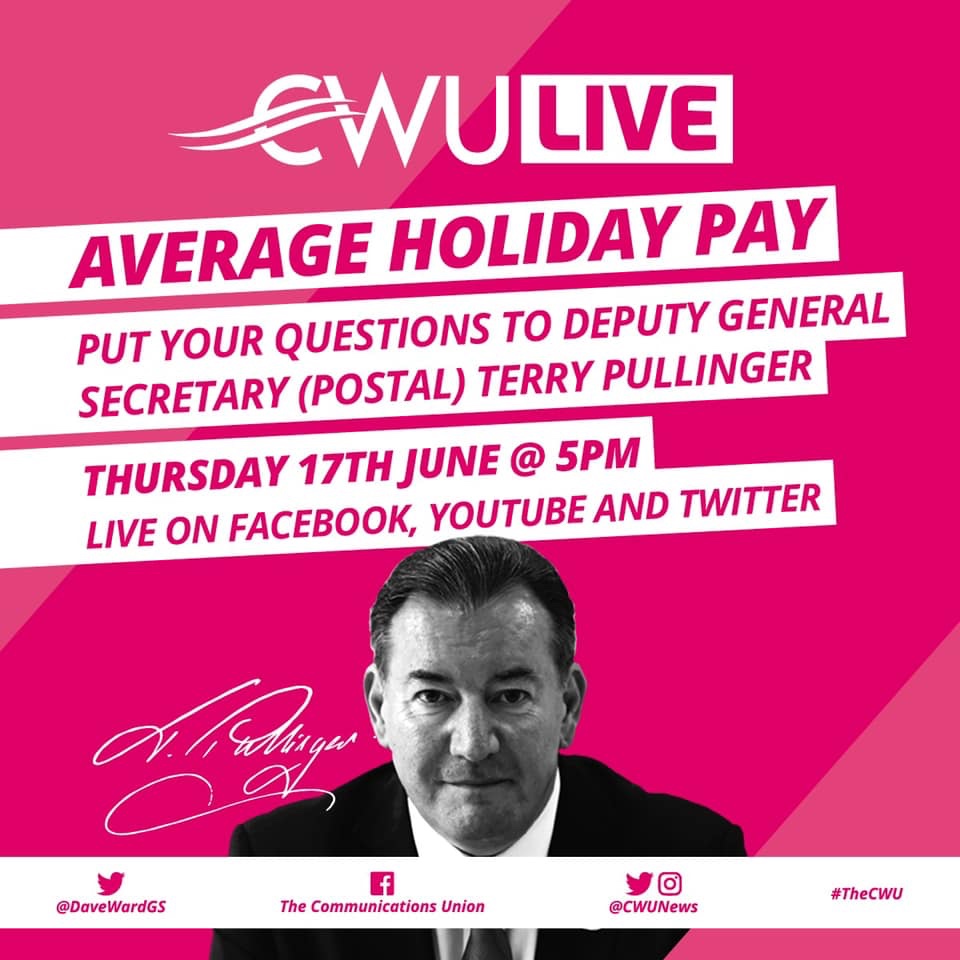
. Please share as far and wide as possible and join us live tonight at 5pm with DGSP Terry Pullinger.

Click on the links below to view the agreement

21LTB245 Average Pay on Annual Leave (Holiday Pay) in Royal Mail Group

Attachment to LTB 245-21 Final VERSION AMENDED 160621 Negotiator’s Agreement – public summary of holiday pay deal

View Online

Royal Mail/CWU Joint Statement & Communication on Return To Shared Van Working Arrangements:

Royal Mail/CWU Joint Statement & Communication on Return To Shared Van Working Arrangements:

This is an important update for Branches, Area Safety Reps and Area Delivery Reps further to the RM/CWU Joint Statement and Communication issued with LTB 237/21 on 11 June 2021.

The Joint Statement made clear that it would be subject to the further Government advice and announcements due on the 14th June as well as the relevant advice from the respective UK Devolved Authorities.

Following the Prime Minister’s announcement on Monday that there will be a delay to the lifting of all legal restrictions on social contact until at least 19 July 2021, further discussions took place with Royal Mail Group on the company’s plans to reintroduce van sharing. Those discussions concluded yesterday evening with agreement that there will be no return to shared vans until 19 July 2021 and that RMG/HQ and CWU/HQ will jointly monitor and review the situation in two weeks’ time.

It has been further agreed that Unit Managers and CWU Area Safety Reps and Area Delivery Reps should utilise the time over the Next four weeks to engage and discuss plans regarding the implementation of shared vans working arrangements in order that a smooth, practical and safe transition back to these arrangements is ready when the time comes.

A new joint communication has been signed confirming the above and reaffirming the contents of the important and detailed joint statement signed and issued on 11 June. Copies of both are attached for your information and attention.

Finally, and also importantly is the added ‘footnote’ to the joint communication being issued this morning making reference to the Royal Mail Group/CWU agreed Workforce Lateral Flow Device Testing Scheme of which both the Employer and Union are urging all Units and all Members to participate in. We would ask all Area and Workplace Reps to support the take up of testing by members whereby the Test Kits are supplied to units for distribution to members in the workplace in order that they can test themselves in the privacy and comfort of their own homes, twice a week and in so doing protect themselves and their work colleagues. To date a number of members with no symptoms have tested positive for Covid-19, so enabling them to self-isolate and seek appropriate treatment whilst helping prevent the Virus spread and potential outbreaks in units amongst their colleague members. A number of Units are not yet participating in the scheme and we would ask that as many Units and members joint in. Please support this.

Yours Sincerely

 Dave Joyce

National Health Safety & Environment Officer

 Mark Baulch

Assistant Secretary Outdoor Postal Department

LTB 246-21 Return To Shared Van Working Arrangements

National Joint Communication Update Van sharing_16 June 2021

Van Sharing Joint Communication.doc 11.06.21  

Joint Statement Return to Van Sharing

Average Pay on Annual Leave (Holiday Pay) in Royal Mail Group

Average Pay on Annual Leave (Holiday Pay) in Royal Mail Group

Further to LTB 243/21 circulated on 16th June 2021, I am pleased to report that the attached Agreement was endorsed by the Postal Executive at a meeting in Birmingham on 9th June 2021.  This is a National Agreement for Royal Mail Group (excluding PFSL) for average holiday pay for non-contractual overtime.

When considering this Agreement, it is extremely important that Branches do this in the context of our journey to reach this point as opposed to trying to benchmark against cases in other businesses.  Each court case has been settled on its own merit and the definitive issue at the crux of the matter is always what does regular look like in that specific circumstance.  For total clarity, there is no specific definition of what constitutes regular overtime.

Against that backdrop, this historical passage has been ongoing since 2014 when it was reported in LTB 587/14 that a meeting with the company’s senior management team had been arranged to discuss the basis of our claim and to try to reach a settlement.

There was very little case study to consider at this time and the position of the CWU and RMG was widely reported in LTB 064/15 circulated on 2nd February 2015 along with a draft copy of a letter that was to be sent to members’ home addresses as an insert in the Voice.

The letter provided a comprehensive overview of the situation and also advised members that although the Union was pursuing this matter with the employer on their behalf, it did not prejudice their individual right to take their own course of action.  The Union however would not be able to provide legal advice to individuals who wished to pursue this matter themselves.  It was made clear that meetings with Royal Mail Group were being held and the respective lawyers were in discussions on finalising Employment Tribunal test cases to protect the legal position of CWU members.  Basically we were waiting for legal case study to inform an agreement with RMG.

Whilst the test cases were initially slow to emerge and have built up latterly, they were still based on individual businesses and their particular circumstances, allowing RMG to argue that the issue of regular and reference periods were still indecisive.

Following the carriage of Motion 60 at Postal Conference in 2018, reinvigorating progress in order to force RMG’s hand became our priority.  It was agreed to consult with Branches to find suitable test cases and once identified we would legally support members making an Employment Tribunal claim.

Our ongoing strategy was devised to increase the pressure on the company to reach a collective national agreement.  We therefore embarked on a complex campaign to maximise the number of claimants nationwide.  This moved us to another level by encouraging as many cases to be started as possible in order to form a group claim against the business.  Branches were informed of this strategy in LTB 123/19 that also contained a ten step process and supporting flowchart to assist in processing these claims.

As claims began to be submitted in ever increasing volumes, Royal Mail Group started to make financial offers at the ACAS stage and significant numbers of members benefited from settlements.  The vast majority were part-time delivery members although the process was enacted by members across all functions and most Royal Mail business units.  As their costs began to increase, Royal Mail Group made a decision around October 2019 to stop making offers at ACAS for any claims that were registered after this time.

The focus then became maximising the number of claimants through Branch involvement that would progress to the Employment Tribunal stage.  To supplement this the DGS(P) Department also met with the Legal Services Department and Unionline to make preparations to commence a group claim and identify a number of Lead Claimants.

The situation was complicated as cases in both Scotland and Northern Ireland are subject to a separate legal process from those in England and Wales with the latter cases initially scheduled to be heard at the Bristol Employment Tribunal in April 2020.

Royal Mail Group came back to the negotiating table and a few meetings were held prior to the outbreak of Covid 19. The pandemic however meant that the Tribunal in Bristol was postponed until 21stJune 2021 although the pre-hearing was held on 2nd June 2021.  At this time there were 5953 cases in England and Wales that were included in the group action and obviously many more have been registered in Scotland and Northern Ireland.  It is estimated that over 7,000 Employment Tribunal cases have been registered nationwide and this is a testimony to the hard work that our Postal Executive members, Field Officials, Branches and Representatives have put into promoting the issue of average pay on annual leave.

Following the endorsement of the Pathway to Change Agreement on 3rd February 2021, an approach was made by Matt Newman, the Chief HR Officer RMG to commence dialogue again with the aim of reaching a national agreement prior to the Employment Tribunal in Bristol.  This was an opportunity that had to be taken and negotiations then commenced in earnest and it soon became clear that there was a refreshing approach to the talks that had not previously been evident.

Branches will understand that the key factor in these talks continued to relate to what defined regularity.  Additionally, whilst the European Directive element of holiday pay applies only to the first twenty days of annual leave, it was important to test this point particularly in terms of our part-time members who, in the main, are the group performing the most overtime.  Part-time members in particular have been used as a flexible resource by the business for far too long and this was highlighted during negotiations.  Back pay was also a major issue and in particular the length of the period and the calculation involved.

The Negotiators Agreement represents a major step forward for the Union.  I believe it also reflects the level of commitment from all of our representatives to reach this point.  Branches will see that the following have been achieved:

  • An agreed understanding of what constitutes regular overtime.
  • An agreed calculation for the payment of holiday pay.
  • Defined reference periods for the calculation of regularity.
  • All overtime to feature in the calculation once the agreed regularity threshold has been met.
  • A process to allow interim and longer term payments to be made.
  • Full-time to be paid for the first four weeks of holiday each year.
  • Part-time to be paid for all contractual annual leave up to full-time hours with hours above full-time being paid for four weeks.
  • Maternity, paternity, SPL or adoption leave for the purposes of the regularity threshold, it is agreed to pro-rate the qualifying period.
  • A maximum of two years back pay subject to meeting the regularity threshold.

Our legal advisers believe that achieving recognition for part-timers up to full-time hours to receive average pay for all their contractual hours and the section on maternity, paternity, SPL or adoption leave are major achievements that would not be reached in a courtroom.  Equally despite RMG having given great publicity to the deal they reached with Unite we have achieved a far improved agreement.

In essence for average holiday pay to make a real difference one has to be performing fairly high levels of overtime, which in our industry has always been available.  This Agreement means that anyone performing 8 hrs per month or more throughout the year will receive an average of all overtime worked in their annual leave ‘top up’ payment.

Ideally the DGS(P) Department would have liked to have circulated the proposed agreement before today but had to conclude further discussions concerning obtaining an agreed process for addressing the high volume of individual cases that are actually at the Employment Tribunal stage.  Since the proposed agreement was endorsed by the Postal Executive there have been intense discussions involving the DGS(P) Department, Legal Services, Unionline and our Solicitors with Royal Mail Group and their Legal counterparts.  These talks have resulted in the terms of a draft order being agreed as well as a full supporting legal document for the agreement on holiday pay.  To be clear the draft order allows for:

  1. The claims of the lead claimants to be stayed with the final hearing listed on 21st\ June to be vacated (The lead claimants have all agreed to this).
  1. If the proposed agreement is ratified, the Union will then send a letter to all claimants asking how they would like to proceed and whether they now wish to withdraw their claim for holiday pay. Back payments to an individual for arrears of holiday pay will be conditional on withdrawing the Employment Tribunal claim.  There will be a reasonable time-frame for members to return the forms.
  1. The Union will then communicate all of the responses received to the Employment Tribunal and not provide legal support and assistance to the remainder.

In order to allow time for communications and a Branch ballot to be enacted, this is a process that had to be agreed and finalised but this does not mean that the Union has given up the cases in the event that the proposed agreement is not ratified.

I am however confident that as over 70,000 of our members perform regular non-contractual overtime this Agreement will be especially welcome and benefit members going forward.  It will also undoubtedly drive the right behaviours in terms of increasing the contractual hours of part-time members.  I have no hesitation in recommending this comprehensive Agreement to Branches and members for acceptance.

A further communication regarding the details and timescales for the Branch ballot will be circulated in due course.

In conclusion, I would like to place on record my thanks and appreciation to all of the Representatives and members who have promoted Union policy in this regard as well as Tony Rupa and the team in the CWU Legal Department, who along with their colleagues from Unionline, have supported the DGS(P) Department throughout the Employment Tribunal application/hearing process and to Ivan Walker, QC for his support and early advice which laid an invaluable foundation on the Union’s approach.

Any enquiries in relation to the content of this LTB should be addressed to the DGS(P) Department.

Yours sincerely,

Terry Pullinger
Deputy General Secretary (Postal)

21LTB245 Average Pay on Annual Leave (Holiday Pay) in Royal Mail Group

Attachment to LTB 245-21 Final VERSION AMENDED 160621 Negotiator’s Agreement – public summary of holiday pay deal

View Online

NEC and Industrial Executive Elections 2021 – Voting Entitlement

NEC and Industrial Executive Elections 2021 – Voting Entitlement

The purpose of this LTB is to provide Branches with further information regarding the forthcoming NEC, and Industrial Executive ballots which are scheduled to take place from 6 July 2021 to 3 August 2021.

In line with our previous policy we are taking this opportunity to provide some additional guidance on the number of candidates that members will be entitled to vote for in each of the respective ballots.

We hope this will assist Branches in providing advice to their members regarding any recommendations that the branch may wish to make.

Branches will find the full list of nominations for the above elections in the following LTB 234/21 dated 10th June and LTB 240/21 dated 14th June 2021.

Listed below are the ballots scheduled to take place in the 2021 series of NEC and IE elections.  Also listed is the relevant member voting entitlement for each particular ballot.

POSTAL CONSTITUENCY

National Executive Council Representatives

Postal Constituency Chair – No ballot required.

Postal Constituency Vice Chair – No ballot required.

Postal Constituency – NEC Section 1

  • All members of the Postal Constituency are entitled to vote in this ballot.
  • There are 17 candidates listed on the voting paper.
  • The number of candidates to be voted for in this ballot can be less, but not more than nine. 
  • Accordingly Branches will be entitled to recommend up to nine candidates to their members.

Postal Constituency – NEC Section 2               

  • All members of the Postal Constituency are entitled to vote in this ballot.
  • There are 2 candidates listed on the voting paper.
  • The number of candidates to be voted for in this ballot is one. 
  • Accordingly Branches will be entitled to recommend onecandidate to their members.

Postal Constituency – NEC Section 3 (Young Worker) – No ballot Required.

Postal Constituency – NEC Section 4 (Women) – No ballot required.

Postal Constituency – NEC Section 4 (LGBT+) 

  • All members of the Postal Constituency are entitled to vote in this ballot.
  • There are 2 candidates listed on the voting paper.
  • The number of candidates to be voted for in this ballot is one. 
  • Accordingly Branches will be entitled to recommend one candidate to their members.

Postal Constituency – NEC Section 4 (Disability) – No ballot required.

Postal Constituency – NEC Section 4 (BAME) 

  • All members of the Postal Constituency are entitled to vote in this ballot.
  • There are 2 candidates listed on the voting paper.
  • The number of candidates to be voted for in this ballot is one. 
  • Accordingly Branches will be entitled to recommend onecandidate to their members.

Postal Executive Representatives – Postal Grades

  • All Postal Grade members of the Postal Constituency are entitled to vote in this ballot.

Please note that members of the Postal Constituency who are Postal & Technical Services grades will not be eligible to vote in this ballot. 

  • There are 17 candidates listed on the voting paper.
  • The number of candidates to be voted for in this ballot can be less, but not more than thirteen.  
  • Accordingly Branches with Postal Grade members will be entitled to recommend up to thirteen candidates to their members.

Postal Executive Representatives – Postal & Technical Services Grades – No ballot required.

TELECOMS & FINANCIAL SERVICES CONSTITUENCY

National Executive Council Representatives

T&FS Constituency Chair – No ballot required.

T&FS Constituency Vice Chair  

  • All members of the TFS Constituency are entitled to vote in this ballot.
  • There are 2 candidates listed on the voting paper.
  • The number of candidates to be voted for in this ballot is one. 
  • Accordingly Branches will be entitled to recommend onecandidate to their members.

T&FS Constituency – NEC Section 1

  • All members of the T&FS Constituency are entitled to vote in this ballot.
  • There are 5 candidates listed on the voting paper.
  • The number of candidates to be voted for in this ballot can be less, but not more than four. 
  • Accordingly Branches will be entitled to recommend up to four candidates to their members.

T&FS Constituency – NEC Section 2 – No ballot Required.

T&FS Constituency – NEC Section 3 (Young Worker) – No ballot Required.

T&FS Constituency – NEC Section 4 (Women)

  • All members of the T&FS Constituency are entitled to vote in this ballot.
  • There are 2 candidates listed on the voting paper.
  • The number of candidates to be voted for in this ballot is one  
  • Accordingly Branches will be entitled to recommend one candidate to their members.

T&FS Constituency – NEC Section 4 (BAME) – No ballot required.

T&FS Constituency – NEC Section 4 (Disability) 

  • All members of the T&FS Constituency are entitled to vote in this ballot.
  • There are 2 candidates listed on the voting paper.
  • The number of candidates to be voted for in this ballot is one  
  • Accordingly Branches will be entitled to recommend one candidate to their members.

T&FS Constituency – NEC Section 4 (LGBT+) – No ballot required.

T&FS Executive Representatives

TFSE – TFSE Young Worker 

  • All members of the T&FS Constituency are entitled to vote in this ballot.
  • There are 2 candidates listed on the voting paper.
  • The number of candidates to be voted for in this ballot is one 
  • Accordingly Branches will be entitled to recommend one candidates to their members.

TFSE – Santander Group and related companies (Santander UK, Santander UK Operations Ltd, Santander UK Technology Ltd, Santander Global and Paragon Customer Communications) – No Ballot Required.

TFSE – Telefonica O2 UK and Connect 44 – No ballot Required.

TFSE – Capita in the T&FS Sector and 14Forty (Capita contract) – No ballot required.

TFSE – All Other Members in the T&FS Constituency 

  • All members of the T&FS Constituency are entitled to vote in this ballot (Excluding members working in Santander Group and related companies, Santander UK, Santander UK Operations Ltd, Santander UK Technology Ltd, Santander Global and Paragon Customer Communications. Telefonica O2 UK, Connect 44. Capita in the T&FS Sector and 14Forty (Capita contract).
  • There are 5 candidates listed on the voting paper.
  • The number of candidates to be voted for in this ballot can be less, but not more than four. 
  • Accordingly Branches will be entitled to recommend four candidates to their members

Any enquiries regarding this Letter to Branches should be addressed to the Senior Deputy General Secretary’s Department on telephone number 020 8971 7237, or email address pmetcalfe@cwu.org

Yours sincerely,

Tony Kearns

Senior Deputy General Secretary

LTB 244/21

View Online

Create a website or blog at WordPress.com

Up ↑