CWU Consolidated Accounts 2019

CWU Consolidated Accounts 2019

Further to LTB 521/20 dated 2nd November which invited questions to the 2019 CWU Accounts, at the closing time of 12:00 hours on Monday 16th November following questions had been submitted by the Harrow and District Branch.

Q1)  It is noted that there has been a reduction of legal & medical costs from 2018 to 2019, can you provide a breakdown of these costs? 

These are contained in the table below:CodeHeading 20192018Variance5000Bandit Attack PMTS1,1894177725001Self-Insured Conditional Fees-20,454-25,9125,4585002Criminal Defence0432-4325003Disbursement Refunds-16,004-50,56234,5585004Disbursement Costs69,40670,982-1,5765005Referral Fees Income-1,920-4,5002,5805006Commission Income-69,5680-69,5685008Medical Fees1,3701,0782925009Medical Tribunals3301491815011Indemnity Insurance47,02741,7505,2775012Solicitors Fees53,02931,75221,2775014Department Expenses4,5696,906-2,3375015Defendants Costs40,92284,000-43,0785017BT Hearing Loss Referral fees0-3603605018BT Hearing Loss Conditional Fees-995-99505019BT Hearing Loss Disbursements0950-950TOTAL108,901156,087-47,186

Q2)  Has there been any income generated by the Legal & Medical Services in 2019 if so where is this recorded in the accounts?

Yes, there has been income generated from legal and medical services during 2019.  This income has been included as part of the total expenses contained in the Accounts on page 24, note H Central Services to Members, Legal & Medical Services.

The total income received during 2019 was £108,941 and in 2018 it totalled £82,329, resulting in a £26,612 year on year increase. The breakdown of this income is the sum of the following headings detailed in the above table; 5001, 5003, 5005, 5006, 5017, and 5018. 

Q3)  It is noted that there is an explanation of Unionline on page 1 of the report.  On page 24 under section H there is a considerable difference between 2018 and 2019 Unionline costs.  Can you provide a full breakdown of the Unionline costs for 2019 and an explanation for the difference in costs between 2018 and 2019? 

Breakdown of Unionline Costs:Heading 20192018VarianceGeneral Department Expenses                                       (directly related to ownership of Unionline)53,65621,89731,759Unionline Recharge2,584,388-1,022,3953,606,783TOTAL2,638,044-1,000,4983,638,542

The explanation provided on page 1 of the “Report of the Senior Deputy General Secretary” is, as the question sets out, the answer to the point raised.  That is, the impact on this particular set of accounts only is that, whilst those discussions continue at national level with the GMB, we have not yet finalised the issue of when we will take cash out of the business in time for that to be recorded in these accounts. Whilst we are of the opinion that the Union will receive repayment of the monies owed, we currently cannot do so with the certainty the auditors need to rely on (i.e. the timescale it will take us to recover the debt in full).  In light of this, we can no longer carry this debt forward.  In accounting terms, this is known as making a provision against an uncertain debt.

In summary, in not being able to specify exactly when amounts owed by Unionline will be repaid and therefore providing for the amounts outstanding we now show an operating loss of £1.04m and a total comprehensive expense of £4.75m.  If we could have specified exactly when the amounts would be repaid, no provision would have been necessary and we would have been reporting an operating income of £2.89m and a total comprehensive expense of £816k.  We want to be absolutely clear in repeating our previous messaging on this matter, this does not mean we have paid out this money in cash.  The total and only cash amount loaned to Unionline remains as it has for some years now at £273,250.

This issue solely relates to the amounts we have recharged Unionline in recent years.  Accordingly, as can be seen, particularly under HQ expenses page 21, the inclusion of this provision against the monies owed to us is the primary reason for the change from a surplus in 2018 to a deficit in 2019. This does not imply that we have written any debts off permanently, but more so that we have agreed to be very cautious in our current assessment as to the recoverability of amounts owed in the short term.  Future recovery of any of these amounts owed will positively impact on our accounts in the future.

In short, the year on year difference is due to the Union not making a recharge to Unionline for the 2019 period.  As well and as explained above, in 2019 the Union included a provision for bad debts against prior year Unionline recharge income.  So in essence the 2018 accounts record income for Unionline in the form of a recharge and 2019 does not include any income, but instead writes off income from prior year recharges, creating the considerable difference year on year.

Any enquiries regarding this Letter to Branches should be addressed to the Senior Deputy General Secretary’s Department on telephone number 020 8971 7237, or email address sdgs@cwu.org.

Yours sincerely,

Tony Kearns
Senior Deputy General Secretary

20LTB550

View Online

COVID-19: Sick Pay – Clinically Extremely Vulnerable (CEV) Members

COVID-19: Sick Pay – Clinically Extremely Vulnerable (CEV) Members

Since the Government announced that England would go into a second lockdown and
members who are in the Clinically Extremely Vulnerable (CEV) category have been
instructed to shield, the CWU have been pressing Royal Mail to amend the Sick Pay
Policy to take into account the exceptional circumstances of Coronavirus Covid-19.
Earlier today Royal Mail communicated their latest policy and it is attached to this LTB
as APP1.

During our meetings we have been expressing the view many of our members,
especially our CEV members will potentially be suffering severe financial difficulties due
to the result of the previous lockdown situation and will be more likely to be moving
towards half or nil pay. Our CEV members will by now have received a communication
from the NHS/Government advising them not to attend work and stay at home
‘shielding’ unless they can work from home.

The latest policy decision means Royal Mail sick pay will be extended to those CEV
members who are due to move onto half or nil pay, including those with less than 12
months service until the 2nd December 2020. Whilst this policy change from Royal Mail
will be very welcome news to CEV members, it is disappointing Royal Mail continue
with policies which are divisive and look at cost rather than the health of our
members/their employees, as this policy does not flow through to any member who is
not in the CEV category. Therefore, if you are contacted by track and trace or another
means and are told to self-isolate for a period of time, you will not continue to get full
pay should you fall into the half or nil pay category, due to exhausting your period of
full pay.

No matter what category of health you are in, members will have to face a very difficult
decision and may have to choose between attending work in defiance of the
Government request or accepting half pay or nil pay if they stay at home.
We do not believe this decision is easier for anyone who is not in the CEV category and
therefore believe the policy should apply to anyone who is contacted by Government to
shield or self-isolate.

Representatives and branches should also note the conditions this policy change has to
annual leave. The new policy insists any pre-booked annual leave has to be taken and
if there are any further lockdowns, any remaining annual leave has to be taken by 31st
March 2021, whether it overlaps with shielding or not, not even being allowed to carry
over the normal 5 days.

This policy decision only applies to CEV employees in England as Scotland, Northern
Ireland and Wales have their own devolved governments. When members are told to
shield going forward we will be discussing this with Royal Mail.

Whilst we want to acknowledge the positive moves for members who are in the Critically
Extremely Vulnerable category who are shielding, for members who have to self isolate
as a result of CV19 this will be seen as divisive and unfair. Many of these members will
be faced with the dilemma of having to choose between risking coming into work or
suffering a financial detriment through no fault of their own. The CWU will continue to
push for these members to be supported further by Royal Mail as we believe short term
cost savings on sick pay are not the right way to support employees through this
pandemic in exchange for the potential health risks involved.

We will continue our discussions with Royal Mail as we believe there will be further
lockdowns and this is only a short term fix. We want to agree a strategy with Royal
Mail which is fair to everyone and where members do not have to make the unenviable
decision of putting themselves, their families and their fellow colleagues at risk through
not being able to afford to stay away from work.

All enquiries regarding the content of this LTB should be addressed to the PTCS
Department, quoting reference 404. Email address: khay@cwu.org.

Yours sincerely,
Carl Maden
Assistant Secretary (Acting) PTCS Department

LTB 547/20
LTB 547/20 – Attachment

CWU DHL Parcel National Petition

CWU DHL Parcel National Petition

To all CWU branches and activists,

Stop DHL Making a Covid Killing at Workers Expense

DHL Parcel UK’s response to the coronavirus pandemic has been shameful.

Due to greatly increased demand, the company have continued to see profits grow, while placing their own key workers in dire financial hardship.

To avoid any potential government fines, DHL has been insistent on reminding employees of their wider obligations should they test positive for Covid-19, or are contacted by the track-and-trace system.

There isn’t any doubt: self-isolation is an essential part of helping to tackle the virus infection rate.

But currently, DHL Parcel UK are paying limited or zero sick pay for workers forced to self-isolate, and are counting this as part of normal sick absences. This means that doing your duty as a citizen could trigger disciplinary processes, and that the company expects workers to pay the price for recovery.

Company policy claims to be reviewing all instances of self-isolation on a case-by-case basis. But in the course of our representing workers, the CWU has found no evidence of any review.

To make it clear: we believe DHL workers are suffering a gross injustice for following government guidelines on Covid-19. We believe that the company’s practice and process is deeply unfair. Nobody should be forced to choose between self-isolating for the common good, or feeding their families and paying bills.

Our petition calls for DHL Parcel UK to:

  • Pay their employees sick pay if they, or a household member or person in their social bubble, displays Covid-19 symptoms;
  • Manage any Covid-19 related absence outside of their sickness absence policy, as employees do not have a choice over self-isolation.

We are asking all CWU branches, members and friends to help widely distribute this petition online through email lists to workers and across social media.

The CWU is committed to creating fairness, equality and justice for all employees across the parcels sector. Our primary goal is to protect employment rights and narrow the gap between recognised and non-recognised companies.

This will enable us to protect terms and conditions within our core business and maintain the integrity of the service.

We need to make sure that all those who benefit from the CWU’s work become members of our union – and that is why wider support in this campaign is crucial.

Actions: 

  1. Distribute the DHL Parcel COVID-19 petition from your social media accounts. We have suggested wording for your posts and images attached. There is also a poster for members to show their solidarity – please post photos of yourself holding this for social media, tagging the below CWU campaign accounts and hashtags
  2. Distribute the DHL COVID-19 petition to CWU Members and activists via email
  3. Engage in the debate with your own comments using #DHLCovid to show solidarity with DHL workers
  4. Please email dhl@cwu.org to let us know about your progress in petition distribution.
  5. Follow our social media accounts for the DHL Campaign:
    1. Facebook: /cwuatDHL  Twitter: @CWUatDHL

Suggested wording for social media posts are:

  1. Tell @DHLParcelUK that their workers should not be forced to choose between self isolating for the common good or feeding their families #DHLCovid
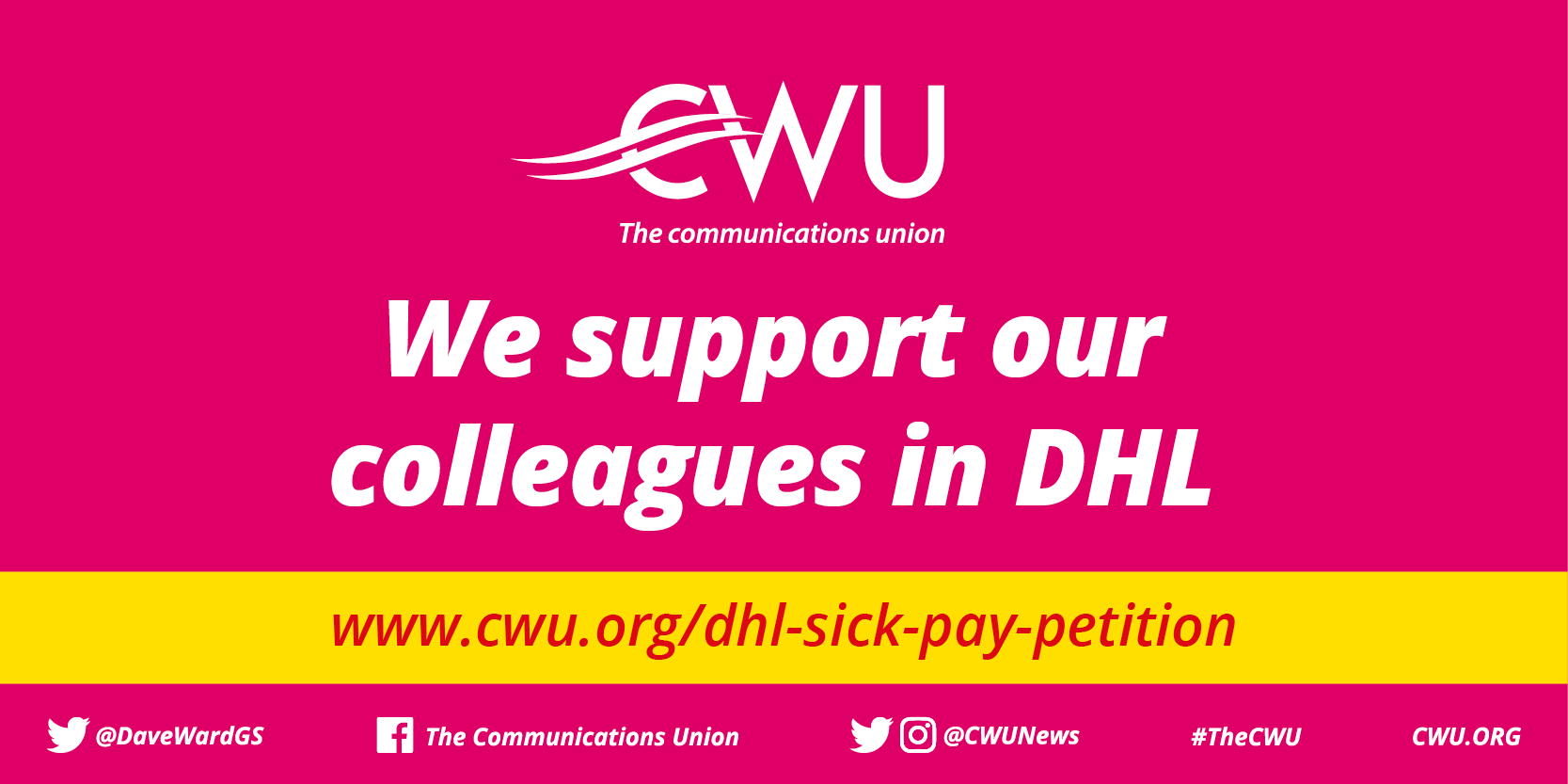
    Sign the petition https://www.cwu.org/dhl-sick-pay-petition
  2. Workers in @DHLParcelUK who worked throughout #COVID19 crisis should not be facing financial hardship, they deserve full sick pay for self-isolation, sign the petition now #DHLCovid https://www.cwu.org/dhl-sick-pay-petition

Yours sincerely,

Ray Ellis
Head of Recruitment and Organising

LTB 546:20 CWU DHL Parcel National Petition

06494 DHL solidarity poster (A4)

06494 DHL solidarity social graphic

Royal Mail Introduction of Mandatory Face Mask Wearing in Indoor Work Situations

Royal Mail Introduction of Mandatory Face Mask Wearing in Indoor Work Situations

In light of the recent worsening Covid-19 circumstances, Royal Mail and the Union have agreed this new measure and are urging full compliance by members, with the crucially important caveat that this must not replace other preventative, risk control measures.

In contrast to the first lockdown, the wearing of face masks is now commonplace in any under-the-roof area where people are together – be it on public transport or in shops.

So clearly we would support this as part of a holistic approach to the safety of our members to stop the spread of the virus and to save lives, and that people who are able to do so, wear masks in the workplace.

Therefore, the disciplines that were in place during the first lockdown should be rigorously enforced once again, along with the wearing of face masks for those able to do so i.e., high levels of hygiene, hand washing regularly, use of sanitiser and disinfectant wipes, two-metre social distancing, all PPE in place and high levels of cleanliness for all equipment and buildings.

The CWU supports all of these key, important safety measures being applied so long as they are applied with equal status, and local reps and members should be fully involved, keeping check and demanding that all of these safety measures are in place.

The CWU is supporting this decision, subject to ongoing discussions, for a number of very important reasons – as we have all seen and heard on the news of the nationwide rise in infections, deaths and hospitalisations and the return to lockdown in England, following on from many areas of the country imposing increased restrictions including Scotland, Wales and Northern Ireland.

As well as the general situation, the incidents of workplace infections have, according to the TUC, risen by an alarming 125 per cent over the recent period and, with the imminent ‘Christmas Pressure’ period and the arrival of an estimated 30,000-plus seasonal casual workers soon to start in Royal Mail, this new measure is of extreme importance.

As well as insisting that the ‘mandatory masks’ measure is not an end in itself and does not replace other existing preventative, risk control measures, the union is also pressing for the urgent introduction of a workplace weekly testing regime which is currently under discussion with Royal Mail and government agencies. CWU/HQ has formally put this forward to Royal Mail Group in order to further improve safety, and reduce workplace transmissions and infections – as well as giving a huge reassurance to the workforce at this tough time.

It has been agreed that masks will not be compulsory while working outside – or when seated to eat or drink in rest rooms during breaks – that visors will be provided, that masks will be changed frequently and not limited, and that medical and other specified exemptions will be applied where appropriate.

There will also be appropriate arrangements for those who rely on lip reading, clear sound or facial expressions.

A video message on this subject featuring Dave Joyce CWU National Health and Safety Officer and Shaun Davis, Royal Mail compliance & sustainability officer can be viewed at this link on CWU Website: https://www.cwu.org/news/royal-mail-workers-wearing-masks-keeping-safe-keeping-healthy/

Further updates will follow.

Yours sincerely

Dave Joyce
National Health, Safety & Environment Officer

LTB 545/20 – Royal Mail Introduction of Mandatory Face Mask Wearing in Indoor Work Situations

RMG/CWU Joint Statement Dealing with Coronavirus/Covid-19 – Protecting and Putting Employees First and Introduction of Mandatory Face Masks

RMG/CWU Joint Statement Dealing with Coronavirus/Covid-19 – Protecting and Putting Employees First and Introduction of Mandatory Face Masks

Discussions with Royal Mail Group on the subject of Covid-19 protection for the workforce and the deployment of face coverings/face masks has been subject to discussion with CWU/HQ over recent weeks. On Friday 30 October the Union was informed of the employer’s intention to change their policy from ‘Strongly Recommended’ to ‘Mandatory’. Proposals were then put to the Union, regarding the company’s intention to move to ‘Mandatory’ face covering/face masks for all staff from Monday 9 November with RMG requesting CWU support.

As the Coronavirus/Covid-19 transmissions and infection rate continues to rise, the country is also entering the flu season. At the same time 33,000 temporary, casual and agency workers are being taken on by the company to support Christmas peak workload. These additional workers will increase the risk of infection, if adequate controls are not in place and maintained. It is therefore now mandatory to wear a face covering in all Royal Mail Group indoor workplaces.

The company also supports and encourages the wearing of face coverings whilst outdoors in order to keep employee safe when engaging customers but it is not mandatory outdoors.

However, it is crucially important to recognise that Royal Mail Group and the CWU agree that face coverings do not replace other preventative measures such as increased hand hygiene, social distancing and increased cleaning; THESE MUST REMAIN IN PLACE.

Wearing a face covering can help workers stay safe by reducing the risk of infection. This is even more important in situations where social distancing is difficult, with the onset of the flu season and where employees meet new people, such as Christmas temporary workers over the Christmas peak in crowded workplaces. The key benefits of face masks/face coverings in the workplace is to prevent the spread of the viral infection and defend the workforce from being a pandemic victim of what is an airborne illness, protecting both the wearer and the surrounding people – giving risk reduction from droplet transmission during exhalation.

The introduction of mandatory face coverings in all indoor workplaces enhances existing preventative, risk control measures to protect the workforce from Coronavirus/Covid-19. This forms part of the RMG Coronavirus Risk Assessment, which is required under health and safety legislation.

CWU/HQ is supporting the initiative having considered the current and worsening Coronavirus/Covid-19 situation across the UK along with expert scientific and medical advice and recommendations. SAGE, the Scientific Group for Emergencies who provides scientific and technical advice to government decision makers during emergencies concluded that the public and workers should be advised to wear face coverings. At the end of September the chief medical officers for England, Scotland, Wales and Northern Ireland changed the view and recommended all four nations upgrade their coronavirus alert levels following the exponential rise in cases and in a powerful joint statement said that “If we are to avoid significant excess deaths and exceptional pressure in the NHS and other health services over the autumn and winter months, everyone has to follow the social distancing guidance, wear face coverings correctly, wash their hands regularly and improve cleaning.”

Mandating of face coverings is a view shared by regulatory bodies such as the Health and Safety Executive and many local authorities. A number of Royal Mail offices (mail centres and delivery offices) have already introduced the wearing face coverings indoors, following outbreaks which made workers there realise the risk and uptake has been good.

The agreed Joint Statement covers off the important issue of the company’s approach to compliance, agreeing a compliance process and a robust exceptions process as well as CWU involvement at all levels. The CWU is supporting this decision, subject to ongoing discussions and regular joint reviews, for a number of very important reasons:

  • The Virus infection rate continues to rise. 33,500 new cases were reported yesterday with nearly 600 deaths.
  • The high daily number of new cases being recorded has been running at 20,000 to 25,000 a day for the last month.
  • Hospital admissions are increasing.
  • A 125% increase in workplace outbreaks, reported by the TUC.
  • 33,000 Christmas casuals/agency workers about to join the RM/PFWW workforce.
  • Local and regional restrictions being imposed across large parts of the country.
  • A second national lockdown in England is now in place with similar restrictions in Scotland, Wales and Northern Ireland.
  • The risk of a flu epidemic alongside the virus pandemic.
  • The number of weekly Coronavirus deaths is at its highest since June.
  • The number of patients admitted to hospital has jumped by more than 60 per cent in 10 days.
  • Hospital patients needing a ventilator has also increased by 50 per cent.
  • Following several Coronavirus/Covid-19 outbreaks/case clusters in Royal Mail and Parcelforce offices, Public Health Authorities, the HSE and local councils have recommended that Royal Mail and Parcelforce should introduce the ‘Mandatory’ wearing of face coverings/face masks in indoor workplaces.
  • A third of UK workers are worried about catching Coronavirus in their workplace.

It is fully agreed that the introduction of the new ‘Mandatory Masks/Face Coverings’ measure is not an end in itself and does not replace other preventative, risk control measures. It must be seen as one of the steps to safer working and a ‘Covid-19 Secure Workplace’.

Mandatory masks is one important component to a ‘five-pronged’, fully committed drive that’s now needed with both RMG and CWU in agreement. These are:

  • Improving Hygiene.
  • Mandatory Face Coverings.
  • Social Distancing (2M).
  • Improved Cleaning (premises and vehicles).
  • ‘Workforce Testing’ (The CWU has also requested the introduction of regular workforce testing which Royal Mail Group have accepted and are in talks with the DHSC on this matter.

RMG and CWU are in full agreement that ‘Mandatory’ face masks/coverings are not a substitute for social distancing (2M), increased/improved cleaning and improved hygiene standards.

The CWU Health, Safety & Environment Department is keen to get a workplace weekly testing regime implemented and have formally put forward a proposal to Royal Mail Group to consider the introduction of regular workplace Covid-19 testing which we strongly believe would improve safety, reduce transmissions and the infection rate plus give a huge reassurance to the workforce at this tough time.

A number of important associated issues have been raised by the Union in order to secure our support and commitment to the ‘Mandatory Masks/Face Covering’ initiative and these have been included in the Joint Statement. These are in summary:

  • Safety will be the No1 priority.
  • Masks per person not to be limited and supplies to be sufficient to enable them to be changed frequently.
  • Masks to not be compulsory whilst working outside.
  • Visors to be provided to supplement the face masks/coverings if employees request them.
  • CWU ASRs to be fully involved in the process with managers and the SHE Team to work together spot-checking/inspecting social distancing and Covid-Secure compliance.
  • A ‘supportive’, non-punitive, mask wearing compliance process in line with the RMG/CWU PPE National Agreement 3-step process.
  • A robust ‘exceptions process’ – this includes (but is not limited to) staff with underlying medical, physical or mental health conditions. Where this is the case, members will inform their manager that they are unable to wear a face covering and their manager will accept it. Management will not refuse to accept exemption for these workers and managers will not request that individuals provide evidence to prove that they are exempt. Exempt workers may wear an exemption card or badge if they so wish but it is not mandatory. Exempt workers do not need to request a letter from a medical professional about the reason for being exempt from wearing a face covering.
  • Employees may remove face coverings when seated to eat or drink in staff mess rooms, rest rooms, restaurants or cafes.
  • Arrangements will be put in place for those members who rely on lip reading, clear sound or facial expressions to communicate.
  • In line with the RMG Five-Year Mental Health Strategy, RMG will, with the full support and involvement of the CWU, support and assist those members in distress with mental health problems. Mental wellbeing will continue to be promoted to minimise the risk of widespread and long-term problems as a result of the pandemic.

Workplace Intense Cleaning Following Cases of Covid-19 Positive Tests

It is confirmed that following the diagnosis of positive cases in Royal Mail Group workplaces, intense virucidal, antimicrobial cleaning will take place of both the workplace and vehicles.

Reducing the Risk of Covid-19 Coronavirus Transmission in the Workplace 

RMG and the CWU recognise that the introduction of the mandatory use of face coverings in indoor settings is part of a package of government control measures to reduce the risk of Coronavirus transmission and must not be treated in isolation as a ‘catch-all’ solution. RMG therefore is fully committed to the need to:

  • Maintaining social distancing of 2m.
  • Promoting increased hygiene standards, frequency of hand washing, hand sanitising and the use of disinfectant wipes.
  • Increase cleaning standards in workplaces, toilets, washrooms, changing rooms, restrooms etc., and vehicles plus surface cleaning, including disinfecting frequent touch points.
  • Keeping the activity time involved as short as possible.
  • Using screens or barriers to separate people from each other.
  • Reducing the number of people each person has contact with.
  • Following government and HSE guidance.
  • Making it understood that face coverings alone are no substitute for all of these above measures.
  • Visors can be worn and will be provided on request (to be worn in conjunction with a face covering).
  • Face coverings will not be compulsory whilst working outside.

Exemptions

To reiterate the important point made above; RMG recognise that some people are unable to wear face coverings for various reasons.  A robust ‘exceptions process’ is now in place. This includes (but is not limited to) staff with underlying medical, physical or mental health conditions. Where this is the case, members will inform their manager that they are unable to wear a face covering and the manager will accept it. Management will not refuse to accept exemption for these workers and managers will not request that individual provide evidence to prove that they are exempt. Exempt workers may wear an exemption card or badge if they so wish but it is not mandatory. Exempt workers do not need to request a letter from a medical professional about the reason for being exempt from wearing a face covering.

Video Update

There is a video update from Dr. Shaun Davis, Royal Mail Group Global Director Compliance & Sustainability and Dave Joyce, CWU National Health, Safety & Environment Officer available to view on the following links –please bring this to the attention of members:

https://royalmailcommunications.newsweaver.com/ldi3fqlw6h/1dn3qmvrypt19wxbbsj1na/external?email=true&a=5&p=5855414&t=2325166

https://royalmailcommunications.newsweaver.com/ldi3fqlw6h/kk2qcc2g20919wxbbsj1na?email=true&lang=en&a=5&p=5855414&t=2325166&autoPlay=VIMEO-475969938

CWU Representatives Involvement

RMG will encourage everyone to support this policy. CWU Representatives will be fully involved at all times with their input taken into account. There will be strong local CWU involvement and employee engagement to ensure better understanding of the policy and the reasons for the ‘Covid-Secure’ risk control measures. Managers and CWU representatives will work together to ensure that this policy is deployed in a supportive manner, providing encouragement, assistance and help – not a punitive approach. SHE Business Partners and CWU ASRs will be fully involved, consulted and available to advise and support unit managers with any queries about the Covid-Secure controls and compliance with them.

Attachments:

  • Joint Statement
  • PPE 3-Step Compliance Process
  • Mandatory Face Coverings poster
  • Mandatory Face Coverings and Masks – Frequently Asked Questions and Answers Version 2 (this will continue to be updated)
  • Guidance for managers on mandatory face coverings in indoor workplaces
  • Colleague Update on mandatory wearing of face coverings in indoor workplaces

Yours sincerely

Dave Joyce
National Health, Safety & Environment Officer

LTB 544/20 – RMG CWU Joint Statement Protecting and Putting Employees First and Introduction of Mandatory Face Masks

Face Coverings Frequently Asked Questions and Answers V2

Mandatory Face Covering – Guidance For Managers v1

Mandatory face coverings poster

PPE Agreement 3-Step Compliance Process

RM_COLLEAGUE UPDATE_Face Coverings

RMG-CWU Joint Statement – Mandating of Face Covering in Indoor Workplaces._ Final

COVID 19 – RESUMPTION OF CLASSROOM BASED, DRIVER CPC TRAINING

COVID 19 – RESUMPTION OF CLASSROOM BASED, DRIVER CPC TRAINING

Branches will recall that Royal Mail suspended classroom based Driver CPC training in March 2020 due to the Covid-19 pandemic. This cessation was facilitated by a Department for Transport (DoT) and Driver and Vehicle Standards Agency (DVSA) action to suspend enforcement arrangements for all Drivers whose Driver Qualification Card (DQC) expired during the period from 1st March 2020 until 31st September 2020, allowing them to continue driving. This information was circulated to Branches in LTB 167/20 on 1st April 2020. 

There was some conjecture over whether this dispensation would be extended and further clarification was issued indicating that all Drivers whose DQC expired between 1st March and 31st August 2020 would have their entitlement extended by 7 months, i.e. a driver whose card expired on 1st June 2020 would have until 1st January 2021 to complete training. 

However, in June 2020 the original dispensation relating to September 2020 was in fact rescinded by the DoT on the basis that in their view there were sufficient CPC training classes available to ensure that training commitments could be met. Drivers with cards expiring from the end of August are now required to complete training and are subject to enforcement action. Failure to complete training removes the entitlement to drive and could lead to fines of £1000.

The phasing of CPC training in Royal Mail has meant that very few Drivers DQC’s were due to expire during this period, however RMG have been monitoring the situation and believe that it is now imperative that Driver CPC training recommences if they are to avoid DQC’s expiring.

Extensive discussions have therefore been taking place between the business and the CWU Health and Safety Department on arrangements to allow classroom training to recommence in a safe manner and SSOW and safety compliance documentation has now been agreed. Classes will be restricted to a maximum of six attendees and full social distancing arrangements will be in place at all times. For the avoidance of doubt, following consultation with the Health and Safety department we can confirm that in line with the generic RMG policy the wearing of Face Coverings will be mandatory in the classroom.

All documentation and agreed processes will be shared in advance with the Advanced Driver Coaches (ADC’s) to ensure that the approach is deployed consistently.

The resumption of training will prioritise any drivers whose cards have expired or that are due to expire soon, following which BAU courses will continue to catch all DQC’s that have not been carried out since March this year.

The departments believe that all necessary actions have been taken to enable training to resume in a Covid safe environment. In these circumstances and against the very real threat that our Professional Driver members could start to lose their entitlement to drive, the department has agreed to support the recommencement of classroom training from Monday, 16th November 2020. It has been agreed to jointly review progress two weeks after the recommencement of DCPC training to check on the process and to ensure that the arrangements are working. 

Attached for the information of Branches are the SSOW and Safety Documents relating to the classroom activity and the latest Gov UK advice on Enforcement.

Branches and Representatives are asked to ensure that the content of this LTB is brought to the attention of our Network and Distribution Professional Driver members.

Any enquiries in relation to this LTB should be addressed to Davie Robertson, Assistant Secretary, email: dwyatt@cwu.org quoting reference 502.02.

Yours sincerely

Davie Robertson

Assistant Secretary

LTB 541/20

Attachment 1 – LTB167-20 Coronavirus CPC

Attachment 2 – DCPC Actions

Attachment 3 – Gov UK Extension of DCPC Expiry Dates

Attachment 4 – Classroom Training Coronavirus SAC1

BRIAN LEE – CWU NATIONAL EXECUTIVE COUNCIL MEMBER (RETIRED MEMBERS’ REPRESENTATIVE)

BRIAN LEE – CWU NATIONAL EXECUTIVE COUNCIL MEMBER (RETIRED MEMBERS’ REPRESENTATIVE)
It is with deep sadness that we must advise Branches that Brian Lee, NEC Retired Members’ representative, passed away suddenly on Monday 9th November.

Brian was an outstanding trade unionist whose long career in Royal Mail ran in tandem with a lifelong commitment to the CWU and representing our members. 

He was first elected to his Branch Committee in 1977 and went on to hold all senior positions in the East London Postal Branch. 

Brian also went on to hold numerous other positions within the union including, the London Region, the National Retired Members Secretary and more recently as an elected member of the National Executive Council, for retired members.

To his many friends and colleagues across the union, he will always be remembered as somebody who carried out his union work in the very best traditions and values of working class people. 

As an active retired member he continued to make a great contribution to the CWU and was always willing to use his experience in nurturing and helping new representatives coming through within the union.

Brian will be sorely missed and I know I speak on behalf of the NEC and the whole union in conveying our sincere condolences to Brian’s wife, family and many friends at this very sad time.

Any enquiries on the above should be sent to the General Secretary’s Office at jdunn@cwu.org.

Yours sincerely,

Dave Ward

General Secretary

LTB 543/20 – BRIAN LEE – CWU NATIONAL EXECUTIVE COUNCIL MEMBER (RETIRED MEMBERS’ REPRESENTATIVE)

POST OFFICE: PAY CLAIM – COLLECTIVE DISPUTE RESOLUTION PROCEDURE

POST OFFICE: PAY CLAIM – COLLECTIVE DISPUTE RESOLUTION PROCEDURE

Branches are advised I have written to the Post Office to formally instigate Stage 1 of the Collective Dispute Resolution Procedure (CDRP). This measure is necessary as we have unfortunately been unable to make sufficient progress during our recent discussions. We have a formal pay offer on the table (closed offer) however this offer is inadequate as it fails to materially address our pay claim in a meaningful way. The Postal Executive has therefore unanimously endorsed the rejection of the offer.

Our Post Office members as Key Workers are performing an amazing job and they warrant a decent pay agreement, which is currently being denied to them even though the Post Office will once again declare a healthy profit when they eventually publish their annual report and accounts, so there is no question of affordability.

Unprecedented managerial failings arising from the Horizon scandal which led to the Post Office reaching an out of court settlement last December of £57.75m is impacting on these pay negotiations. This is a significant amount of compensation (although Postmaster Claimants deserved more). Also legal fees amounted to tens of millions. The Post Office has incurred over £100m via a combination of compensation costs and legal fees and there is no doubt these costs will continue to rise. Our members are paying the price for the Horizon scandal which is unforgivable.

On a positive note, a further pay meeting has now been arranged for Monday 16th November and it is hoped tangible progress can be made towards an agreement. We are aiming to conclude an agreement with the uplift in pay and arrears to be made in December’s salaries; this requires movement by the Post Office. If an agreement is not possible due to an intransigent employer, we will escalate the dispute to the next stage with ultimately referral to Acas should this be necessary.

I would be grateful if Branches and Reps could share this communication with our Post Office members. Also I would wish to assure members we are determined to see a good outcome in terms of being able to secure a fair and reasonable pay settlement.

Yours sincerely

Andy Furey
Assistant Secretary

LTB 542 – Post Office – Pay Claim – Collective Dispute Resolution Procedure

FREE online film screening for CWU Members

FREE online film screening for CWU Members

To: All Branches 

Dear Colleagues,

LOCKDOWN CINEMA has launched a scheme for UK Trade Unions to buy their members complimentary streaming and download tickets to watch its films.

The first film included in the scheme is ‘THE BIG MEETING’, the critically-acclaimed documentary about the legendary Durham Miners’ Gala.

We have 200 CWU promotional codes to offer on a first come first served basis. Branches can offer this code to members for a 100% discount on a virtual ticket. Tickets are usually priced @£3.49 for rental or @£6.99 for download). The film is available until 19th December.

WATCH NOW FOR FREE!

Follow this link: https://vimeo.com/ondemand/thebigmeeting

Select the option to buy the film.

Create or login to your Vimeo account

Enter the promo code: TBMTUCWU

Watch the film for FREE!

“The CWU are delighted to partner with Lockdown Cinema. I encourage our members and those interested in our movement to take the opportunity to learn more from this brilliant initiative.” Dave Ward, General Secretary

Kind regards,

Amie Retallick

Deputy Head of Communications, Engagement and Media

Email: aretallick@cwu.org

LTB 540/20 – FREE online film screening for CWU Members

RMG/CWU/”BRAKE” National Road Safety Week – “No Need To Speed” Campaign 16-22 Nov 2020:

RMG/CWU/”BRAKE” National Road Safety Week – “No Need To Speed” Campaign 16-22 Nov 2020:

Introduction:

Royal Mail Group, the CWU and Unite/CMA will be supporting the 2020 “BRAKE” Road Safety Charity’s annual national Road Safety Campaign from 16-22 November which this year has the theme “No Need To Speed”. The 2020 campaign will be about raising the awareness of all drivers, of Royal Mail, Parcelforce, RMP&FS and RMSS fleet vehicles, of the critically important issue of ensuring that they stick to speed limits, travel at safe speeds and understand why this is so important.

The campaign will concentrate on key messages to drivers and managers with the emphasis on how important it is for drivers to ensure that they don’t drive at excessive speed at any time.

Background:

While it might sound like an elementary campaign title, first-hand evidence underlines the fact that there is still a need for basic education of a significant proportion of drivers. There may be a minority who choose to ignore road safety messages but there’s good reason to believe a far larger number would act on the advice, if they were made aware of it. When it comes to road safety, it’s simple: ‘speed matters.’

In a crash, 1mph can mean the difference between life and death, but it’s known that people still regularly break speed limits or travel too fast for the conditions of the road. With someone injured on a UK road every four minutes, and vehicle speed playing a part in every crash, it’s time to come together to say that there is “No Need to Speed.”

This Road Safety Week (16–22 November) we are sharing the what, the why, and the where of speed, because whether you’re walking to work, riding or driving on a country lane or motorway or driving at work, the speed of traffic matters to your safety.

Why is speed so important? The formula is simple: the higher the speed, the longer the stopping distance, the harder the crash and the greater the risk of death and injury. “No Need to Speed” is a reminder to everyone of how the speed they travel affects other people.

Every time we’re on the road we need to consider what speed is appropriate to keep ourselves and others safe. Everyone knows that roads have speed limits, but do we understand what appropriate speed is, what leads some people to travel too fast, and what are the solutions that can make sure people move at safe speeds?

Speed also matters for our health and wellbeing – slower traffic can help make places feel more welcoming for the people who live, work and play in them. This can mean more people choosing to walk and cycle to get around and more people interacting with each other on the street, creating fitter, healthier and happier communities. This “Road Safety Week”, the aim is for everyone to learn that there is “No Need to Speed” and to find out just why speed matters for safe and healthy journeys whether its social, domestic, pleasure or work purposes. We want to create a better road environment by encouraging drivers to drive at safe speeds on healthy streets.

To Obtain a ‘Free’ “BRAKE” Road Safety Charity Campaign Pack go to: http://roadsafetyweek.org.uk/our-theme

Some ‘Excess Speed” Facts:

  • Speed is one of the main factors in fatal road accidents.
  • Around 6,000 people are killed or seriously injured in road accidents every year where ‘exceeding the speed limit’ or ‘travelling too fast for the conditions’ was recorded as a contributory factor by the Police.
  • 800,000 drivers received a speeding fine and penalty points last year.
  • Depending on the level of excessive speed above the limit, drivers can receive 3 to 6 penalty points and can be disqualified from driving and be fined up to £2,500.
  • In the last 7 months, 877 Royal Mail and Parcelforce drivers were prosecuted for speeding violations whilst at work.

The Top 3 Notices of Intended Prosecution received by Royal Mail Drivers on duty in the last 7 months are as follows:

  • Speeding 923
  • Not wearing seatbelt 67
  • DWDCA 30

CWU ASR Activity Guide & Checklist (Attached):

By following the daily activity guide and checklist, carrying out Safety Inspections at selected offices, and speaking to our drivers/members during w/c 16 November, ASRs can play a key role in helping to raise the profile of ‘excess speed’ during Road Safety Week for our members’ benefit by helping keep Royal Mail, Parcelforce, RMP&FS and RMSS drivers safe.

During the week, which is fully supported by the CWU/HQ Health, Safety & Environment Department, CWU ASRs will be fully involved and consulted in this Road Safety Week Campaign.  CWU/ASR full support and participation is much appreciated by Royal Mail, Parcelforce Worldwide, RMSS, RMP&FS and CWU HQ.

Benefits of the Campaign:

  • Improved compliance with RMG Policy and Road Traffic Law.
  • Increase awareness amongst drivers and managers.
  • Reduction in road traffic collisions.

ASRs Should Agree With Operational Managers, Which Units Will Be Visited And Jointly Supported During The Road Safety/No Need To Speed Campaign, And:

  • Assist the front-line manager in delivering the WTLL.
  • Carry out additional safety inspections and spot check activities to increase awareness.
  • Remind drivers to carry out their safety checks before they set out on their journeys during of Road Safety Week.

Engage CWU/Member Drivers:

  • Use the Road Safety Campaign materials (attached) to talk to drivers about the importance of not speeding and safe driving.
  • Check that drivers have received the WTLL briefing on ‘No Need To Speed’.
  • Check drivers have seen the poster and leaflets (attached).
  • Ask drivers – Do they follow Royal Mail policy on vehicle safety checks?
  • Remind drivers of the Fleet Customer Helpline number: 0345 266 0005.

Engage Front Line Managers And Ask them:

  • What activities have they completed for the ‘No Need To Speed’ Safety Campaign?
  • Have they made all drivers aware of the actions they need to take?

Attachments:

  • ASR ‘No Need To Speed’ Activity Guide & Checklist
  • Road Safety Week/’No Need To Speed’ Safety Campaign Plan
  • ‘No Need To Speed’ Safety Campaign Power Point Slide
  • ‘No Need To Speed’ WTLL/Huddle for Road Safety Week
  • Speeding – one-page brief for logistics drivers
  • ‘No Need To Speed’ Safety Poster

Thanks for your support and assistance at this very difficult time.

Yours sincerely

Dave Joyce
National Health, Safety & Environment Officer

LTB 534/20 – RMG CWU BRAKE National Road Safety Week – No Need To Speed Campaign 16-22 Nov 2020

No Need To Speed Poster – FINAL

RS Speeding RS Campaign One Page brief – FINAL 9th Nov 20

SHE Huddle FY20 015 No Need To Speed -FINAL 9th Nov 2020

Slide for No Need To Speed – FINAL – 9th Nov

Speeding August 2020 ASR – FINAL 9th Nov 20

Speeding- one-page brief for logistics drivers – FINAL 9th Nov 20

Create a website or blog at WordPress.com

Up ↑