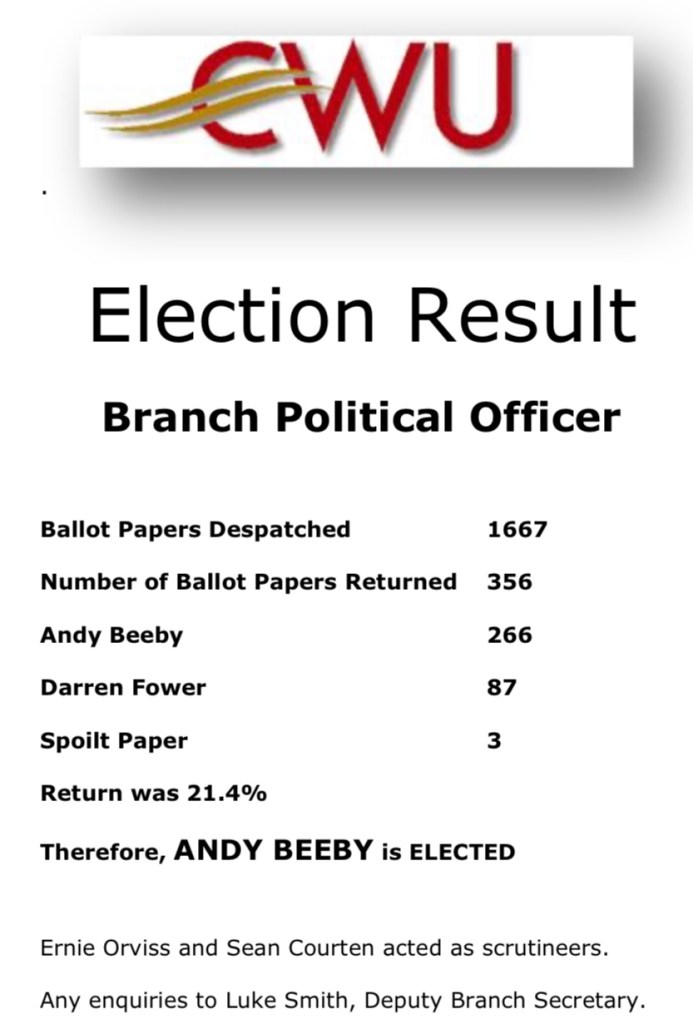
CWU Eastern No5 Election ResultBranch Political Officer


Workers of the world unite; you have nothing to lose but your chains. Karl Marx.
Urgent Update on The CWU’s decision to ballot the membership for strike action
Dear Colleague
Royal Mail over the last three weeks have made a calculated decision to move ahead with their Business strategy without agreement.
Approximately 30 offices across the Country have been given notice that revisions including MPU closures and Post Box Strategy Revisions will be introduced within the next 4 to 6 weeks.
Royal Mail’s decision to introduce these unagreed plans, means there are a significant number of OPGs who don’t know if they have a job and if they do in which location within 4 to 6 weeks.
In London , Camden MPU has been given notice it will be closing in 4 weeks and the work transfered to Greenford Mail Centre. The staff at Camden MPU do not know where they will be working in 4 weeks time and if they have a job , what they will be performing.
This is totally unacceptable. Royal Mail should be ashamed with themselves.
In fact , Royal Mail have adopted a new charm offensive spinning and trying to justify their decision to introduce unagreed change on revisions.
However the cold and stark reality is that there decision to push ahead with unagreed change leaves post workers in those sites with an uncertain future.
We understand that Royal Mail will be announcing more executive action over the next few weeks. Royal Mail are currently targeting , MPU closures , Post Box Strategy , VRs linked to a Mail Centre realignment , moving delivery starts back and removal of improved attendances in Delivery.
At the same time running parallel to this Royal Mail are also introducing their Journey Transformation Agenda by imposition and not negotiation.
This includes introducing in Swindon and Crewe the removal of larger parcels ( Above Shoe Box size )from the core delivery and moving it later.
There end game plan is that approximately one in every six deliveries will become a later driver who will deliver the larger parcels for not only the office they work but the catchment areas which the Later Acceptance Office currently delivers for.
The driver will move later in the day and deliver all the larger parcels for a number of offices. The remaining 5 walks will be asked to absorb the drivers delivery. Additionally Royal Mail plan to reduce replenishment van duties.
The Delivery Offices in the wider catchment area will lose this workload completely , meaning that there will be a requirement for reductions in duties , attendances and hours.
Royal Mail’s end game is to have 3 parcel hubs across the UK which will automate the larger parcels to circa 200 to 300 offices.
This is completely game changing and will have an impact on every office, every function and will lead to significant job reductions and new ways of working.
Royal Mail are trying to impose this far reaching plan on the workforce. This is simply unacceptable.
Additionally Royal Mail have decided to introduce Automated Hours Data Capture into a number of offices including PRDC by imposition.
Royal Mail say on their Communications that it simply designed to replace having to sign in and out with a pen and paper.
Nothing could be further from the truth. Royal Mail want to introduce automated signing in and out and link it to the hours you actually get paid and your attendance times.
In fact in Greenford Mail Centre a manager attempted to use the data from the automated hours data capture to change part timers starts time by 30 minutes and removal of scheduled attendance.
Royal Mail are trying to con its workforce by deliberately not telling employees that the only way that the cost of introducing the equipment for automated signing in and out is by linking it to what is paid in overtime , SA and eventually to use it to resource introduce revisions and annualised hours.
Royal Mail are also imposing Resource Scheduler which is designed to produce a different duty schedule for offices on a weekly or seasonal basis.
The imposition of AHDC and Resource Scheduler is part of Royal Mail’s wider strategy called Enterprise which is designed to link PDA’s , AHDC , Traffic Transformation together to produce a new duty list for a delivery office per week or for a period and reduce overtime , rest day working , part timers hours above contracts , change start times and remove improved attendances.
This policy is ultimately designed to reduce the unions ability to consult and negotiate on duties and resourcing as the computer and systems are designed to introduce the change.
It is against this backdrop that the CWU has been left with no other alternative than to ballot the membership for strike action.
The ballot timetable is that ballot papers will be dispatched on 3rd March and the result will be announced on 17th March.
All industrial action ballot results are important but rarely have we seen Royal Mail management deciding to virtually de-recognise the CWU and impose what they want without any safeguards for members as we see now happening .
The CWU have been perfectly reasonable and said that we would talk with Royal Mail about the issues they want providing they halted the executive action.
To date all Royal Mail have done is threaten to introduce more executive action.
It is therefore essential that members vote once again to support your union who is fighting to stop Royal Mail’s imposing change on the workforce which will have far reaching effects on jobs and terms and conditions.
Over the next few weeks all reps will be hold membership meetings to inform you of the reasons to vote yes in the Industrial Action Ballot.
However perhaps the biggest reason to vote yes is to inform Royal Mail that imposition is never the answer to introducing change on the workforce. This union cannot never allow Royal Mail to impose change on the membership.
By voting yes , the membership will once again demonstrate that they stand by their union and demand negotiation on their future terms and conditions and not dictation.
Please vote yes and make your voice heard to Royal Mail that we will never be defeated.
A statement by the London Divisional Committee
Four Pillars – Honouring our Agreement: Industrial Action Ballot Timetable
Further to the National Briefing held on Tuesday 17th December 2019 and the update provided in LTB 30/20 circulated in January, the Postal Executive met today to discuss a ballot timetable for Industrial Action to support the CWU’s strategy going forward in respect of the ongoing dispute with Royal Mail Group.
Working in close consultation with the SDGS Department, the Postal Executive endorsed the following ballot timetable for all appropriate CWU grades in the Royal Mail Group:
Membership Verification: to commence 6th February 2020 and be completed by 20th February 2020.
Issue Industrial Action Notice to Ballot: 25th February 2020.
Ballot Opens: 3rd March 2020.
Ballot Closes: 17th March 2020.
Ballot Result: 17th March 2020.
While the Union has spelt out the above timetable, Branches should note that the CWU remain available for negotiations with Royal Mail Group providing the company works with us to create the right environment for positive negotiations and cease their current programme/policy of deploying unagreed change by Executive Action.
Any enquiries in relation to the content of this LTB should be addressed to the DGS(P) Department.
Yours sincerely,
Terry Pullinger Dave Ward Carl Maden
Deputy General Secretary (Postal) General Secretary / Assistant Secretary
Andy Furey Davie Robertson Mark Baulch
Assistant Secretary Assistant Secretary Assistant Secretary
20LTB059 – Four Pillars – Honouring our Agreement Industrial Action Ballot Timetable
POST OFFICE: FORMAL SUBMISSION OF PAY CLAIM – 1ST APRIL 2020
The Postal Executive has today formally endorsed our pay claim letter on behalf of all members working in the Post Office. The pay claim is for a single year from 1st April 2020 and has a number of key elements as follows:
A balanced package of measures would make for a better settlement and will be more attractive to our members than just a standard pay increase, hence the inclusion of the elements above. Also included in the claim is a proposal for the introduction of a Collective Defined Contribution (CDC) pension scheme in line with conference policy from 2018 (Motion 22).
Next Steps
In order to make early progress, we have offered Post Office management a series of meeting dates in February and March as our aspiration on behalf of our members is to reach an early settlement if possible.
Branches are urged to bring this LTB to the attention of our Post Office members.
Further developments will be reported.
Yours sincerely
Andy Furey
Assistant Secretary
20LTB058 Post Office – Formal Submission of Pay Claim – 1st April 2020
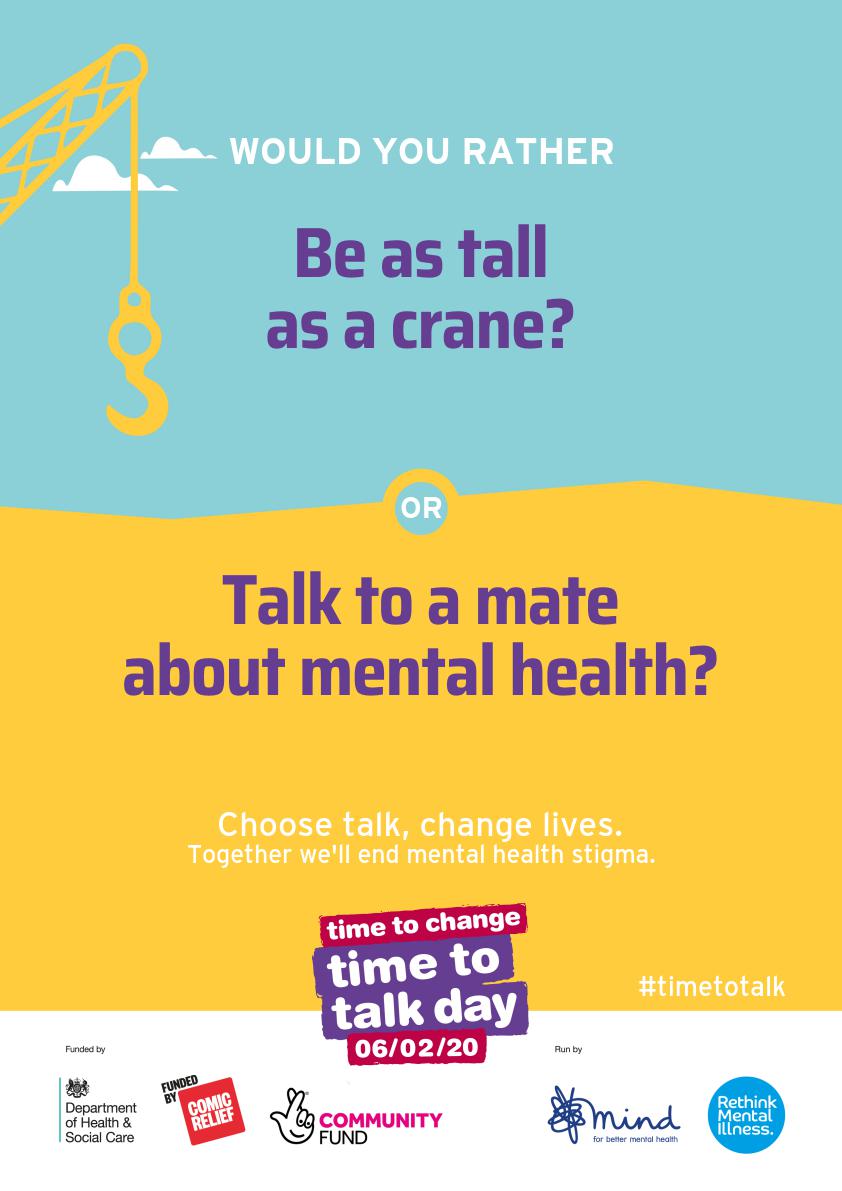
TIME TO TALK DAY 2020 – THURSDAY 6 FEBRUARY 2020
Time to Talk Day 2020 will take place on Thursday 6 February. With one in four of us experiencing a mental health problem in any given year, there has never been a better time for your workplace to get involved in Time to Talk Day.
Choose to talk about mental health and help change lives
Time To Talk Day brings the nation together to ‘get talking’ and break the silence round mental health problems.
Mental health problems affect one in four of us yet people are still afraid to talk about it. For people with mental health problems not being able to talk about it can be one of the worst parts of the illness. So by getting people talking about mental health we can break down stereotypes, improve relationships, aid recovery and take the stigma out of something that affects us all.
Too often, people who experience a mental health problem are also expected to take the lead on talking about mental health in the wider sense. Time To Talk Day encourages everyone to talk about mental health.
Time to Talk Day encourages everyone to be more open about mental health – to talk, to listen, to change lives.
On Time to Talk Day the campaign organisers are asking everyone to have a conversation about mental health – whether that’s texting a friend, chatting to a colleague or organising a stigma-busting event.
We know that talking about mental health can feel awkward, but it doesn’t have to. This year, ‘Time To Change’ are using the popular game ‘Would you rather?’ to help break the ice and get the conversation flowing.
The more conversations we have about mental health, the more myths we can bust and barriers we can break down – helping to end the isolation, shame and worthlessness that too many of us feel when experiencing a mental health problem.
This year conversation is at the heart of the day as we use the popular game ‘Would you rather?’ to encourage more people to talk than ever before. If you’re not familiar with the game, don’t worry – by asking one of the campaign’s ‘Would you rather’ questions you’ll be able to start up a mental health conversation with work colleagues and Union members.
Attached please find:
The 2020 ‘Time To Change’ – ‘Time To Talk’ Day Poster.
The 2020 ‘Time To Talk’ Day Workplace Campaign Comms Pack which is pack full of tips, ideas and resources to help get your workplace talking. You’ll find inside:-
Further resources/materials for the day as downloads at the following link:
Yours sincerely,
Dave Joyce
National Health Safety & Environment Officer
Re-ballot announced. Please share as widely as possible

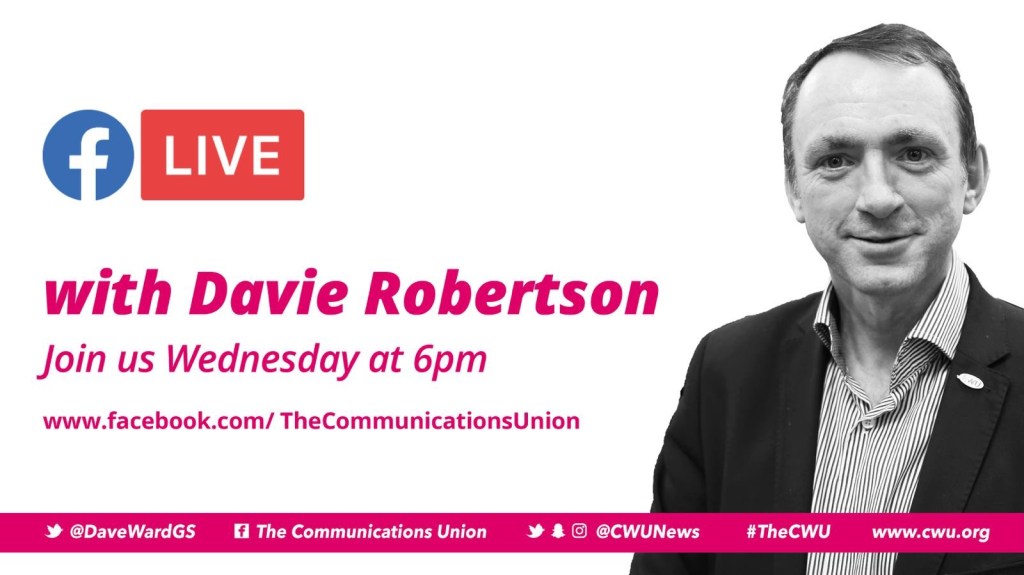
Facebook live for members in parcelforce, mail centres and logistics this Wednesday 4/2/2020 at 6pm
Please share as widely as possible
Coronavirus Outbreak – Update & Advice
The Health, Safety & Environment Department continues to monitor the situation and continues to be in daily contact with the Royal Mail Group Head of Health and the Safety, Health & Environment team regarding the Coronavirus Outbreak.
RMG are keeping the situation under review and have issued a third communication Friday evening (copy attached). RMG continues to promote the ‘good hand hygiene’ message with soap and water. Additionally, ‘Disposable Gloves’ as a barrier are being made available to anyone on request through their line manager which they recommended as an additional precaution. They are ensuring managers know how to order gloves for employees and RMGHQ will review the situation over the weekend and will decide if any further measures or communications are necessary. The Health, Safety & Environment Department has requested the provision of Hand Sanitizer Gel to the workforce.
In the meantime they have reiterated the message from the UK’s Chief Medical Officer, PHE and NHS that ‘Hand hygiene’ is the first and most important line of defence.
The UK’s four Chief Medical Officers have raised the risk level for coronavirus from low to moderate as the virus spreads across the world.
There are 10,000 cases in China and 220 Deaths. 25 Other Countries including the UK have now confirmed cases. The NHS are managing the two UK cases In Newcastle and announced that the cases are quarantined, being treated and they are confident that the matter is under control.
The UK’s four Chief Medical Officers did add, however, the risk to individuals has not increased despite the threat level being raised. For that reason, they are advising an increase of the UK risk level from low to moderate. This does not mean they think the risk to individuals in the UK has changed at this stage, but that government have been urged to plan for all eventualities.
As they previously stated, it is likely there will be individual cases but they are confident in the ability of the NHS and HSC in Northern Ireland to manage these in a way that protects the public and provides high-quality care.
The officers are Professor Chris Whitty for England, Dr Frank Atherton for Wales, Dr Catherine Calderwood for Scotland and Dr Michael McBride for Northern Ireland.
The greatest concern of the World Health Organisation (WHO) is the potential for the virus to spread to countries with weaker health systems than the UK and others – which are ill-prepared to deal with it.
In the meantime the Chief Medical Officers, Public Health England, World Health Organisation (WHO) and the NHS emphasise the importance of ‘hand hygiene’ as the first and most important line of defence. Like cold and flu bugs, the new virus is spread via droplets when a person coughs or sneezes. The droplets land on surfaces and are picked up on the hands of others and spread further. People catch the virus when they touch their infected hands to their mouth, nose or eyes.
It follows that the single most important thing people can do to protect themselves is to keep their hands clean by washing them frequently with soap and water or use a hand sanitising gel.
People should also try to avoid touching their mouth, nose or eyes with unwashed hands – something we all do unconsciously on average about 15 times an hour.
Other tips include:
Q & As
Is it just droplets from the nose and mouth that spread the new virus?
Probably not, but they are by far the most common risk. The NHS is advising doctors that the virus is also likely to be contained in other bodily secretions including in blood, faeces and urine. Here again, hand and surface hygiene is the key.
How can I protect my family, especially children?
Children are a major vector for the spread of droplet-based viruses because they interact physically so much with each other and are not the best at keeping themselves clean. However, you can greatly lower the risk that children pose of spreading or catching viruses by: Explaining to them how germs spread and the importance of good hand and face hygiene. Keeping household surfaces clean, especially kitchens, bathrooms and door handles. Using clean cloths to wipe surfaces, so you don’t transfer germs from one surface to another. Giving everyone their own towel and making sure they know not to share toothbrushes etc. Keep your home dry and airy (bugs thrive in musty environments).
What about face masks, do they work?
Paper face masks are not generally recommended by the NHS for ordinary citizens – with good reason. They are ill-fitting and what protection they might initially provide soon expires. Worse, they quickly become moist inside providing the perfect environment for germs to thrive in. They also become a hazard for others if carelessly discarded. However, an exception to this would be if you were displaying symptoms such as coughing or sneezing – then a mask may help prevent you spreading the virus to others in busy locations. In hospitals, healthcare workers treating patients with the virus will wear masks but these are specialist devices and there are strict protocols they must follow to ensure they remain safe and effective.
Can the new coronavirus be treated?
There is no simple cure for the new coronaviruses – just as there is no cure for the common cold. In more severe cases, the virus causes pneumonia, an infection that inflames the lungs and causes breathing difficulty. This is where the main danger lies. Viral pneumonia cannot be treated with antibiotics and, for the moment at least, there are no antivirals specific to this particular virus. Instead doctors focus on supporting patients’ lung function as best they can. They may be given oxygen or placed on a breathing machine (ventilator) in the most severe cases. Other symptoms such as fever and discomfort will be treated using drugs such as aspirin and ibuprofen. Secondary infections may be treated with antibiotics.
Are some groups of people more at risk than others?
Data from China suggests that people of all ages are at risk of contracting the virus. However, as with most respiratory illnesses, it is likely to be the young and old who are most at risk once infected. People with a reduced chance of surviving pneumonia include:
As data accumulates, a much clearer picture of the particular risk groups for the new virus will emerge.
Is there a vaccine for the new coronavirus?
There is currently no vaccine but researchers in the US, UK and China have already begun working on one, thanks to China’s prompt sharing of the virus’s genetic code. However, any potential vaccine will not be available for up to a year and would most likely be given to health workers most at risk of contracting the virus first. For now, it is a case of containment. China has started building several 1,000-bed hospitals to treat patients which it hopes to finish within days. Capacity to treat patients who require both ventilation and isolation will also be the biggest challenge for the NHS if the virus takes hold in the UK.
What advice has the UK government issued?
In addition to the advice on symptoms above, the British government has been advising against “all but essential” travel to China. The Foreign and Commonwealth Office is also evacuating British citizens from China’s most affected region.
What is happening at UK airports?
Public Health England (PHE) has announced “enhanced monitoring of direct flights” from China and has a small rota of doctors who are on hand at Heathrow to provide information and deal with possible cases. British Airways and Virgin Atlantic have ceased direct flights. In other major hub airports around the world, the authorities have gone further and are checking passengers temperature on arrival and distributing hand sanitisers to combat the spread of the virus. Good quality research suggests that hand cleansing at Heathrow and nine other global air hubs could slash the spread of the virus by up to 40%.
Where is the best place to sit on a plane?
The best place to sit is at a window in the middle of the cabin, so research suggests. This is because it reduces your risk of being infected by droplets shed by people walking up and down the aisles.
What is the difference between a coronavirus and a flu virus?
Coronaviruses and flu viruses might cause similar symptoms but genetically they are very different. Flu viruses incubate very rapidly – you tend to get symptoms two to three days after being infected, but coronaviruses take much longer, say disease outbreak scientists at Imperial College London. With the flu virus you become immune but there are lots of different viruses circulating. Coronaviruses don’t evolve in the same way as flu with lots of different strains, but equally our body doesn’t generate very good immunity.
What risks are presented if the coronavirus mutates?
Chinese officials have warned that the virus is already starting to mutate, which means there’s a chance that the disease could start to infect many more people. The worry is that if you have a new virus that is exploring a human host it’s possible that they might mutate and spread more easily in humans, say virologists at the University of Nottingham. The genetic sequence of the virus shows a slow mutation rate.
Can you catch Coronavirus from Parcels and Packages Posted from China to the UK?
According to BBC health and science correspondents Dr Michelle Roberts and Biologist James Gallagher along with the US Department of Health in Minnesota, the answer is no, there is no evidence this is a risk. These Medical experts say the Coronavirus can only survive on inanimate objects for a few hours, maybe a day or two in perfect laboratory conditions and parcels and packages from China take several days to arrive. Some diseases can spread through surfaces contaminated by people coughing or sneezing on them. It has not been shown this new Coronavirus can do that. Even if it could, there would still be questions about whether international shipping would be a major problem. Cold viruses tend to survive less than 24 hours outside the human body although Norovirus (a severe stomach bug) can last for months outside the body. The most reassuring fact so far is that Coronavirus cases seem to require close contact with an infected person – say, a family member or healthcare worker – in order to spread. Coronaviruses are a large family of viruses that cause respiratory illnesses such as Pneumonia and Bronchitis. The viruses are in the respiratory tract and they spread mainly through the air via coughing or sneezing, through close personal contact and touching one’s mouth, nose, or eyes after touching an object or surface with the virus on it, before washing one’s hands.
Maintain Good Basic Hygiene
The NHS and doctors advise everyone to maintain good basic hand and personal hygiene standards, washing hands regularly to minimise the risk of any infection as this virus outbreak develops. Use sanitizer gel, use gloves when working as an added barrier precaution.
Any enquiries regarding this Letter to Branches should be addressed to the Health, Safety & Environment Department on telephone number 020 8971 7365.
Yours sincerely,
Dave Joyce
National Health, Safety & Environment Officer
 CWU Eastern No5 Branch