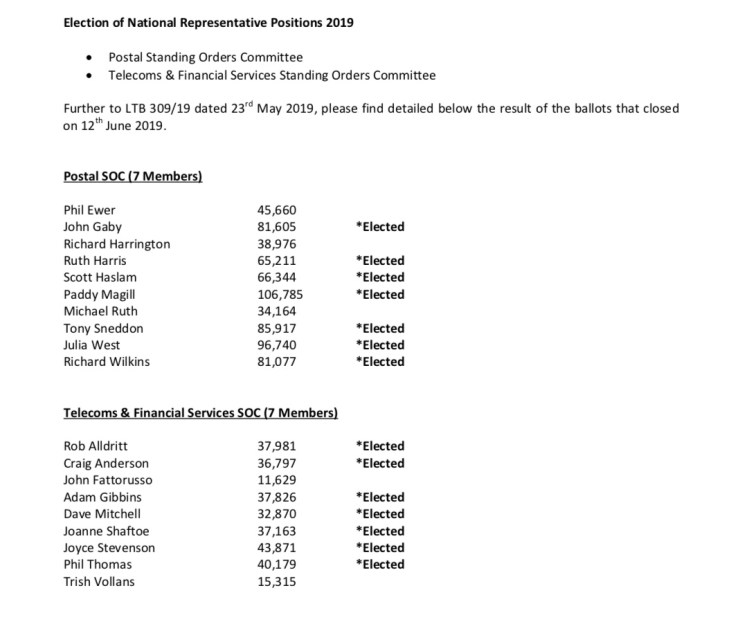
Election of National Representative Positions 2019


Workers of the world unite; you have nothing to lose but your chains. Karl Marx.
No.361/2019
12th June 2019
For the Immediate Attention of All:
Postal Branches
PFW Regional Organisers
PFW Representatives
Dear Colleagues
JOINT STATEMENT BETWEEN PARCELFORCE WORLDWIDE AND THE CWU ON THE REALIGNMENT OF DEPOT CUSTOMER SERVICE RESOURCE
Branches and representatives will be aware that in line with the commitments contained in the Parcelforce Annex of the Four Pillars agreement, review activity has been taking place under the Terms of Reference between Parcelforce Worldwide and the CWU for Customer Service Activity Across All Teams 2018/19 (LTB 345/18 refers).
Initial review activity in line with the aforementioned Terms of Reference has already resulted in a Joint Statement being agreed in 2018 for a framework to enable the reintroduction of the Mystery Shopper and Call Coaching.
In addition to the above, analysis has been taking place via the Table of Success Customer Service Joint Working Group (CSJWG) in relation to the realignment of Customer Service resource to provide a more professional and effective customer experience. The recommendation that has been provided by the CSJWG has indicated that it would be beneficial to have dedicated teams of Customer Service advisors and admin staff in depots.
Discussions have therefore been taking place with the business in relation to a Joint Statement to facilitate the realignment of activity, which has now been concluded and endorsed by the Postal Executive, a copy of which is attached for your information (Appendix A).
Branches and representatives will note that the attached document provides a defined list of responsibilities for each role and that a comprehensive, dedicated training package has been developed for Customer Service teams which will be delivered jointly.
Colleagues will of course be aware that Motion 96 reproduced below, was debated and carried at Annual Conference 2019:
Motion 96: This Conference instructs the Postal Executive to secure an agreement with Parcelforce that protects the job security of our admin CSP grades within our Depots.
This Conference agrees that the current proposals submitted by the business are not in the long term best interest of our Depot admin members and threatens the ethos of the CSP uni-grade (every member of staff can do any job for which they have been trained to do), by attempting to pigeon hole members into definitive roles.
The Postal Executive is therefore tasked to negotiate an agreement that offers the appropriate training to all admin grades which will lead to a more professional workforce within our Depot admin units.
The programme that has been developed and agreed in relation to the review activity will provide training for 334 advisors, which we believe is a major achievement in respect of the conference policy that was adopted.
The CSJWG will review the activity jointly in November 2019 to ensure that the realignment continues to support the forecasted levels of customer call demand going forward.
In addition to the Joint Statement a copy of the WTLL which is due to be briefed imminently, is also attached for information (Appendix B).
Any enquiries in relation to this LTB should be addressed to Davie Robertson, Assistant Secretary, email: dwyatt@cwu.org or shayman@cwu.org quoting reference number: 134.02
Davie Robertson
Assistant Secretary
LTB 361-19 – JS Realignment of Depot Customer Service Resource
JS ON THE REALIGNMENT OF DEPOT CUSTOMER SERVICE RESOURCE
Cervical Screening Awareness Campaign Month – June 2016: PHE & Jo’s Cervical Cancer Trust
Following Motion 38 (2009) carried at the Union’s 2009 Conference, correspondence and meetings took place with ‘Jo’s Cervical Cancer Trust’ which established a long-standing working relationship, involving the CWU providing support and assistance to the Charity in raising awareness and providing better, easily accessed information for CWU members and their families, and at the same time supporting ‘Jo’s Cervical Cancer Trust’ campaigning objectives. Motion 6 (2019) was carried on the subject of Cervical Cancer Screening campaigning, however the Health, Safety & Environment department has been very active in campaigning on this issue for years. We will continue to support Cervical Screening Awareness raising campaigns and encourage Branches and Regions to cascade that support and awareness raising. We are additionally discussing with the major employers support for the ‘Time to Test’ campaign and encouraging women staff to attend screening.
The CWU has a strong, long-working link and relationship with ‘Jo’s Cervical Cancer Trust’ and we’ve supported the successful ‘HPV Vaccination campaign’, the ‘Put Yourself in The Picture’ campaign, the ‘Smear For Smear’ campaign and we are registered supporters of the ‘Time to Test’ campaign with the CWU Logo being the only Trade Union Logo on the Jo’s Cervical Cancer Trust supporters organisations Website Page! I have personally met Jo’s Sister and Jo’s Trust CEO Robert Music on several occasions in meetings and at lobbying events – both have thanked CWU for its support and asked me to pass their thanks on to our Reps, Branches and members.
Cervical Screening Awareness National Campaign led by Jo’s Cervical Cancer Trust.
Jo’s Cervical Cancer Trust is the only UK charity dedicated to women and their families affected by cervical cancer and cervical abnormalities. Their aim is to offer information, support and friendship to women of all ages, to help them to understand the importance of cervical screening, and to provide their own personal brand of support if their screening shows up abnormalities or if they are diagnosed with cancer.
What is cervical screening (a smear test)?
Cervical screening is a free health test that helps prevent cervical cancer. It checks for cell changes (abnormal cells) on your cervix caused by high-risk human papillomavirus (HPV). It is not a test for cancer.
You might hear cervical screening being called a smear test. This is just a different name for the same test.
In the UK, Women are automatically invited for cervical screening if they are:
Women are invited:
Women may get their first invite up to 6 months before turning 25 and an appointment can be booked as soon as the invite is received.
It is very rare to develop cervical cancer:
Any woman worried about any symptoms, should get them checked by their doctor or nurse, whatever their age.
Cervical Screening – Why is it important?
Cervical screening prevents 75% of cervical cancers from developing in the UK yet one in four women do not attend cervical screening when invited. Not going for cervical screening is one of the biggest risk factors for developing cervical cancer.
The NHS Cervical Screening Programme has made a significant impact on cervical cancer mortality since it was established in 1988, saving an estimated 5,000 lives a year. However, women attending for Cervical Screening is at a 20-year low. Figures published by NHS Digital show that the percentage of eligible women (aged 25 to 64) attending for screening has dropped to 71%. The national target for cervical screening coverage is 80% with coverage at its lowest amongst those women aged 25 – 35. Earlier this year Public Health England launched its first ever national multimedia cervical screening campaign. See LTB No. 228/2019 dated 12 April 2019 on the PHE ‘Cervical Screening Saves Lives Campaign’.
The Campaign target audience is all eligible women aged 25 – 64.
The campaign aims are to:
The PHE Campaign launched earlier this year in March and the Jo’s Trust Campaign this month focus is on all things to do with Cervical Cancer including information about symptoms and causes of the disease, ways to prevent it and importantly encouraging women to attend screening.
Did you know?
What You Can Do
The Health, Safety & Environment Department wants all Branches and Health and Safety Reps to get involved and help us raise awareness. Branches and Reps can run campaigns and activities locally at a time when it suits them. It doesn’t have to be at any specific time or date. Raising awareness in your Branch area is often one of the best and most effective ways of reaching a high number of members and planning it in your programme is probably the best way of going about it.
Examples of how you could reach and raise awareness amongst members in your local branch area include:
Order Jo’s Cervical Cancer Trust publications and Materials to display and hand out
Jo’s Cervical Cancer Trust can send you materials to display and hand out or you can download your own from the Charity’s resource centre. Jo’s Cervical Cancer Trust has a series of comprehensive materials available for you to download. The materials are organised into two categories: fundraising and information. All the factsheets have been refereed by members of their expert medical panel. If you want to order hard copies of any of their campaign materials, please fill in a materials order form or download a form and send your order to:
– See all the available materials and resources at this Website link:-
https://www.jostrust.org.uk/shop/information
– Email to: publications@jostrust.org.uk
More Information
If you want more information contact Jo’s Cervical Cancer Trust:-
Postal address:
Jo’s Cervical Cancer Trust,
CAN Mezzanine,
7-14 Great Dover Street,
London, SE1 4YR
You can phone the Jo’s Trust office on: 020 3096 8100You can Email at: info@jostrust.org.uk
The Jo’s Cervical Cancer Trust Helpline for members is 0808 802 8000
The Jo’s Cervical Cancer Trust helpline is open regularly throughout the week. It’s an opportunity to talk things through with someone who cares. All of the volunteers on the helpline have experience of either cervical cancer or cervical abnormalities and they have all received training to provide information and support on a very wide range of topics.
Attachments:
Yours sincerely
Dave Joyce
National Health, Safety & Environment Officer
19LTB360 Cervical Screening Awareness Campaign Month – June 2016 PHE & Jo’s Cervical Cancer Trust
Men’s Health Month June 2019 – Raising Awareness of Key Numbers For Men:
During Men’s Health Month 2019, the Men’s Health Forum are raising awareness of:
For men who want to get to know their numbers better, the Forum is also publishing Man MOT, a new interactive mini-manual that enables men to check their own health and then challenges them to do better.
Man MOT has 25 health challenges in total.
Key numbers for men:
Key numbers for policy-makers and service providers:
THE MHF MESSAGE:
One man in five dies before he is old enough to retire. Together, by knowing our numbers, we can change this statistic.
For Men’s Health Month 2019, the Men’s Health Forum has pulled out the key numbers. There are seven numbers and five statistics they want all men to know including the male life-expectancy gap in their area. At the Men’s Health Forum, men of all ages, policy-makers and service-providers alike all ask what they can do to improve men’s health. Knowing a few simple numbers can make all the difference. To take it further, the MHF new interactive manual ‘Man MOT- DIY checks and challenges’ helps men put those numbers to work monitoring their own health and living healthier lives. Man MOT is a new interactive manual built around knowing your numbers, that enables men to check their own health and then challenges them to do better. Easy to use – 25 health challenges in total.
A copy of the Men’s Health Forum Mini-Manual Booklet order form is attached.
Yours sincerely
Dave Joyce
National Health, Safety & Environment Officer
19LTB359 Men’s Health Month June 2019 – Raising Awareness of Key Numbers For Men
National Blood Week & World Blood Donor Day 14 June 2019: ”Save Someone’s Life”
Every year, NHS Blood and Transplant run a national campaign to encourage much needed new donors to register to give blood.
The ask is simple: help to spread the word and reach as many people as possible.
14 June is the World Health Organisation’s “World Blood Donor Day” with the WHO continuing the work worldwide to build a culture of voluntary blood donation. On World Blood Donor Day, WHO is emphasising the role that every individual can play in preparing for the next unforeseen emergency by giving blood now. The statistics from the WHO inform us that blood donation by 1% of the population can meet a nation’s most basic requirements for blood and 57 countries collect 100% of their blood supply from voluntary, unpaid blood donors BUT NOT THE UK WHERE THERE IS A SHORTAGE OF DONORS! Further information is available on NHSBT Website at: https://www.nhsbt.nhs.uk/how-you-can-help/
NHS Blood and Transplant (NHSBT) have again welcomed the support of the CWU and its members.
The CWU Health, Safety & Environment Department will again be fully supporting the week and continuing the work done together in previous years and we hope that Branches, Regional Health and Safety Forums, Health and Safety Reps and all other Branch Officials and CWU Reps can join in and can get involved again to make 2019 a successful year.
Across the UK blood donors make a difference every day saving people whose lives depend on blood. Over the last year 900,000 people have given up their time to help patients in need. But there is an urgent need for more new donors.
A national appeal has being launched to urgently find new black donors to help patients with Sickle Cell disease, the most common and fastest growing genetic blood disorder in England and the UK.
NHSBT need 200,000 new blood donors to ensure that patients in the future have access to the blood they need, when they need it.
There is also a need for 40,000 new black donorsto stop the pain experienced by black patients with Sickle Cell disease. They need life-saving blood from black donors, which provides the closest match to their own.
The 2019 campaign focuses on raising awareness about blood donation and the urgent need for more donors as well as thanking those blood donors for the gift of life and highlights the dimension of ‘sharing’ and ‘connection’ between blood donors and patients. The campaign aims to highlight stories of people whose lives have been saved through blood donation, to motivate regular blood donors to continue to give blood and encourage people who are in good health who have never given blood to begin doing so, particularly young people.
Facts
Why should people donate blood?
Safe blood saves lives and improves health. Blood transfusion is needed for people who lose too much blood through work or road accident injuries, those undergoing major surgery and complex operations, cancer patients, those with certain illnesses that destroy blood cells, women with complications of pregnancy, such as ectopic pregnancies and haemorrhage before, during or after childbirth, children with severe anaemia etc. It is also needed for regular transfusions for people with conditions such as Thalassaemia and Sickle Cell disease and is used to make products such as clotting factors for people with haemophilia.
There is a constant need for regular blood supply because blood can be stored for only a limited time before use. Regular blood donations by a sufficient number of healthy people are needed to ensure that safe blood will be available whenever and wherever it is needed.
Blood is the most precious gift that anyone can give to another person — the gift of life. A decision to donate your blood can save a life, or even several if your blood is separated into its components — red cells, platelets and plasma — which can be used individually for patients with specific conditions.
NHSBT is on a mission to raise awareness of the importance of blood donation and recruit more new donors in order to save and improve lives.
As well as working with partners such as the CWU to boost national noise and conversation around blood donation, in response to patient needs there is a particular focus this year on reaching and engaging black blood donors, who are more likely to have the rare blood types needed to treat diseases like Sickle Cell.
NHSBT is also focusing on recruiting donors in specific regions where more donors are needed, including London, Manchester, Liverpool, Sheffield, Bradford, Leeds, Birmingham, Oxford, Bristol and Southampton.
Campaign details and how you can get involved
To give blood in the UK you can register as a donor at https://www.blood.co.uk/ which provides information on who can give blood, how to become a donor and the donation process.
For More Information visit the NHSBT Website at:- https://www.nhsbt.nhs.uk/how-you-can-help/
Yours sincerely
Dave Joyce
National Health, Safety & Environment Officer
19LTB358 National Blood Week & World Blood Donor Day 14 June 2019 – Save Someone’s Life
THE U WORD DELIVERY WORKPLACE PODCAST – EPISODE 5
Dear Colleagues,
Please see below a link to the latest episode of our workplace podcast. This month we have focused on the Emergency Motion at Annual Conference and the Four Pillars Agreement.
Can all CWU Representatives share this link with members via social media, email, text and WhatsApp. We would also encourage Reps to bring the podcast to the attention of members during WTLL sessions or indeed any other any similar opportunity.
https://soundcloud.com/the-cwu/the-u-word-workplace-special-episode-5
Any enquires should be directed to the Outdoor Department, reference 535, email address: outdoorsecretary@cwu.org.
Yours sincerely,
Mark Baulch
CWU Assistant Secretary
LTB 357.19 – The U Word Delivery Workplace Podcast – Episode 5
Election of CWU Regional Secretaries 2019
Further to LTB 297/19 dated 17th May 2019 at the close of nominations the following had been received:
Eastern Region
| Paul Moffat | Central Counties & Thames Valley | *ELECTED |
Midland Region
| Kate Hudson | South Midlands Postal | *ELECTED |
North East Region
| John Woodhouse | Newcastle Amal | *ELECTED |
Northern Ireland Region
| *Ballot Required | |
| Eamonn Cooke | Northern Ireland Combined |
| Billy Hannaway | Northern Ireland West |
| David Kennedy | Northern Ireland Telecom |
North West Region
| Carl Webb | North Lancs & Cumbria | *ELECTED |
Scotland Region
| *Ballot Required | |
| Craig Anderson | Scotland No 1 |
| John Carson | Glasgow District Amal |
South East Region
| *Ballot Required | |
| David Banbury | Kent Invicta Branch |
| Paul Carpenter | South East No 5 |
South West Region
| Kevin Beazer | Bristol & District Amal | *ELECTED |
Wales & The Marches Region
| Gary Watkins | Gwent Amal | *ELECTED |
London Region
| *Ballot Required | |
| Khurrum Khan | South West Middlesex Amal |
| Ian Murphy | Harrow & District |
Please note that the timetable for the ballots is as follows:
| Despatch ballot material from: | 2 July 2019 |
| Close of ballot: | 24 July 2019 (first post) |
Any enquiries regarding this LTB should be addressed to the Senior Deputy General Secretary’s Department on telephone number 0208 971 7237 or email address sdgs@cwu.org.
Yours sincerely,
Tony Kearns
Senior Deputy General Secretary

Election of NEC Retired Members Sector Representative 2019
Further to LTBs 229/19 dated 12th April, LTB 296/19 dated 17th May and LTB 321/19 dated 28th May 2019, please find below the list of nominations for the above position:
NOMINATIONS FOR RETIRED MEMBERS SECTOR REPRESENTATIVE

Further information regarding Postal and TFS NEC positions will be published in due course.
Any enquiries regarding this Letter to Branches should be addressed to the Senior Deputy General Secretary’s Department on telephone number 020 8971 7237, or email address sdgs@cwu.org.
Yours sincerely,
Tony Kearns
Senior Deputy General Secretary

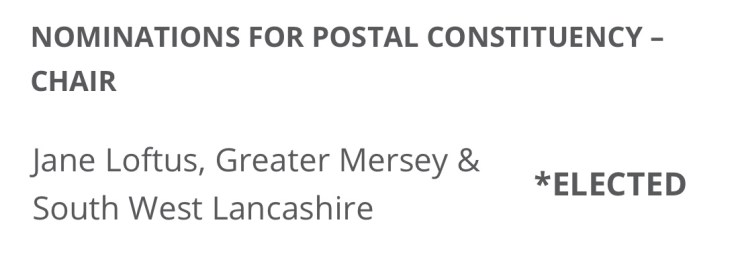
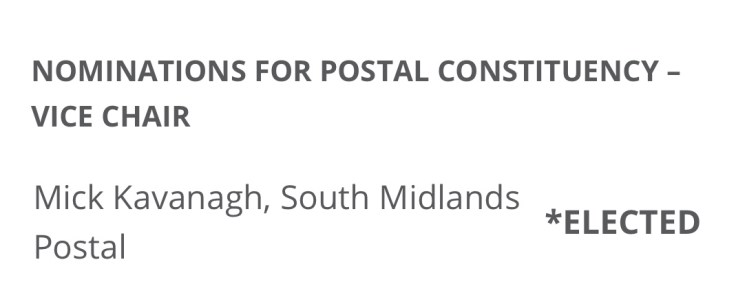
Further to LTBs 229/19 dated 12th April, LTB 296/19 dated 17th May and LTB 321/19 dated 28th May 2019, please find below the list of nominations for the above Postal Constituency positions.
Please note that the list of nominations for the Telecom and Financial Services Constituency positions will be published on 14th June 2019.
Postal Constituency:
NOMINATIONS FOR POSTAL CONSTITUENCY – CHAIR
NOMINATIONS FOR POSTAL CONSTITUENCY – VICE CHAIR
NOMINATIONS FOR POSTAL CONSTITUENCY – NEC REPRESENTATIVE (SECTION 1)
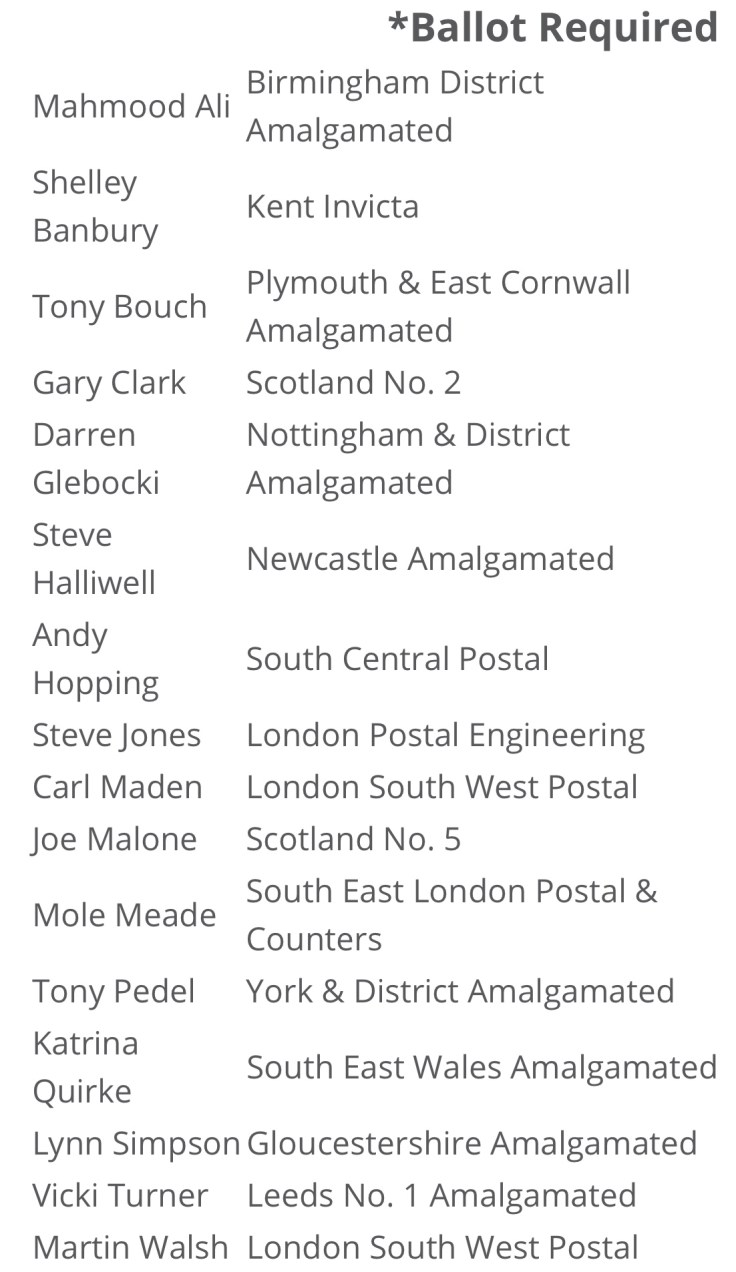
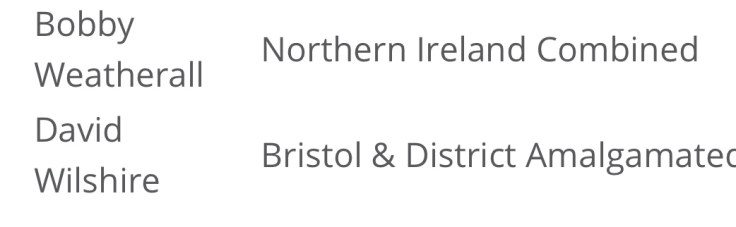
NOMINATIONS FOR POSTAL CONSTITUENCY – NEC REPRESENTATIVE (SECTION 2)
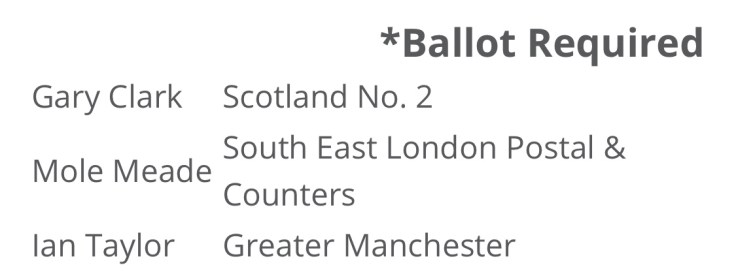
NOMINATIONS FOR POSTAL CONSTITUENCY – NEC YOUNG WORKER (SECTION 3)
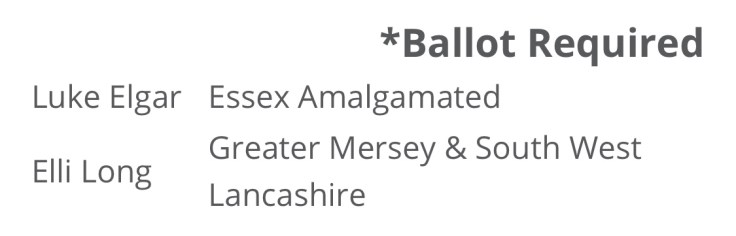
NOMINATIONS FOR POSTAL CONSTITUENCY – NEC DISABILITY (SECTION 4)
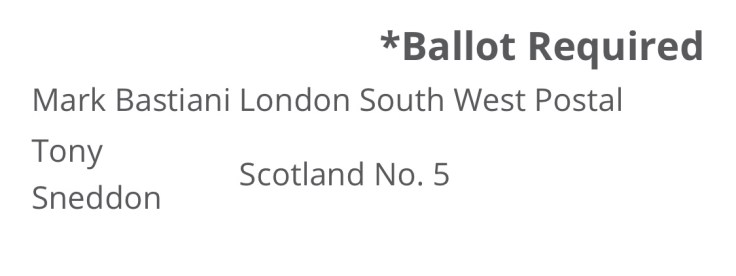
NOMINATIONS FOR POSTAL CONSTITUENCY – NEC LGBT (SECTION 4)

NOMINATIONS FOR POSTAL CONSTITUENCY – POSTAL EXECUTIVE – POSTAL GRADES
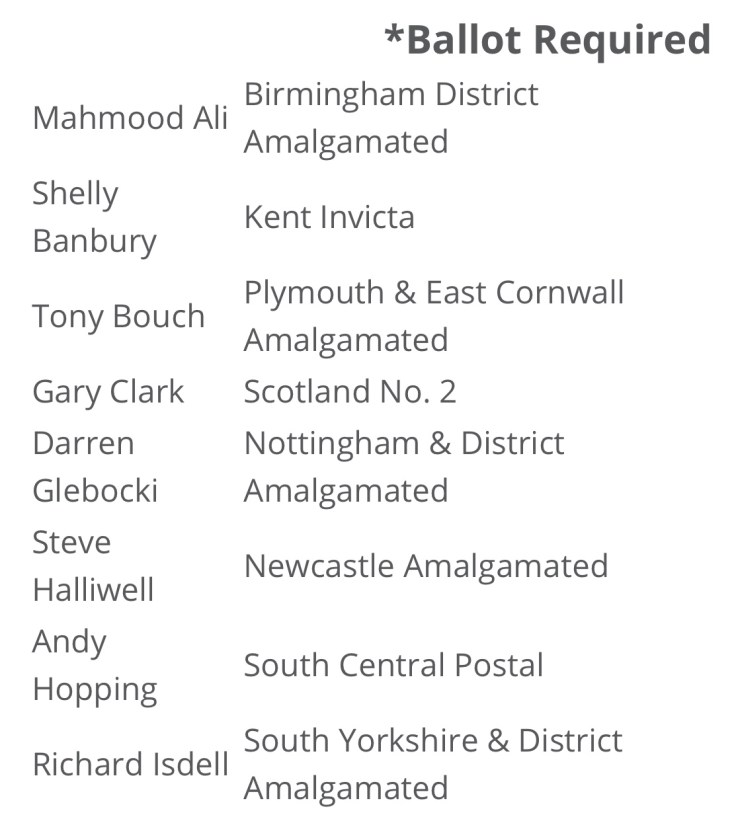
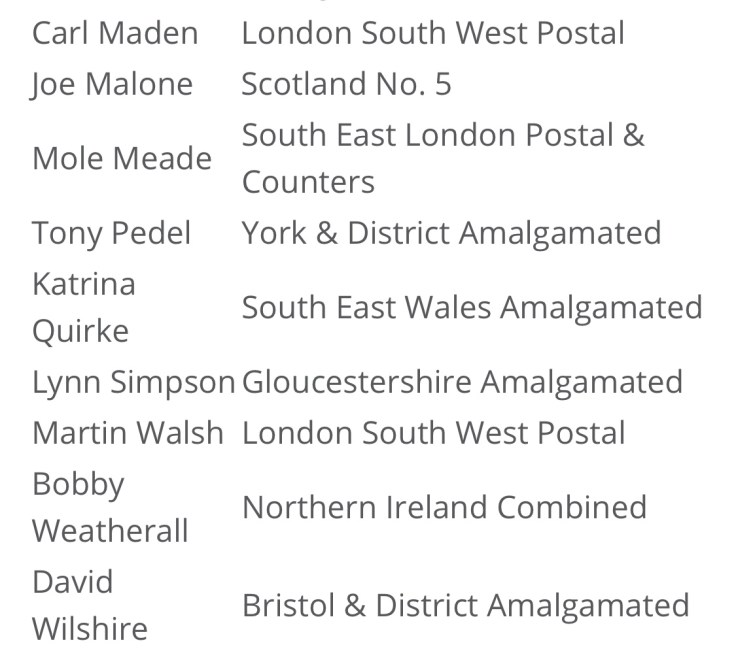
NOMINATIONS FOR POSTAL CONSTITUENCY – POSTAL EXECUTIVE – POSTAL & TECHNICAL SERVICES GRADES
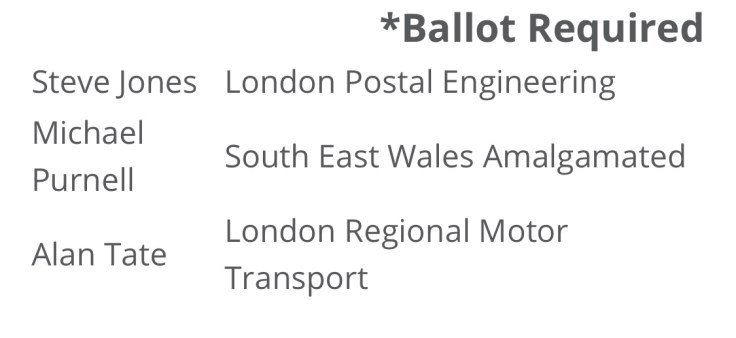
Any enquiries regarding this Letter to Branches should be directed to Senior Deputy General Secretary for the attention of Peter Metcalfe on 0208 971 7368, or pmetcalfe@cwu.org.
Yours sincerely,
Tony Kearns
Senior Deputy General Secretary

 CWU Eastern No5 Branch