RM & CWU ADDENDUM – COVERING THE USE/STUDY OF PDA OUTDOOR ACTUALS

RM & CWU ADDENDUM – COVERING THE USE/STUDY OF PDA OUTDOOR ACTUALS

Dear Colleague,

Further to LTB 251/17 regarding the use/study of PDA Outdoor Actuals, the department has been in discussions with Royal Mail reviewing the activity of this initiative in order to understand the current position following the “go live” in May 2017.

As a result of the work completed to date and to assist in the discussions taking place on how and what will form part of the full national deployment for PDA Outdoor Actuals, we have agreed that a further validation exercise will take place for all Delivery Offices in the Cheshire and Merseyside Delivery Leader Catchment Area (Annex A).

This will commence from w/c 5th March 2018 and will be undertaken through the initial deployment of the Dashboard to ensure the IT infrastructure and solution architecture including: data flows, platform hosting, system availability and system performance, continue to function with the extended deployment. In addition it allows reporting outputs to be shared with their intended users, data validation and feedback on report design and employee engagement.

During the extension the reports/dashboard will be available showing:

• Start and end time of outdoor activity and total duration

• Comparison with Planned routes, Planned time, RCS booked time

Further work is continuing on future phases of the dashboard which will include the following:

• Matched route

• Distance covered and time taken to complete the route

• Activity breakdown and movement classification where available

• Path taken on a map

• Compliance to route sequence

• Correct use of delivery equipment

• First time delivery success rate and variability

• Consistency of service

• Compliance with meal reliefs if taken during outdoor activity

• Transactions i.e. collection and delivery event scans

Additionally we have reconfirmed with Royal Mail’s senior management team and also included within the addendum that this new technology is not being introduced to track individuals or to be used for individual performance management and is not being deployed for, or will be used as, a disciplinary tool.

The increased deployment of the App and Dashboard reporting will ensure that following the validation exercise, more information will be available to inform the talks regarding how full National deployment to all Royal Mail Collection and Delivery units will take place and the timescales for expected completion, which will be subject to further discussions between both parties and National Agreement.

In addition we are also in discussions regarding how new software applications are developed to support PDA use (e.g. electronic manifest for parcels, Deliver to Neighbour event code, SafePlace capture, Hazard information etc) both parties will review how the data from these overlay against the PDA dashboards to provide a more commercially powerful profile of outdoor operation in order to enhance the current products and services provided, as well as look at how Royal Mail win new traffic/growth initiatives.

Any enquiries to the content of the above please contact the Outdoor Department reference 530, email address: outdoorsecretary@cwu.org.

Yours sincerely,


Mark Baulch

CWU Assistant Secretary

LTB 132.18 – RM & CWU Addendum – Covering the Use of PDA Outdoor Actuals

Addendum to PDA Outdoor Actuals_Cheshire and Merseyside Delivery Leader Final

GENERAL CONFERENCE 2017 – MOTION 29 AND MOTION 35 

GENERAL CONFERENCE 2017 – MOTION 29 AND MOTION 35 

Branches received an update on Motion 29 carried at General Conference 2017 in LTBs 573/17 and 653/17.

Following on from those LTBs the Working Group set up under the terms of Motion 29 met at CWU Headquarters on Monday the 5th February 2018. The recommendations of the Working Group that arose out of that meeting were then placed before a meeting of the Retired Members Advisory Committee on Friday the 9th February 2018.

As previously indicated the matter was subsequently placed before the NEC at their meeting on Thursday the 22nd February 2018 and the purpose of this LTB is to inform Branches of the decisions taken by the NEC on Motion 29, and to respond to the terms of Motion 35 that was also carried at General Conference 2017. Accordingly the contents of this LTB reflect the contents of the document placed before the NEC.

In the first instant it is worth reiterating that the final paragraph of Motion 29 was clear in that it sates “The NEC will agree a way forward that supports the principles listed in this Motion and will subsequently publish a report no later than the end of September 2017”. The reason this point is made is because in line with the last paragraph of the motion, the final decision on the issues contained therein are to be determined by the NEC. That is what was agreed by General Conference 2017 and as such is policy of the CWU. The question the NEC had to address was how it fulfils its role as laid out in Motion 29.

The recommendations carried below address four key areas that the working group reached a consensus on, Plan 5 membership, succession planning, voting rights and enhancing the role of retired members.

Recommendation 1 deals with that part of the motion that sought clarity to the role being played by members who are not “retired members” but are no longer in employment. In short this is the legacy from the former portable grade of membership that now appears as Plan 5.

The Working Group felt that as Plan 5 membership issues reach way beyond any role that retired individuals may wish to take up, this matter needs to be addressed by the NEC.

In discussing this issue the Working Group was also clear that a previous suggestion that all the issues here could be resolved by all retired members becoming Plan 5 members was dismissed emphatically. The recommendation therefore is that the NEC addresses the issue of Plan 5 membership and that the best way to deal with this is for the Finance Organising and Structure (FOS) Committee to have an initial discussion on this at their next meeting in order to begin such a review.

Recommendation 2 deals with that part of the motion that stated that succession planning and progression are important to the development and longevity of the CWU.

The consensus of the Working Group was that they recognised the issue of “blocking” younger people coming forward had widespread implications for the entire union and as such they formed the view that this was not something they themselves would be able to resolve in the short term.

The consensus was that the NEC needs to develop a “Future Leaders Agenda” that deals with succession planning at all levels of the CWU. The recommendation is that the project group working on redesign be asked to produce a preliminary paper on this matter that scopes the size of the issue and identifies what options exist to ensure we develop and bring forward representatives at all levels of the CWU structure.

Recommendation 3 deals with the issue of voting rights. The consensus reached by the Working Group was that whilst the industrial/occupational arguments are clearly understood, there are some positions that could fall outside of this and that the NEC needs to take whatever action necessary to allow retired members to vote for and be able to stand for Branch Treasurer/Financial Secretary positions and Branch Political Officer Positions. The vehicle to do this would be for the NEC to amend the Branch Model Constitution and that this would be subject to the normal subsequent endorsement processes.

The Working Group also agreed that it should be made expressly clear that retired members can vote in any election that may take place for the positions of General Secretary, Senior Deputy General Secretary and the role of Legal Services Assistant Secretary.

Recommendation 4 addressed the issue of providing clarity on the role to be played by retired members. The way the existing rules are written were considered to be negative in their approach when it comes to dealing with retired members and their issues at branch level.

Firstly rule 6.4.8 needs to change, the word “problems” needs to be removed and replaced with a more positive; “Branches are responsible for promoting the interests of their retired members and for engaging with their retired members to actively involve them in dealing with these issues, accordingly Branches shall establish a Retired Members Section to ensure that the interests of their retired members are protected and promoted. The Retired Members Section shall be entitled to elect a Section Committee which shall be responsible for engaging positively with members of the section to actively involve them in pursuing their interests and issues.”

Secondly, whereas the rule currently states that a Branch will appoint someone to look after the retired members this should also be rewritten to allow retired members themselves to determine who represents them, as follows. “One position on the Branch Committee will be reserved for a representative from the retired members section, elected by and from the members of that section. That individual shall be entitled to attend Branch Committee meetings to ensure that retired members’ issues are raised and discussed at this level. Such a representative shall not be entitled to vote on any industrial/occupational issues at these meetings.” 

This change should be seen as a very positive step forward in reaching out to retired members, they should no longer be seen as problematical, as the current rule infers and this approach shows that we are actively promoting retired members by allowing them their own voice at branch committee level. It is then up to retired members to grasp this opportunity and ensure they become more actively involved, this change clears the path for more involvement from retired members and that opportunity needs to be embraced.

As is stated above, the Retired Members Advisory Committee then met on Friday 9th February to discuss the outcome of the Working Group and to express their opinion.

On the first point, the issue of a review of Plan 5 membership the RMAC agrees with the recommendation of the Working Group and wished to add that they emphatically reject the option of all retired members migrating to Plan 5 membership as a solution to the issue of voting rights.

On the second point, a need for a “Future Leaders Agenda” to be developed by the NEC, the RMAC agrees with.

On the third issue, voting rights, the RMAC believes that the Working Group recommendation does not go far enough. Their view, following all the arguments that we are all familiar with, is that retired members should be able to vote but not stand in all elections for Branch Officer positions.

Finally, on the fourth issue, that of a change to the existing rule to enhance the role played by retired members and to give them a direct position on the Branch Committee, the RMAC agrees with.

In bringing this matter to a conclusion the NEC understands that, amongst some, the issue of voting rights continues to be an issue of controversy. This is pointed out because it is worth remembering that Motion 29 was abundantly clear in that “upholding the principle that retired members should not be able to vote for occupational/industrial positions” is policy of the CWU.

The motion is also clear, as pointed out above, that it is for the NEC to agree the way forward. This matter has been the subject of extensive debate at NEC level, at 2 Retired Members’ Conferences, on the Working Group and on the RMAC.

The NEC recognises that it is doubtful if any solution that the NEC comes up with would receive universal support. Failure to reinstate full voting rights for all retired members will not please some. Equally, reinstating all those rights would see those Branches wherein branch positions undertake industrial/ occupational roles, object. In short there is no one solution that will satisfy everyone but the NEC is guided by the policy carried by General Conference.

So the position we have is that the Working Group have met and in line with the conference policy reached a number of conclusions. The NEC were then required to consider, debate and determine the way forward. As a result the NEC has agreed the following course of action with regard to Motion 29.

1 The NEC agreed that there is a need to review the purpose of the Plan 5 membership subscription rate with the principle that the rate is specifically for CWU members who are in or are actively seeking work and that the FOS are tasked with developing an initial position on this and to report back to the NEC.

2 The NEC agreed that the Redesign Project Group produce an initial paper on designing a “Future Leaders Agenda” within the CWU with the aim of ensuring effective succession planning at all representative levels throughout the union.

3 The NEC agreed that retired members can vote and stand for Branch Treasurer/Financial Secretary and Branch Political Officer positions within Branches and the NEC agrees to amend the Branch Model Constitution accordingly, subject to the correct processes.

4 The NEC agreed to take the necessary steps to alter the CWU National Rule Book to change rule 6.4.8 to read as laid out above to positively prescribe a role for retired members within branches.

MOTION 35

Having dealt with Motion 29 the NEC then had to determine how to address Motion 35, this was also carried at CWU General Conference 2017 and reads as follows:

This Conference instructs the NEC to request that the CWU’s General Secretary and the President publish to the Union’s Membership the full reasons and rational behind LTB 664/16 REVISED BRANCH MODEL CONSTITUTION and the additional note to be inserted at the foot of paragraph 4.4 that states that “Retired Members are not entitled or eligible to stand for election or be able to vote in the above elections (a) to (i).” 

It is important to understand the wording used in this motion, this is because on a number of occasions, particularly at the Retired Members Conference, criticism was raised because the legal advice given to the NEC had not been published.

Motion 35 makes no mention of the legal advice and simply talks about “full reasons and rationale”. The NEC makes this point because we are not publishing the legal advice and Motion 35 makes no mention of it. The NEC are obliged to comply with the terms of the motion as written and not what some people now suggest they believe they voted for. The NEC arrived at an agreed position on this motion, highlighted as follows.

Motion 35 called for full reasons and a rationale to be given for the decision taken by the NEC. The reason that lay behind the decision stemmed from the way the rule book clearly distinguishes between retired members and those yet to retire. The rule book lays out distinct provisions by which retired members are able to voice issues of concern to them. As such the rights of retired members, by rule, are clearly distinct from those yet to retire. Where the rule book didn’t differentiate was in the issue of voting rights and the decision taken by the NEC was to ensure that rules on voting rights followed the rest of the rule book in clearly distinguishing between the two groups i.e. those who are retired and those who are yet to retire. 

The substantive point i.e. the difference between the interests of members in work (occupational issues) has now been dealt with and a policy agreed by CWU General Conference i.e. that the principle is that retired members should not be able to vote for occupational/industrial positions. This is now CWU policy and subsequent to Motion 35 being carried the Working Group set up under Motion 29 has now identified a way forward on this issue and this has now been endorsed by the NEC, details of which are contained within this LTB. The NEC therefore has now acted and carried out its responsibilities under both Motion 29 and Motion 35.”  

In conclusion the NEC, in line with the policy carried at General Conference, has determined how to deal with the issues contained in Motion 29. The NEC will now move to make the necessary changes to the Branch Model Constitution and once this has taken place branches will be informed accordingly. The NEC will now also identify the earliest opportunity to submit the rule change required to alter rule 6.4.8 as laid out in this LTB to enhance the role of retired members at branch level.

Further information on Plan 5 membership and a “Future Leader’s Agenda” will be reported to branches as developments occur.

We would like to take this opportunity to thank those members of the RMAC, Joan Moxon, Brian Lee and Rod Downing who took part in the working group for their input and also to the small number of branches who submitted comments for consideration.

Any enquiries regarding this Letter to Branches should be addressed to the Senior Deputy General Secretary’s Department on telephone number 020 8971 7237, or email address sdgs@cwu.org.

Yours sincerely,

Tony Kearns

Senior Deputy General Secretary

18LTB134

View Online

Royal Mail – Mk 4 Parcel York Container – Next Steps in the Phased Introduction and Roll-out: (Design, Health, Safety, Ergonomic and Training Aspects)

Royal Mail – Mk 4 Parcel York Container – Next Steps in the Phased Introduction and Roll-out: (Design, Health, Safety, Ergonomic and Training Aspects)

To: All Branches

Dear Colleagues,

LTB 103/2017 issued on 22 February 2017 provided Branches and Representatives with a detailed report on the history and development of the Mk4 York Container and joint work with earlier Prototypes since 2011, leading up to the Trial of 182 Prototype Units last year in Swindon, Oxford, Reading and HCN, through to the trial’s successful conclusions based on positive all round feedback.

The RM Head of Container Equipment, the Royal Mail Lead Ergonomist, the Royal Mail Delivery Design Principle Engineer, Project Lead and Automation Team along with the CWU Health, Safety & Environment Department and CWU ASRs in trial offices monitored the trial equipment, attending regular meetings on site and participating in weekly conference calls as well as surveying staff for feedback which was very positive regarding this new concept container during the trial.

LTB 519/17 issued on 26 September 2017 detailed the first phase of the roll-out on a limited and controlled basis. It was discussed and generally agreed beforehand that rather than initiate a national roll-out of large numbers of these new containers at that stage, that as the Mk4 York was a completely new and redesigned unit in comparison to the York containers Mk’s 1, 2 and 3 (including the ALP Sleeve), that the initial batch should be smaller in number to enable wider testing within a limited number of sites to further prove the concept and design. This was primarily in order to test the design concept, durability and components of the Mk4 and this phase of the roll-out proved invaluable.

During the trial, a number of relatively minor design, manufacturing and build quality issues were noted on the containers through the trial, and subsequently, the manufacturer has addressed all of these. The key design changes recommended by RM/CWU included a new modified gate locking system with modified tough plastic lock parts on the upper gates and new reinforced gate metal flaps; rivets instead of stitching on panels; improved, reinforced hinges; an additional lifting strap for ease of lifting and locking of the gate into its stowed position; a new gate locking hook on the side; new reshaped gate metal flaps plus tough plastic locking parts and additional cross tubes added on the base frame to reinforce the structure. These modifications have been thoroughly jointly assessed and improved the units which also fully met with all of the safety, ergonomic and operational requirements. The manufacturer also conducted extensive durability testing, which has yielded wholly positive results.

During the phase 1 roll-out, some further minor improvements in the design, build quality and components were identified and further improvement modifications undertaken in conjunction with the manufacturer.

The background to the Mk4 York is that there had been no fundamental change to the York container design for 20 years, and although the basic design is still sound, robust and very reliable, it was designed originally for mail bags and letter trays, and there are now increasing numbers of small parcels/packets and strapped bundles in the operation along with the introduction of Parcels Automation Machines and York Tippers.

It was identified that existing York sleeves were presenting problems with these new traffic streams, e.g. bundles sliding between the existing York container bars and pushing out or bulging the strapped front of the existing containers, resulting in safety and transportation problems, leading to increasing numbers of complaints from members and CWU Reps.

Additionally, during trials of the first Parcel Automation Machine at Swindon Mail Centre, it quickly became apparent that parcels were becoming stuck in the standard ALP Sleeves, used in Mk 1, 2 and 3 York containers which resulted in inefficient tipping into the machine and high levels of trapped items requiring manual unloading and feeding.

Consequently, the M4 York has been designed specifically for small parcels and strapped bundles. It can be used for letter trays, but existing Yorks remain more suitable for these. As a smooth sided, non-sleeved container, it tips cleanly when used on the Parcel Automation Machines.

The Trial and first phase roll-out have confirmed that this container is fully fit for purpose, and the Mark 4 York will now therefore be adopted as a new standard type York container, to be used in appropriate mail steams alongside existing Yorks, Mk 1, 2 & 3 of which there are circa 550,000 in Royal Mail Service.

Following the trials and testing, 10,000 Mk4 York containers were ordered and purchased from the current York container manufacturer and supplier, Hartwell’s, with the majority held in store awaiting phase 2 of the roll-out.

In phase 1 of the roll-out, 2,500 Mk4 York containers were put into service in the following 4 automation sites; Swindon MC, Greenford MC, HCN MC, Chelmsford MC from 16th October last year for full use on Parcel Automation Machines as well as transfers to and from Delivery Offices and Collection Hubs in those Mail Centre catchment areas. In addition, Jubilee MC, Leeds MC, Medway MC and Bristol MC also received Mk4 Yorks from the 4 main phase one MC sites, for use on site and return of automated mail back to the 4 main phase 1 MC Offices. These MC sites did not use the containers for inward transfers to DOs in their areas. Over this period the containers were used in closed loop operations to/from these Mail Centres.

The next stage is to gradually phase in the remaining 7,500 Mk4 York containers, into the Royal Mail operation through automation, manual operation, stowing, transportation, loading, unloading, nesting etc., through a constant use basis.

The Mk4 Yorks have been and will continue to be used on Parcel/Packet Automation traffic streams to achieve maximum benefits and in wider use. The purchase of a smaller initial number and utilising them in a small number of offices has allowed Royal Mail to learn more about how these containers perform in greater numbers, in constant use, over a longer period.

The necessary safety documentation was put in place prior to the roll-out of phase 1 and the mandatory requirement remains that all those using the Mk4 York container must be appropriately trained.

The Royal Mail Container Management Team and CWU Health, Safety & Environment Department have been jointly monitoring performance and robustness of the Mk4’s in automation and importantly in manual operation, concentrating not only on efficiency but on robustness, safety and ergonomics within all operations and then feeding back to the supplier with any issues.

CWU Area Health and Safety Representatives (ASRs) will continue to be fully involved and will play an important role in the monitoring of the containers during this the next phase 2 roll-out, as they have during the trial and phase 1 roll-out periods and now as the containers are rolled out across more Parcel Automation Offices. ASRs will monitor and review the container’s use, checking robustness and safe condition and use, within the automation and manual operations, feeding back into the ongoing national review process. There will be effective meaningful involvement and consultation between local management and CWU Area and Workplace Health & Safety Representatives on the deployment, training, safe use and monitoring of the containers.

Staff, Workplace Coaches and CWU Area and Workplace Health and Safety Reps will be fully trained on the equipment, on its safe operation and standard operating procedures. Health and Safety is of paramount importance to both Royal Mail and the CWU and as such Safe Systems of Work and Standard Operating Procedures will be kept under review throughout deployment by the Royal Mail Assets Containers National Team and the CWU Health Safety & Environment Department.

The agreed next phase is to roll out the remaining 7,500 Mk4 York containers currently in storage. The RM Automation Team are geared up ready to complete the MK4 York training of the workforce in the additional eight Parcel Automation sites ready for Phase 2 deployment, working towards full deployment in 16 Parcel Automation sites which will allow the RM Containers Team to release the remainder of the 10,000 Mk4 York containers into the network system and so enabling the Mk4’s to be used in the automation streams which it was primarily designed for and where it gives its best returns, reducing the manual streams overall.

During Phase 2, the current four Parcel Automation Offices – Swindon MC, Greenford MC, Home Counties North MC and Chelmsford MC, and other future automated Mail centres will move to a full Mk4 York use, including to and from collection hubs in those areas. These four MCs will then send Mk4 Yorks to the already circulating four Parcel Automation Plants at Leeds MC, Jubilee MC, Bristol MC and Medway MC. The following additional eight Parcel Automation Offices will now also go live with Mk4 York containers at all sites deploying Parcel sortation machines. These plants will only use and return Mk4 Yorks with automated mail back to the four original current sites rather than fully using them in their areas. This will make best use of the Mk4 Yorks keeping them in relatively closed loops. Mk4 York training and deployment is now scheduled and imminent in the offices listed above.

If any defects or damage is identified and found on the containers, there is a damaged/repair process that has been developed (see attached) which must be followed.

Note: The CWU/HQ Postal Department and PEC agreed the introduction and operational deployment of the Mk4 York with a joint statement in LTB 357/17.

Yours sincerely

Dave Joyce
National Health, Safety & Environment Officer

18LTB133 Royal Mail – Mk 4 Parcel York Container – Next Steps in the Phased Introduction and Roll-out (Design, Health, Safety, Ergonomic and Training Aspects)

Mk4 York Roll Out RM-CWU Joint Statement

York Container Mk 4 Additional Requirements SSoW v2.5

Mk4 York Out of Service Process V4

MK4 York training brief

Copy 17LTB103

Copy 17LTB519

View Online

Royal Mail – Reducing Stamp Fraud – New (C7 Type) Stamp Cancellation Ink Trials

Re: Royal Mail – Reducing Stamp Fraud – New (C7 Type) Stamp Cancellation Ink Trials

To: All Branches

Dear Colleagues,

Background

Stamp Fraud costs Royal Mail millions each year. A number of functions were brought together by Stephen Agar, Royal Mail MD of C&NA, and the Reducing Stamp Fraud project was launched early last year. This project involves senior stakeholders from Revenue Protection; Criminal Law; Investigations and Security; Operations; Engineering; Customer Experience and the Stamp Production team. The project objectives are to understand the scale of stamp fraud to Royal Mail and look at what counter-measures, through a series of activities, could be taken make it harder for criminals to defraud Royal Mail.

Stamp fraud is as a result of customers re-using un-cancelled stamps, re-using stamps [washed or un-cancelled] and using counterfeit stamps.

Royal Mail have undertaken extensive research and development work with existing machine ink and cancellation equipment with current supplier PostJet/Domino working to identify potential options. Postjet have used known washing techniques to test options and identified a pigment which can be added to the ink. In parallel, they explored the pigment dispersion which leads to a fluid architecture that is a little different from the current fluid used on Royal Mail machines but requires some longer term user testing. This ink component has had successful primary tests on paper and stamps already e.g., with stamps significantly damaged by the time the ink had washed or partially washed off. Over the last few months the supplier has explored and tested several modifications to the fluid, with and without binders, and concluded that most of the binders are to some degree water soluble leading to marginal differences in performance over the standard fluid. The conclusion was that ink changes should improve resistance to bleaching without significant changing of the user experience. The benefit is that mail cancelled by automation will have ink which is fit for purpose. This in turn will both seriously disrupt the supply chain for ‘kiloware’ (sale of bulk used stamps) and stamps intended to be washed for resale as ‘new’ and will have a direct and positive impact on Royal Mail’s revenue.

Summary of actions specific to cancellation ink

The project team has reviewed all cancellation ink to ensure that it is fit for purpose i.e., it cannot be washed off without damage being caused to the stamps but print quality and machine performance is maintained or enhanced. The project team has worked with procurement and engineering to ensure that the inks are fit for purpose, safe to use and pose no health and safety risk to Royal Mail staff and in particular Engineers. As a result:

▪ A liquid ink, SP87, will be available in liquid form and will be used in the cartridges of Royal Mail Trodat stampers.

◦ The liquid ink is available via Royal Mail Stores now.

◦ The Trodat stampers will be available from Monday 5th March 2018 via the ARIBA ordering process.

▪ Royal Mail assures the CWU that the ink used on the stamp cancelling machines is fit for purpose and has not changed and poses no risk to safety and health of CWU Members.

▪ Royal Mail’s external suppliers have produced an ink for use on the iLSM and IMP automatic sorting machines which is a variant of the current K7 ink. This has been tested and preliminary results indicate it meets Royal Mail requirements however a live test is required before national deployment.

◦ The new ink, C7 ink, is going to be tested for a period of 6 weeks.

◦ IMP tests are due to commence on 5th March at Greenford. These will continue for 4 weeks until 31st March 2018 and will be on one machine.

◦ iLSM tests are due to commence on 19th March in Swindon. These will continue for 4 weeks until 13th April 2018 and will be on one machine.

◦ SAC1 and COSHH Assessment have been completed and received safety concurrence.

◦ OCC concurrence has been received.

◦ ISS /Biffa have confirmed the waste from this ink can be removed as per current processes.

◦ On site engagement with Mail Centre Managers, Performance Delivery Managers, work area managers and the CWU Area and Workplace Health and Safety Reps (Operations and Engineering) will take place at all sites.

◦ Following tests and a full review of the impact on the operation, a decision will be made regarding national deployment. If deployment is recommended as the course of action, it is anticipated that this will be done site by site with the larger sites being completed first.

Impact on staff – C7 ink tests

▪ The supplier will be converting existing printers and installing them for the trial.

▪ The supplier will be reverting converted printers after the trial.

▪ The ink is expected to perform the same as current and there is no change to process for Engineers re: maintenance etc.

▪ Operational staff will not be affected directly by the ink changes but they will be asked to continue to:

◦ Record issues/contact the local engineer as current BAU.

◦ Process 5 x test cards on the machine with the converted printer hourly on late shift on the first day. Subsequent days will require 2 x sets of 5 test cards processed at the start and end of cancellation on late shift i.e., 5pm and 9pm. The cards need to be removed and filed and at the end of the week posted by Special Delivery. This is essential for Royal Mail to manage and check print quality.

CWU Area Health and Safety Rep & Engineering Health and Safety Rep Involvement

It has been agreed that both Area Health and Safety Reps and Engineering Health and Safety Reps will be fully engaged, involved and consulted prior to and during the trial with their feedback, input taken into account.

Attachments:

• Safety Assessment & Concurrence (SAC1)

• COSHH Assessment

• K7+ Safety Data Sheet

• PostJet Safety Data Sheet

Yours sincerely

Dave Joyce
National Health, Safety & Environment Officer

18LTB131 Royal Mail – Reducing Stamp Fraud – New (C7 Type) Stamp Cancellation Ink Trials

Ink_TestsPXB 100118.doc_SAC1 v2 (4) (2)

Copy of k7+ ink CoSHH Assessment 090118

K7+ Safety Data Sheet

PostJet_Safety_Data_Sheet

View Online

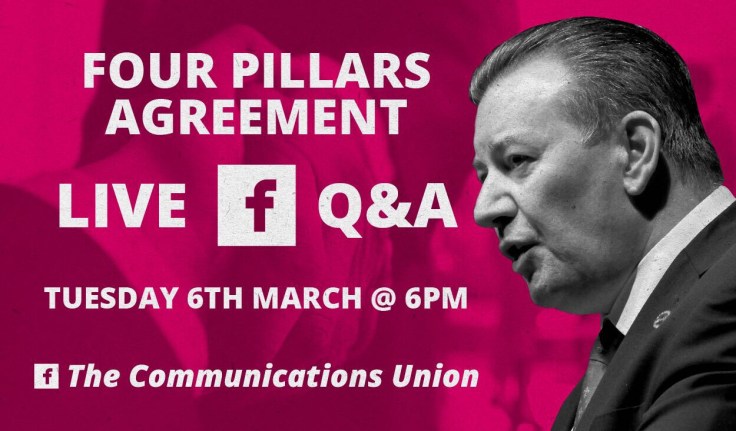
Live Facebook Q&A 6th March #TheCWU

Colleagues,

Tomorrow at 6pm we are going to hold a Live Facebook Q&A with Mark Baulch and Davie Robertson on the Pipeline pillar of the Four Pillars Agreement.

The session will be hosted on the CWU Facebook page.

Don’t forget we are also holding a session on the whole agreement with Terry Pullinger on Tuesday at 6pm. Ray Ellis will also be online for that session to take pension related questions.

Please share this information with your colleagues.

#PowerOfTheUnion #TheCWU

Create a website or blog at WordPress.com

Up ↑