POSTPONEMENT OF CWU NATIONAL AWARDS EVENING

POSTPONEMENT OF CWU NATIONAL AWARDS EVENING

Branches will be aware from LTB109/18 that we intended to host a CWU National Awards evening on Monday 23rd April.

The purpose of this LTB is to advise branches that after giving this matter further consideration and in particular taking into account significant logistical difficulties, we have decided to postpone the event. The matter will be considered further as something that may be planned for our 2019 conference.

In the meantime, please accept our apologies to branches who had taken the time to correspond on this matter.

Yours sincerely

Dave Ward

General Secretary

18LTB175 POSTPONEMENT OF CWU NATIONAL AWARDS

View Online

INDEPENDENT REVIEW OF UNIONLINE

INDEPENDENT REVIEW OF UNIONLINE

The purpose of this LTB is to update Branches on the independent review of Unionline which was notified in LTB 468/17.

As previously explained, given the overall financial position of the union, the impact of the Lord Justice Jackson legal reforms and the reported accounts of Unionline to date, the NEC agreed it was appropriate to ensure the review was undertaken independently. Therefore, to carry out this important work we engaged a business model consultant who has previously undertaken excellent work for the union.

The Terms of Reference for the independent review were agreed by the NEC and shared with our sister union and Unionline partner, the GMB. The Terms of Reference were comprehensive and designed to examine all aspects of the performance of Unionline, the basis upon which it was set up and its prospects for the future.

The current position is that work is continuing and the aim is to conclude the review in the near future with a report being presented to the NEC and a subsequent report being published to Branches. If the review is not concluded by General conference 2018, we will ensure there is an opportunity to provide a comprehensive update on Unionline as part of the redesign session scheduled for Monday 23rd April.

In undertaking the review it was explained that we would also be seeking the views of Branches on the accessibility, quality and range of services provided by Unionline. Therefore, to facilitate this a short survey is attached. We would ask that Branches complete this and return it to the GS Department gsoffice@cwu.org no later than 17th April 2018.

We can also advise that in conjunction with the GMB, we will be working towards a suitable survey of individual members who have either contacted and / or used Unionline services.

Finally, Branches will be aware of a previous Unionline LTB 89/18 sent out recently by the Head of Legal Services in response to a Conference Motion. It is important that LTB 89/18 is now seen within the context of the wider Unionline review. When the independent review was agreed by the NEC it was explained that the work required to respond to the Conference Motion would still go ahead and that this would need to be carried out in a complementary way to the wider review.

However, given that LTB 89/18 was published separately, we would emphasise and ask Branches to note that the outcome of the independent review takes precedence in terms of its scope, content and its relevance to how we take Unionline forward in the future.

Further information will be sent out in due course.

Any enquiries on the content of this the General Secretary on gsoffice@cwu.org.

Yours sincerely

Dave Ward

General Secretary  

18LTB174 INDEPENDENT REVIEW OF UNIONLINE

CWU Branch Survey – Unionline

View Online

ONLINE JOINING #TheCWU

ONLINE JOINING

Following the introduction of the Trade Union Act which included alterations to our Membership Application Forms, we have been reviewing the Online Joining section of the website.

It has come to our attention that we have had over 1,000 failed attempts in less than one month to access the old (and no longer working) Online Joining URL. This was the URL used before switching to the new website a few months ago.

Following investigation it has been found that many Branch Officers have “Join Online” / “Join Now” hyperlinks within their Email signatures, which is likely to be a cause in the traffic being directed to the old URL.

Branches are advised that the old (and no longer working) ULR is:

https://members.cwu.org/onlinejoining/registration.aspx

The new ULR which should be used in its place is: 

https://www.cwu.org/join-us/join-online/

Branches will need to update these Hyperlinks to ensure users are directed to the correct webpage so we do not lose any potential joiners.

Any enquires regarding this LTB should be addressed to the SGDS department for the attention of Martin Akerman makerman@cwu.org or Matt Edwards, System Administrator medwards@cwu.org

Yours sincerely,

Tony Kearns

Senior Deputy General Secretary

18LTB171

View Online

Royal Mail Delivery Production Plan (DPP)

Royal Mail Delivery Production Plan (DPP)

Dear Colleagues,

Over recent weeks, the Outdoor Department has received a number of enquiries regarding a Royal Mail process called Delivery Production Plan which gives a forecast of the workload requirement for the coming weeks.

The Department and Union nationally had not been informed or involved in any discussions regarding this process, which as a result meant the matter was raised at the highest level within the company regarding how this had been allowed to happen. As a result, urgent meetings were arranged with Royal Mail to establish the status of this management programme.

Royal Mail informed us that the Delivery Production Plan is not introducing anything new that they haven’t already been doing for the past couple of years or more. The main difference is that the Production Plan has pulled together many disparate pieces of information and systems that Delivery Office managers have formerly had to interact with. This information then produces a forecast workload based on WIPWH and WIPGH. The development of Production Plan pulled these data sources into one programme which is part of Royal Mail’s ongoing campaign to streamline and simplify the workload of Delivery Office Managers and assist the weekly resourcing meetings with the CWU. It is important to note that this programme was finalised and deployed before the Pay & Four Pillars National Agreement was concluded.

It is evident that DPP is a financial budget driven plan that establishes weighted items and workload figures that managers have to aim to achieve on a weekly basis.

Although the union made it clear to Royal Mail that we do not agree with this approach and that all National Agreements on Revision and Resourcing in Weekly Resource Meetings (WRMs) hold the field, we recognise Royal Mail continues to use weighted items as the business efficiency measure with the Regulator. This creates this parallel resourcing approach that our representatives continue to face problems with in WRM’s when managers use budget based WIPWH forecasts that are not consistent with our agreed processes.

This issue was the subject of much debate in recent Pay & Four Pillars negotiations which has resulted in the words contained within section 10.2 Efficiency & Productivity (see below):

We already have a number of agreed industrially engineered performance standards, but the business efficiency measure ‘Weighted Items Per Gross Hour’ (WIPGH) is unagreed yet a highly influential measure from both Royal Mail’s and the regulators’ perspective. Both parties agree that it is imperative that any efficiency measure is jointly agreed and understood.

To this end a joint working group will be established involving operational and work study expertise from both management and the CWU, involving all functions to fully review all the efficiency measures currently being used and produce recommendations over a three month period at the start of this agreement. These recommendations will be taken forward into further National joint discussions in order to jointly agree the efficiency and productivity measures. Acknowledging throughout these discussions that whilst the business will seek to influence the view of Ofcom on its measures of efficiency, it will need to use and follow the measures to ensure alignment with the Regulator, however current national agreements will hold the field for changing arrangements and resourcing between RMG and the CWU.

Subject to endorsement/ratification of the Agreement, the Department will be immediately looking to establish the joint working group to ensure the terms of the agreement are fulfilled.

In the interim, we have made it absolutely crystal clear to Royal Mail that all current National Agreements, Joint Statements etc on determining hours within revision activity and weekly forecasting hold the field and there is no agreement with the CWU on Delivery Production Plan.

Royal Mail accepts this and maintains that the DPP only aims to assist managers in weekly resourcing meetings. They have provided a statement to this affect which is contained within their user guide which representatives should refer managers to if local managers try to impose the outputs based on weighted items and the overall outputs that DPP produces.

Production Plan represents a simplification and integration of existing tools and systems which will free up time for the DOM to focus on other areas. Production Plan is a management driven process and does not change or alter any of the existing commitments we have to conduct an effective weekly resourcing meeting with the local CWU unit rep in line with current national agreements on revisions and resourcing.

Whilst Production Plan aims to give the unit manager a clearer understanding of what potential forecast workload can be considered in resource meetings, especially on the outdoor element where no current agreement exists with the CWU, this does not alter but is intended to support the commitment we have to fully engage and consult with the local CWU rep on resourcing decisions for the following weeks. The standard agreed weekly resourcing meeting agenda should still form the basis for the regular weekly meetings and Production Plan does not replace the Auto IWT in establishing forecast indoor workload.

Production Plan can only act as a guide to help the manager in weekly resourcing meetings towards securing an agreed outcome with their CWU Rep for the following week.

As per the current processes regarding Resource Meetings, where differences continue to exist in agreeing the outputs for the resourcing requirements for the following weeks, the IR Framework should be used. In addition we would ask Branches to provide reports to their Divisional Representatives as well as the Department when the above takes place. Further updates regarding the on going discussions in respect of the future Efficiency & Productivity will be reported as they develop.

Any queries to the content of the above please contact the Outdoor Department reference 230.03, email address: outdoorsecretary@cwu.org.

Yours sincerely,


Mick Kavanagh

CWU (Acting) Assistant Secretary

LTB 168.18 – Delivery Production Plan

GET OUT THE VOTE

GET OUT THE VOTE

It is hugely important that we get as many members as possible to vote on the Four Pillars and Pay Agreement.

In line with our ongoing commitment to engage and involve our members, we are urging every CWU Representative and Officer at every level to do all they can to encourage every individual member to exercise their democratic right, get out the vote and secure a high turnout that delivers the biggest possible YES vote in favour of the Agreement.

The bigger the YES vote the stronger the Union’s voice and influence in delivering our Agreement going forward and ultimately, securing members’ future employment, standard of living and retirement security.

The Department has been made aware that members in some locations have not received their ballot paper. If this is the case, branches are advised to request a ballot paper by contacting the Customer Service Helpline at the Electoral Reform Society (ERS) using the following email:- customerservices@electoralreform.co.uk

When making a request, branches need to ensure they provide ERS with details of the members:-

• Name
• CWU Membership Number
• Correct postal address
Branches are urged to do all you can to GET OUT THE VOTE.

Any further enquiries in relation to the content of this LTB should be directed to the DGS(P) Department.

I thank you for your excellent support throughout this campaign and this push to get a huge vote on the Agreement will be the perfect conclusion from inception to agreement.

Yours sincerely,

Terry Pullinger
Deputy General Secretary (Postal)

18LTB167 – GET OUT THE VOTE

VOTING TIME – ROYAL MAIL BALLOT DRAWS TO A CLOSE AND DEAL REACHED WITH BT

We are now into the last full week of voting on the Four Pillars Agreement. The inspirational campaign has seen members right across the UK #RiseUp in defence of their jobs, futures and union.

It is now vital we return the biggest YES vote possible. Here DGS(P) Terry Pullinger has a final message for members – USE YOUR VOTE and encourage your colleagues to do the same.

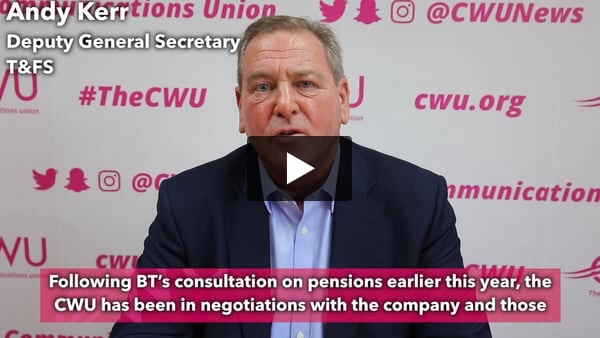
After extensive negotiations and the pressure applied through the #TellBTNo campaign an agreement has been reached on Pensions and Pay with BT. This will now go out to a vote of all our members. Meetings will take place in every branch in the UK in the coming weeks and we will be holding Live Facebook sessions to explain the agreement and ballot timetable in more detail. Please make every effort to get to your local meeting.

Watch DGS(T&FS) Andy Kerr reveal that an agreement has been reached.

#TheCWU #PowerOfTheUnion 


A final message from DGS(P) Terry Pullinger on the #FourPillars

A final message from DGS(P) Terry Pullinger . Use your vote and back #TheCWU and the #FourPillars vote YES.

#PowerOfTheUnion

https://www.facebook.com/cwuEasternNo5/videos/1868645829852134/

New International Health and Safety Management Standard (ISO 45001)

New International Health and Safety Management Standard (ISO 45001):


Dear Colleagues,

Introduction:

The International Standardisation Organisation (ISO) has approved the world’s first occupational health and safety standard and new certifiable standard for occupational health and safety (ISO45001). The standard was first published this week. This will replace the non-certifiable British Standard OHSAS 18001 which was introduced in 1999. BS OHSAS 18001 will be withdrawn.

The standard is now likely to be used in workplaces across the UK, although it will take some time before it is properly implemented in a way that will allow organisations to get properly certified. It is likely to be most commonly used in multi-national corporations that will seek to have a standard OHS system across the entire globe. It may also become a requirement in many procurement and infrastructure contracts.

Background:

The ISO’s attempts to develop what is now ISO45001 were initially met with strong opposition from international employers and Trade Union bodies, on the basis that this was a matter that should be dealt with through social dialogue. In addition, the International Labour Organisation (ILO), which has its own guidelines on OSH management systems (ILO 2001), refused to support it; they believed that health and safety standards should be developed by governments, unions and employers through the ILO process, which gives an equal voice to each of these groups to ensure that the views of the social partners are closely reflected in labour standards. Unions agreed and believed that ILO-OSH 2001 guidelines should be the starting point for this, although there was a need for some updating and strengthening of the current document. The ILO agreed to proceed with an elaboration of its own standard, but this did not happen; hence the ISO tried again and succeeded in co-opting the ILO into the process in 2013 when the two organisations signed a Memorandum of Understanding on the development of ISO 45001 (ILO 2013), on the basis of a number of assurances that the ISO standard would be consistent with the ILO guidelines. In October 2013 a project committee met in London to create the first working draft of ISO 45001. Around 50 national standards bodies (NSBs) were involved in the first meeting, along with the ILO, the ITUC and the International Organisation of Employers (IOE). Further meetings were held in Casablanca, Dublin and Geneva.

ISO 45001 and Legal Compliance:

Achieving ISO45001 accreditation will not, in itself, be sufficient to meet all the requirements of British Health and Safety law, and it differs in several ways from the HSE health and safety management system HSG65, so employers cannot rely on simply having met the requirements of ISO45001 to be confident of having a safe and healthy workplace which is legally compliant.

Main Differences between ISO 45001 and BS OHSAS 18001:

• Context.

• A lot more on leadership.

• A lot more on Worker Participation and TU/Safety Rep Involvement. Much more focus and improvement in this area.

• Documentation is much simpler

Process:

• Employers have to meet requirements for:

• Risk Management.

• Provision of resources.

• Performance measurements.

• Analysis.

• Continual improvements.

• Once processes are in place, the employer can seek ‘Certification’.

• Then a Stage 1 Audit is carried out.

• A Stage 2 is then carried out following any remedial action and once completed satisfactorily, Certification can follow.

What ISO 45001 says that is most positive:

• The focus is on top management/board buy in.

• There is a high level of Worker Involvement in it.

• It is strong on the ‘Hierarchy Of Controls’ in risk management, mirroring EU Legislation.

• Integrates Safety and Health.

• The emphasis of the wording is based on changing the workplace not the worker, improving on BS18001.

• Better than HSG65 in some areas (but lower than UK Law in some areas).

• Worker involvement is greatly improved (but lower than the SRSC Regs).

• No requirement for Free PPE or Free Training mentioned.

Some Concerns:

• Focuses heavily on processes and documentation rather than focusing on outcomes.

• It’s a tool to make money for those companies and organisations advertising to get companies through Certification.

Summary Conclusions:

• It replaces BS OHSAS 18001.

• The UK still has HSG65 (which was revised with heavy Trade Union involvement).

• ISO 45001 doesn’t mean anything in Law – complying with ISO 45001 doesn’t mean a company is complying with Health and Safety Law.

• ISO 45001 could well be used as a standard for companies seeking contracts in various sectors but particularly construction.

• Importantly, companies and organisations will not get the ISO 45001 Certification without demonstrable Trade Union involvement.

• Costs £100 a copy.

• Certification has to be renewed every 3 years.

Attachments:

Further more detailed information can be found in the excellent attachments which are:-

1 ETUI Policy Brief.

2 ISO 45001 TUC Guide.

3 ISO 45001 Introduction & Checklist by the TUC.

Note: ISO 45001 is an improvement over its predecessor and is generally good and having a health and safety management system is important but it must not be about pointless paperwork. What makes a workplace safer is removing hazards, controlling risks and ensuring good worker involvement.

Yours sincerely

Dave Joyce
National Health, Safety & Environment Officer

18LTB164 New International Health and Safety Management Standard (ISO 45001)

ISO+OSH+management+systems+Robertson+2016.03 (1)

ISO 45001 TUC Guide

ISO 45001 TUC Introduction Checklist

GET OUT THE VOTE #FourPillars

GET OUT THE VOTE

It is hugely important that we get as many members as possible to vote on the Four Pillars and Pay Agreement.

In line with our ongoing commitment to engage and involve our members, we are urging every CWU Representative and Officer at every level to do all they can to encourage every individual member to exercise their democratic right, get out the vote and secure a high turnout that delivers the biggest possible YES vote in favour of the Agreement.

The bigger the YES vote the stronger the Union’s voice and influence in delivering our Agreement going forward and ultimately, securing members’ future employment, standard of living and retirement security.

The Department has been made aware that members in some locations have not received their ballot paper. If this is the case, branches are advised to request a ballot paper by contacting the Customer Service Helpline at the Electoral Reform Society (ERS) using the following email:- customerservices@electoralreform.co.uk

When making a request, branches need to ensure they provide ERS with details of the members:-

• Name

• CWU Membership Number

• Correct postal address

Branches are urged to do all you can to GET OUT THE VOTE.

Any further enquiries in relation to the content of this LTB should be directed to the DGS(P) Department.

I thank you for your excellent support throughout this campaign and this push to get a huge vote on the Agreement will be the perfect conclusion from inception to agreement.

Yours sincerely,


Terry Pullinger

Deputy General Secretary (Postal)

18LTB167 – GET OUT THE VOTE

Create a website or blog at WordPress.com

Up ↑