Latest from the Branch

World Menopause Month – October 2023

World Menopause Month – October 2023

Introduction:

October marks Menopause Awareness Month. We’re once again putting the spotlight on the menopause and our support for those members experiencing menopausal symptoms. The month is to raise awareness, break the stigma and highlight the support options available for improving health and wellbeing.

British Menopause Society ‘Menopause, Misinformation and Management’

The conversation around menopause is getting louder but there is still a lot of misinformation. The British Menopause Society this year produced, in partnership with ITN Business, a news-style programme, hosted by Louise Minchin, to support both World Menopause Month and Day. In the programme British Menopause Society medical professionals aim to dispel menopause misinformation, talking to businesses and employers about best-practice menopause policies and providing information and practical menopause advice for younger women. A recording of the ‘YouTube’ menopause programme ‘Menopause Misinformation and Management’ is available to watch for those who couldn’t watch the live launch at this link: https://thebms.org.uk/news/world-menopause-day-2023/ (See attached press release).

Websites with good, comprehensive Menopause advice and guidance are:

Menopause Matters.Co.UK

This is an independent, award winning website providing up to date, accurate information about the menopause, menopausal symptoms and treatment options. On this site you’ll find lots of excellent information on what happens leading up to, during and after the menopause, what the consequences can be, what you can do to help and what treatments are available.

Menu of items covered:

  • Menopause
  • Premature Menopause
  • Menopause Symptoms
  • Bleeding Problems
  • Vaginal Problems
  • Bladder Matters
  • Menopause and HRT after Hysterectomy
  • Treatments
  • Diet, Lifestyle and Exercise
  • Menopause at Work
  • Hormone Replacement Therapy
  • HRT Preparations
  • Prescribable non-HRT
  • Testosterone
  • Alternatives Therapies
  • Alternatives Techniques
  • Decision Tree
  • Contraception
  • Osteoporosis
  • Heart Disease
  • A to Z of menopause and medical conditions
  • Magazine
  • Shop

‘Henpicked’

‘Henpicked’ is one of the UK’s largest, fastest-growing websites for women, here to give women a place to have their say, sparking discussion, promoting healthy debate and, aiming to bring about positive change. ‘Henpicked’ is a dynamic community of women who want to help one another with news and views on a number of subjects with women supporting women. ‘Henpicked’ has a special website section on ‘Menopause in the Workplace’ covering awareness, toolkits and training and their menopause in the workplace experts provide line manager and colleague training, videos, eLearning, policy and communications expertise.

Website: https://henpicked.net/menopause-hub/menopause-and-work/

 ‘Daisy Network’ Charity

Daisy Network is a charity dedicated to providing information and support to women diagnosed with Premature Ovarian Insufficiency, also known as Premature Menopause.

Website: https://www.daisynetwork.org/

Other Good Informative Websites covering The Menopause:

Research Reports

‘GenM’

‘GenM’ say that we ‘need to talk’ more openly about menopause and need to stop teaching women to make do and mend in this period in their lives. ‘GenM’ have published a report – The ‘GenM’ Menopause Invisibility Report’ (copy attached) which revealed the distinct lack of education and support for people going through the menopause. ‘GenM’ called upon companies and employers to open up the conversation and help normalize menopause for future generations. Royal Mail Group has signed up to that agenda.

‘GenM’ is seeking to make menopause a more positive experience for everyone. According to ‘GenM’ women going through the menopause often feel “alone and invisible” due to a lack of knowledge, as well as the lack of choices offered to them by employers. According to ‘GenM’s’ Invisibility Report, which was published last year, 87% of menopausal people feel overlooked by society and by employers. 97% feel employers should cater more to the needs and wants of menopausal people; and 91% have never seen specific advertising or marketing for menopausal products.

There are 15.5 million perimenopausal and menopausal people throughout the UK, and it’s abundantly clear that they are underserved, and deserve much better state ‘GenM’.

‘GenM’ has previously worked hard to improve the treatment of menopausal people in the workplace through its ‘Choose to Challenge campaign’. ‘GenM’ say that menopause is not just a workplace issue, but a societal one.

‘GenM’ state that there are 48 symptoms of menopause, yet most women can only name between three and five. So if women don’t even know the symptoms of their own menopause, how can we expect men to? How can we expect employers and organisations to? They want ‘brands’ to create products that cater to them, and market those products accordingly so that women know what is available to them?

‘GenM’ want major brands to cater to their menopausal customers and to normalise the conversation around menopause, as well as create and market products that will cater to the needs of menopausal people. Major brands including M&S and Boots have already joined ‘GenM’ in co-signing an open letter to the industry asking major ​​brands from all sectors to pledge to better understand the needs of those going through menopause, use their platforms to normalise the conversation around the topic, and review how their policies, products and services can improve the menopause experience.

‘GenM’ also wants companies to develop their internal teams so they can support their menopausal employees. (See attached the ‘GenM’ Menopause Invisibility Report’).

Website: https://gen-m.com/

Fawcett Society Study

In 2022, the Fawcett Society, UK membership charity campaigning for gender equality and women’s rights at work, at home and in public life published a study based on data from the largest ever survey of menopausal and peri-menopausal women in the UK which revealed a lack of support for often severe symptoms which mean the needs of menopausal women are being ignored both in workplaces and by healthcare providers. The survey was commissioned by Channel 4 and collected data from over 4,000 women.

The findings showed:

  • 77% find at least one menopause symptom ‘very difficult’.
  • 44% of women experience three or more symptoms that are this severe.
  • 84% of women say they find sleeping difficult.
  • 73% suffered brain fog.
  • 69% suffered anxiety or depression.
  • 44% of menopausal women said their ability to work has been affected by their symptoms.
  • 80% of menopausal women said their workplace has no basic support in place for them. No support networks. No absence policies. No information sharing with staff.
  • 21% of women who have to wear uniform or a dress code to work found it uncomfortable given their symptoms.
  • 81% of menopausal women say every employer should have an action plan on the menopause.

The report uncovers the stigma many women face, saying they have seen menopause or menopause symptoms treated as a joke by people at work. Among women who had taken time off due to menopause, 40% had cited anxiety or depression as the main reason on their sick note, rather than share their menopause status. Almost half (45%) of women haven’t spoken to their GP about their symptoms. 31% said it took many appointments before their GP realised they were experiencing menopause or perimenopause. Official guidance says that hormone replacement therapy (HRT) should be offered to women who are struggling with menopause symptoms, but just 39% of women say their GP or nurse offered HRT as soon as they knew they were experiencing menopause, and only 14% of menopausal women said that they are currently taking HRT. Current HRT shortages have been widely reported as due to increased demand – but this evidence suggests that we are only seeing the beginning of the potential rise in uptake.

The report concludes that the Government needs to make urgent changes, requiring employers to have menopause action plans, to creating a route into menopause healthcare, to ensuring that GPs are adequately trained to spot menopause symptoms. For too long, menopause has been shrouded in stigma, we need to break the culture of silence and ensure menopausal women are treated with the dignity and support they deserve instead of being expected to just get on with it. The Fawcett Society called on the Government to respond to these findings by:

  • Requiring employers to have menopause action plans.
  • Make flexible work the default.
  • Implementing a public information campaign – 87% of menopausal women agree that all women in their 40s or 50s should be sent a list of menopause symptoms by the NHS, and 81% agree that Government should run a public campaign to inform people about the menopause.
  • Inviting every woman in her 40s or 50s to speak with her GP about menopause – 87% of women agree this should happen.
  • Ensuring GPs receive mandatory training to help diagnose menopause earlier – 94% of women agree that every GP practice should have someone who is trained on the menopause.

(See attached Fawcett Society Report ‘Menopause and the Workplace’).

ComRes Study

A 2018 ‘ComRes’ study looking at how the menopause affects women at work and in their relationships, and the treatments they found effective found:

  • 70% of working women didn’t want to make their employers aware of their menopause symptoms.
  • 48% felt that their mental health had suffered as a result of the menopause.
  • 25% said that the menopause made them want to stay at home.

King’s College Study

A 2018 ‘King’s College London’ study looked at how symptoms of menopause affect women’s work and careers and found women struggling with menopause symptoms. The study concluded that a simple self-help cognitive behavioural therapy programme, provided in short practical and accessible guidance on the subject and coping at work, would have a positive effect, helping to reduce the degree to which women felt their symptoms were causing them problems and improving the way in which they felt they could discuss menopause in the work place, thus challenging the stereotypical belief that women in menopause are ‘past it’. The study found many women suffering from these debilitating symptoms and feeling unsupported during the menopause with some dropping out of the work force. This natural process has been overlooked and considered a taboo for too long it concluded. Findings from the study:

  • In the UK 1 in 3 UK workers are over 50. All female workers will go through the menopause. The average age of menopause for women in the UK is 51. Some begin in their early 40’s and for others it can go on into their late 50’s and beyond.
  • 3 in 4 women experience menopause symptoms and 1 in 4 of these women experience severe physical or psychological symptoms.
  • 4 out of 10 women haven’t ever consulted their GP about symptoms of menopause.
  • Employers should do more to provide support and better protect these women.

Royal Mail Group Menopause Support Package For Women:

Royal Mail Group currently has around 17,000 women employees who are likely to be experiencing menopausal and perimenopausal symptoms – so as one of the UK’s largest employers – it matters to them!  Following discussions with the Royal Mail Group’s Head of Health and Wellbeing last year a new ‘Let’s Talk Menopause’ campaign, to enhance the support afforded to women employees experiencing and indeed suffering menopausal symptoms was launched. And it’s there for partners too.  Royal Mail stated in launching the new campaign that; “Most women will come up against menopausal symptoms, but that’s not to assume every person’s experience will be the same. Royal Mail Group want employees to feel they can have the conversation and seek the support they need however the menopause is impacting them. RMG doesn’t want any woman in our business to feel that they’re unable to do their job or progress their career – RMG wants everyone to feel at their very best.”

To strengthen the company’s commitment and agree a step change in menopause support, Royal Mail Group signed up to the ‘Wellbeing For Women Menopause Workplace Pledge’ and in doing so, Royal Mail Group committed to:

  • Recognising that the menopause can be an issue in the workplace and women need support.
  • Talking openly, positively and respectfully about the menopause.
  • Actively supporting and informing employees affected by the menopause.

The New Enhanced RMG Menopause Support Package included:

  • A new RMG ‘Let’s Talk Menopause’ Intranet Group.
  • ‘Meno-Mates’ – local volunteers to help to raise awareness, listen and signpost their colleagues to available support.
  • Menopause guidance.
  • Menopause Toolkit – Confidential and available 24/7 for employees seeking assistance, referrals, including direct access to counselling, support, advice and guidance, conversations, articles, programmes, signposting, physical help and advice on reasonable adjustments, modified duties, flexible working, quiet space etc.
  • Menopause awareness eLearning – Training for managers, ‘Meno-Mates’ and CWU Reps.

Attachments:

  • BMS Press Release
  • Gen-M Invisibility Report
  • Fawcett Society ‘Menopause and the Workplace’ Report
  • Women’s Health Concern ‘Menopause Factsheet’

Yours sincerely

Dave Joyce
National Health, Safety & Environment Officer

23LTB262 World Menopause Month October 2023

V3-BMS-WMD-Launch-Press-Release-V3-13.10.23

Gen-M-Invisibility-Report-The-Menopause

FawcettSociety – Menopause and the Workplace 2022

Womens Health Concern – Menopause Factsheet (Nov2022)

View Online

Pancreatic Cancer Awareness Month November 2023 and World Pancreatic Cancer Day Thursday 16 November 2023:

Pancreatic Cancer Awareness Month November 2023 and World Pancreatic Cancer Day Thursday 16 November 2023:

Introduction

November is Pancreatic Cancer Awareness Month and World Pancreatic Cancer Day is Thursday 16 November. Most people are not always as knowledgeable about pancreatic cancer as breast, lung or prostate cancer, but the disease is just as debilitating.

Pancreatic Cancer Awareness Month November & World Pancreatic Cancer Day 16 November

This month is Pancreatic Cancer Month and Thursday 16 November is World Pancreatic Cancer Day. People and organisations around the UK and the world will unite to call for more action in the fight against the world’s toughest cancer. The World Pancreatic Cancer Coalition has brought together more than 80 organizations from over 30 countries and six continents to raise awareness and inspire action on World Pancreatic Cancer Day. Through this combined effort, they aim to bring greater attention, awareness, and better outcomes to this deadly disease. The organisations call on all to take action to raise awareness about pancreatic cancer, the symptoms and risks of this disease, and the urgent need for earlier detection. CWU is supporting the initiative.

World Pancreatic Cancer Day is organised by an International Steering Group made up of the following organisations: Pancreatic Cancer Action (UK), Pancreatic Cancer UK, PurpleOurWorld Australia, The JCM Foundation (USA), Craig’s Cause Pancreatic Cancer Society (Canada), European Cancer Patient Coalition (EU), PASYKAF (Cyrpus). The initiative is supported and promoted in the UK by the ‘Pancreatic Society of Great Britain and Ireland’ Website:- https://www.psgbi.org/world-pancreatic-cancer-day/)

What You Need to Know About Cancer of the Pancreas 

The pancreas is a fish shaped organ that lies behind the stomach, deep in the body. It measures about 6 inches long and less than 2 inches wide. The pancreas is made up of exocrine glands (which make pancreatic enzymes that break down food in the intestines) and clusters of cells (which make hormones like insulin that help balance the amount of sugar in the blood).

Pancreatic cancer starts when the exocrine glands or the endocrine cells form tumours, which can spread throughout the body. Cancers formed by the exocrine cells are much more common.

When pancreatic cancer spreads, the cancer cells may also be found in nearby lymph nodes, the liver, the lungs or in fluid collected from the abdomen.

What is the pancreas? 

The pancreas is a large gland that lies behind the stomach, at the back of the tummy area (abdomen) – at about the same height as the bottom of the breastbone. It is about 15cm (6 inches) long and shaped a bit like a tadpole. It is often described as having a head, body and tail. It is surrounded by several large and important organs and blood vessels. The head of the pancreas is next to the duodenum (first part of the small intestines). The body of the pancreas is the middle section, and the tail is next to the spleen. The liver, stomach, intestines, left kidney and gallbladder are also all close to the pancreas. The blood vessels that carry blood to the liver, intestines, kidneys and lower part of the body are very close to the pancreas, and may touch it. The pancreatic duct runs the length of the pancreas. It carries pancreatic juices, which contain enzymes made by the pancreas to the intestines. The pancreatic duct and bile duct (which carries a fluid called bile from the liver) both open into the duodenum (small intestines).

Facts About Pancreatic Cancer 

  • Pancreatic cancer is the 10th most common cancer in the UK.
  • Pancreatic cancer is the fifth biggest cancer killer in the UK – 26 a day.
  • 8,500 people die from pancreatic cancer in the UK every year.
  • Just 5% of patients survive – it has the worst survival rate of all 22 common cancers.
  • The average life expectancy on diagnosis is four to six months.
  • There are around 9,500 new cases of pancreatic cancer in the UK every year.
  • About 1 in 75 people will get pancreatic cancer at some point in their life.
  • Pancreatic cancer affects men and women equally.
  • Nearly half of people are diagnosed as an emergency in our A&E system.

The earlier pancreatic cancer is caught, the better chance a person has of surviving 5 years after being diagnosed. 

Pancreatic cancer – what is it? 

Pancreatic cancer occurs when a malignant tumour forms in the pancreas. There are two main types of pancreatic cancer: Exocrine tumours which make up the vast majority of all pancreatic cancers and come from the cells that line the ducts in the pancreas which carry digestive juices into the intestine, and rarer, Endocrine tumours which are much less common.

What causes pancreatic cancer? 

The causes of pancreatic cancer are not fully understood. However, there are some risk factors that make developing pancreatic cancer more likely:

Smoking – There is a direct relationship between the amount you smoke and the risk of pancreatic cancer. Around a third of all cases are associated with smoking.

Age – The risk of developing pancreatic cancer increases with age. It mainly affects people who are 50-80.

Chronic Pancreatitis – Long-term inflammation of the pancreas (pancreatitis) has been linked to pancreatic cancer.

Diabetes – There have been a number of reports which suggest that diabetics have an increased risk of developing pancreatic cancer.

Obesity – Recent studies have shown that risk is higher in people who are obese (have a Body Mass Index more than 30). Some studies show that obese women who carry their weight on their stomach area are at an increased risk of developing pancreatic cancer.

Stomach Ulcer – Stomach Ulcer and Helicobacter pylori infection (a stomach infection).

Genetics – In about 1 in 10 cases, pancreatic cancer is inherited from a person’s parents. Certain genes also increase your chances of getting pancreatitis, which in turn increases your risk of developing cancer of the pancreas.

Symptoms of pancreatic cancer 

In the early stages, a tumour in the pancreas doesn’t usually cause any symptoms, which can make it difficult to diagnose.

It’s important to remember that these symptoms can be caused by many different conditions, and aren’t usually the result of cancer. But individuals should contact their GP if concerned, or if these symptoms start suddenly.

The first noticeable symptoms of pancreatic cancer are often:

  • pain in the back or stomach area – which may come and go at first and is often worse when you lie down or after you’ve eaten
  • unexpected weight loss
  • jaundice – the most obvious sign is yellowing of the skin and whites of the eyes; it also causes your urine to be dark yellow or orange and your stools (faeces) to be pale-coloured

Other possible symptoms of pancreatic cancer include:

  • nausea and vomiting
  • bowel changes
  • fever and shivering
  • indigestion
  • blood clots

Those affected may also develop symptoms of diabetes if they have pancreatic cancer, because it can produce chemicals that interfere with the normal effect of insulin.

Diagnosing pancreatic cancer 

The GP will first ask about general health and carry out a physical examination. They may examine the tummy (abdomen) for a lump and to see whether the liver is enlarged.

They’ll also check the skin and eyes for signs of jaundice and may request a urine sample and blood test.

If the GP suspects pancreatic cancer, the person concerned will usually be referred to a specialist at a hospital for further investigation where the following may take place:

  •  an ultrasound scan
  • a computerised tomography (CT) scan
  • a magnetic resonance imaging (MRI) scan
  • a positron emission tomography (PET) scan – where an injection is given of a very small amount of radioactive medication, known as a tracer, which helps to show up cancers in an image

Depending on the results of a scan, further tests may include:

  • an endoluminal ultrasonography (EUS) endoscopy – a type of endoscopy which allows close-up ultrasound pictures to be taken of the pancreas
  • an endoscopic retrograde cholangiopancreatography (ERCP) – a type of endoscopy which is used to inject a special dye into the bile and pancreatic ducts; the dye will show up on an X-ray and highlight any tumours
  • a laparoscopy – a surgical procedure that allows the surgeon to see inside the body using a laparoscopy (a thin, flexible microscope)
  • A biopsy, where a small sample is taken from a suspected tumour, may also be carried out during these procedures.

NICE guidelines 

In 2018, the National Institute for Health and Care Excellence (NICE) published updated guidelines to help GPs recognise the signs and symptoms of pancreatic cancer and refer people for the right tests faster.

To find more on this read the NICE 2018 guidelines suspected Pancreatic cancer in adults: recognition, diagnosis and management [NG85] Published: 07 February 2018

Go to:- https://www.nice.org.uk/guidance/ng85

Treating pancreatic cancer 

Cancer of the pancreas is difficult to treat. It rarely causes any symptoms in the early stages, so it’s often not detected until the cancer is fairly advanced. If the tumour is large, treating the cancer will be more difficult.

If diagnosed with pancreatic cancer, the treatment will depend on the type and location of the cancer, and how far it’s advanced. Age, general health and personal preferences will also be taken into consideration.

The first aim will be to completely remove the tumour and any other cancerous cells. If this isn’t possible, treatment will focus on preventing the tumour growing and causing further harm to the body.

The three main treatments for pancreatic cancer are:

  • surgery
  • chemotherapy
  • radiotherapy

Some types of pancreatic cancer only require one form of treatment, whereas others may require two types of treatment or a combination of all three.

Recovering from Pancreatic Cancer Surgery 

Recovering from pancreatic cancer surgery can be a long and difficult process.

Patients will probably experience some pain after the operation. Adequate pain relief will be prescribed.

After any type of surgery to the digestive system, the bowel will temporarily stop working. This means the patient won’t be able to eat or drink straight away.

The patient will gradually be able to sip fluids, before eventually being able to drink and eat more regularly. Advice will be given about what foods should be eaten following the operation.

After the tumour has been removed, the patient will probably have a six-month course of chemotherapy, which greatly increases the chance of being cured. But because cancer of the pancreas is difficult to diagnose and treat, many people don’t recover completely.

Treatment can be very effective in helping to ease symptoms and make the patient as comfortable as possible. Chemotherapy can help shrink the tumour and slow down its growth.

Pancreatic Cancer UK 

Pancreatic Cancer UK is a charity fighting to make a difference by taking on pancreatic cancer, by supporting those affected by the disease, investing in research, lobbying for greater recognition of pancreatic cancer, and being there for everyone involved in the fight. The Charity wants to make sure that everyone touched by it gets the support and information they need. The Charity is there for everything you need to know about pancreatic cancer.

  • They provide expert, personalised support and information via a Support Line and through a range of publications.
  • They fund innovative research to find the breakthroughs that will change how we understand, diagnose and treat pancreatic cancer.
  • They campaign for change; for better care, treatment and research, and for pancreatic cancer to have the recognition it needs.

Support Line – Freephone 0808 801 0707

Pancreatic Cancer UK operates a Freephone ‘Support Line’ which is a lifeline for thousands of patients, families and friends. Available to anyone affected by pancreatic cancer. The Pancreatic cancer specialist nurses understand the issues that individuals might be facing and can support people in coping with pancreatic cancer. They can provide individual specialist information about pancreatic cancer, treatment options and managing symptoms and side effects. As a listening ear, they can also help with your concerns and provide support and discuss sensitive issues with respect and acceptance.

Contact Details – Further Information: 

Pancreatic Cancer UK
6th Floor Westminster Tower
3 Albert Embankment
London, England SE1 7SP
Tel: 020 3535 7090
Email: enquiries@pancreaticcancer.org.uk
Website: http://www.pancreaticcancer.org.uk/

To speak to a specialist nurse, contact:

The Confidential Freephone Support Line Freephone: 0808 801 0707

Or email: nurse@pancreaticcancer.org.uk

Pancreatic Cancer Action 

Pancreatic Cancer Action is another leading charity in the field with a focus on improving early diagnosis of pancreatic cancer and improving the quality of life for those affected by pancreatic cancer. They are on a mission to stamp out late detection which is the reason that the survival rate has remained at between 2% – 4% for nearly 50 years.

Contact Details – Further Information: 

Pancreatic Cancer Action Pancreatic Cancer Action
BASE Bordon Innovation Centre,
Broxhead House,
Louisburg Barracks,
60 Barbados Road,
Bordon,
GU35 0FX

Tel: 0303 040 1770
Email: enquiries@panact.org
Website: www.pancreaticcanceraction.org

Attachments:

  • Pancreatic Cancer UK – How is Pancreatic Cancer Diagnosed Factsheet.
  • Pancreatic Cancer UK – Information, Leaflets, Booklets and Publications List.
  • Pancreatic Cancer UK – How to look after yourself and get support through pancreatic cancer
  • Pancreatic Cancer UK – Services Information Z-Card
  • Pancreatic Cancer UK – Pancreatic cancer an overview of diagnosis and treatment
  • Pancreatic Cancer UK – Poster

Yours sincerely

Dave Joyce
National Health, Safety & Environment Officer

23LTB261 Pancreatic Cancer Awareness Month November 2023 and World Pancreatic Cancer Day Thursday 16 November 2023

Pancreatic Cancer UK Factsheet – How_is_pancreatic_cancer_diagnosed

Pacreatic Cancer UK – Information Booklets Leaflets and Publications

Pancreatic Cancer UK Emotional Support Patients Leaflet

Pancreatic Cancer UK Services Information Z-Card

Pancreatic Cancer UK – Pancreatic cancer an overview of diagnosis and tr…

Pancreatic Cancer UK – Poster

View Online

Update to CWU Members – Royal Mail Group

Update to CWU Members – Royal Mail Group

New Christmas Incentive Scheme – Talks with the CEO and continuing managerial actions

Pleases find attached a CWU members’ communication that we would ask you to distribute today as widely as possible.

We are preparing meetings with Branches and Representatives on a range of issues in the next week or so.

Yours sincerely

Dave Ward – General Secretary                                                

Andy Furey – Acting Deputy General Secretary (Postal)  

23LTB260 Update to CWU Members – Royal Mail Group

Update to Royal Mail Group members 19.10.23

View Online

New Christmas Incentive Scheme – Talks with the CEO and continuing managerial actions

New Christmas Incentive Scheme – Talks with the CEO and continuing managerial actions

Update to CWU Members – Royal Mail Group 

New Christmas Incentive Scheme – Talks with the CEO and continuing managerial actions

CWU members may now be aware that Royal Mail have announced an incentive scheme, based on units improving quality of service, which could deliver up to £500 per employee.  The full details of the scheme will be shared in separate communications next week. 

The CWU broadly welcomes this initiative and in recent weeks, our interventions have redesigned key elements of the proposal to maximise the number of employees who are likely to receive payments.   

This scheme has arisen from high-level discussions between the Royal Mail Group CEO and the CWU General Secretary on the need to urgently improve morale, quality of service and resourcing, whilst also focusing on all the other serious issues facing the company.

The discussions with the new CEO have been positive and there appears to be more common ground than we have seen previously, particularly with a joint acceptance that the only way we can rebuild the Royal Mail Group is by working together at all levels.

However, we have made it clear that we believe a small cohort of senior managers are still refusing to turn the page and move on from our recent dispute. 

Judged by their actions, the evidence is overwhelming that this group fundamentally disagree with the right of the union and employees to have a real say in the direction of the company. 

Their continuing managerial actions on issues such as failed/imposed delivery revisions, Mail Centre supernumeries, command and control performance apps and the deliberate and relentless undermining of the USO, are scuppering any chance of real progress.

It is now time for Royal Mail to make up their minds.  Do they really want to work together to save the company, or are they going to continue to allow this group of managers to wreck any chance of serious joint working and the rebuilding of relationships.

The CWU wants nothing more than the agreement to be honoured and for us to align the interests of employees, customers and the company. 

We also recognise that jointly fixing quality of service and resourcing for the upcoming peak and Christmas period, will be critical to any chance of growing the business in the future.  We support this objective and we want CWU members to have the best chance possible to achieve the full £500 on offer.

We are making preparations for a series of CWU representatives’ briefings online and an open session with our members to set out how we intend to move forward. 

The initial engagement with the Royal Mail Group CEO is a platform to build on, but none of us can wait any longer for quality of service and resourcing to drastically improve. 

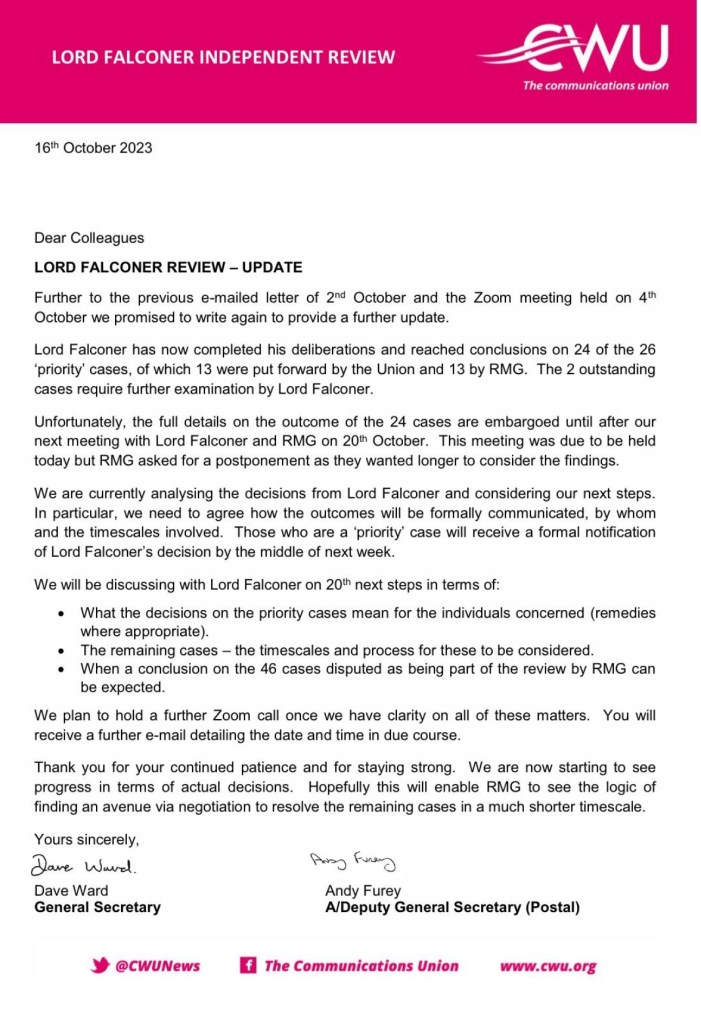
Finally, we are also anticipating the imminent announcement of the outcome of the first batch of cases from the Lord Falconer review.  We will share the details as soon as we are able to. This is another very important moment. 

Thank you for your continued support and please join the live sessions when they are announced.              

Dave Ward    
General Secretary                                                   

Andy Furey
Acting Deputy General Secretary (P)

https://www.cwu.org/rm-update-oct

CWU Mentoring Exchange Scheme

CWU Mentoring Exchange Scheme

Branches will be aware that the Equality, Education and Development department have relaunched the CWU’s Mentoring Exchange Scheme.

The renewed scheme is now much more structured, allowing mentors and mentees the ability to balance busy work schedules with easy to use guides and resources.

Mentoring is a widely recognised succession tool that helps to assist individuals through structured and focused support, through sharing of experience and skills. Used formally and informally by many different organisations mentoring helps to develop the potential of individuals with less experience by pairing them with representatives with more experience. It is a proven way of increasing confidence, knowledge and networking to help open up opportunities for advancement.

Mentoring has been proven to be a particularly useful tool for helping to develop and bring through Women, BAME, Disability, LGBT+ and Young Worker Representatives.

If you think that being mentored could be right for you, you can apply to the scheme if you meet the following criteria:

  • That you are a representative of the CWU
  • That you wish to progress and develop in the CWU
  • That you have a readiness to invest time and commitment to the partnership
  • That you have your branch support to participate in the scheme

 If you are interested in becoming a CWU mentee please submit a completed application by 3rd November 2023. You can access the electronic application by using the following link: Mentee Application

Please forward any enquiries relating to this LTB to equality&education@cwu.org in the first instance.

Yours sincerely,

Kate Hudson
Head of Equality, Education & Development

23LTB 259 – CWU Mentoring Exchange Scheme

View Online

UNAGREED EXTENSION OF MY PERFORMANCE APP

UNAGREED EXTENSION OF MY PERFORMANCE APP

Branches and Representatives will be aware Royal Mail has communicated the extension of “My Performance”.  The Business Recovery, Transformation & Growth (BRT&G) Agreement, Appendix 5, section 3, recognised that Royal Mail intended to develop a My Performance app/tile and committed the CWU to discussions in line with the commitments in Appendix 5 of the BRT&G agreement.  In particular, the introduction includes the following safeguards for our members:

“Technology and data will be used to understand workplace and individual performance in a fair, and consistent way.  It will also help support the identification of potential operational improvements…..to focus support where it is needed with an emphasis on solving the vast majority of performance concerns informally via peer-on-peer support and coaching”

The CWU’s concerns regarding Royal Mail’s approach has been made clear in meetings and formally in a letter sent by the Officers on Wednesday 4th October 2023.  It should be noted that the extension, which is due to commence next week, will involve c.25,600 delivery members across 332 Units as follows:

  • Scotland (excluding the highlands)   62
  • North East                                               95
  • Midlands                                                 111
  • Anglia                                                       64

Whilst My Performance is currently aimed at Delivery Members, the intention is to roll this out to all grades / functions.

We believe in the current environment, whereby achieving Quality of Service should be the absolute priority, especially as we are approaching peak, that the scale and timing for a successful extension to the My Performance Pilot is ill-conceived and is an unnecessary distraction for all.  Given the pressures to deliver the USO and to improve QofS as we approach the peak period, we have genuine concerns that managers’ focus won’t be on having positive conversations when their attention will undoubtedly be on the operation.  Our strong view is that an agreed extension to the Pilot should be activated in the New Year and this will provide all parties with the necessary time to ensure the coaching and training around the App is both appropriate and balanced.

The extended programme Royal Mail intend to deploy is not consistent with the BRT&G safeguards.  Instead, the My Performance approach and design has clearly been developed with the focus on pressurising our members in respect of individual performance.  This is without any context or reference to individual circumstances and is the first step in a migration to a more aggressive approach to performance management.

Whilst we have received a response from Royal Mail that attempts to reassure us of our involvement, it does not respond to our very real concerns.  Therefore, Branches, Representatives and Members are advised that such a large scale extension of My Performance is not agreed by the CWU.

We are particularly perturbed by the Royal Mail categorisation of each member being placed into a Gold, Silver, Bronze or Purple designation.  Alongside this, a further determination that every member needs to improve to achieve the Gold standard.  We have had no real input into these categorisations or designations or how the initiative will actually work in practice.  Essentially, Royal Mail’s whole premise is not based on how you perform your role but on what Royal Mail are calling their “values”.  The CWU have not agreed these “values” and we believe this is a sinister attempt to put undue pressure on our members at a time when everyone will be focused on delivering a successful peak.

Furthermore, to put this matter into perspective, and to provide a context as to how management are viewing performance in general, below are deeply concerning comments by management attributable to the purple category:-

  • Regularly displays a negative or defeatist attitude at work which affects others 
  • Resistant to feedback, often arguing or disengaging from conversations. 
  • Not approachable to team mates when they need it and may share information about others without their consent 
  • Avoids collaboration and works in isolation, even when teamwork is needed 
  • Downplays colleagues’ achievements and shows minimal interest or recognition for their accomplishments 
  • Requires multiple prompts or reminders before taking action on wellbeing and the impact on others.

The above comments are disgraceful and none of our members should have these unfounded assertions made against them.  The fact is, these types of accusations against our members are subjective, cannot be verified via any App, and fundamentally illustrate how management view some of our members.  It is utterly wrong that line managers will be encouraged and empowered to attribute such allegations towards members who simply want to do a good job.

The Postal Executive want to reach an acceptable agreement with Royal Mail for an extension to My Performance; however, whilst the initiative remains in its current format we are unable to conclude an agreement.

Branches, Representatives and Members do not have to co-operate with any conversations managers may wish to have arising from Purple, Bronze, Silver and Gold designations without their Representative being present.  Indeed, it is imperative that all members receive full support in this regard.  This is necessary as the BRT&G Agreement states:

“Both parties recognise care needs to be taken to ensure we build a positive and supportive workplace culture”. 

The CWU are committed to the BRT&G Agreement; however, Royal Mail are taking this initiative and extension beyond the spirit and intent of the agreement, with no meaningful engagement.  Whilst meetings have been held, management have not changed or modified their proposals despite the significant concerns raised by the Union.

The guiding principle surrounding this matter is that “Individual data will be used for coaching purposes in a supportive manner” and all managers should be adopting this position.  Accordingly, if Representatives and Members feel undue pressure is being placed upon them by their manager, they should use the grievance procedure and if this does not resolve the issue and becomes a wider Industrial Relations problem, the flashpoint procedure should be used.  If Royal Mail continue to refuse to modify their unreasonable and unfair stance to this extension, the Postal Executive will support all local requests for Industrial Action ballots to defend our members against these unjust measures.

Any enquiries to this LTB please contact: The Outdoor Department reference 580, email address: jrodrigues@cwu.org

Yours sincerely

Mark Baulch – Assistant Secretary                      

Carl Maden – Assistant Secretary                                

Davie Robertson – Assistant Secretary  

LTB258

View Online

BRT&G Agreement – Key Principles – Mail Centre Supernumeraries & Surpluses – Dispute Resolution Procedure

BRT&G Agreement – Key Principles – Mail Centre Supernumeraries & Surpluses – Dispute Resolution Procedure

Further to LTB 245/23 circulated on the 28thSeptember 2023 Branches will be aware of the continuing unacceptable approach Royal Mail continues to apply to our displaced members in Mail Centres.  As previously reported the Union believed that an agreement had been reached on Key Principles in late September.  Royal Mail subsequently withdrew their support for that agreement and tabled a revised document which removed the necessary guarantees and protections on which the Key Principles were founded.  The revised document was rejected by our Postal Executive and the matter escalated to the Chief Operating Officer and Chief People Officer.

The Union has remained committed to securing an agreement to take pressure off our members and as such further talks took place last week and this week with the senior HR team.  A further draft proposal was received yesterday from Royal Mail which is again completely unacceptable and would require the Union to agree that Royal Mail’s Regional Redeployment Programme, including the use of Redeployment pools has replaced the Nationally agreed Managing the Surplus Framework (MTSF).

Under no circumstances will the CWU agree to a weakening of the MTSF Agreement.  It is clear that Royal Mail will not reach an agreement other than on their terms, which would undermine the MTSF agreement which has provided fundamental protections for our members for over 20 years.  This is not solely a Mail Centre issue but one that affects all CWU members in Royal Mail Group.

Branches will recall that we had registered National DRP’s on the current approach in Mail Centres but also in regard to the BRT&G commitment at section 3.1.3 of that agreement where Royal Mail reaffirmed their commitment to MTSF:

3.1.3    With the exception of VR compensation terms, the full terms of the Existing MTSF process for Voluntary Redundancies will apply, including how surpluses and redeployments are managed.

Given the actions of the company we consider Royal Mail to be in breach of the MTSF agreement and therefore in breach of the BRT&G agreement.  In line with section 2.6.3 the Union will refer the matter to ACAS for support and facilitation to ensure that Royal Mail implement the BRT&G agreement in full including the commitments in 3.1.3.

In the view of the CWU the actions of the senior Royal Mail management team in unilaterally deploying a process which is clearly incompatible with the terms of MTSF and is designed to isolate and pressure our members is frankly a disgrace.  They have had every opportunity to amicably resolve this matter and have continually refused to do so.

For our members currently forced into the unagreed Redeployment process we would reiterate the advice given in LTB 245/23:

On the basis of Royal Mails’ commitment to MTSF Processes in section 3.1.3 of the BRT&G agreement, Members and Representatives are reminded of the following:

  • No employee can be subject to compulsory redundancy.
  • No employee can be forced to reduce their contracted hours or grade. Should any individual choose to do so then Buy Down compensation must apply.
  • Under no circumstances should our members be compelled to apply for external jobs, if they wish to remain in Royal Mail employment.
  • Under the terms of MTSF the responsibility for identifying reasonable alternative redeployment opportunities lies with the business. It is not the responsibility of the individual to search for alternative internal vacancies.
  • Any redeployment offers must be progressed in line with MTSF processes and the onus is on management to make suitable job offers.

A Zoom Briefing of Divisional and Area Processing Representatives will take place on Monday, 16thOctober 2023 to provide a full update and discuss next steps, details of which will follow and tailored coms and advice are being prepared for our Mail Centre members.

Given the circumstances we would reiterate that all Rule 13 ballot requests received in relation to this issue will be progressed by the PE as a matter of urgency.

Any enquiries in relation to this LTB should be addressed to Davie Robertson, Assistant Secretary, email: shayman@cwu.org  quoting reference: 733.02.

Yours sincerely

Andy Furey – A/Deputy General Secretary (Postal)                                                                             

Davie Robertson – Assistant Secretary

257-23 – MC Supernumerary-Surplus – 13.10.23

View Online

Union Learning Representative’s Networking Event – Registration Reminder!

Union Learning Representative’s Networking Event – Registration Reminder!

Further to LTB 206/23, we are writing to remind Branches and Regions to register for the Union Learning Representative’s Networking Event, taking place on Wednesday 1st and Thursday 2nd November 2023 at Leonardo Hotel Glasgow (formerly Jury’s Inn) 80 Jamaica St, Glasgow G1 4QG.

The programme for the 2 days will include a range of speakers, practical workshops, latest CWU learning developments and a celebration of our collective achievements. It is an opportunity for ULRs to share ideas, come together and support learning across the CWU.

Applications should be made by Branch Secretaries via courseadmin@cwu.org with the name and membership number of the ULR who MUST be registered on the OLS as a Role holder. If any attendees have any accessibility requirements, please contact the department ASAP.

For ease of reference, I have attached LTB 206/23 for further information. Any queries on this LTB should be directed to the email above.

I look forward to seeing you at the event.

Yours sincerely,

Kate Hudson
Head of Equality, Education & Development

23LTB 257 – ULR Networking Event Registration Reminder

Att – 23LTB 206 – ULR Networking Event – 1st-2nd November 2023

View Online

Create a website or blog at WordPress.com

Up ↑