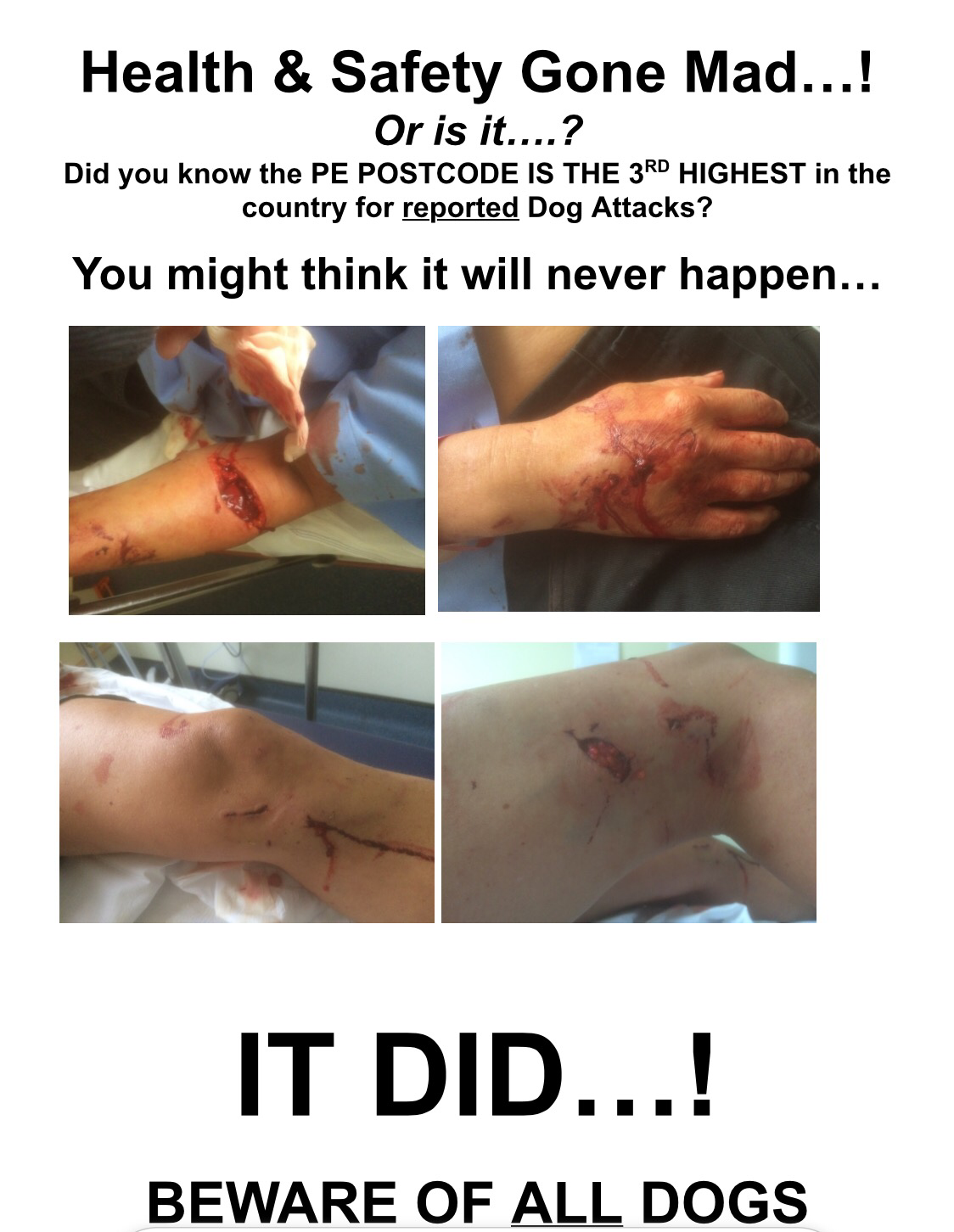
Health & Safety Gone Mad. Or is it?


Workers of the world unite; you have nothing to lose but your chains. Karl Marx.
Boston Postwoman Severely Injured In Horror Dog Attack After Being Savaged By Two Dobermans:
To: All Branches
Dear Colleagues,
Postwoman Sharron Singer received 19 separate injuries when she was pounced on by two large powerful Doberman dogs at an address in Wrangle, near Boston on Monday 3rd July.
The most serious of the injuries to her arm required four hours of complex reconstruction surgery and skin grafts to repair muscles, tendons, nerves and ligament damage. She is currently in the Boston Pilgrim Hospital.
Sharron does the delivery round in Wrangle, just outside Boston which she shares with her husband David on different days of the week and ironically either one of them could have ended up as the victim.
There was no knowledge of the presence of these dogs, which apparently arrived at the house only a couple of days prior to the attack as Sharon entered the address to deliver mail to the occupants. The two big dogs which are of a powerful, athletic breed attacked very quickly and aggressively and came at Sharron from nowhere, unexpectedly without warning. This breed of dog is used by Police forces and the military in various countries in Europe. Sharon remains in hospital and will have to undergo extensive treatment and further operations to treat her various serious injuries. Royal Mail has suspended deliveries to the address and the Communication Workers Union is assisting Sharon and David and working with Royal Mail in relation to the shock to work colleagues at Boston Delivery Office.
Sharron has been through what can only be described as a terrible, terrifying ordeal, which I wouldn’t wish upon anyone. A Police investigation is underway and those responsible for the irresponsibility and reckless ownership of these potentially dangerous animals should face the full force of the law in due course if, as expected, the Dangerous Dogs Act has been breached. Sharon’s life was in danger when this attack took place and we are just relieved that she survived. Her life however will never be quite the same. I only hope the physical and psychological damage sustained in this attack can be repaired, but it won’t be 100%. It never is in such cases.
Last week was Royal Mail/Communication Workers Union National Dog Awareness Week because seven postal workers are attacked and injured by dogs every day in the UK. 2,500 a year and 15,000 in the last five years. It’s ironic that Sharon should suffer such an appalling attack during Dog Awareness Week. We have been appealing publicly for dog owners to be more responsible and to control and restrain their animals when postmen and women deliver their mail, packets and parcels, six days a week, 52 weeks a year and to 29 million addresses. The public enjoy a first class service from Royal Mail which is the best in the world and everybody looks forward these days to their mail order items being delivered by their local postman or post woman. Unfortunately however, some of them, but a minority, don’t give any thought to the safety of the ordinary postman or woman when they bring their mail to their door. Postal workers deserve, and are entitled, to be safe at work wherever they go and to go home at the end of the day as fit and as healthy as when they arrived in the morning – not as in too many cases, when they end up like Sharon, being taken to hospital in an ambulance with serious life changing injuries”.
The Dogs have been seized by the Police and a Criminal Investigation is underway. Royal Mail has suspended deliveries to the address indefinitely. Further reports will be made in due course as the investigation and potential prosecution case develops and continues.
Top Tips for Dog Owners
During Dog Awareness Week the Union along with Royal Mail have been promoting “Responsible Dog Ownership” through a number of simple Dog Safety tips as set out below:-
Ensure your dog is out of the way before the postman or woman arrives. Put the dog in a secured room or place your pet in the back garden or a faraway room.
If you have a back garden, please close off the access, in case your dog could get round to the front when the postman calls.
Dog attacks can happen when you’ve opened the door to collect or sign for an item. Please keep your dog in another room before answering the door and make sure children don’t open the door, as dogs can push by them and attack.
Give your dog some food or a toy to occupy them while your mail is being delivered
Wait 10 minutes after your mail has arrived to let your pet back into your hallway or outside. Keep everything as calm and low-key as possible. Check the Postman/Woman has left and the garden gate is shut.
If your dog likes to attack your mail coming through the door then consider installing a wire letter receptacle. It will protect your post, and your postman’s fingers.
If it’s not practical for you to keep your dog away from a postman delivering your mail, please consider fitting a secure mailbox on the edge of your property.
Please ensure your dog is microchipped, wearing a collar and tag and that your contact details on the tag and microchip are up to date (Both are required by Law).
Dog Awareness Week Video:- https://we.tl/1ViCj5S1pO
Attachment:- Photographs of some of Boston Postwoman victim Sharon Singer’s Injuries which have been released with the full consent of the member and her husband, both CWU members, in order to highlight the Dangerous Dogs/Irresponsible Owner risk to Postal Workers, in the hope of further raising awareness and that lessons can be learned and future attacks on fellow delivery members can be avoided by owners following the above ‘Top Tips’. ‘WARNING GRAPHIC IMAGES’
Thanks:- On behalf of CWU/HQ we send our best wishes for a speedy and full recovery to Sharon Singer and I would like to thank Sharon and David for their agreement and willingness to support full open publicity regarding the details of the attack along with the Injury Photographs. Finally my thanks to all the Eastern No5 Branch Area and Local Reps for their involvement and support and the support of all the Boston DO members.
Yours sincerely
Dave Joyce
National Health, Safety & Environment Officer
Email Attachments – Click to download
Attachment 1 – LTB388/17 Boston Postwoman Severely Injured In Horror Dog Attack After Being Savaged By Two Dobermans:

CWU Four Pillars of Security Campaign – Bulletin No. 6
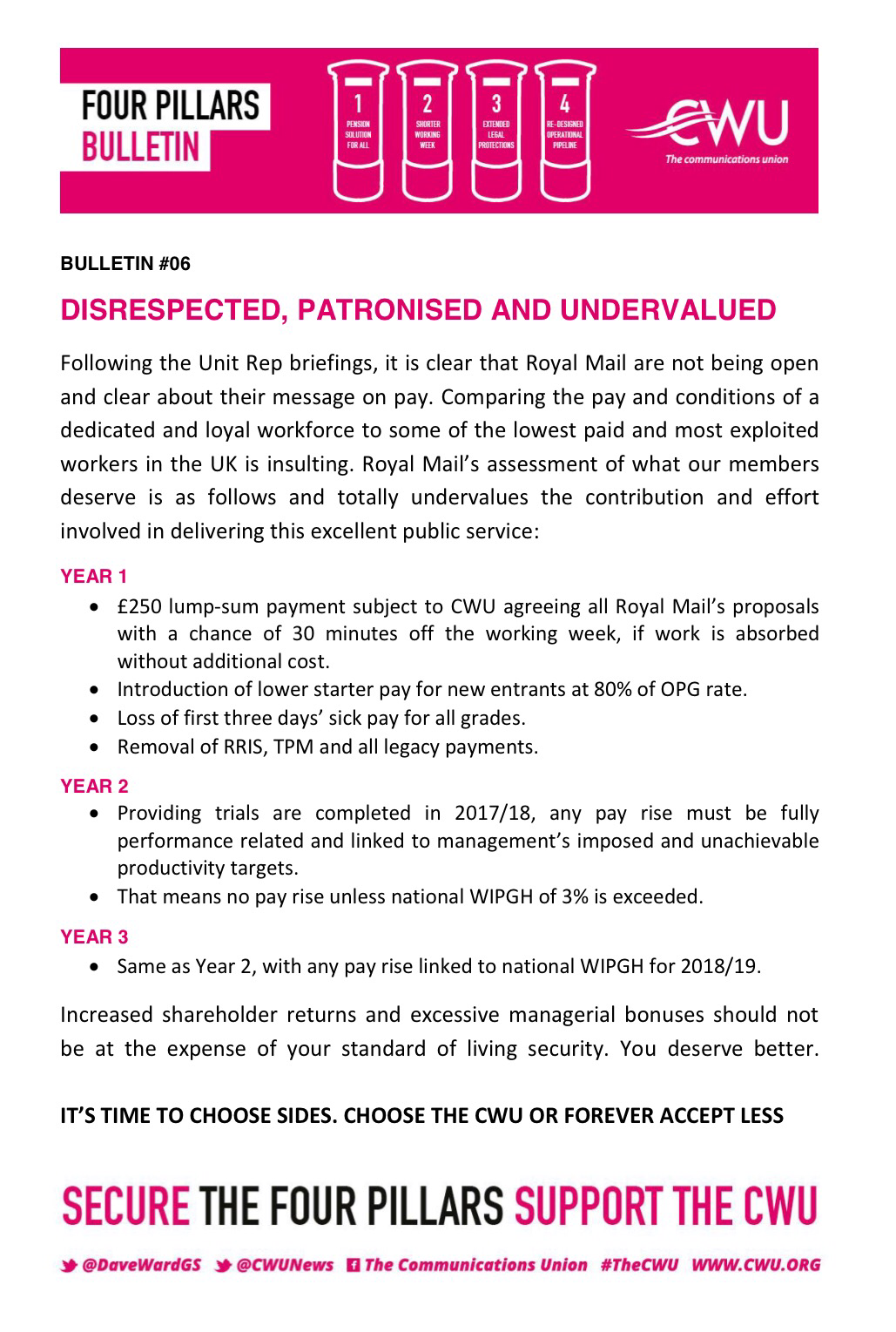
Further to LTB 370/17, attached is Bulletin No 6 concerning the Four Pillars of Security campaign.
The attached Bulletin has also been shared with Divisional, Regional and Area Representatives – as will all future Bulletins.
As previously advised, it is imperative that every Branch ensures that each Bulletin is forwarded to Unit/Local/Shift Representatives via email and if necessary by physical means without delay.
The co-operation and assistance of all Branches in this regard is greatly appreciated.
Any enquiries in relation to the content of this LTB should be addressed to the DGS(P) Department.
Yours sincerely
Terry Pullinger
Deputy General Secretary (Postal)
Email Attachments – Click to download
· Attachment 1 – LTB 387/17 – CWU Four Pillars of Security Campaign – Bulletin No. 6
· Attachment 2 to LTB 387/17 – Bulletin 6

BOSTON POSTWOMAN SEVERELY INJURED IN HORROR DOG ATTACK AFTER BEING SAVAGED BY TWO DOBERMANS

Postwoman Sharron Singer received 19 separate injuries when she was pounced on by two large powerful Doberman dogs at an address in Wrangle, near Boston on Monday 3rd July.
The most serious of the injuries to her arm required four hours of complex reconstruction surgery and skin grafts to repair muscles, tendons, nerves and ligament damage. She is currently in the Boston Pilgrim Hospital.
Sharron does the delivery round in Wrangle which she shares with her husband David on different days of the week and ironically either one of them could have ended up as the victim.
There was no knowledge of the presence of these dogs, which apparently arrived at the house only a couple of days prior to the attack as Sharron entered the address to deliver mail to the occupants. The two big dogs which are of a powerful, athletic breed attacked very quickly and aggressively and came at Sharron from nowhere, unexpectedly without warning. This breed of dog is used by Police forces and the military in various countries in Europe. Sharron remains in hospital and will have to undergo extensive treatment and further operations to treat her various serious injuries. Royal Mail has suspended deliveries to the address and the Communication Workers Union is assisting Sharron and David and working with Royal Mail in relation to the shock to work colleagues at Boston Delivery Office.
The Communication Workers Union National Health, Safety and Environment Officer Dave Joyce, who spearheaded the Union’s successful ‘Bite Back’ Campaign which succeeded in achieving the introduction of tougher dog control laws, said “Sharron has been through what can only be described as a terrible, terrifying ordeal, which I wouldn’t wish upon anyone. A Police investigation is underway and those responsible for the irresponsibility and reckless ownership of these potentially dangerous animals should face the full force of the law in due course if, as expected, the Dangerous Dogs Act has been breached. Sharron’s life was in danger when this attack took place and we are just relieved that she survived. Her life however will never be quite the same. I only hope the physical and psychological damage sustained in this attack can be repaired, but it won’t be 100%. It never is in such cases.
This week is Royal Mail/Communication Workers Union National Dog Awareness Week because seven postal workers are attacked and injured by dogs every day in the UK. 2,500 a year and 15,000 in the last five years. It’s ironic that Sharron should suffer such an appalling attack during Dog Awareness Week. We have been appealing publicly for dog owners to be more responsible and to control and restrain their animals when postmen and women deliver their mail, packets and parcels, six days a week, 52 weeks a year and to 29 million addresses. The public enjoy a first class service from Royal Mail which is the best in the world and everybody looks forward these days to their mail order items being delivered by their local postman or post woman. Unfortunately however, some of them, but a minority, don’t give any thought to the safety of the ordinary postman or woman when they bring their mail to their door. Postal workers deserve, and are entitled, to be safe at work wherever they go and to go home at the end of the day as fit and as healthy as when they arrived in the morning – not as in too many cases, when they end up like Sharron, being taken to hospital in an ambulance with serious life changing injuries”.
Private Correspondence
Firstly apologies for the unprecedented nature of this LTB which reproduces correspondence exchanged between Jon Millidge (RM Group HR Director) and I.
Jon Millidge’s letter is essentially his thoughts on how we could consider re-energising the current negotiations on the Four Pillars of Security. My response is attached.
I have no idea why he chose to make all local managers aware of his private letter to me, except to try to undermine the Union or me personally. This is clearly no way for senior managers to behave as it is ridiculous to consider operating a working relationship that would undermine trust by publicising correspondence whether private or public.
You will note from my response that there are major flaws in the proposal which basically offers an unacceptable pension solution and jam tomorrow for everything else.
To be clear it is unacceptable for the managerial team that claim they can be trusted to then publish private correspondence on an embryonic idea. Jon Millidge’s actions are unprecedented and represent an artificial appeasement to distract us from pursuing our Four Pillars of Security agenda.
Requesting more meaningful discussions at a senior level whilst supporting operational management breaking our agreements and taking the sword to our members in the workplace is utterly inconsistent. However, we will continue to seek a negotiated settlement in line with the CWU’s policy in respect of both content and timescale.
When challenged, the business claim that they have only shared the letter with local managers but this does not excuse such behaviour. If Local Representatives advise you that local management have shared Jon Millidge’s letter with them then please share my response, the content of which is self-explanatory.
This may well be the first of a number of initiatives to try and distract the Union from its goals and drive disunity. I urge you to keep your eye on the real prize – a tangible meaningful agreement on the Four Pillars of Security.
Any enquiries regarding the content of this LTB should be addressed to the DGS(P) Department, quoting reference 24000.
Yours sincerely
Terry Pullinger
Deputy General Secretary (Postal)
Email Attachments – Click to download
· Attachment 1 – LTB 386/17 Private Correspondence
· Attachment 2 – Letter from Jon Millidge 16.06.17
· Attachment 3 – Letter to Jon Millidge 03.07.17
Campaign Against Living Miserably (CALM)
To: All Branches
Dear Colleagues,
Suicide is the single biggest killer of men aged under 45 in the UK.
The Campaign Against Living Miserably, or CALM, is a charitable, campaigning organisation that exists to prevent male suicide in the UK and to improve support for those bereaved or affected by suicide which currently accounts for 78% of all suicides. The CALM organisation seeks to prevent male suicide by:
Offering support to men in the UK who are down or in crisis via their helpline services, website and magazine.
Challenging a culture that prevents men seeking help when they need it.
Pushing for changes in policy and practice so that suicide is better prevented.
CALM encourage men, a high-risk group, to get help in difficult times. Their campaign raises awareness of the CALM helpline, website, webchat and magazine, which provide direct support to men who are depressed or in crisis.
CALM runs a private forum for people bereaved by suicide and host the SBSP website.
CALM’s public facing staff members are ASIST trained.
CALM are founding members of TASC & SBSP and attend APPG Suicide Prevention meetings. They host an agency database on their website, signposting to relevant services.
CALM pushes for change at a governmental level, calling for more robust reporting of suicide by coroners and for gender to become a permanent thread through the national suicide prevention strategy.
CALM inform the CWU that they struggle to cope with demand and the level of interest from supporters, volunteers, fundraisers as well as from the press and wider public. This is testament to the success of their campaign and service provision, which reaches out and provides support to men, an otherwise neglected high-risk group.
More about Suicide
Suicide is the single biggest killer of men aged under 45 in the UK.
Men are three times more likely than women to take their own life.
Every day more than 12 men take their own life in the UK.
There were 6,117 suicides in the UK in 2015 of which 75% were male.
Male suicide has an enormous emotional impact on those bereaved, who are then much more likely to take their own lives.
Male suicide costs an estimated £20m each day (each suicide is estimated to cost £1.67million).
Of men under the age of 45 in the UK, more than 4 in 10 (42%) have contemplated taking their own life.
Less than half of men who said they contemplated suicide spoke to anyone about how they were feeling with most reporting that they didn’t want to cause a fuss or make others worry, and almost 1 in 3 said they didn’t speak up because they didn’t know how to talk about it.
The most common reasons men feel low are: failing at work or school, money problems, losing someone, and appearance.
ABOUT ‘CALM’
Why only men?
In 2014 there were 6,109 suicides in the UK, of which 76%, or 4,623, were male, and suicide currently stands as the biggest single killer of men aged under 45 in this country. The ratio of male to female suicide has shown a sustained rise over the last 30 years. In 1981 men accounted for 62% of suicides in this country, which rose to 70% in 1988, 75% in 1995 and hit 78% in 2013. (Source: ONS)
CALM wants to make people aware that suicide is a gender issue; CALM want to challenge those social constraints preventing men from seeking help when they need it and the charity wants to support those affected by suicide and depression, as well as develop the support available for the bereaved through the Suicide Bereavement Support Partnership. Even though CALM is focused on men, they take calls to their helpline and web chat from anyone. It’s CALM’s belief that all of us at one time or another, regardless of gender, will hit a crisis and we could all do with specialist help when things go wrong.
Why are the stats for men so high?
CALM believe that there are social and cultural barriers that prevent men from speaking out. From feedback CALM has received, and research conducted, men often say that they don’t feel comfortable expressing how they feel if they’re having a bad time, as they’re expected to be strong at all times, and not being so equates to weakness or failure as a man. The Men’s Health Forum (MHF) research confirms that Men are far worse than Women in every respect when it comes to looking after their own health and wellbeing.
How long has CALM been around?
CALM was first launched as a pilot by the Department of Health in Manchester in 1997, in response to a spike in young male suicides and was then extended to Merseyside in 2000. Factory Records boss Tony Wilson supported the pilot, which was run by Jane Powell, who created a powerful and effective campaign which directly reached out to young men on their terms through music. In 2004/5 the pilot was due to end and Tony Wilson supported the move to make CALM a charity, and became a Founding Trustee when the charity was launched in 2006.
What services does CALM offer?
CALM currently takes over 5,000 calls to their helpline each month, around 80% from men, and 20% from women.
In August 2014, CALM launched its ‘Webchat’ service which replaced the texting service and ‘CALM Webchat’ is going from strength to strength.
The CALM Website is filled with articles, stories and experiences there to both entertain and inform, and written by men and for men. The website also contains a database of local agencies for Men to find more specific support on particular issues.
CALM has a free quarterly men’s magazine, “CALMzine”, which is available at ‘Topman’ stores across the country, and is stocked in other independent retailers, record stores, comedy clubs and Gyms in London.
When is CALM Helpline & Webchat open?
The CALM Helpline and Webchat services are open from 5pm to midnight every day of the year. National Helpline Number: 0800 58 58 58; London Helpline Number: 0808 802 58 58. Calls are confidential and anonymous. Calls to the London number are free from landlines, payphones and all mobiles. Calls to the national number are free from landlines, payphones and from all mobiles. Calls won’t show up on phone bills.
What happens when someone calls the Helpline?
CALM offers a friendly ear who will listen and talk through any issue a caller wants to talk about. Trained helpline workers will then work towards creating a positive action plan for the caller, which will include signposting to local and/or national services. All calls are confidential and anonymous. CALM will never ask for names or addresses.
Do CALM support people bereaved by suicide?
CALM is a founding member of the ‘Suicide Bereavement Support Partnership’, which is working toward ensuring that anyone bereaved or affected by suicide has access to timely and appropriate support.
If you have been bereaved or affected by suicide and feel you need or would benefit from support, or you want more information, please visit the CALM partner website: http://www.suicidebereavementsupport.com
How can I help my friend or family member?
It’s always very difficult if you’re worried that someone close to you is at risk of suicide. The CALM Helpline is there for everyone, not only those in crisis, so you can call to find out more info on how to help them. You can also find support information on the CALM ‘Worried About Someone’ page, also visit at the CALM ‘Get Help’ page to find more information on particular issues.
Is CALM a big organisation?
CALM is a small charity. There are currently only 5 full-time paid members of staff. CALM relies heavily on the generous time, energy and skills of volunteers, supporters, and fundraisers to keep the campaign running.
Does CALM have any volunteering opportunities? How can I get involved?
CALM currently takes on volunteers in the London office for a range of different tasks, and they also have City Street Teams filled with people ready to head out to gigs, comedy events, festivals, fundraisers and more. Anyone interested in volunteering with CALM, should sign up to the CALM campaign.
Does CALM take volunteers on your helpline?
Unfortunately not. Our helpline is operated by a Community Interest Company set up to support the work of CALM by providing dedicated helpline services. As such, there are only trained and paid persons working on the helpline.
Where does CALM get funding from?
CALM receives funding from charitable trusts and foundations, health commissioners, corporate partnerships and public donations to support CALM services. At the end of the Financial Year (March 2015), CALM’s income was £647,454. Further information can be found in our Annual Accounts, which are publicly available from the Charity Commission.
Where does the money go?
CALM helpline and webchat accounts for over half of CALM’s annual outgoings, since CALM takes on the cost of calls in order to ensure calls to the helpline are free for everyone. Since CALM is a small organisation, it has minimal red tape, so all the money raised really does go directly back in to the organisation and to fund CALM services.
Motion 69(2016)
Motion 69 was carried at CWU General Conference in 2016 as follows:-
“Motion 69(2016)
Coference is becoming increasingly concerned about the increased rate of suicide within young men under the age of 45.
Figures collated by the Campaign Against Living Miserably (Calm) show there were 4,623 male suicides in the UK in 2014, the second highest number in 15 years and the equivalent of 12 deaths a day.
In this country we have a problem that we can’t shy away from anymore. Suicide is the biggest killer of men under the age of 45, 32% of men who contemplated suicide didn’t want people to worry about them while 41% of men who contemplated suicide felt that they couldn’t talk about their feelings.
With such a rise in the rates of suicide in young men, it is now becoming a serious health issue. More men feeling able to talk about their problems and seek help would be a step in the right direction. That said, improvement in attitudes alone can’t serve as a substitute for resources and the funding of services that help people when they need it.
Conference therefore calls for the Executive to work with charities such as CALM (Campaign Against Living Miserably) to raise awareness of the help and support that exist.
The Executive to arrange a campaign, by means of posters, leaflets and the relevant helplines available to encourage more of our male members to highlight and talk about any issues causing them a concern.
Great Western Branch”
CWU & CALM Engagement
Subsequently discussions took place with the ‘CALM’ General Manager and other Officials as did discussions between CWU and other Campaigning Charities including ‘PAPYRUS’ and ‘The Samaritans’. CALM attended and had a stand at the CWU 2017 Annual Conference where CALM reported a high level of interest and engagement with Conference delegates.
CALM has suggested that CWU Representatives and Members can:
Check the CALM website for regular updates on CALM’s campaigns and activity and how to get involved,
Follow CALM on social media for lots of information, news and articles about men, mental health and society in general
Get in touch with CALM to ask for materials for Branches and Workplace.
CALM recommend their CALMzine mag, which is a lifestyle magazine and a great read for any man.
CALM has other promotional materials also.
CALM Speakers and Workshops
If any CWU Branches, Regions, Regional H&S Forums or other collectives within the Union are interested in talks or workshops put on by CALM speakers, they would be happy to do these but given the size of CWU, the small charity would need to carefully diarise commitments as they don’t have huge internal resource. CALM does make a small charge for more interactive sessions and workshops as they do involve an investment in time but are really great ways of facilitating conversations in the workplace about what it means to be a man and getting some of these difficult issues out in the open.
CALM Organisation & Contact Details
Joel Beckman
General Manager
CALM – Campaign Against Living Miserably
PO Box 68766 London SE1P 4JZ
Charity Reg No: 1110621 & Scot SC044347
Tel: 02036979331
Mob:07713634779
Email: joelbeckman@thecalmzone.net
Bríd Anne McKeown
Volunteer & Supporter Engagement Officer
CALM – Campaign Against Living Miserably
PO Box 68766 London SE1P 4JZ
Charity Reg No: 1110621 & Scot SC044347
Tel:02036979331
Mob:0750 785 5093
Email: brid@thecalmzone.net
Website: http://www.thecalmzone.net/
Twitter: @thecalmzone
Facebook: Campaign-Against-Living-Miserably
You Tube: http://www.youtube.com/user/thecalmzonenet
General Email: info@thecalmzone.net
CALM Helpline
The CALM free of charge, anonymous and confidential Helpline is for men who are feeling down or need to talk of find information and support.
Open from 5pm – Midnight every day.
Nationwide:- 0800 58 58 58
London:- 0808 802 58 58
(Outside these Hours Ring The Samaritans on 116 123 – round the clock, 24 hours a day, 365 days a year. If you need a response immediately, it’s best to call on the phone. This number is FREE to call. You don’t have to be suicidal to call. Alternatively Email:- jo@Samaritans.org)
Webchat
The CALM Webchat is open from 5pm – Midnight every day.
CALM Factsheets – Learn more about an issue:-
Abuse
Alcohol & Drugs
Anger
Anxiety
Bereavement
Support After Suicide
Bi-Polar
Bullying
Depression
Divorce & Separation
Eating Disorders
Exam Stress
Financial Stress
Gambling
Hair Loss
Hearing Voices
Homelessness
Impotence
In Care
Masturbation
Mental Health
OCD
PTSD
Racism
Relationships
Self Harm
Sexuality
Suicide
Terminal Illness
Work issues
All the above listed CALM Factsheets are available for download at the following CALM Website Link:- https://www.thecalmzone.net/help/get-help/
Alternatively, materials can be ordered from CALM for a suggested donation. Telephone the above numbers for details.
Yours sincerely
Dave Joyce
National Health, Safety & Environment Officer
“All men, at times of need, may not know where to turn or go. CALM gives this freedom to know there is always someone to listen and more importantly help. Suicide is preventable.”
“Things can get tough, but CALM can help you get your life back. Being silent isn’t being strong.”
Email Attachments – Click to download
LTB 383/17 Campaign Against Living Miserably (CALM)

 Download a nomination form from the link below
https://cwue5.org/wp-content/uploads/2015/03/branch-nomination-form.docx
External Building Cladding and BT Fire Safety
To: All Branches
Dear Colleagues,
In light of the horrific events at Grenfell Tower, there has been a lot of interest raised regarding how BT manages this issue across their estate. With that in mind BT have drafted a briefing document that summarises the fire strategy in BT and the next steps they will be taking to ensure they identify specific risks, which will be addressed as appropriate. Please see the BT briefing on cladding attached.
And if you’re a field engineer whose work takes you into blocks of flats as part of your role, you’ll know from the news that all local authorities are reviewing the fire risks on all blocks of flats and similar buildings. It’s important to be aware of, and follow any updated advice given by the local authorities or building owners before entering buildings.
This has been briefed out to staff and there will also be an article included in the next edition of Safe & Well.
Attachment: BT Brief on London Tower Fire
Yours sincerely
Dave Joyce
National Health, Safety & Environment Officer
Email Attachments – Click to download
LTB 382/17 LTB 382/17 External Building Cladding and BT Fire SafetyT
14,500 ATTACKS ON POSTAL WORKERS OVER THE LAST FIVE YEARSCWU and ROYAL MAILLAUNCH 2017 DOG AWARENESS WEEK
To: All Branches with Postal Members
Dear Colleagues,
Reproduced below for your information is a Press Release issued today by Royal Mail and the CWU.
Around 14,500 dog attacks have taken place on postmen and woman over the last five years , with around 2,500 in the last year alone
Royal Mail’s fifth annual Dog Awareness Week launches today and runs from the 3 to 8 July 2017. It aims to raise awareness of the issue of dog attacks and encourage responsible dog ownership
The number of dog attacks on postmen and women has fallen since the peak in 2007/8 of 6,500 primarily due to the CWU Bite-Back Campaign and legal changes won by the Union, toughening up the Dangerous Dogs Act. The reduction in attacks is encouraging but it is still too high at two and a half thousand a year. The Union estimates there could be 500 to 1000 more minor attacks that go unreported. Every dog attack is one attack too many
On average there are still seven attacks take place each day across the UK, some leading to a permanent and disabling injury
In the last year, 71% of attacks on postal workers happened at the front door or in the front garden
Postmen and women need to be able to deliver the service they provide in communities across the UK without the risk of injury
The number of dog attacks on postmen and women increases during summer holidays, when children and parents are at home and dogs are more likely to be out in the garden
The Police, Dog wardens and major Dog charities are lending support to the Dog Awareness Week campaign including Battersea Dogs & Cats Home, Dogs Trust, PDSA, Wood Green Animal Shelter, Dog Trainers, Local Authorities, the National Police Chief’s Council and the National Dog Wardens Association.
Dog Awareness Week is a joint Royal Mail – Communications Workers Union initiative.
A special Dog Awareness Week postmark will be applied to all stamped items from Monday 3 July 2017 to Saturday 8 July 2017
Royal Mail has revealed that over the last five years there have been around 14,500 dog attacks on postmen and woman across the UK, with around 2,500 in the last year alone.
The fifth annual Dog Awareness Week launched today (Monday 3rd July) runs from 3 to 8 July 2017. The week aims to raise awareness of the issue of dog attacks on postmen and women and encourage responsible dog ownership.
The number of dog attacks on postmen and women has fallen on the previous year. This reduction in attacks is encouraging but it is still too high at 2,500 a year. Every dog attack is one attack too many. On average there is still as many as seven attacks take place each day, some leading to a permanent and disabling injury. The CWU estimate a further 500 – 1000 minor attacks and near miss incidents may be going unreported.
Royal Mail and the CWU knows that most dogs are not inherently dangerous, however, even the most placid animal can be prone to attack if it feels its territory is being threatened. Royal Mail’s stated first priority as an employer is to ensure the welfare and safety of the workforce who provide a valuable service to customers across the length and breadth of the UK and in every community. The CWU endorses this approach.
Research also shows that the number of attacks rises during the school holidays and in the summer months when parents and children are at home.
In the last year, 71% of dog attacks on postal workers have happened at the front door or in the front garden. At these times, dogs are more likely to be unsupervised in the garden or the dog is not kept under control when the postman or woman knocks on the door.
Royal Mail and the Communications Workers Unions’ Dog Awareness Week is supported by a wide range of organisations and animal charities including Battersea Dogs & Cats Home, Dogs Trust, the National Police Chief’s Council and the National Dog Wardens Association.
CWU National Health and Safety Officer Dave Joyce said “Seven postal workers attacked by dogs every day of the year is unacceptable and the whole idea of Dog Awareness Week is to highlight the problem and the repercussions for dog owners and the victims, many of whom are seriously injured”.
“Over 70% of dog attacks on postmen and women occur on the garden path or at the doorstep of the dog’s owner home. It just needs owners to restrict their animals’ access to the front garden or to put their dog in another room before opening the door to collect a parcel or sign for an item”.
“Customers are always pleased to see the postman or postwoman arrive as they’re eager to take delivery of their goods they’ve ordered and paid for on the internet but thousands of them unfortunately don’t give a second thought to the postal worker’s safety by putting the dog in a safe, secure place. The vast majority of our customers and their dogs aren’t a problem but irresponsible and reckless dog owners are.“
“The new dog control laws now identify and penalises irresponsible dog owners and many are now facing prosecution and paying heavy court penalties and getting criminal records. So it’s in their best interest in more ways than one to make sure the dog doesn’t bite the postman/woman. One owner was recently fined £8,800 after his dog injured a postwoman’s fingers as she put letters through the door – which is another big problem postal workers face! The penalties can include losing their dogs, being banned from dog ownership, paying compensation, big fines and even a jail sentence.”
“Dog owners need to fully understand that their actions usually are the cause of a dog being dangerous and simple precautions can prevent the pain for everyone concerned. No matter what breed of dog is involved, the dog can present a substantial danger to postal workers.”
TV presenter and Battersea Dogs & Cats Home Ambassador, Paul O’Grady is backing the campaign and said: “Many people find it endearing when their dogs are protective of their owners and homes, but this can quickly escalate, no matter what breed or size of dog, resulting in dog bite incidents. You may feel your dog is the softest in the world but other people can be intimidated by their behaviour and this isn’t fair. No one should feel unsafe while doing their job, including postmen and women. As owners it’s our responsibility to train our pets to behave appropriately around strangers. Encourage good behaviour and spend time getting your pets familiar with people visiting the house.”
Dr Shaun Davis, Royal Mail Group Global Director of Safety, Health, Wellbeing & Sustainability added: “There have been around 14,500 attacks on our postman and woman over the last five years, with around 2,500 this year alone. Some of these attacks have led to extremely serious and life changing injuries and this is unacceptable”.
“While the number of dog attacks on postmen and women has fallen in the last year, the numbers are still far too high. Our postmen and women need to be able to deliver the service they provide to communities across the UK, without the risk of injury. This is why this campaign is so important. We need to keep raising awareness of this serious issue and ask all dog owners to keep their pets under control and be a responsible dog owner.”
Dogs Trust has been a supporter of the campaign for the last five years and Director of Canine Behaviour and Research Dr Rachel Casey said; “Teaching dogs how to settle in a home environment and not be worried by the arrival of the postman is such an important day-to-day skill, but one that is often overlooked. Teaching dogs to be relaxed when the post arrives makes a world of difference to yours and the postperson’s day. It also takes relatively little time to teach, especially when introduced early in life. Where dogs are reactive it is important to put in place simple safety measures, such as keeping them away from the door when the post arrives, in the short term.
“However, with a bit of work dogs can learn that postmen and women coming to the door is a normal occurrence and not something to be either worried or excited about – once this is established this daily event can pass them by.”
To help promote dog safety, a special Dog Awareness Week postmark will be applied to all stamped items from Monday 3July 2017 to Saturday 8 July 2017.
A wide range of activities will be taking place during Dog Awareness Week including;
CWU National Health and Safety Officer Dave Joyce is giving a number of Press, Media and Radio interviews across the Country along with victims and Royal Mail spokespersons
Royal Mail postmen and women will be speaking about their own experiences of dog attacks to colleagues and the public
Dog Awareness posters will be in place in all Royal Mail enquiry office’s giving dog owners tips on how they can help
Dog wardens will be visiting a number of Delivery Offices across the country giving dog safety talks to postmen and women
Dogs Trust’s expert behaviourist Dr Rachel Casey is available to talk about dog behaviour to help people understand the mind of the dog
Work Time Briefings will be given to staff on Dog Awareness and Dog Safety measures.
A widespread Communications will be launched by RM and CWU including a Newsflash, Briefings, RMTV, CWU LTBs, ASR Bulletins and CWU Website and Voice Articles.
RM Safety Advisors and CWU Area Safety Reps will be visiting and inspecting high impact Delivery Offices and speaking to Delivery Managers and Staff.
Top Postcode Areas for Highest Number of Attacks
Postcode Area Number of attacks
Northern Ireland 67
BN 64
PE 60
GU 58
S 51
TN 51
ME 49
BS 48
LS 46
NG 43
Top Tips for Dog Owners
Even the most lovable dog can be a danger to postal staff. Dogs are territorial by nature and if they feel they need to protect their family, they can become unpredictable.
Here are some top tips and ideas for dog owners to help your postman or postwoman deliver your post in safety:
If you have a back garden, please close off the access, in case your dog could get round to the front when the postman calls.
Dog attacks can happen when you’ve opened the door to collect or sign for an item. Please keep your dog in another room before answering the door and make sure children don’t open the door, as dogs can push by them and attack.
Give your dog some food or a toy to occupy them while your mail is being delivered
Wait 10 minutes after your mail has arrived to let your pet back into your hallway. Keep everything as calm and low-key as possible.
If your dog likes to attack your mail consider installing a wire letter receptacle. It will protect your post, and your postman’s fingers
Please ensure your dog is microchipped, wearing a collar and tag and that your contact details on the tag and microchip are up to date.
Further Royal Mail Website Information is available at: http://www.royalmail.com/dogawareness and http://www.royalmailgroup.com/dogs for hints and tips on dog safety. Communication Workers Union Website is at: http://www.cwu.org/
[Reproduced below for your information is a Press Release issued today by Royal Mail and the CWU.]
Attachment: Dog Awareness Week Infographics
Yours Sincerely
Dave Joyce
National Health, Safety & Environment Officer
Email Attachments – Click to download
LTB 378/17 14,500 ATTACKS ON POSTAL WORKERS OVER THE LAST FIVE YEARS

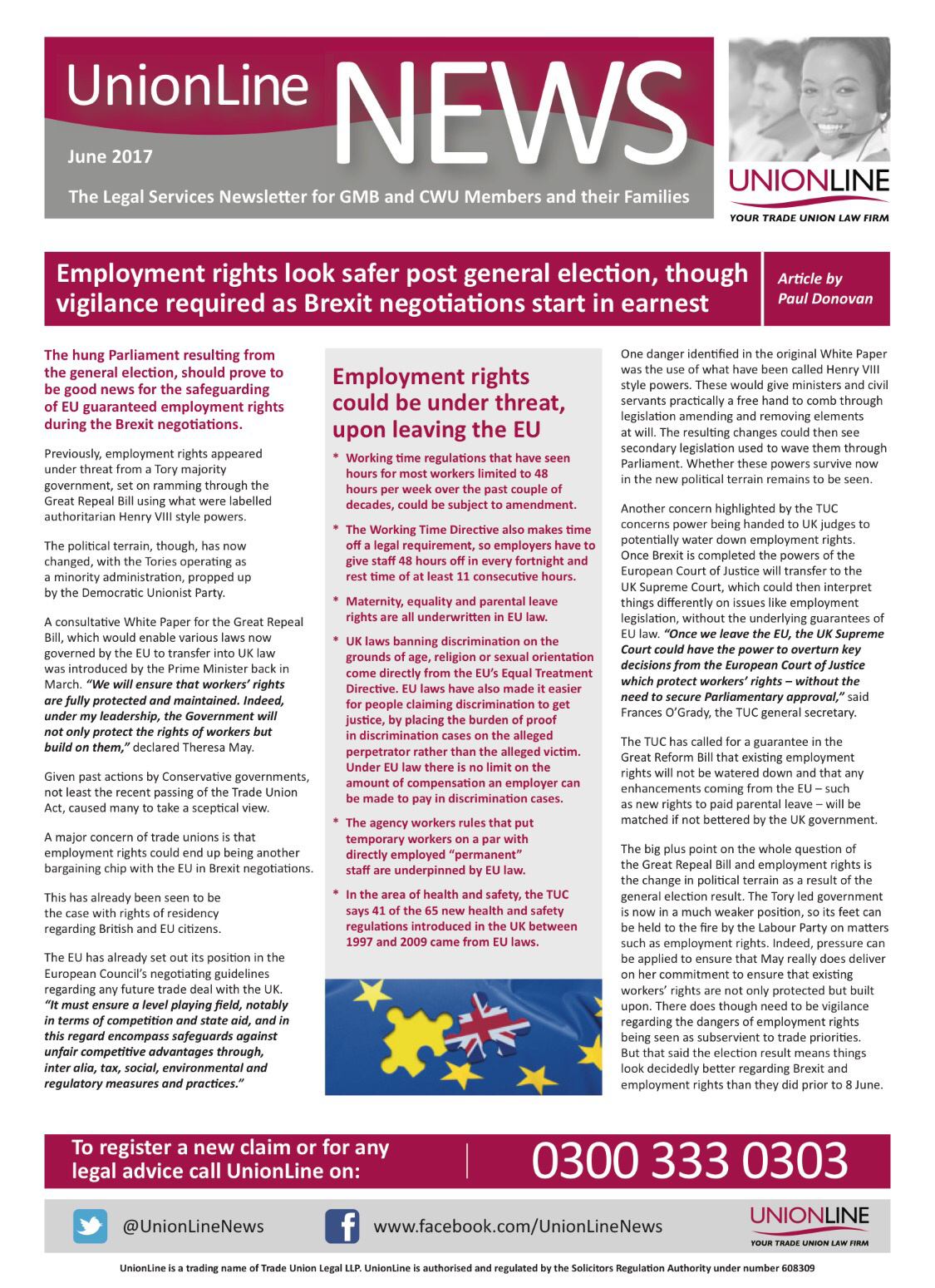
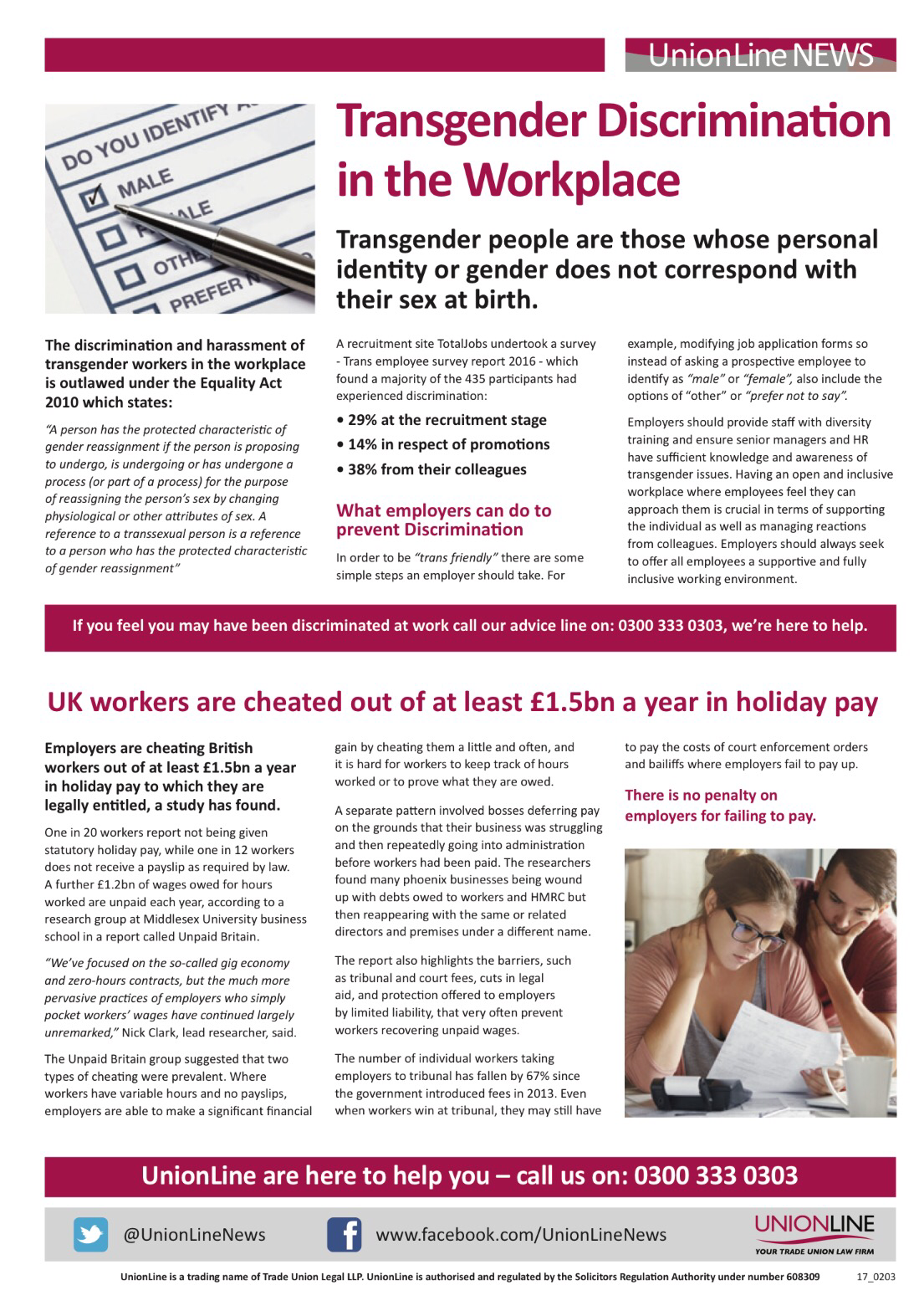
 CWU Eastern No5 Branch