Latest from the Branch

Royal Mail Fleet – Slip Over Seat Covers for Light Commercial Vehicles/Vans (LCVs):

Royal Mail Fleet – Slip Over Seat Covers for Light Commercial Vehicles/Vans (LCVs):

To: All Branches

Dear Colleagues,

The Health, Safety & Environment Department has been receiving a number of enquiries during the winter from Branch ASRs regarding the health and safety issues associated with LCV van seats getting soaked in bad weather, heavy rain, sleet and snow. Seat bases were soaking up rain water from wet clothing and rain ingress and this was causing obvious problems for subsequent drivers getting soaked from damp seats. Seats were becoming smelly and not fit to use in some cases and can present possible health risks. There was also premature wear and early replacement required in some cases as well as many vans being logged out of service.

Royal Mail Fleet has in response set up a contract to provide ‘slip over seat covers’ containing Kevlar for the driver seats in LCVs (light commercial vehicles). The intention is to equip all new vehicles starting with new vans delivered from May 2018 onwards. It will provide a waterproof cover to stop the seat base soaking up rain water from wet clothing and deliver extended life and performance of the OE seat cover.

Yours sincerely

Dave Joyce
National Health, Safety & Environment Officer

18LTB147 Royal Mail Fleet – Slip Over Seat Covers for Light Commercial VehiclesVans (LCVs)

Specification Sheet

Royal Mail New Slip Over Seat Covers

View Online

The Future Risk: Impact of Work on Health, Safety and Wellbeing Report Published By The ‘British Safety Council’

The Future Risk: Impact of Work on Health, Safety and Wellbeing Report Published By The ‘British Safety Council’

To: All Branches

Dear Colleagues,

The British Safety Council (BSC) have notified the CWU Health, Safety & Environment Department of the publication of their new report entitled ‘The Future Risk: Impact of Work on Health, Safety and Wellbeing’, a copy of which is being circulated for the information of Branches, Health and Safety Reps and Regional Health and Safety Forums.

The Report was commissioned by the BSC from ‘Robertson Cooper’ researchers. It reviews the existing literature on this subject and makes a number of recommendations.

The Report considers and examines the latest evidence, mostly from the UK, into how work is likely to change in the future, what the probable impact will be on people’s physical and mental wellbeing and what employers, trade unions, educators and government should do now to prepare for the future.

While providing an overview of the landscape of work, the report explores the changes that employers and employees are likely to experience over the next 20 years. It focuses on the risks of these changes to the health, safety and wellbeing of the workforce.

The main themes explored by the report include the implications of “any time, any place” work. A move away from standard work practices, hours and location etc., which will challenge the relationship between employers and their workforce. The report states that we are currently seeing loyalty between employers and employees decreasing, which means that retaining healthy, high performing employees is even more important and adds that organisations of the future need to trust their employees and manage by praise and reward.

A second theme in the report is the need to build so called “resilience”. The report states that the future world of work will place new pressures and forms of stress on employees. Working alongside intelligent machines and robots, which never stop, outperform humans and are incapable of social interactions, will require an entirely different set of skills. This may strip away everything good work in a traditional social environment offers employees, such as a sense of identity and belonging, as well as social support. That’s why employers will need to introduce specialist training and wellbeing programmes to help their employees gain skills that will build their resilience and help them to cope in new circumstances. [NOTE: So called “resilience” is a controversial approach that has been invading workplaces, with a mission to “toughen up feeble workers” and shrug off the work stress and strain. The Trade Unions are not impressed with an approach like this that wants workers to be more resilient rather than workplaces more healthy].

A third theme in the report is forward-thinking education. New jobs in partially-automated, remote or less secure workplaces may require a greater variety of “soft skills”, including creativity, leadership, flexibility and social skills, as well as skills related to new technology and the ability to collaborate with intelligent machines and robots. The Report recommends that schools and training bodies should start developing such skills and this process should continue beyond the compulsory education system. Such training must teach employees how to look after themselves, as well as how to take responsibility for their own health, safety and wellbeing.

The fourth theme covered in the report is the necessity to update regulatory systems to protect modern workers. The report states that in modern workplaces, where humans will work alongside robots and companies operate across borders, the answer to the question of where ownership of risk lies, that is, who should take responsibility if something goes wrong, will be of crucial importance. As employment contracts are increasingly diffuse (people in the gig economy are often not classified as workers), companies may wish to avoid the costs of sickness absence or liability insurance. The report concludes on this that the government should look at all measures to protect the self-employed and gig economy workers.

Finally, the report concludes that there is a need to understand future risks. These fundamental changes to work and the work environment present huge risks to employers, employees, the economy and the environment. For example, the fast pace of innovation, insecurity around employment status and a drive for efficiency are putting increasing pressure on people, and can lead to stress, which people working remotely may not be able to handle, particularly if they are older. The current understanding of these risks is poor in places. The report, while identifying the risks which have particular relevance to employee health, safety and wellbeing, calls for further research into this area.

In a statement launching the report Matthew Holder, head of campaigns at the British Safety Council, said that at a time when work is rapidly changing, whether through technological innovation or types of employment, there is an urgent need to have a more strategic view on what research says about the future of work and risk, and how these two issues are related.

See attached copy of the report for your information.

Yours sincerely

Dave Joyce
National Health, Safety & Environment Officer

18LTB145 The Future Risk Impact of Work on Health, Safety and Wellbeing Report Published By The ‘British Safety Council’

BSC Future Risk Impact of Work on HS Report 2018

View Online

National Gate Meeting Day Video From DGSP Terry Pullinger

It’s National Gate Meeting Day. Make sure you get everyone in the office together today, play this video message from DGSP Terry Pullinger and send us your photos backing the union – many members will receive their ballot papers today – Vote now and Vote YES! #PowerOfTheUnion

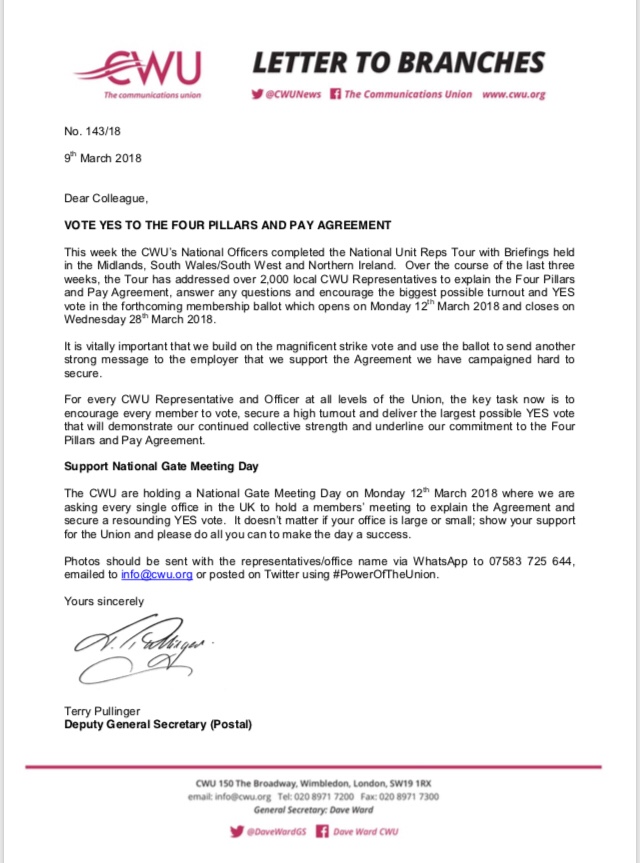
VOTE YES TO THE FOUR PILLARS AND PAY AGREEMENT

Dear Colleague,

VOTE YES TO THE FOUR PILLARS AND PAY AGREEMENT

This week the CWU’s National Officers completed the National Unit Reps Tour with Briefings held in the Midlands, South Wales/South West and Northern Ireland. Over the course of the last three weeks, the Tour has addressed over 2,000 local CWU Representatives to explain the Four Pillars and Pay Agreement, answer any questions and encourage the biggest possible turnout and YES vote in the forthcoming membership ballot which opens on Monday 12th March 2018 and closes on Wednesday 28th March 2018.

It is vitally important that we build on the magnificent strike vote and use the ballot to send another strong message to the employer that we support the Agreement we have campaigned hard to secure.

For every CWU Representative and Officer at all levels of the Union, the key task now is to encourage every member to vote, secure a high turnout and deliver the largest possible YES vote that will demonstrate our continued collective strength and underline our commitment to the Four Pillars and Pay Agreement.

CWU REDESIGN PROJECT – NATIONAL BRIEFING ‪13TH MARCH 2018‬

CWU REDESIGN PROJECT – NATIONAL BRIEFING 13TH MARCH 2018

Further to LTB 81/18 CWU Redesign Project regarding the National Briefing being held at the Midland Hotel, 16 Peter Street, Manchester, M60 2DS on the 13th March 2018, please find attached for the information of Branches an advance copy of the Agenda.

Any enquiries should be addressed to the gsoffice@cwu.org.

Yours sincerely

Dave Ward

General Secretary

18LTB144 National Briefing agenda

View Online

CWU Education & Training Courses / UCU Industrial Action

CWU Education & Training Courses / UCU Industrial Action

You will be aware that members of the UCU are currently taking strike action in defence of proposed changes to their pensions.

Owing to the formal arrangements that the CWU has with colleges around the UK, including within the devolved nations, the dispute has meant that to ensure CWU support with the UCU, any scheduled accredited courses have been cancelled.

We have assured Branches and individual students that we will be looking to reschedule these as soon as possible.

The greatest impact involves the following courses:

• Advanced Skills Part 1 course (Alvescot Lodge) scheduled for 12th – 16th March 2018 will now to take place from 30 April – 4 May 2018

• The Postal Agreements & Procedures course (Alvescot Lodge) scheduled for 30 April – 4 May is postponed and all those that have applied will be transferred to the course running from 2 – 6 July 2018

All effected Branches and representatives have been informed but this LTB reinforces the position.

Any enquiries in relation to this LTB should be addressed to:

Lee Wakeman (lwakeman@cwu.org) or Maxine Todd (mtodd@cwu.org).

Yours sincerely,

Trish Lavelle

Head of Education & Training

18LTB141 – CWU Education & Training Courses – UCU Industrial Action

View Online

Branch BAME Officer Positions

Branch BAME Officer Positions

The CWU Rule Book makes provision for the role of BAME Officer to be included in the Branch Officer makeup and we are eager to see all our CWU Branches fill these positions accordingly.

The CWU is also keen to ensure that we maximise the opportunities available to our members from under-represented groups to become involved in our trade union structures.

If you require any advice and guidance or assistance regarding the above please contact the Equal Opportunities Department on dnoel@cwu.org.

Attached for your information is a copy of a guide to the role of BAME Officer.

Yours sincerely

Dave Ward

General Secretary

LTB 137-18 – Branch BAME Officer Positions

BAME Officer – branch role

View Online

Create a website or blog at WordPress.com

Up ↑