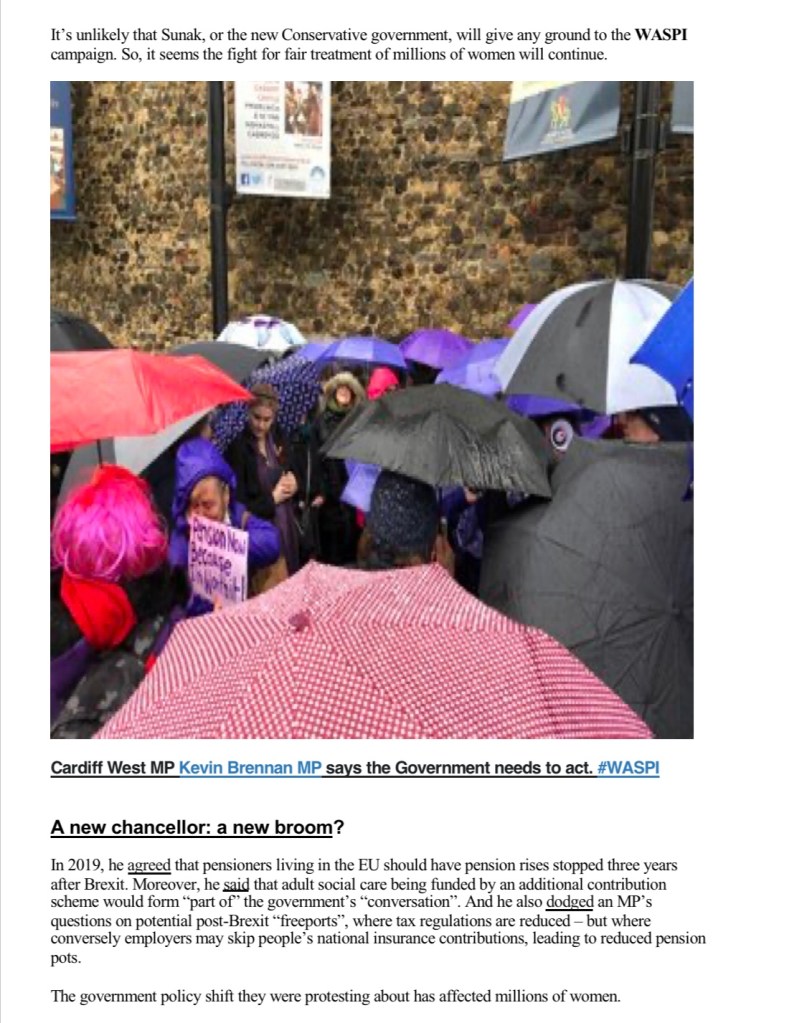
Millions of Waspi women who lost out by state pension increase given sliver of hope

Millions of Waspi women who lost out by state pension increase given sliver of hope.

               Campaigning group Backto60 has been granted the right to appeal

              the High Court’s ruling CREDIT:  ISABEL INFANTES/ AFP •  Jessica Beard, pensions reporter

22 JANUARY 2020

Women born in the Fifties affected by the rise in their state pension age from 60 to 65 have been given a sliver of hope after being granted approval to appeal a High Court ruling from last October.

Two women from the Backto60 campaign group took the Government to a judicial review, arguing the delay in receiving their state pension had disproportionately affected them. Until 2010, women were entitled to receive the state pension from the age of 60, but the government announced in 1995 that this would increase to the age of 65 to equalise the playing field with men. 

The two women argued that many others of their generation took time out of work to care for children which limited their earnings, meaning they had less opportunity to build up a healthy private pension.

The High Court judges decided they had not been discriminated against, and claimed the government’s move was to “correct historic direct discrimination against men”.

But now the group has had a breakthrough in its fight by receiving the green light to contest the ruling in the Court of Appeal. 

Many of the complaints made by campaigners including group Backto60 and Women Against State Pension Inequality (Waspi) have called for a reinstatement of the age of 60 for women’s state pension and for compensation of the amount they have missed out on since the ruling. 

Campaigners and complainants argue they did not have enough time to prepare for the change, which has left them worse off in retirement and that they have experienced financial loss with a negative impact on their health, emotional well-being or home life. They contend that the change has discriminated against 3.8 million people, leaving them £47,000 out of pocket in retirement. 

Separately, the Parliamentary and Health Service Ombudsman (PHSO) is set to begin investigating a sample of complaints from women affected, after sending out communications to them last week. 

The PHSO has been barred by the High Court ruling from recommending the reimbursement of these “lost” pensions, and nor can it advise in favour of a reversal of the Pensions Act legislation. However, it has been investigating to see if there has been an injustice as a result of maladministration, under which it could make recommendations to pay out compensation. 

The investigation differs from the judicial review in that not all the issues considered were taking into account as part of the review, including DWP’s and ICE’s complaint handling and the communication of changes to National Insurance. 

The ombudsman will look at whether the DWP conducted its communication of the changes to women’s state pension age wrongly or poorly, focusing on what the department should have done to better voice the changes.  

State pension age: Fresh hope for WASPI & Back-to-60 women as court appeal is granted

State pension age: Fresh hope for WASPI & Back-to-60 women as court appeal is granted.

STATE PENSION: Campaigners who have been affected by the state pension age changes for women have been granted permission to appeal the decision lodged regarding the Judicial Review about the age and sex and age discrimination.

By JESS SHELDON

PUBLISHED: Wed, Jan 22, 2020 

Julie Delve and Karen Glynn, from the campaign group Backto60, challenged the Department for Work and Pensions (DWP) with a judicial review, which took place last year. The campaigners argued that rising their state pension age “unlawful discriminated against them on the grounds of age, sex and age and sex combined”.

On Monday this week, (20th January) Back-To-60 confirmed that the campaign group had been granted permission to appeal the decision.

An announcement on the Back-To-60 website reads: “We are delighted to confirm that http://www.back-to-60.com have been granted permission to Appeal ON ALL GROUNDS at The Court of Appeal.”

Speaking in a video outside Number 10 Downing Street on Monday, Joanne Welch, Back-to-60 director said: “We’re delighted to be here today at Number 10 Downing Street, and share with you the brilliant news that Back-to-60 has been granted an appeal in the High Court based on all grounds argued.

“Absolutely thrilled to share that with you, and thank you everybody who’s donated and supported us, because without you, we would not be here.”

State pension age changes: Backto60 campaigners have been granted permission to appeal the decision.

The Case Tracker for Civil Appeals states that the case is currently awaiting a hearing.

It says that the hearing will be by February 25, 2021.

Also speaking outside Number 10 Downing Street on Monday, Jackie Jones, a Labour MEP for Wales, said: “I’m here at Number 10 Downing Street for Back-To-60. We just handed in a petition for women born in the 50s to get their pensions back, and this is absolutely vital. Legislation should be passed.”

However, changes to the state pension age for women were announced the Pensions Act 1995.

Under the Pensions Act 2011, the state pension age for women increased more quickly to 65 between April 2016 and November 2018.

Now, the state pension age for women is increasing for both men and women.

In October last year, Ms Delve and Ms Glynn, supported by campaign group Back-to-60, took the Department for Work and Pensions (DWP) to court over the changes.

The women, supported by Back-to-60, claimed the increases discriminated against them on the grounds of sex, age and both sex and age combined, and that they were not given adequate notice of the changes, in order to prepare for the years without their state pension.

State pension age changes: A judicial review took place last year, but the claims were dismissed

However, High Court judges dismissed their claims “on all grounds”.

Lord Justice Irwin and Mrs Justice Whipple said in a statement: “There was no direct discrimination on grounds of sex, because this legislation does not treat women less favourably than men in law,”

“Rather it equalises a historic asymmetry between men and women and thereby corrects historic direct discrimination against men.”

The DWP cannot comment on pending legal action.

Last year, Ms Welch spoke to Express.co.uk about the campaign. During an exclusive interview, she said: “They [50s women] were quite happy. They had raised their families, looked after them, and probably cared for the elderly in some cases.

State pension age changes: The DWP released new figures of the total cost                                estimate of reversing the changes last year.

“Maybe they were looking forward to their retirement, and then the rug is ripped up from beneath their feet.”

The Campaign Director also explained that the group are seeking a “fair equality”.

She said: “Generally speaking, people are pro equality – as are we. However, we will be looking for a fair equality.

“50s women have suffered lifelong inequity, like the pension gap, the pay gap, the maternity gap. It’s like, ‘Mind the Gap’.

“You’d have to be a 50s woman to actually understand these gaps.

“Women weren’t even entitled to occupational pensions. It was seriously as bad as that.”

Elsewhere, the campaign group Women Against State Pension Age Inequality (WASPI) has received a notification from the Parliamentary and Health Service Ombudsman (PHSO) that they will proceed with a revised proposal to investigate six sample Complaints of Maladministration.

Over-75s face winter heat misery as free TV licences end.• Daily Mirror

Over-75s face winter heat misery as free TV licences end.• Daily Mirror.

• 23 Jan 2020

THOUSANDS of over-75s could struggle to pay winter heating bills after the Tories broke an election pledge to protect free TV licences.

Around 3.7 million face paying £154.50 to watch telly from June, with only those on Pension Credit still be eligible for the free lifeline.

And Age UK, which fought alongside the Mirror to save free licences, says it will be a “bridge too far” for many. Charity boss Caroline

Abrahams warned: “As winter bites many pensioners are worried about heating bills and cutting back on essentials, including food.

“The last thing older people in this situation need is to be hit in the pocket because they have to find the money for a TV licence.”

The Conservatives had promised in their 2017 manifesto to continue funding the perk until 2022.

Tories’ turn off.• Fresh fears for over-75s’ finances as they face looming TV licence fee bill.

From June millions of pensioners are going be £154 worse off.

That’s because this Tory government reneged on its promise to maintain free TV licences for the over 75s.

Age UK says the loss of the benefit will leave hundreds of thousands of elderly struggling to pay their heating and water bills.

Boris Johnson has tried to wash his hands of all responsibility by blaming the BBC.

This is unfair on the cash-strapped broadcaster, which was told by ministers to accept responsibility for funding free TV licences or risk losing its charter to operate.

Pensioners left out of pocket will realise that the fault lies with a Tory government.

Coronavirus and Avian Flu Outbreaks in China – Statements From Royal Mail Group, Department of Social Care (DHSC) and Public Health England (PHE) and Further Advice

Coronavirus and Avian Flu Outbreaks in China – Statements From Royal Mail Group, Department of Social Care (DHSC) and Public Health England (PHE) and Further Advice

This is an update further to LTB No. 033/2020, issued on 22 January 2020.

Royal Mail Group Statement:

Royal Mail Group issued the attached advice on their intranet site on Friday morning 24 January and stated that the Business is monitoring the Coronavirus outbreak situation in China and will issue more updates as appropriate following advice from Public Health England (PHE).

PHE maintain that the risk to the UK population has been assessed as low and should this assessment change, the NHS is well prepared. Royal Mail has advised that as with all mail handling and all other roles, good hand and personal hygiene should be maintained to minimise the risk of any infection of colds and flu, which are very common at this time of year. Hands should always be washed before eating and any gloves worn for mail handling should be washed frequently. Royal Mail has decided that although the risk of infection is very low, while the Coronavirus situation is developing, disposable gloves will be made available to anyone handling large numbers of parcels or letters originating from China who would like to wear them as an additional precaution. Any member wishing to be provided with the disposable gloves should request them from their manager. Details of how they are to be ordered have been provided to Office Managers and are contained in the attached Royal Mail statement.

Department of Health and Social Care (DHSC) and Public Health England (PHE)

The latest news update and statement from DHSC and PHE jointly is attached. They confirm continued enhanced monitoring of the Coronavirus situation in Wuhan, China and are ready to put in place proportionate, precautionary measures to protect the UK public. All direct flights from Wuhan, China to the UK are being met and advice and support to travellers is being provided if they feel unwell. The team involved includes medical inspectors, doctors, admin support and a team leader. They will check for symptoms of Coronavirus and provide information to all passengers about symptoms and what to do if they become ill. Mandarin and Cantonese language support will be available and leaflets will be available to all passengers.

DHSC has issued clinical guidance for the detection and diagnosis of Coronavirus, and PHE has developed a diagnostic test, making the UK one of the first countries outside China to have a prototype specific laboratory test for this new disease.

The UK is well prepared for new diseases and the UK’s approach is kept under constant review. UK public health measures are world-leading and the NHS is well prepared to manage and treat new diseases.

Despite the current reports of 2000 confirmed cases and 50 deaths in China and confirmed cases of 15 other places outside China, DHSC and PHE confirm that the risk to the UK population has been assessed as low, based on the emerging evidence regarding case numbers, potential sources and human to human transmission. To date there are no confirmed cases of this new infection in the UK.

Can you catch Coronavirus from Parcels and Packages Posted from China to the UK?

According to BBC health and science correspondents Dr. Michelle Roberts and Biologist James Gallagher along with the US Department of Health in Minnesota, the answer is no, there is no evidence this is a risk. These Medical experts say the Coronavirus can only survive on inanimate objects for a few hours, maybe a day or two in perfect laboratory conditions and parcels and packages from China take several days to arrive. Some diseases can spread through surfaces contaminated by people coughing or sneezing on them. It has not been shown this new Coronavirus can do that. Even if it could, there would still be questions about whether international shipping would be a major problem. Cold viruses tend to survive less than 24 hours outside the human body although Norovirus (a severe stomach bug) can last for months outside the body. The most reassuring fact so far is that Coronavirus cases seem to require close contact with an infected person – say, a family member or healthcare worker – in order to spread. Coronaviruses are a large family of viruses that cause respiratory illnesses such as Pneumonia and Bronchitis. The viruses are in the respiratory tract and they spread mainly through the air via coughing or sneezing, through close personal contact and touching one’s mouth, nose, or eyes after touching an object or surface with the virus on it, before washing one’s hands.

Maintain Good Basic Hygiene

The NHS and doctors advise everyone to maintain good basic hand and personal hygiene standards, washing hands regularly to minimise the risk of any infection as this virus outbreak develops.

Yours sincerely

Dave Joyce
National Health, Safety & Environment Officer

20LTB043 Coronavirus and Avian Flu Outbreaks in China

Attachment 1

Attachment 2

Attachment 3

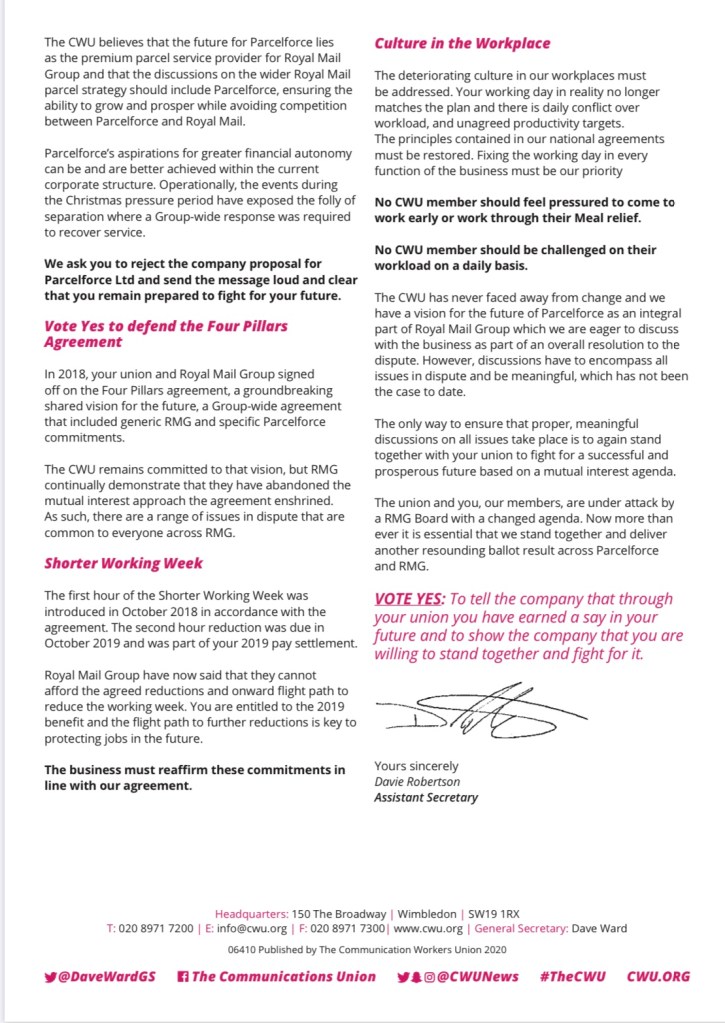
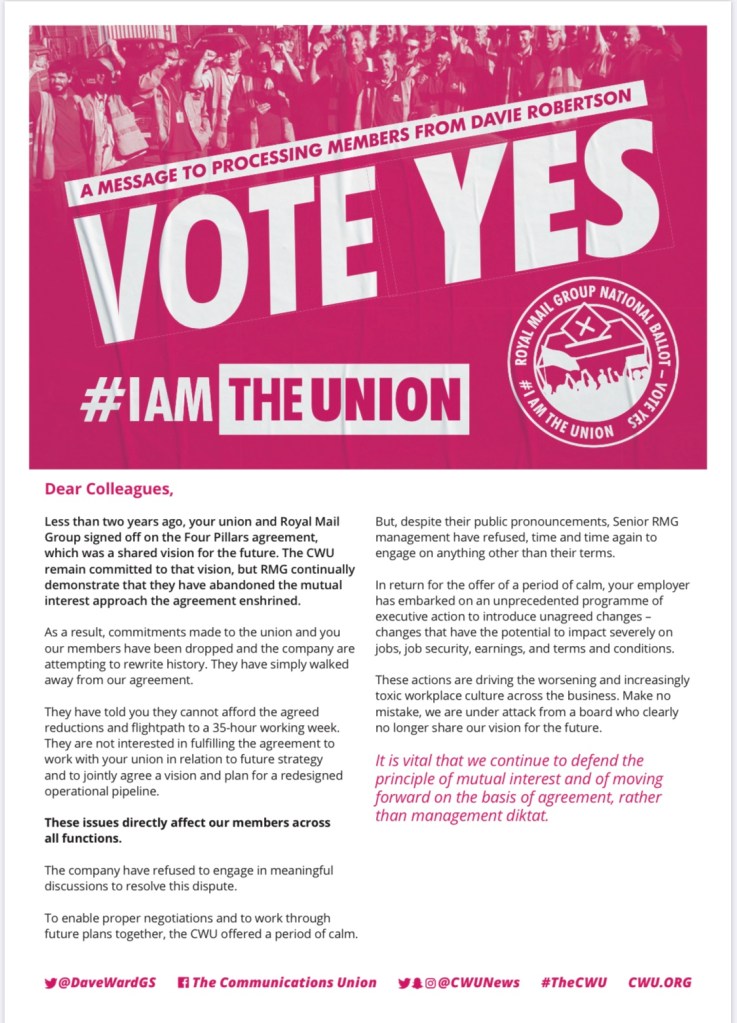
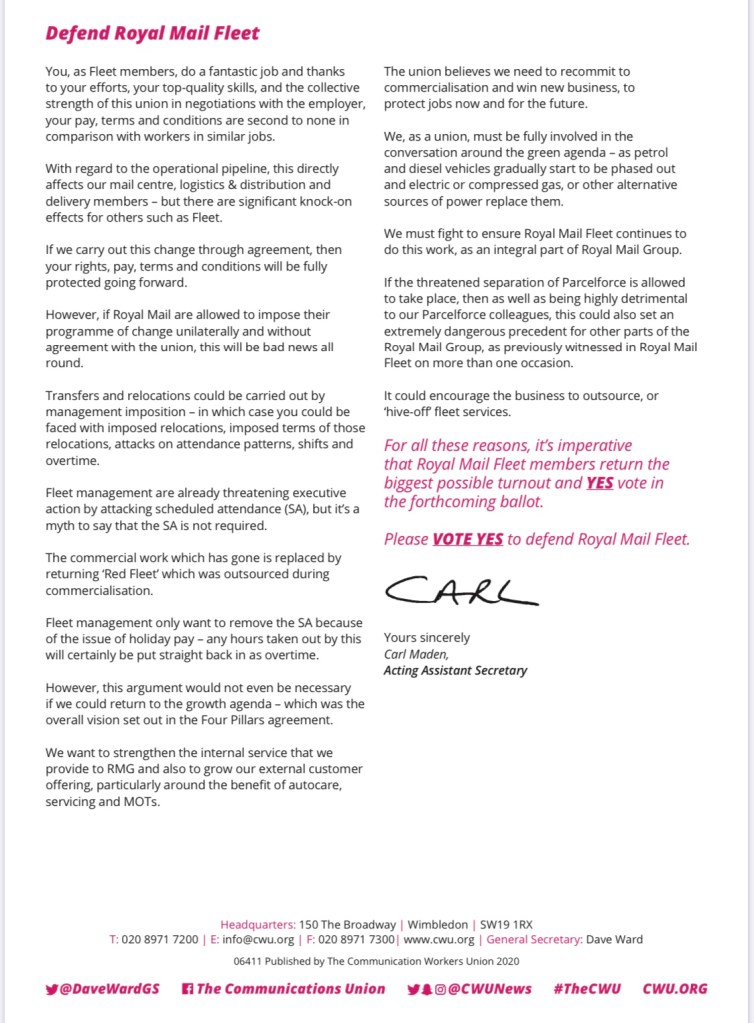
NATIONAL INDUSTRIAL ACTION BALLOT – ROYAL MAIL/PARCELFORCE MEMBERSHIP

NATIONAL INDUSTRIAL ACTION BALLOT – ROYAL MAIL/PARCELFORCE MEMBERSHIP

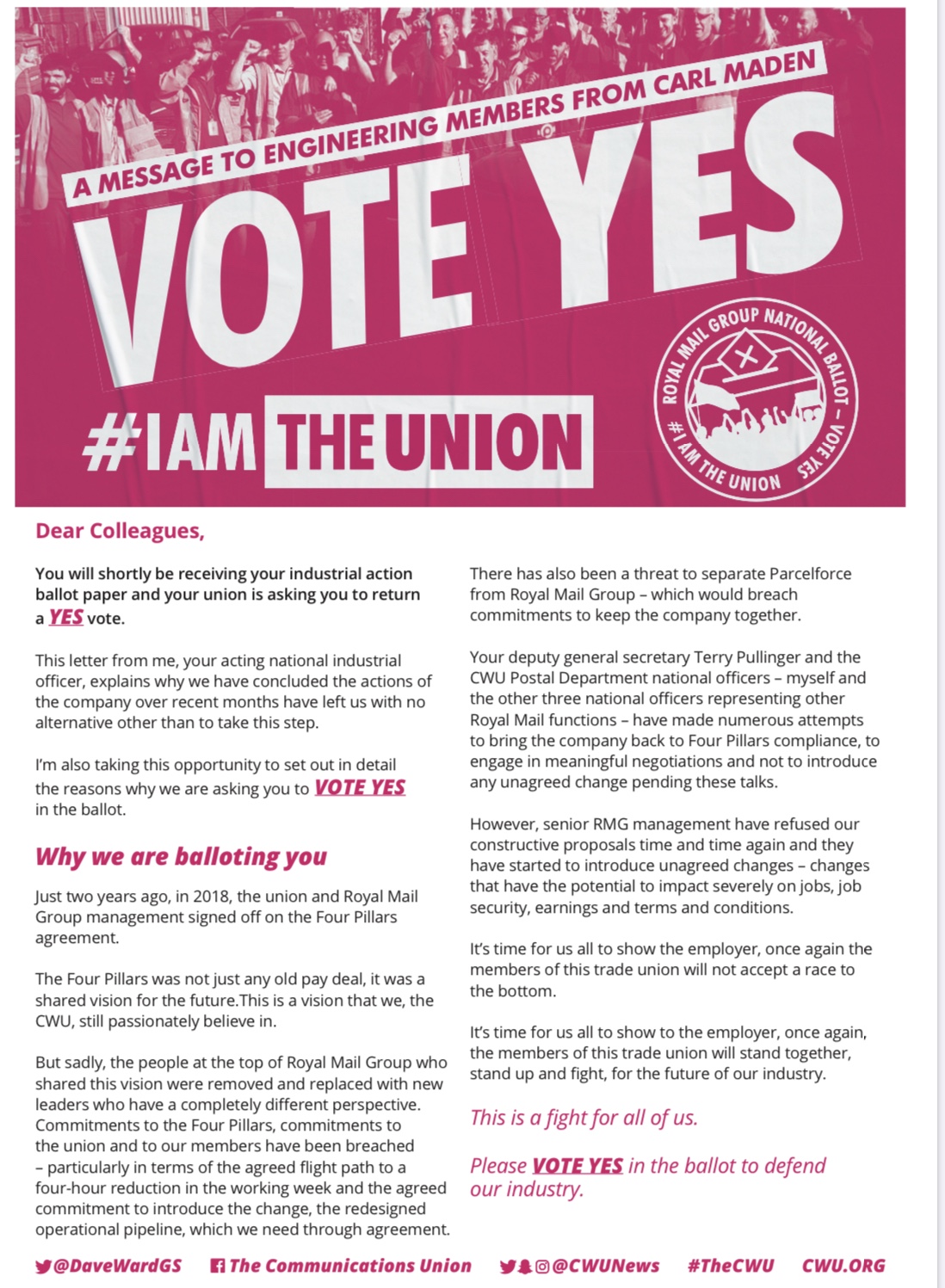
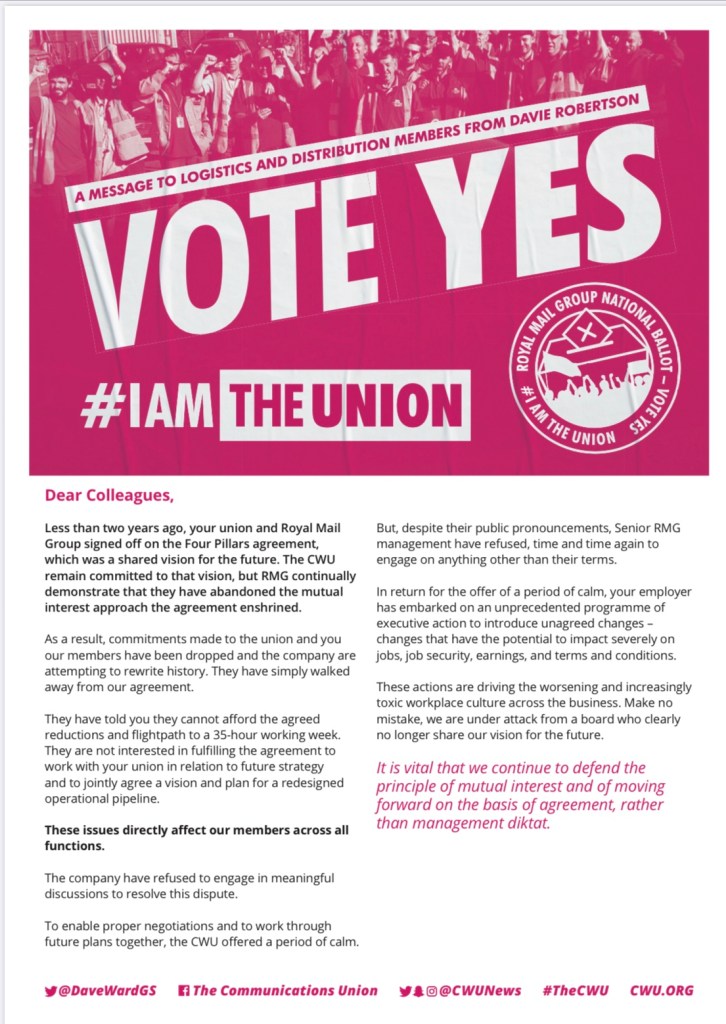
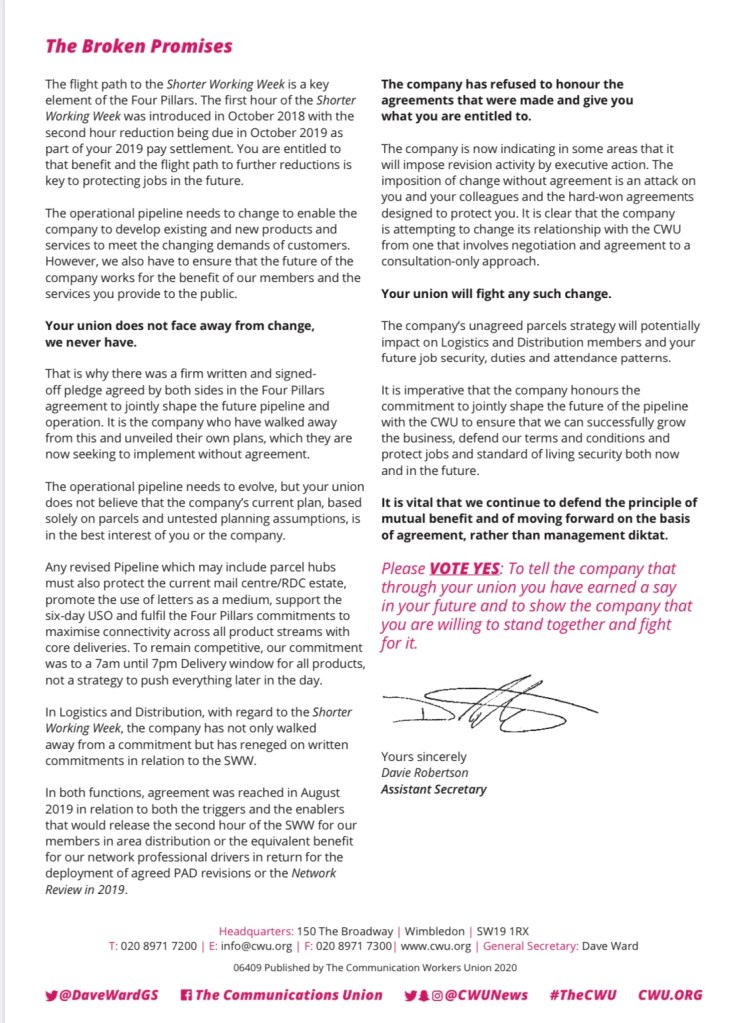
You will have seen, across various communication platforms within the CWU, the updated position with regard to negotiations with Royal Mail regarding the 4 Pillars of Security and the future direction of the business, updates will continue to be communicated by Terry Pullinger DGSP.

We are at a position where we will now need to ballot our membership for Industrial Action as a result of Royal Mail’s failure to negotiate a resolution to the issues under discussion.

The purpose of this LTB is to begin the necessary processes regarding our membership records in order that we are able to produce a ballot when the Postal Executive require it.  It is anticipated that such a ballot will be required in the very near future.

Branches will be aware of the continuous legal challenges from Royal Mail that the union has recently faced on industrial action ballots. It is essential therefore that all branches are ready to engage with CWU HQs on this issue when needed.

The SDGS Department will be writing directly to Branch Secretaries in order to begin the process of checking membership records to enable this ballot to take place.

The seriousness of the situation our members face, as well as the future of the industry cannot be understated. As you are all aware decisions to ballot for national industrial action are not taken lightly, however given the circumstances we have been left with no choice.

We need to emphasise that this check of membership records is an extremely important activity that will be essential to us undertaking a strike ballot.

From this point on there will be an extremely close working relationship between the, GS, DGS(P) and SDGS departments on this issue and a support structure consisting of Postal Executive Members and Senior Field Officials will be put in place to assist Branch Secretaries, where required, to ensure that the process is concluded at pace and that this union acts as one in moving forward at such an important time.

Any enquiries regarding this Letter to Branches should be addressed to the Senior Deputy General Secretary’s Department on telephone number 020 8971 7237, or email address sdgs@cwu.org.

Yours sincerely,Dave Ward

General SecretaryTony Kearns                                 

Senior Deputy General SecretaryTerry Pullinger

Deputy General Secretary (Postal)

20LTB042

Election of:  CWU Delegates to the TUC Equality Conferences – 2020

Election of:

  • CWU Delegates to the TUC Equality Conferences – 2020

Further to LTB 012/20 dated 9th January 2020, at the close of nominations on the 24th January 2020 the following have been received:

TUC WOMENS CONFERENCE

Postal 

4 Lay MembersBallot RequiredRachel DaleyBristol & District AmalClare DrummondGreater ManchesterChristine GlynnSouth Central PostalTina HolmesLeicestershireKath KellyNewcastle AmalRuth MeadowsShropshire & Mid Wales

Telecoms & Financial Services

3 Lay MembersBallot RequiredSylvia BeckettCapital, Mersey, Lincolnshire & South Yorks,  Mid Wales The Marches & North Staffs, Scotland No 1Mel GorrieScotland No 1, Capital, Lincolnshire & South Yorks, Mersey, Mid Wales The Marches & North StaffsGwawr JenkinsSouth Wales, Capital, Lincolnshire & South Yorks, Mersey,  Mid Wales The Marches & North Staffs, Scotland No 1Cathy RhodesWest Yorkshire

TUC BLACK WORKERS CONFERENCE

Postal                                                                                                   

4 Lay Members (1 Woman)Ballot RequiredAdam AlarakhiaLeicestershireGreg AmissahNorth Lancs & CumbriaAmar SoofiSouth Central PostalDaniel SmithShropshire & Mid WalesIan TaylorGreater Manchester

Telecoms & Financial Services

3 Lay Members (1 Woman)Sylvia BeckettCapital, Lincolnshire & South Yorks,  Mersey, Mid Wales The Marches & North Staffs, Scotland No 1*ELECTEDPagget LewisCapital, Lincolnshire & South Yorks,  Mersey,  Mid Wales The Marches & North Staffs, Scotland No 1*ELECTED

TUC DISABLED WORKERS CONFERENCE

Postal 

4 Lay Members ( 1 Woman)Adam AlarakhiaLeicestershire*ELECTEDEsther RobertsonEastern No 4*ELECTEDTony SneddonScotland No 5*ELECTEDLee Starr ElliottBristol & District Amal*ELECTED

Telecoms & Financial Services

3 Lay Members (1 Woman)         Jonathan BellshawLincolnshire & South Yorks, Capital, Mersey, Mid Wales The Marches & North Staffs, Scotland No 1*ELECTEDGemma HughesSouth Wales, Capital, Lincolnshire & South Yorks Mersey, Mid Wales The Marches & North Staffs, Scotland No 1* ELECTEDJacky MorreyMid Wales The Marches & North Staffs, Capital, Lincolnshire & South Yorks , Mersey, Scotland No 1* ELECTED

TUC LGBT CONFERENCE

4 Lay Members (1 Woman) Ruth MeadowsShropshire & Mid Wales*ELECTEDTony SneddonScotland No 5*ELECTEDPeter ThompsonSouth Central Postal*ELECTED

Telecoms & Financial Services

3 Lay Members (1 Woman)Jason ReynoldsCapital, Mersey, Lincolnshire & South Yorks,  Mid Wales The Marches & North Staffs, Scotland No 1*ELECTEDDuncan StrivensSouth London Surrey & North Hampshire*ELECTED

The timetable for the ballot is as follows:

Dispatch ballot papers:                      28 January 2020

Ballot closes:                                         11 February 2020 (14:00)

Any enquiries regarding this Letter to Branches should be addressed to the Senior Deputy General Secretary’s Department on telephone number 020 8971 7237, or email address sdgs@cwu.org.

Yours sincerely,

Tony Kearns
Senior Deputy General Secretary

20LTB041

Bowel Cancer Screening Programme Review – Screening to Start Earlier at Age 50

Bowel Cancer Screening Programme Review – Screening to Start Earlier at Age 50:

Following a comprehensive review of the evidence, the UK National Screening Committee (UK NSC), an independent committee of screening experts, has recommended that bowel cancer screening begin 10 years earlier than it used to and should be offered from age 50 to 74 using the new and more accurate screening test, the faecal immunochemical test (FIT) at a sensitivity level of 20ug/g. Currently bowel cancer screening is offered every 2 years to men and women aged 60 to 74. People older than this can ask for a screening kit every 2 years by calling the free helpline on 0800 707 60 60. Using the kit, you collect small samples of your poo and post them to a lab which then checks them for tiny amounts of blood, which could be caused by cancer.

The UK National Screening Committee (UK NSC) makes recommendations to government ministers in the 4 UK countries on all aspects of population screening. It ensures that screening provides more benefit than harm, at a reasonable cost to the NHS. Their recommendations are based on internationally recognised criteria and an evidence based review process.

Evidence showed that screening people at a younger age would allow more bowel cancers to be picked up at an earlier stage. Currently, men and women in England are first invited for screening at the age of 60 and sent a home testing kit. The change brings England in line with Scotland where bowel screening is already automatically offered from age 50. Cancer Research UK said it was delighted by the government’s decision to lower the age bowel screening starts.

An additional one-off test called bowel scope screening was introduced in England for men and women in their 56th year in 2018.

In August 2018, UK government ministers agreed that in the future bowel cancer screening in England will start at the age of 50. PHE and the NHS are looking at how this can best be achieved.

Bowel cancer is a general term for cancer that begins in the large bowel. Depending on where it starts, bowel cancer is sometimes called colon or rectal cancer.

Screening Tests

Faecal immunochemical test

The current home test kits are being improved. In the future, the plan is to send a more accurate test to everyone from the age of 50. A new test kit called ‘the faecal immunochemical test’ (FIT) was introduced in England in June 2019. This kit is now sent with all invitations for bowel cancer screening. People eligible for bowel cancer screening get an invitation letter, along with an information leafletexplaining screening and its possible benefits and risks. About a week later, the programme sends a FIT kit with instructions on how to use it at home. Results are sent out 2 weeks after the laboratory receives the completed kit. The screening programme offers individuals with an abnormal screening result a colonoscopy. This test involves a thin, flexible tube with a camera being inserted into the bowel to look for polyps which can turn cancerous.

Guaiac faecal occult blood test

The ‘guaiac faecal occult blood test’ (gFOBT) kit was phased out during 2019 and replaced by the FIT kit.

Bowel scope test

Bowel scope screening (also called a flexible sigmoidoscopy or ‘flexisig’) is an additional test for people in their 56th year. Bowel scope screening is being introduced by the NHS, but is not yet available everywhere.

Those who have an abnormal result after screening will be offered a colonoscopy.

The risk of bowel cancer rises steeply from around age 50-54 and rates are significantly higher among males than females. Starting screening 10 years earlier at 50 will help spot more abnormalities at an early stage that could develop into bowel cancer if not detected. The change would take time to implement but the new ‘FIT’ bowel screening test which is being rolled out is a much more convenient, user friendly and reliable test and the NHS and PHE say that this is a real opportunity to reshape our bowel screening programme and potentially detect the stages of bowel cancer much earlier.

Bowel Cancer Statistics and Risks

  • Bowel cancer is the fourth most common cancer in the UK.
  • 42,000 people diagnosed every year.
  • More than 16,000 people die from the cancer annually in the UK.
  • People are 14 times more likely to survive bowel cancer if it’s found early.
  • Public information about bowel cancer screening is available on the NHS website.
  • Members can also call the free bowel cancer screening helpline on 0800 707 60 60.

Symptoms of Bowel Cancer

  • Bleeding from your bottom and/or blood in your poo.
  • A persistent and unexplained change in bowel habit.
  • Unexplained weight loss.
  • Extreme tiredness for no obvious reason.
  • A pain or lump in your tummy.

Cancer Research UK stated that this will mean more cancers can be spotted earlier, saving lives. When bowel cancer is diagnosed at an early stage, 9 in 10 people survive but when it is detected in the late stages, survival falls to 1 in 10. One of the biggest challenges is finding enough staff to carry out diagnostic tests, such as colonoscopies, which more people will need when screening is extended.Bowel cancer screening is one of 11 NHS national population screening programmes now available in the UK.

Attachment: NHS Bowel Cancer Screening Information Leaflet

Yours sincerely

Dave Joyce
National Health, Safety & Environment Officer

20LTB039 Bowel Cancer Screening Programme Review – Screening to Start Earlier at Age 50

Bowel_Cancer_Screening_Leaflet

Royal Mail Group Property & Facilities Solutions Limited (RMG P&FSL) – Health Surveillance Programme

Royal Mail Group Property & Facilities Solutions Limited (RMG P&FSL) – Health Surveillance Programme:

The CWU Health, Safety & Environment Department has been working with Royal Mail Group, Property & Facilities Solutions Limited in a joint extensive review of the health surveillance support programme for the RMP&FSL engineering grades, to be deployed in early 2020.

What is Health Surveillance?

Health Surveillance is a term that is used to describe a system of regular health checks that detect the early signs of work-related ill health among employees exposed to certain health risks, as set down in law and within control limits as determined by the Health and Safety Executive. Workplace health surveillance is a health and safety at work legal requirement where there is exposure to physical hazards, including (but not limited to): noise, vibration, solvents and fumes, lead, dusts and other substances potentially hazardous to health.

What are the benefits of Health Surveillance?

Providing a healthy workplace is as important as providing a safe place of work and safe systems of work.  Health surveillance can be used to help identify where more needs to be done to control risks and where early signs of work-related ill health are detected, employers can then take action to prevent further harm and protect employees.

Health surveillance is a legal requirement and should not be confused with:

  • Workplace wellbeing checks, such as promoting healthy living.
  • Fitness to work examinations e.g., DfT fitness to drive, operate cranes, forklift trucks or health assessments requested by night employees.

Is the Health Surveillance programme voluntary?

Royal Mail Group is legally required to provide health surveillance where there is an identified risk to health from hazardous substances. An employee must however, give their informed consent for health surveillance and are free to withdraw consent at any time. It must be emphasised, however, that health surveillance is there for the workforce’s protection and wellbeing. The CWU and Unite/CMA have been fully consulted and involved in the development of the programme. The Unions support the initiative and recommend employees participate.

Are there any exceptions?

Statutory medical surveillance is required, for example, under the Control of Lead at Work, Regulation 10, Control of Substances Hazardous to Health (COSHH) Regulations Regulation 11, Noise at Work Regulations Regulation 9, Vibration Regulations, Regulation 7 etc.

If medical surveillance is required by role and a person does not wish to participate, a review of related work activities will be undertaken.

Who is the occupational health provider?

Optima Health, Royal Mail Group’s approved occupational health provider will undertake the health surveillance appointments. Information gathered by Optima Health will be used solely as part of the Health Surveillance Programme to support and assist employees and to monitor their health and wellbeing and to ensure that the controls in place are adequate. It will be used for no other purpose and is ‘confidential’.

What happens next?

The CWU has been working with Royal Mail Group, Property and Facilities Solutions to create a comprehensive information pack which will be briefed out to teams by their managers prior to health surveillance appointments being arranged. The information contains a Q and A document which covers frequently asked questions. The health surveillance appointments will be arranged to coincide with team briefings where possible to reduce the amount of additional driving for those attending appointments.

Further information will be disseminated by Royal Mail Property and Facilities Solutions in due course. The CWU and Unite/CMA will continue to be fully involved at all levels in the Health Surveillance Programme both monitoring its deployment and undertaking a joint review at the appropriate time.

Attachments:-

  • Occupational Health Surveillance – RMP&FS/ Unions Joint Statement
  • RMPFS – Health Surveillance Q & A
  • ‘How To’ Health Surveillance Employees Guide
  • Example Report Letter – Hearing
  • Example Report Letter – Vibration
  • Example Report Letter – Skin
  • HSE Guidance on Health Surveillance & Regulations Extracts – COSHH, Lead, Noise, Vibration.

Yours sincerely

Dave Joyce
National Health, Safety & Environment Officer

20LTB038 Royal Mail Group Property & Facilities Solutions Limited (RMG P&FSL) – Health Surveillance Programme

RMPFS Health Surveillance Joint Statement December 2019 Final

RMPFS – Health Surveillance Q A (009)

‘How To’ Guide – Health Surveillance for Employees v.9 Rev1

Practitioner Outcome – AUDIO

Practitioner Outcome – HAVS

Practitioner Outcome – Skin

Doc1 (3)

Create a website or blog at WordPress.com

Up ↑