A message on the dispute for our deaf members
AVERAGE PAY ON LEAVE (HOLIDAY PAY CLAIMS) AGAINST ROYAL MAIL GROUP LIMITED
Please find attached LTB 112/20 which contains a slightly amended flowchart. Please note that the reference period changes to 52 weeks from 6th April and that claims logged before this date still need to have a 12 week reference period.
AVERAGE PAY ON LEAVE (HOLIDAY PAY CLAIMS) AGAINST ROYAL MAIL GROUP LIMITED
Further to LTB 034/20 issued on 23rd January 2020, I am writing to advise Branches that as of 6th April 2020 the reference period used to calculate all holiday pay will increase from 12 weeks to 52 weeks. Branches should therefore ensure that this is reflected in all ACAS Early Conciliation submissions and the Employment Tribunal Claim Form (ET1).
I am also able to confirm that the preliminary hearing for those Employment Tribunal cases in England and Wales that have been stayed has now been set in Bristol for 10:00am on Friday 27th March 2020 and Desphal Panesar, QC from Old Square Chambers has been placed on record for the CWU.
A further meeting was held with the business on 19th February 2020 in an attempt to conclude an acceptable agreement and dialogue is continuing.
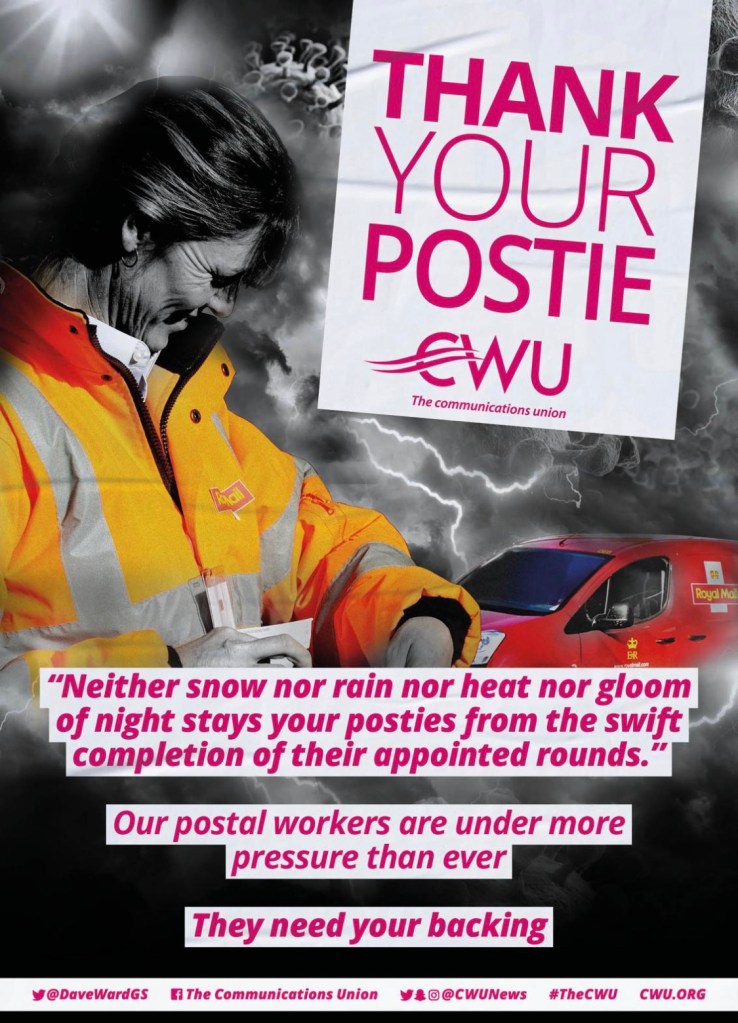
Further updates will be provided to Branches in due course however it is still vital that the number of claims are maximised. This is especially important given that we are now heading into the period where all members will start taking their first four weeks annual leave for 2020/21. For ease of reference a flowchart is attached as well as a poster to help promote these cases.
In closing, I would like to thank Branches for your continued efforts in relation to the holiday pay claims and further updates will be provided in due course.
Any enquiries in relation to the content of this LTB should be addressed to the DGS(P) Department.
Yours sincerely,
Terry Pullinger
Deputy General Secretary (Postal)
20LTB112 β AVERAGE PAY ON LEAVE (HOLIDAY PAY CLAIMS) AGAINST ROYAL MAIL GROUP LIMITED
BT PERSONNEL β Coronavirus (COVID-19)
Further to LTB 105/2020, the Unionβs BT Personnel Team have been in consultation with the company on the advice to employees regarding the Coronavirus situation, and this information is specific to BT, including Openreach and EE.
Attached is the present advice from BT; they acknowledge that as the situation is changing all the time updates will be sent to employees.
A link is copied below to BTβs Coronavirus microsite.
https://hr.bt.com/en-gb/safety-wellbeing/health-alerts/coronavirus-guidance
Members are encouraged to keep up-to-date on the situation.
Also attached is set of questions and answers with further guidance.
Any enquiries from Branches regarding this LTB should be referred to my office in the first instance.
Yours sincerely
Dave Jukes
Assistant Secretary
LTB 110.2020
Attachment 1 β LTB 110.2020
Attachment 2 β LTB 110.2020
Coronavirus (Covid-19) Update β First Royal Mail Group Employee/CWU Member, Positive Test, Corona Virus Victim:
This LTB is being issued to confirm the basic facts of the first case of a Royal Mail employee and CWU member becoming unwell at work and subsequently testing positive for the Coronavirus (Covid-19) infection and to deal with the unhelpful misinformation and rumour appearing on social media.
As of yesterday evening the UK national number of confirmed Coronavirus cases was confirmed by the Government as 273 and is expected to continue to climb.
The facts of the case involving a Royal Mail employee and CWU member involve a Postman/OPG employed at the Manchester South West Delivery Office, who recently returned from holiday in Italy, without any immediate symptoms but on returning to work became ill after a single day back at work and after showing the symptoms of the virus contacted NHS 111 and was tested which resulted in a positive result after which he went off work and into self-quarantine and is following medical advice and treatment.
The CWU Health, Safety & Environment Department was immediately informed by the Business and we have been in consultation with Royal Mail HQ and working with the local CWU Area Health and Safety Rep and CWU Divisional IR Rep.
Prior to this case occurring, RMP&FS had been in discussions with the CWU Health, Safety & Environment Department with regard to their plans to set up arrangements for initiating βdeep cleansβ of Royal Mail premises by specialist cleaning teams, using a powerful multi-purpose virucidal/bactericidal cleaner and sanitiser β should it be required. This has been carried out at Manchester SWDO.
It is also worth adding that scientific experts conclude that this virus does not survive long outside of a host person or animal and estimate that it can survive on hard and soft surfaces no more than a few hours to a day at most approximately.
Royal Mail Groupβs Head of Health has been working in conjunction with and under the advice of Public Health England who have confirmed their satisfaction that the Delivery Office building poses no risk of infection to the workforce and that it can operate normally.
Transmission of the virus is airborne which means itβs spread in a similar way to colds and flu to other persons, normally via close personal contact with infected individuals through coughing and sneezing small fine droplets which are breathed in by others and they can become infected.
At the request of the CWU Health, Safety & Environment Department, it has been agreed that a professional medically qualified clinician will brief the Manchester SWDO workforce to provide the necessary assurances and to answer any questions.
See attached Joint Statement which in summary firstly commits Royal Mail Group to joint working with the CWU in line with the advice and guidance of the WHO, UK CMO, Department of Health, PHE and NHS in order to plan ahead to take appropriate action. It covers agreed arrangements for deep cleaning and disinfecting of offices where necessary as per PHE guidelines. It covers Royal Mail and CWU joint support for promoting regular handwashing and the use of gloves and alcohol disinfectant wipes for shared equipment and the joint promotion of good respiratory hygiene in the workplace. Importantly it commits Royal Mail Group to adopt a supportive approach to self-isolation in relation to, pay, absence policy and fit note provision.
This is the first case in Royal Mail Group and being one of the UKβs largest employers, we have to expect that it may not be the last. We are satisfied that the Royal Mail Group Head of Health and the Director of Safety, Health, Wellbeing and Sustainability and their teams are doing everything possible to ensure the safety, health and wellbeing of the members involved, working with Public Health England and working closely in consultation with the Union and both sides are committed to continue working in liaison during the current virus outbreak.
Finally, All ASRs and Branch Reps are asked to remain vigilant in encouraging members to maintain good hygiene standards at all times, thoroughly washing hands regularly and using alcohol-based wipes to clean shared equipment such as PDAs, scanners and keyboards. Members should also be encouraged to act responsibly, follow Government travel advice and restrict contact with anyone who may have travelled to high-risk areas and countries and who have an obvious fever or cough. Anyone exhibiting any flu-like symptoms and feeling unwell should be advised to limit the spread of infection and call NHS 111 without delay.
Further reports will follow in due course.
Yours sincerely
Dave Joyce
National Health, Safety & Environment Officer
Dave Ward and Terry Pullinger LIVE at AGMs this morning. Get the vote out 8/3/20
Dave Ward and Terry Pullinger LIVE at AGMs this morning. Get the vote out
IAmTheUnion πββπββ
National Call The Vote Out Day
Following the success of National Call The Vote Out Day in the 2019 ballot it is once again planned to assist with increasing the turnout and final week activity this year.
On Wednesday 11th March (12:00-17:00) we will host the event at CWU HQ.
We would urge every single branch to send delegates to the event so we can make as many calls to members as possible. Last time we made 10,000 calls. We want to beat that this year.
All attendees need to bring is a mobile phone and charger.
Branches should register delegates for the event by emailing Marcia Murray mmurray@cwu.org with names and numbers by no later than 12noon on Tuesday 10th March.
We look forward to seeing as many of you as possible in attendance on the day. Thank you for your ongoing work to secure the highest possible yes vote and return.
Yours sincerely,
Terry Pullinger β Deputy General Secretary Postal
Dave Ward β General Secretary
All Party Parliamentary Group (APPG)Β for Respiratory HealthΒ Publishes Inquiry Report Warning UK Government That It Must Act to Prevent the βnext Asbestosβ Taking More Lives in the UK
All Party Parliamentary Group (APPG) for Respiratory Health Publishes Inquiry Report Warning UK Government That It Must Act to Prevent the βnext Asbestosβ Taking More Lives in the UK:
The All Party Parliamentary Group (APPG) for Respiratory Health has urged the Government to take action to prevent the βnext Asbestosβ from taking more lives in the UK with the publication of its report entitled βSilica The Next Asbestosβ.
The APPG and not-for-profit organisation B&CEβs joint report, Silica β The Next Asbestos, examines the danger posed by Respirable Crystalline Silica (RCS); the biggest risk to construction workersβ health after Asbestos. The inquiry was launched on 9 July 2019 and the Report was published on 4 March 2020.
Around 600,000 UK workers are exposed to RCS each year, which is created when bricks or stone are either fractured, cut or drilled into. This can cause Silicosis, the most common chronic occupational lung disease in the world. In Australia, the recent rise in cases of Silicosis has been described as an βemerging occupational health epidemicβ, but awareness and understanding of the risks of RCS exposure remains βlowβ, the report says.
The new report calls on the Government to take a number of crucial steps to address these issues and protect construction workers from exposure to RCS.
The Report recommendations include:
- Halving the workplace exposure limit (WEL) for RCS in the UK from 0.1mg/m3 to 0.05mg/m3 in line with the 2003 recommended exposure standard from the Scientific Committee on Occupation Exposure Limits.
- Developing and implementing a targeted industry awareness campaign for those at risk of developing Silicosis.
- Introducing occupational health services into GP surgeries to allow for occupational histories to be taken where work-related ill health is suspected.
- Introducing new health and safety regulations specifically relating to the control of Respirable Crystalline Silica (RCS), to bring it into line with Asbestos.
- Introducing an NHS screening programme for those exposed to RCS.
Thousands of construction workers are being put at risk by breathing in tiny dust particles when they drill or cut stone, the new report states. Workers are being put at risk of developing Silicosis β a chronic lung disease caused by the inhalation of Silica dust. Silicosis occurs when the bodyβs immune system tries to remove the tiny particles of dust, resulting in swelling and scarring of the lung tissue. The condition usually develops after being exposed to Silica for at least a decade but some are affected sooner. Symptoms include a persistent cough, shortness of breath with weakness and tiredness. There is no cure and treatments aim to relieve symptoms and improve quality of life.
The Inquiry has raised awareness around the risks of Silica dust and given insight into the steps being taken to improve at-work health, especially around the issue of Silica dust. The APPG hope the report will assist the Health and Safety Executive, the Government and the construction industry to shine light on an under-documented issue and protect the construction workforce from preventable injury and illnesses. The aim of this report is to start a long-overdue conversation between Government, Parliament, health bodies and the construction industry about how to tackle Silicosis; an entirely preventable, often fatal, condition.
Retired Stone Mason Gordon Sommerville, 59, from Scotland gave evidence to the inquiry and told how he had to retire due to ill-health. He recalled the almost non-existent levels of industry awareness to the dangers of inhaling dust at the start of his 38-year career. He said that today colleagues teach stoneworkers of the dangers, the HSE runs awareness campaigns and larger companies will supply employees with respiratory protection. But still the danger of dust has not filtered through to most and ignorance is still the major cause of dust diseases he concluded.
In a 2014 report, the HSE stated that Silica is the biggest risk to construction workers after Asbestos and in July 2019, The Australian Department of Public Health launched its βTaskforce into Silicosis and Other Dust Diseasesβ.
Yours sincerely
Dave Joyce
National Health, Safety & Environment Officer
20LTB108 All Party Parliamentary Group (APPG) for Respiratory Health Publishes Inquiry Report
Royal Mail Property & Facilities Solutions β RMG Portable Appliance Testing (PAT) Frequency Changes
Royal Mail Property & Facilities Solutions β RMG Portable Appliance Testing (PAT) Frequency Changes:
Background
The main change is that RMG will move from the current general regime of 12 monthly PAT testing to 24 monthly PAT testing. Following discussions regarding the higher risk areas using bench and hand held power tools and equipment it was agreed that Vehicle Service Centres, Quadrant Facilities, RM and RMP&FS Engineering Workshops would be excluded and will receive a 6 month formal visual inspection by a competent person (PHS) and 12 monthly PAT testing. The PAT schedule has been amended to accommodate the variation. In relation to Fixed Wire Testing, there will be no change to the current situation which is a 5 yearly programme.
Introduction:
RMP&FS has been undertaking a national review of the frequency of Portable Appliance Testing (PAT) to reflect the level of risk based on guidance provided by the Health & Safety Executive, Fire & Rescue Service and other published guidance to ensure that a risk management approach is achieved which minimises risks associated with the use of transportable and portable electrical appliances throughout the Royal Mail Group (RMG) estate.
Future Testing Frequency:
The outcome of the review has concluded and has been subject to consultation and input from the CWU Health, Safety & Environment Department. The new testing frequencies are:
- Vehicle Service Centres β 12 monthly formal PA Tests plus 6 monthly
- Engineering Workshops formal checks performed by a specialist
- Quadrant Kitchens contractor
- All other sites/areas β 24 monthly formal PAT tests performed by a specialist contractor
What is Changing?
As part of these changes, more emphasis will be placed on pre-use checks which should be made by users of portable appliances in line with existing PIC (Person in Control) Handbook guidance. The HSE guide is provided below (HSG107 (Third edition) Published 2013) as additional reference.
User Checks:
The person using the equipment should be encouraged to look at it before use and check for signs that it may not be in sound condition, for example:
- Damage (apart from light scuffing) to the supply cable, including fraying or cuts;
- Damage to the plug or connector, e.g., the casing is cracking or the pins are bent;
- Inadequate joints, including taped joints in the cable;
- The outer sheath of the cable is not effectively secured where it enters the plug or the equipment. Evidence would be if the coloured insulation of the internal cable cores were showing;
- The equipment has been subjected to conditions for which it is not suitable, e.g., it is wet or excessively contaminated;
- Damage to the external casing of the equipment;
- Loose parts or screws;
- Evidence of overheating (burn marks or discolouration).
(This list is not exhaustive)
Dealing With Faulty Equipment:
Any faults found as part of the pre-use checks should be reported to the unit manager (PIC) and the equipment taken out of use immediately. Managers should take effective steps to ensure that the equipment is not used again until it is repaired or replaced; the defective equipment should be labelled as βfaultyβ and removed from the area of work.
Available Support β RMP&FS Help Desk:
Faults should be reported and any questions or queries can be raised by contacting the Property & Facilities Solutions helpdesk on 0844 800 9191 or use the Self-Service link to report a fault via the Property & Facilities Portal at: https://selfservice.royalmailpfs.com/
Checking When An Office Is Due A Portable Appliance Test (PAT):
The Office Manager (PIC) can log into the Compliance Records Database (CRD) and view details for the office concerned for all certification including PAT records. Dates when the next PAT is due will be provided (where a six monthly visit is required the PAT programme schedule will be amended and the CRD updated to reflect this requirement). Alternatively, a call can be made to the Property & Facilities Solutions helpdesk on 0844 800 9191.
Compliance Checks and Auditing:
To ensure that the level of risk associated with the use of portable appliances throughout the RMG estate is risk managed, RMP&FS has introduced a process for an annual review of PAT test results. The review will deliver a formal three-stage process:-
- Contractor/Supplier to provide detailed records of PAT tests in a format that allows easy and accurate assessment of results. To be provided on a monthly basis and collated for an annual review of results β part of contract specification and KPI.
- Data Team (PFSL) to collate PAT results and provide detailed report for Subject Matter Experts review β data to be collated every 12 months and completed by December 31st each calendar year
- PFSL Subject Matter Expert to review collated data and perform a risk verification exercise, i.e., a low failure rate would indicate that the interval between tests/inspections can be increased whilst a high failure rate would indicate that the interval between tests/inspections should be shortened. Output of the review and recommendations will be developed and submitted to the PFSL Board by the 28th February each year for consideration and action as necessary.
Additionally:
- Persons in Control β will have documented processes outlining responsibilities regarding the property management and safety of staff and which includes guidance on portable appliances.
- Property Help Desk β available 24-hours, 7-days a week allows for the reporting of equipment that requires testing, replacing or repair.
- SHE Team Safety Advisors β are available to provide safety professional support and advice when necessary and can assist in the safety management processes for both staff and PICs.
- Safety Audits β are carried out by the RMG SHE Safety team and the nominated FM service provider (Property & Facilities Solutions Ltd).
PAT Testing Supplier
RMP&FS has appointed βPHSβ to carry out both Portable Appliance Testing and Fixed Wired Testing to agreed programmes within the RMG estate. PHS will commence the new PAT & FWT programme of scheduled inspection and testing visits on 1 April 2020.
Starting Date:
The new PAT testing regime will formally start from 1 April 2020. However, there is an interim arrangement in place to cover the sites/areas where the 6 monthly visit is required/due. If there are any queries from our colleagues then the PFS helpdesk should be contacted in the first instance.
Enquiries
Any Management enquiries can be directed to Tim K Williams RMP&FS Property Risk & Assurance Lead Mobile: 07841 788464 Email: tim.k.williams@royalmail.com
Yours sincerely
Dave Joyce
National Health, Safety & Environment Officer
Davie Robertson, National Officer responds to the Parcelforce communications you have received in the last few days and why it’s imperative you vote