UKHSA Burkholderia Stabilis Risk Guidance – Check Your First Aid Kits

UKHSA Burkholderia Stabilis Risk Guidance – Check Your First Aid Kits

Dear Colleagues,

The UKHSA UK Health Security Agency – GOV.UK is investigating an outbreak of Burkholderia Stabilis involving individuals across the UK, linked to wipes. There have been fifty-nine confirmed cases of Burkholderia Stabilis, and one death associated with the infection.

Wipes used in first aid kits should be individually wrapped and sterile, in compliance with British Standard BS8599-1.

There will be a variety of First Aid kits in many workplaces and CWU branches around the UK.

The UKHSA and MHRA Medicines and Healthcare products Regulatory Agency – GOV.UK are urging the public and workplace first aiders to check your first aid kit and ensure you have appropriate sterile products for treating wounds.

The direct public advice is to not use four specified non-sterile alcohol-free wipe products, due to the risk of infection associated with their use. If you have the products listed below, UKHSA advice is not to use them and to dispose of them in your household waste as a precautionary measure given the potential for contamination.

    • ValueAid Alcohol Free Cleansing Wipes
    • Microsafe Moist Wipe Alcohol Free
    • Steroplast Sterowipe Alcohol Free Cleansing Wipes
    • Reli Wipe Alcohol Free Cleansing Wipes

For familiarity purposes, images of the above specified products can be viewed via the link below.

What is Burkholderia stabilis, and why should I check my first aid kit? – UK Health Security Agency

Key messages:

  • Do not use non-sterile alcohol-free wipes on broken or damaged skin – these are not suitable for wound care.
  • Seek advice and support from trained first aiders for any workplace sustained cuts or wounds.
  • Seek medical attention for significant injuries or wounds that show signs of infection.


CWU engagement via local workplace health and safety committees is encouraged wherever possible, with primary focus on First Aid risk assessments and local First Aid risk control for workplaces.

The Health and Safety (First Aid) Regulations 1981 states: “An employer shall provide or ensure that there are provided such equipment and facilities as are adequate and appropriate in the circumstances for enabling first aid to be rendered to his employees if they are injured or become ill at work”.

Regular Checks

Regular checks of First Aid kits are crucial to ensure that the contents are complete, in good condition, and ready for use. It is recommended that a thorough inspection of a workplace First Aid kit is carried out at least monthly

Further HSE guidance on the application of the First Aid at Work Regulations is shared alongside this LTB.

This LTB is shared on behalf of CWU Central Services.

If you have any questions or need any further information, please contact:

Jamie McGovern FRSPH MIIAI 

CWU Health & Safety Policy Assistant at jmcgovern@cwu.org.

LTB 045 2026- UKHSA Burkholderia stabilis risk guidance_

HSE guidance – first aid at work regulations 1981

View Online

ROYAL MAIL PROCESSING ENGINEERING TERRITORIAL REP BALLOT

ROYAL MAIL PROCESSING ENGINEERING TERRITORIAL REP BALLOT

  • Northern Territory

Further to LTB’s  24/06 dated 27th January 2026, Branches should note that the ballot timetable for the above elections has now been confirmed with the independent scrutineer, and is as follows:

Ballot Papers Despatched:      19thFebruary 2026

Ballot Closes:                           12th March 2026 (1st Post)

Branches should note that the ballot papers will be despatched 2nd class post and returned to the Independent Scrutineer by 2nd class post.

The successful candidates will take up position from Monday 16th March 2026

Any enquiries regarding this letter to Branches should be addressed by email to lparrett@cwu.org.

Yours sincerely,

Martin Walsh
Deputy General Secretary (P)

26LTB044

View Online

PARCELFORCE WORLDWIDE BALLOT TIMETABLES

PARCELFORCE WORLDWIDE BALLOT TIMETABLES

  • Parcelforce Area Health & Safety Representative – South East Region 2026
  • Parcelforce Worldwide Area Organiser – Northern Ireland 2026

Further to LTB’s  25/06 & 26/06 dated 27thJanuary 2026, Branches should note that the ballot timetable for the above elections has now been confirmed with the independent scrutineer, and is as follows:

Ballot Papers Despatched:      19thFebruary 2026

Ballot Closes:                           12th March 2026 (1st Post)

Branches should note that the ballot papers will be despatched 2nd class post and returned to the Independent Scrutineer by 2nd class post.

The successful candidates will take up position from Monday 16th March 2026

Any enquiries regarding this letter to Branches should be addressed by email to lparrett@cwu.org.

Yours sincerely,

Martin Walsh
Deputy General Secretary (P)

26LTB043

View Online

ROYAL MAIL: RAISING CONCERNS AGREEMENT – CASE STATISTICS

ROYAL MAIL: RAISING CONCERNS AGREEMENT – CASE STATISTICS

Branches will recall that LTB 166/2025 issued on 8th August 2025 contained the statistics in relation to the six-month review period for Raising Concerns. At that time, the PTCS Department asked for feedback on the application of the Raising Concerns Agreement, and in particular examples of where the process wasn’t being adhered to by managers. This information was required to assist us with further discussions moving forward into the 12-month review of the Agreement.  The PTCS Department received a number of enquiries along with some cases that Branches and Representatives wished for us to review and consequently we undertook this activity and provided feedback where appropriate.

Bobby Weatherall, Acting Assistant Secretary, Alan Tate, PE Member, and Peter Donaghy, Policy Advisor, met with Royal Mail on 19th November 2025 to discuss the latest statistics (attached). Following this meeting, we shared this information with the Postal Executive and subsequently presented to the Senior Field Officials (SFO) at their meeting in Cardiff on 4thDecember 2025.

For ease of reference and for the benefit of Branches and members, below is a summarised overview and analysis of the attached statistics:

  • 4,866 cases (as at 7th October 2025) raised since the launch of Raising Concerns
  • Cases raised under the previous procedures 23/24 = 2,681. The cases raised under the new procedure for 24/25 = 4,275, which is an increase of 59%
  • 67% of the outcomes are informally resolved, upheld or partially upheld
  • 578 concerns have been resolved informally, including through mediation
  • 1,293 concerns have been taken through the formal process of which 52% have been upheld or partially upheld
  • 505 appeals raised since launch. Out of 403 concluded, 28% of appeals are either upheld or partially upheld
  • Informal cases – 88% have met the 14-day meeting status. 86.9% completed
  • Formal cases – 95.2% have met the 14-day meeting status. 86.9% completed.

All the above statistics apply to UK operations.  There are also statistics for Parcelforce, National Distribution, Fleet Maintenance, PFSL, and Central Functions.

Further to the above, and following feedback from the field, we have made a couple of improvements to the Raising Concerns Agreement and these can be seen in the attached presentation on pages 7, 8 and 9.  These are as follows:

  • Firstly, ‘Where a case is raised against a CWU Representative, the case manager must record this in a drop-down box and ticking ‘Yes’ before they can move forward. They must also inform the Divisional Representative of a case involving a CWU Representative’. 
  • Secondly, the previous wording in the agreement was, ‘Following the formal investigation, the investigating manager will communicate the outcome to the employee raising the concern and to the employee responding to the concern giving their rationale for the decision. This will be set out clearly in a decision report which includes reference to how the evidence they gathered throughout the investigation supports their decision.’ 

The new wording in the agreement is, ‘Following the formal investigation the investigating manager will communicate the outcome to both the employee who raised the concern and the employee responding to the concern, providing the rationale for the decision. The employee who raised the concern will receive an outcome letter and a decision report outlining the rationale for the outcome. The employee responding to the concern will receive and outcome letter that includes the rationale relevant to their involvement. In both cases, the rationale should reference how the evidence gathered during the investigation supports the decision’.

We are naturally aware and recognise there are frustrations coming from some of our Reps and members whereby they are unhappy with the outcomes of their Raising Concerns case, or the way the manager has dealt with the case. However, these concerns do not indicate there are any underlying problems with the Raising Concerns Agreement itself, and the feedback into the Department is that the process is generally fit for purpose and is in the main working for our members, particularly in comparison to the former arrangements. Crucially, the stats demonstrate that cases are being heard and dealt with in significant numbers and a high number of these cases are completed within the 14-day period. Bobby Weatherall, Postal Executive member, will continue to monitor and review the cases coming into the Department and respond on my behalf.

Lastly, Branches are reminded of the following clause within the Agreement – Any concerns regarding the interpretation or application of these principles should be referred to the signatories for resolution”. 

 Any enquiries in relation to this LTB should be sent to snicholas@cwu.orgor hmaughan@cwu.org.

Yours sincerely,

Andy Furey

Assistant Secretary

LTB 041/26 – RM Raising Concerns Agreenment – Case Statistics

Att: Appendix to LTB 041 Raising Concerns

View Online

ROYAL MAIL: THE COLLECTIVE PLAN – ANNUAL BENEFIT STATEMENT & ADJUSTMENT LETTERS

ROYAL MAIL: THE COLLECTIVE PLAN – ANNUAL BENEFIT STATEMENT & ADJUSTMENT LETTERS

Branches and members are advised that the Collective Plan has issued its first Annual Benefit Statement and adjustment letters.  These will be sent via second class post from today, Monday 9th February to all scheme members who were in the Collective Plan between October 2024 and March 2025.

The Annual Benefit Statement tells Collective Plan members how much they’d built up in the Collective Plan to 31 March 2025, how much they might get from the Collective Plan at age 67, and other information the Collective Plan is legally required to send to members.

The adjustment letters inform members of the outcome of the Collective Plan’s valuations, which determine how much everyone’s income for life and lump sum are adjusted. The results of the valuations are:

  • Income for life built up in the period to 31 March 2025 will increase by 6.4%on 31 March 2026
  • Lump sum built up in the period to 31 March 2025 will increase by 7.6% on 31 March 2026

Scheme members should remember, everyone’s income for life is adjusted each year by the same percentage, even after you’ve retired, so that the cost of everyone’s income for life stays in balance with the value of the Collective Plan’s assets. This means your income for life can go down as well as up, both before and after you start getting your income for life.

Your lump sum is guaranteed and cannot go down, and each year the Trustee will work out if your lump sum can go up or not, and by how much if it can go up. You will see from above that this year it is going up by 7.6%.

Branches are urged to encourage members to sign up to:

  • The MSS website where they can see how much has been built up so far and an indication of what they might receive at age 67 (link – https://www.securermcollectiveplan.com). Members must register for the Collective Plan’s Member Self-Service to access the Annual Benefit Statement and adjustment letter in the future as they will only be provided via the MSS from next year. Details about how to do this are included in the letter from the Collective Plan.
  • Details of dependants – it is also vitally important that members provide these details via the MSS website.

Members can also sign up to the following via the Royal Mail People App

  • Lump sum booster (a 1% member contribution is matched at 1% by Royal Mail) – Royal Mail – Pensions
  • AVCs – If members pay AVCs into the Collective Plan, those payments will build up in a separate pot. And they’ll have different rules about how members can take them. Refer to the AVC Handbook. Royal Mail – Pensions

Conclusion

The Collective Plan has been running since 7th October 2024 and this is the first annual valuation (which will be repeated every year going forward).  Clearly, this year’s outcome is very healthy and positive for our members.

Lastly, if Branches or members require further information, the attached Q&As will assist.  Members can also use the various QR codes to access the relevant information on the Collective Plan website.

Any enquiries in relation to this LTB should be sent to snicholas@cwu.org or hmaughan@cwu.org

Yours sincerely,

Andy Furey
Assistant Secretary                                  

LTB 039 RM THE COLLECTIVE PLAN – ANNUAL BENEFIT STATEMENT AND ADJUSTMENT LETTERS

LTB 039 Attachment FAQs for Union

View Online

National LGV Recruitment Exercise

National LGV Recruitment Exercise 

Following discussions at national level as part of the Rebuilding Royal Mail, Section 5 commitment on Reducing Reliance on Agency Workers, it has been agreed that a national Recruitment Exercise for LGV Professional Driver Roles will commence for internal candidates on Monday 9th February 2026.

While the exact number of roles at each location is still under review and it has yet to be finalised, we can confirm that business is looking to recruit at the following sites:

Birmingham VOC, Belfast VOC, Carlisle VOC, Chorley VOC, Chelmsford VOC, Croydon VOC, Coventry Hub VOC, East Midlands Airport VOC, Exeter VOC, Gatwick VOC, Greenford VOC, HWDC VOC, Manchester VOC, Midlands Super Hub VOC, Northern Home Counties VOC, Norwich VOC, NW Hub VOC, Peterborough VOC, Plymouth VOC, PRDC VOC, Preston VOC, Scottish Parcel Hub VOC, South East Parcel Hub VOC, Southampton VOC, South West Parcel Hub VOC, Swindon VOC, Tyneside, VOC Woking VOC, Wolverhampton VOC, and Yorkshire Parcel Hub VOC.

While the CWU had requested that the business offer vocational training Royal Mail have confirmed at this time there is no budget for Vocational Driver Training other than a 2026 LGV Apprenticeship program, which will also be launched shortly.  Details on that will be confirmed.

As such the internal LGV recruitment program is open to all employees who hold the relevant vocational C+E License.   While Driver CPC training will be offered, only candidates with a C+E license and no more than 6 penalty points will be considered.

With a basic salary of £38,307, rising with the April pay award this is an excellent opportunity for Royal Mail Group employees to progress to a Professional Driver role.  The recruitment exercise will open for internal candidates on 9th February 2026 and close on the 1st March 2026. After the 1st March 2026 any remaining vacancies will be offered to external candidates.

We would encourage all CWU members in possession of a LGV C+E License who wishes to progress to a Professional Driver role to take advantage of the opportunity and apply for a role at the location(s) of their choice.  Applications are through Success Factors.

Attached for the information of Branches, Representatives and Members is the Recruitment Poster, and internal advertisement.

We would ask that Branches give the content of this LTB the widest possible circulation.

Any enquiries in relation to this LTB should be addressed to Davie Robertson, Assistant Secretary, email: jrodrigues@cwu.org  or jmansell@cwu.org  quoting reference LTB 038/26.

Yours sincerely,

Davie Robertson
Assistant Secretary

LTB 038.26 – National LGV Recruitment Exercise

Internal poster_LGV driver

LGV drivers workvivo post.docx

View Online

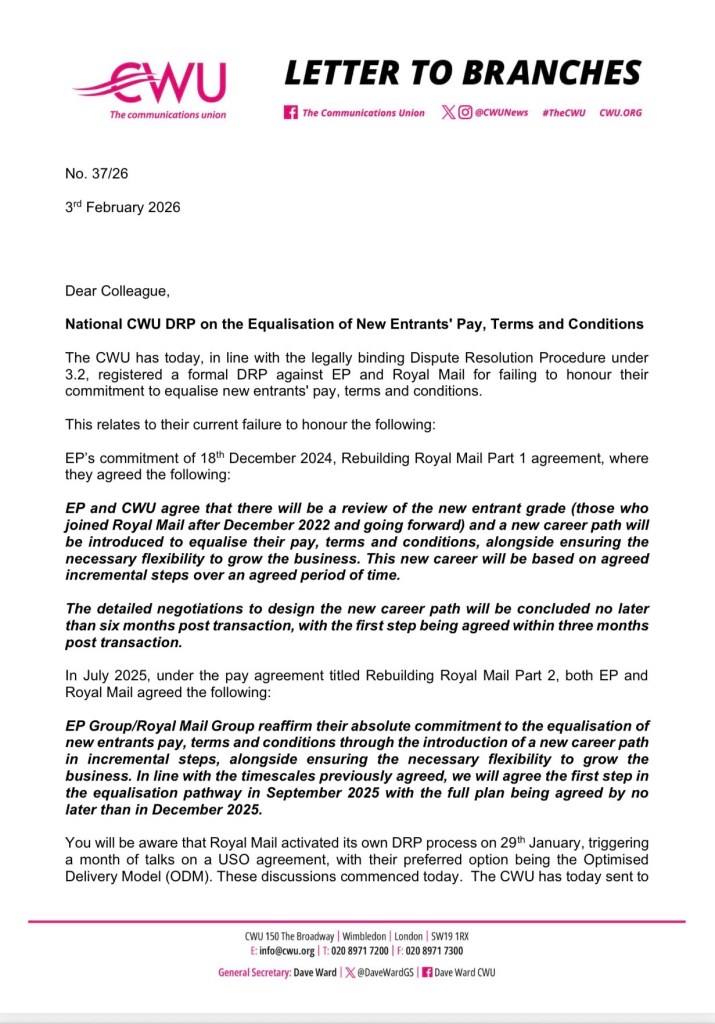
National CWU DRP on the Equalisation of New Entrants’ Pay, Terms and Conditions

National CWU DRP on the Equalisation of New Entrants’ Pay, Terms and Conditions

The CWU has today, in line with the legally binding Dispute Resolution Procedure under

3.2, registered a formal DRP against EP and Royal Mail for failing to honour their

commitment to equalise new entrants’ pay, terms and conditions.

This relates to their current failure to honour the following:

EP’s commitment of 18th December 2024, Rebuilding Royal Mail Part 1 agreement, where

they agreed the following:

EP and CWU agree that there will be a review of the new entrant grade (those who

joined Royal Mail after December 2022 and going forward) and a new career path will

be introduced to equalise their pay, terms and conditions, alongside ensuring the

necessary flexibility to grow the business. This new career will be based on agreed

incremental steps over an agreed period of time.

The detailed negotiations to design the new career path will be concluded no later

than six months post transaction, with the first step being agreed within three months

post transaction.

In July 2025, under the pay agreement titled Rebuilding Royal Mail Part 2, both EP and

Royal Mail agreed the following:

EP Group/Royal Mail Group reaffirm their absolute commitment to the equalisation of

new entrants pay, terms and conditions through the introduction of a new career path

in incremental steps, alongside ensuring the necessary flexibility to grow the

business. In line with the timescales previously agreed, we will agree the first step in

the equalisation pathway in September 2025 with the full plan being agreed by no

later than in December 2025.

You will be aware that Royal Mail activated its own DRP process on 29th January, triggering

a month of talks on a USO agreement, with their preferred option being the Optimised

Delivery Model (ODM). These discussions commenced today. The CWU has today sent

to Royal Mail a document detailing the reasons why we do not support the ODM along with

our USO proposal.

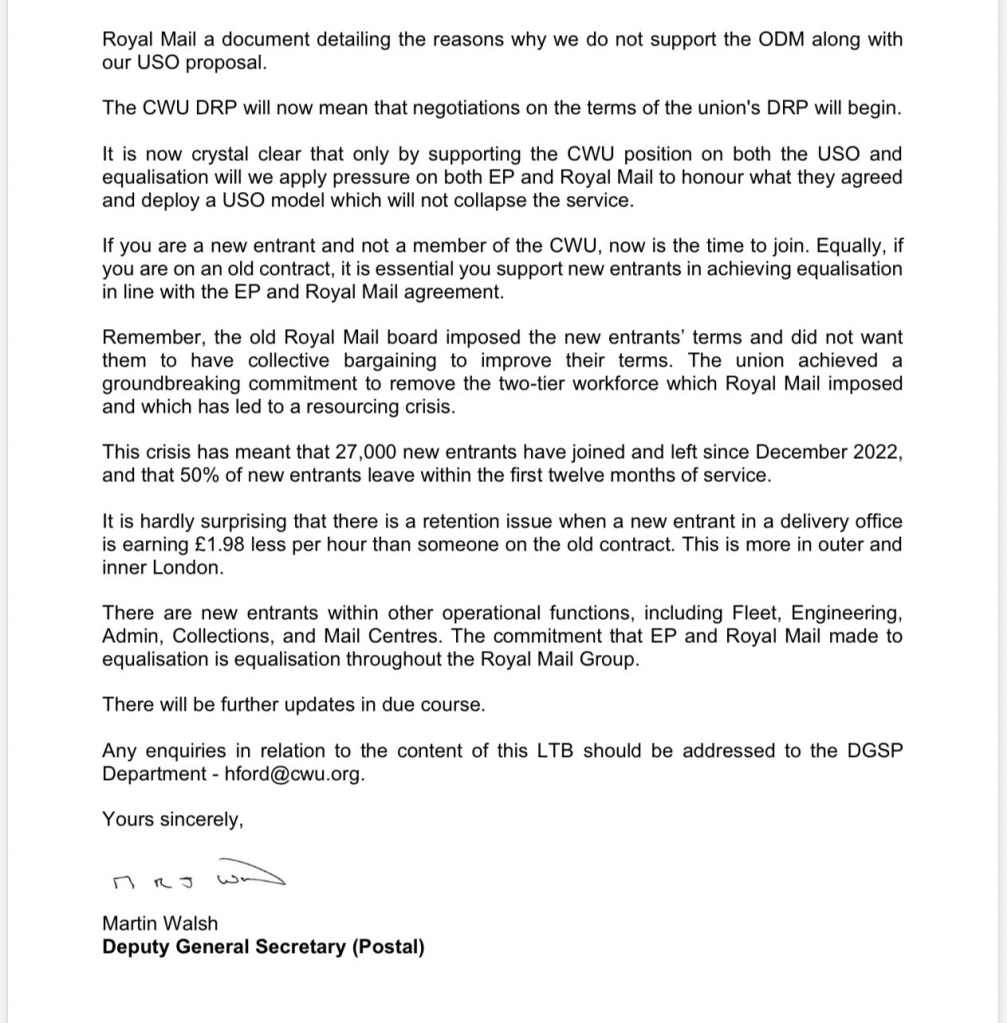
The CWU DRP will now mean that negotiations on the terms of the union’s DRP will begin.

It is now crystal clear that only by supporting the CWU position on both the USO and

equalisation will we apply pressure on both EP and Royal Mail to honour what they agreed

and deploy a USO model which will not collapse the service.

If you are a new entrant and not a member of the CWU, now is the time to join. Equally, if

you are on an old contract, it is essential you support new entrants in achieving equalisation

in line with the EP and Royal Mail agreement.

Remember, the old Royal Mail board imposed the new entrants’ terms and did not want

them to have collective bargaining to improve their terms. The union achieved a

groundbreaking commitment to remove the two-tier workforce which Royal Mail imposed

and which has led to a resourcing crisis.

This crisis has meant that 27,000 new entrants have joined and left since December 2022,

and that 50% of new entrants leave within the first twelve months of service.

It is hardly surprising that there is a retention issue when a new entrant in a delivery office

is earning £1.98 less per hour than someone on the old contract. This is more in outer and

inner London.

There are new entrants within other operational functions, including Fleet, Engineering,

Admin, Collections, and Mail Centres. The commitment that EP and Royal Mail made to

equalisation is equalisation throughout the Royal Mail Group.

There will be further updates in due course.

Any enquiries in relation to the content of this LTB should

Time to Talk Day 2026 – 5th February 2026Theme: ‘Brave the big talk’.

Time to Talk Day 2026 – 5th February 2026Theme: ‘Brave the big talk’.

Dear Colleagues,

Every year Mind and Rethink Mental Illness promote Time to Talk Day – Mind which is ‘a day for friends, families, communities, and workplaces to come together to talk, listen and change lives’.

About Time to Talk Day

Time to Talk Day is held at the beginning of February every year. It is about helping people and communities to come together to have the nation’s biggest mental health conversation day.

The following link provides access to the Mates in Mind website and access to an ‘all year round’ workplace notice board poster, which has a QR code link to over 20 confidential support services and the ‘be a mate’ text support service.

Time to Talk Day: 5 February 2026 | Mates in Mind

The CWU is again supporting the ‘Time to Talk Day’ national campaign which spotlights the importance of having more open, honest mental health conversations, encouraging people to have those conversations about how they’re feeling and to help combat the stigma that still exists around mental health.

People talking about their mental health and how they are really feeling can be difficult. But talking is crucially important. Mental Health charities and experts continually emphasise the point that the more conversations we have, the better life is for everyone.

Additionally, there are different versions available for each UK nation (England, Scotland, Wales and Northern Ireland), which can be sourced via the following links:

#TimeToTalkDay Time to Talk Day – Mind

Scotland: Time To Talk Day 2026 | End Mental Health Stigma and Discrimination

Northern Ireland (Inspire): Time to Talk Day – Inspire Wellbeing

Wales (Time to Change Wales): Talking about your Mental Health | Time to Change Wales

For those who find themselves in situations where you don’t want to talk about feelings or your mental health, there are alternative ways to look for support.  New advice on using apps and other digital tools to support mental health was published on 27th January 2026 by the Medicines and Healthcare products Regulatory Agency (MHRA)

MHRA issues new guidance for people using mental health apps and technologies – GOV.UK

This guidance was published for the purpose of advising the public, parents, carers and professionals who use or recommend these digital tools.

Currently there are more than 20,000 mental health apps available in the iOS and Google app stores. These products are now widely available and often used alongside NHS and community care, but it is not always clear which are reliable, safe or right for an individual. The new guidance therefore aims to help people make more informed choices and know what to do if something doesn’t feel right.

In the recent TUC Biennial Trade Union Safety Reps survey, Stress was by far the most widespread workplace concern in all regions and nations.

SafetyRepsSurvey20242025.pdf

Stress was identified as the top workplace hazard identified by 79 per cent of all respondents, a higher proportion than both 2022/3 (73 per cent) and 2020/21 (76 per cent).

CWU participation in the TUC Biennial Safety Reps survey was the fifth largest of 36 unions, with 145 CWU Health and Safety Reps taking part in the 2024/25 survey.

So, for 2026 we are again asking branches and Regions to support the ‘Time to Talk Day’ national campaign on 5th February 2026 which spotlights the importance of honest mental health conversations, whilst also recognising that every day has the potential to be a ‘Time to talk’ day.

This LTB is shared on behalf of CWU Central Services.

If you have any questions or need any further information, please contact-

Jamie McGovern FRSPH MIIAI 

CWU Health & Safety Policy Assistant at jmcgovern@cwu.org

LTB 035/26 time to talk day

Attachment: Time-to-talk-day-2026-generic-poster

View Online

PURCHASE OF ANNUAL LEAVE (POAL)

PURCHASE OF ANNUAL LEAVE (POAL)

As you may know in 2025, the company suspended enrolment and continuation of Purchase of Annual Leave (POAL) due to concerns about possible legal risks under National Minimum Wage (NMW) Legislation.  Since that time, our members have continued to receive the benefits of purchasing annual leave without being required to pay or make up associated payments.

The legislation states that, after Salary Sacrifice, your hourly rate in a pay period cannot be below the current rate of £12.21, which will increase to £12.71 in April.  The pay package is complex, as we have the basic, plus functional supplements and shift allowances that are added into take home pay but may not be part of the calculation however we believe that they should be as they are paid year-round and in the case of shift supplements only lost after an 8-week sick absence.

We have taken legal advice to seek clarity on whether this can be added to the basic pay rate, as this makes a big difference in the calculation; we have not received clarification either way.  As Royal Mail are also awaiting legal clarification, the company have taken the safe route of implementing a NMW check for eligibility before anyone can participate in the normal POAL scheme.

We must ensure our members are not part of any arrangement that reduces their pay below legal limits or breaches legislation.  Such actions may result in fines and extra National Insurance and Tax costs of up to £150 per year for members.

As a result of our discussions, we have been pursuing a temporary replacement scheme for those failing the NMW check, ensuring they can enjoy additional leave.

This has resulted in what is called Annual Leave Unpaid (ALU).  This is the same as Unpaid Special Leave, with one difference: there is no impact upon annual leave entitlements.  If you take unpaid leave, this can reduce your leave entitlement; this scheme will not have that impact.

We are pursuing payment advances and support to mitigate financial difficulties; this work is ongoing.

In te meantime, as we need our members to have clarity on the extra leave they wish to have at their disposal, the system will go live for opting into the scheme on PSP, Robin or via your manager.  All managers have been given instructions on how they should support and deploy the new approach.  The new system for POAL and ALU is an annual application and you will need to renew it each year.

For those who will use ALU instead of POAL and are impacted financially, we have suggested ways to mitigate the cost in any given week such as:

  • Taking less than a full week and supplementing the rest of the leave request with contractual leave i.e. 2 days unpaid, 3 days contractual. This, of course, is your choice and subject to your own finances.
  • We have suggested saving the money each week into a separate account, so that you can then draw upon it when you take ALU. This again is your choice.  The current POAL scheme runs in a similar way but Royal Mail deducts the money directly and keeps it each week/month to pay for the leave when it is taken.

We are still seeking alternatives to the ALU and will be taking this to the Government to seek clarity on the legislation and should we be successful in our interpretation of the Salary Sacrifice legislation in NMW, the ALU would be removed and we would return to the traditional Purchase of Annual Leave system.  Until we achieve this or get the required clarity, we have ensured members have access to additional leave.

Several other routes are also being explored to mitigate the impact of the NMW legislation however these require company agreement.

This situation rises not from any individuals’ actions but from the way the legislation is written.  While intended to protect employees from exploitation, the legislation has unfortunately resulted in unintended and unwelcome consequences for our members.

Yours sincerely

Martin Walsh

Deputy General Secretary (Postal)

LTB 033/26 – PURCHASE OF ANNUAL LEAVE (POAL)

View Online

Create a website or blog at WordPress.com

Up ↑